REVIEW 3 major objections 6 minor 60 references
Influence of the Dirac Sea on Phase Transitions in Monolayer Graphene under Strong Magnetic Fields
T0 review · 3 major / 6 minor · reviewed 2026-08-12 · deepseek-v4-flash
Pith's one-line read Ground states at charge neutrality and at filling ±1 in monolayer graphene switch between magnetic and Kekulé-distorted order as dielectric screening and magnetic field change.
desk verdict A credible non-perturbative RG+HF phase diagram for graphene QH states, with the Dirac sea doing real work, but the load-bearing isotropic-fluid ansatz (Eq. 71) needs independent confirmation before trusting the quantitative phase boundaries. read the letter →
The pith
A machine-rendered reading of the paper's core claim, the machinery that carries it, and where it could break.
The reading
What carries the argument
The central object is the self-consistent Hartree-Fock density matrix of an "isotropic Dirac fluid" in a magnetic field, which the paper argues is diagonal in the Landau level index: $\rho^{vv',ss'}_{n\xi,n'\xi'}=0$ for $n\neq n'$. That block structure allows the density matrix to be decomposed as $\rho=\hat{\rho}_0\oplus\rho_{\mathrm{DS}}$, with the zeroth Landau level a $4\times4$ spin-valley matrix and the Dirac sea a direct sum of $8\times8$ matrices parameterized by angles $\theta_n$ that describe particle-hole mixing within each Landau level. Because the short-range self-energy is independent of $n$ while the Coulomb self-energy decays with $n$, the magnetic anisotropic energy separates into a zeroth-Landau-level piece and a Dirac-sea piece, and the two can be compared directly. The other half of the machinery is the two-step procedure: RG flow of the Fermi velocity and of the four short-range couplings $g_{zz},g_{\perp z},g_{z\perp},g_{\perp\perp}$ from lattice scale to magnetic length, then nonperturbative Hartree-Fock with dozens of Landau levels.
What would settle it
In an open-surface graphene sample with weak dielectric screening, image the ν=0 quantum Hall state at a field where the paper's phase diagram predicts the Kekulé-distorted phase: observing the honeycomb pattern of the canted antiferromagnet rather than the threefold bond-ordered Kekulé pattern would contradict the central claim.
Extended reading notes
Core claim
On its own terms, the central discovery is a quantitative $(\kappa_0,B)$ phase diagram—where $\kappa_0$ is graphene's fine-structure constant, inversely tied to the dielectric screening $\epsilon_r$—showing a first-order transition from AF/CAF to KD order at $\nu=0$ and from spin-polarized CDW to spin-polarized KD at $\nu=\pm1$ as $\kappa_0$ grows and $B$ falls. The mechanism is not a single-particle Zeeman or substrate effect. The renormalization group makes the inter-valley, sublattice-flipping coupling $g_{\perp z}$ increasingly attractive, favoring the Kekulé state, while Landau-level mixing with the Dirac sea changes the Hartree and Fock potentials so that their zeroth-Landau-level cancellation at $\nu=\pm1$ is lifted. The paper reports that once $\kappa_0$ exceeds roughly 0.8, the Dirac sea contributes more to the magnetic anisotropic energy than the zeroth Landau level, so the effect is nonperturbative in character.
Load-bearing premise
The calculation assumes the quantum Hall ground state is an isotropic Dirac fluid whose density matrix is block-diagonal in the Landau level index, so particle and hole states mix only within the same index; if the true state mixes different Landau level indices, the phase boundaries and the Dirac sea energy contributions would change.
Editorial extensions
If this is right
- Open-surface STM devices should predominantly show KD order at low magnetic field, while double-encapsulated devices should remain canted-antiferromagnetic, reconciling the two experimental observations within one parameter set.
- At $\nu=\pm1$, the ground state should be a spin-polarized charge-density wave over most of the screened phase diagram, with a switch to spin-polarized KD only when screening is weak and the field is small.
- Quantitative ground-state predictions that project only onto the zeroth Landau level are missing a comparable part of the magnetic anisotropic energy at small dielectric screening.
- The KD phase should appear in STM as a threefold bond-density pattern, with valley phase $\phi$ distinguishing the Kekulé-O from the symmetry-broken Kekulé variant.
- The transition between the ordered states is first order, although the authors mark that conclusion as tentative because momentum dependence of the vertex function is neglected.
Reading between the lines
- As an extension, the same two-step scheme should give concrete phase boundaries for bilayer graphene in the $\nu=5/2$ regime, where the Dirac sea has also been invoked; a test would be whether the predicted boundaries shift with dielectric screening.
- The isotropic-fluid Ansatz is the point where the theory has a natural failure mode: if interactions are strong enough for a nematic state with mixing between different Landau-level indices, Eq. (71) and the whole $\rho_0 \oplus \rho_{\mathrm{DS}}$ energy decomposition would need revision.
- A reader could also test the screening dependence directly: the paper's central parameter is the dielectric constant of the environment, so varying the encapsulation material should move the critical field at which KD order appears in the same sample.
Editorial analysis
A structured set of objections, weighed in public.
Referee Report
Summary. This manuscript proposes a two-step microscopic theory of the ν=0 and ν=±1 quantum Hall states in monolayer graphene. The authors first run a renormalization group from the carbon lattice scale to the magnetic length to obtain renormalized Fermi velocity and short-range valley-sublattice couplings, using bare values from a previous LCAO calculation and literature electron-phonon estimates. They then feed these couplings into self-consistent Hartree-Fock calculations with up to 50 Landau levels. The central results are: (i) at ν=0, a transition from canted antiferromagnetic to Kekulé-distorted (and sublattice-polarized) states as the fine-structure constant grows or the magnetic field falls, in qualitative agreement with the experimental screening dependence; (ii) at ν=±1, a transition from spin-polarized charge-density wave to spin-polarized KD; and (iii) a decomposition of the magnetic anisotropic energy into zero-Landau-level and Dirac-sea parts, with the latter dominant at large κ0. The paper emphasizes that these transitions arise without fine-tuning parameters to the target experiments.
Significance. If correct, the results provide a parameter-free-from-fitting explanation for why STM sees KD order in open-surface devices while transport sees AF order in encapsulated devices, and they make concrete predictions for ν=±1 and for Landau-level coherence visible in STM. The paper should be credited for giving explicit formula-level derivations (self-energies in Appendix C), a convergence check in NLL (Appendix B), and candid statements of the limitations of the RG and of the isotropic-fluid assumption. The main caveat is that the Dirac-sea attribution is built on an assumption whose validity is least tested exactly in the strong-coupling region where that attribution matters.
major comments (3)
- [Section IV.A, Eq. (71)] The 'isotropic Dirac fluid' ansatz is load-bearing. The decomposition ρ = ρ0 ⊕ ρDS (Eq. 72), the energy splitting ϵ = ϵ0 + ϵDS (Eq. 89), and the central Fig. 10 all require the converged density matrix to be diagonal in the Landau-level index. The authors note in the same section that for very strong interactions the isotropic fluid may become nematic, in which case Eq. (71) would fail. The parameter region where the Dirac sea dominates (κ0 ≳ 0.8 at B=10 T in Fig. 10) and where KD is stabilized (bottom right of Figs. 1 and 2) is precisely that strong-coupling regime. The numerical search is restricted to translation-invariant states and, as described, does not attempt states with off-diagonal Landau-level-index coherence; random seeds within the restricted subspace do not test Eq. (71). I request a stability check against nematic LL-index mixing, or a clear statement that the predicted KD region and the Dirac-sea decomposition are conditional on this untested assumption.
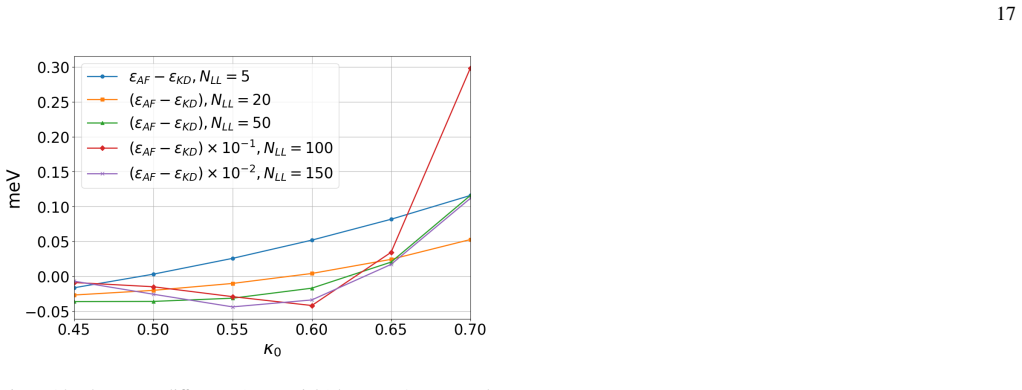
- [Section IV.B, Appendix B, Eq. (89), Fig. 10] The central claim that the Dirac sea dominates the magnetic anisotropic energy at large κ0 rests on separately converged values of ϵ0 and ϵDS, but Appendix B verifies convergence only of the total energy difference between AF and KD. Since the two components are individually divergent before background subtraction (Appendix C) and are regulated by the Landau-level cutoff, the relative weight of ϵDS in Fig. 10 should be shown to be stable as NLL grows. Please provide the NLL dependence of the separate zero-Landau-level and Dirac-sea energy differences.
- [Section II and Section III.B] The phase diagrams in Figs. 1 and 2 label the transitions as first-order, yet the RG vertex calculation neglects momentum-dependent vertices, and the authors state in Section II that these neglected terms 'could potentially alter the nature of the transitions from first to second order.' If the first-order label is part of the paper's claims, it is not supported; otherwise the figures should be relabeled or the text should explicitly state that the order of the transition is not determined by the present calculation.
minor comments (6)
- [Section IV.A] The text says 'anisotropic relativistic fluid' when describing the converged solution that satisfies Eq. (71); this should presumably read 'isotropic relativistic fluid'. In addition, Eq. (71) is described as 'diagonal with respect to the Landau level index', but it allows particle-hole mixing with the same index; 'block-diagonal in n' would be clearer.
- [Before Fig. 2] The line 'Next thing to do' followed by two bullet items appears to be an editing remnant and should be removed from the published text.
- [Abstract and throughout] There are several grammatical slips, including 'we predict a transitions', 'the Zeorth Landau level', and 'groudnstates'; a careful proofread is needed.
- [Eq. (6)] The condition excluding the (0,0) term is written as 'exclude u = v = 0', which is ambiguous; it should be written as '(u,v) ≠ (0,0)' or equivalent.
- [Fig. 10] The caption calls the quantity an 'absolute energy difference' while the text refers to 'energy difference per particle'; please unify the terminology and specify the units.
- [Abstract] The statement that the Dirac sea 'contributes to one electron per graphene unit cell' is not defined or elaborated in the main text; please clarify what this statement means.
Circularity Check
No significant circularity: the phase diagrams and Dirac-sea energy decomposition are computed from independent microscopic RG/HF inputs, not fitted to the target experimental transitions.
full rationale
I walked the claimed derivation chain from bare coupling constants through RG flow to self-consistent Hartree-Fock and found no step in which a 'prediction' reduces by construction to an input. The bare coupling constants in Table I are taken from the authors' earlier LCAO calculation (Ref. [27]) and from literature electron-phonon values; they are not fitted to the experimental AF/KD phase boundary, and the paper explicitly notes that the bare values are too small to explain experiments, so the later RG enhancement is doing real work rather than returning a fitted input. The RG flow equations are standard one-loop equations (Aleiner-Kharzeev-Tsvelik) integrated from the lattice scale to the magnetic length, with the magnetic field entering through the stopping scale, not through an adjusted parameter. The Hartree-Fock calculation then uses these renormalized couplings as inputs and compares energies of competing symmetry-broken states; the phase boundaries in Figs. 1 and 2 emerge from energy crossings, and the comparison with experiments is post hoc rather than used to tune parameters. The Dirac-sea energy decomposition in Eq. (89) is an exact arithmetic identity given the block-diagonal density-matrix structure of Eq. (71), and the statement that the Dirac sea dominates the magnetic anisotropic energy at large κ0 is a computed result (Fig. 10), not a definition of the phase transition. The isotropic-Dirac-fluid restriction, Eq. (71), is an acknowledged limitation (Section IV.A) that could affect quantitative phase boundaries if a nematic state were lower in energy, but that is a validity caveat, not circular reasoning. The self-citation to Ref. [27] is load-bearing as input, but it is an independent microscopic estimate that does not itself contain the target phase diagram, so it does not make the derivation circular.
Assumptions & free parameters
free parameters (7)
- Bare electron-electron coupling g_zz(a0) =
184 meV·nm²
- Bare electron-electron coupling g_⊥z(a0) =
43 meV·nm²
- Bare electron-electron coupling g_z⊥(a0) =
25 meV·nm²
- Bare electron-electron coupling g_⊥⊥(a0) =
269 meV·nm²
- Bare electron-phonon coupling g_z⊥^{e-p}(a0) =
-52 meV·nm²
- Bare electron-phonon coupling g_⊥z^{e-p}(a0) =
-69 meV·nm²
- Landau level cutoff NLL =
50
assumptions (5)
- domain assumption The low-energy theory is described by the Euclidean action Eq. (1) with four independent short-range couplings (g_zz, g_⊥z, g_z⊥, g_⊥⊥) dictated by C6v and time-reversal symmetry.
- domain assumption The dynamically screened Coulomb interaction is treated in RPA with the one-loop particle-hole bubble, Eqs. (16)-(19), and this dressed interaction is used in the Wilsonian RG integrals.
- domain assumption The four-point vertex function depends on frequency and momentum only through the leading logarithm; momentum-dependent vertex corrections are irrelevant in the RG sense.
- domain assumption The Hartree-Fock ground state is translation invariant and isotropic, so the density matrix is k-independent and diagonal in Landau level index, Eqs. (62) and (71).
- domain assumption Divergences from the infinite Dirac sea are regulated by subtracting the background density matrix ρ_bg of Eq. (C14) from Ref. 50.
Cite this review
Pith. "Pith review of Influence of the Dirac Sea on Phase Transitions in Monolayer Graphene under Strong Magnetic Fields." pith.science (2026). https://pith.science/paper/GD7BWYPN
@misc{pith2026241116986,
  author       = {Pith},
  title        = {Pith review of: Influence of the Dirac Sea on Phase Transitions in Monolayer Graphene under Strong Magnetic Fields},
  year         = {2026},
  howpublished = {\url{https://pith.science/paper/GD7BWYPN}},
  note         = {Machine review of arXiv:2411.16986}
}
abstract
Recent scanning tunneling microscopy experiments have found Kekul\'e-Distorted (KD) ordering in graphene subjected to strong magnetic fields, a departure from the antiferromagnetic (AF) state identified in earlier transport experiments on double-encapsulated devices with larger dielectric screening constant $\epsilon$. This variation suggests that the magnetic anisotropic energy is sensitive to dielectric screening constant. To calculate the magnetic anisotropic energy without resorting to perturbation theory, we adopted a two-step approach. First, we derived the bare valley-sublattice dependent interaction coupling constants from microscopic calculations and account for the leading logarithmic divergences arising from quantum fluctuations by solving renormalization group flow equations in the absence of magnetic field from the carbon lattice scale up to the much larger magnetic length. Subsequently, we used these renormalized coupling constants to perform non-perturbative, self-consistent Hartree-Fock calculations. Our results demonstrate that the ground state at neutrality ($\nu=0$) transitions from a AF state to a spin-singlet KD state when dielectric screening and magnetic fields become small, consistent with experimental observations. For filling fraction $\nu=\pm1$, we predict a transitions from spin-polarized charge-density wave states to spin-polarized KD state when dielectric screening and magnetic fields become small. Our self-consistent Hartree-Fock calculations, which encompass a large number of Landau levels, reveal that the magnetic anisotropic energy receives substantial contributions from the Dirac sea when $\epsilon$ is small. Our work provides insights into how the Dirac sea, which contributes to one electron per graphene unit cell, affects the small magnetic anisotropic energy in graphene.
Figures


Figures from the paper (11 more)


Reference graph
Works this paper leans on
-
[1]
(82), the total kinetic energy is given by: ET = Tr( ˆT ρ) = − NLLX n≥0 √ 2ℏωc l2 B √n cos θn
Kinetic energy With the parametrization of the density matrix in Eq. (82), the total kinetic energy is given by: ET = Tr( ˆT ρ) = − NLLX n≥0 √ 2ℏωc l2 B √n cos θn. (C1) The factor cos θn arises due to the LL mixing. This mixing effect increases the energy, as the wavefunction can extend into the positive Landau levels.The total kinetic energy diverges due...
-
[2]
(65),ΣC nξ,n′ξ′ is contributed by the following matrix elementsVnξ,n2ξ2,n3ξ3,n′ξ′
Self-energy of long-range Coulomb potential In Eq. (65),ΣC nξ,n′ξ′ is contributed by the following matrix elementsVnξ,n2ξ2,n3ξ3,n′ξ′. Their explicit form is given by the following: 17 Figure14. Theenergydifference(perparticle)betweenAFstateand KD state in the Hartree-Fock approximation atB = 10T. Zeeman and sublattice polarization energies are set to zero...
-
[3]
Self-energy of short-range interaction In this section, we derive the explicit formula for the self-energy, denoted asΣ⋄, resulting from short-range interactions. Considering the presence of four distinct valley-sublattice dependent terms in the anisotropic Hamiltonian, we will separateΣ⋄ into its respective components as follows: ˆΣ⋄ = ˆΣzz + ˆΣ⊥z + ˆΣz⊥...
-
[4]
J.G.Checkelsky,L.Li, andN.P.Ong,Phys.Rev.B 79,115434 (2009)
work page 2009
- [5]
- [6]
- [7]
-
[8]
K. Yang, S. Das Sarma, and A. H. MacDonald, Phys. Rev. B 74, 075423 (2006)
work page 2006
Show all 60 references
-
[9]
E. M. Spanton, A. A. Zibrov, H. Zhou, T. Taniguchi, K. Watan- abe, M. P. Zaletel, and A. F. Young, Science360, 62 (2018), https://www.science.org/doi/pdf/10.1126/science.aan8458
2018 doi
-
[10]
A. A. Zibrov, E. M. Spanton, H. Zhou, C. Kometter, T. Taniguchi, K. Watanabe, and A. F. Young, Nature Physics 14, 930–935 (2018)
2018
-
[11]
C.R.Dean,A.F.Young,P.Cadden-Zimansky,L.Wang,H.Ren, K.Watanabe,T.Taniguchi,P.Kim,J.Hone, andK.L.Shepard, Nature Physics7, 693 (2011)
2011
-
[12]
M. O. Goerbig, Rev. Mod. Phys.83, 1193 (2011)
2011
-
[13]
112,126804 (2014)
I.SodemannandA.H.MacDonald,Phys.Rev.Lett. 112,126804 (2014)
2014
-
[14]
L.A.Cohen,N.L.Samuelson,T.Wang,T.Taniguchi,K.Watan- abe, M. P. Zaletel, and A. F. Young, Science382, 542 (2023), https://www.science.org/doi/pdf/10.1126/science.adf9728
2023 doi
-
[15]
J. C. W. Song, A. V. Shytov, and L. S. Levitov, Phys. Rev. Lett. 111, 266801 (2013)
2013
-
[16]
H. Zhou, H. Polshyn, T. Taniguchi, K. Watanabe, and A. F. Young, Nature Physics16, 154 (2019)
2019
-
[17]
L.Veyrat,C.Déprez,A.Coissard,X.Li,F.d.r.Gay,K.Watan- abe,T.Taniguchi,Z.Han,B.A.Piot,H.Sellier, andB.Sacépé, 20 Science367, 781 (2020)
2020
-
[18]
Broken symme- tries and excitation spectra of interacting electrons in partially filledlandaulevels,
G. Farahi, C.-L. Chiu, X. Liu, Z. Papic, K. Watanabe, T. Taniguchi, M. P. Zaletel, and A. Yazdani, “Broken symme- tries and excitation spectra of interacting electrons in partially filledlandaulevels,” (2023),arXiv:2303.16993[cond-mat.mes- hall]
2023 arXiv
-
[19]
S.-Y. Li, Y. Zhang, L.-J. Yin, and L. He, Phys. Rev. B100, 085437 (2019)
2019
-
[20]
Vanishing bulk heat flow in the nu=0 quantum hall ferromagnet in monolayer graphene,
R. Delagrange, M. Garg, G. L. Breton, A. Zhang, Q. Dong, Y. Jin, K. Watanabe, T. Taniguchi, P. Roulleau, O. Maillet, P. Roche, and F. D. Parmentier, “Vanishing bulk heat flow in the nu=0 quantum hall ferromagnet in monolayer graphene,” (2024), arXiv:2409.08878 [cond-mat.mes-hall]
2024 arXiv
-
[21]
Feshami and H
B. Feshami and H. A. Fertig, Phys. Rev. B94, 245435 (2016)
2016
-
[22]
Coissard, D
A. Coissard, D. Wander, H. Vignaud, A. G. Grushin, C. Re- pellin, K. Watanabe, T. Taniguchi, F. Gay, C. B. Winkelmann, H. Courtois, H. Sellier, and B. Sacépé, Nature605, 51 (2021)
2021
-
[23]
X. Liu, G. Farahi, C.-L. Chiu, Z. Papic, K. Watanabe, T. Taniguchi, M. P. Zaletel, and A. Yazdani, Science375, 321 (2022)
2022
-
[24]
Stepanov, S
P. Stepanov, S. Che, D. Shcherbakov, J. Yang, R. Chen, K. Thi- lahar, G. Voigt, M. Bockrath, D. Smirnov, K. Watanabe, T. Taniguchi, R. K. Lake, Y. Barlas, A. H. Macdonald, and C. N. Lau, Nature Physics14, 907 (2018)
2018
-
[25]
H.Fu, K.Huang, K.Watanabe, T.Taniguchi, andJ.Zhu,Phys. Rev. X11, 021012 (2021)
2021
-
[26]
The polar angleθ of these two statesarethesameduetothe U (1)KK ′ symmetryofthevalley
Fig.11e-f)showanothertypeofthe Kekulé state and canted-Kekulé state when the relative phase angle ϕ = π, which breaks the the sixfold rotational symme- try C6 of the graphene lattice. The polar angleθ of these two statesarethesameduetothe U (1)KK ′ symmetryofthevalley. D. Khar...
-
[27]
Absence of heatflowin ν=0quantumhallferromagnetinbilayergraphene,
R. Kumar, S. K. Srivastav, U. Roy, U. Singhal, K. Watanabe, T. Taniguchi, V. Singh, P. Roulleau, and A. Das, “Absence of heatflowin ν=0quantumhallferromagnetinbilayergraphene,” (2024), arXiv:2409.09663 [cond-mat.mes-hall]
2024 arXiv
-
[28]
H. Zhou, C. Huang, N. Wei, T. Taniguchi, K. Watanabe, M. P. Zaletel,Z.Papi’c,A.H.Macdonald, andA.F.Young,Physical Review X (2021)
2021
-
[29]
D.S.Wei,T.vanderSar,S.H.Lee,K.Watanabe,T.Taniguchi, B. I. Halperin, and A. Yacoby, Science 362, 229 (2018), https://www.science.org/doi/pdf/10.1126/science.aar4061
2018 doi
-
[30]
Kharitonov, Physical Review B85, 155439 (2012)
M. Kharitonov, Physical Review B85, 155439 (2012)
2012
-
[31]
126, 117203 (2021)
N.Wei,C.Huang, andA.H.MacDonald,Phys.Rev.Lett. 126, 117203 (2021)
2021
-
[32]
N. Wei, G. Xu, I. S. Villadiego, and C. Huang, arXiv preprint arXiv:2401.12528 (2024)
2024 arXiv
-
[33]
Jung and A
J. Jung and A. H. MacDonald, Phys. Rev. B80, 235417 (2009)
2009
-
[34]
Aleiner, D
I. Aleiner, D. Kharzeev, and A. Tsvelik, Physical Review B76, 195415 (2007)
2007
-
[35]
S. J. De, A. Das, S. Rao, R. K. Kaul, and G. Murthy, Physical Review B107, 125422 (2023)
2023
-
[36]
standardmodel
usually neglect the momentum dependence, considering them irrelevant in the RG sense. However, these ostensibly negligible terms could potentially alter the nature of the tran- sitions from first to second order[37]. Letusnowsummarizethephasediagramat ν = ±1. Atthis filling fr...
-
[37]
Vafek and J
O. Vafek and J. Kang, Physical Review Letters125, 257602 (2020)
2020
-
[38]
S.Raghu,S.A.Kivelson, andD.J.Scalapino,Phys.Rev.B 81, 224505 (2010)
2010
-
[39]
Kang and O
J. Kang and O. Vafek, Physical review letters122, 246401 (2019)
2019
-
[40]
A.Das,R.K.Kaul, andG.Murthy,Physicalreviewletters 128, 106803 (2022)
2022
-
[41]
Shankar,Quantum field theory and condensed matter: an introduction(Cambridge University Press, 2017)
R. Shankar,Quantum field theory and condensed matter: an introduction(Cambridge University Press, 2017)
2017
-
[42]
128,106803 (2022)
A.Das,R.K.Kaul, andG.Murthy,Phys.Rev.Lett. 128,106803 (2022)
2022
-
[43]
D. T. Son, Physical Review B75, 235423 (2007)
2007
-
[44]
M. S. Foster and I. Aleiner, Physical Review B77, 195413 (2008)
2008
-
[45]
J.W.González,F.Guinea, andM.A.H.Vozmediano,Physical Review B59 (1998)
1998
-
[46]
González, F
J. González, F. Guinea, and M. Vozmediano, Nuclear Physics B424, 595 (1994)
1994
-
[47]
113, 105502 (2014)
J.Hofmann,E.Barnes, andS.DasSarma,Phys.Rev.Lett. 113, 105502 (2014)
2014
-
[48]
E.Barnes,E.H.Hwang,R.E.Throckmorton, andS.DasSarma, Phys. Rev. B89, 235431 (2014)
2014
-
[49]
Magnetism in the dilute electron gas of rhombohedral multilayer graphene,
T. Wolf, N. Wei, H. Zhou, and C. Huang, “Magnetism in the dilute electron gas of rhombohedral multilayer graphene,” (2024), arXiv:2408.15884 [cond-mat.str-el]
2024 arXiv
-
[50]
Zibrov, E
A. Zibrov, E. Spanton, H. Zhou, C. Kometter, T. Taniguchi, K. Watanabe, and A. Young, Nature Physics14, 930 (2018)
2018
-
[51]
D.M.BaskoandI.L.Aleiner,Phys.Rev.B 77,041409(2008)
2008
-
[52]
D.BaskoandI.Aleiner,PhysicalReviewB—CondensedMatter and Materials Physics77, 041409 (2008)
2008
-
[53]
S.Piscanec,M.Lazzeri,F.Mauri,A.Ferrari, andJ.Robertson, Physical review letters93, 185503 (2004)
2004
-
[54]
F.Wu,F.Wu,A.H.Macdonald, andI.Martin,Physicalreview letters121 25, 257001 (2018)
2018
-
[55]
BARLAS, W.-C
Y. BARLAS, W.-C. LEE, K. NOMURA, and A. H. MAC- DONALD,InternationalJournalofModernPhysicsB 23,2634 (2009), https://doi.org/10.1142/S0217979209062104
2009 doi
-
[56]
Lukose and R
V. Lukose and R. Shankar, Physical Review B94, 085135 (2016)
2016
-
[57]
I.SodemannandA.H.MacDonald,Physicalreviewletters 112 12, 126804 (2013)
2013
-
[58]
J.An,A.C.Balram, andG.Murthy,PhysicalReviewB (2024)
2024
-
[59]
Berk and J
N. Berk and J. Schrieffer, Physical Review Letters17, 433 (1966)
1966
-
[60]
B. M. Kousa, N. Wei, and A. H. MacDonald, arXiv preprint arXiv:2402.10440 (2024)
2024 arXiv
Reviewed August 12, 2026 · model on record in the stance chip above.
Discussion (0). Continue with ORCID to comment.