REVIEW 3 major objections 6 minor 67 references
Explainable Mapper: Charting LLM Embedding Spaces Using Perturbation-Based Explanation and Verification Agents
T0 review · 3 major / 6 minor · reviewed 2026-08-06 · deepseek-v4-flash
Pith's one-line read The paper claims that mapper graphs of LLM embedding spaces can be annotated semi-automatically by two classes of LLM-based agents—explainers that generate candidate linguistic explanations and verifiers that test them via…
desk verdict A solid mapper-agent framework for exploring LLM embeddings, but the verification scores only measure GPT-4o self-consistency, so the replication claims are suggestive rather than proven. read the letter →
The pith
A machine-rendered reading of the paper's core claim, the machinery that carries it, and where it could break.
The reading
What carries the argument
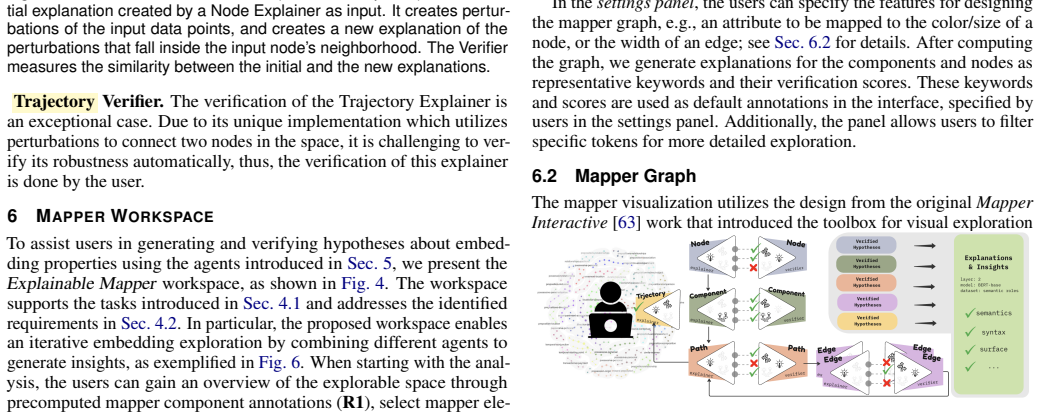
The load-bearing mechanism is the perturbation-based verification loop: for a given mapper element, the Verification Agent generates five perturbed sentences per input sentence using one-token substitution or rephrasing that keeps the focus word, filters the perturbed embeddings so only those staying within the original node's neighborhood are kept (using the average pairwise distance within the node as a threshold), re-runs the original summarization or comparison prompt on those perturbed data points, and measures the cosine similarity between the original and new explanations using MiniLM sentence embeddings. That similarity score is the operational definition of explanation robustness. The mapper graph itself, constructed with an L2-norm lens and DBSCAN clustering, supplies the topological neighborhoods that make the comparisons meaningful.
What would settle it
Take a mapper node whose true linguistic property is independently known, for example a node whose tokens are all prepositions, run the full explanation-plus-verification pipeline, and compare the consistency score against a human judgment of whether the explanation is correct; if explanations with high cosine similarity are still factually wrong about the node's part of speech or semantic role, the verification score fails as a proxy for faithfulness. A more direct version is to hold out a labeled set of sentences, perturb them, and check whether the cosine-similarity threshold that the paper treats as high separates true statements from false ones.
Extended reading notes
Core claim
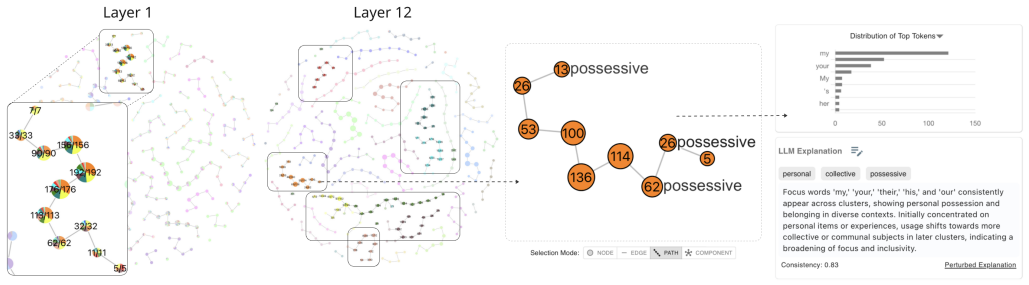
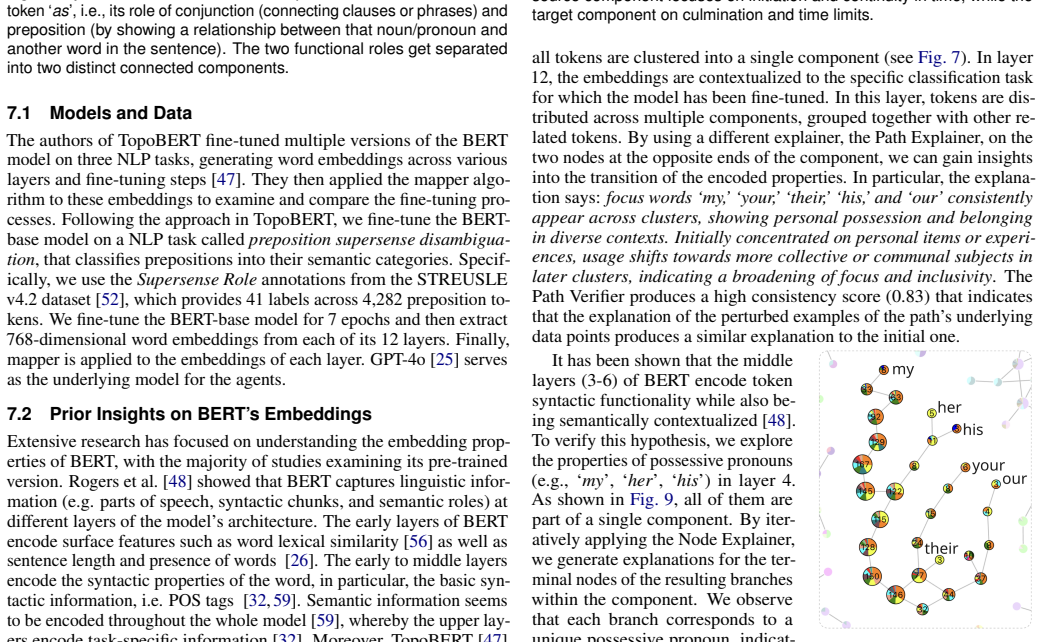
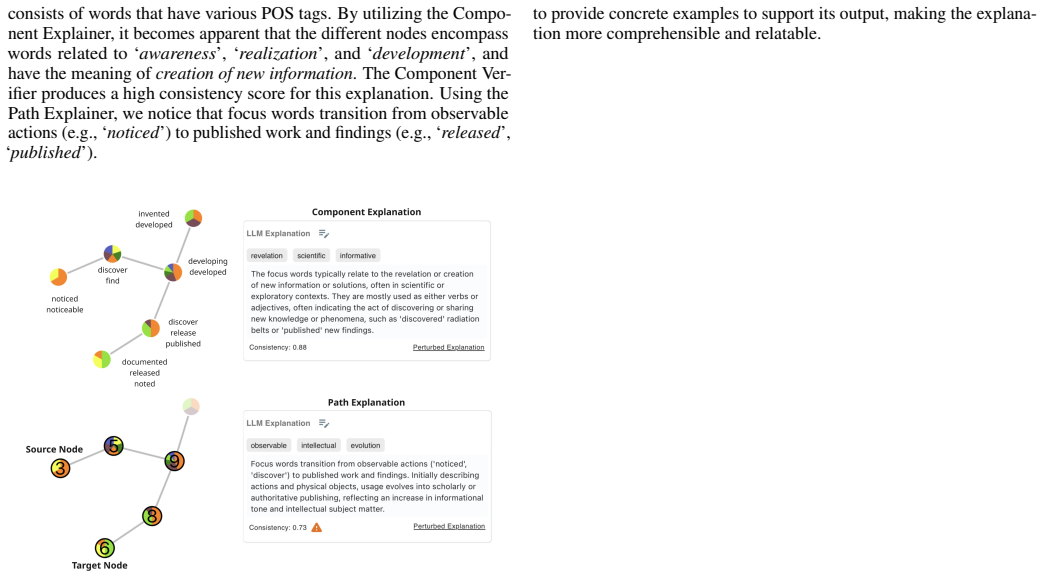
The central claim is that mapper graphs of LLM embedding spaces can be made interpretable through a divergence-convergence workflow in which LLM-based Explanation Agents generate candidate explanations of topological neighborhoods and LLM-based Verification Agents test those explanations for robustness. Robustness is operationalized as consistency: five perturbed sentences are generated for each input sentence via one-token changes or rephrasings that preserve the focus token, the perturbed embeddings that remain inside the same mapper neighborhood are re-summarized with the same method, and the cosine similarity between the original and perturbed summaries (computed with a MiniLM sentence encoder) is reported as the explanation's consistency score. The paper argues that explanations surviving this perturbation test are more likely to faithfully describe the embedding properties, and it supports this by replicating prior results on BERT: possessive pronouns in early layers are non-contextualized and cluster into one component, middle layers separate syntactic functions such as conjunctive versus prepositional uses of 'as', and upper layers separate temporal prepositions by initiation versus culmination. Each replicated finding is accompanied by consistency scores (for example, 0.83 for a path explanation and 0.86 for a path) that the authors interpret as validating the explanations.
Load-bearing premise
The entire verification logic rests on the premise that if the same language model produces a similar explanation after light, meaning-preserving perturbations of the input sentences, then the explanation is robust and faithful—but the check only measures self-consistency of one model, not whether the explanation matches the actual linguistic properties of the neighborhood.
Editorial extensions
If this is right
- Users can generate candidate explanations for any mapper element without manually inspecting thousands of embeddings.
- Explanation robustness is reported as a single consistency score, letting users prioritize which insights to trust.
- The same divergence-convergence agent pattern transfers to edge, path, component, and trajectory explanations.
- Because the workspace records annotations and interaction provenance, each verified insight is traceable to the nodes and sentences that produced it.
- Replication of prior BERT findings suggests the pipeline can serve as a literature-validation tool for embedding studies.
Reading between the lines
- If the same-model consistency score were replaced or augmented by cross-model agreement, for instance having two different LLMs explain the same perturbed neighborhood, the verification would better guard against model-specific hallucination patterns; the paper only mentions such ensembles as future work.
- The filtering step that keeps only perturbed sentences whose embeddings stay inside the node implicitly assumes the node's metric threshold is stable, so a testable extension is to check whether consistency scores change when the DBSCAN epsilon or mapper overlap parameters are varied.
- The paper's trajectory explanations, verified manually by the user, suggest that automated trajectory similarity scoring, such as comparing multiple generated trajectories via embedding distance, would extend the same robustness logic to path-level claims.
- A direct practical downstream use is model-difficulty auditing: nodes whose explanations have low consistency scores may mark contexts where the model's embeddings are unstable, providing a candidate list for targeted fine-tuning.
Editorial analysis
A structured set of objections, weighed in public.
Referee Report
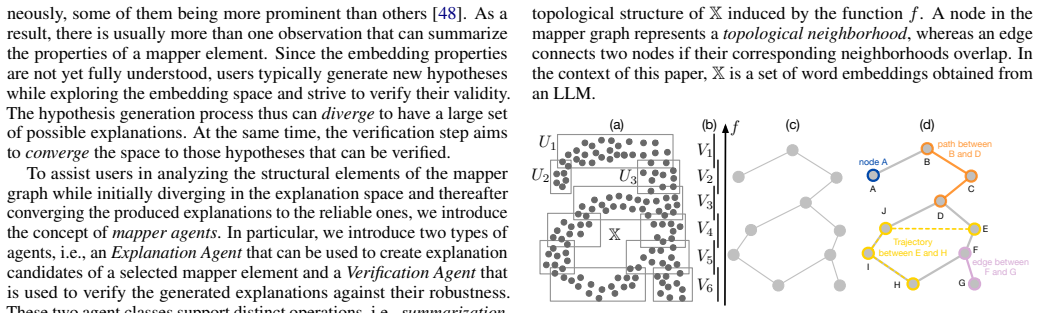
Summary. The paper introduces Explainable Mapper, a visual analytics framework for exploring large language model embedding spaces through mapper graphs. It defines a taxonomy of mapper elements (nodes, edges, paths, components, trajectories) and proposes two classes of LLM-based agents: Explanation Agents, which generate candidate explanations via summarization, comparison, and perturbation operations, and Verification Agents, which assess the robustness of those explanations by perturbing input sentences, regenerating explanations, and comparing them with cosine similarity using MiniLM. The framework is instantiated in a workspace, and the evaluation consists of case studies on BERT embeddings that aim to replicate known layer-wise linguistic properties, such as the encoding of possessive pronouns, conjunction/preposition roles, and temporal prepositions. The paper also includes prompt templates in the supplement and discusses limitations in Section 8.
Significance. The framework addresses a real need in embedding-space analysis: the labor-intensive, largely manual interpretation of topological neighborhoods in high-dimensional embedding spaces. The taxonomy of mapper elements and the clear specification of agent operations (summarization, comparison, perturbation) are useful contributions, and the case studies are internally consistent and anchored to established BERT findings. The paper also provides full prompt templates, which supports reproducibility of the agent behavior. However, the significance is limited by two issues. First, the verification mechanism measures self-consistency of a single LLM under its own perturbations, not correctness or fidelity of the explanation to the underlying embedding structure; thus, the reported consistency scores (0.83, 0.86) do not validate the explanations. Second, the evaluation is qualitative and based on a handful of hand-picked examples, with no systematic comparison to prior work, no user study, and no sensitivity analysis of mapper parameters.
major comments (3)
- [Section 5.2.2] The Verification Agent's consistency score is computed by having GPT-4o generate the original explanation, generate perturbed sentences for the same node, regenerate an explanation from those perturbed sentences, and then compare the two explanations using MiniLM cosine similarity. This measures the self-consistency of one model's text generation, not whether the explanation captures a real property of the embedding neighborhood. The case studies in Section 7.3 and the supplement rely on this score (e.g., 0.83, 0.86, "high consistency") as evidence that explanations are robust, but the score could be inflated by the model's stylistic consistency and by shared template tokens in the prompts (e.g., 'focus word', 'summary', 'keywords'). Section 8 concedes that verification 'does not guarantee absolute correctness,' yet the framework's stated purpose—'to converge the explanation space to the most reliable candidates'—depends on this measure. I recommend either reframing the score as a self-consistency proxy with no correctness connotation, or adding a validation study: for instance, verifying a deliberately wrong explanation (contradicting the actual node content) and showing that its score is lower, or comparing the score against human expert judgments on a sample of mapper elements.
- [Section 9 and Section 7.3] The conclusion states that 'through multiple case studies, we show how the Explainable Mapper workspace can be used to replicate findings from prior work,' but the evaluation does not support the word 'replicate' in a systematic sense. The three case studies in Section 7.3 (possessive pronouns, 'as' as conjunction/preposition, temporal prepositions) and the additional cases in the supplement are qualitative, hand-picked examples with descriptive explanations and consistency scores. No selection criteria are given for the mapper elements analyzed, no quantitative comparison to the original TopoBERT or BERTology results is reported, and no user study or inter-annotator agreement is included. If the contribution is meant to be an 'evaluation through replication studies' (Section 1), the authors should define what constitutes a successful replication and apply that criterion consistently, or explicitly frame the case studies as demonstrations of the system's potential rather than as evidence of replication.
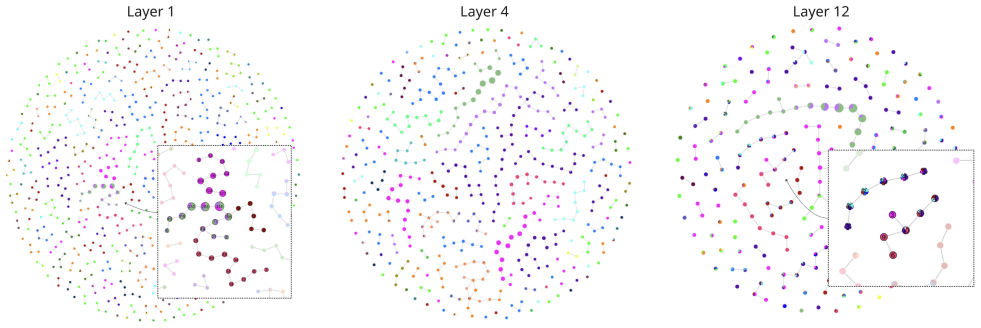
- [Section 6.1 and Section 7.3] The mapper graph construction depends on several user-specified parameters: the number of cover intervals n, the cover overlap p, DBSCAN's minPts and ε. While Section 6.1 states that ε is estimated using the elbow method, no sensitivity analysis is reported for the other parameters or for ε itself. The case-study observations, such as the separation of 'as' into two distinct components in layer 5 (Figure 8), could depend on the particular parameter choices. Because the replication claims rest on structural observations like these, a sensitivity analysis—for example, varying n, p, and minPts over a reasonable range and reporting how often the qualitative findings persist—is needed to demonstrate that the reported structures are not artifacts of cherry-picked parameters.
minor comments (6)
- [Section 2.2] In the formal definition of a trajectory, the phrase 'a embedding in a target node' should be 'an embedding in a target node.'
- [Section 5.2.1] The text introducing the Node Explainer says the comparison operation 'shares the input with the summarization operation,' but the accompanying table shows the comparison operation taking two non-adjacent nodes as input. This inconsistency should be clarified.
- [Supplement, Appendix A (Fig. 12)] The explanation text contains the typo 'This my suggest' which should read 'This may suggest.'
- [Section 5.2.2 and Section 6.4] The paper reports cosine similarity values (e.g., 0.83, 0.86) and describes them as 'high consistency' or 'highly consistent,' but no threshold or scale is defined. Please specify what range of cosine similarity is considered high, and state the exact MiniLM variant and pooling method used.
- [Section 9] The paper states that the workspace 'will be made publicly available under acceptance,' but no repository, data, or demo link is provided. For reproducibility of the case studies, please include an anonymous repository or supplementary material with the code, data, and model configurations.
- [Section 3.2] The citation to 'Varbench' should be formatted as 'VarBench' to match the cited paper's title.
Circularity Check
Verification scores are self-consistency by construction; the framework and replication anchors remain independent.
-
self definitional
[Section 5.2.2 (Verification Agents); cf. Section 7.3 and Section 8.]
"A new explanation is created on the perturbed examples using the same method as for the original Explainer. We then evaluate the similarity between the original and the new explanation applying a cosine similarity on the sentence embedding vectors extracted using the MiniLM model [60]. The similarity is used as an indicator of the explanation’s robustness."
The robustness score is, by construction, the cosine similarity between two summaries that both come from the same GPT-4o prompt template: one on the original node sentences and one on GPT-4o's own perturbed paraphrases that remain in the node. 'Robustness' is therefore operationalized as same-model self-consistency, and the score is exactly the measured quantity. Reporting a 'high consistency score' (e.g., 0.83 for the Path Verifier, 0.86 in the supplement) as evidence that an explanation is 'more likely to faithfully explain' the embedding space reduces to saying the model's summary resembles its own summary under its own perturbations.
full rationale
The mapper graph construction, taxonomy, and agent prompt design are self-contained: embeddings are extracted from a fine-tuned BERT, mapper is computed with standard parameters, and explanations are generated by GPT-4o prompts. No fitted parameter is relabeled as a prediction, and no uniqueness theorem or ansatz is imported from the authors' prior work to force the choice. The case studies anchor against published BERT findings (Rogers et al., Tenney et al., plus TopoBERT), which gives the replication claim independent content even though TopoBERT is by overlapping authors. The one genuinely circular step is the Verification Agent's operationalization of robustness: the score is, by construction, the cosine similarity between two summaries produced by the same GPT-4o prompt on the original and on LLM-perturbed in-node sentences. Thus a 'high consistency score' restates that the model's summary resembles itself under its own perturbations; it does not validate that the explanation captures a true shared property of the mapper node. The paper's Section 8 disclaimer limits but does not remove this self-definitional reduction, because the verification claims rely on this score as the convergence criterion. Since the central framework and the replication studies do not otherwise reduce to their inputs, the overall circularity is partial (4/10).
Assumptions & free parameters
free parameters (6)
- Mapper cover intervals n =
not specified (user-set)
- Mapper cover overlap p =
not specified (user-set)
- DBSCAN minPts =
default 3
- DBSCAN epsilon =
estimated via elbow method
- Verification retention threshold =
node-specific average pairwise distance
- Number of perturbed sentences per input =
5
assumptions (7)
- standard math Mapper graph construction (1D nerve of a pullback cover) faithfully summarizes the topological structure of the embedding point cloud.
- domain assumption The L2-norm lens captures meaningful activation strength for token embeddings.
- domain assumption Prior BERT layer-wise findings (early surface, middle syntax, upper semantics) are correct and serve as ground truth for the replication studies.
- domain assumption LLM-generated summaries and keywords accurately describe the common linguistic properties of the input sentences.
- domain assumption Cosine similarity between original and perturbed explanations (via MiniLM) is a valid robustness indicator.
- domain assumption A perturbed sentence whose embedding is within the node's average pairwise distance still belongs to the same topological neighborhood.
- domain assumption 1-token perturbations and paraphrases have minimal impact on embeddings, so stability under them reflects explanation robustness.
Cite this review
Pith. "Pith review of Explainable Mapper: Charting LLM Embedding Spaces Using Perturbation-Based Explanation and Verification Agents." pith.science (2026). https://pith.science/paper/GDKLOXXJ
@misc{pith2026250718607,
  author       = {Pith},
  title        = {Pith review of: Explainable Mapper: Charting LLM Embedding Spaces Using Perturbation-Based Explanation and Verification Agents},
  year         = {2026},
  howpublished = {\url{https://pith.science/paper/GDKLOXXJ}},
  note         = {Machine review of arXiv:2507.18607}
}
read the original abstract
Large language models (LLMs) produce high-dimensional embeddings that capture rich semantic and syntactic relationships between words, sentences, and concepts. Investigating the topological structures of LLM embedding spaces via mapper graphs enables us to understand their underlying structures. Specifically, a mapper graph summarizes the topological structure of the embedding space, where each node represents a topological neighborhood (containing a cluster of embeddings), and an edge connects two nodes if their corresponding neighborhoods overlap. However, manually exploring these embedding spaces to uncover encoded linguistic properties requires considerable human effort. To address this challenge, we introduce a framework for semi-automatic annotation of these embedding properties. To organize the exploration process, we first define a taxonomy of explorable elements within a mapper graph such as nodes, edges, paths, components, and trajectories. The annotation of these elements is executed through two types of customizable LLM-based agents that employ perturbation techniques for scalable and automated analysis. These agents help to explore and explain the characteristics of mapper elements and verify the robustness of the generated explanations. We instantiate the framework within a visual analytics workspace and demonstrate its effectiveness through case studies. In particular, we replicate findings from prior research on BERT's embedding properties across various layers of its architecture and provide further observations into the linguistic properties of topological neighborhoods.
Figures


Figures from the paper (17 more)







Reference graph
Works this paper leans on
- [1]
-
[2]
K. Amara, R. Sevastjanova, and M. El-Assady. SyntaxShap: Syntax-aware explainability method for text generation. In Findings of the Association for Computational Linguistics: ACL 2024, pp. 4551–4566. Association for Computational Linguistics, Bangkok, Thailand, Aug. 2024. doi: 10. 18653/v1/2024.findings-acl.270 3
work page 2024
-
[3]
L. Basyal and M. Sanghvi. Text summarization using large language models: a comparative study of mpt-7b-instruct, falcon-7b-instruct, and openai chat-gpt models. arXiv preprint arXiv:2310.10449, 2023. 3
arXiv 2023
-
[4]
M. Berger. Visually analyzing contextualized embeddings. In IEEE Visualization Conference (VIS), pp. 276–280, 2020. 3
work page 2020
-
[5]
S. Biasotti, D. Giorgi, M. Spagnuolo, and B. Falcidieno. Reeb graphs for shape analysis and applications. Theoretical Computer Science, 392:5–22,
-
[6]
A. Boggust, B. Carter, and A. Satyanarayan. Embedding Comparator: Visualizing Differences in Global Structure and Local Neighborhoods via Small Multiples. In 27th Int. Conf. on Intelligent User Interfaces, pp. 746– 766, 2022. 1, 3, 4
work page 2022
-
[7]
J. Bos, V . Basile, K. Evang, N. J. Venhuizen, and J. Bjerva. The groningen meaning bank. In N. Ide and J. Pustejovsky, eds., Handbook of Linguistic Annotation, pp. 463–496. Springer Netherlands, Dordrecht, 2017. doi: 10. 1007/978-94-024-0881-2_18 11, 13
work page 2017
-
[8]
M. Carrière, B. Michel, and S. Oudot. Statistical analysis and parameter selection for mapper. Journal of Machine Learning Research, 19(12):1– 39, 2018. 2
work page 2018
Show all 67 references
-
[9]
Chalapathi, Y
N. Chalapathi, Y . Zhou, and B. Wang. Adaptive covers for mapper graphs using information criteria. In IEEE International Conference on Big Data (Big Data), 2021. 2
2021
-
[10]
H. J. Cho, J. Zhao, S. W. Jung, E. Ladewig, D.-S. Kong, Y .-L. Suh, Y . Lee, D. Kim, S. H. Ahn, M. Bordyuh, H. J. Kang, J. K. Sa, Y . J. Seo, S. T. Kim, D. H. Lim, Y .-S. Dho, J.-I. Lee, H. J. Seol, J. W. Choi, W.-Y . Park, C.-K. Park, R. Rabadan, and D.-H. Nam. Distinct genom...
2019
-
[11]
Clouatre, P
L. Clouatre, P. Parthasarathi, A. Zouaq, and S. Chandar. Local structure matters most: Perturbation study in NLU. In Findings of the Association for Computational Linguistics: ACL 2022, pp. 3712–3731. Association for Computational Linguistics, Dublin, Ireland, May 2022. doi: 1...
2022
-
[12]
Danilevsky, K
M. Danilevsky, K. Qian, R. Aharonov, Y . Katsis, B. Kawas, and P. Sen. A survey of the state of explainable AI for natural language processing. In Proc. of the 1st Conf. of the Asia-Pacific Chapter of the Association for Computational Linguistics and the 10th Int. Joint Conf. ...
2020
-
[13]
Devlin, M.-W
J. Devlin, M.-W. Chang, K. Lee, and K. Toutanova. BERT: Pre-training of deep bidirectional transformers for language understanding. In Proceed- ings of the Conference of the North American Chapter of the Association for Computational Linguistics: Human Language Technologies, p...
2019
-
[14]
P. Dlotko. Ball mapper: a shape summary for topological data analysis. arXiv preprint arXiv:1901.07410, 2019. 3
1901 arXiv
-
[15]
Ester, H.-P
M. Ester, H.-P. Kriegel, J. Sander, and X. Xu. A density-based algorithm for discovering clusters in large spatial databases with noise. In Proceed- ings of the 2nd International Conference on Knowledge Discovery and Data Mining, pp. 226–231, 1996. 2
1996
-
[16]
Ethayarajh
K. Ethayarajh. How contextual are contextualized word representations? Comparing the geometry of BERT, ELMo, and GPT-2 embeddings. In Proceedings of the 2019 Conference on Empirical Methods in Natural Language Processing and the 9th International Joint Conference on Natu- ral ...
2019
-
[17]
Garg and G
S. Garg and G. Ramakrishnan. Bae: Bert-based adversarial examples for text classification. In Proceedings of the 2020 Conference on Empirical Methods in Natural Language Processing (EMNLP), pp. 6174–6181, 2020. 3
2020
-
[18]
Geniesse, O
C. Geniesse, O. Sporns, G. Petri, and M. Saggar. Generating dynamical neuroimaging spatiotemporal representations (DyNeuSR) using topologi- cal data analysis. Network Neuroscience, 3(3), 2019. 3
2019
-
[19]
Hedström, L
A. Hedström, L. Weber, D. Krakowczyk, D. Bareeva, F. Motzkus, W. Samek, S. Lapuschkin, and M. M.-C. Höhne. Quantus: An explainable ai toolkit for responsible evaluation of neural network explanations and beyond. Journal of Machine Learning Research, 24(34):1–11, 2023. 9
2023
-
[20]
Heimerl and M
F. Heimerl and M. Gleicher. Interactive analysis of word vector embed- dings. Computer Graphics Forum, 37(3):253–265, 2018. 3
2018
-
[21]
Heimerl, C
F. Heimerl, C. Kralj, T. Moller, and M. Gleicher. embComp: Visual interactive comparison of vector embeddings. IEEE Transactions on Visualization and Computer Graphics, 2020. 3
2020
-
[22]
Hsieh, C.-K
C.-Y . Hsieh, C.-K. Yeh, X. Liu, P. Ravikumar, S. Kim, S. Kumar, and C.- J. Hsieh. Evaluations and methods for explanation through robustness analysis. In International Conference on Learning Representation (ICLR),
-
[23]
Huang, W
L. Huang, W. Yu, W. Ma, W. Zhong, Z. Feng, H. Wang, Q. Chen, W. Peng, X. Feng, B. Qin, and T. Liu. A survey on hallucination in large language models: Principles, taxonomy, challenges, and open questions. ACM Trans. Inf. Syst., 43(2), article no. 42, 55 pages, Jan. 2025. doi: ...
2025
-
[24]
Huang, D
Z. Huang, D. Witschard, K. Kucher, and A. Kerren. V A + Embeddings STAR: A State-of-the-Art Report on the Use of Embeddings in Visual Analytics. Computer Graphics Forum, 2023. doi: 10.1111/cgf.14859 1, 3
2023 doi
-
[25]
Hurst, A
A. Hurst, A. Lerer, A. P. Goucher, A. Perelman, A. Ramesh, A. Clark, A. Ostrow, A. Welihinda, A. Hayes, A. Radford, et al. Gpt-4o system card. arXiv preprint arXiv:2410.21276, 2024. 8
2024 arXiv
-
[26]
Jawahar, B
G. Jawahar, B. Sagot, and D. Seddah. What does BERT learn about the structure of language? In Proc. of the Annual Meeting of the Association for Computational Linguistics, pp. 3651–3657. ACL, Florence, Italy, July
-
[27]
Jeitziner, M
R. Jeitziner, M. Carriére, J. Rougemont, S. Oudot, K. Hess, and C. Brisken. Two-tier mapper, an unbiased topology-based clustering method for en- hanced global gene expression analysis. Bioinformatics, 35(18):3339– 3347, 2019. 3
2019
-
[28]
D. Jin, Z. Jin, J. T. Zhou, and P. Szolovits. Is bert really robust? a strong baseline for natural language attack on text classification and entailment. Proceedings of the AAAI conference on artificial intelligence, 34(05):8018– 8025, 2020. 3
2020
-
[29]
Knudson, F
A. Knudson, F. González-Casabianca, A. Feged-Rivadeneira, M. F. Pe- dreros, S. Aponte, A. Olaya, C. F. Castillo, E. Mancilla, A. Piamba-Dorado, R. Sanchez-Pedraza, M. J. Salazar-Terreros, N. Lucchi, V . Udhayakumar, C. Jacob, A. Pance, M. Carrasquilla, G. Apráez, J. A. Angel, ...
2020
-
[30]
Kurita, N
K. Kurita, N. Vyas, A. Pareek, A. W. Black, and Y . Tsvetkov. Measuring bias in contextualized word representations. In Proceedings of the First Workshop on Gender Bias in Natural Language Processing, pp. 166–172,
-
[31]
B. Lee, C. Plaisant, C. S. Parr, J.-D. Fekete, and N. Henry. Task taxon- omy for graph visualization. In Proceedings of the 2006 AVI workshop on BEyond time and errors: novel evaluation methods for information visual- ization, pp. 1–5, 2006. 4
2006
-
[32]
N. F. Liu, M. Gardner, Y . Belinkov, M. E. Peters, and N. A. Smith. Lin- guistic knowledge and transferability of contextual representations. In Proceedings of the 2019 Conference of the North American Chapter of the Association for Computational Linguistics: Human Language Te...
2019
-
[33]
Liu, P.-T
S. Liu, P.-T. Bremer, J. J. Thiagarajan, V . Srikumar, B. Wang, Y . Livnat, and V . Pascucci. Visual exploration of semantic relationships in neural word embeddings. IEEE Transactions on Visualization and Computer Graphics, 24(1):553–562, 2017. 3
2017
-
[34]
Marjanovic, I
S. Marjanovic, I. Augenstein, and C. Lioma. Investigating the impact of model instability on explanations and uncertainty. In Findings of the Association for Computational Linguistics: ACL 2024, pp. 11854–11879. Association for Computational Linguistics, Bangkok, Thailand, Aug...
2024 doi
-
[35]
J. C. Mathews, S. Nadeem, A. J. Levine, M. Pouryahya, J. O. Deasy, and A. Tannenbaum. Robust and interpretable PAM50 reclassification exhibits survival advantage for myoepithelial and immune phenotypes. NPJ Breast Cancer, 5(30), 2019. 3
2019
-
[36]
Mikolov, I
T. Mikolov, I. Sutskever, K. Chen, G. S. Corrado, and J. Dean. Distributed representations of words and phrases and their compositionality. In Ad- vances in Neural Information Processing Systems, pp. 3111–3119, 2013. 2, 3
2013
-
[37]
Moradi and M
M. Moradi and M. Samwald. Evaluating the robustness of neural language models to input perturbations. In Proceedings of the 2021 Conference on Empirical Methods in Natural Language Processing, pp. 1558–1570,
2021
-
[38]
Mozannar, J
H. Mozannar, J. Lee, D. Wei, P. Sattigeri, S. Das, and D. Sontag. Effective human-ai teams via learned natural language rules and onboarding. Ad- vances in Neural Information Processing Systems, 36:30466–30498, 2023. 3
2023
-
[39]
Nicolau, A
M. Nicolau, A. J. Levine, and G. Carlsson. Topology based data analysis identifies a subgroup of breast cancers with a unique mutational profile and excellent survival. Proceedings of the National Academy of Sciences, 108(17):7265–7270, 2011. 3
2011
-
[40]
Patania, F
A. Patania, F. Vaccarino, and G. Petri. Topological analysis of data. EPJ Data Science, 6(7), 2017. 3
2017
-
[41]
Pennington, R
J. Pennington, R. Socher, and C. D. Manning. GloVe: Global vectors for word representation. Proceedings of the Conference on Empirical Methods in Natural Language Processing (EMNLP), pp. 1532–1543, 2014. 2, 3
2014
-
[42]
Purvine, D
E. Purvine, D. Brown, B. Jefferson, C. Joslyn, B. Praggastis, A. Rathore, M. Shapiro, B. Wang, and Y . Zhou. Experimental observations of the topology of convolutional neural network activations. In Proceedings of the 37th AAAI Conference on Artificial Intelligence (AAAI), 2023. 1, 3
2023
-
[43]
K. Qian, S. Wan, C. Tang, Y . Wang, X. Zhang, M. Chen, and Z. Yu. Var- bench: Robust language model benchmarking through dynamic variable perturbation. In Findings of the Association for Computational Linguis- tics: EMNLP 2024, pp. 16131–16161, 2024. 3
2024
-
[44]
Qiang, S
Y . Qiang, S. Nandi, N. Mehrabi, G. Ver Steeg, A. Kumar, A. Rumshisky, and A. Galstyan. Prompt perturbation consistency learning for robust lan- guage models. In Findings of the Association for Computational Linguis- tics: EACL 2024, pp. 1357–1370. Association for Computationa...
2024
-
[45]
Rathore, N
A. Rathore, N. Chalapathi, S. Palande, and B. Wang. TopoAct: Exploring the shape of activations in deep learning. Computer Graphics Forum, 40(1):382–397, 2021. 1, 2, 3
2021
-
[46]
Rathore, S
A. Rathore, S. Dev, J. M. Phillips, V . Srikumar, Y . Zheng, C.-C. M. Yeh, J. Wang, W. Zhang, and B. Wang. VERB: Visualizing and interpreting bias mitigation techniques for word representations. ACM Transactions on Interactive Intelligent Systems, 14(1):1–34, 2023. 1
2023
-
[47]
Rathore, Y
A. Rathore, Y . Zhou, V . Srikumar, and B. Wang. TopoBERT: Exploring the topology of fine-tuned word representations.Information Visualization, 22(3):186–208, 2023. 1, 2, 3, 8
2023
-
[48]
Rogers, O
A. Rogers, O. Kovaleva, and A. Rumshisky. A primer in BERTology: What we know about how BERT works. Transactions of the Association for Computational Linguistics, 8:842–866, 2020. doi: 10.1162/tacl_a_00349 1, 2, 4, 8, 14
2020 doi
-
[49]
Romero-Alvarado, J
D. Romero-Alvarado, J. Hernández-Orallo, and F. Martínez-Plumed. How resilient are language models to text perturbations? In International Conference on Intelligent Data Engineering and Automated Learning, pp. 85–96, 2024. 3
2024
-
[50]
Rosen, M
P. Rosen, M. Hajij, and B. Wang. Homology-preserving multi-scale graph skeletonization using mapper on graphs. IEEE Workshop on Topological Data Analysis and Visualization (TopoInVis), pp. 10–20, 2023. 3
2023
-
[51]
Saggar, O
M. Saggar, O. Sporns, J. Gonzalez-Castillo, P. A. Bandettini, G. Carlsson, G. Glover, and A. L. Reiss. Towards a new approach to reveal dynamical organization of the brain using topological data analysis. Nature Commu- nications, 9(1399), 2018. 3
2018
-
[52]
Schneider and N
N. Schneider and N. A. Smith. A corpus and model integrating multiword expressions and supersenses. In R. Mihalcea, J. Chai, and A. Sarkar, eds., Proceedings of the 2015 Conference of the North American Chapter of the Association for Computational Linguistics: Human Language T...
2015 doi
-
[53]
Sevastjanova, E
R. Sevastjanova, E. Cakmak, S. Ravfogel, R. Cotterell, and M. El-Assady. Visual comparison of language model adaptation. IEEE Transactions on Visualization and Computer Graphics, 29(1):1178–1188, 2022. doi: 10. 1109/TVCG.2022.3209458 1, 3
2022
-
[54]
Sevastjanova, R
R. Sevastjanova, R. Gerling, T. Spinner, , and M. El-Assady. Layerflow: Layer-wise exploration of llm embeddings using uncertainty-aware inter- linked projections. Computer Graphics Forum, 2025. 1, 3, 5
2025
-
[55]
Sevastjanova, A.-L
R. Sevastjanova, A.-L. Kalouli, C. Beck, H. Hauptmann, and M. El-Assady. Explaining Contextualization in Language Models using Visual Analytics. In Proc. of the Association for Computational Linguistics , ACL. ACL,
-
[56]
Sevastjanova, A.-L
R. Sevastjanova, A.-L. Kalouli, C. Beck, H. Hauptmann, and M. El-Assady. Lmfingerprints: Visual explanations of language model embedding spaces through layerwise contextualization scores. Computer Graphics Forum, 41(3):295–307, 2022. doi: 10.1111/cgf.14541 1, 3, 4, 8, 13
2022 doi
-
[57]
Singh, F
G. Singh, F. Mémoli, and G. E. Carlsson. Topological methods for the analysis of high dimensional data sets and 3D object recognition. Euro- graphics Symposium on Point-Based Graphics, pp. 91–100, 2007. 1, 2, 3
2007
-
[58]
Sivaraman, Y
V . Sivaraman, Y . Wu, and A. Perer. Emblaze: Illuminating machine learning representations through interactive comparison of embedding spaces. In 27th Int. Conf. on Intelligent User Interfaces , pp. 418–432,
-
[59]
Tenney, D
I. Tenney, D. Das, and E. Pavlick. BERT rediscovers the classical NLP pipeline. In Proc. of the Annual Meeting of the Association for Computa- tional Linguistics, pp. 4593–4601. ACL, Florence, Italy, July 2019. doi: 10.18653/v1/P19-1452 8
2019 doi
-
[60]
W. Wang, F. Wei, L. Dong, H. Bao, N. Yang, and M. Zhou. Minilm: Deep self-attention distillation for task-agnostic compression of pre-trained transformers. Advances in neural information processing systems, 33:5776– 5788, 2020. 5
2020
-
[61]
Y . Wang, Z. Zhang, and R. Wang. Element-aware summarization with large language models: Expert-aligned evaluation and chain-of-thought method. In Proceedings of the 61st Annual Meeting of the Association for Computational Linguistics (Volume 1: Long Papers), pp. 8640–8665. As...
2023 doi
-
[62]
Zhang, F
T. Zhang, F. Ladhak, E. Durmus, P. Liang, K. McKeown, and T. B. Hashimoto. Benchmarking large language models for news summariza- tion. Transactions of the Association for Computational Linguistics, 12:39– 57, 2024. doi: 10.1162/tacl_a_00632 3
2024 doi
-
[63]
Y . Zhou, N. Chalapathi, A. Rathore, Y . Zhao, and B. Wang. Mapper Interactive: A scalable, extendable, and interactive toolbox for the visual exploration of high-dimensional data. In Proceedings of the IEEE 14th Pacific Visualization Symposium (PacificVis), pp. 101–110, 2021. 1, 2, 6
2021
-
[64]
Y . Zhou, Y . Zhou, J. Ding, and B. Wang. Visualizing and analyzing the topology of neuron activations in deep adversarial training. Topology, Algebra, and Geometry in Machine Learning (TAGML) Workshop at ICML,
-
[65]
Goal” gradually transitions to node 4 la- beled “Organization
J. E. Zini and M. Awad. On the explainability of natural language pro- cessing deep models. ACM Computing Surveys, 55(5), article no. 103, 31 pages, dec 2022. doi: 10.1145/3529755 1 SUPPLEMENT In this supplement, we first present additional use cases for the clas- sical mapper...
2022 doi
-
[2019]
doi: 10.18653/v1/P19-1356 2, 8
-
[2021]
doi: 10.48448/1bf4-bg31 1, 3, 4
Reviewed August 6, 2026 · model on record in the stance chip above.
Discussion (0). Sign in to comment.