REVIEW 3 major objections 6 minor 1 cited by
Electronic properties of {\alpha}-RuCl3 in proximity to graphene
T0 review · 3 major / 6 minor · reviewed 2026-08-14 · deepseek-v4-flash
Pith's one-line read This paper argues that putting a monolayer of α-RuCl3 on graphene stretches the layer and electron-dopes it, turning the Mott insulator into a metal and strengthening its Kitaev exchange by more than 50 percent.
desk verdict A plausible but stacking-dependent claim of Kitaev enhancement in alpha-RuCl3/graphene; worth refereeing, but the headline number is computed for only one of the two structures the paper itself reports. read the letter →
The pith
A machine-rendered reading of the paper's core claim, the machinery that carries it, and where it could break.
The reading
What carries the argument
The central mechanism is interface strain acting through the Ru-Cl-Ru bond angle: in the relaxed heterostructure the angle opens from about 94 degrees (bulk) to about 96.5 degrees, suppressing the direct Ru-Ru hopping that generates the non-Kitaev couplings and the itinerant hopping $t_0$; what remains is the ligand-mediated hopping that produces the Kitaev exchange, so the ratio $|K/J|$ jumps from 2.43 to 33-43. The other load-bearing element is the charge-transfer analysis on the DFT densities, which fixes $\delta \approx 0.064$ e per RuCl$_3$ and places the Fermi level at the lower edge of the upper Hubbard band. The exchange couplings are computed by projecting the DFT band structure onto Wannier orbitals and exactly diagonalizing a two-site multiorbital Hubbard cluster, following the method of Ref. [10].
What would settle it
Measure the Hall carrier density or the shift of the graphene Dirac cone in a clean $\alpha$-RuCl$_3$/graphene device: it should show close to 0.06 electrons per RuCl$_3$ unit transferred and the RuCl$_3$ layer should be gapless at the Fermi level. On the magnetic side, inelastic neutron or resonant inelastic x-ray scattering on a strained monolayer should show $|K/J|$ well above the bulk value near 2.4; if the ratio stays near 2.4, the claimed >50% Kitaev enhancement is falsified.
Extended reading notes
Core claim
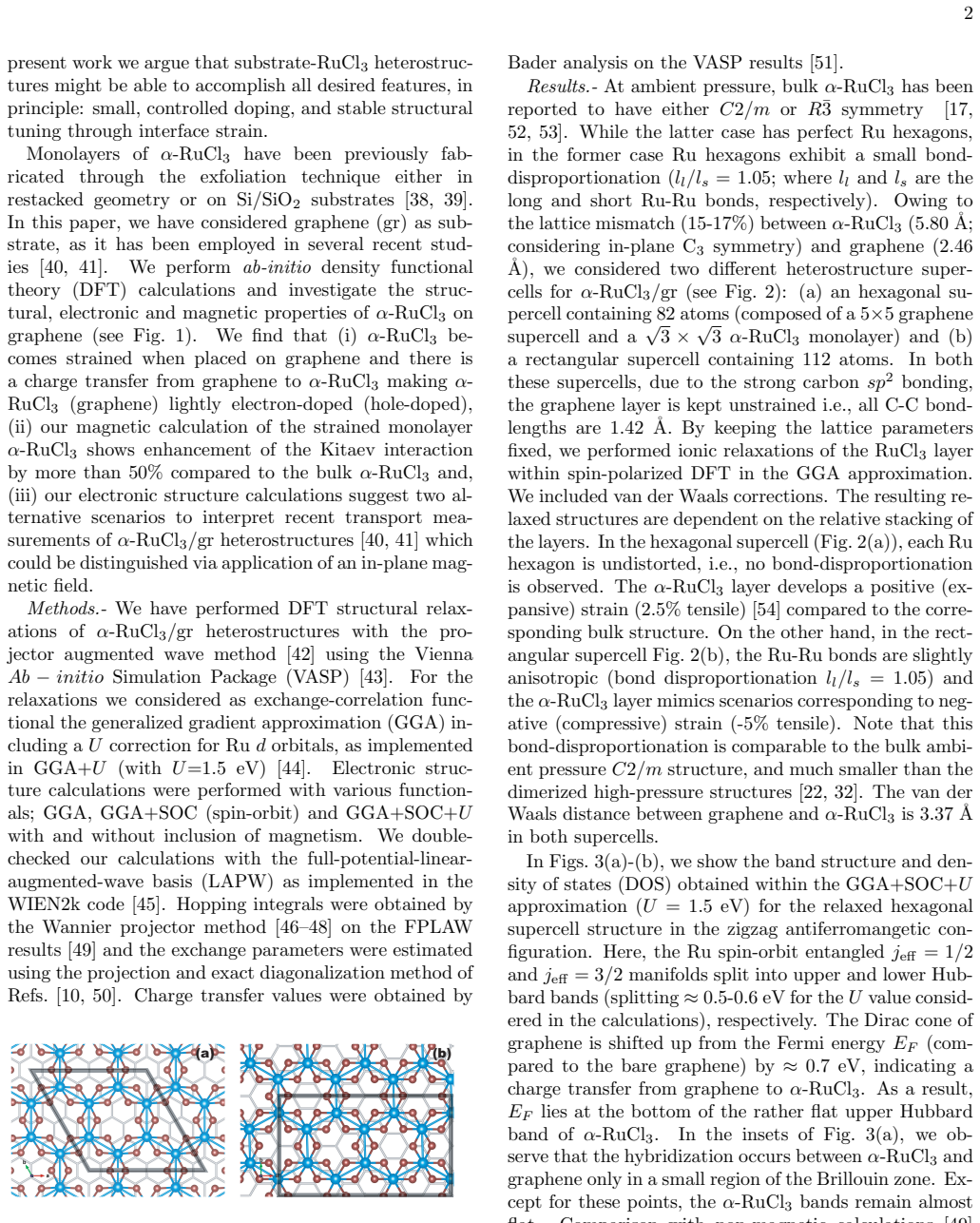
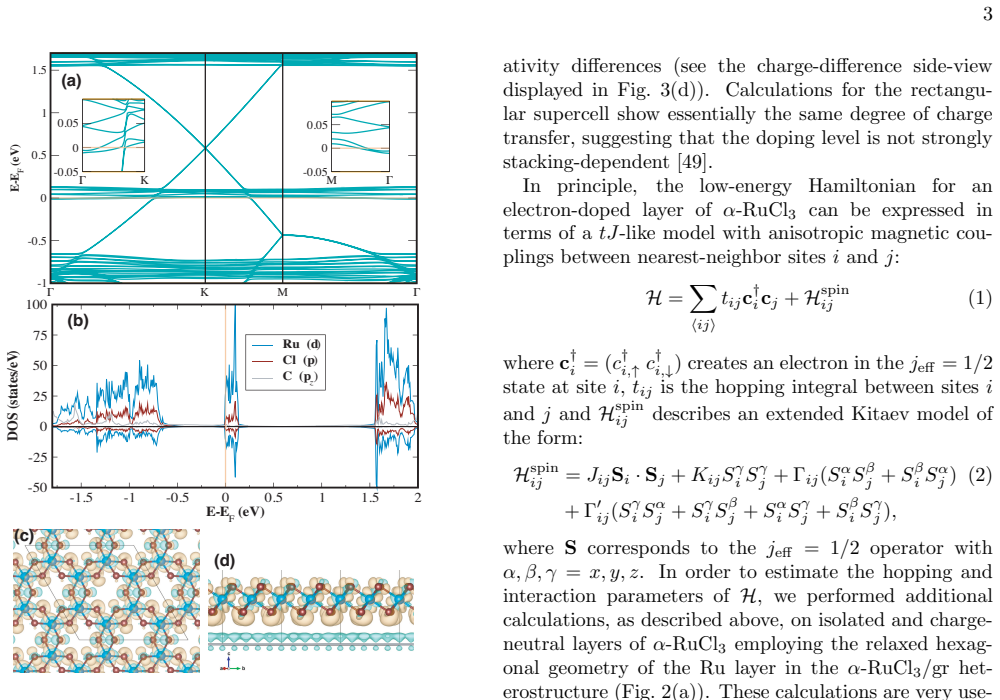
On the paper's own terms: $\alpha$-RuCl$_3$ in contact with graphene forms a commensurate interface in which graphene stays unstrained and $\alpha$-RuCl$_3$ takes up a tensile strain of about 2.5 percent (or, in the rectangular supercell, a compressive strain with mild bond disproportionation). Charge partitioning analysis gives a charge transfer $\delta \approx 0.064$ e per RuCl$_3$ unit, so the formerly Mott-insulating $\alpha$-RuCl$_3$ becomes lightly electron-doped and its Fermi energy sits at the bottom of the upper Hubbard band, while graphene is correspondingly hole-doped. Exact diagonalization of two-site clusters with Wannier-derived hoppings shows that the strain opens the Ru-Cl-Ru bond angle from about 94 degrees to about 96.5 degrees, suppressing direct Ru-Ru hopping, which in turn suppresses the non-Kitaev $J$ and $\Gamma$ couplings and the effective hopping $t_0 \approx 7$ meV while enhancing the Kitaev coupling $K$ from about 7 meV to about 17 meV. The paper reads this as placing the system near the $K = t_0$ condition where doped Kitaev-Heisenberg models host p-wave superconductivity, and notes that the undoped strained geometry satisfies $|K/J| > 8$, the region where the Kitaev quantum spin liquid is expected. It also proposes that two recent transport experiments on $\alpha$-RuCl$_3$/graphene can be explained either by spin-fluctuation scattering or by hybridization-induced anomalous quantum oscillations, distinguishable by an in-plane magnetic field.
Load-bearing premise
The quantitative predictions rest on correlation parameters that are inherited from earlier bulk studies rather than derived here: $U=1.5$ eV for the relaxations and $U=3$ eV, $J_H=0.6$ eV, $\lambda=0.15$ eV for the exchange calculations, with no demonstration that the charge transfer $\delta\approx0.06$, the metallization, or the >50% Kitaev enhancement survives over a realistic range of these parameters, exchange-correlation functionals, van der Waals schemes, or stacking arrangements.
Editorial extensions
If this is right
- The $\alpha$-RuCl$_3$/graphene interface is a tunable doped Kitaev system: charge transfer dopes the layer while strain tunes the exchange, so the same device can explore both doped and undoped regimes.
- With $K \approx 17$ meV and $t_0 \approx 7$ meV the system sits near the $K = t_0$ condition where doped Kitaev-Heisenberg models predict p-wave superconductivity, though the small $t_0$ implies low carrier mobility.
- Applying a gate voltage could increase the doping and shift the heterostructure into the nontrivial topological superconducting region predicted for hole dopings of 0.25-0.4.
- If the transferred charge is removed (by a spacer layer or by saturating graphene), the strained monolayer would have $|K/J| > 8$ and so approach the Kitaev quantum spin liquid phase.
- The two proposed transport scenarios (spin-fluctuation scattering versus hybridization-induced anomalous quantum oscillations) can be distinguished by an in-plane magnetic field, which suppresses the magnetic order but not the hybridization.
Reading between the lines
- Other substrates with different lattice constants could tune strain and charge transfer continuously, offering a generic way to move layered Kitaev candidates through the doped phase diagram without chemical substitution.
- The paper's quantitative claims would be tested by a systematic sensitivity study over $U$, exchange-correlation functional, and van der Waals scheme; without it, the exact $\delta$ and the size of the Kitaev enhancement remain parameter-dependent.
- If the strain mechanism is generic, the same bond-angle argument should apply to other 4d/5d honeycomb halides, making interface strain a control knob for non-Kitaev couplings beyond $\alpha$-RuCl$_3$.
- The proposed in-plane-field experiment not only distinguishes the two transport scenarios; it also directly probes whether the magnetic order survives in the doped monolayer, which would constrain any superconductivity mechanism.
Signed reviews
Editorial analysis
A structured set of objections, weighed in public.
Referee Report
Summary. The manuscript investigates the electronic and magnetic properties of α-RuCl3 monolayers placed on graphene using DFT+U (VASP), Wannier projection, and two-site exact diagonalization. It reports that, in a hexagonal commensurate supercell, α-RuCl3 develops +2.5% tensile strain and becomes electron-doped (δ ≈ 0.064 e per RuCl3 unit), that the Fermi level lies at the bottom of the upper Hubbard band, and that the extracted exchange parameters show a greater-than-50% enhancement of the Kitaev coupling relative to bulk, with |K/J| rising from 2.43 to 33–43. The paper also discusses possible p-wave superconducting states and proposes transport experiments to distinguish magnetic-scattering versus hybridization scenarios.
Significance. If the central claims hold, this work offers a concrete substrate-engineering route to enhance Kitaev interactions and to dope a candidate Kitaev material, with quantitative predictions for charge transfer and exchange constants. The paper's strengths are its explicit workflow from DFT to Wannier hoppings to exact diagonalization, the cross-checking between VASP and WIEN2k, and the falsifiable predictions for charge transfer and magnetotransport. However, the key quantitative results depend on model parameters inherited from earlier studies without sensitivity analysis and on one particular stacking geometry; the significance is therefore conditional until those dependencies are quantified and the stacking issue is addressed.
major comments (3)
- [Results (Table I and supercell discussion)] The magnetic couplings and the >50% Kitaev enhancement are reported only for the hexagonal supercell with +2.5% tensile strain and undistorted Ru hexagons. The paper itself states that the relaxed structures depend on relative stacking, and it reports a second rectangular supercell with compressive strain, Ru-Ru bond disproportionation ll/ls = 1.05, and Ru-Cl-Ru angles of 85°–91°, yet no exchange parameters are given for this geometry. Since the enhancement is attributed to the larger Ru-Cl-Ru angle (96.54°), a compressive, bond-disproportionated stacking is expected to yield substantially different couplings. The abstract's claim that 'in the strained α-RuCl3 monolayer the Kitaev interactions are enhanced' is therefore not established as a robust property of α-RuCl3/graphene; it is conditional on a specific commensurate stacking. The authors should either compute the magnetic couplings for the rectangular geometry, or explicitly restrict the claim to the hexagonal stacking and provide a structural or energetic argument that this stacking is the relevant one for exfoliated samples.
- [Table I caption and Methods] The central exchange parameters are obtained from exact diagonalization with U = 3 eV, JH = 0.6 eV, and λ = 0.15 eV, while the DFT structural relaxations use U = 1.5 eV; all of these values are taken from previous work without any sensitivity analysis. Because the central conclusions (|K| enhancement of more than 50%, |K/J| ≈ 33–43, and small t0 ≈ 7 meV) are quantitative, a moderate change in these parameters could alter the balance of K, J, Γ, and Γ′ and could affect the inferred phase-diagram position. The authors should report at least a few variations (for example, U = 2.5–3.5 eV, JH = 0.4–0.8 eV, λ = 0.1–0.2 eV, and perhaps a different functional or U in the relaxation) and demonstrate that the qualitative conclusions survive, or state the resulting uncertainty explicitly.
- [Supplemental Material, Section A (constrained magnetism)] The self-consistent calculation for the zigzag antiferromagnetic state collapsed to ferromagnetic moments and had to be stabilized with a penalty constraint, and the paper reports that FM and zzAFM configurations are almost degenerate. The band structure in Fig. 3(a) of the main text, including the Fermi-level position at the bottom of the upper Hubbard band, is obtained from this constrained zzAFM state. This makes the metallization and the precise placement of EF less robust than the text implies. The authors should show the corresponding GGA+SOC+U band structure for the unconstrained FM (or nonmagnetic) state and discuss whether the Fermi-level position and the hybridization near EF survive, or explicitly state that the transport interpretation assumes zzAFM order.
minor comments (6)
- [Discussion (superconductivity paragraph)] The text states 'K≈ 17 eV', which should be '17 meV'. Also, the statement that α-RuCl3/gr is 'close to satisfying' the criterion K = t0 should be quantified, since K/t0 ≈ 2.4 is not obviously close.
- [Abstract vs Conclusions] The abstract says the Kitaev interactions are 'enhanced by more than 50%' while the Conclusions say 'enhanced by a factor of two'; these should be made consistent.
- [Results and Supplemental Material, Table I] The main text gives the Ru-Cl-Ru bond angle as 96.54° for the hexagonal supercell, while Supplemental Material Table I lists 96.92°; this discrepancy should be reconciled.
- [Results (charge transfer paragraph)] The main text says the rectangular supercell shows 'essentially the same degree of charge transfer' as the hexagonal supercell, but Supplemental Material Table II lists 0.046–0.059 e per RuCl3 versus 0.064 e; the variation should be stated explicitly.
- [Results (strain discussion)] The phrase 'negative (compressive) strain (-5% tensile)' is confusing; it should be rephrased as 'compressive strain of -5%' or similar.
- [Throughout] There are several typographical errors, including 'augemented' and 'impletemented' in the Supplemental Material and 'supperconductivity' in the Conclusions; these should be corrected.
Circularity Check
No circularity: the Kitaev enhancement is computed from the relaxed heterostructure geometry via Wannier projection and exact diagonalization, not imposed by construction.
full rationale
The paper's derivation chain is self-contained in the relevant sense: DFT relaxation of the α-RuCl3/graphene heterostructure produces a strained geometry; Wannier projection gives hopping integrals; exact diagonalization of a multiorbital Hubbard model on two-site clusters yields the exchange parameters J, K, Γ, Γ′. The claimed >50% Kitaev enhancement follows from comparing these computed values for the strained hexagonal geometry with previously published bulk values (Ref. [10], Winter, Li, Jeschke, and Valentí). The bulk comparison values are not fitted to the present target, and the strained values are not adjusted to reproduce any desired K or |K/J|. The correlation parameters U = 3 eV, JH = 0.6 eV, λ = 0.15 eV are inherited from earlier work rather than derived here, which is a parameter-transferability concern but not circularity under the stated rules. No self-citation functions as an unverified load-bearing theorem, no fitted input is renamed as a prediction, and no ansatz is smuggled in through citation: the extended Kitaev model and the two-site ED extraction method are standard and are applied to the new geometry. The paper's own admission that the relaxed structure depends on stacking, and its decision to report magnetic couplings only for the hexagonal supercell, raise a robustness/selection question about how general the enhancement is; that is a correctness or scope limitation, not a circularity. Accordingly, the central claim is not equivalent to its inputs by definition, and no circular step can be exhibited with the required specificity.
Assumptions & free parameters
free parameters (4)
- DFT Hubbard U (Ru d) =
1.5 eV
- Hubbard U in two-site ED =
3 eV
- Hund coupling JH in ED =
0.6 eV
- Spin-orbit coupling λ in ED =
0.15 eV
assumptions (6)
- domain assumption Density functional theory with GGA+U, including SOC, accurately describes the ground state and band structure of α-RuCl3/graphene.
- domain assumption The chosen commensurate supercells with unstrained graphene and strained α-RuCl3 represent the real experimental interface.
- domain assumption A two-site cluster exact diagonalization of a multiorbital Hubbard model captures the effective magnetic couplings of the extended Kitaev model.
- domain assumption The low-energy physics is restricted to collinear magnetic configurations, and the constrained zzAFM state is representative.
- domain assumption Bader charge analysis provides a quantitative measure of interlayer charge transfer.
- domain assumption The doped Kitaev-Heisenberg phase diagram of Refs. [33-36] applies to α-RuCl3/graphene at the calculated doping and parameters.
Cite this review
Pith. "Pith review of Electronic properties of {\alpha}-RuCl3 in proximity to graphene." pith.science (2026). https://pith.science/paper/GDKPOEXM
@misc{pith2026190804793,
  author       = {Pith},
  title        = {Pith review of: Electronic properties of \alpha-RuCl3 in proximity to graphene},
  year         = {2026},
  howpublished = {\url{https://pith.science/paper/GDKPOEXM}},
  note         = {Machine review of arXiv:1908.04793}
}
read the original abstract
In the pursuit of developing routes to enhance magnetic Kitaev interactions in {\alpha}-RuCl3, as well as probing doping effects, we investigate the electronic properties of {\alpha}-RuCl3 in proximity to graphene. We study {\alpha}-RuCl3/graphene heterostructures via ab initio density functional theory calculations, Wannier projection and non-perturbative exact diagonalization methods. We show that {\alpha}-RuCl3 becomes strained when placed on graphene and charge transfer occurs between the two layers, making {\alpha}-RuCl3 (graphene) lightly electron-doped (hole-doped). This gives rise to an insulator to metal transition in {\alpha}-RuCl3 with the Fermi energy located close to the bottom of the upper Hubbard band of the t2g manifold. These results suggest the possibility of realizing metallic and even exotic superconducting states. Moreover, we show that in the strained {\alpha}-RuCl3 monolayer the Kitaev interactions are enhanced by more than 50% compared to the unstrained bulk structure. Finally, we discuss scenarios related to transport experiments in {\alpha}-RuCl3/graphene heterostructures.
Figures

Figures from the paper (2 more)

Forward citations
Cited by 1 Pith paper
-
Hunting Majorana Fermions in Kitaev Magnets
A review of theoretical and experimental evidence that Kitaev magnets exhibit thermal fractionalization into Majorana fermions and Z2 fluxes, with the half-quantized thermal Hall effect as the strongest proposed signature.
Reference graph
Works this paper leans on
-
[1]
Kitaev, Annals of Physics 321, 2 (2006)
A. Kitaev, Annals of Physics 321, 2 (2006)
2006
- [2]
-
[3]
Savary and L
L. Savary and L. Balents, Reports on Progress in Physics 80, 016502 (2017)
2017
-
[4]
M. R. Norman, Rev. Mod. Phys. 88, 041002 (2016)
2016
-
[5]
Y. Zhou, K. Kanoda, and T.-K. Ng, Rev. Mod. Phys. 89, 025003 (2017)
2017
-
[6]
Knolle and R
J. Knolle and R. Moessner, Annu. Rev. Condens. Matter Phys. 10, 451 (2019)
2019
-
[7]
L. J. Sandilands, Y. Tian, K. W. Plumb, Y.-J. Kim, and K. S. Burch, Phys. Rev. Lett. 114, 147201 (2015)
2015
-
[8]
H.-S. Kim, V. V., A. Catuneanu, and H.-Y. Kee, Phys. Rev. B 91, 241110(R) (2015)
work page 2015
Show all 61 references
-
[9]
Banerjee, C
A. Banerjee, C. A. Bridges, J.-Q. Yan, A. A. Aczel, L. Li, M. B. Stone, G. E. Granroth, M. D. Lumsden, Y. Yiu, J. Knolle, et al., Nature Materials 15 (2016)
2016
-
[11]
Kim and H.-Y
H.-S. Kim and H.-Y. Kee, Phys. Rev. B 93, 155143 (2016)
2016
-
[12]
J. G. Rau, E. K.-H. Lee, and H.-Y. Kee, Annual Review of Condensed Matter Physics 7, 195 (2016)
2016
-
[13]
S. M. Winter, A. A. Tsirlin, M. Daghofer, J. van den Brink, Y. Singh, P. Gegenwart, and R. Valenti, Journal of Physics: Condensed Matter 29, 493002 (2017)
2017
-
[14]
Hermanns, I
M. Hermanns, I. Kimchi, and J. Knolle, Annual Review of Condensed Matter Physics (2017)
2017
-
[15]
Banerjee, P
A. Banerjee, P. Lampen-Kelley, J. Knolle, C. Balz, A. A. Aczel, B. Winn, Y. Liu, D. Pajerowski, J. Yan, C. A. Bridges, et al., npj Quantum Materials 3, 8 (2018)
2018
-
[16]
Takagi, T
H. Takagi, T. Takayama, G. Jackeli, G. Khaliullin, and S. E. Nagler, Nature Reviews Physics1, 264 (2019), ISSN 2522-5820
2019
-
[17]
R. D. Johnson, S. C. Williams, A. A. Haghighirad, J. Sin- gleton, V. Zapf, P. Manuel, I. I. Mazin, Y. Li, H. O. Jeschke, R. Valent´ ı, et al., Phys. Rev. B 92, 235119 (2015)
2015
-
[18]
L. J. Sandilands, Y. Tian, A. A. Reijnders, H.-S. Kim, K. W. Plumb, Y.-J. Kim, H.-Y. Kee, and K. S. Burch, Phys. Rev. B 93, 075144 (2016)
2016
-
[19]
Yadav, N
R. Yadav, N. A. Bogdanov, V. M. Katukuri, S. Nishi- moto, J. van den Brink, and L. Hozoi, Scientific Reports 6 (2016)
2016
-
[20]
Baek, S.-H
S.-H. Baek, S.-H. Do, K.-Y. Choi, Y. S. Kwon, A. U. B. Wolter, S. Nishimoto, J. van den Brink, and B. B¨ uchner, Phys. Rev. Lett. 119, 037201 (2017)
2017
-
[21]
Banerjee, P
A. Banerjee, P. Lampen-Kelley, J. Knolle, C. Balz, A. Aczel, B. Winn, Y. Liu, D. Pajerowski, J.-Q. Yan, C. Bridges, et al., arXiv:1706.07003 (2017)
2017 arXiv
-
[22]
Hentrich, A
R. Hentrich, A. U. B. Wolter, X. Zotos, W. Brenig, D. Nowak, A. Isaeva, T. Doert, A. Banerjee, P. Lampen- Kelley, D. G. Mandrus, et al., Phys. Rev. Lett. 120, 117204 (2018)
2018
-
[23]
Koitzsch, C
A. Koitzsch, C. Habenicht, E. M¨ uller, M. Knupfer, B. B¨ uchner, S. Kretschmer, M. Richter, J. van den Brink, F. B¨ orrnert, D. Nowak, et al., Phys. Rev. Materials 1, 052001 (2017)
2017
-
[24]
S. M. Winter, K. Riedl, D. Kaib, R. Coldea, and R. Va- lent´ ı, Phys. Rev. Lett.120, 077203 (2018)
2018
-
[25]
Riedl, Y
K. Riedl, Y. Li, S. M. Winter, and R. Valent´ ı, Phys. Rev. Lett. 122, 197202 (2019)
2019
-
[26]
Z. Wang, J. Guo, F. F. Tafti, A. Hegg, S. Sen, V. A. Sidorov, L. Wang, S. Cai, W. Yi, Y. Zhou, et al., arXiv:1705.06139 (2017)
2017 arXiv
-
[27]
Y. Cui, J. Zheng, K. Ran, J. Wen, Z.-X. Liu, B. Liu, W. Guo, and W. Yu, Phys. Rev. B 96, 205147 (2017)
2017
-
[28]
Jackeli and G
G. Jackeli and G. Khaliullin, Phys. Rev. Lett. 102, 017205 (2009)
2009
-
[29]
J. G. Rau, E.-H. Lee, and H.-Y. Kee, Phys. Rev. Lett. 112, 077204 (2014)
2014
-
[30]
E.-H. Lee, R. Schaffer, S. Bhattacharjee, and Y. B. Kim, Phys. Rev. B 89, 045117 (2014)
2014
-
[31]
Schaffer, S
R. Schaffer, S. Bhattacharjee, and Y. B. Kim, Phys. Rev. B 86, 224417 (2012)
2012
-
[32]
Biesner, S
T. Biesner, S. Biswas, W. Li, Y. Saito, A. Pustogow, M. Altmeyer, A. U. B. Wolter, B. B¨ uchner, M. Roslova, T. Doert, et al., Phys. Rev. B 97, 220401(R) (2018)
2018
-
[33]
Y.-Z. You, I. Kimchi, and A. Vishwanath, Phys. Rev. B 86, 085145 (2012)
2012
-
[34]
Hyart, A
T. Hyart, A. R. Wright, G. Khaliullin, and B. Rosenow, Phys. Rev. B 85, 140510(R) (2012)
2012
-
[35]
Okamoto, Phys
S. Okamoto, Phys. Rev. B 87, 064508 (2013)
2013
-
[36]
W. Choi, P. W. Klein, A. Rosch, and Y. B. Kim, Phys. Rev. B 98, 155123 (2018)
2018
-
[37]
Schmidt, D
J. Schmidt, D. D. Scherer, and A. M. Black-Schaffer, Phys. Rev. B 97, 014504 (2018)
2018
-
[38]
Weber, L
D. Weber, L. M. Schoop, V. Duppel, J. M. Lippmann, J. Nuss, and B. V. Lotsch, Nano Letters 16, 3578 (2016)
2016
-
[39]
B. Zhou, Y. Wang, G. B. Osterhoudt, P. Lampen-Kelley, D. Mandrus, R. He, K. S. Burch, and E. A. Henrik- sen, Journal of Physics and Chemistry of Solids 128, 291 (2019)
2019
-
[40]
B. Zhou, J. Balgley, P. Lampen-Kelley, J.-Q. Yan, D. G. Mandrus, and E. A. Henriksen, arXiv preprint arXiv:1811.04838 (2018)
2018 arXiv
-
[41]
Mashhadi, Y
S. Mashhadi, Y. Kim, J. Kim, D. Weber, T. Taniguchi, K. Watanabe, N. Park, B. Lotsch, J. H. Smet, M. Burghard, et al., arXiv preprint arXiv:1906.10405 (2019)
2019 arXiv
-
[42]
P. E. Bl¨ ochl, Phys. Rev. B50, 17953 (1994)
1994
-
[49]
see Suplementary Information for details (2019)
2019
-
[50]
Riedl, Y
K. Riedl, Y. Li, R. Valent, and S. M. Winter, phys. status solidi (b) 0, 1800684 (????)
-
[52]
Reschke, F
S. Reschke, F. Mayr, S. Widmann, H.-A. K. von Nidda, V. Tsurkan, M. V. Eremin, S.-H. Do, K.-Y. Choi, Z. Wang, and A. Loidl, Journal of Physics: Condensed Matter 30, 475604 (2018)
2018
-
[53]
T. T. Mai, A. McCreary, P. Lampen-Kelley, N. Butch, J. R. Simpson, J.-Q. Yan, S. E. Nagler, D. Mandrus, A. R. H. Walker, and R. V. Aguilar, arXiv preprint 6 arXiv:1908.01021 (2019)
2019 arXiv
-
[54]
The strains are calculated with respect to the ideal bond length in the hexagonalαRuCl3 in order the compare the values in the two supercell on the same ground
-
[55]
Gerber, Y
E. Gerber, Y. Yao, T. A. Arias, and E.-A. Kim, arXiv preprint arXiv:1902.09550 (2019)
2019 arXiv
-
[56]
Knolle and N
J. Knolle and N. R. Cooper, Phys. Rev. Lett.115, 146401 (2015)
2015
-
[57]
Zhang, X.-Y
L. Zhang, X.-Y. Song, and F. Wang, Phys. Rev. Lett. 116, 046404 (2016). Electronic properties of α-RuCl3 in proximity to graphene Sananda Biswas,1 Ying Li,1, 2 Stephen M. Winter, 1 Johannes Knolle, 3, 4, 5 and Roser Valent´ ı1 1Institut f¨ ur Theoretische Physik, Goethe-Univer...
2016
-
[58]
Kresse and J
G. Kresse and J. Hafner, Phys. Rev. B 47, 558 (1993)
1993
-
[59]
S. L. Dudarev, G. A. Botton, S. Y. Savrasov, C. J. Humphreys, and A. P. Sutton, Phys. Rev. B 57, 1505 (1998)
1998
-
[60]
Biesner, S
T. Biesner, S. Biswas, W. Li, Y. Saito, A. Pustogow, M. Altmeyer, A. U. B. Wolter, B. B¨ uchner, M. Roslova, T. Doert, et al., Phys. Rev. B 97, 220401 (2018)
2018
-
[61]
Grimme, Journal of Physics and Chemistry of Solids 27, 1787 (2006)
S. Grimme, Journal of Physics and Chemistry of Solids 27, 1787 (2006)
2006
-
[62]
P. H. Dederichs, S. Bl¨ ugel, R. Zeller, and H. Akai, Phys. Rev. Lett. 53, 2512 (1984)
1984
-
[63]
Henkelman, A
G. Henkelman, A. Arnaldsson, and J´ onsson, Computa- tional Material Science 36, 354 (2006)
2006
-
[64]
Foyevtsova, H
K. Foyevtsova, H. O. Jeschke, I. I. Mazin, D. I. Khomskii, and R. Valent´ ı, Phys. Rev. B88, 035107 (2013)
2013
-
[65]
Aichhorn, L
M. Aichhorn, L. Pourovskii, V. Vildosola, M. Ferrero, O. Parcollet, T. Miyake, A. Georges, and S. Biermann, Phys. Rev. B 80, 085101 (2009)
2009
-
[66]
Ferber, K
J. Ferber, K. Foyevtsova, H. O. Jeschke, and R. Valent´ ı, Phys. Rev. B 89, 205106 (2014)
2014
-
[67]
Blaha, K
P. Blaha, K. Schwarz, G. K. H. Madsen, D. Kvasnicka, and J. Luitz (2001)
2001
-
[68]
J. P. Perdew, K. Burke, and M. Ernzerhof, Phys. Rev. Lett. 77, 3865 (1996)
1996
-
[69]
S. M. Winter, Y. Li, H. O. Jeschke, and R. Valent´ ı, Phys. Rev. B 93, 214431 (2016)
2016
Reviewed August 14, 2026 · model on record in the stance chip above.
Discussion (0). Continue with ORCID to comment.