REVIEW 2 major objections 3 minor 1 cited by
Pseudoscalar Higgs Production at Muon Colliders: The Role of One-Loop Effective Vertices
T0 review · 2 major / 3 minor · reviewed 2026-08-16 · deepseek-v4-flash
Pith's one-line read Loop-induced photon and Z fusion can dominate pseudoscalar Higgs production at a muon collider, with rates high enough to probe the extended Higgs sector.
desk verdict Clean one-loop matching applied to a muon-collider process, but the advertised high-energy enhancements rest on an uncontrolled off-shell form-factor assumption and need a serious re-derivation. read the letter →
The pith
A machine-rendered reading of the paper's core claim, the machinery that carries it, and where it could break.
The reading
What carries the argument
The load-bearing object is the set of one-loop effective vertices $\gamma\gamma A$, $\gamma Z A$, and $ZZ A$, embodied in the effective Lagrangian $\mathcal{L}_{\rm eff} \supset \frac{g_{A\gamma\gamma}}{v} A\, F_{\mu\nu}\tilde F^{\mu\nu} + \frac{g_{A\gamma Z}}{v} A\, F_{\mu\nu}\tilde Z^{\mu\nu} + \frac{g_{AZZ}}{v} A\, Z_{\mu\nu}\tilde Z^{\mu\nu}$. Because $A$ does not couple to $W$ or $Z$ at tree level, only fermion loops contribute; the paper keeps the top, bottom, and tau loops. The coefficients are determined by matching the effective-theory decay widths to the exact one-loop results, so the vertices carry the exact dependence on fermion masses and Yukawa ratios through the standard loop functions. These vertices are then used as local momentum-dependent derivative couplings in the simulation of $t$-channel fusion, and this derivative structure is what produces the energy enhancement at high $\sqrt{s}$: the amplitude grows with the momentum of the exchanged boson, partially cancelling the phase-space suppression.
What would settle it
Compute the exact one-loop amplitude for $\mu^+\mu^-\to\mu^+\mu^- A$ with momentum-dependent form factors retained, for example at $\sqrt{s}=10$ TeV, $m_A=500$ GeV, and $\tan\beta=5$ in Type-X; if the resulting ratio of loop-induced to tree-level cross section is far below the claimed factor of about 20, the point-like effective-vertex treatment fails.
Extended reading notes
Core claim
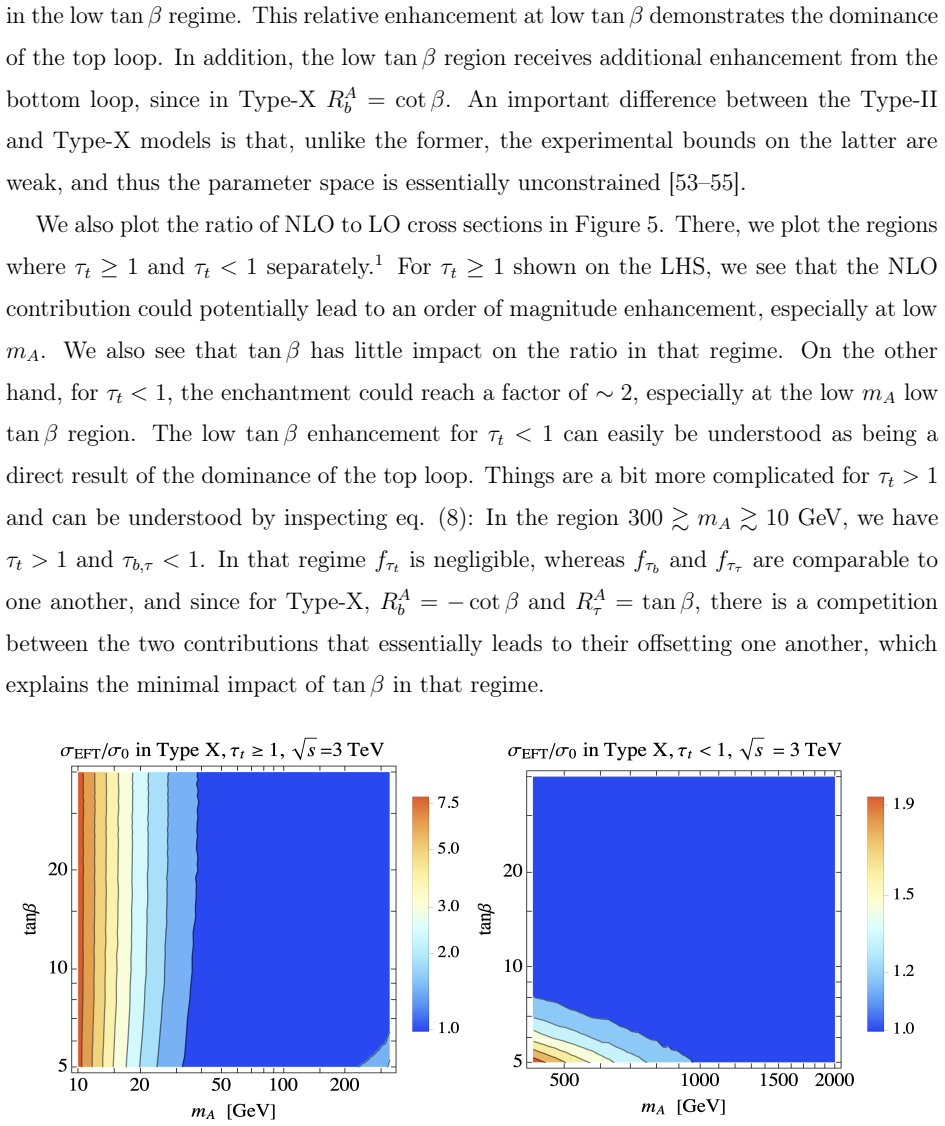
The central claim is that one-loop corrections to the production of the CP-odd Higgs boson $A$ in $\mu^+\mu^- \to \mu^+\mu^- A$ are not a small correction: they are comparable to, and in some regions larger than, the tree-level contribution. After integrating out the fermion loops, the paper writes an effective Lagrangian with derivative couplings $\frac{g_{A VV}}{v} A\, V_{\mu\nu}\tilde V^{\mu\nu}$ and fixes the coefficients by matching the resulting decay widths to the exact one-loop rates for $A\to\gamma\gamma$, $A\to\gamma Z$, and $A\to ZZ$ from the literature. Using these vertices for $t$-channel vector-boson fusion in a simulation, the paper finds enhancements of roughly a factor of 2 for Type-II and up to about 10 for Type-X in the low-$m_A$, low-$\tan\beta$ region, with the top-quark loop (plus the bottom-quark loop in Type-X) responsible for the low-$\tan\beta$ enhancement. At fixed mass, the loop contribution grows relative to the tree level with collision energy, because the derivative couplings produce an energy-growing amplitude that competes with the $1/s$ phase-space falloff. In the experimentally open regions, the predicted cross sections reach about 1 fb for Type-II and 5 fb for Type-X at $\sqrt{s}=3$ TeV, which the paper presents as making the muon collider a feasible discovery machine for the pseudoscalar Higgs sector.
Load-bearing premise
The calculation assumes that the one-loop gamma/Z fusion vertices, fixed by matching on-shell decay amplitudes, remain accurate as local derivative couplings when the exchanged bosons are virtual and far off their mass shells in the t-channel fusion process; if the true quantum amplitudes flatten or fall with virtual momentum instead of growing, the predicted enhancement is an overestimate.
Editorial extensions
If this is right
- In Type-II, the one-loop $\gamma\gamma$, $\gamma Z$, and $ZZ$ fusion contributions can double the production cross section of $A$ in the low-$m_A$, low-$\tan\beta$ region, where the top-quark loop dominates.
- In Type-X, the same loop contributions can enhance the cross section by up to about an order of magnitude, making loop-induced vector-boson fusion the dominant production channel there.
- At a 3 TeV muon collider, the experimentally allowed parameter space can yield cross sections of about 1 fb in Type-II and 5 fb in Type-X, rates high enough for a dedicated search for the pseudoscalar Higgs.
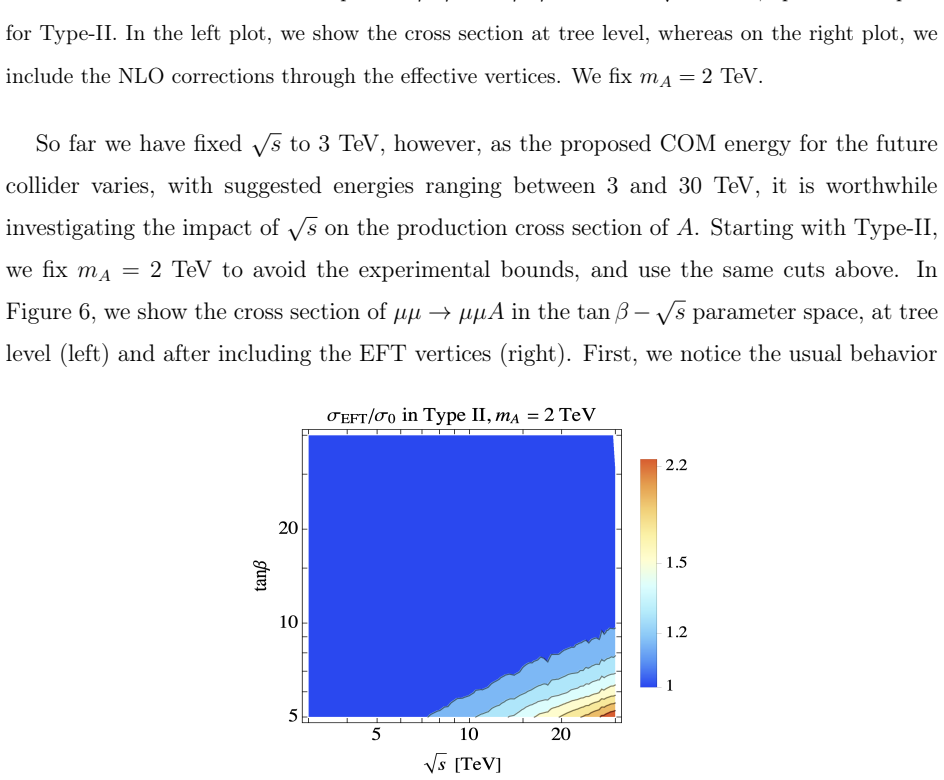
- Raising the collision energy does not simply suppress the loop-induced signal: because the effective vertices are derivative couplings, the NLO-to-LO ratio grows with $\sqrt{s}$, reaching factors of up to about 20 for Type-X with $m_A=500$ GeV at low $\tan\beta$.
- The largest absolute cross sections occur at high $\tan\beta$, while the largest relative enhancements occur at low $\tan\beta$, a separation that could help discriminate the 2HDM type.
Reading between the lines
- A natural extension, not pursued in the paper, is to Type-I and Type-Y models: since all quark Yukawa ratios are $\cot\beta$ in Type-I, the low-$\tan\beta$ enhancement could be even more pronounced, and the absence of a compensating bottom-loop effect might distinguish Type-I from Type-X in the same channel.
- The same effective vertices predict $\gamma\gamma$, $\gamma Z$, and $ZZ$ decay signatures for $A$; measuring $A$ in both its production and its loop-induced decays at a muon collider could test the consistency of the derivative-coupling treatment.
- The high-energy growth is the place where the shortcut is most vulnerable: if the full one-loop form factors for off-shell $V^*V^*\to A$ flatten or fall at large virtuality, the advertised enhancement factors, especially the factor of about 20 at high $\sqrt{s}$, would be an artifact of the local vertex approximation.
- Because the tree-level process is governed by the muon Yukawa coupling, the same method could be applied to other weakly coupled new scalars at muon colliders, turning loop-induced fusion into a general search strategy for CP-odd states.
Signed reviews
Editorial analysis
A structured set of objections, weighed in public.
Referee Report
Summary. The paper studies the production of the CP-odd Higgs A in the process mu+ mu- -> mu+ mu- A at future muon colliders within the Type-II and Type-X 2HDM. It introduces dimension-five effective vertices A gamma gamma, A gamma Z, and A Z Z, with coefficients matched to the known one-loop decay amplitudes for A -> gamma gamma, gamma Z, and Z Z. These effective vertices are implemented in FeynRules/MadGraph to compute the loop-induced VV-fusion contribution (called NLO) and compare it with the tree-level A-strahlung cross section (called LO). The paper reports enhancements up to ~2 in Type-II and ~10 in Type-X, and cross sections up to ~1 fb and ~5 fb in experimentally allowed regions, and concludes that a muon collider is a feasible probe of the 2HDM pseudoscalar sector.
Significance. If the reported cross sections were correct, the loop-induced VV-fusion mechanism would be a leading production mode for a light pseudoscalar A at multi-TeV muon colliders, with discovery potential especially in the weakly constrained Type-X model. The matching of the effective couplings to published exact one-loop amplitudes (Eqs. (5)-(15)) is transparent and correctly implements the top/bottom/tau loop contributions, and the use of external LHC and B->X_s gamma constraints is appropriate. However, the central quantitative claims rest on treating on-shell-matched constants as local couplings for off-shell t-channel vector bosons, an approximation whose validity is not demonstrated and which is likely to fail in the high-energy regime where the claimed enhancements are largest. The paper therefore provides a useful framework and a clear benchmark calculation, but its headline numbers require substantial additional work before they can be considered robust predictions.
major comments (2)
- [Section II, Eqs. (5)-(10)] The effective couplings g_A^VV are matched to the on-shell decay amplitudes A->VV, with the Passarino-Veltman functions evaluated at q1^2 = q2^2 = M_V^2 and P^2 = M_A^2 (Eqs. (9)-(15)). They are then implemented as constant, momentum-independent local vertex factors in the t-channel vector-boson-fusion process mu+ mu- -> mu+ mu- A, where the exchanged gamma*/Z* have spacelike virtualities that can reach |q^2| ~ s, with s up to (20 TeV)^2. The vertex of Eq. (4) is proportional to k1^rho k2^sigma, so the amplitude grows linearly with the boson momenta; the paper explicitly attributes the high-energy enhancement to this 'derivative-type coupling' (Section III, discussion of Figs. 7 and 9). However, the actual one-loop form factors depend nontrivially on q1^2, q2^2, and P^2, and for off-shell photons the triangle amplitude is known to fall as 1/q^2 at large virtuality rather than to grow. No justification is given for using the on-shell constants throughout the kinematic range, and no check (for example, comparing with the full one-loop matrix element at a test point) is provided. Since the claimed enhancements of ~2 (Type-II) and ~10 (Type-X) and the associated cross-section maxima in Figs. 2-10 are driven by this high-energy growth, the central quantitative claims are not established by the present calculation.
- [Section II, Eqs. (5)-(10)] For mA > 2 m_f, the loop functions f(tau) and I2 in Eqs. (7)-(8) and (11) acquire imaginary parts, so the matched coefficients g_A^gamma gamma and g_A^gamma Z are complex in general (for example, for the top loop when mA > 350 GeV). Eq. (5) uses (g_A^gamma gamma)^2 rather than |g_A^gamma gamma|^2, which is only valid for a real coupling, and the effective Lagrangian of Eq. (3) is written with real coefficients. The paper does not explain how the complex couplings are inserted into the FeynRules model, how Hermiticity of the Lagrangian is restored, or how the phases affect the interference between the gamma-gamma, gamma-Z, and Z-Z fusion amplitudes. This is not a purely formal point: for mA = 500 GeV (used in Fig. 8 for Type-X) the imaginary parts from the top loop are sizeable, and the relative phases can change the predicted cross sections. The matching procedure should be restated in terms of a Hermitian Lagrangian with complex coefficients (or with separate real and imaginary parts), and the width formulas should use absolute values.
minor comments (3)
- [Abstract and Sections I, IV] The text describes the calculation as 'NLO', but only the VV-fusion diagrams with the triangle insertion are computed; the full one-loop correction to mu+ mu- -> mu+ mu- A would also include vertex and box corrections to the A-strahlung diagrams. The terminology should be qualified, for example as 'loop-induced VV-fusion contribution', to avoid implying a complete NLO calculation.
- [Section III, Figs. 2-4] The exclusion contours are said to come from LHC searches [49] and B->X_s gamma [50-52], but the specific limits used (for example, the numerical value of Br(B->X_s gamma) and the precise LHC analysis) are not given, so the reader cannot reproduce the excluded regions.
- [Section IV (Conclusion)] There is a typo in the conclusion: 'searching for the the pseudoscalar A' should read 'searching for the pseudoscalar A'.
Circularity Check
No circularity: the one-loop effective vertices are matched to published exact amplitudes, and the predicted cross sections are independent outputs rather than fitted inputs.
full rationale
The derivation chain is self-contained and not circular. The paper takes standard 2HDM Yukawa couplings (Table I), then uses published exact one-loop results for A→γγ, A→γZ, and A→ZZ (refs. [41], [42], [43], none by the present authors) to fix the coefficients gAγγ, gAγZ, and gAZZ in the EFT Lagrangian of Eq. (3) by matching on-shell decay widths (Eqs. (5)–(15)). No parameter is fitted to the cross sections being predicted. The subsequent FeynRules/MadGraph simulation of µ+µ−→µ+µ−A with those fixed vertices, including cuts, phase-space integration, and interference among γγ, γZ, and ZZ contributions, is a genuine calculation whose output (the enhancement factors and cross sections in Figs. 2–10) is not equal to any input by construction. The central quantitative assumption—that the on-shell-matched constant coefficients remain valid for off-shell t-channel vector-boson fusion at large virtualities—is a physics approximation and a possible source of overestimate, but it is not circularity: a wrong approximation is different from a prediction that reduces to its input. Self-citations in the paper ([3]–[10]) are background and are not load-bearing for the claimed result. External constraints from the LHC and B→Xsγ are imposed independently. Therefore no circular step is present, and the appropriate score is 0.
Assumptions & free parameters
free parameters (4)
- mA (scan variable) =
10-2000 GeV (fixed at 500 GeV and 2 TeV in energy scans)
- tan beta (scan variable) =
5-40 (fixed at 5 and 10 in some scans)
- center-of-mass energy sqrt(s) =
3-30 TeV (fixed at 3 TeV in mA-tan beta scans)
- acceptance cuts =
pT(mu) >= 10 GeV, |eta(mu)| <= 3.5, Delta R >= 0.4
assumptions (5)
- domain assumption CP is conserved in the 2HDM sector considered, so the A V V effective vertex takes the single CP-odd form in Eq. (3).
- domain assumption Only t, b, and tau fermion loops are kept in the A V V amplitudes; all other fermions are omitted.
- ad hoc to paper The matched constant couplings g_A VV are valid for off-shell vector bosons in t-channel VV fusion.
- standard math The one-loop formulas for A to gamma gamma, gamma Z, ZZ from Refs. [41-43] are correct and complete for the 2HDM fermion content.
- domain assumption The Yukawa coupling structure of Type-II and Type-X 2HDM is as given in Table I, including R_A_mu = tan beta.
Cite this review
Pith. "Pith review of Pseudoscalar Higgs Production at Muon Colliders: The Role of One-Loop Effective Vertices." pith.science (2026). https://pith.science/paper/GDOXMJ4G
@misc{pith2026250502092,
  author       = {Pith},
  title        = {Pith review of: Pseudoscalar Higgs Production at Muon Colliders: The Role of One-Loop Effective Vertices},
  year         = {2026},
  howpublished = {\url{https://pith.science/paper/GDOXMJ4G}},
  note         = {Machine review of arXiv:2505.02092}
}
abstract
We investigate the production of the pseudoscalar Higgs boson $A$ at muon colliders within the framework of Type-II and Type-X Two-Higgs-Doublet Model (2HDM) at the Next-to-Leading Order (NLO), utilizing an Effective Field Theory (EFT) approach. In particular, we analyze the level of enhancement to the cross section due to the inclusion of the one-loop corrections involving $\gamma$ and $Z$ boson fusion compared to the tree-level contribution. We find that for Type-II, including the effective vertices of $\gamma\gamma A$, $\gamma Z A$ and $ZZ A$, could lead to an enhancement of a factor of $\sim 2$ at low $m_A$ and low $\tan\beta$, whereas for Type-X, the enhancement could reach $\sim 10$ in the same regime. We also investigate the impact of the COM energy and $\tan \beta$ on the production cross section. We find that for the region of the parameter space not excluded by experiment, cross sections of $\gtrsim 1$ fb for Type-II, and $\gtrsim 5$ fb for Type-X, are possible, making the proposed muon collider a feasible alternative for probing the 2HDM extended Higgs sector.
Figures


Figures from the paper (7 more)




Forward citations
Cited by 1 Pith paper
-
Search for pseudoscalar Higgs boson $A_0$ of the Bestest Little Higgs model at the LHC and FCC-hh
Within the Bestest Little Higgs model, a 500 GeV pseudoscalar A0 produced by gluon fusion is estimated to yield about 10 to 100 events in the WW and gg channels at the HL-LHC and FCC-hh for the chosen benchmarks.
Reference graph
Works this paper leans on
-
[37]
International Muon Collider collaboration, The Muon Collider, 2504.21417. I
-
[53]
Belle collaboration, Measurement of the inclusiveB→Xs+dγ branching fraction, photon energy spectrum and HQE parameters, in38th International Conference on High Energy Physics, 8, 2016 [1608.02344]
work page Pith review arXiv 2016
-
[1]
ATLAScollaboration, Observation of a new particle in the search for the Standard Model Higgs boson with the ATLAS detector at the LHC, Phys. Lett. B716 (2012) 1 [1207.7214]. I
arXiv 2012
-
[2]
CMS collaboration, Observation of a New Boson at a Mass of 125 GeV with the CMS Experiment at the LHC, Phys. Lett. B716 (2012) 30 [1207.7235]. I
arXiv 2012
-
[3]
F. Abu-Ajamieh, S. Chang, M. Chen and M.A. Luty,Higgs coupling measurements and the scale of new physics, JHEP 07 (2021) 056 [2009.11293]. I
arXiv 2021
-
[4]
F. Abu-Ajamieh,Model-independent Veltman condition, naturalness and the little hierarchy problem *, Chin. Phys. C 46 (2022) 013101 [2101.06932]
arXiv 2022
-
[5]
F. Abu-Ajamieh,The scale of new physics from the Higgs couplings toγγ and γZ, JHEP 06 (2022) 091 [2112.13529]
arXiv 2022
-
[6]
The Scale of New Physics from the Higgs Couplings to gg
F. Abu-Ajamieh,The scale of new physics from the Higgs couplings to gg, Phys. Lett. B833 (2022) 137389 [2203.07410]
work page Pith review arXiv 2022
Show all 58 references
-
[7]
Dawson et al.,Report of the Topical Group on Higgs Physics for Snowmass 2021: The Case for Precision Higgs Physics, inSnowmass 2021, 9, 2022 [2209.07510]
S. Dawson et al.,Report of the Topical Group on Higgs Physics for Snowmass 2021: The Case for Precision Higgs Physics, inSnowmass 2021, 9, 2022 [2209.07510]
2021 arXiv
-
[8]
Abu-Ajamieh and S.K
F. Abu-Ajamieh and S.K. Vempati,Can the Higgs still account for the g−2 anomaly?, Int. J. Mod. Phys. A38 (2023) 2350091 [2209.10898]
2023 arXiv
-
[9]
Abu-Ajamieh, M
F. Abu-Ajamieh, M. Frasca and S.K. Vempati,Flavor violating di-Higgs couplings, Nucl. Phys. B 1008 (2024) 116694
2024
-
[10]
Abu-Ajamieh, A
F. Abu-Ajamieh, A. Ahriche and N. Okada,Novel and Updated Bounds on Flavor-violating Z Interactions in the Lepton Sector, 2503.07236. I
-
[11]
The two Higgs doubletsH1 and H2 have hypercharges Y = +1 and−1 respectively, H1 = ϕ0∗ 1 −ϕ− 1 ; H2 = ϕ+ 2 ϕ0 2
for a comprehensive review). The two Higgs doubletsH1 and H2 have hypercharges Y = +1 and−1 respectively, H1 = ϕ0∗ 1 −ϕ− 1 ; H2 = ϕ+ 2 ϕ0 2 . (1) Minimizing the scalar potential leads the doublets to acquire VEVsv1 and v2, such that p v2 1 +v2 2 =vSM = 246 GeV, an...
-
[12]
Theoretical aspects of some physics beyond standard models
and the references therein). Independently, research on 2HDM searches at future collid- ers has taken place; includinge+e− colliders such as the International Linear Collider (ILC) [13–15] and the Compact Linear Collider (CLIC) [16–19]; hadron colliders such as the 100 TeV Fut...
2000
-
[13]
Branco, P.M
G.C. Branco, P.M. Ferreira, L. Lavoura, M.N. Rebelo, M. Sher and J.P. Silva,Theory and phenomenology of two-Higgs-doublet models, Phys. Rept. 516 (2012) 1 [1106.0034]. I
2012 arXiv
-
[14]
Kling, S
F. Kling, S. Su and W. Su,2HDM Neutral Scalars under the LHC, JHEP 06 (2020) 163 [2004.04172]. I
2020 arXiv
-
[15]
Baer et al., eds.,The International Linear Collider Technical Design Report - Volume 2: Physics, 1306.6352
ILC collaboration, H. Baer et al., eds.,The International Linear Collider Technical Design Report - Volume 2: Physics, 1306.6352. I
-
[16]
Abramowicz et al.,The International Linear Collider Technical Design Report - Volume 4: Detectors, 1306.6329
H. Abramowicz et al.,The International Linear Collider Technical Design Report - Volume 4: Detectors, 1306.6329. 18
-
[17]
Hashemi,Possibility of observing Higgs bosons at the ILC in the lepton-specific 2HDM, Phys
M. Hashemi,Possibility of observing Higgs bosons at the ILC in the lepton-specific 2HDM, Phys. Rev. D98 (2018) 115004 [1805.10513]. I
2018 arXiv
-
[18]
CLIC, CLICdp collaboration, Updated baseline for a staged Compact Linear Collider, 1608.07537. I
-
[19]
Aicheler, P
M. Aicheler, P. Burrows, M. Draper, T. Garvey, P. Lebrun, K. Peach et al., eds.,A Multi-TeV Linear Collider Based on CLIC Technology: CLIC Conceptual Design Report,
-
[20]
CLIC collaboration, The CLIC Potential for New Physics, 1812.02093
-
[21]
Hashemi and M
M. Hashemi and M. Molanaei,Heavy neutral 2HDM Higgs boson pair production at CLIC energies, Phys. Rev. D108 (2023) 035012 [2306.16116]. I
2023 arXiv
-
[22]
FCC collaboration, FCC-hh: The Hadron Collider: Future Circular Collider Conceptual Design Report Volume 3, Eur. Phys. J. ST228 (2019) 755. I
2019
-
[23]
FCC collaboration, FCC Physics Opportunities: Future Circular Collider Conceptual Design Report Volume 1, Eur. Phys. J. C79 (2019) 474. I
2019
-
[24]
Kling, H
F. Kling, H. Li, A. Pyarelal, H. Song and S. Su,Exotic Higgs Decays in Type-II 2HDMs at the LHC and Future 100 TeV Hadron Colliders, JHEP 06 (2019) 031 [1812.01633]. I
2019 arXiv
-
[25]
S. Li, H. Song and S. Su,Probing Exotic Charged Higgs Decays in the Type-II 2HDM through Top Rich Signal at a Future 100 TeV pp Collider, JHEP 11 (2020) 105 [2005.00576]
2020 arXiv
-
[26]
Hajer, Y.-Y
J. Hajer, Y.-Y. Li, T. Liu and J.F.H. Shiu,Heavy Higgs Bosons at 14 TeV and 100 TeV, JHEP 11 (2015) 124 [1504.07617]
2015 arXiv
-
[27]
Craig, J
N. Craig, J. Hajer, Y.-Y. Li, T. Liu and H. Zhang,Heavy Higgs bosons at lowtanβ: from the LHC to 100 TeV, JHEP 01 (2017) 018 [1605.08744]. I
2017 arXiv
-
[28]
Sasaki and T
K. Sasaki and T. Uematsu,CP-odd Higgs boson production ineγ collisions, Phys. Lett. B 781 (2018) 290 [1712.00197]. I
2018 arXiv
-
[29]
Delahaye, M
J.P. Delahaye, M. Diemoz, K. Long, B. Mansoulié, N. Pastrone, L. Rivkin et al.,Muon Colliders, 1901.06150. I
1901 arXiv
-
[30]
Muon Collider collaboration, The physics case of a 3 TeV muon collider stage, 2203.07261
-
[31]
Aime et al.,Muon Collider Physics Summary, 2203.07256
C. Aime et al.,Muon Collider Physics Summary, 2203.07256
-
[32]
Schulte, J.-P
D. Schulte, J.-P. Delahaye, M. Diemoz, K. Long, B. Mansoulié, N. Pastrone et al.,Prospects on Muon Colliders, PoS ICHEP2020 (2021) 703
2021
-
[33]
Bartosik et al.,Detector and Physics Performance at a Muon Collider, JINST 15 (2020) 19 P05001 [2001.04431]
N. Bartosik et al.,Detector and Physics Performance at a Muon Collider, JINST 15 (2020) 19 P05001 [2001.04431]
2020 arXiv
-
[34]
K. Long, D. Lucchesi, M. Palmer, N. Pastrone, D. Schulte and V. Shiltsev,Muon colliders to expand frontiers of particle physics, Nature Phys. 17 (2021) 289 [2007.15684]
2021 arXiv
-
[35]
Accettura et al.,Towards a muon collider, Eur
C. Accettura et al.,Towards a muon collider, Eur. Phys. J. C83 (2023) 864 [2303.08533]
2023 arXiv
-
[36]
T. Han, Y. Ma and K. Xie,High energy leptonic collisions and electroweak parton distribution functions, Phys. Rev. D103 (2021) L031301 [2007.14300]
2021 arXiv
-
[38]
Krawczyk,Testing 2HDM at muon colliders, AIP Conf
M. Krawczyk,Testing 2HDM at muon colliders, AIP Conf. Proc.435 (1998) 635 [hep-ph/9803484]. I
1998 arXiv
-
[39]
T. Han, S. Li, S. Su, W. Su and Y. Wu,Heavy Higgs bosons in 2HDM at a muon collider, Phys. Rev. D104 (2021) 055029 [2102.08386]. I, IV
2021 arXiv
-
[40]
Ouazghour, A
B.A. Ouazghour, A. Arhrib, K. Cheung, E.-s. Ghourmin and L. Rahili,Associated charged Higgs boson production within the 2HDM: e-e+ versusµ-µ+ colliders, Phys. Rev. D110 (2024) 095026 [2408.13952]. I
2024 arXiv
-
[41]
Bredt, W
P.M. Bredt, W. Kilian, J. Reuter and P. Stienemeier,NLO electroweak corrections to multi-boson processes at a muon collider, JHEP 12 (2022) 138 [2208.09438]. I
2022 arXiv
-
[42]
Carmi, A
D. Carmi, A. Falkowski, E. Kuflik, T. Volansky and J. Zupan,Higgs After the Discovery: A Status Report, JHEP 10 (2012) 196 [1207.1718]. II
2012 arXiv
-
[43]
Gunion, H.E
J.F. Gunion, H.E. Haber, G.L. Kane and S. Dawson,The Higgs Hunter’s Guide, vol. 80 (2000), 10.1201/9780429496448. II, II
2000 doi
-
[44]
Gunion, H.E
J.F. Gunion, H.E. Haber and C. Kao,Searching for the CP odd Higgs boson of the minimal supersymmetric model at hadron supercolliders, Phys. Rev. D46 (1992) 2907. II
1992
-
[45]
M. Aiko, S. Kanemura and K. Sakurai,Radiative corrections to decay branching ratios of the CP-odd Higgs boson in two Higgs doublet models, Nucl. Phys. B 986 (2023) 116047 [2207.01032]. II
2023 arXiv
-
[46]
Passarino and M.J.G
G. Passarino and M.J.G. Veltman,One Loop Corrections for e+ e- Annihilation Into mu+ mu- in the Weinberg Model, Nucl. Phys. B 160 (1979) 151. II
1979
-
[47]
Ellis, Z
R.K. Ellis, Z. Kunszt, K. Melnikov and G. Zanderighi,One-loop calculations in quantum field theory: from Feynman diagrams to unitarity cuts, Phys. Rept.518 (2012) 141 [1105.4319]. II
2012 arXiv
-
[48]
Alloul, N.D
A. Alloul, N.D. Christensen, C. Degrande, C. Duhr and B. Fuks,FeynRules 2.0 - A complete toolbox for tree-level phenomenology, Comput. Phys. Commun.185 (2014) 2250 [1310.1921]. 20 III
2014 arXiv
-
[49]
Degrande, C
C. Degrande, C. Duhr, B. Fuks, D. Grellscheid, O. Mattelaer and T. Reiter,UFO - The Universal FeynRules Output, Comput. Phys. Commun.183 (2012) 1201 [1108.2040]. III
2012 arXiv
-
[50]
Alwall, M
J. Alwall, M. Herquet, F. Maltoni, O. Mattelaer and T. Stelzer,MadGraph 5 : Going Beyond, JHEP 06 (2011) 128 [1106.0522]. III
2011 arXiv
-
[51]
ATLAScollaboration, Search for heavy Higgs bosons decaying into two tau leptons with the ATLAS detector usingpp collisions at√s = 13 TeV, Phys. Rev. Lett.125 (2020) 051801 [2002.12223]. 2, 3, III
2020 arXiv
-
[52]
Misiak and M
M. Misiak and M. Steinhauser,Weak radiative decays of the B meson and bounds onMH ± in the Two-Higgs-Doublet Model, Eur. Phys. J. C77 (2017) 201 [1702.04571]. 2, 3, III
2017 arXiv
-
[54]
Particle Data Group collaboration, Review of particle physics, Phys. Rev. D110 (2024) 030001. 3, III
2024
-
[55]
Das and N
N. Das and N. Ghosh,Unveiling the CP-odd Higgs boson in a generalized 2HDM at a muon collider, Phys. Rev. D111 (2025) 015035 [2406.18698]. III
2025 arXiv
-
[56]
Jueid, J
A. Jueid, J. Kim, S. Lee and J. Song,Type-X two-Higgs-doublet model in light of the muon g-2: Confronting Higgs boson and collider data, Phys. Rev. D104 (2021) 095008 [2104.10175]
2021 arXiv
-
[57]
Y. Ma, D. Pagani and M. Zaro,EW corrections and heavy boson radiation at a high-energy muon collider, Phys. Rev. D111 (2025) 053002 [2409.09129]. III
2025
-
[58]
Bagnaschi, L
E. Bagnaschi, L. Fritz, S. Liebler, M. Mühlleitner, T.T.D. Nguyen and M. Spira,Pseudoscalar MSSM Higgs Production at NLO SUSY-QCD, JHEP 03 (2023) 124 [2207.02807]. III 21
2023 arXiv
Reviewed August 16, 2026 · model on record in the stance chip above.
Discussion (0). Continue with ORCID to comment.