REVIEW 5 major objections 4 minor 31 references
Twitter Sentiment on Affordable Care Act using Score Embedding
T0 review · 5 major / 4 minor · reviewed 2026-08-14 · deepseek-v4-flash
Pith's one-line read Score embedding—word vectors initialized from per-class frequency scores and fine-tuned by a convolutional net—matches or beats sentiment baselines; on ACA tweets it shows negative TrumpCare sentiment consistently dominating over time.
desk verdict Score embedding is a small, sensible method tweak, but the paper's TrumpCare sentiment result is an artifact of the classifier's negative prior. read the letter →
The pith
A machine-rendered reading of the paper's core claim, the machinery that carries it, and where it could break.
The reading
What carries the argument
Score embedding is a word-representation layer in which word $w_t$ is initially mapped to the $C$-dimensional vector $x_t = (s^1_t,\dots,s^C_t)$, with each entry $s^c_t$ the relative frequency of $w_t$ in class-$c$ training documents—for 3-class sentiment, $s^{+}_t = f^{+}_t / (f^{+}_t + f^{0}_t + f^{-}_t)$, and analogously for neutral and negative. These score vectors are then fine-tuned by a convolutional network with multiple filter widths and max-over-time pooling, trained to maximize the log-likelihood of the true class labels. This mechanism carries the argument: it injects supervision at initialization, so no massive unlabeled corpus is required, and it fixes the embedding dimension at the number of classes, so each axis has a stable meaning as a word's association with a given category.
What would settle it
Randomly sample about 1,000 tweets from the June–July 2017 window, label them with the same annotation codebook, and compare the model's predicted sentiment distribution to the labeled distribution; if the predicted negative share substantially exceeds the labeled negative share, the 'consistently greater' trend is an artifact of the training prior rather than a measure of public opinion.
Extended reading notes
Core claim
The paper's central claim is that initializing word embeddings with per-class frequency scores—score embedding—lets a convolutional neural network learn vectors that are both accurate for sentiment classification and interpretable as class associations. On the three-class ACA Twitter data, score embedding reaches 69.4% accuracy, the highest among the compared methods, which include lexicon scoring, bag-of-words classifiers, Paragraph Vector, pre-trained GloVe vectors, sentiment-specific SSWE vectors, and score representation with SVM. On the five-class Sentiment Treebank it reaches 46.0%, competitive with the CNN baseline and most recursive models, although below Paragraph Vector's 48.7%. The paper further claims that applying the trained model to 26,604,224 unlabeled tweets from the June–July 2017 window shows negative sentiment toward 'TrumpCare' was consistently greater than neutral and positive sentiment over that period.
Load-bearing premise
The trend claim assumes that a sentiment classifier trained on roughly 2,400 manually labeled tweets—most of them anti-TrumpCare—correctly measures public opinion when applied to 26 million unlabeled tweets from a later period the model never saw.
Editorial extensions
If this is right
- A sentiment classifier can be trained from a few thousand labeled examples without external word-vector corpora, because the embedding layer is initialized from the very labels used for the task.
- The embedding dimension is no longer a tuned hyperparameter; it equals the number of classes, and each axis can be reported as a class-association score.
- The approach generalizes to any C-class categorization task by computing C frequency scores per word, so the same machinery transfers across domains (health-care tweets and movie reviews).
- Aggregating per-tweet sentiment over time produces a fine-grained timeline of a public policy debate; the author notes that peaks and valleys in the trend correspond to events in the Affordable Care Act timeline.
- On the SST benchmark, score embedding's accuracy is close to or above most compared models, suggesting the method is broadly competitive rather than domain-specific.
Reading between the lines
- A missing ablation the paper never runs: train the same convolutional network from random or one-hot initializations of the same dimension; if accuracy is unchanged, the per-class score initialization is not the source of the gains, and if accuracy drops, the scores carry the contribution.
- The June–July 2017 trend could be an artifact of the heavily imbalanced labeled sample (1,351 against vs. 355 pro), since a prior-dominated classifier naturally emits a negative majority; class-balanced training or calibration on a held-out period would tell whether the trend is a real signal.
- Interpretability could be measured rather than asserted: rank words by their fine-tuned negative and positive score axes and compare the ranking to human ratings or to a sentiment lexicon; high agreement would make the association claim testable.
- The keyword list used to collect ACA tweets was fixed in early 2016, and reapplying it to June–July 2017 assumes the debate is still captured by the same terms, so the trend could shift if newer hashtags dominate the later period.
Signed reviews
Editorial analysis
A structured set of objections, weighed in public.
Referee Report
Summary. The paper proposes score embedding, a supervised method that initializes word vectors with per-class frequency scores (Equation 5) and fine-tunes them through a convolutional neural network for sentiment classification. The method is evaluated on a newly collected ACA Twitter dataset and on the Stanford Sentiment Treebank, with reported accuracy comparisons in Tables 2 and 3. The paper further applies the trained classifier to 26,604,224 unlabeled ACA tweets from June-July 2017 and claims that negative sentiment toward 'TrumpCare' was consistently greater than neutral and positive sentiment over time (Section 4.2, Figure 3). The central claims are that score embedding is interpretable, performs at or near the state of the art, and reveals public opinion trends.
Significance. The paper identifies a real limitation of unsupervised word embeddings for sentiment analysis and proposes a simple, low-dimensional supervised initialization whose dimensions are interpretable by construction. The ACA dataset and the manual labeling effort, with reported Cohen's kappa of 0.87, could be useful resources. However, the empirical evidence is not yet at the level required to support the paper's claims: the accuracy comparisons are point estimates without variance or significance tests, the interpretability claim is never measured, and the headline time-series finding about 'TrumpCare' is confounded by the imbalanced training prior and unvalidated distribution shift. No code, data, or reproducibility details are provided, so the claimed advantages cannot be independently checked.
major comments (5)
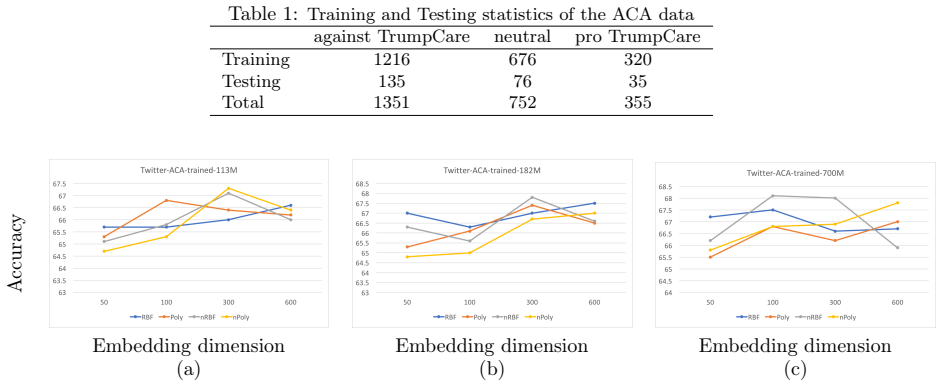
- [Section 4.2, Figure 3] The claim that negative sentiment toward 'TrumpCare' was consistently greater than neutral and positive sentiment is not supported by the evidence. The classifier was trained on a heavily imbalanced sample (1,351 against, 752 neutral, 355 pro, Table 1) and then applied to 26,604,224 unlabeled tweets from June-July 2017 without any held-out labels from that period, calibration, or class-prior correction. A cross-entropy-trained model tends to reproduce the training majority, so the aggregate curve in Figure 3 is expected to show a negative majority even without real signal. Using labels to build features is not by itself circular, but applying the fitted model to unlabeled data and interpreting its output as independent evidence of public opinion is not valid without target-period validation.
- [Tables 2 and 3] The reported accuracies are point estimates with no variance, confidence intervals, or significance tests. In Table 2 the margin between score embedding (69.4) and the best pre-trained word-vector baseline (68.1) is small, and in Table 3 the margin over CNN (46.0 vs 45.0) is even smaller; these differences could easily be noise. The claim that score embedding 'outperforms or is at least comparable to state-of-the-art methods' is therefore not established.
- [Section 3.2] The interpretability claim, that each embedding dimension 'indicates the association of each term with the corresponding class,' is asserted but never evaluated. Fine-tuning the initialized scores through backpropagation can change the values arbitrarily, and the paper provides no example vectors, no correlation analysis between final and initialized dimensions, and no human or quantitative evaluation of interpretability.
- [Sections 4.1 and 4.2] The training data were collected from March to July 2016, while the target corpus used for the time-series analysis is from June to July 2017, a period with substantial political and lexical shift. The paper itself notes that many collected tweets were unrelated and had to be filtered, which further increases distributional mismatch. No temporal validation set, no accuracy or calibration check on the target period, and no prevalence-adjusted baseline are reported, so the over-time finding is unvalidated.
- [Section 3.3 and 4.2] The experimental setup is not described in enough detail to assess or reproduce the results: the paper does not report the number of random restarts, the optimization settings, the regularization hyperparameters, or the model-selection procedure for the convolutional filters and dropout. Without this information, the reported accuracies cannot be distinguished from favorable runs over a large hyperparameter space.
minor comments (4)
- [Title page] There are typographical errors: 'Scool' should be 'School,' and 'introducescore' should be 'introduces score.'
- [Tables 2 and 3] The spelling 'paragh-vec' is inconsistent and should be corrected to 'paragraph-vec' or 'para2vec'; also 'Random Forrest' should be 'Random Forest.'
- [Figure 3] Figure 3 lacks axis labels and a clear numeric scale, which makes it difficult to interpret the claimed peaks and valleys in sentiment volume.
- [Section 2.2] The paper should clarify whether the scores in Equation 5 are computed on the training partition only or on the full labeled set; using the test labels for constructing scores would leak information.
Circularity Check
The TrumpCare sentiment time series is a projection of the fitted classifier's imbalanced training prior, while the benchmark evaluations remain independent.
-
fitted input called prediction
[Section 4.2 (Results, ACA application) and Table 1 (training split)]
"The score embedding classifier was applied to a subset of our ACA data from June to July 2017 with 26604224 tweets. After identifying the sentiment orientation of each tweet towards “TrumpCare”, then we aggregated the volume of each category over time (Figure 3). Interestingly our results show that, the negative sentiment towards “TrumpCare” consistently was greater than the neutral and positive sentiment over time."
This reported finding is not an independent measurement of public opinion: it is the output of a classifier fitted to a training sample in which 1216 of 2212 tweets (55%) are labeled against TrumpCare, 676 neutral, and 320 pro (Table 1). The model is trained on tweets collected March-July 2016 and applied to June-July 2017 tweets with no temporally matched validation, no calibration, and no class-prior correction. The aggregate volume curves in Figure 3 therefore largely reproduce the training prior rather than testing any hypothesis; the 'consistently greater negative' claim is a projection of the fitted classifier, statistically forced by the imbalanced labels.
full rationale
The benchmark portions of the paper are not circular: score embedding is evaluated with 5-fold cross-validation on ACA (Table 2) and on the external Stanford Sentiment Treebank (Table 3), where test labels are not used during training, so the accuracy comparisons are independent evidence. The interpretability of the embedding is largely definitional, since the initial dimensions are class-frequency scores from Eq. 5, but the paper does not use that definition to prove an external claim, so I do not count it as a circularity step. The only load-bearing circularity is the opinion-trend claim: the classifier is fitted to a negative-majority training set and then applied to millions of unlabeled tweets from a later period; the resulting aggregate curve is the classifier's own fitted output, not a separately validated measure of public sentiment. Because no validation on the target period, no prevalence or prior correction, and no baseline are reported, the 'consistently greater negative sentiment' result reduces to the training distribution of the fitted model. That warrants a partial-circularity score of 6; it does not invalidate the methodological comparisons, which are held out and externally benchmarked.
Assumptions & free parameters
free parameters (3)
- Number of convolutional filters =
128
- Filter window sizes =
3, 4, and 5
- Dropout rate
assumptions (3)
- domain assumption The hand-labeled 2,458-tweet sample is representative of the full ACA Twitter conversation.
- domain assumption The per-word class-frequency ratios of Eq. 5 capture the semantic association between a word and a sentiment class.
- domain assumption Convolutional neural networks with max-pooling are an appropriate text classification model for this task.
invented entities (1)
-
Score embedding
Cite this review
Pith. "Pith review of Twitter Sentiment on Affordable Care Act using Score Embedding." pith.science (2026). https://pith.science/paper/GDQSIDDT
@misc{pith2026190807061,
  author       = {Pith},
  title        = {Pith review of: Twitter Sentiment on Affordable Care Act using Score Embedding},
  year         = {2026},
  howpublished = {\url{https://pith.science/paper/GDQSIDDT}},
  note         = {Machine review of arXiv:1908.07061}
}
read the original abstract
In this paper we introduce score embedding, a neural network based model to learn interpretable vector representations for words. Score embedding is a supervised method that takes advantage of the labeled training data and the neural network architecture to learn interpretable representations for words. Health care has been a controversial issue between political parties in the United States. In this paper we use the discussions on Twitter regarding different issues of affordable care act to identify the public opinion about the existing health care plans using the proposed score embedding. Our results indicate our approach effectively incorporates the sentiment information and outperforms or is at least comparable to the state-of-the-art methods and the negative sentiment towards "TrumpCare" was consistently greater than neutral and positive sentiment over time.
Figures


Reference graph
Works this paper leans on
-
[1]
Sentiwordnet 3.0: an enhanced lex- ical resource for sentiment analysis and opinion mining
Stefano Baccianella, Andrea Esuli, and Fabrizio Sebastiani. Sentiwordnet 3.0: an enhanced lex- ical resource for sentiment analysis and opinion mining. In LREC, volume 10, 2010
work page 2010
-
[2]
On using twitter to monitor political sentiment and predict election results
Adam Bermingham and Alan Smeaton. On using twitter to monitor political sentiment and predict election results. In Proceedings of the Workshop on Sentiment Analysis where AI meets Psychology, 2011
work page 2011
-
[3]
From unlabelled tweets to twitter-specific opinion words
Felipe Bravo-Marquez, Eibe Frank, and Bern- hard Pfahringer. From unlabelled tweets to twitter-specific opinion words. In Proceedings of the 38th International ACM SIGIR Confer- ence on Research and Development in Informa- tion Retrieval. ACM, 2015
work page 2015
-
[4]
Natural language processing (almost) from scratch
Ronan Collobert, Jason Weston, Léon Bottou, Michael Karlen, Koray Kavukcuoglu, and Pavel Kuksa. Natural language processing (almost) from scratch. Journal of Machine Learning Re- search, 12(Aug), 2011
work page 2011
-
[5]
John Duchi, Elad Hazan, and Yoram Singer. Adaptive subgradient methods for online learn- ing and stochastic optimization.Journal of Ma- chine Learning Research, 12(Jul), 2011
work page 2011
-
[6]
Modeling customer satisfaction from unstructured data using a bayesian ap- proach
Mohsen Farhadloo, Raymond A Patterson, and Erik Rolland. Modeling customer satisfaction from unstructured data using a bayesian ap- proach. Decision Support Systems, 90, 2016
work page 2016
-
[7]
Multi- class sentiment analysis with clustering and score representation
Mohsen Farhadloo and Erik Rolland. Multi- class sentiment analysis with clustering and score representation. In Data Mining Work- shops, 2013 IEEE 13th International Conference on. IEEE, 2013
work page 2013
-
[8]
Funda- mentals of sentiment analysis and its applica- tions
Mohsen Farhadloo and Erik Rolland. Funda- mentals of sentiment analysis and its applica- tions. In Sentiment Analysis and Ontology En- gineering. Springer, 2016
work page 2016
Show all 31 references
-
[9]
A synopsis of linguistic theory, 1930-1955
John R Firth. A synopsis of linguistic theory, 1930-1955. Studies in linguistic analysis , 1957
1930
-
[10]
Modeling inter- estingness with deep neural networks, Decem- ber 17 2015
Jianfeng Gao, Li Deng, Michael Gamon, Xi- aodong He, and Patrick Pantel. Modeling inter- estingness with deep neural networks, Decem- ber 17 2015. US Patent App. 14/304,863
2015
-
[11]
Inducing domain- specific sentiment lexicons from unlabeled cor- pora
William L Hamilton, Kevin Clark, Jure Leskovec, and Dan Jurafsky. Inducing domain- specific sentiment lexicons from unlabeled cor- pora. arXiv preprint arXiv:1606.02820 , 2016
2016 arXiv
-
[12]
Mining and summa- rizing customer reviews
Minqing Hu and Bing Liu. Mining and summa- rizing customer reviews. In Proceedings of the tenth ACM SIGKDD . ACM, 2004
2004
-
[13]
Effective use of word order for text categorization with con- volutional neural networks
Rie Johnson and Tong Zhang. Effective use of word order for text categorization with con- volutional neural networks. arXiv preprint arXiv:1412.1058, 2014
2014 arXiv
-
[14]
Convolutional neural networks for sentence classification
Yoon Kim. Convolutional neural networks for sentence classification. InIn EMNLP. Citeseer, 2014
2014
-
[15]
Re-embedding words
Igor Labutov and Hod Lipson. Re-embedding words. In Proceedings of the 51st Annual Meet- ing of the ACL (Volume 2: Short Papers) , vol- ume 2, 2013
2013
-
[16]
Distributed repre- sentations of sentences and documents
Quoc Le and Tomas Mikolov. Distributed repre- sentations of sentences and documents. InPro- ceedings of the 31st International Conference on Machine Learning, 2014
2014
-
[17]
Gradient-based learning ap- plied to document recognition
Yann LeCun, Léon Bottou, Yoshua Bengio, and Patrick Haffner. Gradient-based learning ap- plied to document recognition. Proceedings of the IEEE, 86(11), 1998
1998
-
[18]
Learning word vectors for sentiment analysis
Andrew L Maas, Raymond E Daly, Peter T Pham, Dan Huang, Andrew Y Ng, and Christo- pher Potts. Learning word vectors for sentiment analysis. InProceedings of the 49th annual meet- ing of the ACL , 2011
2011
-
[19]
Efficient estimation of word rep- resentations in vector space
Tomas Mikolov, Kai Chen, Greg Corrado, and Jeffrey Dean. Efficient estimation of word rep- resentations in vector space. arXiv preprint arXiv:1301.3781, 2013
2013 arXiv
-
[20]
Distributed rep- resentationsofwordsandphrasesandtheircom- positionality
Tomas Mikolov, Ilya Sutskever, Kai Chen, Greg S Corrado, and Jeff Dean. Distributed rep- resentationsofwordsandphrasesandtheircom- positionality. InAdvances in neural information processing systems, 2013
2013
-
[21]
Wordnet: alexicaldatabasefor english
GeorgeAMiller. Wordnet: alexicaldatabasefor english. Communications of the ACM , 38(11), 1995
1995
-
[22]
Nrc-canada: Building the state- of-the-art in sentiment analysis of tweets.arXiv preprint arXiv:1308.6242, 2013
Saif M Mohammad, Svetlana Kiritchenko, and Xiaodan Zhu. Nrc-canada: Building the state- of-the-art in sentiment analysis of tweets.arXiv preprint arXiv:1308.6242, 2013
2013 arXiv
-
[23]
Opinion mining and sentiment analysis
Bo Pang, Lillian Lee, et al. Opinion mining and sentiment analysis. Foundations and Trends R© in Information Retrieval , 2(1–2), 2008
2008
-
[24]
Compass: Spatio temporal sentiment analysis of us election what twitter says! In Proceedings of the 23rd ACM SIGKDD
Debjyoti Paul, Feifei Li, Murali Krishna Teja, Xin Yu, and Richie Frost. Compass: Spatio temporal sentiment analysis of us election what twitter says! In Proceedings of the 23rd ACM SIGKDD. ACM, 2017
2017
-
[25]
Glove: Global vectors for word representation
Jeffrey Pennington, Richard Socher, and Christopher Manning. Glove: Global vectors for word representation. InProceedings of the 2014 conference on EMNLP, 2014. 8
2014
-
[26]
Semantic composi- tionalitythroughrecursivematrix-vectorspaces
Richard Socher, Brody Huval, Christopher D Manning, and Andrew Y Ng. Semantic composi- tionalitythroughrecursivematrix-vectorspaces. In Proceedings of the 2012 joint conference on EMNLP,pages1201–1211.AssociationforCom- putational Linguistics, 2012
2012
-
[27]
Semi-supervised recursive autoencoders for predicting sentiment distributions
Richard Socher, Jeffrey Pennington, Eric H Huang, Andrew Y Ng, and Christopher D Man- ning. Semi-supervised recursive autoencoders for predicting sentiment distributions. In Pro- ceedings of the conference on EMNLP , 2011
2011
-
[28]
Recursive deep models for semantic compositionality over a sentiment treebank
Richard Socher, Alex Perelygin, Jean Wu, Jason Chuang, Christopher D Manning, Andrew Ng, and Christopher Potts. Recursive deep models for semantic compositionality over a sentiment treebank. In Proceedings of the 2013 conference on EMNLP, 2013
2013
-
[29]
Learning sentiment- specific word embedding for twitter sentiment classification
Duyu Tang, Furu Wei, Nan Yang, Ming Zhou, Ting Liu, and Bing Qin. Learning sentiment- specific word embedding for twitter sentiment classification. InProceedings of the 52nd Annual Meeting of the ACL , volume 1, 2014
2014
-
[30]
# tagspace: Semantic embeddings from hash- tags
JasonWeston, SumitChopra, andKeithAdams. # tagspace: Semantic embeddings from hash- tags. In Proceedings of the 2014 Conference on EMNLP, 2014
2014
-
[31]
Com- positional matrix-space models for sentiment analysis
Ainur Yessenalina and Claire Cardie. Com- positional matrix-space models for sentiment analysis. In Proceedings of the Conference on EMNLP, pages 172–182. Association for Com- putational Linguistics, 2011. 9
2011
Reviewed August 14, 2026 · model on record in the stance chip above.
Discussion (0). Continue with ORCID to comment.