REVIEW 2 major objections 5 minor 1 cited by
Noncoherent MIMO Communications: Theoretical Foundation, Design Approaches, and Future Challenges
T0 review · 2 major / 5 minor · reviewed 2026-08-07 · deepseek-v4-flash
Pith's one-line read Three approaches cover CSI-free MIMO links: subspace, energy, and differential detection.
desk verdict A comprehensive and useful taxonomy of noncoherent MIMO, likely to become a standard entry point, but its comparative performance tables need an explicit caveat about heterogeneous source conditions. read the letter →
The pith
A machine-rendered reading of the paper's core claim, the machinery that carries it, and where it could break.
The reading
What carries the argument
The organizing device is the classification itself, built on three named objects: the Grassmann manifold $G(M,\mathbb{C}^T)$, the space of $M$-dimensional subspaces of $\mathbb{C}^T$, whose points are the codewords of subspace signaling; the energy statistic $(1/N)\sum_{n=1}^N |y_n|^2$, the squared received norm averaged over antennas that becomes a stable decision variable as $N$ grows; and differential encoding, where information is carried by a unitary rotation matrix between consecutive transmitted blocks. Each approach is tied to a structural invariant of the fading channel—subspace invariance, energy hardening, or smooth phase variation—and the survey maps those invariants to applicable channel models and antenna regimes.
What would settle it
A single standardized benchmark that evaluates Grassmannian, energy-based, and differential schemes under identical channel statistics, antenna counts, and SNR would settle whether the comparative guidance holds; for example, if an energy-based scheme with a moderate antenna array in an uncorrelated block-fading channel outperformed a Grassmannian scheme at the same spectral efficiency, the claimed regime separation would need revision.
Extended reading notes
Core claim
The central claim is that noncoherent MIMO communication is comprehensively understood through three CSI-free signal-recovery principles: Grassmannian signaling, which encodes information in the column space of the transmitted matrix because the unknown channel only rotates and scales that subspace; energy-based detection, which encodes information in the signal amplitude and relies on channel hardening across many receive antennas to stabilize the received energy; and differential detection, which encodes information in the transition between successive symbols, assuming the channel changes slowly enough that the rotation survives. The paper further claims these approaches have complementary applicability across channel models and system constraints, with each one best suited to a distinct regime of coherence time, antenna count, and channel statistics.
Load-bearing premise
The survey's comparative conclusions assume that performance numbers from different source papers, obtained under different channel models, antenna counts, SNR regimes, and detector complexities, can be juxtaposed directly without a single unified evaluation framework.
Editorial extensions
If this is right
- System designers can select a noncoherent approach by measuring three quantities: coherence time relative to symbol period and antenna count, receive-antenna count, and whether channel statistics are known and stable.
- Grassmannian signaling becomes the method of choice for block-fading channels with moderate antenna counts and moderate-to-high SNR, where pilots would consume too much of a short coherence interval.
- Energy-based detection provides a viable low-complexity, low-rate uplink for massive SIMO IoT scenarios where channel hardening is strong and power control is accurate.
- Differential detection is best suited to continuously varying channels with smooth phase evolution, and its OFDM-compatible subcarrier-domain variant enables latency-friendly noncoherent operation in high-mobility links.
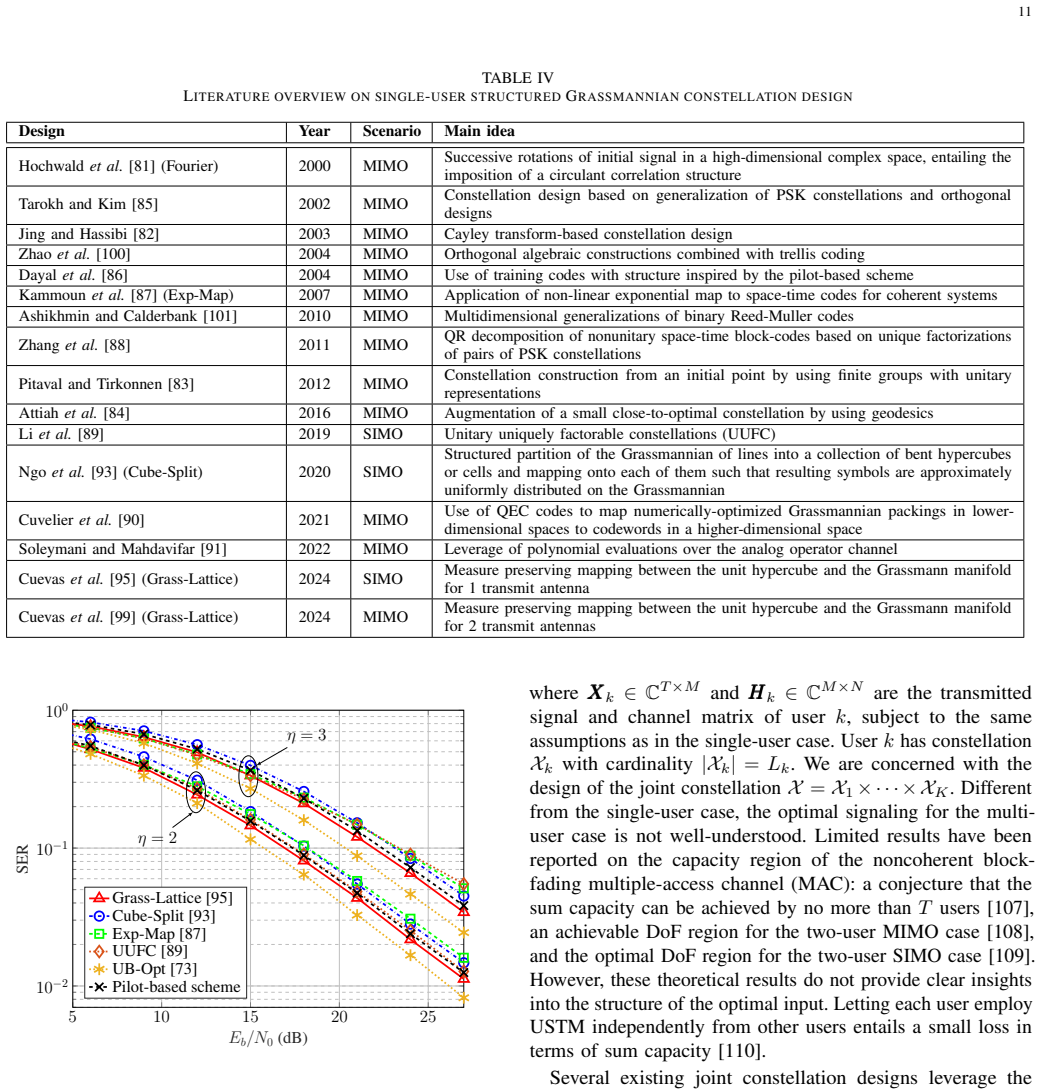
- Unstructured Grassmannian constellations are rate-limited to roughly below 1.5 bits/antenna/channel use by ML-detector complexity, while structured designs such as Cube-Split and Grass-Lattice extend practical operation to higher spectral efficiencies.
Reading between the lines
- The taxonomy suggests a natural testbed for hybrid designs: combining energy detection with differential phase encoding could cover regimes where neither hardening nor smooth phase variation alone is sufficient, an overlap the survey does not explore.
- Machine-learning-based detectors may blur the boundaries of the classification, since data-driven receivers can learn subspace, energy, and differential features simultaneously rather than committing to a single invariant.
- The survey's comparative tables could be sharpened into a single reproducible benchmark where all three approaches are evaluated under identical channel statistics, antenna counts, and SNR, which would transform the qualitative suitability claims into quantitative design rules.
- The zero-mean grassmannian fix (multiplying by a random binary sign) is a practical detail with broad consequence: it makes Grassmannian signaling compatible with AC-coupled front-ends, removing a hidden implementation barrier that could otherwise dominate error performance.
Editorial analysis
A structured set of objections, weighed in public.
Referee Report
Summary. The paper is a survey of noncoherent MIMO communication, organized around three CSI-free design approaches: subspace detection based on Grassmannian signaling, energy detection, and differential detection. For each approach the manuscript reviews the theoretical foundation, single-user and multi-user constellation design, and practical limitations. It also provides comparative discussions of OFDM compatibility, DC-component effects, hardware-impairment robustness, spectral efficiency, and user scalability, concluding with an outlook on machine learning, massive random access, RIS, ISAC, OTFS, and LPD communications. The central claim is that noncoherent schemes can be comprehensively classified into these three approaches and that the approaches are complementary across channel models and system constraints.
Significance. If the comparative layer is taken at face value, the survey would be a valuable single reference for the noncoherent MIMO area: it covers the classical information-theoretic foundations (Zheng–Tse, Marzetta–Hochwald, Hochwald–Sweldens) and a large body of design results in a common framework. The manuscript is unusually explicit about modeling assumptions (Table VIII), provides a self-contained tutorial on Grassmannian packing (Appendix A), and makes optimized packing tables publicly available (Appendix B with repository link), which are concrete strengths. The three-way taxonomy itself is well supported and useful. The main risk is not the taxonomy but the cross-approach comparative conclusions, which are built from heterogeneous source results without a common evaluation protocol.
major comments (2)
- [Section VI and Table IX] The comparative ratings in Table IX (spectral efficiency, scalability with number of users, HWI impact) are assembled from results obtained under different channel models, antenna counts, SNR regimes, detectors, and complexity assumptions. For example, the "Low" spectral efficiency for energy-based schemes is based on wideband capacity scaling results [133], while "High" for structured Grassmannian schemes is supported by uncoded SER/constellation-rate arguments in [73]; these are not commensurate metrics. Similarly, the "Poor" scalability entries are backed by different complexity arguments in [64], [113], [128], [129] for Grassmannian, in [131], [134] for energy-based, and in [149] for differential schemes, without a common definition of what "scalable" means. Because the abstract advertises "comparative insights into their suitability across different channel models and system constraints," and Fig. 2 plus Table IX are the concrete embodiment of that claim, this comparability problem is load-bearing. The authors should either provide a common evaluation protocol or clearly state, at the start of Section VI, that the comparison is qualitative and that the underlying studies are not directly commensurable.
- [Section I, first paragraph after the bullet list] The sentence "It has also been shown that noncoherent detection outperforms coherent detection, with the cost of pilot transmissions taken into account, in terms of ergodic capacity [12], finite-blocklength achievable rate [13], and error exponent [14]" is stated without the necessary regime qualifiers. The cited results are model-specific: [12] is a high-SNR block-fading result with short coherence, [13] concerns a specific finite-blocklength setting, and [14] addresses massive SIMO. As written, the sentence generalizes to arbitrary MIMO configurations, which is a stronger claim than the cited literature supports. The authors should either add the technical conditions (SNR regime, coherence-block length, antenna scaling) to this sentence, or move the claim to a passage where each citation's setup is made explicit.
minor comments (5)
- [Section V.B, Eq. (18)] The constellation condition X_i^H X_j = X_k implicitly requires the transmitted matrices to be square unitary (M x M), but the notation allows T x M with T not necessarily equal to M; please clarify that differential USTM operates on M x M unitary matrices and state how the group property is imposed.
- [Appendix B, Table XI] Decimal notation is inconsistent: some entries use a comma (0,983454) and others use a point (0.985761); please unify the decimal convention.
- [Appendix A and Table VII] There are several spelling errors: "Riemmanian" in the first paragraph of Appendix A, "Procrustres" instead of "Procrustes," "Howchald" in Table VII, and "Tirkonnen" should be "Tirkkonen."
- [Table IX, HWI row] The entry "High" for hardware-impairment impact on differential detection is difficult to reconcile with Section VI.C, which notes that differential schemes are relatively robust to phase noise; please label the row as overall sensitivity to HWIs or add a footnote distinguishing the impairment types.
- [Section VI.A] For the OFDM implementations of Grassmannian signaling, the text groups [151]–[153] together, but [153] is an over-the-air experimental study whereas [151] and [152] are design proposals; the difference in evaluation maturity should be stated.
Circularity Check
No significant circularity: the survey's taxonomy and theoretical foundations rest on external, non-self results, and its self-citations do not carry the load.
full rationale
This manuscript is a survey, not a derivation with fitted inputs, so the main circularity patterns (self-definition, fitted input renamed as prediction, equations reducing to their own inputs by construction) do not arise. The central classification of noncoherent MIMO schemes into Grassmannian/subspace, energy-based, and differential-detection approaches is presented descriptively, and the load-bearing theoretical benchmarks are imported from external, non-self works (e.g., Zheng and Tse [12], Hochwald and Marzetta [26], and Hassibi and Marzetta [27] for the near-optimality of unitary space-time modulation, and Manolakos, Chowdhury, and Goldsmith [33], [131] for energy-based scaling). The paper contains many self-citations, especially in the Grassmannian constellation-design sections and in the comparative Table IX, but these citations point to specific prior designs and numerical results by the authors; they are not invoked as a uniqueness theorem or as the sole justification for the survey's organizing premise. The cross-paper comparisons in Section VI and Table IX juxtapose results obtained under different channel models and assumptions without a common benchmark, which is a legitimate correctness/fairness limitation, but it is not a circular reduction because the comparative statements do not define their own evidence in terms of the conclusions. Overall, the survey's content is independently sourced and its comparative layer is a synthesis of existing literature rather than a self-referential derivation.
Assumptions & free parameters
assumptions (4)
- domain assumption The three-way classification (Grassmannian signaling, energy-based, differential detection) is exhaustive enough to represent the state of the art in noncoherent MIMO.
- domain assumption Performance claims from different cited papers are comparable under the survey's comparative framework.
- standard math The standard information-theoretic results for noncoherent block-fading channels (Zheng-Tse capacity, USTM optimality in the high-SNR regime) are correctly reported.
- standard math The manifold geometry facts in Appendix A (chordal, geodesic, Fubini-Study distances and packing bounds) are correctly summarized.
Cite this review
Pith. "Pith review of Noncoherent MIMO Communications: Theoretical Foundation, Design Approaches, and Future Challenges." pith.science (2026). https://pith.science/paper/GDZEDLFY
@misc{pith2026250523172,
  author       = {Pith},
  title        = {Pith review of: Noncoherent MIMO Communications: Theoretical Foundation, Design Approaches, and Future Challenges},
  year         = {2026},
  howpublished = {\url{https://pith.science/paper/GDZEDLFY}},
  note         = {Machine review of arXiv:2505.23172}
}
read the original abstract
Noncoherent communication is a promising paradigm for future wireless systems where acquiring accurate channel state information (CSI) is challenging or infeasible. It provides methods to bypass the need for explicit channel estimation in practical scenarios such as high-mobility networks, massive distributed antenna arrays, energy-constrained Internet-of-Things devices, and unstructured propagation environments. This survey provides a comprehensive overview of noncoherent communication strategies in multiple-input multiple-output (MIMO) systems, focusing on recent advances since the early 2000s. We classify noncoherent communication schemes into three main approaches where CSI-free signal recovery is based on subspace detection (i.e., Grassmannian signaling), differential detection, and energy detection, respectively. For each approach, we review the theoretical foundation and design methodologies. We also provide comparative insights into their suitability across different channel models and system constraints, highlighting application scenarios where noncoherent methods offer performance and scalability advantages over traditional coherent communication. Furthermore, we discuss practical considerations of noncoherent communication, including compatibility with orthogonal frequency division multiplexing (OFDM), resilience to hardware impairments, and scalability with the number of users. Finally, we provide an outlook on future challenges and research directions in designing robust and efficient noncoherent systems for next-generation wireless networks.
Figures


Figures from the paper (6 more)




Forward citations
Cited by 1 Pith paper
-
CSI-Free Symbol Detection for Atomic MIMO Receivers via In-Context Learning
A transformer trained by in-context learning directly maps pilot-response examples to data symbols for a linearized atomic MIMO measurement model, outperforming two optimization-based baselines in simulation.
Reference graph
Works this paper leans on
-
[133]
Capacity scaling in a non-coherent wideband massive SIMO block fading channel,
F. Gómez-Cuba, M. Chowdhury, A. Manolakos, E. Erkip, and A. J. Goldsmith, “Capacity scaling in a non-coherent wideband massive SIMO block fading channel,” IEEE Trans. Wireless Commun. , vol. 18, no. 12, pp. 5691–5704, Dec. 2019
work page 2019
-
[73]
Union bound minimization approach for designing Grassmannian constellations,
D. Cuevas, J. Álvarez Vizoso, C. Beltrán, I. Santamaria, V . Tu ˇcek, and G. Peters, “Union bound minimization approach for designing Grassmannian constellations,” IEEE Trans. Commun. , vol. 71, no. 4, pp. 1940–1952, Apr. 2023
1940
-
[64]
Joint constella- tion design for noncoherent MIMO multiple-access channels,
K.-H. Ngo, S. Yang, M. Guillaud, and A. Decurninge, “Joint constella- tion design for noncoherent MIMO multiple-access channels,” IEEE Trans. Inf. Theory, vol. 68, no. 11, pp. 7281–7305, Nov. 2022
2022
-
[113]
Constrained Riemannian noncoherent constellations for the MIMO multiple access channel,
J. Álvarez Vizoso, D. Cuevas, C. Beltrán, I. Santamaria, V . Tu ˇcek, and G. Peters, “Constrained Riemannian noncoherent constellations for the MIMO multiple access channel,” IEEE Trans. Inf. Theory, vol. 69, no. 7, pp. 4559–4578, Jul. 2023
2023
-
[128]
Codebook training for trellis-based hierarchical Grassmannian classification,
S. Schwarz and T. Tsiftsis, “Codebook training for trellis-based hierarchical Grassmannian classification,” IEEE Wireless Commun. Lett., vol. 11, no. 3, pp. 636–640, Mar. 2022
work page 2022
-
[129]
Approximate soft successive detection for Grassmannian product superposition coding,
S. Schwarz and M. Girsch, “Approximate soft successive detection for Grassmannian product superposition coding,” IEEE Commun. Lett. , vol. 27, no. 9, pp. 2274–2278, Sep. 2023
work page 2023
-
[131]
CSI is not needed for optimal scaling in multiuser massive SIMO systems,
A. Manolakos, M. Chowdhury, and A. J. Goldsmith, “CSI is not needed for optimal scaling in multiuser massive SIMO systems,” in Proc. IEEE Int. Symp. Inf. Theory (ISIT) , Jun. 2014, pp. 3117–3121
work page 2014
-
[134]
Constellation design in noncoherent massive SIMO systems,
A. Manolakos, M. Chowdhury, and A. J. Goldsmith, “Constellation design in noncoherent massive SIMO systems,” in Proc. IEEE Global Conf. Commun. (GLOBECOM) , Dec. 2014, pp. 3690–3695
work page 2014
-
[149]
Constellation design for multiuser non-coherent massive SIMO based on DMPSK modulation,
M. J. Lopez-Morales, K. Chen-Hu, A. García-Armada, and O. A. Dobre, “Constellation design for multiuser non-coherent massive SIMO based on DMPSK modulation,” IEEE Trans. Commun., vol. 70, no. 12, pp. 8181–8195, Dec. 2022
work page 2022
-
[12]
Communication on the Grassmann manifold: A geometric approach to the noncoherent multiple-antenna channel,
L. Zheng and D. N. C. Tse, “Communication on the Grassmann manifold: A geometric approach to the noncoherent multiple-antenna channel,” IEEE Trans. Inf. Theory , vol. 48, no. 2, pp. 359–383, Feb. 2002
2002
-
[13]
Short packets over block-memoryless fading channels: Pilot-assisted or noncoherent transmission?
J. Östman, G. Durisi, E. G. Ström, M. C. Coskun, and G. Liva, “Short packets over block-memoryless fading channels: Pilot-assisted or noncoherent transmission?” IEEE Trans. Commun. , vol. 67, no. 2, pp. 1521–1536, Feb. 2019
2019
-
[14]
Coherent versus noncoherent massive SIMO systems: Which has better performance?
M. Chowdhury, A. Manolakos, and A. J. Goldsmith, “Coherent versus noncoherent massive SIMO systems: Which has better performance?” in Proc. IEEE Int. Conf. Commun. (ICC) , London, UK, Jun. 2015, pp. 1691–1696. 25
2015
Show all 198 references
-
[1]
Capacity limits of MIMO channels,
A. Goldsmith, S. Jafar, N. Jindal, and S. Vishwanath, “Capacity limits of MIMO channels,” IEEE J. Sel. Areas Commun. , vol. 21, no. 5, pp. 684–702, Jun. 2003
2003
-
[2]
How much training is needed in multiple-antenna wireless links?
B. Hassibi and B. M. Hochwald, “How much training is needed in multiple-antenna wireless links?” IEEE Trans. Inf. Theory , vol. 49, no. 4, pp. 951–963, Apr. 2003
2003
-
[3]
Design and performance analysis of noncoherent detection systems with massive receiver arrays,
L. Jing, E. Carvalho, P. Popovski, and A. Oliveras Martinez, “Design and performance analysis of noncoherent detection systems with massive receiver arrays,” IEEE Trans. Signal Process. , vol. 64, no. 19, pp. 5000–5010, Oct. 2016
2016
-
[4]
T. L. Marzetta, E. G. Larsson, H. Yang, and H. Q. Ngo, Fundamentals of Massive MIMO . Cambridge University Press, 2016
2016
-
[5]
Synchronization in complex networks of phase oscillators: A survey,
F. Dörfler and F. Bullo, “Synchronization in complex networks of phase oscillators: A survey,” Automatica, vol. 50, no. 6, pp. 1539–1564, Jun. 2014
2014
-
[6]
Massive synchrony in distributed antenna systems,
E. G. Larsson, “Massive synchrony in distributed antenna systems,” IEEE Trans. Signal Process. , vol. 72, pp. 855–866, Jan. 2024
2024
-
[7]
Pilot contamination in massive MIMO communications,
A. Dey, P. Pattanayak, and D. Singh Gurjar, “Pilot contamination in massive MIMO communications,” in 5G and Beyond Wireless Systems: PHY Layer Perspective , M. Mandloi, D. Gurjar, P. Pattanayak, and H. Nguyen, Eds. Singapore: Springer, 2021, pp. 21–42. [Online]. Available: htt...
2021 doi
-
[8]
Ambient IoT: A missing link in 3GPP IoT devices landscape,
M. M. Butt, N. R. Mangalvedhe, N. K. Pratas, J. Harrebek, J. Kimionis, M. Tayyab, O.-E. Barbu, R. Ratasuk, and B. Vejlgaard, “Ambient IoT: A missing link in 3GPP IoT devices landscape,” IEEE Internet Things Mag., vol. 7, no. 2, pp. 85–92, Jan. 2024
2024
-
[9]
Adaptive coherent/non-coherent single/multiple-antenna aided channel coded ground-to-air aeronautical communication,
C. Xu, J. Zhang, T. Bai, P. Botsinis, R. G. Maunder, R. Zhang, and L. Hanzo, “Adaptive coherent/non-coherent single/multiple-antenna aided channel coded ground-to-air aeronautical communication,” IEEE Trans. Commun., vol. 67, no. 2, pp. 1099–1116, Feb. 2019
2019
-
[10]
Evaluation of polar-coded noncoherent acoustic underwa- ter communication,
V . Lidström, “Evaluation of polar-coded noncoherent acoustic underwa- ter communication,” IEEE J. Ocean. Eng. , vol. 50, no. 2, pp. 448–461, Apr. 2025
2025
-
[11]
A Generalized gaussian model for wire- less communications,
K.-H. Ngo and S. Yang, “A Generalized gaussian model for wire- less communications,” in Proc. IEEE Int. Symp. Inf. Theory (ISIT) , Melbourne, Australia, 2021, pp. 3237–3242
2021
-
[15]
Non- coherent MIMO communication for the 5th generation mobile: Overview and practical aspects,
S. Roger Varea, J. Cabrejas Peñuelas, D. Calabuig Soler, J. F. Mon- serrat del Río, Y . Fouad, R. H. Gohary, and H. Yanikomeroglu, “Non- coherent MIMO communication for the 5th generation mobile: Overview and practical aspects,” in Waves, vol. 6. Instituto de Telecomunicacione...
2014
-
[16]
Noncoherent MIMO signaling for block-fading channels: Approaches and challenges,
R. H. Gohary and H. Yanikomeroglu, “Noncoherent MIMO signaling for block-fading channels: Approaches and challenges,” IEEE Veh. Technol. Mag., vol. 14, no. 1, pp. 80–88, Mar. 2019
2019
-
[17]
Sixty years of coherent versus non-coherent tradeoffs and the road from 5G to wireless futures,
C. Xu, N. Ishikawa, R. Rajashekar, S. Sugiura, R. G. Maunder, Z. Wang, L.-L. Yang, and L. Hanzo, “Sixty years of coherent versus non-coherent tradeoffs and the road from 5G to wireless futures,” IEEE Access, vol. 7, pp. 178 246–178 299, Dec. 2019
2019
-
[18]
Non-coherent and backscatter communications: Enabling ultra- massive connectivity in 6G wireless networks,
S. J. Nawaz, S. K. Sharma, B. Mansoor, M. N. Patwary, and N. M. Khan, “Non-coherent and backscatter communications: Enabling ultra- massive connectivity in 6G wireless networks,” IEEE Access, vol. 9, pp. 38 144–38 186, Feb. 2021
2021
-
[19]
Multiple antenna systems in mobile 6G: Directional channels and robust signal processing,
S. Schwarz and S. Pratschner, “Multiple antenna systems in mobile 6G: Directional channels and robust signal processing,” IEEE Commun. Mag., vol. 61, no. 4, pp. 64–70, Apr. 2023
2023
-
[20]
Wireless chaos-based communication systems: A com- prehensive survey,
G. Kaddoum, “Wireless chaos-based communication systems: A com- prehensive survey,” IEEE Access, vol. 4, pp. 2621–2648, May 2016
2016
-
[21]
Massive MIMO for next generation wireless systems,
E. G. Larsson, O. Edfors, F. Tufvesson, and T. L. Marzetta, “Massive MIMO for next generation wireless systems,” IEEE Commun. Mag. , vol. 52, no. 2, pp. 186–195, Feb. 2014
2014
-
[22]
Massive MIMO: An introduction,
T. L. Marzetta, “Massive MIMO: An introduction,” Bell Labs Tech. J. , vol. 20, pp. 11–22, Mar. 2015
2015
-
[23]
Gigantic MIMO channel characterization: Challenges and enabling solutions,
M. Li, Z. Yuan, Y . Lyu, P. Kyösti, J. Zhang, and W. Fan, “Gigantic MIMO channel characterization: Challenges and enabling solutions,” IEEE Commun. Mag. , vol. 61, no. 10, pp. 140–146, Oct. 2023
2023
-
[24]
Enabling 6G performance in the upper mid-band by transitioning from massive to gigantic MIMO,
E. Björnson, F. Kara, N. Kolomvakis, A. Kosasih, P. Ramezani, and M. B. Salman, “Enabling 6G performance in the upper mid-band by transitioning from massive to gigantic MIMO,” Nov. 2024. [Online]. Available: https://arxiv.org/abs/2407.05630
2024 arXiv
-
[25]
Massive internet of things for industrial applications: Addressing wireless IIoT connectivity challenges and ecosystem frag- mentation,
S. Mumtaz, A. Alsohaily, Z. Pang, A. Rayes, K. F. Tsang, and J. Rodríguez, “Massive internet of things for industrial applications: Addressing wireless IIoT connectivity challenges and ecosystem frag- mentation,” IEEE Ind. Electron. Mag. , vol. 11, no. 1, pp. 28–33, Mar. 2017
2017
-
[26]
Unitary space-time modulation for multiple-antenna communications in Rayleigh flat fading,
B. M. Hochwald and T. L. Marzetta, “Unitary space-time modulation for multiple-antenna communications in Rayleigh flat fading,” IEEE Trans. Inf. Theory, vol. 46, no. 2, pp. 543–564, Mar. 2000
2000
-
[27]
Multiple-antennas and isotropically random unitary inputs: The received signal density in closed form,
B. Hassibi and T. L. Marzetta, “Multiple-antennas and isotropically random unitary inputs: The received signal density in closed form,” IEEE Trans. Inf. Theory , vol. 48, no. 6, pp. 1473–1484, Jun. 2002
2002
-
[28]
Quadratic detection in noncoherent massive SIMO systems over correlated channels,
M. Vilà-Insa, A. Martí, J. Riba, and M. Lamarca, “Quadratic detection in noncoherent massive SIMO systems over correlated channels,” IEEE Trans. Wireless Commun., vol. 23, no. 10, pp. 14 259–14 272, Oct. 2024
2024
-
[29]
Optimal multilevel ASK with noncoherent diversity reception in uncorrelated nonidentical and correlated Rayleigh fading,
R. K. Mallik, R. D. Murch, S. P. Dash, and S. K. Mohammed, “Optimal multilevel ASK with noncoherent diversity reception in uncorrelated nonidentical and correlated Rayleigh fading,” IEEE Trans. Commun., vol. 64, no. 5, pp. 2204–2219, May 2016
2016
-
[30]
Constellation design for energy- based noncoherent massive SIMO systems over correlated channels,
W. Han, Z. Dong, H. Chen, and X. Gao, “Constellation design for energy- based noncoherent massive SIMO systems over correlated channels,” IEEE Wireless Commun. Lett. , vol. 11, no. 10, pp. 2165–2169, Oct. 2022
2022
-
[31]
Non-coherent massive MIMO systems: A constellation design approach,
H. Xie, W. Xu, H. Q. Ngo, and B. Li, “Non-coherent massive MIMO systems: A constellation design approach,” IEEE Trans. Wireless Commun., vol. 19, no. 6, pp. 3812–3825, Jun. 2020
2020
-
[32]
Energy- efficient and low-latency massive SIMO using noncoherent ML detection for industrial IoT communications,
X.-C. Gao, J.-K. Zhang, H. Chen, Z. Dong, and B. Vucetic, “Energy- efficient and low-latency massive SIMO using noncoherent ML detection for industrial IoT communications,” IEEE Internet Things J. , vol. 6, no. 4, pp. 6247–6261, Aug. 2019
2019
-
[33]
Energy-based modulation for noncoherent massive SIMO systems,
A. Manolakos, M. Chowdhury, and A. Goldsmith, “Energy-based modulation for noncoherent massive SIMO systems,” IEEE Trans. Wireless Commun., vol. 15, no. 11, pp. 7831–7846, Nov. 2016
2016
-
[34]
Kay, Fundamentals of Statistical Signal Processing, Volume II: Detection Theory
S. Kay, Fundamentals of Statistical Signal Processing, Volume II: Detection Theory. Upper Saddle River, NJ: Prentice Hall, 1998
1998
-
[35]
Cognitive radio techniques under practical imperfections: A survey,
S. K. Sharma, T. E. Bogale, S. Chatzinotas, B. Ottersten, L. B. Le, and X. Wang, “Cognitive radio techniques under practical imperfections: A survey,” IEEE Commun. Surv. Tutor. , vol. 17, no. 4, pp. 1858–1884, Jul. 2015
2015
-
[36]
A noncoherent multiuser large-scale SIMO system relying on M-ary DPSK and BICM-ID,
V . Monzón Baeza, A. García-Armada, W. Zhang, M. El-Hajjar, and L. Hanzo, “A noncoherent multiuser large-scale SIMO system relying on M-ary DPSK and BICM-ID,” IEEE Trans. Veh. Technol., vol. 67, no. 2, pp. 1809–1814, Feb. 2018
2018
-
[37]
Non-coherent massive SIMO system based on M-DPSK for Rician channels,
V . Monzón Baeza and A. García-Armada, “Non-coherent massive SIMO system based on M-DPSK for Rician channels,” IEEE Trans. Veh. Technol., vol. 68, no. 3, pp. 2413–2426, Mar. 2019
2019
-
[38]
Repre- sentation theory for high-rate multiple-antenna code designs,
A. Shokrollahi, B. Hassibi, M. Hochwald, and W. Sweldens, “Repre- sentation theory for high-rate multiple-antenna code designs,” IEEE Trans. Inf. Theory, vol. 47, no. 6, pp. 2335–2367, Sep. 2001
2001
-
[39]
Noncoherent massive MIMO,
V . Monzón Baeza and A. García-Armada, “Noncoherent massive MIMO,” Wiley 5G Ref: The Essential 5G Reference Online , pp. 1– 28, 2019
2019
-
[40]
Differential unitary space-time modulation,
B. Hochwald and W. Sweldens, “Differential unitary space-time modulation,” IEEE Trans. Commun., vol. 48, no. 12, pp. 2041–2052, Dec. 2000
2000
-
[41]
Differential space-time modulation,
B. L. Hughes, “Differential space-time modulation,” IEEE Trans. Inf. Theory, vol. 46, no. 7, pp. 2567–2578, Nov. 2000
2000
-
[42]
Mutual information of IID complex Gaussian signals on block Rayleigh-faded channels,
F. Rusek, A. Lozano, and N. Jindal, “Mutual information of IID complex Gaussian signals on block Rayleigh-faded channels,” IEEE Trans. Inf. Theory, vol. 58, no. 1, pp. 331–340, Jan. 2012
2012
-
[43]
Closed-form output statistics of MIMO block-fading channels,
G. Alfano, C. Chiasserini, A. Nordio, and S. Zhou, “Closed-form output statistics of MIMO block-fading channels,” IEEE Trans. Inf. Theory , vol. 60, no. 12, pp. 7782–7797, Dec. 2014
2014
-
[44]
On the capacity of large-MIMO block-fading channels,
W. Yang, G. Durisi, and E. Riegler, “On the capacity of large-MIMO block-fading channels,” IEEE J. Sel. Areas Commun. , vol. 31, no. 2, pp. 117–132, Feb. 2013
2013
-
[45]
Capacity of a mobile multiple- antenna communication link in Rayleigh flat fading,
T. L. Marzetta and B. M. Hochwald, “Capacity of a mobile multiple- antenna communication link in Rayleigh flat fading,” IEEE Trans. Inf. Theory, vol. 45, no. 1, pp. 139–157, Jan. 1999
1999
-
[46]
Channel coding rate in the finite blocklength regime,
Y . Polyanskiy, H. V . Poor, and S. Verdu, “Channel coding rate in the finite blocklength regime,” IEEE Trans. Inf. Theory , vol. 56, no. 5, pp. 2307–2359, May 2010
2010
-
[47]
Toward massive, ultrareliable, and low-latency wireless communication with short packets,
G. Durisi, T. Koch, and P. Popovski, “Toward massive, ultrareliable, and low-latency wireless communication with short packets,” Proc. IEEE, vol. 104, no. 9, pp. 1711–1726, Aug. 2016
2016
-
[48]
Short- packet communications over multiple-antenna Rayleigh-fading channels,
G. Durisi, T. Koch, J. Östman, Y . Polyanskiy, and W. Yang, “Short- packet communications over multiple-antenna Rayleigh-fading channels,” IEEE Trans. Commun. , vol. 64, no. 2, pp. 618–629, Feb. 2016
2016
-
[49]
On single-antenna Rayleigh block- fading channels at finite blocklength,
A. Lancho, T. Koch, and G. Durisi, “On single-antenna Rayleigh block- fading channels at finite blocklength,” IEEE Trans. Inf. Theory , vol. 66, no. 1, pp. 496–519, Jan. 2020
2020
-
[50]
On noncoherent multiple-antenna Rayleigh block-fading channels at finite blocklength,
C. Qi and T. Koch, “On noncoherent multiple-antenna Rayleigh block-fading channels at finite blocklength,” Mar. 2025. [Online]. Available: https://arxiv.org/abs/2503.01504
2025
-
[51]
Saddlepoint approximations for short-packet wireless communications,
A. Lancho, J. Östman, G. Durisi, T. Koch, and G. Vazquez-Vilar, “Saddlepoint approximations for short-packet wireless communications,” IEEE Trans. Wireless Commun. , vol. 19, no. 7, pp. 4831–4846, Jul. 2020
2020
-
[52]
A multiple access scheme for non-coherent SIMO communications,
K.-H. Ngo, A. Decurninge, M. Guillaud, and S. Yang, “A multiple access scheme for non-coherent SIMO communications,” in Proc. Asilomar Conf. Signals Syst. Comput. , CA, USA, Oct. 2018, pp. 1846–1850
2018
-
[53]
Multiple-antenna signal constellations for fading channels,
D. Agrawal, T. J. Richardson, and R. L. Urbanke, “Multiple-antenna signal constellations for fading channels,” IEEE Trans. Inf. Theory , vol. 47, no. 6, pp. 2618–2626, Sep. 2001
2001
-
[54]
Advanced Grassmannian constellation designs for non- coherent MIMO communications,
D. Cuevas, “Advanced Grassmannian constellation designs for non- coherent MIMO communications,” Ph.D. dissertation, Universidad de Cantabria, Spain, Nov. 2024, software available at https://github.com/ diegocuevasfdez/grassbox/
2024
-
[55]
The closest packing of spherical caps in n dimensions,
R. A. Rankin, “The closest packing of spherical caps in n dimensions,” Proc. Glasgow Math. Assoc. , vol. 2, no. 3, p. 139–144, Jul. 1955
1955
-
[56]
Packing lines, planes, etc.: packings in Grassmannian spaces,
J. H. Conway, R. H. Hardin, and N. J. A. Sloane, “Packing lines, planes, etc.: packings in Grassmannian spaces,” Experiment. Math., vol. 5, no. 2, pp. 139–159, 1996
1996
-
[57]
Bounds on packings of spheres in the Grassmann manifold,
A. Barg and D. Y . Nogin, “Bounds on packings of spheres in the Grassmann manifold,” IEEE Trans. Inf. Theory, vol. 48, pp. 2450–2454, Sep. 2002
2002
-
[58]
Sphere-packing bounds in the Grassmann and Stiefel manifolds,
O. Henkel, “Sphere-packing bounds in the Grassmann and Stiefel manifolds,” IEEE Trans. Inf. Theory , vol. 51, no. 10, pp. 3445–3456, Oct. 2005
2005
-
[59]
Quantization bounds on Grassmann manifolds and applications to MIMO communications,
W. Dai, Y . Liu, and B. Rider, “Quantization bounds on Grassmann manifolds and applications to MIMO communications,” IEEE Trans. Inf. Theory, vol. 54, no. 3, pp. 1108–1123, Mar. 2008
2008
-
[60]
Asymptotic error probability analysis of quadratic receivers in Rayleigh-fading channels with applications to a unified analysis of coherent and noncoherent space-time receivers,
M. Brehler and M. K. Varanasi, “Asymptotic error probability analysis of quadratic receivers in Rayleigh-fading channels with applications to a unified analysis of coherent and noncoherent space-time receivers,” IEEE Trans. Inf. Theory , vol. 47, no. 6, pp. 2383–2399, Sep. 2001
2001
-
[61]
Signal design and convolutional coding for noncoherent space-time communication on the block-Rayleigh-fading channel,
M. L. McCloud, M. Brehler, and M. K. Varanasi, “Signal design and convolutional coding for noncoherent space-time communication on the block-Rayleigh-fading channel,” IEEE Trans. Inf. Theory , vol. 48, no. 5, pp. 1186–1194, May 2002. 26
2002
-
[62]
Coherence-based subspace packings for MIMO noncoherent communications,
J. Álvarez Vizoso, D. Cuevas, C. Beltrán, I. Santamaria, V . Tu ˇcek, and G. Peters, “Coherence-based subspace packings for MIMO noncoherent communications,” in Proc. Eur. Signal Process. Conf. (EUSIPCO) , Belgrade, Serbia, Aug. 2022, pp. 1906–1910
2022
-
[63]
On design criteria and construction of noncoherent space-time constellations,
M. J. Borran, A. Sabharwal, and B. Aazhang, “On design criteria and construction of noncoherent space-time constellations,” IEEE Trans. Inf. Theory, vol. 49, no. 10, pp. 2332–2351, Oct. 2003
2003
-
[65]
Noncoherent MIMO communication: Grassmannian constellations and efficient detection,
R. H. Gohary and T. N. Davidson, “Noncoherent MIMO communication: Grassmannian constellations and efficient detection,” IEEE Trans. Inf. Theory, vol. 55, no. 3, pp. 1176–1205, Mar. 2009
2009
-
[66]
Grassmannian constellation based on antipodal points and orthogonal design and its simplified detecting algorithm,
L. Peng, D. Hu, L. Zhang, and Z. Qin, “Grassmannian constellation based on antipodal points and orthogonal design and its simplified detecting algorithm,” J. Comput. Netw. Commun. , vol. 2017, Apr. 2017
2017
-
[67]
Noncoherent communication in multiple-antenna systems: Receiver design and codebook construc- tion,
M. Beko, J. Xavier, and V . A. N. Barroso, “Noncoherent communication in multiple-antenna systems: Receiver design and codebook construc- tion,” IEEE Trans. Signal Process. , vol. 55, no. 12, pp. 5703–5715, Dec. 2007
2007
-
[68]
Construct- ing packings in Grassmannian manifolds via alternating projection,
I. S. Dhillon, J. R. Heath, T. Strohmer, and J. A. Tropp, “Construct- ing packings in Grassmannian manifolds via alternating projection,” Experiment. Math., vol. 17, no. 1, pp. 9–35, Jan. 2008
2008
-
[69]
Unitary space-time constellation design based on the Chernoff bound of the pairwise error probability,
Y . Wu, K. Ruotsalainen, and M. Juntti, “Unitary space-time constellation design based on the Chernoff bound of the pairwise error probability,” IEEE Trans. Inf. Theory , vol. 54, no. 8, pp. 3842–3850, Aug. 2008
2008
-
[70]
Geometrical and numerical design of structured unitary space–time constellations,
G. Han and J. Rosenthal, “Geometrical and numerical design of structured unitary space–time constellations,” IEEE Trans. Inf. Theory , vol. 52, no. 8, pp. 3722–3735, Aug. 2006
2006
-
[71]
Constructing Grassmannian frames by an iterative collision-based packing,
B. Tahir, S. Schwarz, and M. Rupp, “Constructing Grassmannian frames by an iterative collision-based packing,” IEEE Signal Process. Lett. , vol. 26, no. 7, pp. 1056–1060, Jul. 2019
2019
-
[72]
A fast algorithm for designing Grassmannian constellations,
D. Cuevas, C. Beltran, I. Santamaria, V . Tucek, and G. Peters, “A fast algorithm for designing Grassmannian constellations,” in Proc. Int. ITG Workshop Smart Anten. (WSA) , French Riviera, France, Nov. 2021
2021
-
[74]
Grassmannian packings: Trust- region stochastic tuning for matrix incoherences,
J. Park, C. Saltijeral, and M. Zhong, “Grassmannian packings: Trust- region stochastic tuning for matrix incoherences,” in Proc. Allerton Conf. Commun. Control Comput (Allerton) , Monticello, IL, USA, Jul. 2022
2022
-
[75]
Grassmannian constellation design for noncoherent MIMO systems using autoencoders,
X. Fu and D. L. Ruyet, “Grassmannian constellation design for noncoherent MIMO systems using autoencoders,” Sep. 2021. [Online]. Available: https://arxiv.org/abs/2109.00621
2021 arXiv
-
[76]
On deep learning techniques for noncoherent MIMO systems,
X. Fu and D. Le Ruyet, “On deep learning techniques for noncoherent MIMO systems,” in Proc. Int. ITG Workshop Smart Anten. (WSA) , French Riviera, France, Nov. 2021, pp. 1–6
2021
-
[77]
Deep neural network based reduced-complexity detector for Grassmann constellation,
R. Baba, H. Iimori, C. Pradhan, S. Malomsoky, and N. Ishikawa, “Deep neural network based reduced-complexity detector for Grassmann constellation,” in Proc. IEEE Veh. Tech. Conf. (VTC) , Washington, DC, USA, Oct. 2024
2024
-
[78]
Boosting spectral efficiency with data-carrying reference signals on the Grassmann manifold,
N. Endo, H. Iimori, C. Pradhan, S. Malomsoky, and N. Ishikawa, “Boosting spectral efficiency with data-carrying reference signals on the Grassmann manifold,” IEEE Trans. Wireless Commun. , vol. 23, no. 8, pp. 10 137–10 149, Aug. 2024
2024
-
[79]
Maximizing spectrum efficiency of data-carrying reference signals via Bayesian optimization,
T. Kato, H. Iimori, C. Pradhan, S. Malomsoky, and N. Ishikawa, “Maximizing spectrum efficiency of data-carrying reference signals via Bayesian optimization,” IEEE Open J. Commun. Soc. , vol. 6, pp. 3892–3903, Apr. 2025
2025
-
[80]
Hardware impairments-aware design of noncoherent Grassmannian constellations,
D. Cuevas, J. Álvarez Vizoso, M. Gutiérrez, I. Santamaría, V . Tucek, and G. Peters, “Hardware impairments-aware design of noncoherent Grassmannian constellations,” in Proc. Int. Conf. Acoust. Speech Signal Process. (ICASSP), Seoul, Korea, Apr. 2024, pp. 9086–9090
2024
-
[81]
Systematic design of unitary space-time constellations,
B. M. Hochwald, T. L. Marzetta, T. J. Richardson, W. Sweldens, and R. Urbanke, “Systematic design of unitary space-time constellations,” IEEE Trans. Inf. Theory , vol. 46, no. 6, pp. 1962–1973, Sep. 2000
1962
-
[82]
Unitary space-time modulation via Cayley transform,
Y . Jing and B. Hassibi, “Unitary space-time modulation via Cayley transform,” IEEE Trans. Signal Process., vol. 51, no. 11, pp. 2891–2904, Nov. 2003
2003
-
[83]
Grassmannian packings from orbits of projective group representations,
R. Pitaval and O. Tirkkonen, “Grassmannian packings from orbits of projective group representations,” in Proc. Asilomar Conf. Signals Syst. Comput., Pacific Grove, CA, USA, Nov. 2012, pp. 478–482
2012
-
[84]
A sys- tematic design approach for non-coherent Grassmannian constellations,
K. M. Attiah, K. Seddik, R. H. Gohary, and H. Yanikomeroglu, “A sys- tematic design approach for non-coherent Grassmannian constellations,” in Proc. IEEE Int. Symp. Inf. Theory (ISIT) , Jul. 2016, pp. 2948–2952
2016
-
[85]
Existence and construction of noncoherent unitary space-time codes,
V . Tarokh and I.-M. Kim, “Existence and construction of noncoherent unitary space-time codes,” IEEE Trans. Inf. Theory , vol. 48, no. 12, pp. 3112–3117, Dec. 2002
2002
-
[86]
Leveraging coherent space- time codes for noncoherent communication via training,
P. Dayal, M. Brehler, and M. K. Varanasi, “Leveraging coherent space- time codes for noncoherent communication via training,” IEEE Trans. Inf. Theory, vol. 50, no. 9, pp. 2058–2080, Sep. 2004
2004
-
[87]
Non-coherent codes over the Grassmannian,
I. Kammoun, A. M. Cipriano, and J. C. Belfiore, “Non-coherent codes over the Grassmannian,” IEEE Trans. Wireless Commun., vol. 6, no. 10, pp. 3657–3667, Oct. 2007
2007
-
[88]
Full diversity blind space-time block codes,
J. Zhang, F. Huang, and S. Ma, “Full diversity blind space-time block codes,” IEEE Trans. Inf. Theory , vol. 57, no. 9, pp. 6109–6133, Sep. 2011
2011
-
[89]
Design of optimal noncoherent constellations for SIMO systems,
S. Li, J.-K. Zhang, and X. Mu, “Design of optimal noncoherent constellations for SIMO systems,” IEEE Trans. Commun. , vol. 67, pp. 5706–5720, Aug. 2019
2019
-
[90]
Quantum codes in classical communication: A space-time block code from quantum error correction,
T. C. Cuvelier, S. A. Lanham, B. R. L. Cour, and R. W. Heath, “Quantum codes in classical communication: A space-time block code from quantum error correction,” IEEE Open J. Commun. Soc. , vol. 2, pp. 2383–2412, Nov. 2021
2021
-
[91]
Analog subspace coding: A new approach to coding for non-coherent wireless networks,
M. Soleymani and H. Mahdavifar, “Analog subspace coding: A new approach to coding for non-coherent wireless networks,” IEEE Trans. Inf. Theory, vol. 68, no. 4, pp. 2349–2364, Apr. 2022
2022
-
[92]
Coding for errors and erasures in random network coding,
R. Koetter and F. R. Kschischang, “Coding for errors and erasures in random network coding,” IEEE Trans. Inf. Theory , vol. 54, no. 8, pp. 3579–3591, Aug. 2008
2008
-
[93]
Cube-split: A structured Grassmannian constellation for non-coherent SIMO communications,
K.-H. Ngo, A. Decurninge, M. Guillaud, and S. Yang, “Cube-split: A structured Grassmannian constellation for non-coherent SIMO communications,” IEEE Trans. Wireless Commun., vol. 19, no. 3, pp. 1948–1964, Mar. 2020
1948
-
[94]
A measure preserving mapping for structured Grassmannian constellations in SIMO channels,
D. Cuevas, J. Alvarez-Vizoso, C. Beltrán, I. Santamaria, V . Tucek, and G. Peters, “A measure preserving mapping for structured Grassmannian constellations in SIMO channels,” in Proc. IEEE Global Conf. Commun. (GLOBECOM), Rio de Janeiro, Brazil, Dec. 2022, pp. 2394–2399
2022
-
[95]
Constellations on the sphere with efficient encoding-decoding for noncoherent communications,
D. Cuevas, J. Álvarez Vizoso, C. Beltrán, I. Santamaria, V . Tu ˇcek, and G. Peters, “Constellations on the sphere with efficient encoding-decoding for noncoherent communications,” IEEE Trans. Wireless Commun. , vol. 23, no. 3, pp. 1886–1898, Mar. 2024
2024
-
[96]
Measure-preserving mappings from the unit cube to some symmetric spaces,
C. Beltrán, D. Ferizovi ´c, and P. R. López-Gómez, “Measure-preserving mappings from the unit cube to some symmetric spaces,” J. Approx. Theory, vol. 308, p. 106145, Jun. 2025
2025
-
[97]
An elementary introduction to the Hopf fibration,
D. W. Lyons, “An elementary introduction to the Hopf fibration,” Math. Mag., vol. 76, pp. 87–98, Apr. 2003
2003
-
[98]
Stable embedding of Grassmann manifold via Gaussian random matrices,
H. Shi, H. Zhang, G. Li, and X. Wang, “Stable embedding of Grassmann manifold via Gaussian random matrices,” IEEE Trans. Inf. Theory , vol. 61, no. 5, pp. 2924–2941, May 2015
2015
-
[99]
Structured multi-antenna Grassmannian constellations for noncoherent communications,
D. Cuevas, C. Beltrán, M. Gutiérrez, I. Santamaria, and V . Tu ˇcek, “Structured multi-antenna Grassmannian constellations for noncoherent communications,” in Proc. IEEE Sens. Array Multichannel Signal Process. Workshop (SAM), Corvallis (OR), USA, Jul. 2024
2024
-
[100]
Orthogonal design of unitary constellations for uncoded and trellis-coded noncoherent space-time systems,
W. Zhao, G. Leus, and G. B. Giannakis, “Orthogonal design of unitary constellations for uncoded and trellis-coded noncoherent space-time systems,” IEEE Trans. Inf. Theory , vol. 50, no. 6, pp. 1319–1327, Jun. 2004
2004
-
[101]
Grassmannian packings from operator Reed–Muller codes,
A. Ashikhmin and A. R. Calderbank, “Grassmannian packings from operator Reed–Muller codes,” IEEE Trans. Inf. Theory , vol. 56, no. 11, pp. 5689–5714, Nov. 2010
2010
-
[102]
Coded unitary space-time modulation with iterative decoding: Error performance and mapping design,
N. H. Tran, H. H. Nguyen, and T. Le-Ngoc, “Coded unitary space-time modulation with iterative decoding: Error performance and mapping design,” IEEE Trans. Commun., vol. 55, no. 4, pp. 703–716, Apr. 2007
2007
-
[103]
Structured quasi-Gray labelling for Reed- Muller Grassmannian constellations,
Y . Qin and R.-A. Pitaval, “Structured quasi-Gray labelling for Reed- Muller Grassmannian constellations,” in Proc. IEEE Int. Symp. Inf. Theory (ISIT), Los Angeles, CA, USA, Jun. 2020, pp. 1444–1449
2020
-
[104]
Constellation mapping for space-time matrix mod- ulation with iterative demodulation/decoding,
Y . Li and X.-G. Xia, “Constellation mapping for space-time matrix mod- ulation with iterative demodulation/decoding,” IEEE Trans. Commun. , vol. 53, no. 5, pp. 764–768, May 2005
2005
-
[105]
Quasi-Gray labelling for Grassmannian constellations,
G. W. K. Colman, R. H. Gohary, M. A. El-Azizy, T. J. Willink, and T. N. Davidson, “Quasi-Gray labelling for Grassmannian constellations,” IEEE Trans. Wireless Commun., vol. 10, no. 2, pp. 626–636, Feb. 2011
2011
-
[106]
Neighborhood preserving codes for assigning point labels: Applications to stochastic search,
S. Baluja and M. Covell, “Neighborhood preserving codes for assigning point labels: Applications to stochastic search,” in Proc. Int. Conf. Comput. Science (CCS) , Jun. 2013, pp. 956–965
2013
-
[107]
Multiuser capacity in block fading with no channel state information,
S. Shamai and T. L. Marzetta, “Multiuser capacity in block fading with no channel state information,” IEEE Trans. Inf. Theory , vol. 48, no. 4, pp. 938–942, Apr. 2002
2002
-
[108]
An achievable pre-log region for the non-coherent block fading MIMO multiple access channel,
Z. Utkovski, D. Ilik, and L. Kocarev, “An achievable pre-log region for the non-coherent block fading MIMO multiple access channel,” in Proc. Int. Symp. Wireless Commun. Syst. (ISWCS) , Aug. 2013. 27
2013
-
[109]
The optimal DoF region for the two-user non-coherent SIMO multiple-access channel,
K.-H. Ngo, S. Yang, and M. Guillaud, “The optimal DoF region for the two-user non-coherent SIMO multiple-access channel,” in Proc. IEEE Inf. Theory Workshop (ITW) , Guangzhou, China, Nov. 2018
2018
-
[110]
Finite-SNR bounds on the sum-rate capacity of rayleigh block-fading multiple-access channels with no a priori CSI,
R. Devassy, G. Durisi, J. Östman, W. Yang, T. Eftimov, and Z. Utkovski, “Finite-SNR bounds on the sum-rate capacity of rayleigh block-fading multiple-access channels with no a priori CSI,” IEEE Trans. Commun. , vol. 63, no. 10, pp. 3621–3632, Oct. 2015
2015
-
[111]
The Grassmannian- codebook based non-coherent multiple access for massive connections,
Y . Li, C. Li, X. He, Y . Zhang, and G. Wu, “The Grassmannian- codebook based non-coherent multiple access for massive connections,” in IEEE/CIC Int. Conf. Commun (ICCC) , Jul. 2021, pp. 189–194
2021
-
[112]
Noncoherent multiuser space-time communications: Optimum receivers and signal design,
M. Brehler and M. K. Varanasi, “Noncoherent multiuser space-time communications: Optimum receivers and signal design,” in Proc. Conf. Inf. Science Sys. (CISS) . The Johns Hopkins University, Mar. 2001, pp. 379–383
2001
-
[114]
Multi- user detection based on expectation propagation for the non-coherent SIMO multiple access channel,
K.-H. Ngo, M. Guillaud, A. Decurninge, S. Yang, and P. Schniter, “Multi- user detection based on expectation propagation for the non-coherent SIMO multiple access channel,” IEEE Trans. Wireless Commun., vol. 19, no. 9, pp. 6145–6161, Sep. 2020
2020
-
[115]
End-to-end learning for uplink MU-SIMO joint transmitter and non-coherent receiver design in fading channels,
S. Xue, Y . Ma, and N. Yi, “End-to-end learning for uplink MU-SIMO joint transmitter and non-coherent receiver design in fading channels,” IEEE Trans. Wireless Commun. , vol. 20, no. 9, pp. 5531–5542, Sep. 2021
2021
-
[116]
Rate-splitting multiple access: Fundamentals, survey, and future research trends,
Y . Mao, O. Dizdar, B. Clerckx, R. Schober, P. Popovski, and H. V . Poor, “Rate-splitting multiple access: Fundamentals, survey, and future research trends,” IEEE Commun. Surv. Tutor., vol. 24, no. 4, pp. 2073– 2126, Jul. 2022
2022
-
[117]
A rate splitting strategy for massive MIMO with imperfect CSIT,
M. Dai, B. Clerckx, D. Gesbert, and G. Caire, “A rate splitting strategy for massive MIMO with imperfect CSIT,” IEEE Trans. Wireless Commun., vol. 15, no. 7, pp. 4611–4624, Jul. 2016
2016
-
[118]
Robust transmission in downlink multiuser MISO systems: A rate-splitting approach,
H. Joudeh and B. Clerckx, “Robust transmission in downlink multiuser MISO systems: A rate-splitting approach,” IEEE Trans. Signal Process., vol. 64, no. 23, pp. 6227–6242, Dec. 2016
2016
-
[119]
Rate splitting for multi- antenna downlink: Precoder design and practical implementation,
Z. Li, C. Ye, Y . Cui, S. Yang, and S. Shamai, “Rate splitting for multi- antenna downlink: Precoder design and practical implementation,” IEEE J. Sel. Areas Commun. , vol. 38, no. 8, pp. 1910–1924, Aug. 2020
1910
-
[120]
Transmit correlation diversity: Generalization, new techniques, and improved bounds,
F. Zhang, K.-H. Ngo, S. Yang, and A. Nosratinia, “Transmit correlation diversity: Generalization, new techniques, and improved bounds,” IEEE Trans. Inf. Theory, vol. 68, no. 6, pp. 3841–3869, Jun. 2022
2022
-
[121]
Sparse regression codes for non-coherent SIMO channels,
S. D. Kancharana, M. K. Sinha, and A. P. Kannu, “Sparse regression codes for non-coherent SIMO channels,” May 2024. [Online]. Available: https://arxiv.org/abs/2405.09915
2024 arXiv
-
[122]
Product superposition for MIMO broadcast channels,
Y . Li and A. Nosratinia, “Product superposition for MIMO broadcast channels,” IEEE Trans. Inf. Theory , vol. 58, no. 11, pp. 6839–6852, Nov. 2012
2012
-
[123]
Coherent product superposition for downlink multiuser MIMO,
Y . Li and A. Nosratinia, “Coherent product superposition for downlink multiuser MIMO,” IEEE Trans. Wireless Commun. , vol. 14, no. 3, pp. 1746–1754, Mar. 2015
2015
-
[124]
Non-coherent broadcasting based on Grassmannian superposition transmission,
S. Schwarz, “Non-coherent broadcasting based on Grassmannian superposition transmission,” in Proc. IEEE Int. Symp. Inf. Theory (ISIT) , Melbourne, Australia, Jul. 2021, pp. 2882–2887
2021
-
[125]
Optimization on flag manifolds,
K. Ye, K. S.-W. Wong, and L.-H. Lim, “Optimization on flag manifolds,” Math. Program., vol. 194, no. 1, pp. 621–660, Jul. 2022
2022
-
[126]
A flag decomposition for hierarchical datasets,
N. Mankovich, I. Santamaria, G. Camps-Valls, and T. Birdal, “A flag decomposition for hierarchical datasets,” to appear in IEEE Conf. Comput. Vis. Pattern Recog. (CVPR) , Nashville TN, USA, Jun. 2025
2025
-
[127]
Non-coherent multi-resolution broadcasting using Grassmannian product codebooks,
S. Schwarz and B. Tahir, “Non-coherent multi-resolution broadcasting using Grassmannian product codebooks,” in Proc. Int. ITG Workshop Smart Anten. (WSA) , French Riviera, France, Nov. 2021
2021
-
[130]
Design and performance of noncoherent massive SIMO systems,
M. Chowdhury, A. Manolakos, and A. J. Goldsmith, “Design and performance of noncoherent massive SIMO systems,” in Ann. Conf. Inf. Sci. Syst. (CISS) , Mar. 2014
2014
-
[132]
Scaling laws for noncoherent energy-based communications in the SIMO MAC,
M. Chowdhury, A. Manolakos, and A. J. Goldsmith, “Scaling laws for noncoherent energy-based communications in the SIMO MAC,” IEEE Trans. Inf. Theory, vol. 62, no. 4, pp. 1980–1992, Apr. 2016
1980
-
[135]
Constellation design for quadratic detection in noncoherent massive SIMO communications,
A. Martí, M. Vilà-Insa, J. Riba, and M. Lamarca, “Constellation design for quadratic detection in noncoherent massive SIMO communications,” in Proc. IEEE Workshop Signal Process. Adv. Wireless Commun. (SPAWC), Sep. 2024, pp. 566–570
2024
-
[136]
Noncoherent detection in massive MIMO systems,
A. Schenk and R. F. H. Fischer, “Noncoherent detection in massive MIMO systems,” in Proc. Int. ITG Workshop Smart Anten. (WSA) , Mar. 2013
2013
-
[137]
A non-coherent multi-user large scale SIMO system relaying on M-ary DPSK,
A. García-Armada and L. Hanzo, “A non-coherent multi-user large scale SIMO system relaying on M-ary DPSK,” in Proc. IEEE Int. Conf. Commun. (ICC), Jun. 2015, pp. 2517–2522
2015
-
[138]
Effect of spatial correlation on the performance of non-coherent massive MIMO based on DMPSK,
M. J. Lopez-Morales, K. Chen-Hu, and A. García-Armada, “Effect of spatial correlation on the performance of non-coherent massive MIMO based on DMPSK,” in Proc. IEEE Global Conf. Commun. (GLOBECOM), Dec. 2021
2021
-
[139]
Non-coherent massive MIMO-OFDM for communications in high mobility scenarios,
K. Chen-Hu, Y . Liu, and A. García-Armada, “Non-coherent massive MIMO-OFDM for communications in high mobility scenarios,” ITU J. Future Evol. Technol., vol. 1, no. 1, Dec. 2020
2020
-
[140]
Differential space-time modulation,
B. Hughes, “Differential space-time modulation,” IEEE Trans. Inf. Theory, vol. 46, no. 7, pp. 2567–2578, Nov. 2000
2000
-
[141]
Non-coherent open-loop MIMO communications over temporally-correlated channels,
J. Cabrejas, S. Roger, D. Calabuig, Y . M. M. Fouad, R. H. Gohary, J. F. Monserrat, and H. Yanikomeroglu, “Non-coherent open-loop MIMO communications over temporally-correlated channels,” IEEE Access , vol. 4, pp. 6161–6170, Jun. 2016
2016
-
[142]
A simple transmit diversity technique for wireless communications,
S. Alamouti, “A simple transmit diversity technique for wireless communications,” IEEE J. Sel. Areas Commun. , vol. 16, no. 8, pp. 1451–1458, Oct. 1998
1998
-
[143]
A differential detection scheme for transmit diversity,
V . Tarokh and H. Jafarkhani, “A differential detection scheme for transmit diversity,” IEEE J. Sel. Areas Commun. , vol. 18, no. 7, pp. 1169–1174, Jul. 2000
2000
-
[144]
A differential QAM detection in uplink massive MIMO systems,
D. Kong, X.-G. Xia, and T. Jiang, “A differential QAM detection in uplink massive MIMO systems,” IEEE Trans. Wireless Commun. , vol. 15, no. 9, pp. 6371–6383, Sep. 2016
2016
-
[145]
Non- coherent massive MIMO integration in satellite communication,
V . Monzón Baeza, V . N. Ha, J. Querol, and S. Chatzinotas, “Non- coherent massive MIMO integration in satellite communication,” in Proc. Int. Commun. Sat. Syst. Conf. (ICSSC 2022) , Stresa, Italy, 2022, pp. 200–205
2022
-
[146]
Incorporating spatial modulation for non-coherent massive MIMO with DPSK schemes,
V . Monzón Baeza, “Incorporating spatial modulation for non-coherent massive MIMO with DPSK schemes,” IEEE Wireless Commun. Lett. , vol. 13, no. 9, pp. 2527–2530, Sep. 2024
2024
-
[147]
Differential space time block codes using nonconstant modulus constellations,
C.-S. Hwang, S. H. Nam, J. Chung, and V . Tarokh, “Differential space time block codes using nonconstant modulus constellations,” IEEE Trans. Signal Process., vol. 51, no. 11, pp. 2955–2964, Nov. 2003
2003
-
[148]
Non-Coherent Multi-User Massive MIMO Receivers with One-Bit Sigma-Delta Quantization,
S. Stern and R. F. H. Fischer, “Non-Coherent Multi-User Massive MIMO Receivers with One-Bit Sigma-Delta Quantization,” in Proc. Int. ITG Workshop Smart Anten. (WSA) , French Riviera, France, Nov. 2021
2021
-
[150]
User Grouping for Non- Coherent DPSK Massive SIMO with Heterogeneous Propagation Conditions,
V . Monzón Baeza and A. García-Armada, “User Grouping for Non- Coherent DPSK Massive SIMO with Heterogeneous Propagation Conditions,” in Proc. Global Congress Elec. Engin. (GC-ElecEng) , Valencia, Spain, 2021, pp. 26–30
2021
-
[151]
Non coherent coding for MIMO-OFDM systems,
R. Ayadi, I. Kammoun, M. Siala, and G. Rodriguez-Guisantes, “Non coherent coding for MIMO-OFDM systems,” in IEEE Int. Symp. Pers. Indoor Mob. Radio Commun. , Sep. 2009, pp. 3243–3247
2009
-
[152]
Time-frequency Grassmannian signalling for MIMO multi-channel-frequency-flat systems,
Y . M. M. Fouad, R. H. Gohary, J. Cabrejas, H. Yanikomeroglu, D. Cal- abuig, S. Roger, and J. F. Monserrat, “Time-frequency Grassmannian signalling for MIMO multi-channel-frequency-flat systems,” IEEE Commun. Lett., vol. 19, no. 3, pp. 475–478, Mar. 2015
2015
-
[153]
Experimental evaluation of non-coherent MIMO Grassmannian signaling schemes,
J. Fanjul, J. Ibáñez, I. Santamaria, and C. Loucera, “Experimental evaluation of non-coherent MIMO Grassmannian signaling schemes,” in Int. Conf. Ad Hoc Netw. Wireless. Springer, Sep. 2017, pp. 221–230
2017
-
[154]
Generalized OFDM-IM with noncoherent detection,
A. Fazeli, H. H. Nguyen, and M. Hanif, “Generalized OFDM-IM with noncoherent detection,” IEEE Trans. Wireless Commun. , vol. 19, no. 7, pp. 4464–4479, Apr. 2020
2020
-
[155]
Performance analysis of improved energy detector with hardware impairments for accurate spectrum sensing,
L. Tlebaldiyeva, T. A. Tsiftsis, and B. Maham, “Performance analysis of improved energy detector with hardware impairments for accurate spectrum sensing,” IEEE Access, vol. 7, pp. 13 927–13 938, Jan. 2019. 28
2019
-
[156]
On the impact of hardware impairments in noncoherent massive MIMO systems,
S. Bucher, G. Yammine, R. F. H. Fischer, and C. Waldschmidt, “On the impact of hardware impairments in noncoherent massive MIMO systems,” in Proc. Int. ITG Workshop Smart Anten. (WSA) , Hamburg, Germany, Feb. 2020
2020
-
[157]
IEEE Std 802.11-2020, Feb
IEEE Standard for Information Technology—Telecommunications and Information Exchange Between Systems—Local and Metropolitan Area Networks—Specific Requirements—Part 11: Wireless LAN Medium Access Control (MAC) and Physical Layer (PHY) Specifications , IEEE Std. IEEE Std 802.11...
2020
-
[158]
Non- coherent modulation with random phase configurations in RIS- empowered cellular MIMO systems,
K. Chen Hu, G. C. Alexandropoulos, and A. García-Armada, “Non- coherent modulation with random phase configurations in RIS- empowered cellular MIMO systems,” ITU J. Future Evol. Techno. (ITU J-FET), vol. 3, no. 2, pp. 374–387, Sep. 2022
2022
-
[159]
On the integration of Grassmannian constellations into LTE networks: A link-level performance study,
J. Cabrejas, D. Martín-Sacristán, S. Roger, D. Calabuig, and J. F. Monserrat, “On the integration of Grassmannian constellations into LTE networks: A link-level performance study,” in Proc. Int. Wireless Commun. Mob. Comput. Conf. (IWCMC) , Valencia, Spain, Jun. 2017, pp. 1824–1829
2017
-
[160]
MOCZ for blind short-packet communication: Basic principles,
P. Walk, P. Jung, and B. Hassibi, “MOCZ for blind short-packet communication: Basic principles,” IEEE Trans. Wireless Commun. , vol. 18, no. 11, pp. 5080–5097, Nov. 2019
2019
-
[161]
A survey of energy-efficient techniques for 5G networks and challenges ahead,
S. Buzzi, I. Chih-Lin, T. E. Klein, H. V . Poor, C. Yang, and A. Zappone, “A survey of energy-efficient techniques for 5G networks and challenges ahead,” IEEE J. Sel. Areas Commun. , vol. 34, no. 4, pp. 697–709, Apr. 2016
2016
-
[162]
5G cellular: key enabling technologies and research challenges,
E. Hossain and M. Hasan, “5G cellular: key enabling technologies and research challenges,” IEEE Instrum. Meas. Mag. , vol. 18, no. 3, pp. 11–21, Jun. 2015
2015
-
[163]
Improper Gaussian signaling for the K-user MIMO interference channels with hardware impairments,
M. Soleymani, I. Santamaria, and P. J. Schreier, “Improper Gaussian signaling for the K-user MIMO interference channels with hardware impairments,” IEEE Trans. Vehic. Tech., vol. 69, no. 10, pp. 11 632– 11 645, Oct. 2020
2020
-
[164]
Multiple antenna systems with hardware impairments: New performance limits,
S. Javed, O. Amin, S. S. Ikki, and M.-S. Alouini, “Multiple antenna systems with hardware impairments: New performance limits,” IEEE Trans. Veh. Technol., vol. 68, no. 2, pp. 1593–1606, Feb. 2019
2019
-
[165]
A new look at dual-hop relaying: Performance limits with hardware impairments,
E. Bjornson, M. Matthaiou, and M. Debbah, “A new look at dual-hop relaying: Performance limits with hardware impairments,” IEEE Trans. Commun., vol. 61, no. 11, p. 4512–4525, Nov. 2013
2013
-
[166]
I/Q-imbalance self-interference coordination,
A.-A. A. Boulogeorgos, V . M. Kapinas, R. Schober, and G. K. Karagiannidis, “I/Q-imbalance self-interference coordination,” IEEE Trans. Wireless Commun., vol. 15, no. 6, pp. 4157–4170, Jun. 2016
2016
-
[167]
OFDM AF relaying under I/Q imbalance: Performance analysis and baseband compensation,
M. Mokhtar, A. Gomaa, and N. Al-Dhahir, “OFDM AF relaying under I/Q imbalance: Performance analysis and baseband compensation,” IEEE Trans. Commun., vol. 61, no. 4, pp. 1304–1313, Apr. 2013
2013
-
[168]
Performance of differential modulation under RF impair- ments,
B. Selim, P. C. Sofotasios, S. Muhaidat, G. K. Karagiannidis, and B. Sharif, “Performance of differential modulation under RF impair- ments,” in Proc. IEEE Int. Conf. Commun. (ICC) , May 2017, pp. 1–6
2017
-
[169]
An introduction to deep learning for the physical layer,
T. O’Shea and J. Hoydis, “An introduction to deep learning for the physical layer,” IEEE Trans. Cogn. Commun. Netw. , vol. 3, no. 4, pp. 563–575, Dec. 2017
2017
-
[170]
Learning to modulate for non-coherent MIMO,
Y . Wang and T. Koike-Akino, “Learning to modulate for non-coherent MIMO,” in Proc. IEEE Int. Conf. Commun. (ICC) , Dublin, Ireland, Jun. 2020, pp. 1–6
2020
-
[171]
Deep-learning-based non-coherent DPSK differential detection in massive MIMO systems,
O. Mahmoud and A. El-Mahdy, “Deep-learning-based non-coherent DPSK differential detection in massive MIMO systems,” in Proc. Telecom. Conf. (ConfTELE), Leiria, Portugal, Feb. 2021, pp. 1–6
2021
-
[172]
On multi-user deep-learning-based non-coherent DPSK multiple-symbol differential detection in massive MIMO systems,
O. Mahmoud, A. E.-S. El-Mahdy, and R. F. H. Fischer, “On multi-user deep-learning-based non-coherent DPSK multiple-symbol differential detection in massive MIMO systems,” IEEE Access, vol. 9, pp. 148 339– 148 352, Nov. 2021
2021
-
[173]
Towards implementation of neural networks for non-coherent detection MIMO systems,
A. Falempin, J. Schmitt, T. D. Nguyen, and J.-B. Doré, “Towards implementation of neural networks for non-coherent detection MIMO systems,” in Proc. IEEE Veh. Technol. Conf. (VTC) , London, United Kingdom, Sep. 2022, pp. 1–5
2022
-
[174]
Non-coherent active device identification for massive random access,
J. Robin and E. Erkip, “Non-coherent active device identification for massive random access,” IEEE Trans. Commun. , vol. 71, no. 10, pp. 5979–5991, Oct. 2023
2023
-
[175]
Unsourced multiple access: A coding paradigm for massive random access,
G. Liva and Y . Polyanskiy, “Unsourced multiple access: A coding paradigm for massive random access,” Proc. IEEE, vol. 112, no. 9, pp. 1214–1229, Sep. 2024
2024
-
[176]
Tensor-based modulation for unsourced massive random access,
A. Decurninge, I. Land, and M. Guillaud, “Tensor-based modulation for unsourced massive random access,” IEEE Wireless Commun. Lett. , vol. 10, no. 3, pp. 552–556, Mar. 2021
2021
-
[177]
Modulation for massive unsourced random access based on tensor block term decomposition,
Z. Luan, Y . Wu, S. Liang, W. Han, B. Bai, and L. Zhang, “Modulation for massive unsourced random access based on tensor block term decomposition,” in IEEE Globecom Workshops, Rio de Janeiro, Brazil, Dec. 2022, pp. 637–643
2022
-
[178]
On the degrees of freedom of IRS-assisted non-coherent MIMO communications,
K. G. Seddik, “On the degrees of freedom of IRS-assisted non-coherent MIMO communications,” IEEE Commun. Lett. , vol. 26, no. 5, pp. 1175–1179, May 2022
2022
-
[179]
Dif- ferential data-aided beam training for RIS-empowered multi-antenna communications,
K. Chen-Hu, G. C. Alexandropoulos, and A. García-Armada, “Dif- ferential data-aided beam training for RIS-empowered multi-antenna communications,” IEEE Access , vol. 10, pp. 113 200–113 213, Oct. 2022
2022
-
[180]
Configur- ing intelligent reflecting surface with performance guarantees: Blind beamforming,
S. Ren, K. Shen, Y . Zhang, X. Li, X. Chen, and Z.-Q. Luo, “Configur- ing intelligent reflecting surface with performance guarantees: Blind beamforming,” IEEE Trans. Wireless Commun. , vol. 22, no. 5, pp. 3355–3370, May 2023
2023
-
[181]
Blind beamforming for coverage enhancement with intelligent reflecting surface,
F. Xu, J. Yao, W. Lai, K. Shen, X. Li, X. Chen, and Z.-Q. Luo, “Blind beamforming for coverage enhancement with intelligent reflecting surface,” IEEE Tran. Wireless Commun., vol. 23, no. 11, pp. 15 736– 15 752, Nov. 2024
2024
-
[182]
On the fundamental tradeoff of integrated sensing and communications under Gaussian channels,
Y . Xiong, F. Liu, Y . Cui, W. Yuan, T. X. Han, and G. Caire, “On the fundamental tradeoff of integrated sensing and communications under Gaussian channels,” IEEE Trans. Inf. Theory , vol. 69, no. 9, pp. 5723–5751, Sep. 2023
2023
-
[183]
On the trade-off between angle of arrival and symbol estimation in bistatic ISAC systems using unitary signaling,
S. Fodor, G. Fodor, and M. Telekz, “On the trade-off between angle of arrival and symbol estimation in bistatic ISAC systems using unitary signaling,” IEEE Trans. Commun. (Early Access) , Dec. 2024
2024
-
[184]
Noncoherent orthogonal time frequency space modulation,
C. Xu, L. Xiang, S. Sugiura, R. G. Maunder, L. L. Yang, D. Niyato, G. Y . Li, R. Schober, and L. Hanzo, “Noncoherent orthogonal time frequency space modulation,” IEEE Trans. Wireless Commun. , vol. 23, no. 8, pp. 10 072–10 090, Aug. 2024
2024
-
[185]
Hiding information in noise: fundamental limits of covert wireless communication,
B. A. Bash, D. . Goeckel, D. Towsley, and S. Guha, “Hiding information in noise: fundamental limits of covert wireless communication,” IEEE Commun. Mag., vol. 53, no. 12, pp. 26–31, Dec. 2015
2015
-
[186]
Low probability of detection communication: Opportunities and challenges,
S. Yan, X. Zhou, J. Hu, and S. V . Hanly, “Low probability of detection communication: Opportunities and challenges,” IEEE Wireless Commun., vol. 26, no. 5, pp. 19–25, Oct. 2019
2019
-
[187]
A new noncoherent Gaussian signaling scheme for low probability of detection communications,
Y . Katsuki, G. de Abreu, K. Ishibashi, and N. Ishikawa, “A new noncoherent Gaussian signaling scheme for low probability of detection communications,” IEEE Wireless Commun. Lett. , vol. 12, no. 3, pp. 545–549, Mar. 2023
2023
-
[188]
Space–time line code for enhancing physical layer security of multiuser MIMO uplink transmission,
J. Choi, J. Joung, and B. C. Jung, “Space–time line code for enhancing physical layer security of multiuser MIMO uplink transmission,” IEEE Syst. J., vol. 15, no. 3, pp. 3336–3347, Sep. 2021
2021
-
[189]
Absil, R
P.-A. Absil, R. Mahony, and R. Sepulchre, Optimization Algorithms on Matrix Manifolds. Princeton, NJ: Princeton University Press, 2008
2008
-
[190]
The geometry of algorithms with orthogonality constraints,
A. Edelman, T. A. Arias, and S. T. Smith, “The geometry of algorithms with orthogonality constraints,” SIAM J. Matrix Anal. Appl. , vol. 20, no. 2, pp. 303–353, Apr. 1999
1999
-
[191]
Ramírez, I
D. Ramírez, I. Santamaria, and L. Scharf, Coherence: In Signal Processing and Machine Learning . Springer Nature, 2023
2023
-
[192]
G. H. Golub and C. F. Van Loan, Matrix Computations, 3rd ed. The Johns Hopkins University Press, 1996
1996
-
[193]
Numerical methods for computing angles between linear subspaces,
A. Björk and G. H. Golub, “Numerical methods for computing angles between linear subspaces,” Math. Comput., vol. 37, no. 123, pp. 579– 594, Jul. 1973
1973
-
[194]
Monte Carlo extrinsic estimators of manifold-valued parameters,
A. Srivastava and E. Klassen, “Monte Carlo extrinsic estimators of manifold-valued parameters,” IEEE Trans. Signal. Process. , vol. 50, no. 2, pp. 299–308, Feb. 2002
2002
-
[195]
Chikuse, Statistics on Special Manifolds
Y . Chikuse, Statistics on Special Manifolds . Springer-Verlag, 2003
2003
-
[196]
Quantum state tomography as a numerical optimization problem,
V . N. Ivanova-Rohling, G. Burkard, and N. Rohling, “Quantum state tomography as a numerical optimization problem,” New J. Phys., vol. 23, no. 12, p. 123034, Dec. 2021
2021
-
[197]
Bounds on the maximal cardinality of a code with bounded modules of the inner product,
V . I. Levenstein, “Bounds on the maximal cardinality of a code with bounded modules of the inner product,” Soviet Math. Dokl. , vol. 25, pp. 526–531, 1982
1982
-
[198]
Game of Sloanes: best known packings in complex projective space,
J. Jasper, E. J. King, and D. G. Mixon, “Game of Sloanes: best known packings in complex projective space,” in Proc. SPIE Wavelets and Sparsity XVIII, vol. 11138, Sep. 2019, p. 111381E
2019
Reviewed August 7, 2026 · model on record in the stance chip above.
Discussion (0). Sign in to comment.