REVIEW 4 major objections 4 minor 74 references
Computing Radially-Symmetric Solutions of the Ultra-Relativistic Euler Equations with Entropy-Stable Discontinuous Galerkin Methods
T0 review · 4 major / 4 minor · reviewed 2026-08-05 · deepseek-v4-flash
Pith's one-line read This paper derives the first entropy-conservative numerical flux for the ultra-relativistic Euler equations and shows in two- and three-dimensional runs that a discontinuous Galerkin scheme built on it conserves the physical entropy to mach
desk verdict A genuinely new entropy-conservative flux for the ultra-relativistic Euler equations, derived cleanly and tested honestly; the positivity gap is real but does not sink the main claim. read the letter →
The pith
A machine-rendered reading of the paper's core claim, the machinery that carries it, and where it could break.
The reading
What carries the argument
The engine of the derivation is the entropy-variable transformation (the 'main field') v = ∇_w S (2.12), the entropy flux potential ψ = −¼ p^{3/4} u√(1+|u|²) (2.13), and the entropy-conservation condition ⟦v⟧·F̃ − ⟦ψ⟧ = 0 (3.1) that a two-point flux must satisfy exactly. The key algebraic step expresses every jump in that condition through two basic jumps, ⟦u_i p^{−1/4}⟧ and ⟦p⟧, using mean-value identities for products, squares, and roots ((3.4)–(3.8)); the condition becomes a linear system whose brackets can be forced to vanish independently, yielding the explicit flux (3.16) — 'affordable' because it uses differential means rather than integral averages. Flux differencing with summation-b
What would settle it
Two concrete checks decide the claims. (1) The theorem is algebraic: evaluate ⟦v⟧·F̃ − ⟦ψ⟧ for any two states with p_± > 0 (say p_+ = 2, p_− = 1, u_+ = (0.3, 0.1), u_− = (−0.2, 0.4)); if the result is not identically zero, the flux is not entropy-conservative. (2) The positivity boundary: run the self-similar expansion of Example 2 in 3D with initial radial velocity close enough to 1 that the flow expands into vacuum — the case the paper excludes; as p → 0 at the wave front, the flux's √p and p^{1/4} denominators should produce NaNs or unphysical states, confirming the p > 0 restriction is rea
Extended reading notes
Core claim
Central claim (Theorem 3.1): there is an explicit two-point flux — momentum part 2(p−√p+ + p+√p−){{u_i p^{−1/4}}}{{u_j p^{−1/4}}} + {{p}}δ_ij, energy part 2(p−√p+ + p+√p−){{p^{−1/4}√(1+|u|²)}}{{u_j p^{−1/4}}}, with {{·}} the arithmetic mean across the interface — that is symmetric, consistent, and entropy-conservative for the ultra-relativistic Euler equations. It satisfies the entropy-conservation condition exactly, so a semidiscrete DG discretization conserves the physical entropy S = p^{3/4}√(1+|u|²) to machine precision in the runs. This is the first entropy-conservative flux for this system.
Load-bearing premise
Every flux formula divides by √p and p^{1/4}, and the entropy variables are defined only where pressure is strictly positive, so the method has no definition — and no safeguard — at vacuum or near-vacuum interfaces; the test cases chosen deliberately avoid the vacuum expansion that the 3D data could produce.
Editorial extensions
If this is right
- A semidiscrete DG discretization using the new flux conserves the physical entropy to machine precision; measured entropy rates in Fig. 3 sit at round-off in both 2D and 3D, so entropy production is controlled by the explicit interface dissipation and shock capturing rather than by accidental numerical error.
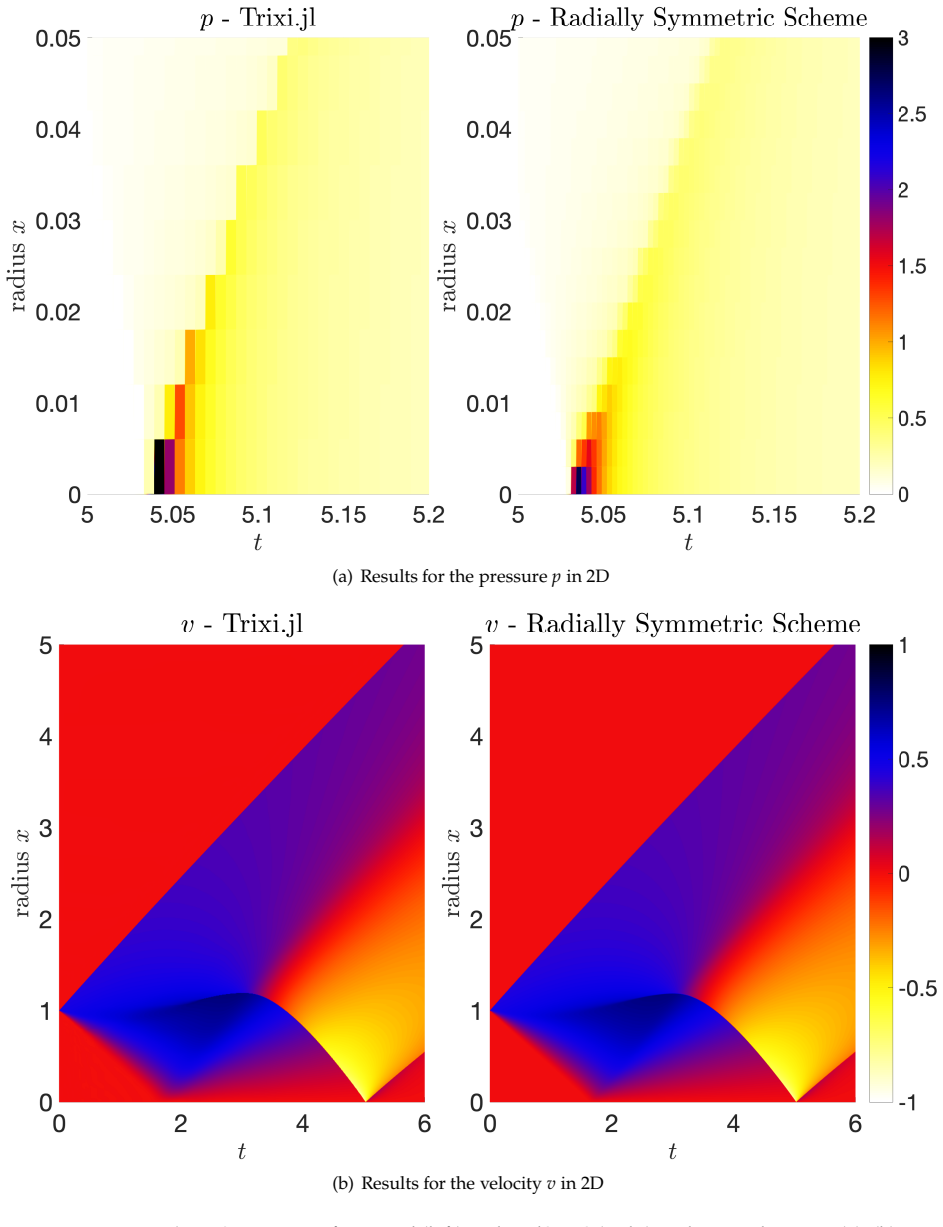
- The scheme reproduces the radially symmetric reference solutions for the shock-plus-stationary example and the self-similar rarefaction example, in both two and three dimensions, matching ODE-based reference solutions.
- The benchmark suite is run for the first time as genuine 3D computations: the bubble expansion, bubble collapse, and sine-velocity cases all produce the expected shock focusing and pressure blow-up near the origin, with the 3D peak pressures under-resolved relative to the one-dimensional reference (e.g. ≈9.7 versus ≈289 in the expansion example) because of computational cost.
- Because the flux is an explicit, symmetric two-point flux, any conservative scheme that uses it as the volume flux inherits semidiscrete entropy conservation; extending it to higher order requires only flux differencing with summation-by-parts operators.
- The solved benchmarks, with reference solutions and reproducing code, give other multi-dimensional relativistic solvers a structure-preserving test case.
Reading between the lines
- The same differential-averaging construction should transfer to neighbouring relativistic systems whose main field is known — the Synge-gas and general (non-ultra) relativistic Euler equations — since the only structural ingredients are the entropy variables, the flux potential, and two convenient jump variables.
- The p > 0 restriction marks the method's real boundary: a 3D vacuum-expansion run (Example 2 with initial velocity near light speed) would immediately break the flux. A natural extension is a blended flux that switches to a positivity-preserving or kinetic solver when an interface pressure approaches zero.
- The under-resolved 3D peaks are a resolution statement, not a sign of instability: re-running the focusing examples with increased refinement near the origin should push the computed peak toward the reference values (≈289, ≈3550, ≈5957), and an entropy-stable baseline should keep those runs stable throughout.
- Machine-precision entropy conservation in smooth regions suggests the scheme can serve as a quantitative probe of the pressure blow-up: tracking peak growth on adaptively refined meshes could test whether the focusing singularity is self-similar, as the one-dimensional analysis predicts.
Editorial analysis
A structured set of objections, weighed in public.
Referee Report
Summary. The paper derives an entropy-conservative two-point numerical flux for the multi-dimensional ultra-relativistic Euler equations, following the Tadmor framework. The authors compute the entropy variables and entropy potential, solve the Tadmor jump condition, and obtain explicit flux formulas (3.16). They embed this flux in a high-order DGSEM with flux differencing, Rusanov interface dissipation, finite-volume subcell shock capturing, AMR, and adaptive time stepping in Trixi.jl. They validate the method on five radially symmetric benchmark problems in 2D and 3D from Kunik et al., comparing against the dedicated 1D solver RadSymS and self-similar ODE reference solutions, and they report machine-precision entropy rates in one test.
Significance. The main claimed contribution is the first entropy-conservative two-point flux for the ultra-relativistic Euler equations, and the paper demonstrates its use in genuine 2D and 3D simulations of the recently proposed benchmarks. If the derivation is correct, this is a substantive, reusable building block for entropy-stable DG methods for relativistic flows. The paper is also strong on reproducibility: it provides a public Julia repository with code and data, and the numerical benchmarks are independently cross-checked against RadSymS and ODE-based self-similar solutions. The central algebraic derivation in Section 3 is checkable and not fitted, and the machine-precision entropy test, once precisely defined, is a meaningful falsifiable check.
major comments (4)
- [Eq. (2.13) and (3.11)] Eq. (2.13) prints the entropy potential as ψ_k = -1/4 S u_k sqrt(1+|u|^2). With S=p^{3/4}sqrt(1+|u|^2), this equals -1/4 p^{3/4} u_k (1+|u|^2), whose jump is not the term [p^{3/4}u_k] used in (3.11). The derivation is consistent with ψ_k = -1/4 S u_k / sqrt(1+|u|^2) = -1/4 p^{3/4}u_k. Please correct (2.13) and adjust the sign/presentation in (3.1); as printed, the derivation cannot be followed.
- [Section 3, eqs. (3.6)-(3.8); Section 5, Examples 3-5] The entropy variables (2.12) and all flux formulas (3.6)-(3.8) require p>0, and this domain of validity is never stated. The positivity-preserving limiter is applied only to Example 2 (Section 4), while Examples 3-5 reach very low pressures before focusing (e.g., Example 3 says p takes very low values around t=4.165 in 3D). No analysis or numerical check is provided that p remains positive for the computed solutions, so the scheme could, in principle, leave the domain of definition of the flux. State the p>0 assumption explicitly, verify it for the reported runs, or extend positivity protection/fallbacks to all tests.
- [Appendix A, eqs. (A.6)-(A.10)] The proof of convexity of -S is incomplete. The text verifies that A1 is positive on vectors (v1,...,vd,0), A2 nonnegative on the same subspace, and A3 positive on (0,...,0,v_{d+1}), but this does not imply that A1+A2+A3 is positive definite on mixed vectors. The Hessian must be tested on arbitrary v=(y,z), including cross terms in A3. Either complete the argument or cite an existing proof of concavity of (2.9); the entropy-stable framework depends on this property.
- [Section 5, Fig. 3] The full scheme includes Rusanov interface dissipation and finite-volume subcell shock capturing, both entropy-dissipative. The statement that 'entropy is conserved up to machine precision' is therefore ambiguous for a test based on Example 1, which is a shock problem. Please define precisely what is plotted (e.g., the semidiscrete entropy residual of the volume EC flux only, or the total entropy balance), and reconcile any claim of exact conservation with the expected entropy production at shocks.
minor comments (4)
- [Eq. (3.10)] In the displayed formula for the jump of the entropy variable, the expression for [p^{-1/2}] appears to contain a duplicated factor [p][p]; this typesetting issue should be cleaned up.
- [Eqs. (3.13) and (3.15)] The statements 'This is clearly a consistent approximation' and 'This is a consistent approximation' are assertions; a one-line equal-state verification (p_L=p_R, u_L=u_R) would make the proof self-contained.
- [References] Reference [69] has DOI 'TODO' and reference [13] has a truncated DOI. Please update before publication.
- [Fig. 3 caption] The caption should state how the 'entropy rate' is computed in space and time, and in which norm or discrete functional it is measured.
Circularity Check
No significant circularity: the entropy-conservative flux is derived by solving the Tadmor condition from the physical entropy, with benchmarks as independent cross-checks.
full rationale
The central claim (Theorem 3.1) is not equivalent to its inputs. The paper defines the entropy variables (2.12) by differentiating the physical entropy (2.9) with respect to the conserved variables, verifies the compatibility relation (2.11) by explicit calculation in Appendix A, and then solves the standard Tadmor entropy-conservation condition (3.1) algebraically. The derivation chooses the jump variables u_i p^{-1/4} and p, rewrites the condition as (3.12), and sets each bracketed coefficient to zero, yielding the energy flux (3.13) and momentum flux (3.15). These fluxes contain no fitted parameters; consistency follows from the stated averages and the identity (3.8), and the entropy rate in Fig. 3 is a direct, falsifiable numerical check of the property. The comparisons against RadSymS from [36,37] and the ODE reference are independent cross-validation, not inputs to the flux derivation. The only self-citations are methodological/tool citations ([49] Ranocha for the generic flux-solving algorithm, which is re-executed here; Trixi.jl and the reproducibility repository), and [36] for the benchmark solver; none supplies an unverified premise or a uniqueness theorem that forces the result. The p>0 restriction is a genuine robustness limitation but not a circularity: the entropy variables and flux are simply undefined outside that region, and the paper does not claim coverage of vacuum states.
Assumptions & free parameters
assumptions (3)
- domain assumption The physical entropy of the system is S = p^{3/4} sqrt(1+|u|^2) and it is a concave entropy (Section 2, eq. 2.9).
- domain assumption The ultra-relativistic equation of state e = 3p holds exactly for the ideal gas (eq. 2.4).
- domain assumption The radially symmetric quasi-1D system (4.4) with the source term (d-1)/2 r^{d-2}(E-P) is equivalent to radially symmetric solutions of the multidimensional system, and RadSymS computes its correct weak solutions.
Cite this review
Pith. "Pith review of Computing Radially-Symmetric Solutions of the Ultra-Relativistic Euler Equations with Entropy-Stable Discontinuous Galerkin Methods." pith.science (2026). https://pith.science/paper/GERWZVFJ
@misc{pith2026250821427,
  author       = {Pith},
  title        = {Pith review of: Computing Radially-Symmetric Solutions of the Ultra-Relativistic Euler Equations with Entropy-Stable Discontinuous Galerkin Methods},
  year         = {2026},
  howpublished = {\url{https://pith.science/paper/GERWZVFJ}},
  note         = {Machine review of arXiv:2508.21427}
}
read the original abstract
The ultra--relativistic Euler equations describe gases in the relativistic case when the thermal energy dominates. These equations for an ideal gas are given in terms of the pressure, the spatial part of the dimensionless four-velocity, and the particle density. Kunik et al.\ (2024, https://doi.org/10.1016/j.jcp.2024.113330) proposed genuine multi--dimensional benchmark problems for the ultra--relativistic Euler equations. In particular, they compared full two-dimensional discontinuous Galerkin simulations for radially symmetric problems with solutions computed using a specific one-dimensional scheme. Of particular interest in the solutions are the formation of shock waves and a pressure blow-up. In the present work we derive an entropy-stable flux for the ultra--relativistic Euler equations. Therefore, we derive the main field (or entropy variables) and the corresponding potentials. We then present the entropy-stable flux and conclude with simulation results for different test cases both in 2D and in 3D.
Figures


Figures from the paper (14 more)




Reference graph
Works this paper leans on
-
[1]
A new front tracking sche me for the ultra-relativistic Euler equations
M. A. E. Abdelrahman and M. Kunik. “A new front tracking sche me for the ultra-relativistic Euler equations.” In:J. Comput. Phys.275 (2014), pp. 213–235./d.pc/o.pc/i.pc: 10.1016/j.jcp.2014.06.051
-
[2]
Analysis of the SBP-SAT Stabilization for Finite Element Methods Part I: Linear Problems
R. Abgrall, J. Nordström, P . Öffner, and S. T okareva. “Ana lysis of the SBP-SAT Stabilization for Finite Element Methods Part I: Linear problems.” In: Journal of Scientific Computing 85.2 (2020), pp. 1–29. /d.pc/o.pc/i.pc: 10.1007/s10915-020-01349-z . arXiv: 1912.08108 [math.NA]. 27
work page Pith review arXiv 2020
-
[3]
Relativistic fluid dynamic s: physics for many different scales
N. Andersson and G. L. Comer. “Relativistic fluid dynamic s: physics for many different scales.” In: Living Reviews in Relativity 24.1 (2021), p. 3. /d.pc/o.pc/i.pc: 10.1007/s41114-021-00031-6
-
[4]
W. Barsukow, C. Klingenberg, L. Lechner, J. Nordström, S. Ortleb, and H. Ranocha. Stability of the Active Flux Method in the Framework of Summation-by-Pa rts Operators. July 2025. arXiv: 2507.11068 [math.NA]
arXiv 2025
-
[5]
Jul ia: A Fresh Approach to Numer- ical Computing
J. Bezanson, A. Edelman, S. Karpinski, and V . B. Shah. “Jul ia: A Fresh Approach to Numer- ical Computing.” In: SIAM Review 59.1 (2017), pp. 65–98. /d.pc/o.pc/i.pc: 10.1137/141000671. arXiv: 1411.1607 [cs.MS]
arXiv 2017
-
[6]
p4est: Scala ble algorithms for parallel adaptive mesh refinement on forests of octrees
C. Burstedde, L. C. Wilcox, and O. Ghattas. “p4est: Scala ble algorithms for parallel adaptive mesh refinement on forests of octrees.” In: SIAM Journal on Scientific Computing 33.3 (2011), pp. 1103–1133. /d.pc/o.pc/i.pc: 10.1137/100791634
-
[7]
M. H. Carpenter, T. C. Fisher, E. J. Nielsen, and S. H. Frank el. “Entropy Stable Spectral Collocation Schemes for the Navier-Stokes Equations: Disc ontinuous Interfaces.” In: SIAM Journal on Scientific Computing 36.5 (2014), B835–B867. /d.pc/o.pc/i.pc: 10.1137/130932193
-
[8]
On discretely entropy conservative and entrop y stable discontinuous Galerkin methods
J. Chan. “On discretely entropy conservative and entrop y stable discontinuous Galerkin methods.” In: Journal of Computational Physics362 (2018), pp. 346–374./d.pc/o.pc/i.pc: 10.1016/j.jcp.2018.02.033
Show all 74 references
-
[9]
Kinetic Energy Preserving and Entrop y Stable Finite Volume Schemes for Compressible Euler and Navier-Stokes Equations
P . Chandrashekar. “Kinetic Energy Preserving and Entrop y Stable Finite Volume Schemes for Compressible Euler and Navier-Stokes Equations.” In: Communications in Computational Physics 14.5 (2013), pp. 1252–1286. /d.pc/o.pc/i.pc: 10.4208/cicp.170712.010313a
2013
-
[10]
Conservation laws for relativistic fluid dyna mics
J. Chen. “Conservation laws for relativistic fluid dyna mics.” In: Arch. Rational Mech. Anal. 139.4 (1997), pp. 377–398. /d.pc/o.pc/i.pc: 10.1007/s002050050057
1997 doi
-
[11]
Entropy stable high order discon tinuous Galerkin methods with suitable quadrature rules for hyperbolic conservation law s
T. Chen and C.-W. Shu. “Entropy stable high order discon tinuous Galerkin methods with suitable quadrature rules for hyperbolic conservation law s.” In: Journal of Computational Physics 345 (2017), pp. 427–461. /d.pc/o.pc/i.pc: 10.1016/j.jcp.2017.05.025
2017 doi
-
[12]
Embedded pairs fo r optimal explicit strong stability preserving Runge-Kutta methods
S. Conde, I. Fekete, and J. N. Shadid. “Embedded pairs fo r optimal explicit strong stability preserving Runge-Kutta methods.” In: Journal of Computational and Applied Mathematics 412 (2022), p. 114325. /d.pc/o.pc/i.pc: 10.1016/j.cam.2022.114325. arXiv: 1806.08693 [math.NA]
2022
-
[13]
C. M. Dafermos. Hyperbolic Conservation Laws in Continuum Physics. 4th. Vol. 325. Grundlehren der mathematischen Wissenschaften. Springer Berlin Heidelberg, 2016, p. 826./d.pc/o.pc/i.pc: 10.1007/978-3-662-49
2016 doi
-
[14]
Recent developments in mathematical aspe cts of relativistic fluids
M. Disconzi. “Recent developments in mathematical aspe cts of relativistic fluids.” In: Living Reviews in Relativity 27.1 (2024), p. 6. /d.pc/o.pc/i.pc: 10.1007/s41114-024-00052-x
2024 doi
-
[15]
A wel l-balanced discontinuous Galerkin method for the first–order Z4 formulation of the Einstein–Euler system
M. Dumbser, O. Zanotti, E. Gaburro, and I. Peshkov. “A wel l-balanced discontinuous Galerkin method for the first–order Z4 formulation of the Einstein–Euler system.” In: Journal of Computational Physics 504 (2024), p. 112875. /d.pc/o.pc/i.pc: 10.1016/j.jcp.2024.112875
2024
-
[16]
Revi ew of summation-by-parts opera- tors with simultaneous approximation terms for the numerical solution of partial differential equations
D. C. D. R. Fernández, J. E. Hicken, and D. W. Zingg. “Revi ew of summation-by-parts opera- tors with simultaneous approximation terms for the numerical solution of partial differential equations.” In:Computers & Fluids95 (2014), pp. 171–196./d.pc/o.pc/i.pc: 10.1016/j.compfluid...
2014 doi
-
[17]
High-order entropy sta ble finite difference schemes for nonlinear conservation laws: Finite domains
T. C. Fisher and M. H. Carpenter. “High-order entropy sta ble finite difference schemes for nonlinear conservation laws: Finite domains.” In: Journal of Computational Physics 252 (2013), pp. 518–557. /d.pc/o.pc/i.pc: 10.1016/j.jcp.2013.06.014
2013 doi
-
[18]
Relativistic barotropic fluids: a God unov-Boillat formulation for their dy- namics and a discussion of two special classes
H. Freistühler. “Relativistic barotropic fluids: a God unov-Boillat formulation for their dy- namics and a discussion of two special classes.” In: Arch. Ration. Mech. Anal. 232.1 (2019), pp. 473–488. /d.pc/o.pc/i.pc: 10.1007/s00205-018-1325-2
2019 doi
-
[19]
On shock profiles in four-fie ld formulations of dissipative relativistic fluid dynamics
H. Freistühler and B. T emple. “On shock profiles in four-fie ld formulations of dissipative relativistic fluid dynamics.” In:Hyperbolic problems: theory, numerics, applications. Vol. I. Vol. 34. SEMA SIMAI Springer Ser. Springer, Cham, 2024, pp. 251–261./d.pc/o.pc/i.pc: 10.1007/...
2024 doi
-
[20]
A well balanced fin ite volume scheme for general relativity
E. Gaburro, M. J. Castro, and M. Dumbser. “A well balanced fin ite volume scheme for general relativity.” In: SIAM J. Sci. Comput. 43.6 (2021), B1226–B1251. /d.pc/o.pc/i.pc: 10.1137/21M1399154
2021 doi
-
[21]
A Skew-Symmetric Discontinuous Galerk in Spectral Element Discretization and Its Relation to SBP-SAT Finite Difference Methods
G. J. Gassner. “A Skew-Symmetric Discontinuous Galerk in Spectral Element Discretization and Its Relation to SBP-SAT Finite Difference Methods.” In: SIAM Journal on Scientific Com- puting 35.3 (2013), A1233–A1253. /d.pc/o.pc/i.pc: 10.1137/120890144
2013 doi
-
[22]
Split Fo rm Nodal Discontinuous Galerkin Schemes with Summation-By-Parts Property for the Compress ible Euler Equations
G. J. Gassner, A. R. Winters, and D. A. Kopriva. “Split Fo rm Nodal Discontinuous Galerkin Schemes with Summation-By-Parts Property for the Compress ible Euler Equations.” In: Journal of Computational Physics 327 (2016), pp. 39–66. /d.pc/o.pc/i.pc: 10.1016/j.jcp.2016.09.013
2016 doi
-
[23]
Groah, J
J. Groah, J. Smoller, and B. T emple. Shock wave interactions in general relativity . Springer Monographs in Mathematics. A locally inertial Glimm scheme fo r spherically symmetric spacetimes. Springer, New Y ork, 2007, pp. viii+152./d.pc/o.pc/i.pc: 10.1007/978-0-387-44602-8
2007 doi
-
[24]
A provably entropy stable subcell shock capturing approach for high or der split form DG for the com- pressible Euler equations
S. Hennemann, A. M. Rueda-Ramírez, F. J. Hindenlang, and G. J. Gassner. “A provably entropy stable subcell shock capturing approach for high or der split form DG for the com- pressible Euler equations.” In: Journal of Computational Physics 426 (2021), p. 109935. /d.pc/o.pc/i.p...
2021
-
[25]
Hicken, G
J. Hicken, G. Yan, and S. Kaur. Constructing stable, high-order finite-difference operators on point clouds over complex geometries. Sept. 2024. arXiv: 2409.00809 [math.NA]
2024 arXiv
-
[26]
Entropy-stable, high-order summation- by-parts discretizations without inter- face penalties
J. E. Hicken. “Entropy-stable, high-order summation- by-parts discretizations without inter- face penalties.” In:Journal of Scientific Computing82.2 (2020), p. 50./d.pc/o.pc/i.pc: 10.1007/s10915-020-01154-8
2020 doi
-
[27]
Multi dimensional Summation-By- Parts Operators: General Theory and Application to Simplex Elements
J. E. Hicken, D. C. D. R. Fernández, and D. W. Zingg. “Multi dimensional Summation-By- Parts Operators: General Theory and Application to Simplex Elements.” In: SIAM Journal on Scientific Computing 38.4 (2016), A1935–A1958. /d.pc/o.pc/i.pc: 10.1137/15M1038360
2016 doi
-
[28]
A Flux Reconstruction Approach to High-Or der Schemes Including Discontin- uous Galerkin Methods
H. T. Huynh. “A Flux Reconstruction Approach to High-Or der Schemes Including Discontin- uous Galerkin Methods.” In: 18th AIAA Computational Fluid Dynamics Conference . American Institute of Aeronautics and Astronautics. 2007. /d.pc/o.pc/i.pc: 10.2514/6.2007-4079
2007 doi
-
[29]
Affordable, entropy-consisten t Euler flux functions II: Entropy production at shocks
F. Ismail and P . L. Roe. “Affordable, entropy-consisten t Euler flux functions II: Entropy production at shocks.” In: Journal of Computational Physics 228.15 (2009), pp. 5410–5436. /d.pc/o.pc/i.pc: 10.1016/j.jcp.2009.04.021
2009 doi
-
[30]
A. Jameson. “Formulation of Kinetic Energy Preserving C onservative Schemes for Gas Dy- namics and Direct Numerical Simulation of One-DimensionalViscous Compressible Flow in a Shock T ube Using Entropy and Kinetic Energy Preserving Schemes.” In: Journal of Scientific Computing ...
2008 doi
-
[31]
Assessing st andard and kinetic energy conserv- ing volume fluxes in discontinuous Galerkin formulations fo r marginally resolved Navier- Stokes flows
B. F. Klose, G. B. Jacobs, and D. A. Kopriva. “Assessing st andard and kinetic energy conserv- ing volume fluxes in discontinuous Galerkin formulations fo r marginally resolved Navier- Stokes flows.” In:Computers & Fluids205 (2020), p. 104557./d.pc/o.pc/i.pc: 10.1016/j.compfluid...
2020
-
[32]
D. A. Kopriva. Implementing Spectral Methods for Partial Differential Equations: Algorithms for Sci- entists and Engineers. New Y ork: Springer Science & Business Media, 2009./d.pc/o.pc/i.pc: 10.1007/978-90-481-2261-
2009 doi
-
[33]
Contractivity of Runge-Kutta me thods
J. F. B. M. Kraaijevanger. “Contractivity of Runge-Kutta me thods.” In: BIT Numerical Mathe- matics 31.3 (1991), pp. 482–528. /d.pc/o.pc/i.pc: 10.1007/BF01933264
1991 doi
-
[34]
Finite Element and Finite D ifference Methods for Hyperbolic Partial Differential Equations
H.-O. Kreiss and G. Scherer. “Finite Element and Finite D ifference Methods for Hyperbolic Partial Differential Equations.” In: Mathematical Aspects of Finite Elements in Partial Differential Equations. Ed. by C. de Boor. New Y ork: Academic Press, 1974, pp. 195–21 2
1974
-
[35]
M. Kunik. Selected initial and boundary value problems for hyperbolic systems and kinetic equations. Otto von Guericke University , Magdeburg, Germany, 2005./d.pc/o.pc/i.pc: 10.25673/30567
2005 doi
-
[36]
Radially symme tric solutions of the ultra- relativistic Euler equations in several space dimensions
M. Kunik, A. Kolb, S. Müller, and F. Thein. “Radially symme tric solutions of the ultra- relativistic Euler equations in several space dimensions. ” In: Journal of Computational Physics 518 (2024), p. 113330. /d.pc/o.pc/i.pc: 10.1016/j.jcp.2024.113330. arXiv: 2402.12857 [math.NA]. 29
2024
-
[37]
Radially symmetric so lutions of the ultra-relativistic Euler equations
M. Kunik, H. Liu, and G. Warnecke. “Radially symmetric so lutions of the ultra-relativistic Euler equations.” In: Methods Appl. Anal. 28.4 (2021), pp. 401–421
2021
-
[38]
A BGK-type flux-vecto r splitting scheme for the ultrarelativistic Euler equations
M. Kunik, S. Qamar, and G. Warnecke. “A BGK-type flux-vecto r splitting scheme for the ultrarelativistic Euler equations.” In: SIAM J. Sci. Comput. 26.1 (2004), pp. 196–223. /d.pc/o.pc/i.pc: 10.1137/S1064827503422208
2004 doi
-
[39]
Kinetic schemes for t he ultra-relativistic Euler equa- tions
M. Kunik, S. Qamar, and G. Warnecke. “Kinetic schemes for t he ultra-relativistic Euler equa- tions.” In: J. Comput. Phys. 187.2 (2003), pp. 572–596. /d.pc/o.pc/i.pc: 10.1016/S0021-9991(03)00125-6
2003 doi
-
[40]
Second-order accur ate kinetic schemes for the ultra- relativistic Euler equations
M. Kunik, S. Qamar, and G. Warnecke. “Second-order accur ate kinetic schemes for the ultra- relativistic Euler equations.” In:J. Comput. Phys.192.2 (2003), pp. 695–726./d.pc/o.pc/i.pc: 10.1016/j.jcp.2003.07.019
2003 doi
-
[41]
Self-similar solutions of the radially symmet ric relativistic Euler equations
G. Lai. “Self-similar solutions of the radially symmet ric relativistic Euler equations.” In: European Journal of Applied Mathematics (2019), 1–31. /d.pc/o.pc/i.pc: 10.1017/S0956792519000317
2019 doi
-
[42]
Fully Discret e, Entropy Conservative Schemes of Arbitrary Order
P . G. LeFloch, J.-M. Mercier, and C. Rohde. “Fully Discret e, Entropy Conservative Schemes of Arbitrary Order.” In: SIAM Journal on Numerical Analysis 40.5 (2002), pp. 1968–1992. /d.pc/o.pc/i.pc: 10.1137/S003614290240069X
2002 doi
-
[43]
An adaptive finite element scheme for transie nt problems in CFD
R. Löhner. “An adaptive finite element scheme for transie nt problems in CFD.” In: Computer Methods in Applied Mechanics and Engineering61.3 (1987), pp. 323–338./d.pc/o.pc/i.pc: 10.1016/0045-7825(87)90098-
1987 doi
-
[44]
Finite volume approximatio ns and strict stability for hyperbolic problems
J. Nordström and M. Björck. “Finite volume approximatio ns and strict stability for hyperbolic problems.” In:Applied Numerical Mathematics38.3 (2001), pp. 237–255./d.pc/o.pc/i.pc: 10.1016/S0168-9274(01)00027-
2001 doi
-
[45]
Finite volume methods, unstruc- tured meshes and strict stability for hyperbolic problems
J. Nordström, K. Forsberg, C. Adamsson, and P . Eliasson. “Finite volume methods, unstruc- tured meshes and strict stability for hyperbolic problems.” In: Applied Numerical Mathematics 45.4 (2003), pp. 453–473. /d.pc/o.pc/i.pc: 10.1016/S0168-9274(02)00239-8
2003 doi
-
[46]
Ultra-relativistic limit o f extended thermodynamics of rarefied polyatomic gas
S. Pennisi and T. Ruggeri. “Ultra-relativistic limit o f extended thermodynamics of rarefied polyatomic gas.” In:Matematiche (Catania)74.2 (2019), pp. 369–395./d.pc/o.pc/i.pc: 10.4418/2019.74.2.10
2019 doi
-
[47]
DifferentialEquations.jl – A Performant and Feature-Rich Ecosys- tem for Solving Differential Equations in Julia
C. Rackauckas and Q. Nie. “DifferentialEquations.jl – A Performant and Feature-Rich Ecosys- tem for Solving Differential Equations in Julia.” In:Journal of Open Research Software5.1 (2017), p. 15. /d.pc/o.pc/i.pc: 10.5334/jors.151
2017 doi
-
[48]
A Note on Numerical Fluxes Conserving a Memb er of Harten’s One-Parameter Family of Entropies for the Compressible Euler Equations
H. Ranocha. “A Note on Numerical Fluxes Conserving a Memb er of Harten’s One-Parameter Family of Entropies for the Compressible Euler Equations.”In: Journal of Computational Physics 462 (Apr. 2022), p. 111236. /d.pc/o.pc/i.pc: 10.1016/j.jcp.2022.111236. arXiv: 2201.03946 [math.NA]
2022
-
[49]
Comparison of Some Entropy Conservative N umerical Fluxes for the Euler Equations
H. Ranocha. “Comparison of Some Entropy Conservative N umerical Fluxes for the Euler Equations.” In:Journal of Scientific Computing76.1 (July 2018), pp. 216–242./d.pc/o.pc/i.pc: 10.1007/s10915-017-0618- arXiv: 1701.02264 [math.NA]
2018 arXiv
-
[50]
Entropy Conserving and Kinetic Energy Pres erving Numerical Methods for the Euler Equations Using Summation-by-Parts Operators
H. Ranocha. “Entropy Conserving and Kinetic Energy Pres erving Numerical Methods for the Euler Equations Using Summation-by-Parts Operators.” In: Spectral and High Order Methods for Partial Differential Equations ICOSAHOM 2018. Ed. by S. J. Sherwin, D. Moxey, J. Peiró, P . E. V...
2018 doi
-
[51]
Generalised Summation-by-Parts Operato rs and Entropy Stability of Numeri- cal Methods for Hyperbolic Balance Laws
H. Ranocha. “Generalised Summation-by-Parts Operato rs and Entropy Stability of Numeri- cal Methods for Hyperbolic Balance Laws.” PhD thesis. TU Brau nschweig, Feb. 2018
2018
-
[52]
O ptimized Runge-Kutta Methods with Automatic Step Size Control for Compressible Computat ional Fluid Dynamics
H. Ranocha, L. Dalcin, M. Parsani, and D. I. Ketcheson. “O ptimized Runge-Kutta Methods with Automatic Step Size Control for Compressible Computat ional Fluid Dynamics.” In: Communications on Applied Mathematics and Computation 4 (Nov . 2021), pp. 1191–1228. /d.pc/o.pc/i.pc: 1...
2021 arXiv
-
[53]
Preventing pressure osci llations does not fix local linear stability issues of entropy-based split-form high-order s chemes
H. Ranocha and G. J. Gassner. “Preventing pressure osci llations does not fix local linear stability issues of entropy-based split-form high-order s chemes.” In: Communications on Ap- plied Mathematics and Computation (Aug. 2021). /d.pc/o.pc/i.pc: 10.1007/s42967-021-00148-z . a...
2021 arXiv
-
[54]
Summation-by-part s operators for correction procedure via reconstruction
H. Ranocha, P . Öffner, and T. Sonar. “Summation-by-part s operators for correction procedure via reconstruction.” In: Journal of Computational Physics 311 (Apr. 2016), pp. 299–328. /d.pc/o.pc/i.pc: 10.1016/j.jcp.2016.02.009. arXiv: 1511.02052 [math.NA]
2016 arXiv
-
[55]
Adaptive numerical simulations with Trixi.jl: A case study of Julia for scientific computing
H. Ranocha, M. Schlottke-Lakemper, A. R. Winters, E. Fau lhaber, J. Chan, and G. J. Gassner. “Adaptive numerical simulations with Trixi.jl: A case study of Julia for scientific computing.” In: Proceedings of the JuliaCon Conferences 1.1 (Jan. 2022), p. 77. /d.pc/o.pc/i.pc: 10.2...
2022 arXiv
-
[56]
Ruggeri and M
T. Ruggeri and M. Sugiyama. Classical and relativistic rational extended thermodynamics of gases. Springer, Cham, 2021, pp. xxxii+669. /d.pc/o.pc/i.pc: 10.1007/978-3-030-59144-1
2021 doi
-
[57]
Classical and ultrarelativist ic limits of the Riemann problem for the relativistic Euler fluid with Synge energy
T. Ruggeri and Q. Xiao. “Classical and ultrarelativist ic limits of the Riemann problem for the relativistic Euler fluid with Synge energy.” In: Ric. Mat. 70.1 (2021), pp. 223–233. /d.pc/o.pc/i.pc: 10.1007/s11587-020-00502-y
2021 doi
-
[58]
Nonlinear hyperbolic waves in relativistic gases of massive particles with Synge energy
T. Ruggeri, Q. Xiao, and H. Zhao. “Nonlinear hyperbolic waves in relativistic gases of massive particles with Synge energy.” In: Arch. Ration. Mech. Anal. 239.2 (2021), pp. 1061–1109. /d.pc/o.pc/i.pc: 10.1007/s00205-020-01590-8
2021 doi
-
[59]
A purely hyper- bolic discontinuous Galerkin approach for self-gravitati ng gas dynamics
M. Schlottke-Lakemper, A. R. Winters, H. Ranocha, and G. J. Gassner. “A purely hyper- bolic discontinuous Galerkin approach for self-gravitati ng gas dynamics.” In: Journal of Computational Physics 442 (June 2021), p. 110467. /d.pc/o.pc/i.pc: 10.1016/j.jcp.2021.110467. arXiv: ...
2021
-
[60]
Skew-symmetric sp litting and stability of high order central schemes
B. Sjögreen, H. C. Yee, and D. Kotov. “Skew-symmetric sp litting and stability of high order central schemes.” In: Journal of Physics: Conference Series . Vol. 837. 1. IOP Publishing. 2017, p. 012019. /d.pc/o.pc/i.pc: 10.1088/1742-6596/837/1/012019
2017 doi
-
[61]
J. Smoller. Shock waves and reaction—diffusion equations. Vol. 258. Springer Science & Business Media, 2012. /d.pc/o.pc/i.pc: 10.1007/978-1-4612-0873-0
2012 doi
-
[62]
General relativistic self-s imilar waves that induce an anomalous acceleration into the standard model of cosmology
J. Smoller and B. T emple. “General relativistic self-s imilar waves that induce an anomalous acceleration into the standard model of cosmology.” In: Mem. Amer . Math. Soc. 218.1025 (2012), pp. vi+69. /d.pc/o.pc/i.pc: 10.1090/S0065-9266-2011-00641-6
2012 doi
-
[63]
Global solutions of the relat ivistic Euler equations
J. Smoller and B. T emple. “Global solutions of the relat ivistic Euler equations.” In: Commu- nications in Mathematical Physics 156.1 (1993), pp. 67–99. /d.pc/o.pc/i.pc: 10.1007/BF02096733
1993 doi
-
[64]
Relativistic detonation waves and b ubble growth in false vacuum decay
P . J. Steinhardt. “Relativistic detonation waves and b ubble growth in false vacuum decay.” In: Phys. Rev. D 25 (8 1982), pp. 2074–2085. /d.pc/o.pc/i.pc: 10.1103/PhysRevD.25.2074
1982 doi
-
[65]
Summation by Parts for Finite Difference App roximations for /u1D451//u1D451/u1D465
B. Strand. “Summation by Parts for Finite Difference App roximations for /u1D451//u1D451/u1D465.” In: Journal of Computational Physics 110.1 (1994), pp. 47–67. /d.pc/o.pc/i.pc: 10.1006/jcph.1994.1005
1994
-
[66]
Review of summation-by-part s schemes for initial-boundary- value problems
M. Svärd and J. Nordström. “Review of summation-by-part s schemes for initial-boundary- value problems.” In:Journal of Computational Physics268 (2014), pp. 17–38./d.pc/o.pc/i.pc: 10.1016/j.jcp.2014.02.031
2014 doi
-
[67]
Entropy stability theory for difference app roximations of nonlinear conservation laws and related time-dependent problems
E. Tadmor. “Entropy stability theory for difference app roximations of nonlinear conservation laws and related time-dependent problems.” In: Acta Numerica 12 (2003), pp. 451–512. /d.pc/o.pc/i.pc: 10.1017/S0962492902000156
2003 doi
-
[68]
The numerical viscosity of entropy stable s chemes for systems of conservation laws. I
E. Tadmor. “The numerical viscosity of entropy stable s chemes for systems of conservation laws. I.” In:Mathematics of Computation49.179 (1987), pp. 91–103./d.pc/o.pc/i.pc: 10.1090/S0025-5718-1987-0890255-
1987 doi
-
[69]
Computing Radially-Symmetric Solutions of the Ultra-Relativistic Euler Equations with Entropy-St able Discontinuous Galerkin Methods
F. Thein and H. Ranocha. Reproducibility repository for "Computing Radially-Symmetric Solutions of the Ultra-Relativistic Euler Equations with Entropy-St able Discontinuous Galerkin Methods" . https://github.com/ranocha/2025_ultrarelativistic_euler. 2025. /d.pc/o.pc/i.pc: TODO
2025
-
[70]
A New Clas s of High-Order Energy Stable Flux Reconstruction Schemes
P . E. Vincent, P . Castonguay, and A. Jameson. “A New Clas s of High-Order Energy Stable Flux Reconstruction Schemes.” In: Journal of Scientific Computing 47.1 (2011), pp. 50–72. /d.pc/o.pc/i.pc: 10.1007/s10915-010-9420-z . 31
2011 doi
-
[71]
On Godunov’s interesting class of system s - The symmetric hyperbolic Eu- ler equations of gas dynamics
G. Warnecke. “On Godunov’s interesting class of system s - The symmetric hyperbolic Eu- ler equations of gas dynamics.” In: Journal of Computational Physics (2024), p. 113588. /d.pc/o.pc/i.pc: 10.1016/j.jcp.2024.113588
2024
-
[72]
Weinberg
S. Weinberg. Gravitation and cosmology: principles and applications of thegeneral theory of relativity. Wiley, 1972. /u.pc/r.pc/l.pc: https://books.google.de/books?id=XLbvAAAAMAAJ
1972
-
[73]
A high order special relativi stic hydrodynamic and magneto- hydrodynamic code with space-time adaptive mesh refinement
O. Zanotti and M. Dumbser. “A high order special relativi stic hydrodynamic and magneto- hydrodynamic code with space-time adaptive mesh refinement.” In: Comput. Phys. Commun. 188 (2015), pp. 110–127. /d.pc/o.pc/i.pc: 10.1016/j.cpc.2014.11.015
2015 doi
-
[74]
Maximum-principle-satisfying and positivity-preserving high- order schemes for conservation laws: survey and new develop ments
X. Zhang and C.-W. Shu. “Maximum-principle-satisfying and positivity-preserving high- order schemes for conservation laws: survey and new develop ments.” In: Proceedings of the Royal Society of London A: Mathematical, Physical and Engineer ing Sciences 467.2134 (2011), pp. 275...
2011
Reviewed August 5, 2026 · model on record in the stance chip above.
Discussion (0). Sign in to comment.