REVIEW 4 major objections 5 minor 6 references
Calligrapher: Freestyle Text Image Customization
T0 review · 4 major / 5 minor · reviewed 2026-08-06 · deepseek-v4-flash
Pith's one-line read Calligrapher re-renders text in any style, beating three baselines
desk verdict A coherent and useful text style customization system, but the headline quantitative gains are likely inflated by a test set generated with the same self-distillation pipeline used for training. read the letter →
The pith
A machine-rendered reading of the paper's core claim, the machinery that carries it, and where it could break.
The reading
What carries the argument
The load-bearing machinery is a three-part setup. First, a self-distillation data pipeline: a large language model produces style-anchored prompts, the pretrained FLUX model generates stylized text images, OCR detects the text boxes, and a random crop becomes the reference while the remaining text region becomes the training target. Second, localized style injection: a style encoder built from a visual backbone, Qformer, and linear layers extracts keys and values that replace the original cross-attention keys and values in the diffusion transformer, so the denoiser attends to reference style rather than text-prompt features. Third, in-context generation: the reference image is spatially concatenated into the latent space with a mask that zeroes out the reference region, allowing the DiT's self-attention to use the reference during denoising. The whole style branch is trained with the flow-matching objective while the base model stays frozen.
What would settle it
Build a test set of real reference images in styles that FLUX cannot reproduce faithfully (for example, irregular hand-lettered graffiti or distressed print textures), run Calligrapher on those references, and measure style similarity (CLIP/DINO) inside the text region. If the scores are no better than the FLUX-Fill baseline's, the self-distillation data pipeline has a coverage gap for that style class. A second check: replace the synthetic test set with real photographed text images and recompute FID; a large FID jump relative to Table 1 would indicate the model is overfit to the synthetic distribution.
Extended reading notes
Core claim
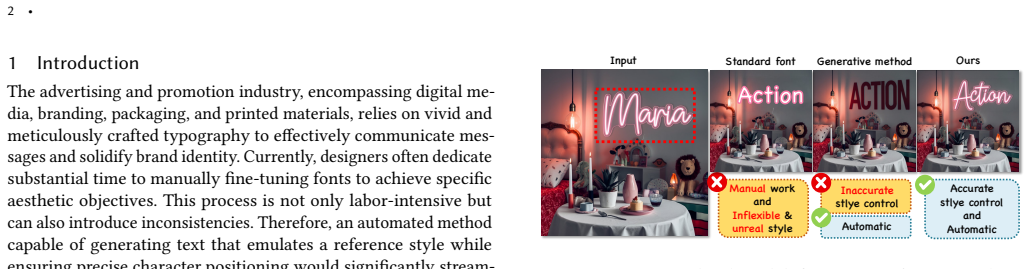
On the paper's own terms, the discovery is that a diffusion model can transfer an arbitrary reference style to new text content with high fidelity when it is trained on self-distilled synthetic pairs and conditioned through two complementary channels: a trainable style encoder whose keys and values replace the cross-attention in the denoising transformer, and an in-context mechanism that concatenates the reference image into the latent input so the transformer's self-attention can draw on it during denoising. The authors report that on their 100-image benchmark Calligrapher achieves FID 38.09 versus 66.68, 69.72, and 67.79 for TextDiffuser-2, AnyText, and FLUX-Fill respectively, and that it reaches the best scores on CLIP, DINO, OCR accuracy, style-sync, text matching, aesthetic quality, and overall user preference (0.72 versus 0.10, 0.04, and 0.14). They also show the method handles cross-reference and non-text references, and that the trained style encoder transfers to a different base model without further training, enabling reference-based text image generation.
Load-bearing premise
The load-bearing premise is that the self-distillation pairs are high-quality ground truth: a crop of a FLUX-synthesized text image is assumed to be a perfect style reference, and the remaining text is assumed to be a perfect example of that style, so that training on these synthetic pairs will transfer to real reference images that FLUX itself may not be able to generate.
Editorial extensions
If this is right
- If the method works as reported, automated typography customization for advertising, branding, and packaging becomes feasible: a user supplies a reference and the system renders any text string in that style while keeping the background intact.
- Cross-reference customization removes the requirement that the reference and the source text share a font, so a designer can preview a logo or headline in dozens of styles from a single source image.
- Non-text references (fire, rainbows, lightning) imply that the model learns texture and material transfer, not just letterform geometry, extending the method beyond calligraphy into general stylized text rendering.
- The claimed zero-shot transfer of the style encoder from FLUX-Fill to FLUX suggests the learned style representation is relatively base-model-agnostic, which could permit style injection into other diffusion transformers without retraining.
Reading between the lines
- A testable extension the paper does not run: evaluate on real photographed references drawn from a distribution FLUX cannot synthesize well, such as grungy hand-painted signs or irregular graffiti, to see whether the self-distillation coverage gap is visible in practice.
- The user study's 0.72 overall preference could be pressure-tested by asking participants to match a specific style attribute (e.g., stroke weight or color palette) rather than give a holistic preference, since holistic scores can be driven by background quality rather than style fidelity.
- If the self-distilled pairs are high quality but only reflect FLUX's style distribution, an adversarial test would be to use a reference image synthesized by a different generative model (e.g., a GAN or another DiT) and measure style similarity against a reference synthesized by FLUX itself.
Editorial analysis
A structured set of objections, weighed in public.
Referee Report
Summary. The paper introduces Calligrapher, a diffusion-based framework for text image customization that transfers the style of a reference image to user-supplied text. The method has three proposed components: a self-distillation pipeline that uses FLUX and an LLM to synthesize a stylized typography benchmark and training pairs; a localized style injection module using a Qformer/linear-layer style encoder whose key/value features replace cross-attention in the denoiser; and an in-context generation mechanism that concatenates the reference image into the VAE latent space during denoising. The authors report quantitative comparisons against TextDiffuser-2, AnyText, and FLUX-Fill on a 100-image benchmark, plus qualitative results for self-reference, cross-reference, non-text reference, and reference-based text image generation. They claim state-of-the-art performance on all metrics.
Significance. If the claims hold, Calligrapher would be a practically useful tool for typography customization and a useful data-generation recipe for a domain with scarce paired training data. The paper has clear strengths: the method is well motivated, the flow-matching objective is stated, the self-distillation and in-context ablations isolate the contributions of those components, and the user study provides a human-preference signal beyond automatic metrics. The release of code, model, and benchmark data is also a positive. However, the main quantitative evidence is currently built on a test set generated by the same FLUX pipeline that produced the training data, and the headline claim of 'best on all metrics' has not been shown to transfer to real-world or out-of-distribution references. The significance of the contribution therefore depends on strengthening the evaluation rather than on the method design alone.
major comments (4)
- [Section 4.3 / Table 1] The quantitative comparison is performed on 'the test set of our typography benchmark,' which is constructed by the same FLUX-based self-distillation pipeline described in Section 3.2. Calligrapher is trained on this exact distribution, while TextDiffuser-2, AnyText, and FLUX-Fill are not. The large FID margin (38.09 vs 66.68/69.72/67.79) could therefore reflect distribution overlap rather than style-transfer ability. This is load-bearing for the claim that the method 'achieves the best in terms of all metrics.' The authors should either evaluate on an independent test set of real typography images with human-provided references, or demonstrate that the test split is disjoint from training and that the FID gap persists when the reference distribution is not FLUX-synthetic.
- [Section 4.2 / 4.3] The quantitative and user-study comparisons are only conducted under the self-reference setting, as stated in Section 4.2 ('we conduct quantitative and qualitative comparisons under this setting'). The central claim of the paper, however, is 'arbitrary text image customization' including cross-reference and non-text references, which are shown only qualitatively in Figs. 5 and 9. The cross-reference and non-text capabilities need quantitative support: style similarity, OCR accuracy, and user preference on a test set that contains cross-reference and non-text cases. At minimum, report a success rate for non-text references, since styles such as fire, lightning, and rainbow are outside the FLUX-text training distribution by construction.
- [Table 1 / Section 4.3] No error bars, confidence intervals, or multiple-seed results are reported for FID, CLIP, DINO, or OCR accuracy on the 100-image test set. The margins for style sync (3.40 vs 2.52), text matching (3.40 vs 2.52), and especially OCR accuracy (0.84 vs 0.81) may not be statistically significant. The user study is described as 30 participants and over 1000 votes, but the paper does not state how many images per participant, which settings are included, or whether the preference scores separate self-reference from cross-reference. These details are needed to assess whether the reported advantage is robust.
- [Section 3.2] The self-distillation pipeline assumes that, after randomly cropping a local region from a FLUX-synthesized stylized text image, the remaining text region is a perfect instance of the desired style and can serve as the training target. If FLUX cannot render a given style, no training pairs for that style are generated, and if FLUX produces incorrect or distorted glyphs, those errors become supervision targets. The paper does not report any filtering, OCR-quality control, or human verification of the synthesized benchmark, nor an ablation with such filtering. Without evidence that the synthetic pairs are high quality, the claim that the method generalizes to 'arbitrary' real or non-text styles is not fully supported.
minor comments (5)
- [Throughout] There are several typos and inconsistent spellings, including 'inlcuding' in Section 1 and 'stlye control' in the Fig. 2 caption; the manuscript should be proofread.
- [References] Rombach et al. 2022a and 2022b refer to the same paper and should be merged, and the reference to 'FLUX.1 Tools' (Black-Forest-Labs 2024b) would benefit from a URL or version identifier. The arXiv identifier 2410.23775 appears for both Huang et al. 2024 and Zhang et al. 2025, which seems incorrect for at least one citation.
- [Fig. 7] The ablation study for self-distillation and in-context generation is shown only through qualitative examples; including a quantitative ablation table (e.g., CLIP/DINO style similarity and OCR accuracy with and without each component) would strengthen the claims in Section 4.4.
- [Section 3.3 / 3.4] The architectural description would benefit from more detail: which transformer blocks receive the style attention replacement, how the output of StyleAttention is combined with the original activations, and whether the style encoder is trained only with the flow-matching loss or has auxiliary losses.
- [Section 3.2] The benchmark details are deferred to a data webpage; at least the dataset size, style diversity, and license should be summarized in the paper, since the benchmark is a claimed contribution.
Circularity Check
No significant circularity; the main caveat is that the test set is generated by the same FLUX self-distillation pipeline used in training, which is an evaluation-validity issue rather than a circular derivation.
full rationale
The paper's derivation chain is an empirical training pipeline, not a chain of definitions or fitted constants. The self-distillation construction (Sec. 3.2) uses FLUX to synthesize stylized text images, crops a reference region, and uses the remaining text region as the target; this is a self-supervised pair-generation scheme and is not logically circular—the target is not defined in terms of the model's output or the paper's claimed result. The quantitative comparison in Sec. 4.3 is performed on the authors' own 100-image typography benchmark, which is generated by the same FLUX pipeline used to create training data. This is an evaluation-validity concern (train/test distribution overlap, possible advantage for any model trained on FLUX-synthetic data; cross-reference and non-text settings are only qualitative), but it does not amount to an equation-level reduction: the model could still fail on the test set, and the paper reports actual metrics rather than fitting them. No load-bearing self-citation or imported uniqueness theorem appears. The comparison against FLUX-Fill is a genuine baseline, and the model is fine-tuned from FLUX-Fill while the baseline is not, which is a standard setup rather than circularity.
Assumptions & free parameters
free parameters (3)
- guidance scale 30.0 =
30.0
- 50 Euler sampling steps =
50
- learning rate 2e-5, batch size 32, 100,000 steps =
2e-5, 32, 100k
assumptions (5)
- domain assumption FLUX and FLUX-Fill generate stylized text of sufficiently high quality to serve as self-distillation training data.
- domain assumption EasyOCR detection plus random cropping produces valid style-reference and target pairs.
- domain assumption The remaining text region in a synthetically generated image is a clean target that has the same style as the cropped reference.
- domain assumption Frozen FLUX plus a small style adapter can absorb arbitrary reference styles.
- domain assumption FLUX and FLUX-Fill have similar parameters so the style encoder transfers between them.
Cite this review
Pith. "Pith review of Calligrapher: Freestyle Text Image Customization." pith.science (2026). https://pith.science/paper/GEUGLDUY
@misc{pith2026250624123,
  author       = {Pith},
  title        = {Pith review of: Calligrapher: Freestyle Text Image Customization},
  year         = {2026},
  howpublished = {\url{https://pith.science/paper/GEUGLDUY}},
  note         = {Machine review of arXiv:2506.24123}
}
read the original abstract
We introduce Calligrapher, a novel diffusion-based framework that innovatively integrates advanced text customization with artistic typography for digital calligraphy and design applications. Addressing the challenges of precise style control and data dependency in typographic customization, our framework incorporates three key technical contributions. First, we develop a self-distillation mechanism that leverages the pre-trained text-to-image generative model itself alongside the large language model to automatically construct a style-centric typography benchmark. Second, we introduce a localized style injection framework via a trainable style encoder, which comprises both Qformer and linear layers, to extract robust style features from reference images. An in-context generation mechanism is also employed to directly embed reference images into the denoising process, further enhancing the refined alignment of target styles. Extensive quantitative and qualitative evaluations across diverse fonts and design contexts confirm Calligrapher's accurate reproduction of intricate stylistic details and precise glyph positioning. By automating high-quality, visually consistent typography, Calligrapher surpasses traditional models, empowering creative practitioners in digital art, branding, and contextual typographic design.
Figures


Figures from the paper (6 more)


Reference graph
Works this paper leans on
-
[6]
InProceedings of the AAAI Conference on Artificial Intelligence
Fontdiffuser: One-shot font generation via denoising diffusion with multi- scale content aggregation and style contrastive learning. InProceedings of the AAAI Conference on Artificial Intelligence. Hu Ye, Jun Zhang, Sibo Liu, Xiao Han, and Wei Yang. 2023. IP-Adapter: Text com- patible image prompt adapter for text-to-image diffusion models.arXiv preprint ...
arXiv 2023
-
[2019]
InProceedings of the IEEE/CVF Conference on Computer Vision and Pattern Recognition
A content transformation block for image style transfer. InProceedings of the IEEE/CVF Conference on Computer Vision and Pattern Recognition. Gihyun Kwon and Jong Chul Ye. 2022. Clipstyler: Image style transfer with a single text condition. InProceedings of the IEEE/CVF Conference on Computer Vision and Pattern Recognition. Junnan Li, Dongxu Li, Silvio Sa...
arXiv 2023
-
[2021]
InProceedings of the IEEE/CVF International Conference on Computer Vision
Styleclip: Text-driven manipulation of stylegan imagery. InProceedings of the IEEE/CVF International Conference on Computer Vision. Alec Radford, Jong Wook Kim, Chris Hallacy, Aditya Ramesh, Gabriel Goh, Sandhini Agarwal, Girish Sastry, Amanda Askell, Pamela Mishkin, Jack Clark, et al . 2021. Learning transferable visual models from natural language super...
arXiv 2022
-
[2022]
Zeyu Liu, Weicong Liang, Zhanhao Liang, Chong Luo, Ji Li, Gao Huang, and Yuhui Yuan
Character-aware models improve visual text rendering.arXiv preprint arXiv:2212.10562(2022). Zeyu Liu, Weicong Liang, Zhanhao Liang, Chong Luo, Ji Li, Gao Huang, and Yuhui Yuan. 2024a. Glyph-byt5: A customized text encoder for accurate visual text rendering. In European Conference on Computer Vision. Zeyu Liu, Weicong Liang, Yiming Zhao, Bohan Chen, Lin Li...
arXiv 2022
-
[2023]
Yuxiang Tuo, Yifeng Geng, and Liefeng Bo
Scene style text editing.arXiv preprint arXiv:2304.10097(2023). Yuxiang Tuo, Yifeng Geng, and Liefeng Bo. 2024. AnyText2: Visual text generation and editing with customizable attributes.arXiv preprint arXiv:2411.15245(2024). Yuxiang Tuo, Wangmeng Xiang, Jun-Yan He, Yifeng Geng, and Xuansong Xie. 2023. Any- text: Multilingual visual text generation and edi...
arXiv 2023
-
[2024]
CustomText: Customized Textual Image Generation using Diffusion Models
CustomText: Customized textual image generation using diffusion models. arXiv preprint arXiv:2405.12531(2024). Or Patashnik, Zongze Wu, Eli Shechtman, Daniel Cohen-Or, and Dani Lischinski
work page Pith review arXiv 2024
Reviewed August 6, 2026 · model on record in the stance chip above.
Discussion (0). Sign in to comment.