REVIEW 3 major objections 6 minor 54 references
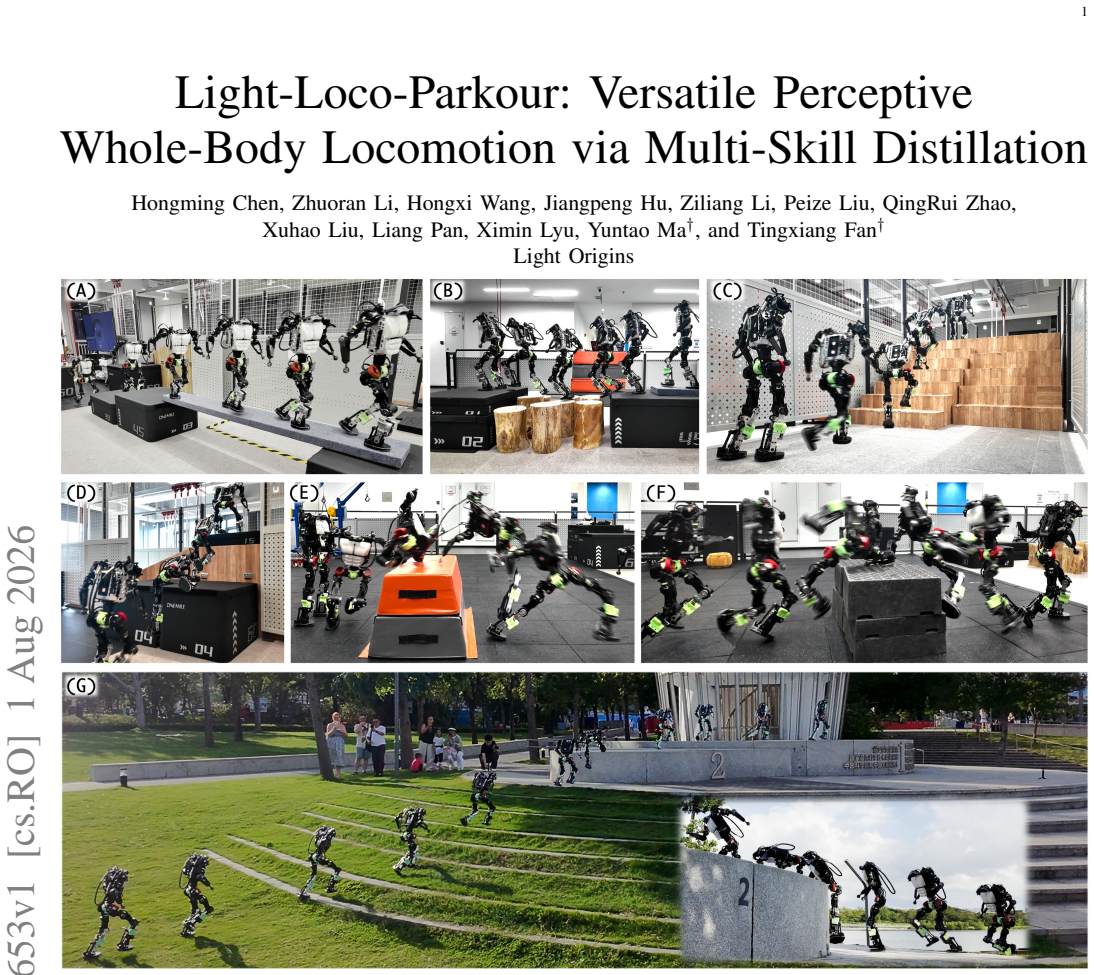
A single learned policy decides on its own when a humanoid should walk, climb, vault, or reverse-vault — reading only onboard depth and a velocity command, with no reference motion, skill label, or hand-coded switch.
Reviewed by Pith at T0; open to challenge. T0 means a machine referee read the full paper against a public rubric. the ladder, T0–T4 →
T0 review · deepseek-v4-flash
2026-08-05 00:54 UTC pith:GF5EZZY2
load-bearing objection A serious, well-ablated humanoid parkour paper whose central 'no hand-coded gate' claim is weakened by a hand-set AMP trigger position; definitely deserves review. the 3 major comments →
Light-Loco-Parkour: Versatile Perceptive Whole-Body Locomotion via Multi-Skill Distillation
The pith
A machine-rendered reading of the paper's core claim, the machinery that carries it, and where it could break.
Core claim
One deployable policy walks and performs whole-body parkour, choosing the behavior from depth and a velocity command alone, with no reference motion, skill label, or hand-coded gate. The pipeline needs almost no data: each skill starts from one video-derived seed motion, grown by iterative lifting of obstacle and rollout into a continuum of feasible, terrain-paired references. Distillation (DAgger plus PPO) generalizes the skill across obstacle geometry, and a reward-only transition stage — a motion prior switching to the skill at a trigger position — lets the when-and-which decision emerge from reward. On a 90 cm humanoid, the policy runs all skills zero-shot on hardware, including climb-an
What carries the argument
The load-bearing mechanism is the conditional adversarial motion prior (AMP) switch in transition fine-tuning: before reaching a skill's trigger position the prior is the locomotion AMP; past it, the prior becomes the skill AMP. This switch actively drives the handoff, pushing the policy to walk up to the obstacle and then adopt the crossing skill, with no goal input. Two further mechanisms carry the rest. Iterative self-augmentation grows one seed motion into a continuum of dynamically feasible, terrain-paired references by lifting both obstacle and rollout by 5–10 cm per iteration. Multi-expert distillation (DAgger + PPO) merges per-skill experts into one student reading only proprioceptio
Load-bearing premise
The transition handoff relies on a skill trigger position at which the motion prior switches from locomotion to the skill, but the paper does not say how that trigger is chosen or learned; if it is placed by hand per obstacle, the no-hand-coded-gate claim is only partly supported, and chaining could fail when obstacle layouts shift or overlap.
What would settle it
Deploy the policy on a course with two skill obstacles in close succession — the paper reports degraded behavior in exactly this regime — and count how often the second skill is invoked. A second probe: log the trigger position of the AMP switch and move the obstacle mid-approach; if the policy commits to the original trigger instead of re-planning from depth, the switching is not fully perceptual.
If this is right
- One seed video per skill can replace a large motion-capture corpus: the iterative lift of obstacle and rollout produces terrain-paired references up to the hardware's torque limits, covering obstacle heights the seed never showed.
- The same single policy tracks a velocity command in open terrain, executes a whole-body traversal at an obstacle, and resumes walking — and it is command-aware, retreating when told to reverse instead of being drawn to any obstacle in view.
- Reward alone can teach the switching: without the transition training group the policy never chains skills (0–33% success on the test courses), and with it the success rate reaches 98%.
- The skills key on perceived geometry, not memorized shape: speed-vault and reverse-vault trained on boxes transfer to a trapezoidal obstacle never seen in training with over 93% success in simulation.
- The whole controller runs at 50 Hz on a low-power edge module with no second network and no runtime motion generator, which is what makes the single-policy claim deployable on modest hardware.
Where Pith is reading between the lines
- The trigger position for the AMP switch is the least-specified element in the pipeline; a testable follow-up is to predict the trigger from depth or drop it entirely and check whether transitions still emerge — if they do, the no-hand-coded-gate claim becomes stronger than the text currently supports.
- The data pipeline still starts with a human aligning a virtual obstacle to the contacts in a recovered video motion, which the authors name as the ceiling on scaling; automating that alignment by detecting contact points from the SMPL track would remove the last human-in-the-loop step.
- Because the depth student's GRU is trained with an auxiliary height-scan reconstruction loss, the latent state should carry terrain that has scrolled out of view; if that loss sustains stepping-stone success, ablating it would predictably reproduce the sharp drops the table shows for the non-recurrent policy.
- The paper reports degraded behavior when obstacles overlap or appear in close succession; a natural extension is a transition curriculum that randomizes obstacle spacing, pushing the policy from selecting one skill at a time toward composing several in sequence.
Editorial analysis
A structured set of objections, weighed in public.
Referee Report
Summary. The paper presents Light-Loco-Parkour (LLP), a single end-to-end perceptive whole-body locomotion policy for a custom 90-cm humanoid. The policy is conditioned only on onboard depth and a velocity command and is claimed to decide autonomously when to walk, balance, climb, step down, or vault, with no reference input, skill label, hand-coded gate, or runtime motion graph. The pipeline combines a perceptive locomotion teacher trained with PPO, per-skill experts learned from seed motions expanded through iterative self-augmentation, multi-expert DAgger distillation into a single height-scan policy, a transition fine-tuning stage with an adversarial motion prior, and a final distillation to a recurrent depth-based student. Experiments include 500-trial simulation ablations, comparisons with four prior systems, a held-out pommel-horse obstacle, a command-adherence test, and qualitative real-world indoor/outdoor demonstrations on hardware.
Significance. If the claims hold, this is a meaningful step for humanoid whole-body parkour: it demonstrates a single deployable policy that combines perceptive locomotion with contact-rich arm/torso skills on custom hardware, and it addresses data scarcity via sparse-seed augmentation rather than a large motion corpus. The simulation ablations are systematic and controlled, the held-out obstacle-shape test is a useful generalization probe, and the command-adherence experiment directly attacks a known failure mode of reference-bound policies. The paper also gives a clear decomposition of the training pipeline that is reproducible from the text. The main reservation is that the headline claim of 'no hand-coded gate' is not fully supported by the transition mechanism as described, since a trigger position appears to be manually placed; this limits the strength of the central contribution as currently written.
major comments (3)
- [§V-C2, Eq. (11), Fig. 6] The abstract and Contribution 3 claim that skill switching emerges from perception and task reward alone, with 'no hand-coded gate.' Section V-C2, however, states that the AMP prior is switched by phase: 'before the robot reaches the skill’s trigger position the prior is the locomotion AMP, and once it passes that position the prior switches to the skill AMP,' and adds that 'this phase switch is what actively drives the handoff.' The manuscript never states how the trigger position is chosen or learned. If it is set by hand per skill/obstacle, the 'no hand-coded gate' claim is contradicted, and Table VII shows the issue is load-bearing: removing AMP drops transition-and-skill success from 98% to 51%. Please either describe how the trigger is learned (with equations or training details) or revise the central claims to acknowledge a hand-set or hand-shaped positional prior in the transitio
- [§VII-B, Fig. 8] The real-world section reports successful traversals of each skill and of autonomous transition courses, but does not report the number of trials, the success criterion, or any failure counts. Because the central claim is that a single policy 'deploys zero-shot' on hardware and switches skills autonomously, qualitative demonstrations alone are insufficient to distinguish a robust learned capability from a curated successful run. Please add a quantitative hardware protocol: number of runs per terrain/skill, the pass/fail definition, and ideally the commanded-velocity adherence and switch timing. This is needed to support the deployment claim.
- [§V-A2, Eq. (6)] The iterative self-augmentation loop lifts both the rollout reference and the obstacle by m ∈ [5,10] cm per iteration and stores the pair as 'dynamically feasible by construction.' The selected rollout is feasible for the obstacle d_i on which it was generated, but the lifted pair (r_{i+1}, d_{i+1}) is a new, more demanding task; there is no argument or experiment showing that a 5–10 cm vertical lift preserves dynamic or kinematic feasibility under the robot's torque and angular-velocity limits. This is an assumption rather than a construction. Please provide a validation metric (e.g., mimic success or torque margin on the lifted height, or a reset-level feasibility check) before claiming the references are feasible by construction.
minor comments (6)
- [§V-C2] It is unclear how the 'trigger position' is computed at runtime when the system is stated to have no odometry. If it is derived from the depth/height scan (e.g., obstacle-relative), state this explicitly; if it uses world position, that conflicts with the no-odometry claim.
- [§VI, Eq. (13)] Clarify whether the reconstruction decoder Dψ is trained jointly with the policy or only as an auxiliary loss after the policy is fixed, and whether the gradient from L_recon flows into the GRU.
- [Abstract / §I] The abstract and introduction say 'no reference input' at inference, while training clearly uses references. Consider phrasing as 'no reference input at deployment' to avoid ambiguity.
- [§V-B] Contribution 2 says 'one policy per skill generalizes across obstacle geometry,' while the final contribution is a single policy. Clarify the relationship between per-skill policies and the unified deployed policy.
- [§VII-C2, Table V] For the Teacher w/o RA ablation, only speed-vault is described in detail; please add a sentence on the other skills to make the table self-contained.
- [Throughout] There are minor typos and spacing issues (e.g., 'the actiona t', 'E[ P'), and the term 'Light-Loco-Parkour' is inconsistently abbreviated. A proofread pass would improve readability.
Circularity Check
The 'autonomous transition, no hand-coded gate' claim is undercut by a hand-set AMP trigger position that actively drives the handoff.
specific steps
-
fitted input called prediction
[Section V-C2, Eq. (12), Fig. 6; Abstract and Contribution 3]
"Finally, a conditional adversarial motion-prior reward [6], r_amp(s_t,s_{t+1}) = −log(1−D_phi(s_t,s_{t+1})), keeps the motion close to the learned behaviors, with the discriminator D_phi switched by phase: before the robot reaches the skill's trigger position the prior is the locomotion AMP, and once it passes that position the prior switches to the skill AMP. This phase switch is what actively drives the handoff"
The paper's headline claim is that the policy selects and executes skills 'with no reference input, skill label, hand-coded gate, or runtime motion graph' and that skill transitions 'emerge from perception and task reward alone.' But the transition mechanism inserts a hand-set positional trigger: the AMP prior is switched from locomotion to skill when the robot passes that position, and the text states this phase switch 'actively drives the handoff.' The trigger position is not learned and no selection procedure is given; it is a task-level positional gate that coerces the switch. Thus the 'autonomous' timing decision is, by construction, the hand-coded trigger, not a purely emergent policy decision. This is a self-definitional use of 'no hand-coded gate': a positional gate is used, and th
full rationale
The core skill-learning and generalization results are not circular: the policy is evaluated on held-out obstacle shapes, depth distillation is supervised by a teacher, and the hardware transfers are external. The self-citation to a co-author's earlier work (ref. [35]) appears only in related work and is not load-bearing. The iterative self-augmentation loop, where the policy's own rollout becomes the next reference, is a bootstrapping data-generation scheme rather than a prediction that equals an input; it is self-referential but not a tautology. However, the specific claim of autonomous, gate-free skill transition is materially undercut by the hand-set AMP trigger position that drives the handoff, and the ablation shows transition success drops from 98% to 51% without AMP. This makes the transition claim partially reduce to a hand-coded input, so the paper is not fully self-contained on its strongest 'no hand-coded gate' assertion.
Axiom & Free-Parameter Ledger
free parameters (7)
- Reward weights for perceptive locomotion (Table I) =
velocity tracking 2.0; angular tracking 2.0; upright 1.0; slack 1.5; undesired contact -2.0; joint limit -10.0; illegal
- Velocity-slack band =
v_c^x / v_x in [0.3, 1.5]
- Per-iteration height lift m =
5-10 cm
- Illegal-footstep threshold delta =
0.1 m
- Foot acceleration threshold and time constant =
30 m/s^2, tau=0.06 s
- Depth noise model parameters =
sigma = 0.005 + 0.02 d, scale jitter 5%
- AMP trigger position =
not reported
axioms (5)
- standard math PPO and DAgger provide a valid learning procedure for the POMDP described in Section III-A
- domain assumption IsaacLab simulation with the domain randomization in Table II is a faithful enough proxy for Lightbot 0 that zero-shot transfer holds
- domain assumption The calibrated depth noise and latency model in Section VI matches the real D435 well enough for the final distillation
- ad hoc to paper Lifting a feasible reference and its obstacle by 5-10 cm at each augmentation iteration preserves dynamic feasibility
- ad hoc to paper The AMP discriminator can be switched by a pre-set trigger position while still claiming reward-only transition learning
Cite this review
Pith. "Pith review of Light-Loco-Parkour: Versatile Perceptive Whole-Body Locomotion via Multi-Skill Distillation." pith.science (2026). https://pith.science/paper/GF5EZZY2
@misc{pith2026260802653,
  author       = {Pith},
  title        = {Pith review of: Light-Loco-Parkour: Versatile Perceptive Whole-Body Locomotion via Multi-Skill Distillation},
  year         = {2026},
  howpublished = {\url{https://pith.science/paper/GF5EZZY2}},
  note         = {Machine review of arXiv:2608.02653}
}
read the original abstract
Existing humanoid whole-body control systems still fall short of the way humans move through cluttered terrain: they either track expressive whole-body references without terrain generalization, or react to terrain online while leaving the arms, torso, and knees largely unused. We present \texttt{Light-Loco-Parkour} (LLP), an end-to-end perceptive whole-body locomotion system that closes this gap with a single deployable policy. Conditioned only on onboard depth and a velocity command, the policy decides when to walk, balance, climb, step down, or vault, with no reference input, skill label, hand-coded gate, or runtime motion graph. Compared with prior humanoid systems, LLP makes three contributions. First, it introduces a whole-body perceptive-control pipeline that extends an RL-trained, velocity-tracking locomotion policy with parkour skills learned from object-interacting motions, so the same policy tracks velocity in open terrain, executes whole-body traversal at obstacles, and resumes locomotion afterward. Second, it acquires terrain-conditioned skills from sparse seeds by expanding a single motion into dynamically feasible, terrain-paired references across obstacle geometry, rather than relying on a large motion corpus. Third, it learns autonomous skill transitions from reward, letting the policy decide when and which whole-body skill to invoke from depth and command alone, with no one-hot skill label, hand-coded state machine, or runtime motion generator. Simulation and real-world experiments show high success across both benchmarked terrains and unseen obstacle variations, and the same policy transfers zero-shot to indoor and outdoor hardware experiments. These results demonstrate autonomous perceptive whole-body locomotion on a humanoid in outdoor settings, using only onboard sensing and a single deployable policy.
Figures


Reference graph
Works this paper leans on
-
[1]
Deepmimic: Example-guided deep reinforcement learn- ing of physics-based character skills,
X. B. Peng, P. Abbeel, S. Levine, and M. Van de Panne, “Deepmimic: Example-guided deep reinforcement learn- ing of physics-based character skills,”ACM Transactions On Graphics (TOG), vol. 37, no. 4, pp. 1–14, 2018
work page 2018
-
[2]
Beyondmimic: From mo- tion tracking to versatile humanoid control via guided diffusion,
Q. Liao, T. E. Truong, X. Huang, Y . Gao, G. Tevet, K. Sreenath, and C. K. Liu, “Beyondmimic: From mo- tion tracking to versatile humanoid control via guided diffusion,”arXiv preprint arXiv:2508.08241, 2025
Pith/arXiv arXiv 2025
-
[3]
Real-world humanoid locomotion with reinforcement learning,
I. Radosavovic, T. Xiao, B. Zhang, T. Darrell, J. Malik, and K. Sreenath, “Real-world humanoid locomotion with reinforcement learning,”Science Robotics, vol. 9, no. 89, p. eadi9579, 2024
2024
-
[4]
Advancing humanoid locomotion: Mastering challenging terrains with denoising world model learn- ing,
X. Gu, Y .-J. Wang, X. Zhu, C. Shi, Y . Guo, Y . Liu, and J. Chen, “Advancing humanoid locomotion: Mastering challenging terrains with denoising world model learn- ing,”arXiv preprint arXiv:2408.14472, 2024
Pith/arXiv arXiv 2024
-
[5]
Teleoperation of humanoid robots: A survey,
K. Darvish, L. Penco, J. Ramos, R. Cisneros, J. Pratt, E. Yoshida, S. Ivaldi, and D. Pucci, “Teleoperation of humanoid robots: A survey,”IEEE Transactions on Robotics, vol. 39, no. 3, pp. 1706–1727, 2023
work page 2023
-
[6]
Amp: Adversarial motion priors for styl- ized physics-based character control,
X. B. Peng, Z. Ma, P. Abbeel, S. Levine, and A. Kanazawa, “Amp: Adversarial motion priors for styl- ized physics-based character control,”ACM Transactions on Graphics (TOG), vol. 40, no. 4, pp. 1–20, 2021
work page 2021
-
[7]
Soft- mimic: Learning compliant whole-body control from examples,
G. B. Margolis, M. Wang, N. Fey, and P. Agrawal, “Soft- mimic: Learning compliant whole-body control from examples,”arXiv preprint arXiv:2510.17792, 2025
arXiv 2025
-
[8]
Hil: Hybrid imitation learning of diverse parkour skills from videos,
J. Wang, Y . Jiang, H. Zhang, C. Tessler, D. Rempe, J. Hodgins, and X. B. Peng, “Hil: Hybrid imitation learning of diverse parkour skills from videos,”arXiv preprint arXiv:2505.12619, 2025
arXiv 2025
-
[9]
Sonic: Supersizing motion tracking for nat- ural humanoid whole-body control,
Z. Luo, Y . Yuan, T. Wang, C. Li, S. Chen, F. Casta ˜neda et al., “Sonic: Supersizing motion tracking for nat- ural humanoid whole-body control,”arXiv preprint arXiv:2511.07820, 2025. 18
Pith/arXiv arXiv 2025
-
[10]
Per- petual humanoid control for real-time simulated avatars,
Z. Luo, J. Cao, A. Winkler, K. Kitani, and W. Xu, “Per- petual humanoid control for real-time simulated avatars,” arXiv preprint arXiv:2305.06456, 2023
Pith/arXiv arXiv 2023
-
[11]
L. Yang, X. Huang, Z. Wu, A. Kanazawa, P. Abbeel, C. Sferrazza, C. K. Liu, R. Duan, and G. Shi, “Omniretar- get: Interaction-preserving data generation for humanoid whole-body loco-manipulation and scene interaction,” arXiv preprint arXiv:2509.26633, 2025
Pith/arXiv arXiv 2025
-
[12]
Z. Zhuang, Z. Fu, J. Wang, C. Atkeson, S. Schwertfeger, C. Finn, and H. Zhao, “Robot parkour learning,”arXiv preprint arXiv:2309.05665, 2023
Pith/arXiv arXiv 2023
-
[13]
N. Rudin, J. He, J. Aurand, and M. Hutter, “Parkour in the wild: Learning a general and extensible agile locomotion policy using multi-expert distillation and rl fine-tuning,”arXiv preprint arXiv:2505.11164, 2025
Pith/arXiv arXiv 2025
-
[14]
High-speed control and nav- igation for quadrupedal robots on complex and discrete terrain,
H. Kim, H. Oh, J. Park, Y . Kim, D. Youm, M. Jung, M. Lee, and J. Hwangbo, “High-speed control and nav- igation for quadrupedal robots on complex and discrete terrain,”Science Robotics, vol. 10, no. 102, p. eads6192, 2025
work page 2025
-
[15]
Z. Zhuang, S. Zhu, M. Zhao, and H. Zhao, “Deep whole- body parkour,”arXiv preprint arXiv:2601.07701, 2026
arXiv 2026
-
[16]
Perceptive humanoid parkour: Chaining dy- namic human skills via motion matching,
Z. Wu, X. Huang, L. Yang, Y . Zhang, K. Sreenath, X. Chen, P. Abbeel, R. Duan, A. Kanazawa, C. Sfer- razzaet al., “Perceptive humanoid parkour: Chaining dy- namic human skills via motion matching,”arXiv preprint arXiv:2602.15827, 2026
Pith/arXiv arXiv 2026
-
[17]
Learning whole-body humanoid locomotion via mo- tion generation and motion tracking,
Z. Zhang, K. Wen, M. Xu, J. He, C. Li, T. Miki, C. Schwarke, C. Zhang, X. B. Peng, and M. Hutter, “Learning whole-body humanoid locomotion via mo- tion generation and motion tracking,”arXiv preprint arXiv:2604.17335, 2026
Pith/arXiv arXiv 2026
-
[18]
Biped walking pattern generation by using preview control of zero- moment point,
S. Kajita, F. Kanehiro, K. Kaneko, K. Fujiwara, K. Harada, K. Yokoi, and H. Hirukawa, “Biped walking pattern generation by using preview control of zero- moment point,” inIEEE International Conference on Robotics and Automation (ICRA), vol. 2. IEEE, 2003, pp. 1620–1626
work page 2003
-
[19]
Centroidal dynamics of a humanoid robot,
D. E. Orin, A. Goswami, and S.-H. Lee, “Centroidal dynamics of a humanoid robot,”Autonomous Robots, vol. 35, no. 2-3, pp. 161–176, 2013
2013
-
[20]
Optimization-based locomotion planning, estimation, and control design for the atlas humanoid robot,
S. Kuindersma, R. Deits, M. Fallon, A. Valenzuela, H. Dai, F. Permenter, T. Koolen, P. Marion, and R. Tedrake, “Optimization-based locomotion planning, estimation, and control design for the atlas humanoid robot,”Autonomous Robots, vol. 40, no. 3, pp. 429–455, 2016
work page 2016
-
[21]
Dynamic locomotion in the MIT cheetah 3 through convex model-predictive control,
J. Di Carlo, P. M. Wensing, B. Katz, G. Bledt, and S. Kim, “Dynamic locomotion in the MIT cheetah 3 through convex model-predictive control,” inIEEE/RSJ International Conference on Intelligent Robots and Sys- tems (IROS). IEEE, 2018, pp. 1–9
work page 2018
-
[22]
A direct method for trajectory optimization of rigid bodies through contact,
M. Posa, C. Cantu, and R. Tedrake, “A direct method for trajectory optimization of rigid bodies through contact,” The International Journal of Robotics Research, vol. 33, no. 1, pp. 69–81, 2014
work page 2014
-
[23]
Learning agile and dynamic motor skills for legged robots,
J. Hwangbo, J. Lee, A. Dosovitskiy, D. Bellicoso, V . Tsounis, V . Koltun, and M. Hutter, “Learning agile and dynamic motor skills for legged robots,”Science robotics, vol. 4, no. 26, p. eaau5872, 2019
2019
-
[24]
Rma: Rapid motor adaptation for legged robots,
A. Kumar, Z. Fu, D. Pathak, and J. Malik, “Rma: Rapid motor adaptation for legged robots,”arXiv preprint arXiv:2107.04034, 2021
Pith/arXiv arXiv 2021
-
[25]
Robust and versatile bipedal jumping control through multi-task reinforcement learning. arxiv 2023,
Z. Li, X. Peng, P. Abbeel, S. Levine, G. Berseth, and K. Sreenath, “Robust and versatile bipedal jumping control through multi-task reinforcement learning. arxiv 2023,”arXiv preprint arXiv:2302.09450, 2023
Pith/arXiv arXiv 2023
-
[26]
Learning robust perceptive locomotion for quadrupedal robots in the wild,
T. Miki, J. Lee, J. Hwangbo, L. Wellhausen, V . Koltun, and M. Hutter, “Learning robust perceptive locomotion for quadrupedal robots in the wild,”Science Robotics, vol. 7, no. 62, p. eabk2822, 2022
2022
-
[27]
Beamdojo: Learning agile hu- manoid locomotion on sparse footholds,
H. Wang, Z. Wang, J. Ren, Q. Ben, T. Huang, W. Zhang, and J. Pang, “Beamdojo: Learning agile hu- manoid locomotion on sparse footholds,”arXiv preprint arXiv:2502.10363, 2025
Pith/arXiv arXiv 2025
-
[28]
Learning humanoid locomotion with perceptive internal model,
J. Long, J. Ren, M. Shi, Z. Wang, T. Huang, P. Luo, and J. Pang, “Learning humanoid locomotion with perceptive internal model,” inIEEE International Conference on Robotics and Automation (ICRA). IEEE, 2025
work page 2025
-
[29]
Pie: Parkour with implicit-explicit learning framework for legged robots,
S. Luo, S. Li, R. Yu, Z. Wang, J. Wu, and Q. Zhu, “Pie: Parkour with implicit-explicit learning framework for legged robots,”IEEE Robotics and Automation Letters, 2024
work page 2024
-
[30]
J. Sun, G. Han, P. Sun, W. Zhao, J. Cao, J. Wang, Y . Guo, and Q. Zhang, “Dpl: Depth-only perceptive humanoid lo- comotion via realistic depth synthesis and cross-attention terrain reconstruction,”arXiv preprint arXiv:2510.07152, 2025
Pith/arXiv arXiv 2025
-
[31]
Smp: Reusable score-matching motion priors for physics-based character control,
Y . Mu, Z. Zhang, Y . Shi, D. Yang, M. Matsumoto, K. Imamura, G. Tevet, C. Guo, M. Taylor, C. Shu, P. Xi, and X. B. Peng, “Smp: Reusable score-matching motion priors for physics-based character control,”arXiv preprint arXiv:2512.03028, 2025
Pith/arXiv arXiv 2025
-
[32]
Asap: Aligning simulation and real-world physics for learning agile humanoid whole-body skills,
T. He, J. Gao, W. Xiao, Y . Zhang, Z. Wang, J. Wang et al., “Asap: Aligning simulation and real-world physics for learning agile humanoid whole-body skills,”arXiv preprint arXiv:2502.01143, 2025
Pith/arXiv arXiv 2025
-
[33]
Kungfubot: Physics-based hu- manoid whole-body control for learning highly-dynamic skills,
W. Xie, J. Han, J. Zheng, H. Li, X. Liu, J. Shi, C. Bai, X. Li, and W. Zhang, “Kungfubot: Physics-based hu- manoid whole-body control for learning highly-dynamic skills,”arXiv preprint arXiv:2506.12851, 2025
Pith/arXiv arXiv 2025
-
[34]
World-grounded human motion recovery via gravity-view coordinates,
Z. Shen, H. Pi, Y . Xia, Z. Cen, S. Peng, Z. Hu, H. Bao, R. Hu, and X. Zhou, “World-grounded human motion recovery via gravity-view coordinates,” inSIGGRAPH Asia 2024 Conference Papers, 2024, pp. 1–11
work page 2024
-
[35]
Make tracking easy: Neural motion retargeting for humanoid whole- body control,
Q. Zhao, K. Yang, X. Wang, S. Zhao, Y . Lu, X. Zhang, Q. Shen, X.-X. Long, and X. Cao, “Make tracking easy: Neural motion retargeting for humanoid whole- body control,”arXiv preprint arXiv:2603.22201, 2026
Pith/arXiv arXiv 2026
-
[36]
Proximal policy optimization algorithms,
J. Schulman, F. Wolski, P. Dhariwal, A. Radford, and O. Klimov, “Proximal policy optimization algorithms,” arXiv preprint arXiv:1707.06347, 2017
Pith/arXiv arXiv 2017
-
[37]
Orbit: A unified simulation framework for interactive robot learning environments,
M. Mittal, C. Yu, Q. Yu, J. Liu, N. Rudin, D. Hoeller, J. L. Yuan, R. Singh, Y . Guo, H. Mazharet al., “Orbit: A unified simulation framework for interactive robot learning environments,”IEEE Robotics and Automation 19 Letters, vol. 8, no. 6, pp. 3740–3747, 2023
work page 2023
-
[38]
Learning quadrupedal locomotion over chal- lenging terrain,
J. Lee, J. Hwangbo, L. Wellhausen, V . Koltun, and M. Hutter, “Learning quadrupedal locomotion over chal- lenging terrain,”Science Robotics, vol. 5, no. 47, p. eabc5986, 2020
work page 2020
-
[39]
D. Chen, B. Zhou, V . Koltun, and P. Kr¨ahenb¨uhl, “Learn- ing by cheating,” inConference on Robot Learning (CoRL). PMLR, 2020, pp. 66–75
work page 2020
-
[40]
Reinforcement learning for versatile, dynamic, and robust bipedal locomotion control,
Z. Li, X. B. Peng, P. Abbeel, S. Levine, G. Berseth, and K. Sreenath, “Reinforcement learning for versatile, dynamic, and robust bipedal locomotion control,”The International Journal of Robotics Research, 2024
work page 2024
-
[41]
Asymmetric actor critic for image-based robot learning,
L. Pinto, M. Andrychowicz, P. Welinder, W. Zaremba, and P. Abbeel, “Asymmetric actor critic for image-based robot learning,” inRobotics: Science and Systems (RSS), 2018
2018
-
[42]
Learning dexterous in-hand manipu- lation,
M. Andrychowicz, B. Baker, M. Chociej, R. J ´ozefowicz, B. McGrew, J. Pachocki, A. Petron, M. Plappert, G. Pow- ell, A. Rayet al., “Learning dexterous in-hand manipu- lation,”The International Journal of Robotics Research, vol. 39, no. 1, pp. 3–20, 2020
work page 2020
-
[43]
Impossibly good experts and how to follow them,
A. Walsman, M. Zhang, S. Choudhury, D. Fox, and A. Farhadi, “Impossibly good experts and how to follow them,” inInternational Conference on Learning Repre- sentations (ICLR), 2022
work page 2022
-
[44]
Leveraging fully observable policies for learning under partial observability,
H. Nguyen, A. Baisero, D. Wang, C. Amato, and R. Platt, “Leveraging fully observable policies for learning under partial observability,” inConference on Robot Learning (CoRL). PMLR, 2023, pp. 1673–1683
work page 2023
-
[45]
Robust asymmetric learning in POMDPs,
A. Warrington, J. W. Lavington, A. Scibior, M. Schmidt, and F. Wood, “Robust asymmetric learning in POMDPs,” inInternational Conference on Machine Learning (ICML). PMLR, 2021, pp. 11 013–11 023
work page 2021
-
[46]
Student-Informed Teacher Training
N. Messikommer, J. Xing, E. Aljalbout, and D. Scara- muzza, “Student-informed teacher training,”arXiv preprint arXiv:2412.09149, 2025
work page internal anchor Pith review Pith/arXiv arXiv 2025
-
[47]
Learning to walk in minutes using massively parallel deep rein- forcement learning,
N. Rudin, D. Hoeller, P. Reist, and M. Hutter, “Learning to walk in minutes using massively parallel deep rein- forcement learning,” inConference on Robot Learning (CoRL). PMLR, 2022, pp. 91–100
work page 2022
-
[48]
Sim-to-real transfer of robotic control with dynamics randomization,
X. B. Peng, M. Andrychowicz, W. Zaremba, and P. Abbeel, “Sim-to-real transfer of robotic control with dynamics randomization,” inIEEE International Confer- ence on Robotics and Automation (ICRA). IEEE, 2018, pp. 3803–3810
work page 2018
-
[49]
Domain randomization for transferring deep neural networks from simulation to the real world,
J. Tobin, R. Fong, A. Ray, J. Schneider, W. Zaremba, and P. Abbeel, “Domain randomization for transferring deep neural networks from simulation to the real world,” in IEEE/RSJ International Conference on Intelligent Robots and Systems (IROS). IEEE, 2017, pp. 23–30
work page 2017
-
[50]
Retar- geting matters: General motion retargeting for humanoid motion tracking,
J. P. Araujo, Y . Ze, P. Xu, J. Wu, and C. K. Liu, “Retar- geting matters: General motion retargeting for humanoid motion tracking,”arXiv preprint arXiv:2510.02252, 2025
arXiv 2025
-
[51]
Parc: Physics- based augmentation with reinforcement learning for char- acter controllers,
M. Xu, Y . Shi, K. Yin, and X. B. Peng, “Parc: Physics- based augmentation with reinforcement learning for char- acter controllers,” inProceedings of the Special Interest Group on Computer Graphics and Interactive Techniques Conference Conference Papers, 2025, pp. 1–11
work page 2025
-
[52]
Flip stunts on bicycle robots using iterative motion imitation,
J. Kim, S. Fahmi, S. Rho, S. Ha, and G. Nelson, “Flip stunts on bicycle robots using iterative motion imitation,” arXiv preprint arXiv:2603.27944, 2026
arXiv 2026
-
[53]
A reduction of imitation learning and structured prediction to no-regret online learning,
S. Ross, G. Gordon, and D. Bagnell, “A reduction of imitation learning and structured prediction to no-regret online learning,” inProceedings of the fourteenth inter- national conference on artificial intelligence and statis- tics. JMLR Workshop and Conference Proceedings, 2011, pp. 627–635
work page 2011
-
[54]
Cref: Cross-modal and recurrent fusion for depth-conditioned humanoid locomotion,
Y . Hao, R. Yu, S. Luo, G. Zhang, J. Wu, and Q. Zhu, “Cref: Cross-modal and recurrent fusion for depth-conditioned humanoid locomotion,”arXiv preprint arXiv:2603.29452, 2026
Pith/arXiv arXiv 2026
discussion (0)
Sign in with ORCID, Apple, or X to comment. Anyone can read and Pith papers without signing in.