REVIEW 3 major objections 5 minor
Learning Discrete Decisions for MIPs with Constraint-Aware Diffusion
T0 review · 3 major / 5 minor · reviewed 2026-08-15 · deepseek-v4-flash
Pith's one-line read Injecting a feasibility projection into every reverse diffusion step yields feasible binary decisions for mixed-integer programs and up to 425x faster solves.
desk verdict A well-engineered diffusion-plus-projection pipeline for discrete decisions in MINLPs, with sound convex-projection theory and promising results, but the AC speedup claim is undercut by an unmeasured MILP projection that the stated theory does not cover. read the letter →
The pith
A machine-rendered reading of the paper's core claim, the machinery that carries it, and where it could break.
The reading
What carries the argument
The load-bearing object is the feasibility projection $\Pi_{C_\xi}$ placed inside every reverse transition. At reverse step $t$, the denoiser's noise prediction is converted into a clean embedded estimate, the tanh map bounds it to $[-1,1]^m$, and the map $e^{-1}$ converts it to a relaxed decision $\hat{z}_t = (\hat{y}_{0,t}+1)/2 \in [0,1]^m$; the projection $u_t = \Pi_{C_\xi}(\hat{z}_t)$ then solves the convex program minimizing $\|u - \hat{z}_t\|_2^2$ over the relaxation $C_\xi$, and the corrected point is reinserted via the consistent noise estimate $\varepsilon_t^C = (y_t - \sqrt{\bar{\alpha}_t} e(u_t))/\sqrt{1-\bar{\alpha}_t}$, which replaces the model's raw prediction in the standard DDPM update. The antipodal embedding $y_0 = 2z^* - 1$ preserves Hamming geometry. Proposition 1 shows the projection residual is the gradient of the squared distance and that projection cannot increase the distance to any feasible reference; Proposition 2 shows the projected reverse kernel is the 2-Wasserstein-closest feasible kernel and that the correction reduces distance to every relaxed-feasible endpoint. The training objective adds a feasibility regularizer that projects the Monte Carlo mean of $K$ perturbed denoiser predictions and backpropagates the residual through the relaxed predictions with a stop-gradient on the projected target.
What would settle it
Measure the wall-clock time of the projection call $\Pi_{C_\xi}$ alone on the IEEE 500-bus benchmark across all 100 reverse steps of a single sample. If solving the load-relevant connectivity MILP over 597 binary variables at each step takes longer than the reported 0.11 s total sampling time, the claim that the exact projection is applied at every step cannot be sustained. A second check is to verify on every test instance that the thresholded terminal point $T(u_0)$ belongs to $Z_\xi$ and induces a feasible AC-OPF, since the paper states the projection does not guarantee either condition.
Extended reading notes
Core claim
The paper's central claim is that incorporating a feasibility projection operator inside every reverse diffusion step—rather than applying it only at the end—steers generated discrete decisions toward the feasible set without destroying the learned data distribution. The projection is applied to the relaxed decision in $[0,1]^m$, mapping it onto the convex relaxation $C_\xi$ of the combinatorial feasible set, and the corrected point is reinserted into the reverse update through a consistent noise estimate. After the final step, a thresholding map recovers a binary decision and the original mixed-integer problem reduces to a continuous program. The paper reports that this repeated-projection protocol improves Hamming distance, exact reconstruction, downstream feasibility, and objective gap relative to no-projection and final-step-projection variants on both benchmark families. The paper is explicit about the scope of the guarantee: the projection enforces only relaxed feasibility, and discrete feasibility is certified only when the recovery map satisfies a slack condition, so downstream feasibility and optimality are attributed to the continuous solver rather than to the diffusion model itself.
Load-bearing premise
The load-bearing premise is that the projection operator called at every reverse step is cheap enough and close enough to the true feasible set that it does not dominate runtime and does not steer samples away from good optima; for the 500-bus power benchmark the paper describes the projection as a MILP over 597 binary line variables, and it does not report the projection cost separately from the overall sampling time.
Editorial extensions
If this is right
- On structured mixed-integer nonlinear programs with a convex relaxation of the discrete constraints, the online combinatorial search can be replaced by one diffusion pass plus one continuous solve, amortizing the hardest part of the computation across related instances.
- Applying the projection at every reverse step improves discrete accuracy and downstream objective gap relative to applying it only at the end, even in settings where the final-step projection already achieves zero infeasibility.
- The generative model represents a distribution over discrete assignments, so it can provide multiple near-optimal feasible decisions for a single instance, something a deterministic predictor cannot do.
- The reported end-to-end runtime is dominated by the continuous completion stage on the two larger power networks, so the speedup is largest when the discrete block is the main bottleneck of the joint problem.
Reading between the lines
- Inference: the projection cost, not reported separately, is the main hidden variable in the speedup claim. If the connectivity projection is solved as a MILP over 597 binary variables at each of 100 reverse steps on the 500-bus case, the reported 0.11 s sampling time would imply the projection is approximated, and the combinatorial difficulty would have moved into the sampling loop rather than dis
- Inference: Proposition 2's Wasserstein-minimal-intervention result frames the projection as a constrained posterior-mean correction, which suggests the same reinsertion mechanism could be transferred to flow-matching or consistency-model samplers that share the posterior-mean parameterization.
- Inference: the appendix's warm-start experiment indicates that for these power instances the solver bottleneck is optimality certification rather than primal solution quality; combining CGD with learned branching or cut-selection guidance is the natural next step, since feasible starts alone do not speed up the solver.
- Inference: the slack certificates (Propositions 5 and 6) define a monitorable condition during generation: if the relaxed slack at the terminal point is too small to absorb the rounding displacement, thresholding can break combinatorial feasibility. Tracking this slack could serve as an early-warning signal for retraining or for switching to a repair map.
Signed reviews
Editorial analysis
A structured set of objections, weighed in public.
Referee Report
Summary. The paper proposes Constrained Graph Diffusion (CGD), a graph-based conditional diffusion model that generates the binary decision block of a mixed-integer optimization problem and then solves the remaining continuous problem with a numerical optimizer. Feasibility is enforced by inserting a projection operator into every reverse diffusion step, projecting a relaxed decision onto a continuous relaxation of the combinatorial feasible set before the next denoising step. The method is evaluated on AC optimal power flow with transmission switching (IEEE 9-, 197-, and 500-bus systems) and on mixed-integer portfolio optimization. The paper reports lower Hamming distance, higher exact reconstruction, zero observed downstream infeasibility for most CGD settings, and wall-clock speedups up to 425x over a joint MINLP solver.
Significance. The paper's decomposition strategy is sensible: amortizing the combinatorial search with a generative model and relegating the continuous variables to a standard solver is a natural way to attack structured MINLPs. The geometric core is a genuine strength: Proposition 1, Proposition 2, and Corollary 3 are stated cleanly and their proofs are correct, and the paper is honest about what the theory does not imply, explicitly noting that repeated projection gives locally improved transitions rather than a certificate of sampling from the constrained distribution. The experimental design is also comparatively thorough, with several learning-based baselines, separate reporting of discrete quality, downstream feasibility, objective gap, and runtime, and a useful negative result on warm-starting. The significance of the framework, however, is conditional on the projection operator living up to the role assigned to it in Algorithm 1.
major comments (3)
- [Section 5.1, Eq. (8)-(9); Section 6.1; Appendix C] The theoretical guarantees (Proposition 1, Proposition 2, Corollary 3) are established only for exact projection onto a nonempty, closed, convex set C_xi, as defined in Eq. (8). The AC transmission-switching projection in Appendix C, however, is a mixed-integer linear program over binary line-status variables z_e with additional flow and supply variables, minimizing a Hamming objective. This is a nonconvex discrete optimization problem, not the convex relaxation C_xi of Eq. (8). Consequently, none of the paper's projection guarantees applies to the operator actually used in the headline AC experiments. The sentence in Section 5.1 allowing 'an application-specific correction with the same interface' when exact projection is impractical does not bridge this gap, because no analogue of Propositions 1-2 or Corollary 3 is provided for the discrete MILP operator. This is load-bearing: the entire conceptual justification for constraint-aware generation rests on the geometry of exact convex projection.
- [Algorithm 1, step 4; Appendix C, final paragraph; Table 3] There is a direct inconsistency between Algorithm 1 and the described AC implementation. Algorithm 1 applies the projection at every reverse step, unconditionally, for t = T down to 1. Appendix C, in contrast, states that 'the projection is applied during diffusion sampling whenever the predicted topology violates the load-relevant connectivity condition,' i.e., conditionally on violation. These two descriptions cannot both describe the evaluated method. Moreover, Table 3 reports only 'CGD sampling' time and does not report the number of projection solves, the time spent inside the projection MILP, or whether the MILP was invoked at every step, only on violation, or replaced by a heuristic. At the 500-bus scale the projection has 597 binary variables; a per-step invocation at T=100 steps would imply roughly 1 ms per MILP solve, which is not credible, while a violation-only invocation would mean the experiments did not test the per-step projection mechanism that the paper claims. The paper must state the actual invocation schedule and report projection cost separately.
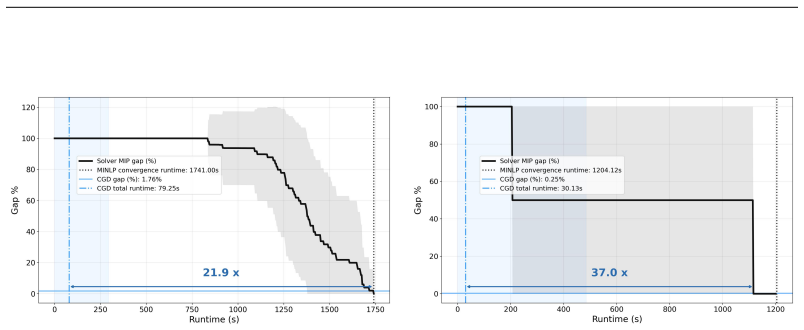
- [Section 6.1, Table 3 and Figures 4-6] The headline speedup of 425.2x on the 9-bus system compares CGD's end-to-end time (0.33 s) with Gurobi's full termination time (140.32 s) at a MIP gap tolerance of 1e-4. This is not an equal-footing comparison: CGD returns a feasible solution without an optimality certificate, whereas Gurobi's reported time includes proving the certificate. The paper's own Figure 4 shows that Gurobi reaches the same 0.01% gap level as CGD after 30.02 s, giving a 91.0x ratio rather than 425.2x. For the 197- and 500-bus systems, no time-to-same-gap comparison is reported, so the 22.0x and 40.0x speedups in Table 3 similarly mix certified and uncertified solution times. To support the speedup claims, the paper should report a time-to-target comparison, or clearly state and justify that the appropriate comparison is against full solver termination.
minor comments (5)
- [Section 6.1] There is a typo in the text: 'solving the resulting nonconvex mixed-integer AC-OPF with GUROBIGurobi' should be 'with Gurobi.'
- [Section 6, Baselines] The sentence 'These predictions are averaged, as in Eq. equation 24' has a duplicated word and an awkward reference; it should read 'as in Eq. (24)'.
- [Appendix D] The description of the portfolio reference solver as 'ECOS BBSOLVER' is unclear; please specify the exact solver and version used for the MIQP reference solutions.
- [Appendix C] The load-bus threshold epsilon is defined but its numerical value is never reported. Since the projection's behavior depends on which buses are classified as loads, the value of epsilon should be given for each benchmark.
- [Appendix D] There is a typo: 'AC-OPF with tranmission switching instances' should be 'transmission switching.'
Circularity Check
No significant circularity: the feasible-projection derivation is self-contained and the reported predictions do not reduce to their inputs by construction.
full rationale
The paper's claimed derivation chain is: (i) decompose the MINLP into discrete decisions z and continuous variables x; (ii) train a conditional graph diffusion model on reference discrete decisions; (iii) at inference, project each relaxed prediction onto a feasible relaxation C_xi; (iv) threshold and solve the induced continuous problem. None of these steps defines a prediction in terms of the target it is supposed to predict. The projection in Eq. (9) is an explicit convex optimization layer, and Propositions 1-2 and Corollary 3 follow from standard projection identities and do not assume the conclusions they establish. Proposition 4 is an explicit composition of stated assumptions and is not used to certify AC feasibility; the paper itself states that for AC transmission switching the component-capacity condition is 'necessary but not sufficient for the nonlinear AC equations.' The supervised evaluation uses Gurobi's reference decisions as training targets and as the basis for objective gaps, but this is behavior cloning rather than a fitted parameter renamed as a prediction; the test gaps are not forced to zero and the paper reports nonzero gaps on all benchmarks (e.g., 0.01%-1.76% for AC, 4.92%-6.56% for portfolio). Self-citations appear in related-work and in the statement that diffusion models lack native constraint enforcement, but the central projection mechanism is derived in this paper with proofs and is not justified by a self-citation chain. The main caveat is not circularity: Appendix C implements the AC projection as a MILP over binary line variables rather than the convex relaxation C_xi of Eq. (8), so the theoretical guarantees do not directly cover the operator used in the headline experiments, and the cost of that MILP is not separately reported. That is a correctness and runtime-support concern, not a circularity concern.
Assumptions & free parameters
free parameters (3)
- Feasibility regularizer weight lambda =
not reported
- Load-bus identification threshold epsilon =
not reported
- Reverse-step count T and Monte Carlo size K =
T=100, K=20 for AC; T=30, K=8 for portfolio
assumptions (4)
- domain assumption Reference solver decisions provide reliable training targets and evaluation references.
- domain assumption The continuous completion subproblem can be solved reliably and much faster than the joint mixed-integer problem.
- ad hoc to paper Load-relevant connectivity is an adequate projection target for AC transmission switching.
- standard math Standard convex projection geometry and DDPM posterior coefficients.
Cite this review
Pith. "Pith review of Learning Discrete Decisions for MIPs with Constraint-Aware Diffusion." pith.science (2026). https://pith.science/paper/GF6BAG3H
@misc{pith2026260813079,
  author       = {Pith},
  title        = {Pith review of: Learning Discrete Decisions for MIPs with Constraint-Aware Diffusion},
  year         = {2026},
  howpublished = {\url{https://pith.science/paper/GF6BAG3H}},
  note         = {Machine review of arXiv:2608.13079}
}
abstract
This paper proposes a novel learning-based approach to approximately solve instances of mixed-integer optimization problems. These problems are computationally challenging, as they require jointly determining discrete and continuous decisions while satisfying complex combinatorial constraints. The proposed method relies on a graph-based generative diffusion model that learns the discrete component of mixed-integer optimization problems while integrating a training-free feasibility projection operator directly into the reverse diffusion process to steer intermediate samples toward the feasible set throughout generation. Once the discrete decisions are generated, the remaining optimization reduces to a continuous problem that can be solved efficiently (relative to the original problem) using existing numerical methods. The resulting framework named Constrained Graph Diffusion (CGD), is problem-agnostic and can accommodate a broad class of mixed-integer optimization problems through suitable projection operators. We evaluate CGD on optimal transmission switching for ACOPF and discrete portfolio optimization, demonstrating substantial improvements in feasibility and solution quality over learning-based baselines while achieving speedups of up to $425\times$ over state-of-the-art numerical solvers for MINLPs.
Figures


Figures from the paper (5 more)



Reviewed August 15, 2026 · model on record in the stance chip above.
Discussion (0). Continue with ORCID to comment.