REVIEW 4 major objections 3 minor 70 references
Unlocking thermodynamic multitasking: Exploring the functioning of two-qubit engines through coherence and entanglement
T0 review · 4 major / 3 minor · reviewed 2026-08-08 · deepseek-v4-flash
Pith's one-line read A single initial-state probability p determines whether a two-qubit system runs as a heat engine or a refrigerator.
desk verdict A well-framed but badly derived mode diagram: the master equations have algebraic errors that invalidate the paper's central claim. read the letter →
The pith
A machine-rendered reading of the paper's core claim, the machinery that carries it, and where it could break.
The reading
What carries the argument
The load-bearing object is the spectral decomposition of the two-qubit Hamiltonian used to construct the global master equation: jump operators A_α(ω) at transition frequencies ω± = (ωB + ωA) ± $\sqrt$((ωA - ωB)^2 + $g^{2}$)/2, with the heat currents Qh and Qc evaluated from those transitions. The control input is the initial-state probability p; the diagnostics are the $\ell^1$-norm coherence C_l1 = 2 exp(-(δ+ + Ω+)t/4) $\sqrt$(p(1-p)) and concurrence for X-states; and the environment knob is the spatial correlation function F(k0 r12) that interpolates between collective and individual decoherence.
What would settle it
Recompute the heat currents Qh and Qc using the exact eigenstates and eigenenergies of H2qb for ωA = 1, ωB = 0.4, and g = 0.1, then re-draw the efficiency and coefficient-of-performance maps of Fig. 4; if the engine and refrigerator intervals in p and t do not match the paper's reported regions, the central claim fails. A complementary experiment would prepare two coupled superconducting or trapped-ion qubits in the same superposition with p = 0.9 and p = 0.2 and measure the signs of Qc and Qh over the first several cycle times.
Extended reading notes
Core claim
On its own terms, the paper argues that a two-qubit system with Hamiltonian H2qb, each qubit dissipatively coupled to a hot or cold bosonic bath, has a richer mode structure when both baths are present. Solving the global Markovian master equation for the Otto cycle, the authors compute the heat currents Qh and Qc and find that the initial-state probability p in |φ(0)> = $\sqrt$(p)|e1g2> + $\sqrt$(1-p)|g1e2> gates the operation: p in [0.8, 1] gives an engine with Qc < 0, Qh > 0, and W < 0, while p in (0, 0.4] gives a refrigerator with the opposite heat signs; intermediate p produces non-functional windows. Coherence, measured by the $\ell^1$ norm, is maximal near p ≈ 0.5, the engine-refrigerator boundary, and concurrence has a peak near p ≈ 0.7 at the edge of the functional region. The paper also reports that efficiency approaches the Carnot limit near p = 0.8, that qubit coupling lowers efficiency only in the global description, and that there is an optimal qubit separation for both modes because collective decoherence enhances heat exchange. Weak coherence injected into the baths does not alter the thermodynamic quantities in the configurations considered.
Load-bearing premise
The mode diagram in Fig. 4 is computed from the paper's stated eigenvalues and eigenvectors of the two-qubit Hamiltonian; if those are not the actual spectrum for unequal qubit frequencies, the heat currents, efficiency curves, and p-intervals for engine and refrigerator operation would all change.
Editorial extensions
If this is right
- If p gates the mode, then the same physical device can be switched between engine and refrigerator operation by changing only the initial superposition, not the baths or the coupling.
- The global master equation is needed to see coupling-dependent efficiency; local treatments miss the qubit coupling's effect, so experiments with coupled qubits should be analyzed with a global description.
- Coherence and concurrence peaks at mode boundaries give observable signatures that a two-qubit thermal machine is about to switch between engine and refrigerator operation.
- An optimal qubit separation exists for both modes, with the engine preferring r12 near 1.2 and both modes favoring near-collective decoherence, so qubit spacing can be used as a design parameter.
- The operating windows reported here, such as efficiency near the Carnot limit at p = 0.8 and power peaking at Tc/Th = 0.2, give concrete parameter regions for experimental implementation.
Reading between the lines
- If the p-gating result is right, a natural extension is to use the initial coherence phase as a general control parameter in larger spin-chain or multi-qubit Otto cycles, not just for two qubits.
- One could test whether coherence is merely an indicator or a functional requirement by engineering the same initial populations without off-diagonal coherence and checking whether the engine and refrigerator mode boundaries shift.
- The paper's finding that weak bath coherence has no thermodynamic effect in transverse and longitudinal qubit-bath couplings suggests that environment coherence only matters when the system-bath interaction generates effective Hamiltonian corrections; other coupling geometries might reveal a nonzero effect.
- The observed non-functional window around p ≈ 0.4-0.8 suggests that moderate superposition can be thermodynamically useless even while coherence is high, which could be investigated as a general feature of multitasking thermal machines.
Signed reviews
Editorial analysis
A structured set of objections, weighed in public.
Referee Report
Summary. The paper studies a two-qubit Otto engine coupled to hot and cold bosonic baths, comparing local and global Markovian master equations. It claims that the initial-state probability p selects the operational mode (engine for p in [0.8,1], refrigerator for 0<p≤0.4), with quantum coherence and concurrence acting as indicators of mode transitions. The paper also analyzes collective versus individual decoherence and the effect of bath coherence on thermodynamic quantities. The quantitative results are presented through closed-form heat currents and density-matrix solutions.
Significance. If the central derivations were correct, the identification of an initial-state parameter that switches between engine and refrigerator operation, together with coherence and concurrence signatures, would be a useful contribution to quantum thermodynamics, and the local-versus-global comparison is of general interest. The paper also supplies analytic expressions for the dissipators and heat currents, which could serve as a reference. However, the correctness of these expressions is the decisive issue, and the manuscript in its current form does not support its claims.
major comments (4)
- [Appendix A, Eqs. (A1)-(A4)] The eigenvalues and eigenvectors of H2qb used to construct the global master equation are incorrect for the non-degenerate case studied throughout (ωA=1, ωB=0.4, g=0.1). The single-excitation block has eigenvalues (ωA+ωB)/2 ± 1/2√((ωA−ωB)^2+g^2) ≈ 1.004 and 0.396, not the values in Eq. (A4); the symmetric and antisymmetric vectors in Eq. (A1) are eigenstates only when ωA=ωB. Consequently, the jump operators in Eqs. (A2)-(A3), the rates δ± and Ω± in Eq. (22), the density-matrix solution in Eq. (23), and the heat currents in Eqs. (B3)-(B4) are evaluated with incorrect transition frequencies and coupling amplitudes, so the mode diagram in Fig. 4 and the coherence/concurrence dynamics in Figs. 5-7 do not describe the model.
- [Sec. II B, Eq. (23)] The purported solution of the global master equation does not reduce to the initial state at t=0. For the prepared initial state |φ(0)>=√p|e1g2>+√(1−p)|g1e2>, which has ρ11(0)=0 and ρ44(0)=0, Eq. (23) gives ρ11(0)=p−2(1−p), vanishing only for one value of p, and the total population is not normalized at t=0. Since all subsequent heat and coherence results are derived from this solution, this is a load-bearing error.
- [Sec. II A, Eq. (10)] The local master equation in Eq. (10) is not compatible with the Lindblad dissipator in Eq. (9). For example, the equation for ρ11 contains a term γ−_A ρ33, which would require an A-qubit transition that is absent from the dissipator, and the off-diagonal equation for ρ23 has a positive coefficient, so coherences grow rather than decay. The analytic solution in Eq. (12) and the local heat currents in Eqs. (B1)-(B2) inherit these errors.
- [Sec. II, Eqs. (4), (9), and (15)] The microscopic system-bath Hamiltonian in Eq. (4) is a longitudinal σz coupling, which produces pure dephasing and cannot generate the amplitude-damping Lindblad operators σα and σ†α used in either master equation. The global construction in Eq. (15) instead assumes transverse coupling Aα=σα, so the paper needs to state the actual interaction Hamiltonian consistently and re-derive the dissipators from it.
minor comments (3)
- [Sec. III A, Fig. 4] The text refers to regions 1, 2, and 3 in Fig. 4(b), but the figure does not mark these regions, making the coefficient-of-performance discussion difficult to follow.
- [Throughout] There are numerous typos and notational inconsistencies, including 'uppering' in Sec. II A, 'fl owing' in the Appendix A introduction, 'pics' and 'at first glens' in Sec. III C, and 'V on Neumann' in Sec. III A; these should be corrected.
- [Sec. II A, Eq. (13)] The definition of η± contains expressions such as γ−_A γ−_A that appear dimensionally inconsistent and are not used in the main derivations; the authors should check this equation.
Circularity Check
No significant circularity: the p-dependent mode switching is an output of the global master equation with p as a control parameter, and the coherence/concurrence indicators are post-hoc diagnostics from the same solutions.
full rationale
The central claim that the initial-state probability p selects engine versus refrigerator operation is not equivalent to an input assumption. The paper fixes a two-qubit Hamiltonian and bath temperatures, solves the global Markovian master equation for the initial state |φ(0)⟩ = √p|e1g2⟩ + √(1−p)|g1e2⟩, and then evaluates the heat currents Qh and Qc via standard formulas (Eqs. B3–B4) whose signs are classified with the standard Table I. The p-dependence of those signs is thus a derived consequence of the dynamics, not a restatement of a fitted parameter or of a definition. Similarly, the coherence and concurrence curves are computed from the same density-matrix solution (Eqs. 31–36) and are explicitly presented as indicators of mode transitions; identifying a correlation between a maximum of C_l1 at p≈0.5 and a mode crossover is a post-hoc observation, not a circular reduction. The paper cites several works by its own authors, but these citations (e.g., [17], [55], [58], [69]) are background references for Otto cycles, coherence measures, or collective emission and do not carry the main derivation. Any objection that Appendix A diagonalizes H2qb incorrectly for ωA≠ωB or that the global heat currents are therefore wrong is a mathematical-correctness concern, not a circularity within the meaning of this pass.
Assumptions & free parameters
free parameters (5)
- g (qubit-qubit coupling) =
0.1 in most figures
- p (initial state probability) =
0 to 1
- γ (damping rate) =
not specified
- δ (detuning in θ = arctan(g/δ)) =
not specified
- Bath temperatures and qubit frequencies =
Tc=15, Th=70, ωA=1, ωB=0.4
assumptions (4)
- domain assumption Born-Markov approximation and weak system-bath coupling justify the Lindblad master equations.
- domain assumption The spectral correlation tensor has the form τ_α,ω = ω^3 e^{βω/2} (sinh(βω/2))^{-1}.
- ad hoc to paper The eigenvectors of H2qb are the symmetric and antisymmetric superpositions |3> and |4> given in Eq. (A1).
- ad hoc to paper The Otto cycle can be implemented by evolving the system under the dissipator with two different initial states, |φ(0)> and |ψ(0)>, with θ = arctan(g/δ).
Cite this review
Pith. "Pith review of Unlocking thermodynamic multitasking: Exploring the functioning of two-qubit engines through coherence and entanglement." pith.science (2026). https://pith.science/paper/GF76IZOO
@misc{pith2026250204986,
  author       = {Pith},
  title        = {Pith review of: Unlocking thermodynamic multitasking: Exploring the functioning of two-qubit engines through coherence and entanglement},
  year         = {2026},
  howpublished = {\url{https://pith.science/paper/GF76IZOO}},
  note         = {Machine review of arXiv:2502.04986}
}
read the original abstract
Recent studies have investigated the role of entanglement in the operation of a two-qubit system as a heat engine, showing that work can be extracted from a single heat bath without direct heat dissipation between the two-qubit system and the cold bath (2021 Phys. Rev. Lett, 126, 120605). In this work, we explore the impact of operating the same two-qubit system model with two heat baths and direct dissipation to the environment by applying both a local and a global Markovian master equation. The addition of a second heat bath enables the system to operate in different modes depending on the initial quantum state. We examine the temporal behavior of concurrence entanglement and quantum coherence, analyzing their observable roles in transitions between various operational regimes. Additionally, we investigate the evolution of information flow throughout the working cycle of the two-qubit system, focusing on the influence of individual and collective decoherence on the system's efficiency and operational modes. We identify the optimal parameter regions for the engine and refrigerator modes to achieve maximum performance. Finally, we investigate the effect of coherence outside the system on its thermodynamic quantities.
Figures


Figures from the paper (8 more)


Reference graph
Works this paper leans on
-
[30]
L. Bresque, P. A. Camati, S. Rogers, K. Murch, A. N. Jordan, and A. Auff`eves, Two-qubit engine fueled by entanglement and local measurements, Phys. Rev. Lett, 126 (2021) 120605
work page 2021
-
[1]
Callen, Thermodynamics and an Introduction to Thermo- statistics (Wiley, New York, 1985)
H.B. Callen, Thermodynamics and an Introduction to Thermo- statistics (Wiley, New York, 1985)
work page 1985
-
[2]
H. Van Houten, L. W. Molenkamp, C. W. J. Beenakker, and C. T. Foxon, Thermo-electric properties of quantum point con- tacts, Semiconductor Science and Technology,7 (1992) B215
work page 1992
-
[3]
Jarzynski, Nonequilibrium equality for free energy differ- 15 (a) (b) (c) (d) (e) (f ) FIG
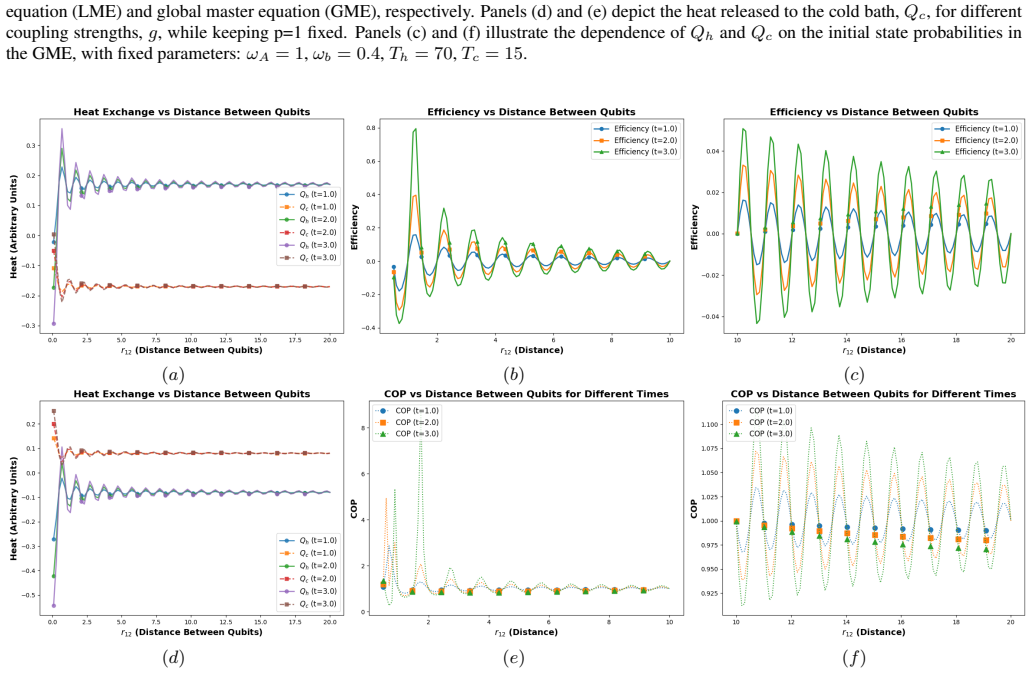
C. Jarzynski, Nonequilibrium equality for free energy differ- 15 (a) (b) (c) (d) (e) (f ) FIG. 11. Dynamics of heat exchange in a two-qubit system. Panels (a) and (b) show the heat absorbed by the system, Qh, in the local master equation (LME) and global master equation (GME), respectively. Panels (d) and (e) depict the heat released to the cold bath, Qc,...
work page 1997
-
[4]
G. E. Crooks, Entropy production fluctuation theorem and the nonequilibrium work relation for free energy differences, Phys. Rev. E, 60 (1999) 2721
work page 1999
-
[5]
H. Tasaki, Jarzynski relations for quantum systems and some applications, arXiv:cond-mat/0009244, (2000)
arXiv 2000
-
[6]
T. Sagawa, and M. Ueda, Generalized Jarzynski equality under nonequilibrium feedback control, Phys. Rev. Lett, 104 (2010) 090602
work page 2010
-
[7]
S. Popescu, A. J. Short, and A. Winter, Entanglement and the foundations of statistical mechanics, Nature Physics, 2 (2006) 754-758
work page 2006
Show all 70 references
-
[8]
M. A. Nielsen, and I. L. Chuang, Quantum computation and quantum information. Cambridge: Cambridge university press, 2001
2001
-
[9]
El Makouri, A
A. El Makouri, A. Slaoui, and R. Ahl Laamara, Monitored nonadiabatic and coherent-controlled quantum unital Otto heat engines: First four cumulants, Phys. Rev. E108 (2023) 044114
2023
-
[10]
Gazeau, Coherent states in Quantum Information: An ex- ample of experimental manipulations, J
J-P. Gazeau, Coherent states in Quantum Information: An ex- ample of experimental manipulations, J. Phys.: Conf. Ser, 213 (2010) 012013
2010
-
[11]
K. D. Wu, T. Theurer, G. Y . Xiang, C. F. Li, G. C. Guo, M. B. Plenio, and A. Streltsov, Quantum coherence and state conver- sion: theory and experiment, npj Quantum Inf, 6 (2020) 22
2020
-
[12]
Slaoui, A
A. Slaoui, A. Salah, and M. Daoud, Influence of Stark-shift on quantum coherence and non-classical correlations for two two- level atoms interacting with a single-mode cavity field, Physica A, 558 (2020) 124946
2020
-
[13]
Dakir, A
Y . Dakir, A. Slaoui, A.B.A. Mohamed, R.A. Laamara, and H. Eleuch, Quantum teleportation and dynamics of quantum co- herence and metrological non-classical correlations for open two-qubit systems, Sci Rep, 13 (2023) 20526
2023
-
[14]
Baumgratz, M
T. Baumgratz, M. Cramer, and M. B. Plenio, Quantifying co- herence, Phys. Rev. Lett, 113 (2014) 140401
2014
-
[15]
Chanda, and S
T. Chanda, and S. Bhattacharya, Delineating incoherent non- Markovian dynamics using quantum coherence, Annals of Physics, 366 (2016) 1-12
2016
-
[16]
Vidal, J
G. Vidal, J. I. Latorre, E. Rico, and A. Kitaev, Entanglement in quantum critical phenomena, Phys. Rev. Lett, 90 (2003) 227902
2003
-
[17]
El Makouri, A
A. El Makouri, A. Slaoui, and M. Daoud, Enhancing the per- formance of coupled quantum Otto thermal machines without entanglement and quantum correlations, J. Phys. B: At. Mol. Opt. Phys, 56 (2023) 085501
2023
-
[18]
Kutvonen, T
A. Kutvonen, T. Sagawa, and T. Ala-Nissila, Thermodynamics of information exchange between two coupled quantum dots, Phys. Rev. E, 93 (2016) 032147
2016
-
[19]
Costantini, et al., Interplay between thermodynamics and ki- netics in the capping of InAs/GaAs (001) quantum dots, Phys
G. Costantini, et al., Interplay between thermodynamics and ki- netics in the capping of InAs/GaAs (001) quantum dots, Phys. Rev. Lett, 96 (2006) 226106
2006
-
[20]
M. H. Devoret, and R. J. Schoelkopf, Superconducting cir- cuits for quantum information: an outlook, Science, 339 (2013) 1169-1174
2013
-
[21]
J. Q. You, and F. Nori, Superconducting circuits and quantum information, Physics today, 58 (2005) 42-47
2005
-
[22]
H ¨affner, C
H. H ¨affner, C. F. Roos, and R. Blatt, Quantum computing with trapped ions, Physics reports, 469 (2008) 155-203
2008
-
[23]
Eschner, G
J. Eschner, G. Morigi, F. Schmidt-Kaler, and R. Blatt, Laser cooling of trapped ions, JOSA B, 20 (2003) 1003-1015
2003
-
[24]
Mavroidis, A
C. Mavroidis, A. Dubey, and M. L. Yarmush, Molecular ma- chines, Annu. Rev. Biomed. Eng, 6 (2004) 363-395
2004
-
[25]
Balzani, A
V . Balzani, A. Credi, F. M. Raymo, and J. F. Stoddart, Arti- ficial molecular machines, Angewandte Chemie International Edition, 39 (2000) 3348-3391
2000
-
[26]
V ojta, Quantum phase transitions, Reports on Progress in Physics, 66 (2003) 2069
M. V ojta, Quantum phase transitions, Reports on Progress in Physics, 66 (2003) 2069
2003
-
[27]
H. T. Quan, Y . X. Liu, C. P. Sun, and F. Nori, Quantum ther- modynamic cycles and quantum heat engines, Phys. Rev. E, 76 (2007) 031105
2007
-
[28]
Friedenberger, and E
A. Friedenberger, and E. Lutz, When is a quantum heat engine quantum?, Europhysics Letters, 120 (2017) 10002
2017
-
[29]
Kamimura, H
S. Kamimura, H. Hakoshima, Y . Matsuzaki, K. Yoshida, and Y . Tokura, Quantum-enhanced heat engine based on superabsorp- tion, Phys. Rev. Lett, 128 (2022) 180602
2022
-
[31]
M. Kloc, P. Cejnar, and G. Schaller, Collective performance of a finite-time quantum Otto cycle. Physical Review E, 100 (2019) 042126
2019
-
[32]
L. M. Zhao, and G. F. Zhang, Entangled quantum Otto heat engines based on two-spin systems with the Dzyaloshin- ski–Moriya interaction. Quantum Information Processing, 16 (2017) 1-13
2017
-
[33]
C. L. Degen, F. Reinhard, and P. Cappellaro, Quantum sensing, Rev. Mod. Phys, 89 (2017) 035002
2017
-
[34]
C. D. Marciniak, et al., Optimal metrology with programmable quantum sensors, Nature, 603 (2022) 604-609
2022
-
[35]
Y . Chu, Y . Liu, H. Liu, and J. Cai, Quantum sensing with a single-qubit pseudo-Hermitian system, Phys. Rev. Lett, 124 (2020) 020501
2020
-
[36]
Bauer, S
B. Bauer, S. Bravyi, M. Motta, and G. K. L. Chan, Quantum algorithms for quantum chemistry and quantum materials sci- ence, Chemical Reviews, 120 (2020) 12685-12717
2020
-
[37]
Polini, et al., Materials and devices for fundamen- tal quantum science and quantum technologies, arXiv preprint:2201.09260, (2022)
M. Polini, et al., Materials and devices for fundamen- tal quantum science and quantum technologies, arXiv preprint:2201.09260, (2022)
2022 arXiv
-
[38]
Hammam, H
K. Hammam, H. Leitch, Y . Hassouni, and G. De Chiara, Exploiting coherence for quantum thermodynamic advantage, New Journal of Physics, 24 (2022) 113053
2022
-
[39]
Y . H. Shi, H. L. Shi, X. H. Wang, M. L. Hu, S. Y . Liu, W. L. Yang, and H. Fan, Quantum coherence in a quantum heat engine, J. Phys. A: Math. Theor, 53 (2020) 085301
2020
-
[40]
Dillenschneider, and E
R. Dillenschneider, and E. Lutz, Energetics of quantum corre- lations, Europhysics Letters, 88 (2009) 50003
2009
-
[41]
Hildner, D
R. Hildner, D. Brinks, J. B. Nieder, R. J. Cogdell, and N. F. Van Hulst, Quantum coherent energy transfer over varying path- ways in single light-harvesting complexes, Science, 340 (2013) 1448-1451
2013
-
[42]
Fusco, M
L. Fusco, M. Paternostro, and G. De Chiara, Work extraction and energy storage in the Dicke model, Phys. Rev. E,94 (2016) 052122
2016
-
[43]
Palafox, R
S. Palafox, R. Rom ´an-Ancheyta, B. C ¸ akmak, and ¨O. E. M¨ustecaplıo˘glu, Heat transport and rectification via quantum statistical and coherence asymmetries, Physical Review E, 106 (2022) 054114
2022
-
[44]
Leitch, K
H. Leitch, K. Hammam, and G. De Chiara, Thermodynam- ics of hybrid quantum rotor devices, Phys. Rev. E, 109 (2024) 024108
2024
-
[45]
Manzano, R
G. Manzano, R. S ´anchez, R. Silva, G. Haack, J. B. Brask, N. Brunner, and P. P. Potts, Hybrid thermal machines: Generalized thermodynamic resources for multitasking, Phys. Rev. Res, 2 (2020) 043302
2020
-
[46]
J. Lu, Z. Wang, R. Wang, J. Peng, C. Wang, and J. H. Jiang, Multitask quantum thermal machines and cooperative effects, Phys. Rev. B, 107 (2023) 075428
2023
-
[47]
F. L. Rodrigues, G. De Chiara, M. Paternostro, and G. T. Landi, Thermodynamics of weakly coherent collisional models, Phys. 17 Rev. Lett, 123 (2019) 140601
2019
-
[48]
Z. N. Hu, K. S. Yi, and K. S. Park, Thermal entanglement of a three-qubit system in inhomogeneous magnetic fields, Journal of Physics A: Mathematical and Theoretical, 40 (2007) 7283
2007
-
[49]
L. A. Correa, J. P. Palao, G. Adesso, and D. Alonso, Perfor- mance bound for quantum absorption refrigerators, Phys. Rev. E, 87 (2013) 042131
2013
-
[50]
H. P. Breuer, and F. Petruccione, The theory of open quantum systems, Oxford University Press, USA, 2002
2002
-
[51]
N. M. Myers, O. Abah, and S. Deffner, Quantum thermody- namic devices: From theoretical proposals to experimental re- ality, A VS quantum science, 4 (2022)
2022
-
[52]
De Chiara, G
G. De Chiara, G. Landi, A. Hewgill, B. Reid, A. Ferraro, A. J. Roncaglia and Mauro Antezza, Reconciliation of quantum local master equations with thermodynamics, New J. Phys,20 (2018) 113024
2018
-
[53]
P. P. Hofer, M. Perarnau-Llobet, L. D. M. Miranda, G. Haack, R. Silva, J. B. Brask, and N. Brunner, Markovian master equa- tions for quantum thermal machines: local versus global ap- proach, New J. Phys, 19 (2017) 123037
2017
-
[54]
Streltsov, G
A. Streltsov, G. Adesso, and M. B. Plenio, Colloquium: Quan- tum coherence as a resource, Rev. Mod. Phys, 89 (2017) 041003
2017
-
[55]
Slaoui, B
A. Slaoui, B. Amghar, and R. Ahl Laamara, Interferomet- ric phase estimation and quantum resource dynamics in Bell coherent-state superpositions generated via a unitary beam splitter, J. Opt. Soc. Am. B, 40 (2023) 2013-2027
2023
-
[56]
Haddadi, M
S. Haddadi, M. Ghominejad, and A. Czerwinski, Quantumness of gravitational cat states in correlated dephasing channels, Eur. Phys. J. C, 84 (2024) 670
2024
-
[57]
W. K. Wootters, Entanglement of formation and concurrence, Quantum Inf. Comput, 1 (2001) 27-44
2001
-
[58]
Amghar, A
B. Amghar, A. Slaoui, J. Elfakir, and M. Daoud, Geometrical, topological, and dynamical description of N interacting spin-s particles in a long-range Ising model and their interplay with quantum entanglement, Phys. Rev. A, 107 (2023) 032402
2023
-
[59]
Haddadi, and M
S. Haddadi, and M. Bohloul, A Brief Overview of Bipartite and Multipartite Entanglement Measures, Int J Theor Phys, 57 (2018) 3912–3916
2018
-
[60]
ur Rahman, H
A. ur Rahman, H. Ali, S. Haddadi, and S. M. Zangi, Gener- ating non-classical correlations in two-level atoms, Alexandria Engineering Journal, 67 (2023) 425-436
2023
-
[61]
Coffman, J
V . Coffman, J. Kundu, and W. K. Wootters, Distributed entan- glement, Phys. Rev. A, 61 (2000) 052306
2000
-
[62]
Hammam, G
K. Hammam, G. Manzano, and G. De Chiara, Quantum coher- ence enables hybrid multitask and multisource regimes in au- tonomous thermal machines, Phys. Rev. Res, 6 (2024) 013310
2024
-
[63]
Pita-Vidal, J
M. Pita-Vidal, J. J. Wesdorp, L. J. Splitthoff, A. Bargerbos, Y . Liu, L. P. Kouwenhoven, and C. K. Andersen, Strong tunable coupling between two distant superconducting spin qubits, Nat. Phys. 20 (2024) 1158–1163
2024
-
[64]
Nourmandipour, M
A. Nourmandipour, M. K. Tavassoly, and S. Mancini, The en- tangling power of a” glocal” dissipative map, arXiv preprint arXiv: 1605.07430 (2016)
2016 arXiv
-
[65]
H. Wang, G. Wu, and D. Chen, Thermal entangled quan- tum Otto engine based on the two qubits Heisenberg model with Dzyaloshinskii–Moriya interaction in an external mag- netic field, Physica Scripta, 86 (2012) 015001
2012
-
[66]
Upadhyay, M
V . Upadhyay, M. T. Naseem, R. Marathe, and ¨O. E. M¨ustecaplıo˘glu, Heat rectification by two qubits coupled with Dzyaloshinskii-Moriya interaction, Physical Review E, 104(2021) 054137
2021
-
[67]
M. Mahmoudi, The effects of Dzyaloshinskii–Moriya inter- action on entanglement dynamics of a spin chain in a non- Markovian regime, Physica A: Statistical Mechanics and its Applications, 545 (2020) 123707
2020
-
[68]
Kumar, S
A. Kumar, S. Lahiri, T. Bagarti, and S. Banerjee, Thermody- namics of one and two-qubit nonequilibrium heat engines run- ning between squeezed thermal reservoirs, Physica A: Statisti- cal Mechanics and its Applications, 623(2023) 128832
2023
-
[69]
Slaoui, M
A. Slaoui, M. I. Shaukat, M. Daoud, and R. A. Laamara, Uni- versal evolution of non-classical correlations due to collective spontaneous emission, The European Physical Journal Plus, 133(2018) 413
2018
-
[70]
Ficek, and R
Z. Ficek, and R. Tana´s, Entangled states and collective nonclas- sical effects in two-atom systems, Physics Reports, 372(2002) 369-443
2002
Reviewed August 8, 2026 · model on record in the stance chip above.
Discussion (0). Continue with ORCID to comment.