REVIEW 1 major objections 7 minor 56 references
Distributed Sparse Interventions in Language Models
T0 review · 1 major / 7 minor · reviewed 2026-07-09 · glm-5.2
Pith's one-line read Editing 0.01% of neurons activates task behavior in language models
desk verdict DSI: sparse neuron-level steering that works, but the ablation design conflates two improvements at once read the letter →
The pith
A machine-rendered reading of the paper's core claim, the machinery that carries it, and where it could break.
The reading
What carries the argument
DSI works in four steps: (1) compute average activation differences between 10-shot and 0-shot prompts for every neuron; (2) estimate each neuron's expected effect on the correct output logit using a first-order Taylor approximation with LRP-modified (robustified) gradients; (3) select the top-n neurons by expected effect as a starting point and iteratively refine both which neurons are selected and their per-neuron intervention scaling using ZeroFPR, a nonconvex sparse optimization algorithm that re-evaluates expected effects at each step to capture nonlinear interactions; (4) apply the refined per-neuron interventions additively during the forward pass on 0-shot inputs. The activation-diff
What would settle it
If one could show that randomly chosen neuron sets of the same size, when paired with the same iterative optimization procedure, achieve comparable task accuracy to DSI-selected sets, then the contribution of the neuron-selection mechanism (as opposed to the optimization procedure itself) would be undermined.
Extended reading notes
Core claim
The paper's central discovery is that task behavior in large language models can be activated by intervening on a remarkably sparse set of individual neurons—distributed across layers and attention heads—provided that nonlinear interactions between neurons are explicitly modeled through iterative refinement of intervention effects, rather than approximated by a single first-order gradient. This finding challenges the prevailing assumption that effective steering requires modifying global directions across all neurons in a layer, and shows that the native neuron basis contains sufficiently sparse task-relevant structure to support fine-grained behavioral control.
Load-bearing premise
The method depends on a first-order gradient approximation (even if robustified) to provide a good enough starting point for the iterative optimizer to find effective sparse neuron sets; if this initialization were poor, the 50-step optimization with 10 restarts might not escape local optima, and the paper does not systematically test how sensitive the results are to initialization quality or optimization settings.
Editorial extensions
If this is right
- If sparse neuron sets can reliably activate tasks, then targeted suppression of those same sets could selectively disable capabilities—such as translation or sentiment analysis—without retraining, offering a surgical alternative to coarse methods like fine-tuning or safety filters.
- The decomposition of tasks into shared neuron sets (e.g., copy neurons) and task-specific neuron sets suggests a natural hierarchy: if higher-level reasoning tasks decompose similarly, one could map compositional structure of model capabilities by analyzing overlaps and differences in neuron sets across tasks.
- The finding that interventions distribute across many layers and heads, rather than concentrating in predefined layers, implies that task representations are genuinely distributed—challenging the common practice of steering at a single chosen layer.
- If the iterative refinement is essential because first-order approximations miss nonlinear interactions, then other interpretability methods that rely on single-pass gradient estimates (e.g., attribution patching) may systematically misidentify the most causally important components.
Reading between the lines
- The paper tests single-token prediction only; if sparse neuron sets identified for single-token tasks do not transfer to multi-token generation (where the model must maintain task behavior across positions), the practical scope of DSI would be narrower than the results suggest.
- The set-based decomposition into copy and transform neurons is demonstrated on two tasks with rigid input-output structure; whether richer, open-ended tasks exhibit similarly decomposable neuron-set structure remains an open question that the paper's case studies only begin to address.
- If the LRP-modified gradient initialization were replaced with a fundamentally different attribution method, the iterative optimizer might converge to different neuron sets—raising the question of whether the identified neurons are stable features of the model or artifacts of the search procedure.
Signed reviews
Editorial analysis
A structured set of objections, weighed in public.
Referee Report
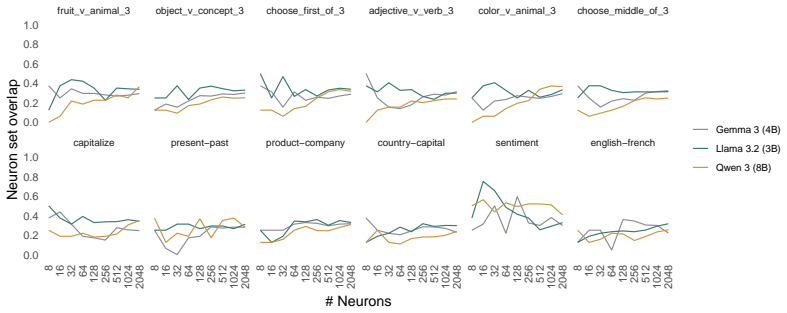
Summary. The paper introduces Distributed Sparse Interventions (DSI), a method for identifying sparse sets of neurons distributed across layers and attention heads that can activate task-relevant behavior in instruction-tuned language models. DSI proceeds by (1) computing activation differences between k-shot and 0-shot prompts, (2) selecting an initial neuron set via a robustified (LRP-modified) gradient estimate, and (3) iteratively refining both the neuron set and per-neuron scaling factors using the ZeroFPR optimizer. The method is evaluated on 12 tasks across three models (Qwen 3 8B, Gemma 3 4B, Llama 3.2 3B), showing that intervening on as few as 8–64 neurons can substantially improve 0-shot task accuracy. Two case studies investigate task composition by decomposing neuron sets into shared (copying) and task-specific components via set operations.
Significance. The paper addresses a genuine gap in the model steering literature: most prior work operates on global directions in activation space, assuming approximate linearity and additivity. The demonstration in Figure 2 that neuron-level interventions exhibit nonlinear, neuron-specific effects—including interaction effects between neuron pairs—is a valuable empirical contribution. The finding that tasks can be activated by intervening on 0.01–0.04% of neurons, distributed across layers and heads, is striking and well-supported by the experimental design (train/test splits, 3 models × 12 tasks, 95% confidence intervals). The set-based perspective on task composition (Section 5) is a novel conceptual angle. Code is reportedly available on GitHub, supporting reproducibility.
major comments (1)
- The ablation design in Section 4.1 conflates two methodological changes, undermining the paper's attribution of performance gains to iterative refinement. The 'no iter.' baseline (Table 1) differs from full DSI in two ways simultaneously: (1) it removes iterative refinement of the neuron set, and (2) it replaces per-neuron scaling factors with a single joint scalar s ∈ [0.01, 50]. The paper states (Section 4.1) that 'both gradient robustification and iterative refinement contribute consistently to improved intervention performance,' but this claim cannot be evaluated because the contribution of iterative set refinement is entangled with the contribution of per-neuron scaling. Figure 2a already shows that optimal intervention strength varies substantially across neurons, so a uniform-scaling baseline is expected to perform poorly regardless of whether iterative set refinement helps. An中间基
minor comments (7)
- Section 3.2, Algorithm 1: The notation s₀ ← 1(topₙ(e)) is introduced without explicit definition of the indicator function. Readers unfamiliar with this convention may need to infer it from context.
- Table 1: The ranges (e.g., '0.18–0.97') are described as 'minimum and maximum accuracy across tasks' but it is unclear whether these are per-task accuracies or per-condition accuracies. Clarifying this would help interpretation.
- Figure 3: The x-axis uses a log-like spacing for neuron set sizes (8, 16, 32, ..., 2048) but is labeled linearly. This could mislead readers about the rate of performance change with set size.
- Section 5.1: The case study reports that the 'specific' neuron set (9 neurons for present-past) achieves 0.37 accuracy on the present-past task, compared to 0.85 for the full 32-neuron set. This is a substantial drop, and the text acknowledges that the specific set 'induce[s] less copy behaviour' but does not fully discuss why the task-specific neurons alone are insufficient. This weakens the decomposition narrative.
- Appendix F: The optimization uses 10 perturbed restarts with noise scale 0.3 and a step size multiplier of 1.5. No sensitivity analysis to these hyperparameters is provided. A brief note on robustness would strengthen the methodological contribution.
- The paper does not compare DSI against existing steering baselines (e.g., function vectors [49], contrastive activation addition [43], LoFiT [54]) in terms of task accuracy. While the ablations against simplified versions of DSI are informative, a direct comparison to established methods would better contextualize the reported gains.
- Section 4, footnote 2: The compute time (~108h on MI300A APUs) is noted, but the per-task or per-intervention-set-size compute cost is not broken down. This would help readers assess practical scalability.
Circularity Check
No significant circularity found; DSI's derivation is self-contained with proper train/test separation and LRP rules used as gradient tools, not load-bearing claims.
full rationale
The paper's derivation chain is self-contained. DSI identifies sparse neuron interventions using activation differences between 10-shot and 0-shot prompts (Eq. 3), a robustified gradient for first-order effect estimation (Eq. 2), and iterative refinement via ZeroFPR optimization (Algorithm 1). The LRP-modified gradient rules (Appendix D, Table 4) are cited from prior work by overlapping author groups [1, 2, 4, 42], but these serve as a computational tool for gradient estimation—they are not the central claim and do not define the intervention in terms of its own output. The method is trained on 100 0-shot and 100 10-shot prompts from a training split and evaluated on 200 held-out 0-shot prompts from a separate test split, so the 'prediction' (task activation on test data) is not fitted to the evaluation data by construction. The ablation baselines ('no iter.' and 'no rob.') differ from full DSI in conflated ways (per-neuron scaling vs. joint scaling), which is a correctness/experimental design concern rather than a circularity issue. The skeptic's attack targets ablation isolation, not circular reasoning. No step in the derivation reduces to its own inputs by definition or self-citation.
Assumptions & free parameters
free parameters (6)
- n (neuron set size) =
8 to 2048 (swept)
- t (number of optimization steps) =
50
- Number of perturbed restarts =
10
- Perturbation noise scale =
0.3
- Step size multiplier for exploration =
1.5
- k (number of ICL examples for activation differences) =
10
assumptions (4)
- domain assumption Task-relevant behavior can be activated by additive interventions on neuron activations (a ← a + δ) rather than requiring structural replacement.
- domain assumption The last token position is the relevant position for capturing task-relevant computations.
- domain assumption LRP-modified gradients provide a more robust estimate of intervention effects than raw gradients in transformer models.
- domain assumption Neurons in the native basis (before projection to residual stream) carry task-relevant structure accessible for intervention.
Cite this review
Pith. "Pith review of Distributed Sparse Interventions in Language Models." pith.science (2026). https://pith.science/paper/GFF6SE6U
@misc{pith2026260707128,
  author       = {Pith},
  title        = {Pith review of: Distributed Sparse Interventions in Language Models},
  year         = {2026},
  howpublished = {\url{https://pith.science/paper/GFF6SE6U}},
  note         = {Machine review of arXiv:2607.07128}
}
read the original abstract
Language models perform a wide range of tasks at varying levels of abstraction with the capacity to flexibly infer tasks from context, execute multiple tasks simultaneously, and select among competing tasks. To study the role of model components in task behaviour, their causal influence can be investigated through interventions. Prior work on model steering has largely focused on interventions along global directions in activation space, modeling task representations as approximately linear and additive. By studying interventions at the neuron level, we find substantial, neuron-specific nonlinear effects on model outputs that are not captured by current steering approaches. We introduce Distributed Sparse Interventions (DSI), an intervention approach that considers nonlinearities and interactions between neurons across layers to identify sparse sets of neurons that elicit task-relevant computations. Across a range of tasks, we demonstrate that DSI can activate task behaviour in instruction-tuned language models by localising and intervening on as few as 0.01% of neurons, highlighting the effectiveness of sparse, distributed interventions in the neuron basis. Additionally, adopting a set-based perspective enables computations over the identified neuron sets, offering insights into the roles of individual neurons by analysing their effects across tasks. Through sparse interventions, DSI enables fine-grained control over model behaviour, localisation of task-relevant neuron sets, and furthers our understanding of task composition.
Figures


Figures from the paper (11 more)




Reference graph
Works this paper leans on
-
[1]
R. Achtibat, S. M. V . Hatefi, M. Dreyer, A. Jain, T. Wiegand, S. Lapuschkin, and W. Samek. AttnLRP: Attention-aware layer-wise relevance propagation for transformers. InProceedings of the 41st International Conference on Machine Learning , volume 235 of Proceedings of Machine Learning Research , pages 135–168. PMLR, 2024. URL https://proceedings.mlr.pres...
work page 2024
-
[2]
A. Ali, T. Schnake, O. Eberle, G. Montavon, K.-R. Müller, and L. Wolf. XAI for transformers: Better explanations through conservative propagation. In Proceedings of the 39th International Conference on Machine Learning, volume 162 of Proceedings of Machine Learning Research, pages 435–451. PMLR,
-
[3]
URL https://proceedings.mlr.press/v162/ali22a.html
-
[4]
Language Model Circuits Are Sparse in the Neuron Basis
A. Arora, Z. Wu, J. Steinhardt, and S. Schwettmann. Language model circuits are sparse in the neuron basis. arXiv preprint arXiv:2601.22594, 2026
work page Pith review arXiv 2026
-
[5]
L. Arras, J. Arjona-Medina, M. Widrich, G. Montavon, M. Gillhofer, K.-R. Müller, S. Hochreiter, and W. Samek. Explaining and Interpreting LSTMs, page 211–238. Springer-Verlag, Berlin, Heidelberg, 2022. ISBN 978-3-030-28953-9. URL https://doi.org/10.1007/978-3-030-28954-6_11
-
[6]
S. Bach, A. Binder, G. Montavon, F. Klauschen, K.-R. Müller, and W. Samek. On pixel-wise explanations for non-linear classifier decisions by layer-wise relevance propagation. PloS one, 10(7):e0130140, 2015
work page 2015
-
[7]
D. Balduzzi, M. Frean, L. Leary, J. P. Lewis, K. W.-D. Ma, and B. McWilliams. The shattered gradients problem: if resnets are the answer, then what is the question? In Proceedings of the 34th International Conference on Machine Learning - Volume 70, ICML’17, page 342–350. JMLR.org, 2017
work page 2017
-
[8]
D. Bau, B. Zhou, A. Khosla, A. Oliva, and A. Torralba. Network dissection: Quantifying interpretability of deep visual representations. In Proceedings of the IEEE Conference on Computer Vision and Pattern Recognition (CVPR), July 2017
work page 2017
Show all 56 references
-
[9]
Beaglehole, A
D. Beaglehole, A. Radhakrishnan, E. Boix-Adsera, and M. Belkin. Toward universal steering and monitoring of AI models. Science, 391(6787):787–792, 2026
2026
-
[10]
Bricken, A
T. Bricken, A. Templeton, J. Batson, B. Chen, A. Jermyn, T. Conerly, N. Turner, C. Anil, C. Denison, A. Askell, et al. Towards monosemanticity: Decomposing language models with dictionary learning. Transformer Circuits Thread, 2(5):6, 2023
2023
-
[11]
Brown, B
T. Brown, B. Mann, N. Ryder, M. Subbiah, J. D. Kaplan, P. Dhariwal, A. Neelakantan, P. Shyam, G. Sastry, A. Askell, S. Agarwal, A. Herbert-V oss, G. Krueger, T. Henighan, R. Child, A. Ramesh, D. Ziegler, J. Wu, C. Winter, C. Hesse, M. Chen, E. Sigler, M. Litwin, S. Gray, B. Ch...
1901
-
[12]
D. Dai, L. Dong, Y . Hao, Z. Sui, B. Chang, and F. Wei. Knowledge neurons in pretrained transformers. In S. Muresan, P. Nakov, and A. Villavicencio, editors, Proceedings of the 60th Annual Meeting of the Association for Computational Linguistics (Volume 1: Long Papers) , pages...
2022 doi
-
[13]
Eberhardt and R
F. Eberhardt and R. Scheines. Interventions and causal inference. Philosophy of science, 74(5):981–995, 2007
2007
-
[14]
Elhage, T
N. Elhage, T. Hume, C. Olsson, N. Schiefer, T. Henighan, S. Kravec, Z. Hatfield-Dodds, R. Lasenby, D. Drain, C. Chen, et al. Toy models of superposition. arXiv preprint arXiv:2209.10652, 2022
2022 arXiv
-
[15]
U. Evci, T. Gale, J. Menick, P. S. C. Rivadeneira, and E. Elsen. Rigging the lottery: Making all tickets winners. In International Conference of Machine Learning, 2020. 10
2020
-
[16]
Frankle and M
J. Frankle and M. Carbin. The lottery ticket hypothesis: Finding sparse, trainable neural networks. In International Conference on Learning Representations, 2019. URL https://openreview.net/forum? id=rJl-b3RcF7
2019
-
[17]
Gemma 3 technical report
Gemma Team. Gemma 3 technical report. 2025. URL https://goo.gle/Gemma3Report
2025
-
[18]
Grattafiori, A
A. Grattafiori, A. Dubey, A. Jauhri, A. Pandey, A. Kadian, A. Al-Dahle, A. Letman, A. Mathur, A. Schelten, A. Vaughan, et al. The llama 3 herd of models. arXiv preprint arXiv:2407.21783, 2024
2024 arXiv
-
[19]
Hendel, M
R. Hendel, M. Geva, and A. Globerson. In-context learning creates task vectors. In Findings of the Association for Computational Linguistics: EMNLP 2023, pages 9318–9333, 2023
2023
-
[20]
Hernandez, A
E. Hernandez, A. S. Sharma, T. Haklay, K. Meng, M. Wattenberg, J. Andreas, Y . Belinkov, and D. Bau. Linearity of relation decoding in transformer language models. arXiv preprint arXiv:2308.09124, 2023
2023 arXiv
-
[21]
Honovich, U
O. Honovich, U. Shaham, S. R. Bowman, and O. Levy. Instruction induction: From few examples to natural language task descriptions. In A. Rogers, J. Boyd-Graber, and N. Okazaki, editors, Proceedings of the 61st Annual Meeting of the Association for Computational Linguistics (Vo...
1935 doi
-
[22]
Huben, H
R. Huben, H. Cunningham, L. R. Smith, A. Ewart, and L. Sharkey. Sparse autoencoders find highly inter- pretable features in language models. InThe Twelfth International Conference on Learning Representations, 2023
2023
-
[23]
Ilharco, M
G. Ilharco, M. T. Ribeiro, M. Wortsman, S. Gururangan, L. Schmidt, H. Hajishirzi, and A. Farhadi. Editing models with task arithmetic. arXiv preprint arXiv:2212.04089, 2022
2022 arXiv
-
[24]
F. R. Jafari, O. Eberle, A. Khakzar, and N. Nanda. Relp: Faithful and efficient circuit discovery in language models via relevance patching. arXiv preprint arXiv:2508.21258, 2025
2025
-
[25]
A. K. Lampinen, Y . Li, E. Hosseini, S. Bhardwaj, and M. Shanahan. Linear representations in language models can change dramatically over a conversation. arXiv preprint arXiv:2601.20834, 2026
2026
-
[26]
Lample, A
G. Lample, A. Conneau, M. Ranzato, L. Denoyer, and H. Jégou. Word translation without parallel data. In International Conference on Learning Representations, 2018. URL https://openreview.net/forum? id=H196sainb
2018
-
[27]
J. Li, Y . Hou, M. Sachan, and R. Cotterell. What do language models learn in context? the structured task hypothesis. In Proceedings of the 62nd Annual Meeting of the Association for Computational Linguistics (Volume 1: Long Papers), pages 12365–12379, 2024
2024
-
[28]
L. Li, P. Dong, Z. Tang, X. Liu, Q. Wang, W. Luo, W. Xue, Q. Liu, X. Chu, and Y . Guo. Discovering sparsity allocation for layer-wise pruning of large language models. InThe Thirty-eighth Annual Conference on Neu- ral Information Processing Systems, 2024. URL https://openrevie...
2024
-
[29]
Y . Li, D. I. Campbell, S. C. Chan, and A. K. Lampinen. Just-in-time and distributed task representations in language models. In Mechanistic Interpretability Workshop at NeurIPS 2025 , 2025. URL https: //openreview.net/forum?id=KC13tBPbQg
2025
-
[30]
Lindsey, A
J. Lindsey, A. Templeton, J. Marcus, T. Conerly, J. Batson, and C. Olah. Sparse crosscoders for cross- layer features and model diffing.https://transformer-circuits.pub/2024/crosscoders/index. html, 2024. Transformer Circuits Thread
2024
-
[31]
Lippl, T
S. Lippl, T. McGee, K. Lopez, Z. Pan, P. Zhang, S. Ziadi, O. Eberle, and I. Momennejad. Algorithmic primitives and compositional geometry of reasoning in language models, 2026. URL https://arxiv. org/abs/2510.15987
2026
-
[32]
D. C. Liu and J. Nocedal. On the limited memory BFGS method for large scale optimization.Mathematical programming, 45(1):503–528, 1989
1989
-
[33]
S. Liu, H. Ye, L. Xing, and J. Zou. In-context vectors: making in context learning more effective and controllable through latent space steering. In Proceedings of the 41st International Conference on Machine Learning, ICML’24. JMLR.org, 2024
2024
-
[34]
Marks, C
S. Marks, C. Rager, E. J. Michaud, Y . Belinkov, D. Bau, and A. Mueller. Sparse feature circuits: Discovering and editing interpretable causal graphs in language models. In The Thirteenth International Conference on Learning Representations, 2025. 11
2025
-
[35]
Montavon, A
G. Montavon, A. Binder, S. Lapuschkin, W. Samek, and K.-R. Müller. Layer-wise relevance propagation: an overview. Explainable AI: interpreting, explaining and visualizing deep learning, pages 193–209, 2019
2019
-
[36]
N. Nanda. Attribution patching: Activation patching at industrial scale. URL: https://www. neelnanda. io/mechanistic-interpretability/attribution-patching, 15:19, 2023
2023
-
[37]
Nanda and J
N. Nanda and J. Bloom. Transformerlens. https://github.com/TransformerLensOrg/ TransformerLens, 2022
2022
-
[38]
Nikankin, A
Y . Nikankin, A. Reusch, A. Mueller, and Y . Belinkov. Arithmetic without algorithms: Language models solve math with a bag of heuristics. In The Thirteenth International Conference on Learning Representa- tions, 2024
2024
-
[39]
B. A. Olshausen and D. J. Field. Sparse coding of sensory inputs. Current Opinion in Neurobiology, 14(4):481–487, 2004. ISSN 0959-4388. doi: https://doi.org/10.1016/j.conb.2004.07.007. URL https: //www.sciencedirect.com/science/article/pii/S0959438804001035
2004 doi
-
[40]
B. A. Olshausen et al. Principles of image representation in visual cortex. The visual neurosciences, 2: 1603–1615, 2003
2003
-
[41]
Panigrahi, N
A. Panigrahi, N. Saunshi, H. Zhao, and S. Arora. Task-specific skill localization in fine-tuned language models. In Proceedings of the 40th International Conference on Machine Learning, ICML’23. JMLR.org, 2023
2023
-
[42]
Qwen3 technical report, 2025
Qwen Team. Qwen3 technical report, 2025. URL https://arxiv.org/abs/2505.09388
2025 arXiv
-
[43]
Rezaei Jafari, G
F. Rezaei Jafari, G. Montavon, K.-R. Müller, and O. Eberle. MambaLRP: Explaining selective state space sequence models. In A. Globerson, L. Mackey, D. Belgrave, A. Fan, U. Paquet, J. Tomczak, and C. Zhang, editors, Advances in Neural Information Processing Systems, volume 37, ...
2024 doi
-
[44]
Rimsky, N
N. Rimsky, N. Gabrieli, J. Schulz, M. Tong, E. Hubinger, and A. Turner. Steering llama 2 via contrastive activation addition. In L.-W. Ku, A. Martins, and V . Srikumar, editors,Proceedings of the 62nd Annual Meeting of the Association for Computational Linguistics (Volume 1: L...
2024 doi
-
[45]
Smilkov, N
D. Smilkov, N. Thorat, B. Kim, F. Viégas, and M. Wattenberg. Smoothgrad: removing noise by adding noise. arXiv preprint arXiv:1706.03825, 2017
2017 arXiv
-
[46]
Socher, A
R. Socher, A. Perelygin, J. Wu, J. Chuang, C. D. Manning, A. Ng, and C. Potts. Recursive deep models for semantic compositionality over a sentiment treebank. In D. Yarowsky, T. Baldwin, A. Korhonen, K. Livescu, and S. Bethard, editors, Proceedings of the 2013 Conference on Emp...
2013
-
[47]
L. Stella. ProximalAlgorithms.jl: Proximal algorithms for nonsmooth optimization in Julia. URL https://github.com/JuliaFirstOrder/ProximalAlgorithms.jl
-
[48]
Sundararajan, A
M. Sundararajan, A. Taly, and Q. Yan. Axiomatic attribution for deep networks. In Proceedings of the 34th International Conference on Machine Learning , volume 70 of Proceedings of Machine Learning Research, pages 3319–3328. PMLR, 06–11 Aug 2017. URL https://proceedings.mlr.pr...
2017
-
[49]
Themelis, L
A. Themelis, L. Stella, and P. Patrinos. Forward-backward envelope for the sum of two nonconvex functions: Further properties and nonmonotone linesearch algorithms. SIAM Journal on Optimization, 28 (3):2274–2303, 2018. doi: 10.1137/16M1080240
2018 doi
-
[50]
E. Todd, M. Li, A. S. Sharma, A. Mueller, B. C. Wallace, and D. Bau. Function vectors in large language models. In The Twelfth International Conference on Learning Representations , 2024. URL https://openreview.net/forum?id=AwyxtyMwaG
2024
-
[51]
Vargas-Barroso, J
V . Vargas-Barroso, J. F. Watson, A. Navas-Olive, A. Schlögl, and P. Jonas. Developmental emergence of sparse and structured synaptic connectivity in the hippocampal ca3 memory circuit. Nature Communica- tions, 2026. 12
2026
-
[52]
X. Wang, K. Wen, Z. Zhang, L. Hou, Z. Liu, and J. Li. Finding skill neurons in pre-trained transformer- based language models. In Proceedings of the 2022 Conference on Empirical Methods in Natural Language Processing, pages 11132–11152, 2022
2022
-
[53]
E. B. Wilson. Probable inference, the law of succession, and statistical inference. Journal of the American Statistical Association, 22(158):209–212, 1927
1927
-
[54]
Xiong, Z
Z. Xiong, Z. Cai, J. Cooper, A. Ge, V . Papageorgiou, Z. Sifakis, A. Giannou, Z. Lin, L. Yang, S. Agarwal, G. Chrysos, S. Oymak, K. Lee, and D. Papailiopoulos. Everything everywhere all at once: LLMs can in-context learn multiple tasks in superposition. In Forty-second Interna...
2025
-
[55]
Q: input 1\nA: output1\n\nQ: input2\nA: output2\n\n[...]Q: inputk\nA: outputk\n\nQ: input\nA:
F. Yin, X. Ye, and G. Durrett. Lofit: Localized fine-tuning on LLM representations. In A. Globerson, L. Mackey, D. Belgrave, A. Fan, U. Paquet, J. Tomczak, and C. Zhang, editors, Advances in Neural Information Processing Systems, volume 37, pages 9474–9506. Curran Associates, ...
2024
-
[56]
How are you feeling today?
and a maximum of 200 generated tokens. During the autoregressive answering process, we intervene on the model on each forward pass. Some special characters (such as emotes) that could not be correctly displayed were stripped. Prompt 1: How are you feeling today? Baseline: I’m ...
2014
Reviewed July 9, 2026 · model on record in the stance chip above.
Discussion (0). Continue with ORCID to comment.