REVIEW 4 major objections 4 minor 82 references
Minimal model of charge and pairing density waves in X-ray scattering experiments
T0 review · 4 major / 4 minor · reviewed 2026-08-14 · deepseek-v4-flash
Pith's one-line read By computing the X-ray response of a d-wave superconductor to local impurities, this paper argues that the incommensurate density modulations seen in cuprates are predominantly pairing density waves rather than charge density waves…
desk verdict Clean analytic diagnostic for CDW vs PDW in X-ray maps, with a solid method and an overreaching experimental conclusion. read the letter →
The pith
A machine-rendered reading of the paper's core claim, the machinery that carries it, and where it could break.
The reading
What carries the argument
The load-bearing object is the density response function $\chi(\mathbf{q},\Omega)$ of Eq. (1), computed from the two-component Green's function of a homogeneous superconductor with a $d$-wave gap and a local impurity. The two scattering vertices — $V_{\mathbf{k}}=V_0\sigma_z$ for a charge (CDW) impurity and $V_{\mathbf{k}}=\Delta_{\mathbf{k}}\sigma_x$ for a pairing (PDW) impurity — are what convert the same band structure into different X-ray maps. The $d$-wave gap factor $\Delta_{\mathbf{k}}$ is the mechanism that breaks the symmetry between $(\bar q,0)$ and $(\bar q,\bar q)$: the gap vanishes at the nodes, so a pairing impurity cannot efficiently scatter antinode to node, while a density impurity has no such restriction. The ratio $R$ and the RIXS peak position are the two concrete observables this machinery produces.
What would settle it
A decisive test is to measure, in one clean cuprate crystal, the full two-dimensional elastic response and the RIXS spectrum with energy resolution better than the superconducting gap. Under the paper's claim, the elastic map must show $R=\chi((\bar q,0),0)/\chi((\bar q,\bar q),0)>1$ and the RIXS peak must center at $\Omega=0$; observing $R<1$ with a clear $(\bar q,\bar q)$ peak, or a RIXS peak at $\Omega=2\Delta_0$, would falsify the PDW assignment.
Extended reading notes
Core claim
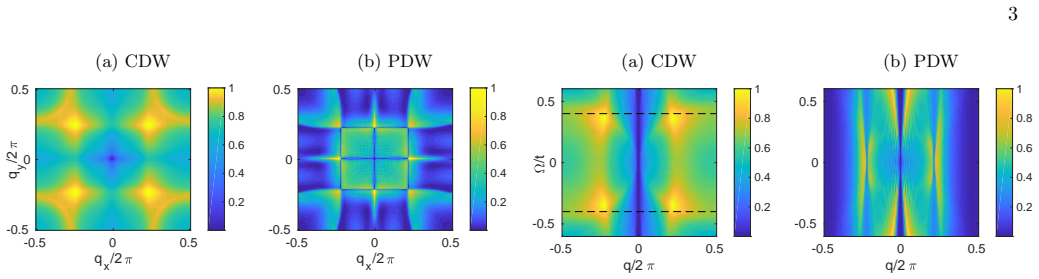
On the paper's own terms, the central discovery is that in a homogeneous superconductor with a $d$-wave gap, perturbed by a local pinning center, the X-ray response $\chi(\mathbf{q},\Omega)$ carries order-specific fingerprints. A charge impurity ($V_{\mathbf{k}}=V_0\sigma_z$) yields $\chi(\mathbf{q},0)$ strongest at the diagonal wavevector $(\bar q,\bar q)$ because bare Fermi-surface nesting involves all four parallel antinodal segments, while a pairing impurity ($V_{\mathbf{k}}=\Delta_{\mathbf{k}}\sigma_x$) weights each segment by the $d$-wave gap $\Delta_{\mathbf{k}}=\Delta_0(\cos k_x-\cos k_y)/2$, favoring antinode-to-antinode connections at $(\bar q,0)$. Hence the ratio $R\equiv \chi((\bar q,0),0)/\chi((\bar q,\bar q),0)$ is generically below 1 for CDWs and above 1 for PDWs. In energy-resolved RIXS, the CDW response is peaked at $\Omega=2\Delta_0$ because charge scattering creates particle-hole pairs across the gap, whereas the PDW response is peaked at $\Omega=0$ because a pairing modulation creates two particles or two holes at the same energy. The paper concludes that available X-ray data on NCCO, Hg1201, and BSCCO — where the $(\bar q,0)$ peak is present in both transverse and longitudinal scans and the $(\bar q,\bar q)$ peak is weak or absent, and the RIXS signal sits near zero energy — are consistent only with the PDW scenario.
Load-bearing premise
The classification rests on the assumption that the observed modulations are weak fluctuations of a homogeneous superconductor with a $d$-wave gap, pinned by local, isotropic scatterers; if real pinning centers are extended or anisotropic, or if strong correlations renormalize the quasiparticle response beyond weak-coupling theory, the predicted peak ratios and RIXS energies could shift.
Editorial extensions
If this is right
- Full two-dimensional maps of the elastic X-ray response can classify the order by the single ratio $R=\chi((\bar q,0),0)/\chi((\bar q,\bar q),0)$: charge order gives $R<1$, pairing order gives $R>1$.
- Energy-resolved RIXS gives an independent test: a peak at $2\Delta_0$ marks a CDW, while a zero-energy peak marks a PDW; the dispersive inelastic shoulder seen in cuprates follows naturally from the PDW response.
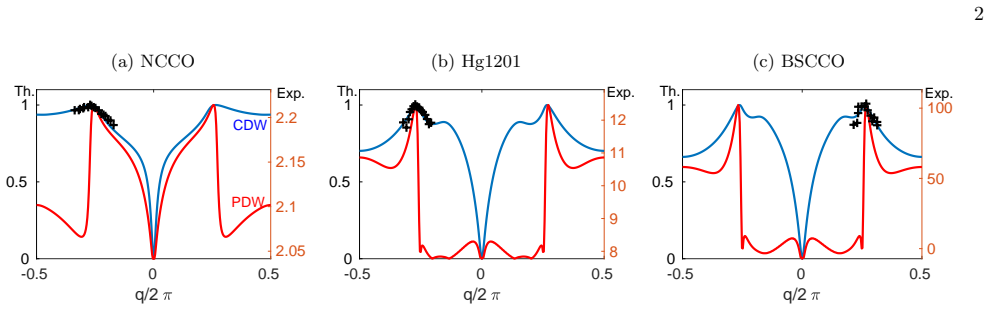
- Under the model, the published elastic and inelastic X-ray data on NCCO, Hg1201, and BSCCO lose their ambiguity: the transverse peak near $(\bar q,0)$ and the weakness or absence of the $(\bar q,\bar q)$ peak single out the PDW scenario.
- At high magnetic fields, vortex cores act as local pairing suppression centers, so the same machinery predicts that PDW modulations become long-ranged near vortices, matching the scanning-tunneling observations.
- The smallness of the X-ray signal relative to ordinary CDW materials is explained because the density modulation $\delta n$ is tiny compared with the pairing modulation $\delta\Delta$, so even a strong pairing order produces a weak charge scattering signal.
Reading between the lines
- Beyond the paper, the $R$ criterion should transfer to any single-band superconductor with known gap symmetry; for an $s$-wave gap the antinodal weighting disappears, so the clean $R>1$ versus $R<1$ separation would likely collapse — a testable prediction for other superconductors.
- Beyond the paper, the energy-resolved prediction is the sharper of the two diagnostics: an instrument with resolution better than $\Delta_0$ could settle the debate by locating the RIXS peak position independent of momentum-space fitting.
- Beyond the paper, one could apply the same response-function machinery to other competing orders (spin density waves, loop currents) by changing the impurity vertex, generating analogous ratio diagnostics for those orders.
- Beyond the paper, a quantitative check of the PDW interpretation would be to verify that the absolute intensity of the $(\bar q,0)$ peak scales with the pairing modulation amplitude rather than the charge modulation; if so, it should track the superconducting condensate and vanish at $T_c$.
Signed reviews
Editorial analysis
A structured set of objections, weighed in public.
Referee Report
Summary. The paper proposes a minimal weak-coupling model in which incipient CDW and PDW fluctuations in a d-wave superconductor are treated as the linear response of a homogeneous BCS state to a single local isotropic pinning center. It derives expressions for the charge and pairing responses, Eqs. (3) and (4), and argues that one-dimensional X-ray scans cannot distinguish the two orders, whereas two-dimensional maps can: the ratio R = χ(q,0)/χ(q,q) is claimed to satisfy R<1 for CDWs and R>1 for PDWs, and energy-resolved RIXS is predicted to peak at Ω≈2Δ0 for CDWs and at Ω≈0 for PDWs. The paper compares the elastic response with published X-ray data on NCCO, Hg1201, and BSCCO, claims that existing observations are consistent only with the PDW scenario, and supports this conclusion with a mean-field extended-Hubbard-model calculation for site and bond impurities.
Significance. If the proposed signatures are robust, the paper offers a useful and falsifiable diagnostic: a two-dimensional X-ray map and an energy-resolved RIXS scan could distinguish incipient CDW from PDW order without relying on ambiguous one-dimensional cuts. The analytic response functions follow from a standard linear-response formula, the two signatures are stated in a directly testable form, and the Hubbard-model calculation provides independent evidence that local bond-like perturbations produce density modulations peaked at (q,0). The main significance is therefore conditional on robustness checks: the local-isotropic-pinning assumption, the regularization of the divergent integrals, and the strength of the experimental claim all need further support before the central conclusion can be accepted.
major comments (4)
- [Eq. (3), footnote [56]] The CDW response is evaluated from an integral that the paper itself identifies as divergent, using Ω→Ω+iΓ with Γ/t=0.1 and N=301. For the Δ0/t=0.1 curves in Fig. 1, this broadening is half of the pair-breaking scale 2Δ0/t=0.2, so the predicted CDW peak at Ω≈2Δ0 and the numerical values of R could be artifacts of the regularization rather than intrinsic features. Since these two quantities are the central discriminators, please provide a convergence study in Γ and N, and at least one independent regularization (for example a finite-temperature Matsubara summation or analytic continuation) demonstrating that the sign of R−1 and the location of the energy peak are unchanged.
- [Weak coupling approach; Discussion] The derivation assumes a single, static, local, isotropic pinning center, and the Discussion concedes that the results "strongly rely" on this assumption. The Hubbard-model check does not close the gap: Fig. 4 tests only two impurity configurations at L=26 and reports static density maps, not the energy-resolved χ(q,Ω) distinction or the R ratio. Finite-range or anisotropic scatterers can weight different Fermi-surface segments and could in principle reverse the sign of R−1 or shift the energy peak. Please test finite-range and momentum-dependent scattering within the weak-coupling response, or restrict the generality of the claim.
- [Identifying CDW and PDW] The statement "Both observations are consistent with the PDW scenario only" is stronger than the evidence presented. Observation (ii) rests on a private communication (Ref. [64]), and the published data cited at the same point are described only as showing the peak at (q,q) to be small or absent, without a quantitative R. No experimental two-dimensional map with measured R values and error bars is shown, and no account is taken of experimental resolution or matrix-element effects that could suppress the (q,q) peak even for a CDW. Please provide a quantitative comparison with published data, including expected and measured R, or reduce the strength of the experimental conclusion.
- [Fig. 1 and parameter choices] The validation in Fig. 1 fits t′ to the experimental one-dimensional scans and reports no uncertainties; the PDW curves in the same figure use t′ values that are either different from the fitted CDW values (NCCO) or identical by assumption (Hg1201, BSCCO), without a stated fitting criterion. Because the later comparison with experiment inherits this parameterization, the authors should show how R and the energy signatures vary within the ARPES-determined range of t′, and should state explicitly how the PDW parameters in Fig. 1 were chosen.
minor comments (4)
- [Abstract and Introduction] The phrase "high-temperature cuprates superconductors" is grammatically awkward; it should read "high-temperature cuprate superconductors."
- [Eq. (5)] The on-site interaction is written as U∑_{j,σ} n_j c†_{j,σ}c_{j,σ}, but n_j is separately defined as a mean-field density; please clarify the notation so that the reader can distinguish the full Hamiltonian from its mean-field form.
- [Fig. 4] Subfigure (b) is symmetrized by 90 degrees and uses a very different color scale from subfigure (a); please state this in the caption and use comparable scales or normalized maps so that the relative peak heights can be assessed.
- [Ref. [64]] A central experimental observation is supported by an unpublished private communication; if this reference is retained, its status should be marked prominently and the authors should consider whether the claim can be supported by published data.
Circularity Check
No significant circularity: the CDW/PDW discriminators are derived from the BCS linear-response integrals, with only t' fitted to peak position and R/energy signatures untuned.
full rationale
Walked the claimed derivation chain. The central formulas, Eq. (3) and Eq. (4), are closed-form linear-response results obtained from the BCS Green's function, Eq. (2), for a momentum-independent charge impurity (Vk = V0 sigma_z) and a local pairing impurity (Vk = Delta_k sigma_x). The claimed signatures — R = chi(q,0)/chi(q,q) < 1 for CDWs vs > 1 for PDWs, and the energy-resolved peak at 2Delta_0 vs 0 — are outputs of these integrals, not quantities fitted to the answer. The only fitted input is t', which is minimized against the one-dimensional elastic peak position, and the paper notes the resulting t'/t values are consistent with ARPES-determined Fermi surfaces. Neither R nor the energy peak position is used as a fitting target. The Hubbard-model section is a separate self-consistent calculation with local delta_U and delta_V impurities; its CDW/PDW classification by comparing delta_n and delta_Delta is a consistency check, not a reuse of the weak-coupling conclusion. Self-citations are not load-bearing: Ref. [45] is invoked only to note that Eq. (3) reduces to the Lindhard response in the Delta_k -> 0 limit, and Ref. [74] is contextual earlier work. The reliance on an unpublished private communication, Ref. [64], weakens one empirical observation but is a data-source concern, not circularity. No step reduces by construction to its own input.
Assumptions & free parameters
free parameters (4)
- t'/t (next-nearest-neighbor hopping) =
-0.22 to -0.7 depending on material and branch
- Delta0/t (d-wave pairing gap) =
0.1 (CDW fits), 0.3 (PDW fits), 0.2 (2D maps)
- Regularization broadening Gamma/t and grid size N =
Gamma/t = 0.1, N = 301
- Hubbard model and impurity parameters =
U/t=1.5, V/t=-0.5, deltaU/t=deltaV/t=0.2, x=0.16, L=26
assumptions (4)
- domain assumption The cuprate superconducting state is described by a BCS Hamiltonian with a d-wave gap, including the pseudogap as a precursor.
- ad hoc to paper Incipient density waves are the linear response to a single local, isotropic, static pinning center.
- domain assumption The extended Hubbard model with on-site U and nearest-neighbor attraction V, treated at mean-field level, captures the generic cuprate competition between CDW and PDW.
- ad hoc to paper The divergent momentum integrals in Eq (3) can be regularized by finite broadening and numerical summation without changing qualitative predictions.
Cite this review
Pith. "Pith review of Minimal model of charge and pairing density waves in X-ray scattering experiments." pith.science (2026). https://pith.science/paper/GGSEYZ4P
@misc{pith2026190800566,
  author       = {Pith},
  title        = {Pith review of: Minimal model of charge and pairing density waves in X-ray scattering experiments},
  year         = {2026},
  howpublished = {\url{https://pith.science/paper/GGSEYZ4P}},
  note         = {Machine review of arXiv:1908.00566}
}
read the original abstract
Competing density waves play an important role in the mystery of high-temperature superconductors. In spite of the large amount of experimental evidence, the fundamental question of whether these modulations represent charge or pairing density waves (CDWs or PDWs) is still debated. Here we present a method to answer this question using momentum and energy-resolved resonant X-ray scattering maps. Starting from a minimal model of density waves in superconductors, we identify distinctive signatures of incipient CDWs and PDWs. The generality of our approach is confirmed by a self-consistent solution of an extended Hubbard model with attractive interaction. By considering the available experimental data, we claim that the spatial modulations in cuprates have a predominant PDW character. Our work paves the way for using X-ray to identify competing and intertwined orders in superconducting materials.
Figures

Reference graph
Works this paper leans on
- [64]
-
[1]
M., Sternlieb, B
Tranquada, J. M., Sternlieb, B. J., Axe, J. D., Naka- mura, Y. & Uchida, S. Evidence for stripe correlations of spins and holes in copper oxide superconductors. nature, 375(6532):561, 1995
1995
-
[2]
Doiron-Leyraud, N. et al. Quantum oscillations and the Fermi surface in an underdoped high-Tc superconductor. Nature, 447(7144):565, 2007
2007
-
[3]
Wu, T. et al. Magnetic-field-induced charge-stripe order in the high-temperature superconductor YBa 2Cu3Oy. Nature, 477(7363):191, 2011
work page 2011
-
[4]
Fradkin, E. & Kivelson, S. A. High-temperature super- conductivity: Ineluctable complexity. Nature Physics , 8(12):864, 2012
work page 2012
-
[5]
LeBoeuf, D. et al. Thermodynamic phase diagram of static charge order in underdoped YBa 2Cu3Oy. Nature Physics, 9(2):79, 2013
work page 2013
-
[6]
Wu, T. et al. Emergence of charge order from the vor- tex state of a high-temperature superconductor. Nature communications, 4:2113, 2013
work page 2013
-
[7]
Hoffman, J. E. et al. A four unit cell periodic pat- tern of quasi-particle states surrounding vortex cores in Bi2Sr2CaCu2O8+δ. Science, 295(5554):466–469, 2002
work page 2002
Show all 82 references
-
[8]
& Ka- pitulnik, A
Howald, C., Eisaki, H., Kaneko, N., Greven, M. & Ka- pitulnik, A. Periodic density-of-states modulations in superconducting Bi 2Sr2CaCu2O8+δ. Physical Review B , 67(1):014533, 2003
2003
-
[9]
Vershinin, M. et al. Local ordering in the pseudogap state of the high-tc superconductor Bi 2Sr2CaCu2O8+δ. Science, 303(5666):1995–1998, 2004
1995
-
[10]
Hanaguri, T. et al. A checkerboard electronic crystal state in lightly hole-doped Ca 2−xNaxCuO2Cl2. Nature, 430(7003):1001, 2004
2004
-
[11]
Ghiringhelli, G. et al. Long-range incommensurate charge fluctuations in (Y, Nd)Ba 2Cu3O6+x. Science, 337(6096):821–825, 2012
2012
-
[12]
Chang, J. et al. Direct observation of competition be- tween superconductivity and charge density wave order in YBa2Cu3O6.67. Nature Physics, 8(12):871, 2012
2012
-
[13]
H., Mahmood, F., Bollinger, A
Torchinsky, D. H., Mahmood, F., Bollinger, A. T., Boˇ zovi´ c, I. & and Gedik, N. Fluctuating charge-density waves in a cuprate superconductor. Nature materials , 12(5):387, 2013
2013
-
[14]
Blackburn, E. et al. X-ray diffraction observations of a charge-density-wave order in superconducting ortho- II YBa 2Cu3O6.54 single crystals in zero magnetic field. Physical review letters, 110(13):137004, 2013
2013
-
[15]
Comin, E. et al. Charge order driven by fermi-arc insta- bility in Bi 2Sr2−xLaxCuO6+δ. Science, 343(6169):390– 392, 2014
2014
-
[16]
da Silva Neto, E. H. et al. Ubiquitous interplay between charge ordering and high-temperature superconductivity in cuprates. Science, 343(6169):393–396, 2014
2014
-
[17]
Le Tacon, M. et al. Inelastic x-ray scattering in YBa2Cu3O6.6 reveals giant phonon anomalies and elas- tic central peak due to charge-density-wave formation. Nature Physics, 10(1):52, 2014
2014
-
[18]
Hashimoto, M. et al. Direct observation of bulk charge modulations in optimally doped Bi1.5Pb0.6Sr1.54CaCu2O8+δ. Physical Review B , 89(22):220511, 2014
2014
-
[19]
Tabis, W. et al. Charge order and its connection with fermi-liquid charge transport in a pristine high-Tc cuprate. Nature communications, 5:5875, 2014
2014
-
[20]
Huecker, M. et al. Competing charge, spin, and super- conducting orders in underdoped Yba 2Cu3Oy. Physical Review B, 90(5):054514, 2014
2014
-
[21]
Achkar, A. J. et al. Impact of quenched oxygen disorder on charge density wave order in YBa2Cu3O6+x. Physical review letters, 113(10):107002, 2014
2014
-
[22]
Gerber, S. et al. Three-dimensional charge density wave order in YBa 2Cu3O6.67 at high magnetic fields. Science, 350(6263):949–952, 2015
2015
-
[23]
Hamidian, M. H. et al. Magnetic-field induced in- terconversion of cooper pairs and density wave states within cuprate composite order. arXiv preprint arXiv:1508.00620, 2015
2015 arXiv
-
[24]
Peng, Y. Y. et al. Direct observation of charge order in underdoped and optimally doped Bi 2(Sr, La)2CuO6+δ by resonant inelastic x-ray scattering. Physical Review B, 94(18):184511, 2016
2016
-
[25]
Chaix, L. et al. Dispersive charge density wave excita- tions in Bi 2Sr2CaCu2O8+δ. Nature Physics, 13(10):952, 2017
2017
-
[26]
Peng, Y. Y. et al. Re-entrant charge order in overdoped (Bi, Pb)2.12Sr1.88CuO6+δ outside the pseudogap regime. Nature materials, 17(8):697, 2018
2018
-
[27]
Jang, H. et al. Superconductivity-insensitive order at q∼ 1/4 in electron-doped cuprates. Physical Review X , 7(4):041066, 2017
2017
-
[28]
da Silva Neto, E. H. et al. Coupling between dynamic magnetic and charge-order correlations in the cuprate superconductor Nd 2−xCexCuO4. Physical Review B , 98(16):161114, 2018
2018
-
[29]
Bluschke, M. et al. Adiabatic variation of the charge-density-wave phase diagram in the 123 cuprate (CaxLa1−x)(Ba1.75−xLa0.25+x)Cu3Oy. Physical Review B, 100(3):035129, 2019
2019
-
[30]
Kang, M. et al. Evolution of charge order topology across 6 a magnetic phase transition in cuprate superconductors. Nature Physics, 15(4):335, 2019
2019
-
[31]
& Grilli, M
Castellani, C., Di Castro, C. & Grilli, M. Singular quasi- particle scattering in the proximity of charge instabilities. Physical review letters, 75(25):4650, 1995
1995
-
[32]
& Grilli, M
Castellani, C., Di Castro, C. & Grilli, M. The charge- density-wave quantum-critical-point scenario. Physica C: Superconductivity, 282:260–263, 1997
1997
-
[33]
He, R. H. et al. From a single-band metal to a high- temperature superconductor via two thermal phase tran- sitions. Science, 331(6024):1579–1583, 2011
2011
-
[34]
Loret, B. et al. Intimate link between charge density wave, pseudogap and superconducting energy scales in cuprates. Nature Physics, 15(8):771, 2019
2019
-
[35]
D., Vafek, O., Yazdani, A
Chen, H. D., Vafek, O., Yazdani, A. & Zhang, S. C. Pair density wave in the pseudogap state of high temperature superconductors. Physical review letters , 93(18):187002, 2004
2004
-
[36]
Lee, P. A. Amperean pairing and the pseudogap phase of cuprate superconductors. Physical Review X , 4(3):031017, 2014
2014
-
[37]
S., Kloss, T
P´ epin, C., De Carvalho, V. S., Kloss, T. & Montiel, X. Pseudogap, charge order, and pairing density wave at the hot spots in cuprate superconductors. Physical Review B, 90(19):195207, 2014
2014
-
[38]
Freire, H., De Carvalho, V. S. & P´ epin, C. Renormaliza- tion group analysis of the pair-density-wave and charge order within the fermionic hot-spot model for cuprate superconductors. Physical Review B, 92(4):045132, 2015
2015
-
[39]
Wang, Y., Agterberg, D. F. & Chubukov, A. Interplay between pair-and charge-density-wave orders in under- doped cuprates. Physical Review B, 91(11):115103, 2015
2015
-
[40]
Wang, Y., Agterberg, D. F. & Chubukov, A. Coexis- tence of charge-density-wave and pair-density-wave or- ders in underdoped cuprates. Physical review letters , 114(19):197001, 2015
2015
-
[41]
Edkins, S. D. et al. Magnetic field–induced pair den- sity wave state in the cuprate vortex halo. Science, 364(6444):976–980, 2019
2019
-
[42]
Hamidian, M. H. et al. Detection of a cooper-pair density wave in Bi2Sr2CaCu2O8+x. Nature, 532(7599):343, 2016
2016
-
[43]
Du, Z. et al. Imaging the energy gap modulations of the cuprate pair-density-wave state Nature, 580(7801):65, 2020
2020
-
[44]
Agterberg, D. F. et al. The physics of pair density waves. Annual Review of Condensed Matter Physics , 11:231, 2020
2020
-
[45]
G., Benjamin, D., He, Y., Dentelski, D
Dalla Torre, E. G., Benjamin, D., He, Y., Dentelski, D. & Demler, E. Friedel oscillations as a probe of fermionic quasiparticles. Physical Review B, 93(20):205117, 2016
2016
-
[46]
Arpaia, R. et al. Dynamical charge density fluctuations pervading the phase diagram of a cu-based high-Tc su- perconductor. Science, 365(6456):906–910, 2019
2019
-
[47]
& La Placa, R
Sachdev, S. & La Placa, R. Bond order in two- dimensional metals with antiferromagnetic exchange in- teractions. Physical review letters, 111(2):027202, 2013
2013
-
[48]
B., Meier, H
Efetov, K. B., Meier, H. & P´ epin, C. Pseudogap state near a quantum critical point. Nature Physics, 9(7):442, 2013
2013
-
[49]
& Sachdev, S
Allais, A., Bauer, j. & Sachdev, S. Density wave insta- bilities in a correlated two-dimensional metal. Physical Review B, 90(15):155114, 2014
2014
-
[50]
& Orgad, D
Caplan, Y., Wachtel, G. & Orgad, D. Long-range order and pinning of charge-density waves in competition with superconductivity. Physical Review B , 92(22):224504, 2015
2015
-
[51]
& Orgad, D
Caplan, Y. & Orgad, D. Dimensional crossover of charge- density wave correlations in the cuprates.Physical review letters, 119(10):107002, 2017
2017
-
[52]
& Simons, B.D
Altland, A. & Simons, B.D. Condensed matter field the- ory (Cambridge university press, 2010)
2010
-
[53]
According to the interpretation of the pseudogap as a precursor of the superconducting pairing gap [80], this approach applies to the pseudogap region as well
-
[54]
& Freeman, A
Massidda, S., Hamada, N., Yu, J. & Freeman, A. J. Elec- tronic structure of Nd-Ce-Cu-O, a fermi liquid supercon- ductor. Physica C: Superconductivity , 157(3):571–574, 1989
1989
-
[55]
Some au- thors [15, 27] disputed this interpretation due to the mis- match between the wavevector observed in X-ray experi- ments and the antinodal distance observed in ARPES
Increasing the hole doping reduces the antinodal distance and, accordingly, reduces the CDW/PDW wavevector observed in BSCCO [15, 81] and YBCO [14, 20]. Some au- thors [15, 27] disputed this interpretation due to the mis- match between the wavevector observed in X-ray experi- ...
-
[56]
(3) involve diverging func- tions
Note that the integrals in Eq. (3) involve diverging func- tions. To normalize these expressions, we substituted Ω→ Ω +iΓ with Γ/t = 0.1 and summed over N = 301 equally spaced points, see the Supplemental Materials. We checked that the qualitative features of the resulting plo...
-
[57]
R., Randeria, M., Ding, H
Norman, M. R., Randeria, M., Ding, H. & Campuzano, J. C. Phenomenological models for the gap anisotropy of Bi 2Sr2CaCu2O8 as measured by angle-resolved pho- toemission spectroscopy. Physical Review B , 52(1):615, 1995
1995
-
[58]
S., Sahrakorpi, S., Lindroos, M., Lin, H
Markiewicz, R. S., Sahrakorpi, S., Lindroos, M., Lin, H. & Bansil, A. One-band tight-binding model parametriza- tion of the high-Tc cuprates including the effect of kz dispersion. Physical Review B, 72(5):054519, 2005
2005
-
[59]
& Ferrell, R
Fulde, P. & Ferrell, R. A. Superconductivity in a strong spin-exchange field. Physical Review , 135(3A):A550, 1964
1964
-
[60]
Larkin, A. I. & Ovchinnikov, Y. N. Nonuniform state of superconductors. Soviet Physics-JETP , 20(3):762–762, 1965
1965
-
[61]
& Kivelson, S
Berg, E., Fradkin, E. & Kivelson, S. A. Theory of the striped superconductor. Physical Review B , 79(6):064515, 2009
2009
-
[62]
Berg, E., Fradkin, E., Kivelson, S. A. & Tranquada, J. M. Striped superconductors: how spin, charge and supercon- ducting orders intertwine in the cuprates. New Journal of Physics, 11(11):115004, 2009
2009
-
[63]
See also the Supplemental Materials for a simplified model of the Fermi surface of cuprates predicting that for CDWs with q/2π = 0.25, R = 3/4
-
[65]
& Robaszkiewicz, S
Micnas, R., Ranninger, J. & Robaszkiewicz, S. An ex- tended hubbard model with inter-site attraction in two dimensions and high-tc superconductivity. Journal of 7 Physics C: Solid State Physics , 21(6):L145, 1988
1988
-
[66]
& Robaszkiewicz, S
Micnas, R., Ranninger, J. & Robaszkiewicz, S. Su- perconductivity in narrow-band systems with local non- retarded attractive interactions. Reviews of Modern Physics, 62(1):113, 1990
1990
-
[67]
Monthoux, P. H. & Scalapino, D. J. Self-consistent dx2−y2 pairing in a two-dimensional Hubbard model. Physical review letters, 72(12):1874, 1994
1994
-
[68]
M., Tsuei, C
Newns, D. M., Tsuei, C. C. & Pattnaik, P.C. Van hove scenario for d-wave superconductivity in cuprates. Phys- ical Review B, 52(18):13611, 1995
1995
-
[69]
Husslein, T. et al. Quantum monte carlo evidence for d-wave pairing in the two-dimensional hubbard model at a van hove singularity. Physical Review B, 54(22):16179, 1996
1996
-
[70]
& Machida, K
Takigawa, M., Ichioka, M. & Machida, K. Quasiparticle structure in antiferromagnetism around the vortex and nuclear magnetic relaxation time. Journal of the Physical Society of Japan, 73(2):450–458, 2004
2004
-
[71]
The relative standard deviation of X is defined as δX≡ (ΣjX 2 j )1/2/ΣjXj
-
[72]
& Franz, M
Pereg-Barnea, T. & Franz, M. Theory of quasiparticle in- terference patterns in the pseudogap phase of the cuprate superconductors. Physical Review B , 68(18):180506, 2003
2003
-
[73]
A., Moritz, B
Nowadnick, E. A., Moritz, B. & Devereaux, T. P. Quasi- particle interference and the interplay between supercon- ductivity and density wave order in the cuprates.Physical Review B, 86(13):134509, 2012
2012
-
[74]
G., He, Y., Benjamin, D
Dalla Torre, E. G., He, Y., Benjamin, D. & Demler, E. Exploring quasiparticles in high-Tc cuprates through photoemission, tunneling, and x-ray scattering experi- ments. New Journal of Physics , 17(2):022001, 2015
2015
-
[75]
H., Senthil, T
Dai, Z., Zhang, Y. H., Senthil, T. & Lee, P. A. Pair- density waves, charge-density waves, and vortices in high- t c cuprates. Physical Review B, 97(17):174511, 2018
2018
-
[76]
X., Martin, I
Zhu, J. X., Martin, I. & Bishop, A. R. Spin and charge order around vortices and impurities in high-t c super- conductors. Physical review letters, 89(6):067003, 2002
2002
-
[77]
& Strinati, G
Simonucci, S., Pieri, P. & Strinati, G. C. Temperature dependence of a vortex in a superfluid fermi gas. Physical Review B, 87(21):214507, 2013
2013
-
[78]
Matsuba, K. et al. Anti-phase modulation of electron-and hole-like states in vortex core of Bi 2Sr2CaCu2Ox probed by scanning tunneling spectroscopy. Journal of the Phys- ical Society of Japan , 76(6):063704, 2007
2007
-
[79]
Yoshizawa, S. et al. High-resolution scanning tunneling spectroscopy of vortex cores in inhomogeneous electronic states of Bi2Sr2CaCu2Ox. Journal of the Physical Society of Japan, 82(8):083706, 2013
2013
-
[80]
Emery, V. J. & Kivelson, S. A. Importance of phase fluc- tuations in superconductors with small superfluid den- sity. Nature, 374(6521):434, 1995
1995
-
[81]
Wise, W. D. et al. Charge-density-wave origin of cuprate checkerboard visualized by scanning tunnelling microscopy. Nature Physics, 4(9):696, 2008
2008
-
[82]
King, P. D. C. et al. Structural origin of appar- ent fermi surface pockets in angle-resolved photoemis- sion of Bi 2Sr2−xLaxCuO6+δ. Physical review letters , 106(12):127005, 2011
2011
Reviewed August 14, 2026 · model on record in the stance chip above.
Discussion (0). Continue with ORCID to comment.