REVIEW 2 major objections 4 minor 20 references
GDoF of Interference Channel with Limited Cooperation under Finite Precision CSIT
T0 review · 2 major / 4 minor · reviewed 2026-08-14 · deepseek-v4-flash
Pith's one-line read Under finite-precision CSIT, the two-user interference channel with limited cooperation admits only four cooperation efficiencies, 0, 1, 1/2, and 1/3, and the paper proves the sum-GDoF is exactly the minimum of the four corresponding…
desk verdict The paper gives the first complete GDoF characterization for the two-user interference channel with limited transmitter cooperation under finite-precision CSIT, and the new 1/3 slope is real, but the converse for that slope leans on an unstated sum-set inequality from the same group's arXiv preprint, so the result is strong but not yet self-contained. read the letter →
The pith
A machine-rendered reading of the paper's core claim, the machinery that carries it, and where it could break.
The reading
What carries the argument
The carrying mechanism is the aligned-images method for converse bounds, specialized to a deterministic model with power-level partitions $A,B,C$ chosen from the transmitter symbol spaces (definitions (43)-(45)). These partitions are engineered so that $A$ is the part of $X_1$ that Receiver 2 cannot hear, $C$ is the part of $X_2$ that Receiver 2 can hear, and $B$ fills out the signal heard by Receiver 1; the sum-set inequality of [16] is then applied to relate their entropies. The resulting entropy chain yields the key GDoF inequality $3d_{11}+3d_{22}+2d_{01}+2d_{02}\le D_{3e}$, which is exactly the $1/3$ slope. Achievability uses Gaussian superposition codebooks with carefully chosen power levels and successive interference cancellation at the receivers, with schemes running through four strong-interference subcases.
What would settle it
At a strong-interference point where the 1/3 bound is active, for instance the paper's example $\alpha_{11}=1.2,\alpha_{22}=1,\alpha_{12}=2,\alpha_{21}=1.8$, compute the entropy difference in (81) directly on the deterministic model instead of bounding it via (89)-(92); if the difference exceeds the claimed $D_{3e}$ bound by more than $o(\log P)$, the converse fails. A cheaper check is to verify each of the three invocations of the sum-set inequality of [16] against that inequality's stated hypotheses for these A, B, C partitions.
Extended reading notes
Core claim
On the paper's own terms, the central discovery is that the sum-GDoF of the two-user interference channel with limited transmitter cooperation and finite-precision CSIT is exactly $\min(D_{\Sigma,\mathrm{IC}}+\pi,\,D_{\Sigma,\mathrm{BC}})$ in the weak and mixed half-duplex regimes, and in the strong-interference half-duplex regime is $\min(D_{\Sigma,\mathrm{IC}}+\pi,\,D_{2e}+\pi/2,\,D_{3e}+\pi/3,\,D_{\Sigma,\mathrm{BC}})$, where $D_{2e}=\alpha_{12}+\alpha_{21}$ and $D_{3e}=\min(\alpha_{21}-\alpha_{22},\alpha_{11})+2\max(\alpha_{21}-\alpha_{11},\alpha_{22})+\alpha_{12}+\max(\alpha_{12}-\alpha_{22},\alpha_{11})$; Theorem 2 gives the analogous full-duplex formula, with $\pi/2$ replacing $\pi$ in the mixed regime and $\min(\alpha_{12},\alpha_{21})+\pi/2$ in strong interference. This characterization is tight in every regime, so the authors claim no parameter combinations are left open. The $1/3$-slope bound, hidden in $D_{3e}+\pi/3$, is the genuinely new phenomenon: it appears only under finite-precision CSIT and strong interference, and the paper identifies its mechanism, namely that an $\epsilon$ increase in sum-GDoF requires an $\epsilon$ increase in each of the three cooperative sub-messages and an $\epsilon$ decrease in each of the two noncooperative messages.
Load-bearing premise
The 1/3-slope converse assumes that a known sum-set inequality applies to the particular power-level partitions A, B, and C constructed in (43)-(45); if that inequality does not cover these partitions, the 1/3 bound and with it the main theorems do not follow.
Editorial extensions
If this is right
- The GDoF of the two-user limited-cooperation interference channel under finite-precision CSIT is fully characterized for all parameter regimes, with no gap left between achievability and converse.
- Every unit of cooperation capability buys exactly 0, 1, 1/2, or 1/3 over-the-air bits; under perfect CSIT only 0, 1, and 1/2 are possible, so 1/3 is the finite-precision signature.
- Corollaries 1 and 2 give closed-form values for the minimum cooperation budget needed to reach the broadcast-channel bound, and in strong interference that budget strictly exceeds the simple shortfall $D_{\Sigma,\mathrm{BC}}-D_{\Sigma,\mathrm{IC}}$.
- In the full-duplex model the mixed-interference bound uses $\pi/2$ instead of $\pi$, and in several strong-interference cases one cooperation direction is wasted, so half-duplex cooperation can beat full-duplex cooperation at the same total budget.
- For symmetric channels the half-duplex and full-duplex formulas coincide, and for $2/3\le\alpha\le1$ there is no cooperation gain, recovering and explaining the earlier broadcast-channel result.
Reading between the lines
- The 1/3 slope points to a possible general law: under finite-precision CSIT, robust cooperation may require simultaneously upgrading all shared sub-messages, so one might expect slopes of the form $1/(K+1)$ in $K$-user extensions; the paper does not make this conjecture and its proofs are specific to two users.
- The same aligned-images-plus-sum-set recipe, applied to the power partitions of this paper, could be aimed at the K-user broadcast channel's strong-interference regime, which the paper notes remains open; whether the recipe carries over is my inference, not its claim.
- The closed-form cooperation-budget formulas can be inverted to optimize channel parameters for a fixed $\pi$, an operation the paper does not perform; the resulting comparison against perfect-CSIT benchmarks would be a direct numerical test of the formulas.
- The paper's closing remark that the 2-user X channel with limited cooperation becomes straightforward suggests that the difficulty is specific to partial message overlap; my inference is that adding more messages, not more users, may be the next hard step.
Signed reviews
Editorial analysis
A structured set of objections, weighed in public.
Referee Report
Summary. The paper characterizes the sum generalized degrees of freedom (GDoF) of the two-user interference channel with limited transmitter cooperation under finite-precision CSIT, for both half-duplex and full-duplex cooperation. Theorem 1 gives the half-duplex sum-GDoF as min(DΣ,IC+π, D2e+π/2, D3e+π/3, DΣ,BC) in the strong interference regime, with D2e and D3e defined in (13)-(14), and the simpler min(DΣ,IC+π, DΣ,BC) in the weak and mixed regimes. Theorem 2 gives the analogous full-duplex characterization, with a mixed-regime expression min(DΣ,IC+π/2, DΣ,BC) and a strong-regime expression involving min(α12,α21)+π/2 and D3e+π/3. The converse is developed through aligned-images bounds and sum-set inequalities, while the achievability is given by explicit Gaussian coding schemes organized into numerous cases. Two corollaries state the minimum cooperation GDoF needed to reach the broadcast-channel bound.
Significance. If the main theorems are correct, the paper closes the GDoF gap between the no-cooperation interference channel and the full-cooperation broadcast channel under finite-precision CSIT, and it identifies a genuinely new 1/3 slope that does not appear under perfect CSIT. The GDoF formulas are explicit and the theorem statements are clear. The paper also provides a detailed case-by-case achievability construction, which is a substantial amount of work. The main caveat is that the 1/3-slope converse relies on a sum-set inequality from the authors' own arXiv preprint [16] without restating its hypotheses; this is a correctness-risk point that needs to be resolved before the characterization can be considered fully established.
major comments (2)
- [§4, Eqs. (64), (78), (82), and (93)] The converse for the D3e bound, leading to (93), depends on the sum-set inequality (Theorem 1 of [16]) being applicable to the partitions A, B, C defined in (43)-(45). The paper invokes this inequality at (64), (78), and (82) but never restates its hypotheses or proves them for the present setting. This is load-bearing because A is a segment of X1 = f1(W11,W01,W02) and C is a segment of X2 = f2(W22,W01,W02). Conditioned on W11,W01 as in (64), both A and C depend on the common message W02; similarly, at (78) they share dependence on W01. A generic sum-set entropy inequality H(Y) ≥ H(A,C) can fail for dependent summands, and the observation after (46) that the combined power levels of A and C are below α12 is necessary but not sufficient. Since [16] is an unreviewed arXiv preprint by the same group, the correctness of the 1/3-slope upper bound cannot be checked from the present text. Please provide a self-contained statement of the inequality and a detailed verification of its hypotheses for the dependent partitions A and C, or supply a proof of the specific instances used at (64), (78), and (82).
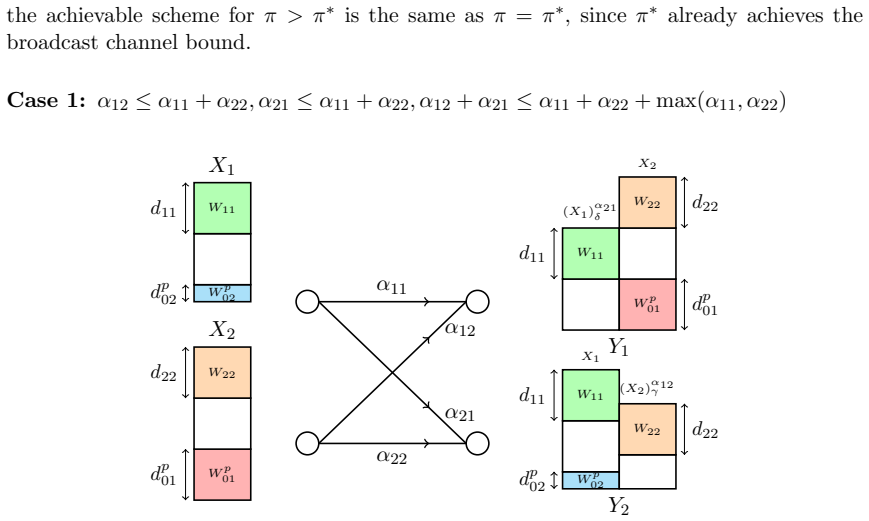
- [§6.1 Case 2 and §6.2 Case 2] The achievability case analysis contains boundary inequalities that are internally inconsistent as printed, which prevents verification of the claimed active-bound transitions. In §6.1 Case 2, after the first bullet states "π ≤ α12−α21", the second bullet writes "When α21−α12 ≤ π ≤ 2α11+2α22−α12−α21"; the lower bound appears to be a sign error for "α12−α21". In §6.2 Case 2, the bullet "When α11+α22−2α12+α21 ≤ π/2 ≤ π+/2" appears to involve a different threshold than the condition "α11+α22+α12−2α21 ≤ π/2" used in the preceding bullet. Because the achievability proof proceeds by partitioning the parameter range into intervals defined by these inequalities, such inconsistencies block a complete check of the strong-interference achievability claim. Please correct these boundaries and re-verify the nonnegativity of all rate assignments over the stated intervals.
minor comments (4)
- [Figure 2] The axis labels in Figure 2 are garbled (e.g., "0:2", "ı`!", "Sum-GDoF`!"), and the figure does not render the intended mathematical notation; it should be regenerated with proper labels.
- [§4, Eqs. (64)-(65)] Equations (64) and (65) appear to be identical as printed; if one of them was intended to display a different intermediate bound, please correct the duplication.
- [§7] The paragraph on the X channel is informal and states several conclusions without proof; since it is presented as an aside rather than a theorem, it should be clearly labeled as an observation or conjecture, or supported with a proof.
- [References] Because the converse relies on the sum-set inequality of [16], the paper should either state the theorem in the main text or include its statement in an appendix, especially given that [16] is an arXiv preprint rather than a published article.
Circularity Check
No significant circularity: the GDoF characterization is derived from stated deterministic-model inequalities and external parameter-free tools, not from the theorem being proved.
full rationale
The derivation chain is not circular. The paper's central results, Theorem 1 and Theorem 2, are explicit min-expressions in terms of previously characterized quantities DΣ,IC and DΣ,BC and newly defined constants D2e = α12 + α21 and D3e = min(α21−α22, α11) + 2max(α21−α11, α22) + α12 + max(α12−α22, α11). These constants are not fitted to the bound they support; they are the entropy bounds (89)–(92) evaluated at the power-level partitions A, B, C defined in (43)–(45). The converse derives the 1/3-slope bound (93) by adding Fano inequalities, entropy bounds, and the sum-set inequality of [16] at (64), (78), and (82). No parameter is fitted to a subset of the data and then renamed as a prediction, and no quantity is defined in terms of the GDoF value being proved. The cited tools ([7], [15], [16]) are prior parameter-free inequalities used as instruments, not restatements of Theorem 1 or Theorem 2. The same-group origin of [16] does not by itself make the argument circular: the inequality is external to the present claim and the paper does not define D3e through it. The skeptical concern that the sum-set inequality in [16] is invoked without restating its hypotheses is a proof-verification risk, not a demonstration that (93) equals an input by construction. The paper even flags that the 1/3-slope converse is the hard part, and its algebra is internally consistent under the cited tools. No self-definitional step, fitted-input-called-prediction step, or imported uniqueness step is present. The only caveat is self-containedness: a reader cannot fully verify (64), (78), and (82) from the present text alone because Theorem 1 of [16] is not restated. That is a rigor gap, not circularity, and under the hard rules it does not raise the circularity score.
Assumptions & free parameters
assumptions (4)
- standard math Aligned images bounds of [7],[15] and sum-set inequalities of [16] hold for the power-level partitions used in the converse.
- domain assumption The deterministic channel model (24)-(25) has a GDoF region that contains that of the original Gaussian channel under finite precision CSIT.
- domain assumption Transmitters have finite precision CSIT: they know only the joint pdfs of channel coefficients, and all Gki(t) lie in [1/Δ, Δ].
- standard math Standard information-theoretic tools (Fano's inequality, Gaussian codebooks, successive cancellation) apply in the GDoF limit.
Cite this review
Pith. "Pith review of GDoF of Interference Channel with Limited Cooperation under Finite Precision CSIT." pith.science (2026). https://pith.science/paper/GGZ5KGR6
@misc{pith2026190800703,
  author       = {Pith},
  title        = {Pith review of: GDoF of Interference Channel with Limited Cooperation under Finite Precision CSIT},
  year         = {2026},
  howpublished = {\url{https://pith.science/paper/GGZ5KGR6}},
  note         = {Machine review of arXiv:1908.00703}
}
abstract
The Generalized Degrees of Freedom (GDoF) of the two user interference channel are characterized for all parameter regimes under the assumption of finite precision channel state information at the transmitters (CSIT), when a limited amount of (half-duplex or full-duplex) cooperation is allowed between the transmitters in the form of $\pi$ DoF of shared messages. In all cases, the number of over-the-air bits that each cooperation bit buys is shown to be equal to either $0, 1, 1/2$ or $1/3$. The most interesting aspect of the result is the $1/3$ slope, which appears only under finite precision CSIT and strong interference, and as such has not been encountered in previous studies that invariably assumed perfect CSIT. Indeed, the achievability and converse for the parameter regimes with $1/3$ slope are the most challenging aspects of this work. In particular, the converse relies on non-trivial applications of Aligned Images bounds.
Figures


Figures from the paper (7 more)




Reference graph
Works this paper leans on
-
[16]
Sum-set Inequalities from Aligned Image Sets: Instruments for Robust GDoF Bounds
A. G. Davoodi and S. A. Jafar, “Sum-set inequalities from aligned image sets: Instru- ments for robust GDoF bounds,” arXiv preprint arXiv:1703.01168 , 2017
work page Pith review arXiv 2017
-
[1]
Straggler mitigation in distributed matrix multiplication: Fundamental limits and optimal coding,
Q. Yu, M. A. Maddah-Ali, and A. S. Avestimehr, “Straggler mitigation in distributed matrix multiplication: Fundamental limits and optimal coding,” arXiv preprint arXiv:1801.07487, 2018
arXiv 2018
-
[2]
Uplink macro diversity of limited backhaul cellular network,
A. Sanderovich, O. Somekh, H. V. Poor, and S. Shamai, “Uplink macro diversity of limited backhaul cellular network,” IEEE Transactions on Information Theory , vol. 55, pp. 3457–3478, Aug 2009
work page 2009
-
[3]
Channels with cooperation links that may be absent,
W. Huleihel and Y. Steinberg, “Channels with cooperation links that may be absent,” IEEE Transactions on Information Theory , vol. 63, pp. 5886–5906, Sep. 2017. 37
work page 2017
-
[4]
Mixed delay constraints in wyner’s soft- handoff network,
H. Nikbakht, M. Wigger, and S. S. Shitz, “Mixed delay constraints in wyner’s soft- handoff network,” in 2018 IEEE International Symposium on Information Theory (ISIT), pp. 1171–1175, June 2018
work page 2018
-
[5]
Cooperative wireless cellular systems: an information theoretic view,
O. Simeone, N. Levy, A. Sanderovich, O. Somekh, B. Zaidel, H. Poor, and S. Shamai, “Cooperative wireless cellular systems: an information theoretic view,” in Foundations and Trends in Communication and Information Theory , vol. 8, pp. 1–177, 2012
work page 2012
-
[6]
Collapse of degrees of freedom in MIMO broadcast with finite precision CSI,
A. Lapidoth and S. Shamai, “Collapse of degrees of freedom in MIMO broadcast with finite precision CSI,” in Proceedings of 43rd Annual Allerton Conference on Commu- nications, Control and Computing , Sep 2005
work page 2005
-
[7]
A. G. Davoodi and S. A. Jafar, “Aligned image sets under channel uncertainty: Set- tling conjectures on the collapse of degrees of freedom under finite precision CSIT,” IEEE Transactions on Information Theory , vol. 62, no. 10, pp. 5603–5618, 2016
work page 2016
Show all 20 references
-
[8]
GDoF of the MISO BC: Bridging the gap between finite precision and perfect CSIT,
A. G. Davoodi, B. Yuan, and S. A. Jafar, “GDoF of the MISO BC: Bridging the gap between finite precision and perfect CSIT,” IEEE Transactions on Information Theory, vol. 64, pp. 7208–7217, Nov 2018
2018
-
[9]
Towards an extremal network theory - robust gdof gain of transmitter cooperation over TIN,
Y. Chan, J. Wang, and S. A. Jafar, “Towards an extremal network theory - robust gdof gain of transmitter cooperation over TIN,” CoRR, vol. abs/1901.09885, 2019
1901 arXiv
-
[10]
Transmitter cooperation under finite precision CSIT: A GDoF perspective,
A. G. Davoodi and S. A. Jafar, “Transmitter cooperation under finite precision CSIT: A GDoF perspective,” IEEE Transactions on Information Theory , vol. 63, no. 9, pp. 6020–6030, 2017
2017
-
[11]
Gaussian interference channel capacity to within one bit,
R. Etkin, D. Tse, and H. Wang, “Gaussian interference channel capacity to within one bit,” IEEE Transactions on Information Theory , vol. 54, no. 12, pp. 5534–5562, 2008
2008
-
[12]
Interference mitigation through limited transmitter co- operation,
I. Wang and D. N. C. Tse, “Interference mitigation through limited transmitter co- operation,” IEEE Transactions on Information Theory , vol. 57, pp. 2941–2965, May 2011
2011
-
[13]
On the synergistic benefits of alternating CSIT for the MISO BC ,
R. Tandon, S. A. Jafar, S. Shamai, and H. V. Poor, “On the synergistic benefits of alternating CSIT for the MISO BC ,” IEEE Transactions on Information Theory , Submitted August 2012. Available online: http://arxiv.org/abs/1208.5071
2012 arXiv
-
[14]
El Gamal and Y.-H
A. El Gamal and Y.-H. Kim, Network information theory . Cambridge University Press, 2011
2011
-
[15]
Generalized Degrees of Freedom of the Symmetric K-User Interference Channel under Finite Precision CSIT,
A. G. Davoodi and S. A. Jafar, “Generalized Degrees of Freedom of the Symmetric K-User Interference Channel under Finite Precision CSIT,” IEEE Transactions on Information Theory, vol. 63, no. 10, pp. 6561–6572, 2017. 38
2017
-
[17]
Degrees of freedom region for the MIMO X channel,
S. Jafar and S. Shamai, “Degrees of freedom region for the MIMO X channel,” IEEE Trans. on Information Theory , vol. 54, pp. 151–170, Jan. 2008
2008
-
[18]
Interference mitigation through limited receiver coop- eration,
I. Wang and D. N. C. Tse, “Interference mitigation through limited receiver coop- eration,” IEEE Transactions on Information Theory , vol. 57, pp. 2913–2940, May 2011
2011
-
[19]
Interference channels with source coopera- tion,
V. M. Prabhakaran and P. Viswanath, “Interference channels with source coopera- tion,” IEEE Transactions on Information Theory , vol. 57, pp. 156–186, Jan 2011
2011
-
[20]
Interference channels with destination coop- eration,
V. M. Prabhakaran and P. Viswanath, “Interference channels with destination coop- eration,” IEEE Transactions on Information Theory , vol. 57, pp. 187–209, Jan 2011. 39
2011
Reviewed August 14, 2026 · model on record in the stance chip above.
Discussion (0). Continue with ORCID to comment.