REVIEW 3 major objections 5 minor 34 references
IAENet: An Importance-Aware Ensemble Model for 3D Point Cloud-Based Anomaly Detection
T0 review · 3 major / 5 minor · reviewed 2026-08-05 · deepseek-v4-flash
Pith's one-line read IAENet claims to improve 3D point-cloud anomaly localization by adaptively reweighting a 2D pretrained expert and a 3D expert, reaching AUPRO 0.944.
desk verdict A neat fusion idea, backed by solid ablations, but the missing point-to-grid mapping makes the headline localization numbers unverifiable as reported. read the letter →
The pith
A machine-rendered reading of the paper's core claim, the machinery that carries it, and where it could break.
The reading
What carries the argument
The central object is the Importance-Aware Fusion (IAF) module, made of a selector network and a predictor network. The selector takes the two expert score maps concatenated pixel-wise and outputs per-location importance weights; the predictor multiplies each map by its weight and applies a nonlinear mapping to produce the final fused score map. The module is trained on synthetic Cut-Paste anomalies with a predictor cross-entropy loss and a selector loss that combines a margin-based performance gate (which closes once fusion beats the better single expert) with an entropy regularizer that drives exploration from equal weights to specialization. Around this sits a dual memory bank built by sh
What would settle it
Re-implement the per-point evaluation by mapping each of the M points to its projected pixel in the depth image, assigning the fused score of that pixel with an explicit rule for out-of-image points and for pixels shared by many points, then recompute mean AUPRO on MVTec 3D-AD. If alternative tie-handling rules change AUPRO by more than a small margin, or produce visible misalignment, the reported gain over prior methods would not be a stable property of the method.
Extended reading notes
Core claim
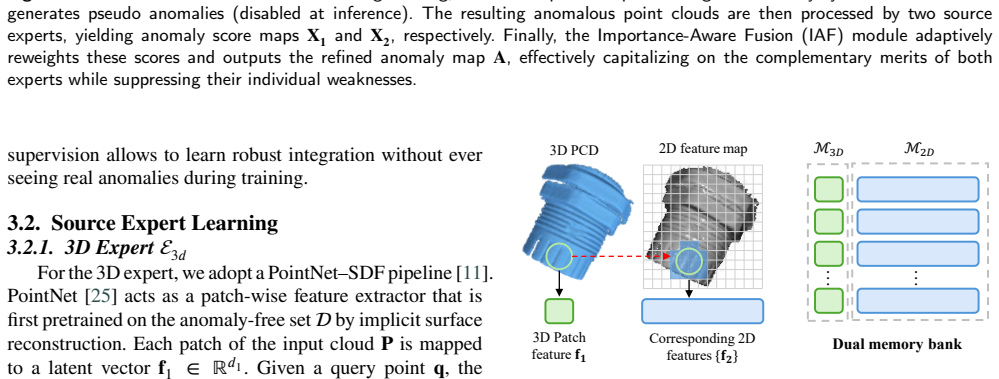
On its own terms, the paper claims that decision-level fusion of 2D and 3D anomaly experts can be made reliable by learning per-location importance weights instead of assuming equal contributions. The 2D expert (pretrained Wide-ResNet-50-2 on a single frontal normal-based depth rendering, plus FPFH descriptors) tends to catch fine surface details but marks many normal points; the 3D expert (PointNet with SDF reconstruction) captures global geometry but can miss subtle defects. IAENet trains a selector network to assign importance scores to the two score maps, uses a margin-based selector loss with an entropy regularizer to force exploration of weight combinations and then stop when fusion be
Load-bearing premise
The localization result assumes that the fused h x w anomaly map on the rendered depth grid can be mapped back to the original point cloud without losing or misaligning points, but the paper does not specify this per-point mapping.
Editorial extensions
If this is right
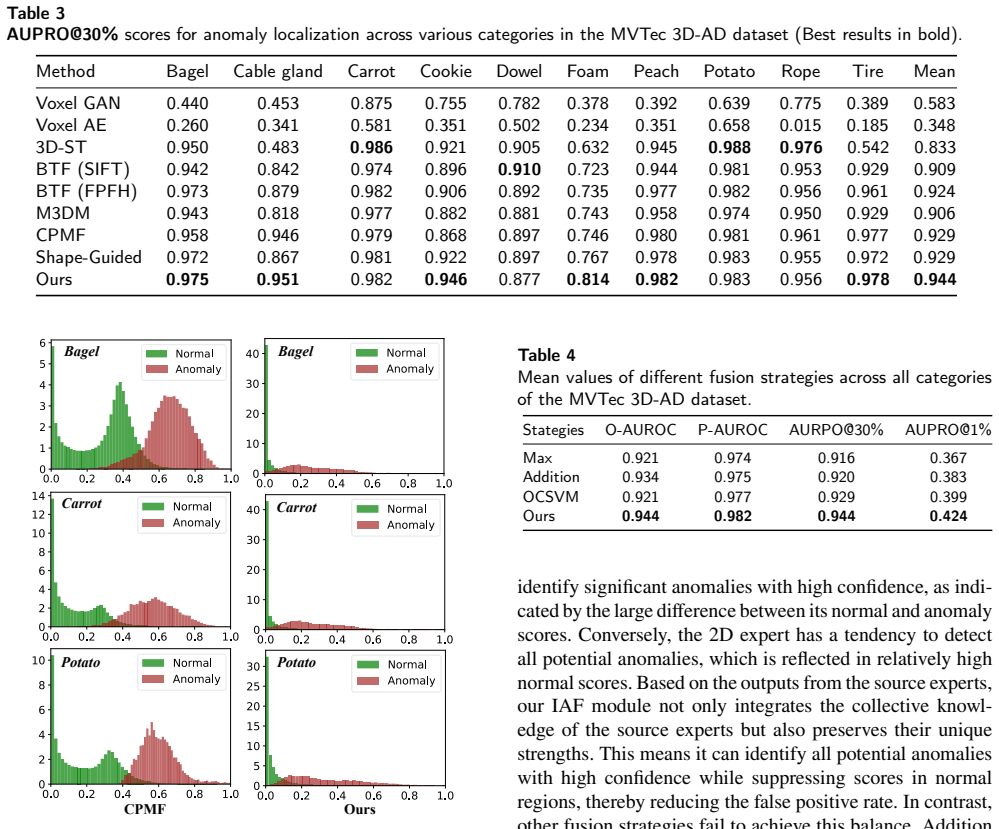
- If the reported numbers hold, learned importance-aware fusion outperforms fixed rules: on MVTec 3D-AD it beats max, addition, and OCSVM fusion on all three metrics by clear margins.
- The 2D expert needs only a single frontal projection to be competitive, so the method avoids tuning multi-view projection counts and angles used by prior approaches, simplifying deployment.
- Because the selector can down-weight a failing expert, the fused object-level score stays high even when one expert collapses, for example Cable gland with 2D expert 0.969, 3D expert 0.710, and fused 0.954.
- The score compression on normal points should translate to fewer false alarms at operating points with strict false-positive budgets, which is the regime the AUPRO curves at small integration limits are meant to capture.
Reading between the lines
- The IAF design is agnostic to what generates the score maps, so the same learned fusion could combine other pairs of detectors, such as RGB and point cloud or flow and memory-bank models; swapping in different experts on MVTec 3D-AD would be a direct test of whether the fusion mechanism, not the specific experts, drives the gain.
- Since training uses synthetic Cut-Paste anomalies only, the paper leaves open how the learned importance weights behave on real defect types whose geometry differs from pasted patches; a per-anomaly-type breakdown of AUPRO would show whether the low false-positive rate holds for every defect class.
- The paper's reported point-level metrics are computed on the original point cloud, while fusion happens on an h x w depth-image grid; spelling out the per-point mapping, and handling of points sharing a pixel or falling outside the rendered view, is a needed reproducibility check before the 0.944 AUPRO claim can be taken at face value.
Editorial analysis
A structured set of objections, weighed in public.
Referee Report
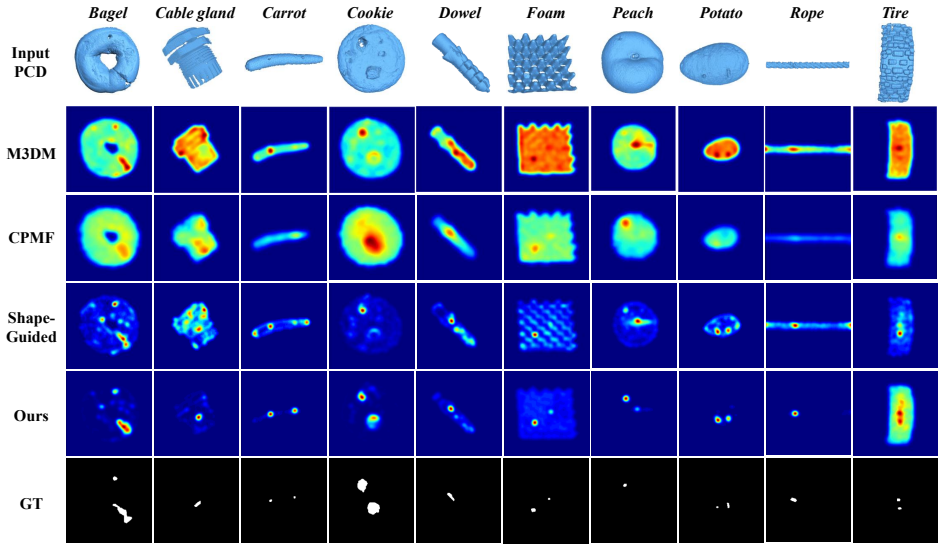
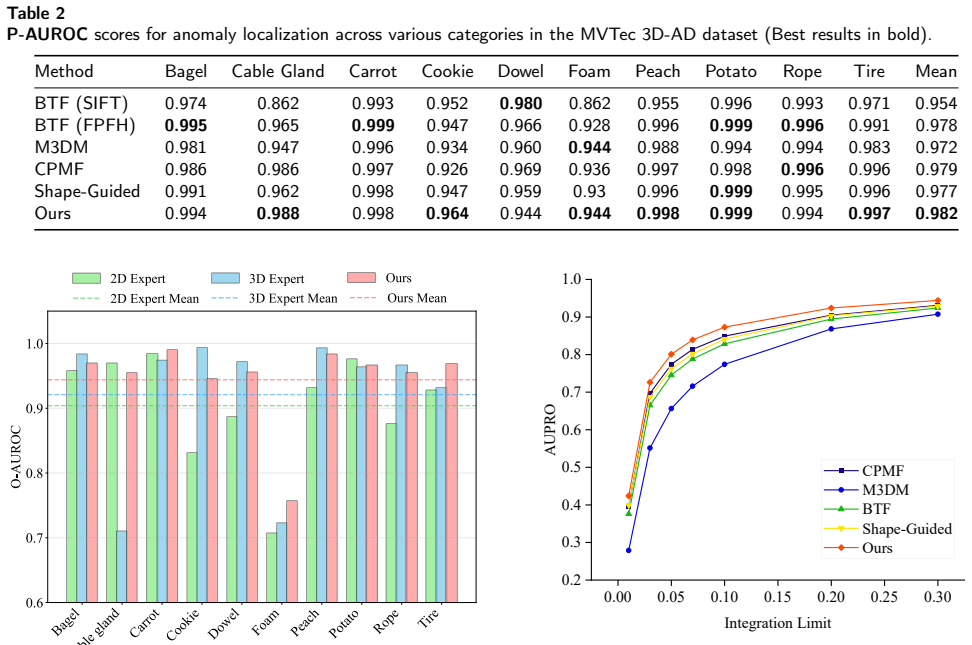
Summary. The paper proposes IAENet, an ensemble framework for 3D point-cloud anomaly detection that combines a 3D expert (PointNet–SDF with dual memory-bank retrieval, following Shape-Guided) and a 2D expert (frozen ImageNet-pretrained ResNet on a single rendered depth map, with FPFH features) through a learned Importance-Aware Fusion (IAF) module. The IAF contains a selector network that reweights the two expert score maps per spatial location and a predictor network that nonlinearly maps the weighted maps to a final anomaly map. The fusion is trained on synthetically generated Cut-Paste anomalies using a margin-based selector loss with an entropy regularizer and a separate predictor loss. Experiments on MVTec 3D-AD report new state-of-the-art point-level localization results (P-AUROC 0.982, AUPRO@30% 0.944) and competitive object-level detection (O-AUROC 0.944), together with ablations of the fusion components and comparisons to max, addition, and OCSVM fusion.
Significance. If the results hold, the paper makes a useful practical contribution: it shows that a well-chosen 2D pretrained backbone can be adapted to 3D anomaly detection via a single depth projection, and that a learned, importance-aware fusion rule can outperform simple max/addition/OCSVM fusion. The proposed margin-gated selector loss is a novel mechanism for suppressing the influence of a poorly performing expert. The paper provides per-category results on a standard benchmark, AUPRO curves at multiple integration limits, and an ablation of the fusion components. However, the central localization claim is currently not verifiable because the paper never specifies how the grid-based fused anomaly map is converted to per-point scores, or how points outside the single frontal view are handled. Without this mapping, the reported AUPRO and false-positive-rate improvements cannot be reliably compared with prior methods that score the full point cloud.
major comments (3)
- [§3.3.1, §4.1.2, §4.1.3] The fusion module operates on h×w grids X1, X2 and outputs a grid A, but the point-level evaluation metrics P-AUROC and AUPRO are defined on the original M-point cloud. The paper never defines how per-point expert scores are rasterized into the depth-image grid, nor how the fused grid A is unprojected to per-point scores. It also does not state what happens to points that are not visible in the single frontal view (Section 4.1.2: 'we only project a frontal view') or that are occluded. If these points receive a default score of 0 or are excluded from evaluation, the reported AUPRO of 0.944 and the 'markedly lower false positive rate' claim are not comparable to baselines that score the full point cloud. The synthetic labels Y_i used in Eq. (18) must also be aligned to the grid; this alignment is not specified. Please provide the exact mapping in both directions, including handling of occl
- [§4.1.2] The 2D expert uses a single frontal depth projection, so it has no information about backside or occluded surface regions. Since the fusion is performed on the grid, it is unclear how the IAF module obtains a fused score for points that do not project into this view. If those points are assigned zero score by default, the point-level localization scores are inflated because many normal points would trivially produce zero false positives. The authors should report the fraction of points covered by the frontal view per category and describe how uncovered points are scored during both training and inference. This is essential for interpreting the comparison with CPMF and Shape-Guided, which score the full cloud.
- [§3.3.2, Eqs. (11)–(13), (18)–(19)] The loss is written as cross-entropy with a sum over i=1..c and c=1. For binary anomaly labels (y∈{0,1}), standard binary cross-entropy is -[y log p + (1-y) log(1-p)]. The formulation as written includes only the positive-class term, which would not penalize high anomaly scores on normal pixels and contradicts the paper's stated goal of suppressing normal-region scores. Please clarify the notation (e.g., sum over both classes) or present the actual binary cross-entropy used. This affects both the selector loss L_s and the predictor loss L_p.
minor comments (5)
- [Table 5] The component names in the ablation table appear swapped: the row labeled 'Predictor Network S_theta' and the row labeled 'Selector Network f_phi_i' contradict the definitions in Section 3.3.1 and Figure 4, where S_theta is the selector and f_phi is the predictor. Please relabel the rows/columns to match the notation used in the text.
- [Abstract and Table 4] There are typos: 'We introduce an novel' in the abstract, and 'AURPO' in Table 4 and Figure 7 should be 'AUPRO'.
- [§3.3.2, Eq. (16)–(18)] The sign of the entropy term is inconsistent across equations: Eq. (16) uses H = -S log S, but the expanded form in Eq. (18) is written with an outer minus sign and S log S. Please align the notation so the gradient direction is unambiguous.
- [§4.1.2] The statement that margin m=0.1 and λ=1 'may require fine-tuning for some categories' raises the question of whether per-category tuning was performed. If so, please report which categories were tuned and the values used; if not, clarify that a single global setting was used.
- [References [29]] The Cut-Paste synthetic data generation is attributed to the authors' own G2SF-MIAD paper. Please clarify the relationship and whether the synthetic data generation code/configuration will be released to facilitate reproducibility.
Circularity Check
No circularity: IAENet's fusion is trained on synthetic labels and evaluated on held-out real anomalies; self-citations are not load-bearing.
full rationale
The paper's central derivation is not circular. The IAF module is trained on a synthetic dataset D' = {(P'_i, Y_i)} generated by Cut-Paste, with per-point binary labels, and is evaluated on the real MVTec 3D-AD test set; the reported O-AUROC/P-AUROC/AUPRO numbers are empirical comparisons against external baselines, not consequences of the training objective. The margin loss (Eqs. 7-18) is a training signal: b is the minimum of the two expert cross-entropy losses computed on the fixed training maps, and the selector/predictor must actually generalize to unseen test point clouds to improve the metrics. Nothing in the definition forces the test-time AUPRO to be high. The one notable self-citation is [29] (G2SF-MIAD) for the Cut-Paste synthesis, but the paper itself describes the paste procedure (mask creation, cutting, pasting, random transformations), and the synthetic target is an independent training signal rather than an already-known prediction. The grid-to-point mapping between Sec. 3.3 (X1,X2 in R^{h x w}, A in R^{h x w}) and the point-level metrics of Sec. 4.1.3 (A in R^M) is never specified, which is a serious reproducibility/validity concern, but it is not circular: it does not make a claimed prediction equivalent to an input. The method is self-contained against external benchmarks, and the small self-citations in the intro/survey are not load-bearing. No circular step can be quoted or exhibited.
Assumptions & free parameters
free parameters (5)
- margin m =
0.1
- loss balance lambda =
1.0
- synthetic samples per class =
800
- nearest neighbor counts k1, k2 =
not stated
- learning rate =
0.01
assumptions (4)
- domain assumption PointNet-SDF pretrained on normal scans yields per-point anomaly scores via |s|.
- domain assumption ImageNet-pretrained ResNet features on a single textured depth map are informative for 3D anomaly detection.
- domain assumption Cut-Paste synthetic anomalies are a valid training proxy for real anomalies.
- domain assumption Shape-guided memory bank retention preserves the most discriminative normal features.
Cite this review
Pith. "Pith review of IAENet: An Importance-Aware Ensemble Model for 3D Point Cloud-Based Anomaly Detection." pith.science (2026). https://pith.science/paper/GH627I5G
@misc{pith2026250820492,
  author       = {Pith},
  title        = {Pith review of: IAENet: An Importance-Aware Ensemble Model for 3D Point Cloud-Based Anomaly Detection},
  year         = {2026},
  howpublished = {\url{https://pith.science/paper/GH627I5G}},
  note         = {Machine review of arXiv:2508.20492}
}
read the original abstract
Surface anomaly detection is pivotal for ensuring product quality in industrial manufacturing. While 2D image-based methods have achieved remarkable success, 3D point cloud-based detection remains underexplored despite its richer geometric cues. We argue that the key bottleneck is the absence of powerful pretrained foundation backbones in 3D comparable to those in 2D. To bridge this gap, we propose Importance-Aware Ensemble Network (IAENet), an ensemble framework that synergizes 2D pretrained expert with 3D expert models. However, naively fusing predictions from disparate sources is non-trivial: existing strategies can be affected by a poorly performing modality and thus degrade overall accuracy. To address this challenge, We introduce an novel Importance-Aware Fusion (IAF) module that dynamically assesses the contribution of each source and reweights their anomaly scores. Furthermore, we devise critical loss functions that explicitly guide the optimization of IAF, enabling it to combine the collective knowledge of the source experts but also preserve their unique strengths, thereby enhancing the overall performance of anomaly detection. Extensive experiments on MVTec 3D-AD demonstrate that our IAENet achieves a new state-of-the-art with a markedly lower false positive rate, underscoring its practical value for industrial deployment.
Figures


Figures from the paper (6 more)



Reference graph
Works this paper leans on
-
[1]
Ammar,M.B.,Mendoza,A.,Belkhir,N.,Manzanera,A.,Franchi,G.,
-
[2]
Bae, J., Lee, J.H., Kim, S., 2023. Pni: industrial anomaly detection using position and neighborhood information, in: Proceedings of the IEEE/CVF International Conference on Computer Vision, pp. 6373– 6383
work page 2023
-
[3]
Bergmann, P., Fauser, M., Sattlegger, D., Steger, C., 2019. Mvtec ad–a comprehensive real-world dataset for unsupervised anomaly detection, in: Proceedings of the IEEE/CVF conference on computer vision and pattern recognition, pp. 9592–9600
work page 2019
-
[4]
Bergmann, P., Fauser, M., Sattlegger, D., Steger, C., 2020. Unin- formedstudents:Student-teacheranomalydetectionwithdiscrimina- tive latent embeddings, in: Proceedings of the IEEE/CVF conference on computer vision and pattern recognition, pp. 4183–4192
work page 2020
-
[5]
The mvtec 3d-addatasetforunsupervised3danomalydetectionandlocalization
Bergmann, P., Jin, X., Sattlegger, D., Steger, C., 2021. The mvtec 3d-addatasetforunsupervised3danomalydetectionandlocalization. arXiv preprint arXiv:2112.09045
arXiv 2021
-
[6]
Bergmann, P., Sattlegger, D., 2023. Anomaly detection in 3d point clouds using deep geometric descriptors, in: Proceedings of the IEEE/CVF Winter Conference on Applications of Computer Vision, pp. 2613–2623
work page 2023
-
[7]
3d-adcs: Untrained 3d anomaly detectionforcomplexmanufacturingsurfaces
Cao, X., Tao, C., Du, J., 2025. 3d-adcs: Untrained 3d anomaly detectionforcomplexmanufacturingsurfaces. JournalofComputing and Information Science in Engineering , 1–15
work page 2025
-
[8]
Informative knowledge distillation for image anomaly segmentation
Cao, Y., Wan, Q., Shen, W., Gao, L., 2022. Informative knowledge distillation for image anomaly segmentation. Knowledge-Based Systems 248, 108846
work page 2022
Show all 34 references
-
[9]
Complementarypseudomultimodal feature for point cloud anomaly detection
Cao,Y.,Xu,X.,Shen,W.,2024. Complementarypseudomultimodal feature for point cloud anomaly detection. Pattern Recognition 156, 110761
2024
-
[10]
Shapenet: An information-rich 3d model repository
Chang, A.X., Funkhouser, T., Guibas, L., Hanrahan, P., Huang, Q., Li, Z., Savarese, S., Savva, M., Song, S., Su, H., et al., 2015. Shapenet: An information-rich 3d model repository. arXiv preprint arXiv:1512.03012
2015 arXiv
-
[11]
Shape- guided dual-memory learning for 3d anomaly detection, in: Proceed- ings of the 40th International Conference on Machine Learning, pp
Chu, Y.M., Liu, C., Hsieh, T.I., Chen, H.T., Liu, T.L., 2023. Shape- guided dual-memory learning for 3d anomaly detection, in: Proceed- ings of the 40th International Conference on Machine Learning, pp. 6185–6194. Cao et al.:Preprint submitted to Elsevier Page 11 of 12
2023
-
[12]
Padim:apatch distributionmodelingframeworkforanomalydetectionandlocaliza- tion,in:Internationalconferenceonpatternrecognition,Springer.pp
Defard,T.,Setkov,A.,Loesch,A.,Audigier,R.,2021. Padim:apatch distributionmodelingframeworkforanomalydetectionandlocaliza- tion,in:Internationalconferenceonpatternrecognition,Springer.pp. 475–489
2021
-
[13]
Imagenet: A large-scale hierarchical image database, in: 2009 IEEE conferenceoncomputervisionandpatternrecognition,Ieee.pp.248– 255
Deng, J., Dong, W., Socher, R., Li, L.J., Li, K., Fei-Fei, L., 2009. Imagenet: A large-scale hierarchical image database, in: 2009 IEEE conferenceoncomputervisionandpatternrecognition,Ieee.pp.248– 255
2009
-
[14]
An image is worth 16x16 words: Transformers for image recognition at scale
Dosovitskiy,A.,Beyer,L.,Kolesnikov,A.,Weissenborn,D.,Zhai,X., Unterthiner, T., Dehghani, M., Minderer, M., Heigold, G., Gelly, S., Uszkoreit, J., Houlsby, N., 2021. An image is worth 16x16 words: Transformers for image recognition at scale. ICLR
2021
-
[15]
3d vision-based anomaly detection in manufacturing: A survey
Du, J., Tao, C., Cao, X., Tsung, F., 2025. 3d vision-based anomaly detection in manufacturing: A survey. Frontiers of Engineering Management , 1–18
2025
-
[16]
Gudovskiy, D., Ishizaka, S., Kozuka, K., 2022. Cflow-ad: Real-time unsupervisedanomalydetectionwithlocalizationviaconditionalnor- malizing flows, in: Proceedings of the IEEE/CVF winter conference on applications of computer vision, pp. 98–107
2022
-
[17]
Deep residual learning for image recognition, in: Proceedings of the IEEE conference on computer vision and pattern recognition, pp
He, K., Zhang, X., Ren, S., Sun, J., 2016. Deep residual learning for image recognition, in: Proceedings of the IEEE conference on computer vision and pattern recognition, pp. 770–778
2016
-
[18]
Horwitz, E., Hoshen, Y., 2023. Back to the feature: classical 3d features are (almost) all you need for 3d anomaly detection, in: Proceedings of the IEEE/CVF Conference on Computer Vision and Pattern Recognition, pp. 2968–2977
2023
-
[19]
Randla-net: Efficient semantic segmentation of large-scalepointclouds,in:ProceedingsoftheIEEE/CVFconference on computer vision and pattern recognition, pp
Hu, Q., Yang, B., Xie, L., Rosa, S., Guo, Y., Wang, Z., Trigoni, N., Markham, A., 2020. Randla-net: Efficient semantic segmentation of large-scalepointclouds,in:ProceedingsoftheIEEE/CVFconference on computer vision and pattern recognition, pp. 11108–11117
2020
-
[20]
A multi-scale information fusion framework with interaction-aware global attention for industrial vi- sionanomalydetectionandlocalization.InformationFusion,103356
Li, Z., Ge, Y., Meng, L., 2025. A multi-scale information fusion framework with interaction-aware global attention for industrial vi- sionanomalydetectionandlocalization.InformationFusion,103356
2025
-
[21]
A survey on rgb, 3d, and multimodal approaches for unsupervised industrial image anomaly detection
Lin, Y., Chang, Y., Tong, X., Yu, J., Liotta, A., Huang, G., Song, W., Zeng, D., Wu, Z., Wang, Y., et al., 2025. A survey on rgb, 3d, and multimodal approaches for unsupervised industrial image anomaly detection. Information Fusion , 103139
2025
-
[22]
Memory association guided unsupervised anomaly detection with adaptive 3d attention
Liu, X., Wu, C., Zhang, H., Wang, L., 2025. Memory association guided unsupervised anomaly detection with adaptive 3d attention. Information Fusion , 103379
2025
-
[23]
Neural-pull: Learning signed distance functions from point clouds by learning to pull space onto surfaces
Ma, B., Han, Z., Liu, Y.S., Zwicker, M., 2020. Neural-pull: Learning signed distance functions from point clouds by learning to pull space onto surfaces. arXiv preprint arXiv:2011.13495
2020 arXiv
-
[24]
Masked autoencoders for point cloud self-supervised learning, in: European conference on computer vision, Springer
Pang, Y., Wang, W., Tay, F.E., Liu, W., Tian, Y., Yuan, L., 2022. Masked autoencoders for point cloud self-supervised learning, in: European conference on computer vision, Springer. pp. 604–621
2022
-
[25]
Pointnet:Deeplearning on point sets for 3d classification and segmentation, in: Proceedings of the IEEE conference on computer vision and pattern recognition, pp
Qi,C.R.,Su,H.,Mo,K.,Guibas,L.J.,2017. Pointnet:Deeplearning on point sets for 3d classification and segmentation, in: Proceedings of the IEEE conference on computer vision and pattern recognition, pp. 652–660
2017
-
[26]
Towards total recall in industrial anomaly detection, in: Proceedings of the IEEE/CVF conference on computer vision and pattern recognition, pp
Roth, K., Pemula, L., Zepeda, J., Schölkopf, B., Brox, T., Gehler, P., 2022. Towards total recall in industrial anomaly detection, in: Proceedings of the IEEE/CVF conference on computer vision and pattern recognition, pp. 14318–14328
2022
-
[27]
Asym- metric student-teacher networks for industrial anomaly detection, in: Proceedings of the IEEE/CVF winter conference on applications of computer vision, pp
Rudolph, M., Wehrbein, T., Rosenhahn, B., Wandt, B., 2023. Asym- metric student-teacher networks for industrial anomaly detection, in: Proceedings of the IEEE/CVF winter conference on applications of computer vision, pp. 2592–2602
2023
-
[28]
Fast point feature his- tograms (fpfh) for 3d registration, in: 2009 IEEE international con- ference on robotics and automation, IEEE
Rusu, R.B., Blodow, N., Beetz, M., 2009. Fast point feature his- tograms (fpfh) for 3d registration, in: 2009 IEEE international con- ference on robotics and automation, IEEE. pp. 3212–3217
2009
-
[29]
G2sf-miad: Geometry-guided score fusion for multimodal industrial anomaly detection
Tao, C., Cao, X., Du, J., 2025. G2sf-miad: Geometry-guided score fusion for multimodal industrial anomaly detection. arXiv preprint arXiv:2503.10091
2025 arXiv
-
[30]
Knowl- edge fusion of large language models, in: The Twelfth International Conference on Learning Representations
Wan, F., Huang, X., Cai, D., Quan, X., Bi, W., Shi, S., 2024. Knowl- edge fusion of large language models, in: The Twelfth International Conference on Learning Representations
2024
-
[31]
Multimodal industrial anomaly detection via hybrid fusion, in: Pro- ceedings of the IEEE/CVF Conference on Computer Vision and Pattern Recognition, pp
Wang, Y., Peng, J., Zhang, J., Yi, R., Wang, Y., Wang, C., 2023. Multimodal industrial anomaly detection via hybrid fusion, in: Pro- ceedings of the IEEE/CVF Conference on Computer Vision and Pattern Recognition, pp. 8032–8041
2023
-
[32]
Invase: Instance-wise variableselectionusingneuralnetworks,in:Internationalconference on learning representations
Yoon, J., Jordon, J., Van der Schaar, M., 2018. Invase: Instance-wise variableselectionusingneuralnetworks,in:Internationalconference on learning representations
2018
-
[33]
Destseg:Segmentationguideddenoisingstudent-teacherforanomaly detection,in:ProceedingsoftheIEEE/CVFConferenceonComputer Vision and Pattern Recognition, pp
Zhang, X., Li, S., Li, X., Huang, P., Shan, J., Chen, T., 2023. Destseg:Segmentationguideddenoisingstudent-teacherforanomaly detection,in:ProceedingsoftheIEEE/CVFConferenceonComputer Vision and Pattern Recognition, pp. 3914–3923. Cao et al.:Preprint submitted to Elsevier Page 12 of 12
2023
-
[2025]
Information Fusion , 103517
FoundationmodelsandTransformersforanomalydetection:A survey. Information Fusion , 103517
Reviewed August 5, 2026 · model on record in the stance chip above.
Discussion (0). Sign in to comment.