REVIEW 1 major objections 6 minor 49 references
Tunneling vortex dynamics in linearly coupled Bose-Hubbard rings
T0 review · 1 major / 6 minor · reviewed 2026-08-14 · deepseek-v4-flash
Pith's one-line read Vortex tunneling between linearly coupled Bose-Hubbard rings follows a Josephson-like sinusoidal current for low interactions.
desk verdict The exact many-body vortex-transfer results are worth a look, but the mean-field comparison has a factor-of-M interaction error that the authors need to fix before the quantitative claims hold. read the letter →
The pith
A machine-rendered reading of the paper's core claim, the machinery that carries it, and where it could break.
The reading
What carries the argument
The load-bearing object is the two-mode mean-field ansatz of Eq. (10), which writes the $N$-particle state as a coherent superposition of the single-ring vortex modes $|\Psi_{q,\uparrow}\rangle$ and $|\Psi_{q,\downarrow}\rangle$ with imbalance $z$ and relative phase $\varphi$. This ansatz reduces the Hamiltonian expectation value to that of a short bosonic Josephson junction and yields the equations of motion (12) for $(z,\varphi)$, whose Josephson and self-trapping regimes organize the dynamics. The observable that carries the vorticity transfer is the chiral current operator $\hat{L}_{\mathrm{chi}}=\hat{L}_\uparrow-\hat{L}_\downarrow$, whose normalized expectation value is shown to oscillate as $\cos(2J_\perp t/\hbar)$ in the low-interaction regime, dual to the population imbalance. The dimensionless interaction parameter $\Lambda=(N-1)U/(2M J_\perp)$ and the period $t_R=\pi\hbar/J_\perp$ are the natural scales of the problem.
What would settle it
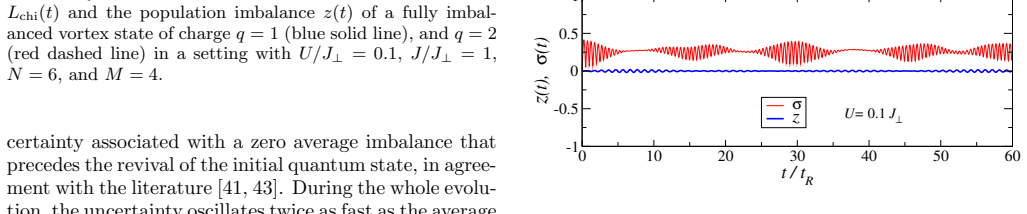
Prepare a double ring with $M=3$ sites per ring, $N=6$ atoms, $J/J_\perp=1$ and $U/J_\perp=0.1$, starting from a fully imbalanced $q=1$ vortex in the upper ring, and measure the chiral current and population imbalance as a function of hold time. The paper predicts $z(t)\approx\cos(2\pi t/t_R)$ and a chiral current following the same cosine for several periods; if instead the imbalance decays within the first period or the chiral current does not oscillate at the expected frequency, the central claim is falsified.
Extended reading notes
Core claim
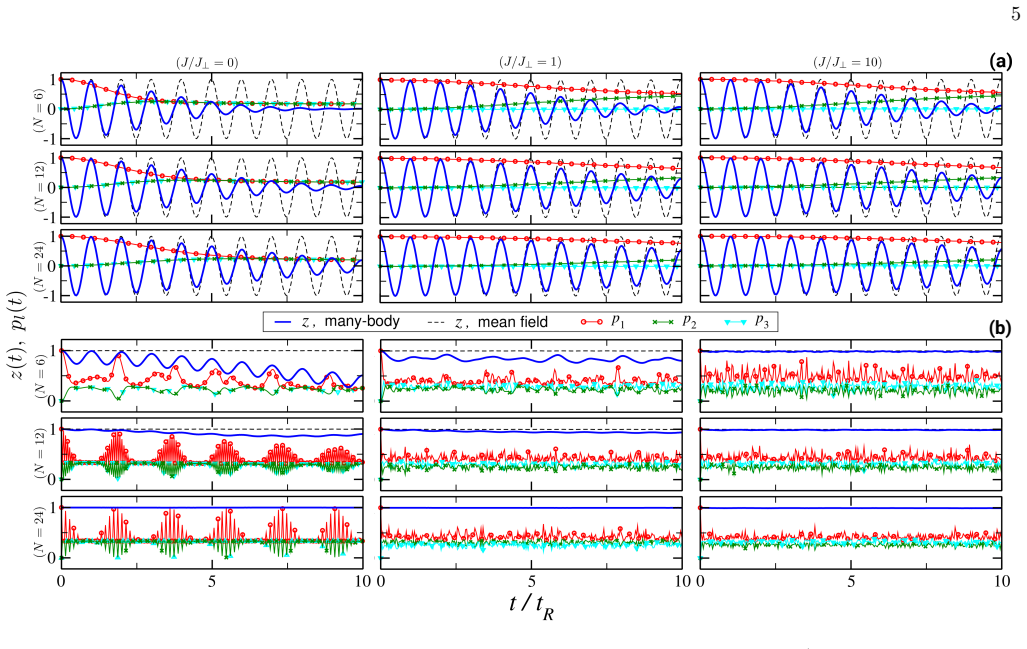
At low on-site interaction, the exact many-body dynamics of a double-ring Bose-Hubbard system shows that an initially imbalanced vortex state $|\Psi_{q,\uparrow}\rangle$ performs coherent oscillations into $|\Psi_{q,\downarrow}\rangle$, with population imbalance $z(t)=\cos(2J_\perp t/\hbar)$ and normalized chiral current following the same cosine, matching the two-mode mean-field equations for a bosonic Josephson junction. The same statement holds for population-balanced fractional-vortex states $|\Psi_{q,\uparrow}\rangle\otimes|\Psi_{q',\downarrow}\rangle$, whose vortex charges are exchanged between rings while the population balance stays near zero or oscillates weakly depending on the energy difference of the charges. The paper claims that this duality between vortex-flux transfer and sinusoidal particle current establishes a coherent tunneling regime connecting current states with chiral symmetry, and that the loss of coherence around $t\approx 10t_R$ at low interaction, followed by revivals, is the signature of the underlying many-body spectrum. Strong interactions, in contrast, drive the system into a self-trapped, fragmented state.
Load-bearing premise
The central claim depends on the assumption that the coupled-ring dynamics remains confined to the two vortex modes used in the mean-field ansatz, with no significant scattering into other quasimomenta; the paper itself shows this coherence fades around ten inter-ring periods even at low interaction.
Editorial extensions
If this is right
- A two-ring Bose-Hubbard circuit can act as a coherent switch of persistent currents: the vortex charge moves back and forth between rings at the inter-ring period while population imbalance oscillates sinusoidally.
- The chiral current provides a direct, observable readout of vortex transfer, since it is proportional to the imbalance in the low-interaction regime.
- Increasing particle number lengthens the coherent Josephson regime, making the proposed dynamics easier to see in experiments with larger condensates.
- The similarity between configurations A and B means the coherent transfer is insensitive to whether the initial vortex is fully imbalanced or a balanced pair of fractional vortices, as long as interactions stay low.
- For strong interactions, self-trapping and fragmentation set in, so the same device would fail as a coherent current switch; this marks the boundary of the usable parameter regime.
Reading between the lines
- Beyond the paper, the vortex-charge oscillation suggests a mapping of the double ring to a two-level system in which the vortex charge plays the role of the flux degree of freedom; this could be tested by measuring the visibility of the oscillations as a function of $J_\perp/J$.
- The collapse and revival seen around $t\approx 10t_R$ imply that a single-tone sinusoidal model is only an envelope; one could fit the revival time as a function of $U$ to extract the nonlinear energy spacing and verify the Bose-Hubbard description.
- A natural next experiment is to start from the interacting stationary vortex (as in Fig. 3b) and vary the quench strength $J_\perp$; the paper predicts almost no difference from the non-interacting preparation, which would confirm that the phase profile, not the initial interaction, controls the coherent transfer.
- The result for $q=2$ (no azimuthal current) suggests that even current-free edge states can transfer population coherently, which implies the mechanism is tied to the phase winding rather than to the magnitude of the circulating current.
Signed reviews
Editorial analysis
A structured set of objections, weighed in public.
Referee Report
Summary. This paper studies the quantum dynamics of vortices in two linearly coupled Bose-Hubbard rings. The authors prepare either a population-imbalanced vortex in one ring or a population-balanced fractional vortex state, then quench on the inter-ring tunneling and on-site interactions, and evolve the many-body state exactly using the SciPy implementation of the Al-Mohy-Higham exponential algorithm. For low interactions they observe coherent, Rabi-period oscillations of the population imbalance and of the chiral current, which they interpret as Josephson-like vortex-flux transfer. They introduce a two-mode mean-field ansatz leading to a short Josephson junction model and compare its predictions with the exact many-body dynamics across the Josephson and self-trapping regimes. The paper concludes that low interactions allow coherent vortex tunneling relevant for flux-qubit-inspired atomtronic devices, while strong interactions suppress chiral currents and lead to fragmentation.
Significance. If the central claim holds, the results are a useful step toward coherent vortex transfer in atomtronic circuits and connect few-site Bose-Hubbard dynamics with flux-qubit phenomenology. The exact many-body calculations are carefully specified and reproducible: the Hamiltonian, parameters, and numerical method are fully stated, and the figures show honest comparisons between exact and mean-field results. The qualitative short-time coherent oscillations seen in the exact dynamics are independent of the mean-field derivation and are supported by the data. However, the quantitative agreement with the mean-field approximation that the abstract claims is undermined by a factor-of-M error in the mean-field energy and equations of motion, so the main quantitative support requires correction and recomputation.
major comments (1)
- [Section II.2, Eqs. (11)-(12)] The interaction term in the mean-field energy has an extra factor of M. For the two-mode ansatz (10), the per-site amplitudes are |α_{l,j}|^2 = (1±z)/(2M), so the interaction energy per particle in units of NJ⊥ is U(N−1)/(4M J⊥)(1+z²) = (Λ/2)(1+z²) with Λ defined in Eq. (14). The manuscript's Eq. (11) instead contains (MΛ/2)(1+z²), which is independent of M and unphysical for fixed N and U. Consequently the second of Eqs. (12) should be dφ/d˜t = Λ z + (z/√(1−z²)) cosφ, not MΛ z + (z/√(1−z²)) cosφ. This error changes the linearized oscillation frequency from √(1+Λ) to √(1+MΛ) and shifts the self-trapping threshold by a factor M. Because the dashed mean-field curves in Figs. 2 and 3(a) are obtained from the incorrect Eqs. (12), the quantitative claim of 'good agreement with a mean-field approximation' in the abstract is not established as written. Please correct Eqs. (11) and (12), recompute the mean-field curves, and revisit the corresponding text; the exact many-body results may still support the qualitative short-time coherent transfer, but the current comparison is internally inconsistent.
minor comments (6)
- [Section II.2] The sentence 'Note that (12) are the typical equations of a single, short bosonic Josephson junction' is somewhat imprecise: the ansatz (10) is a single-orbital two-mode state, which is a stronger assumption than a purely two-site junction. Please rephrase to clarify the level of approximation.
- [Abstract] The phrase 'dually follows' is unclear; consider 'correspondingly follows' or 'in a dual manner'.
- [Reference [18]] The citation for L. Amico, Scientific Reports 86, 153 (2014) appears to have an incorrect volume number; Scientific Reports volumes are numbered consecutively from 4 onward.
- [Equation (24)] The many-body transition probability P(t)=[sin(J⊥t/ℏ)]^{2N} is correct, but the difference from the single-particle result in Eq. (18) is a finite-N effect worth a brief parenthetical remark.
- [Section III] The sentence 'the many-body dynamics approaches more to the mean field solution for increasing number of particles' is ungrammatical; suggest 'approaches the mean-field solution more closely'.
- [Figure 6 caption] The legend uses (q,q′) notation, while the text refers to 'half-vortex states (1,0)' and 'vortex states (0,2)'; please define the notation in the caption.
Circularity Check
No significant circularity: the Josephson-like equations are an explicit mean-field ansatz approximation, and the central dynamical claim is supported by independent exact many-body evolution with no fitted parameters.
full rationale
The paper does not fit any parameter and does not use a self-citation as load-bearing evidence. Equation (10) is an explicitly stated two-mode coherent-state ansatz; Eqs. (11)-(12) are derived directly from that ansatz and are labeled as such ('From this ansatz, the expectation value...'). The central claim of coherent sinusoidal vortex transfer at low interaction is obtained from exact time evolution of the full Bose-Hubbard Hamiltonian (1) using the SciPy implementation of the algorithm of Ref. [34]. The comparison with the mean-field equations is a test of the ansatz against the exact many-body dynamics, not a derivation of the result from the ansatz. No prediction is equivalent to an input by construction: the interaction parameter Lambda is a fixed combination of physical inputs (Eq. 14), and the exact dynamics is computed independently. The self-citations (Refs. 19, 33, 36) provide context, static properties, and comparison to earlier mean-field work, but they are not the basis for the paper's main conclusion. The paper also explicitly acknowledges the mean-field description's limits (coherence is lost around t approximately 10 t_R even at U/J_perp = 0.1, and fragmentation develops), which further confirms that the exact many-body results carry the evidential weight. A separate internal-consistency concern exists: the interaction term in Eq. (11) appears to contain an extra factor of the ring size M relative to the stated ansatz and Eq. (14), which would affect the quantitative mean-field comparison; however, this is a correctness issue, not an instance of circularity.
Assumptions & free parameters
assumptions (4)
- domain assumption The Bose-Hubbard model, as written in Eq. (1), adequately describes two coupled discrete rings of ultracold bosons.
- domain assumption The system evolves unitarily as a closed quantum system, with no dissipation or measurement.
- ad hoc to paper Initial states are prepared at J⊥ = 0 and U = 0, and J⊥ and U are then switched on instantaneously.
- ad hoc to paper The two-mode ansatz (10) confines the dynamics to the vortex modes |Ψ_{q,↑}⟩ and |Ψ_{q,↓}⟩, neglecting other quasimomenta within each ring.
Cite this review
Pith. "Pith review of Tunneling vortex dynamics in linearly coupled Bose-Hubbard rings." pith.science (2026). https://pith.science/paper/GHV5C7ZJ
@misc{pith2026190801353,
  author       = {Pith},
  title        = {Pith review of: Tunneling vortex dynamics in linearly coupled Bose-Hubbard rings},
  year         = {2026},
  howpublished = {\url{https://pith.science/paper/GHV5C7ZJ}},
  note         = {Machine review of arXiv:1908.01353}
}
read the original abstract
The quantum dynamics of population-balanced fractional vortices and population-imbalanced vortices in an effective two-state bosonic system, made of two coupled discrete circuits with few sites, is addressed within the Bose-Hubbard model. % We show that for low on-site interaction, the tunneling of quantized vortices between the rings performs a coherent, oscillating dynamics connecting current states with chiral symmetry. The vortex-flux transfer dually follows the usual sinusoidal particle current of the Josephson effect, in good agreement with a mean-field approximation. Within such regime, the switch of persistent currents in the rings resembles flux-qubit features, and is feasible to experimental realization. On the contrary, strong interatomic interactions suppress the chiral current and lead the system into fragmented condensation.
Figures


Figures from the paper (3 more)


Reference graph
Works this paper leans on
-
[1]
for M = 3, q = 0,±1 and for M = 4, q = 0,±1, 2
Single-particle vortices and fractional vortices The single-particle dispersion (at U = 0) of the Hamiltonian (1) contains two energy branches ϵ± q =−2J cos(2πq/M )∓J⊥ that correspond to Bloch waves [25, 33, 36] ⏐⏐Ψ± q ⟩ = 1√ 2M M−1∑ l=0 ei 2πql M ( ˆa† l,↑± ˆa† l,↓ ) |vac⟩ , (7) where the integer quasimomentum takes the values q = 0,±1,±2,..., ⌊M/2⌋, e.g...
-
[2]
Mean-field ansatz for the large-particle-number limit The effect of the population imbalance on the many- body dynamics, as present in the imbalanced vortex states of Eq (8), can be characterized within a mean- field approximation when the total number of particles N is large. In this case, the many-body state can be ex- pressed as a coherent macroscopic sup...
- [3]
-
[4]
M. K. Olsen and A. S. Bradley, Phys. Rev. A 91, 043635 (2015)
work page 2015
-
[5]
B. T. Seaman, M. Kr¨ amer, D. Z. Anderson, and M. J. Holland, Phys. Rev. A 75, 023615 (2007)
work page 2007
-
[6]
I. M. Georgescu, S. Ashhab, and F. Nori, Rev. Mod. Phys. 86, 153 (2014)
2014
-
[7]
C. Ryu, M. F. Andersen, P. Clad´ e, V. Natarajan, K. Helmerson, and W. D. Phillips, Phys. Rev. Lett. 99, 260401 (2007)
work page 2007
-
[8]
A. Ramanathan, K. C. Wright, S. R. Muniz, M. Ze- lan, W. T. Hill, C. J. Lobb, K. Helmerson, W. D. Phillips, and G. K. Campbell, Phys. Rev. Lett. 106, 130401 (2011)
work page 2011
Show all 49 references
-
[9]
Moulder, S
S. Moulder, S. Beattie, R. P. Smith, N. Tammuz, and Z. Hadzibabic, Phys. Rev. A 86, 013629 (2012)
2012
-
[10]
Beattie, S
S. Beattie, S. Moulder, R. J. Fletcher, and Z. Hadzibabic, Phys. Rev. Lett. 110, 025301 (2013)
2013
-
[11]
Eckel, J
S. Eckel, J. G. Lee, F. Jendrzejewski, N. Murray, C. W. Clark, C. J. Lobb, W. D. Phillips, M. Edwards, and G. K. Campbell, Nature 506, 200 (2014)
2014
-
[12]
C. Ryu, P. W. Blackburn, A. A. Blinova, and M. G. Boshier, Phys. Rev. Lett. 111, 205301 (2013)
2013
-
[13]
Chiorescu, Y
I. Chiorescu, Y. Nakamura, C. J. P. M. Harmans, and J. E. Mooij, Science 299, 1869 (2003)
2003
-
[14]
Aghamalyan, L
D. Aghamalyan, L. Amico, and L. C. Kwek, Phys. Rev. A 88, 063627 (2013)
2013
-
[15]
Aghamalyan, M
D. Aghamalyan, M. Cominotti, M. Rizzi, D. Rossini, F. W. J. Hekking, A. Minguzzi, L. C. Kwek, and Amico, New. J. Phys. 17, 045023 (2015)
2015
-
[16]
D. W. Hallwood and J. Brand, Phys. Rev. A 84, 043620 (2011)
2011
-
[17]
Gallem´ ı, M
A. Gallem´ ı, M. Guilleumas, J. Martorell, R. Mayol, A. Polls, and B. Juli´ a-D´ ıaz, New J. Phys. 17, 073014 (2015)
2015
-
[18]
Schenke, A
C. Schenke, A. Minguzzi, and F. Hekking, Phys. Rev. A 84, 053636 (2011)
2011
-
[19]
P. L. Halkyard, M. P. A. Jones, and S. A. Gardiner, Phys. Rev. A 81, 061602(R) (2010)
2010
-
[20]
Amico, Scientific Reports 86, 153 (2014)
L. Amico, Scientific Reports 86, 153 (2014)
2014
-
[21]
Gallem´ ı, A
A. Gallem´ ı, A. Mu˜ noz Mateo, R. Mayol, and M. Guilleu- mas, New Journal of Physics 18, 015003 (2016)
2016
-
[22]
Tylutki, L
M. Tylutki, L. P. Pitaevskii, A. Recati, and S. Stringari, Phys. Rev. A 93, 043623 (2016)
2016
-
[23]
Calderaro, A
L. Calderaro, A. L. Fetter, P. Massignan, and P. Wittek, Phys. Rev. A 95, 023605 (2017)
2017
-
[24]
Lesanovsky and W
I. Lesanovsky and W. von Klitzing, Phys. Rev. Lett. 98, 050401 (2007)
2007
-
[25]
Brand, T
J. Brand, T. J. Haigh, and U. Z¨ ulicke, Phys. Rev. A 80, 011602(R) (2009)
2009
-
[26]
Richaud and V
A. Richaud and V. Penna, Phys. Rev. A 96, 013620 (2017)
2017
-
[27]
H¨ ugel and B
D. H¨ ugel and B. Paredes, Phys. Rev. A 89, 023619 (2014)
2014
-
[28]
Tokuno and A
A. Tokuno and A. Georges, New J. Phys. 16, 073005 (2014)
2014
-
[29]
Piraud, F
M. Piraud, F. Heidrich-Meisner, I. P. McCulloch, S. Greschner, T. Vekua, and U. Schollw¨ ock, Phys. Rev. B 91, 140406(R) (2015)
2015
-
[30]
Uchino, Phys
S. Uchino, Phys. Rev. A 93, 053629 (2016)
2016
-
[31]
Victorin, F
N. Victorin, F. Hekking, and A. Minguzzi, Phys. Rev. A 98, 053626 (2018)
2018
-
[32]
Orignac and T
E. Orignac and T. Giamarchi, Phys. Rev. B 64, 144515 (2001)
2001
-
[33]
T. Haug, L. Amico, R. Dumke, and L.-C. Kwek, Quan- tum Science and Technology 3, 035006 (2018)
2018
-
[34]
Atala, M
M. Atala, M. Aidelsburger, M. Lohse, M. T. Barreiro, B. Paredes, and I. Bloch, Nature Physics 10, 237208 (2014)
2014
- [35]
-
[36]
A. H. Al-Mohy and N. J. Higham, SIAM Journal on Sci- entific Computing 33, 488 (2011)
2011
-
[37]
E. J. Mueller, T.-L. Ho, M. Ueda, and G. Baym, Phys. Rev. A 74, 033612 (2006)
2006
-
[38]
J. A. G. Granados, A. M. Mateo, M. Guilleumas, and X. Vi˜ nas, New J. Phys.21, 043036 (2019)
2019
-
[39]
Son and M
D. Son and M. A. Stephanov, Phys. Rev. A 65, 63621 (2002)
2002
-
[40]
Buonsante, R
P. Buonsante, R. Burioni, E. Vescovi, and A. Vezzani, Phys. Rev. A 85, 043625 (2012)
2012
-
[41]
Raghavan, A
S. Raghavan, A. Smerzi, S. Fantoni, and S. R. Shenoy, Phys. Rev. A 59, 620 (1999)
1999
-
[42]
Juli´ a-D´ ıaz, D
B. Juli´ a-D´ ıaz, D. Dagnino, M. Lewenstein, J. Martorell, and A. Polls, Phys. Rev. A 81, 023615 (2010)
2010
-
[43]
Robinett, Physics Reports 392, 1 (2004)
R. Robinett, Physics Reports 392, 1 (2004)
2004
-
[44]
G. J. Milburn, J. Corney, E. M. Wright, and D. F. Walls, Phys. Rev. A 55, 4318 (1997)
1997
-
[45]
Greiner, O
M. Greiner, O. Mandel, T. W. H¨ ansch, and I. Bloch, Nature 419, 51 (2002)
2002
-
[46]
A. M. Mateo, V. Delgado, M. Guilleumas, R. Mayol, and J. Brand, Phys. Rev. A 99, 023630 (2019)
2019
-
[47]
J. F. S. Brachmann, W. S. Bakr, J. Gillen, A. Peng, and M. Greiner, Opt. Express 19, 12984 (2011)
2011
-
[48]
Aidelsburger, M
M. Aidelsburger, M. Atala, M. Lohse, J. T. Barreiro, B. Paredes, and I. Bloch, Phys. Rev. Lett. 111, 185301 (2013)
2013
-
[49]
Miyake, G
H. Miyake, G. A. Siviloglou, C. J. Kennedy, W. C. Bur- ton, and W. Ketterle, Phys. Rev. Lett. 111, 185302 10 (2013). [48] M. R. Sturm, M. Schlosser, R. Walser, and G. Birkl, Phys. Rev. A 95, 063625 (2017)
2013
Reviewed August 14, 2026 · model on record in the stance chip above.
Discussion (0). Continue with ORCID to comment.