REVIEW 3 major objections 4 minor 1 cited by
Open-systems tools for non-thermalizing closed quantum systems
T0 review · 3 major / 4 minor · reviewed 2026-08-16 · deepseek-v4-flash
Pith's one-line read Adaptive, excitation-conserving circuits can keep small qubit networks far from thermal equilibrium.
desk verdict Inventive adaptive circuits that demonstrably avoid thermalization, but the non-Markovianity claim leans on an under-validated ensemble-averaged map. read the letter →
The pith
A machine-rendered reading of the paper's core claim, the machinery that carries it, and where it could break.
The reading
What carries the argument
The load-bearing object is the phase-covariant single-qubit propagator map $\Lambda_q(\ell,\ell-1)$, which because of excitation conservation has the single moving parameter $\tau_{z,q}(\ell) = z_{b,\ell-1}\sin^2\theta + C^{xx}_{ab,\ell-1}\sin 2\theta$, with $\theta = \pi/15$ fixed by the gate. All variation in single-qubit dynamics therefore lives in one number per qubit per layer, set by the partner's Bloch component and the two-qubit correlation. The update rules R2–R5 choose the next layer's interaction graph by extremizing a scalar function of the state—trace distance from the thermal reference (R2), summed change in extractable work (R3), greedy per-qubit work maximization (R4), or a strategy-mimic pairing rule (R5)—and the paper compares these against random R1 and against Bernoulli circuits with the same emergent edge weights.
What would settle it
Examine the distribution of individual (not averaged) two-qubit density matrices in the CS1 ensemble near layer 300: if the fraction of individual circuits whose single-qubit propagator violates the positivity condition is negligible while the ensemble-averaged map violates it, the non-Markovianity claim is an artifact of averaging.
Extended reading notes
Core claim
The central discovery is that for qubit networks with conserved excitation number and a single interaction gate, the sequence of two-qubit pairings—not the gate itself—controls whether the closed system thermalizes. Random pairings (R1) drive all single-qubit dynamics toward a common phase-covariant channel whose fixed point is the maximum-entropy state at fixed energy. Adaptive pairings (R2–R4) generate long-lived non-equilibrium steady states in which the single-qubit map parameter $\tau_z$ has a broad, non-Gaussian distribution, correlations are concentrated in a few qubit pairs, and the noise-reduced propagator maps between layers frequently fail to be completely positive. The failure of complete positivity is the paper's marker that the rest of the network acts as a non-Markovian environment rather than a memoryless bath.
Load-bearing premise
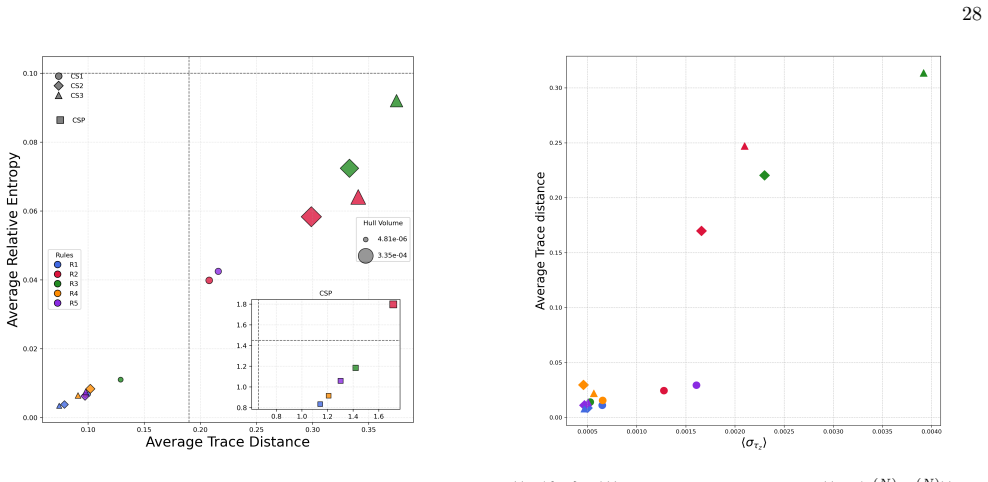
The non-Markovianity result depends on treating the noise-reduced propagator, built from the ensemble-averaged two-qubit state, as representative of what a typical single qubit experiences; if the averaging itself creates the positivity violations, the conclusion fails.
Editorial extensions
If this is right
- If the claim holds, non-equilibrium steady states can be prepared in closed systems without any engineered dissipation, using only a conserved charge, a fixed gate, and a classical controller that rewires the circuit.
- The single-qubit distribution of $\tau_z$, especially its variance and kurtosis, becomes a cheap diagnostic that separates thermalizing from non-thermalizing circuit dynamics.
- Noise-reduced non-completely-positive propagator maps serve as a signature that subsystem memory is retained, tying non-thermalization to quantum non-Markovianity.
- The Bernoulli-circuit comparison shows that biased random wiring with the same emergent frequencies does not reproduce the steady state; the state-dependent sequence of layers is essential.
- The results give a concrete way to rank non-thermalizing dynamics by thermodynamic utility: extractable-work persistence intervals cleanly separate R1 (exponential decay) from R2–R5 (long intervals).
Reading between the lines
- A natural extension the paper leaves open: any conserved charge, not just excitation number, may support the same construction, so the mechanism could generalize to fermionic or spin-1 networks by replacing the phase-covariant map with the appropriate covariant class.
- One testable prediction is that the non-completely-positive maps should be observable by single-qubit process tomography on the actual circuit: if the positivity violations vanish when tomography is done on individual runs rather than on ensemble-averaged states, the non-Markovianity is an averaging artifact.
- The extractable-work interval statistic suggests a practical probe for near-term hardware: circuits run on few qubits could be classified as thermalizing or not by measuring how often a qubit's extractable work increases on consecutive layers.
- The strategy-mimic rule's sensitivity to the central state hints that imperfect local information can either preserve or destroy non-thermalizing behavior; mapping when it fails could clarify the role of information access in engineered non-equilibrium steady states.
Signed reviews
Editorial analysis
A structured set of objections, weighed in public.
Referee Report
Summary. The paper constructs U(1)-symmetric, excitation-conserving quantum circuits on networks of N qubits, with all gates taken from a fixed two-qubit unitary U* (Eq. 10) and the only freedom at each layer being the pairing of qubits into neighborhoods. Five update rules are compared: R1 (random), R2 (maximize the trace distance of the single-qubit states from the reference thermal state), R3 (maximize the total change in extractable work), R4 (greedy per-qubit maximization of extractable work), and R5 (a heuristic "strategy mimic" rule). Starting from ensembles of initial states around four central states (CSP, CS1, CS2, CS3), the authors track the single-qubit phase-covariant dynamics, which reduce to a single parameter tau_z per qubit per layer. They characterize the late-time behavior through heatmaps of <sigma_z>, distributions of tau_z, two-qubit correlations, PCA convex-hull volumes, mutual-information graph complexity, persistence of positive extractable-work changes, and the fraction of non-completely-positive propagator maps. The central claim is that the constrained rules R2-R4, and often R5, produce inhomogeneous non-thermalizing steady states that are clearly distinguishable from the approximately thermalizing random rule R1, and that the non-thermalizing states are associated with non-Markovian single-qubit dynamics signaled by non-completely-positive noise-reduced propagator maps.
Significance. If the results hold, the paper provides a clean, exactly solvable-in-structure family of circuit models in which inhomogeneous subsystem dynamics persist over long times, with the open-systems description reduced to a single parameter tau_z per qubit. The analytical reduction leading to Eqs. (43)-(45) is elegant and correct, and the trace-distance monotonicity bound in Eq. (32) is a solid constraint on what any such rule can achieve. The paper is also commendable for cross-checking the central claim with multiple independent diagnostics (PCA state-space volume, mutual-information graph measures, extractable-work statistics, and non-CP fractions) rather than relying on a single order parameter. However, two load-bearing points need attention: the noise-reduced propagator maps in Section IV.B lack uncertainty quantification and are used to draw the non-Markovianity conclusion, and R2's trace-distance evidence is partly circular because the same quantity is optimized by the update rule. Neither issue appears fatal to the overall picture, but both must be addressed before the non-Markovianity claim can be accepted as stated.
major comments (3)
- [Section IV.B, Eq. (43), Figs. 20-21] The noise-reduced propagator map is defined by taking element-by-element ensemble averages of the partner Bloch vector z_b and the correlation C^xx_ab and then inserting these averages into Eq. (43) for tau_z. Because the update rules R2-R5 make the circuit state-dependent, the ensemble mean does not evolve under any fixed CPTP map; the reconstructed object is a statistical summary, not the dynamics of a typical member. The conclusion that non-CP dynamics occur 'beyond finite-size noise' requires two things that are not shown: that the ensemble-averaged tau_z lies outside the CP interval by more than sampling uncertainty, and that this reflects typical individual maps rather than a few large outliers. While a mean outside the CP region implies that some individual maps are non-CP, it does not establish that the effect is beyond noise, and the absence of error bars, confidence intervals, or a comparison between the noise-reduced map and the distribution of individual tau_z at the same qubits and layers leaves the primary open-systems result under-supported.
- [Section II.D, Eq. (23); Section IV.A, Fig. 17] R2 is defined as the rule that, at each layer, maximizes the trace distance of the single-qubit states from the reference thermal state (Eq. (23)). The top panel of Figure 17 then reports the late-time average trace distance as evidence that R2 keeps the network far from the thermal state. This particular diagnostic is therefore not an independent test of non-thermalization for R2; the comparison to R1 is partly by construction. A similar, though weaker, concern applies to R3 and R4, whose objective functions are built from Delta W_ex and whose performance is then evaluated in part by extractable-work measures. The central claim does not collapse, because the paper also reports independent measures such as sigma(tau_z), mutual-information disparity, and non-CP fractions, but the authors should either explicitly label the trace-distance and extractable-work results as consistency checks of the objective functions or provide a control rule that optimizes a quantity not used as a diagnostic.
- [Title and Abstract vs. Section II.D] The title and abstract describe the systems as "closed quantum systems," but Section II.D states that the dynamics are "not self-contained, or closed" because an external controller with exact knowledge of the initial state and a full record of the circuit must compute and apply each layer's extremizing gate arrangement. This is an internal inconsistency in the central framing. The physical results are unaffected, but the scope claim should be qualified: these are adaptively programmed unitary circuits, not autonomous closed Hamiltonian dynamics, and the difference matters for how the "non-equilibrium steady state" and the absence of measurements are interpreted.
minor comments (4)
- [Figures 3-6] The captions for Figures 3-6 appear as placeholders ("* CS1", "* CS2", "* CS3", "* CSP") and the main text refers to them only collectively; the figures need complete captions and in-text references that match the numbering used elsewhere (e.g., Figure 7 for the heatmaps).
- [Appendix B] The notation for central states in Appendix B is inconsistent with Section II.B: the text lists "CSP 1, CSP 2, CSP 3, CSP" where the body uses CSP, CS1, CS2, CS3. The notation should be unified.
- [Section III.A, Eq. (38)] The Bernoulli-process circuits are called "Markovian circuits," but the word "Markovian" is used elsewhere in the paper for the quantum open-system divisibility property. Clarify that Eq. (38) defines a classically Markovian sequence of gates, not a quantum-Markovian evolution, to avoid confusion with Section IV.B.
- [Appendix A.3, Figs. 31-32] The exponential fit to the variance of <sigma_z> versus N and the inferred large-N limit are load-bearing for the claim that R2 retains non-CP dynamics at large system size, but no fit parameters, confidence intervals, or residuals are reported. Please provide these details or soften the large-N extrapolation.
Circularity Check
R2's trace-distance and R3/R4's extractable-work metrics are the very quantities those rules optimize, so these specific non-thermalization demonstrations reduce by construction; independent measures such as mutual-information complexity and non-CP maps keep the central claim partially supported.
-
self definitional
[Section II.D, Eqs. (23)-(24), and Section IV.A, Figure 17]
"R2: Subsystems avoid the global thermal state This rule maximizes the sum of distances of each qubit from the equilibrium state determined by the appropriate central state (see Eq.(14)). That is, for each trial interaction graph Ik, Tr from Eq.(20) is the scalar function to be extremized: MR2(I(N)k |ρ(N), ¯ρ) = Tr({ρq|I(N)k(ℓ + 1)}, ¯ρ), (23) ... The circuit that maximizes this function determines the interaction network actually applied in the ℓ + 1 layer of the circuit: I(N)ℓ+1,R2 = arg max I(N)k MR2(I(N)k |ρ(N), ¯ρ). (24)"
The average trace distance from the reference thermal state is R2's objective function: at every layer, R2 chooses the interaction graph that maximizes exactly this quantity. Section IV.A then uses the same quantity as evidence that non-random rules 'can increase the average trace distance from the thermal reference state' and thereby achieve non-thermalizing behavior. The reported non-thermalization along the trace-distance axis is therefore not an independent discovery but the value of the optimized cost, so this particular demonstration is by construction. Other evidence, such as relative entropy and mutual-information complexity, is not directly optimized and retains independent content.
-
self definitional
[Section II.D, Eqs. (25)-(29), and Sections III.D.3 and IV.A, Figures 15, 16, 18]
"R3: Subsystems collectively maximize ∆W ex. This rule maximizes the sum of the change in extractable work for each qubit. That is, for each trial interaction graph Ik, the scalar function to be extremized is MR3(I(N)k |ρ(N)) = (sum over q) ∆W ex q|I(N)k (25) ... The circuit that maximizes this function determines the interactions in the ℓ + 1 layer of the circuit: I(N)ℓ+1,R3 = arg max I(N)k MR3(I(N)k |ρ(N)). (28)"
R3 and R4 are defined by maximizing, or greedily prioritizing, the per-layer change in extractable work. The paper later reports total positive ΔWex and the persistence of consecutive positive ΔWex intervals as a thermodynamic utility advantage of these rules over R1. The total positive ΔWex over a layer is the optimized cost itself, so R3/R4 outperforming R1 on this measure is largely by construction; the persistence statistic is a derived summary of the same optimized quantity and inherits the bias. Independent measures, including mutual-information graph complexity and non-CP propagator maps, are not optimized and provide separate support.
full rationale
The paper's central construction is a set of adaptive circuit rules R2-R5 that select each layer by extremizing a scalar function of the single-qubit state ensemble. The main circularity is that two of the headline nonequilibrium measures are the very objective functions used to define the dynamics. R2 is defined as the layer-wise maximizer of the total trace distance from the reference thermal state, and the paper then reports that same trace distance as evidence that R2 keeps the network away from thermal equilibrium. Similarly, R3 is defined as the layer-wise maximizer of total ΔWex, and the paper reports total positive ΔWex and its persistence as a thermodynamic-utility advantage. These demonstrations are not independent of the construction; they confirm that the optimizer optimizes. This is a genuine but partial circularity, because the paper also presents several quantities that are not directly optimized, including relative entropy, mutual-information network complexity, state-space volume, correlation distributions, and non-CP propagator maps. The non-CP/noise-reduced-map argument in Section IV.B is not itself circular: the noise-reduced map is a statistical object constructed from ensemble averages, and the interpretation of its non-CP nature as evidence of non-Markovianity beyond finite-size noise is an inference that may be questioned on statistical grounds, but it does not reduce by definition to an input quantity. The paper's self-citations are not load-bearing: the cited prior works by the same authors supply context and previously considered random circuits, but the core equations and derivations in this manuscript are self-contained. Weighing the by-construction character of the trace-distance and extractable-work measures against the independent evidence, the overall circularity is partial rather than total.
Assumptions & free parameters
free parameters (8)
- gate angle theta =
pi/15
- cold and hot thermal populations p_c_therm, p_h_therm =
0.1, 0.4
- CS2 population vector =
{0.02352335, 0.08, 0.28, 0.12, 0.12, 0.28, 0.08, 0.11647665, then 0.1 for additional qubits}
- CS3 population vector =
{0.04340705, 0.12, 0.09, 0.15, 0.3, 0.14, 0.23, 0.02659295, then 0.1 for additional qubits}
- prep circuit depth =
10 layers
- PCA variance cutoff for convex hull =
0.85
- smoothing window and steady-state window =
30 layers; layers 300-500
- ensemble size =
100 random circuits
assumptions (6)
- domain assumption Initial states are product states diagonal in the excitation basis, and all gates conserve total excitation number, so single-qubit dynamics is phase-covariant.
- ad hoc to paper An external controller with exact knowledge of the initial state and a record of the circuit can select each layer's gate arrangement by extremizing M without performing measurements.
- domain assumption Random circuit evolution R1 with the same gate and connectivity is a thermalizing baseline for mixed central states at N=12.
- ad hoc to paper The exponential fit to the variance of <sigma_z> versus N (Figure 31) describes the large-N limit for R1 and R2.
- ad hoc to paper Ensemble-averaged noise-reduced propagator maps faithfully represent typical single-qubit dynamics.
- standard math The reference thermal state rho_bar(N), the product state maximizing single-qubit entropy subject to the conserved charge E, is the appropriate equilibrium state.
invented entities (1)
-
External controller/device for update rules
Cite this review
Pith. "Pith review of Open-systems tools for non-thermalizing closed quantum systems." pith.science (2026). https://pith.science/paper/GIOFGKRJ
@misc{pith2026250500116,
  author       = {Pith},
  title        = {Pith review of: Open-systems tools for non-thermalizing closed quantum systems},
  year         = {2026},
  howpublished = {\url{https://pith.science/paper/GIOFGKRJ}},
  note         = {Machine review of arXiv:2505.00116}
}
read the original abstract
We design several examples of constrained, symmetric quantum circuit dynamics that generate non-equilibrium steady states. The qubit networks maintain local memory of the initial conditions and display inhomogeneous subsystem dynamics over long times, clearly distinguishable from approximately thermalizing networks of the same size. Each network can be described as an ensemble of open systems, a collection of qubits evolving with phase-covariant dynamics. Constraints from the conservation law and global unitary dynamics of the entire network bound the distribution of single-qubit dynamics in the ensemble, but different steady states are distinguishable by several measures. We quantify the distance of the steady states from the homogeneous steady state and further characterize them using the complexity of their mutual information networks, the volume of state space explored, a thermodynamic utility measure using extractable work, and correlated structure in the occurrence of non-completely positive qubit propagator maps.
Figures


Figures from the paper (25 more)




Forward citations
Cited by 1 Pith paper
-
Non-Markovianity of subsystem dynamics in isolated quantum many-body systems
Quenching a mixed-field Ising chain from paramagnetic to ferromagnetic parameters makes small subsystems display strong non-Markovian, memory-retaining dynamics, while the reverse quench is nearly Markovian.
Reference graph
Works this paper leans on
-
[1]
State space explored The state space explored by quantum systems deter- mines all thermodynamic and information theoretic mea- sures of the dynamics. While the evolution of the full state is not easy to visualize, the constrained nature of the dynamics used here (as demonstrated in Eq (52), for example) means that even the ensemble of single-qubit states ...
-
[2]
Mutual information graphs: Clustering and disparity Mutual information is a measure of information shared between subsystems in the network, and provides ad- ditional detail beyond the correlation magnitudes pre- sented in the previous section. Some work has suggested that the graph complexity of mutual information may be an indication of interesting phys...
-
[3]
Extractable work: Total and persistence When the qubits in the network start with differ- ent populations, or temperatures, the process of ther- malization will lead to instances where the extractable work achievable by some qubits increases [45]. How- ever, if some subsystems stay usefully out of equilibrium, then they may continue to have positive ∆ W e...
-
[4]
Polkovnikov, K
A. Polkovnikov, K. Sengupta, A. Silva, and M. Vengalat- tore, Rev. Mod. Phys. 83, 863 (2011)
2011
-
[5]
Fendley, K
P. Fendley, K. Sengupta, and S. Sachdev, Phys. Rev. B 69, 075106 (2004)
2004
-
[6]
In this section, we show several of the same analyses for networks with C = 4
Results for connectivity C = 4 In the body of the paper, we presented results for networks whose interaction graph has connectivity C = 2. In this section, we show several of the same analyses for networks with C = 4. These interaction graphs are shown in left column of Figure 2, bottom and middle panels. In all other respects the procedure, the procedure...
-
[7]
Approach to the steady state Many of the qubit networks with connectivity C = 2 reach a steady state. This section shows several examples of the evolution across many layers to show the approach to the steady state, and how it compares between central state distributions and update rules. Figure 27 shows the time evolution of the total magnitude of correl...
-
[8]
Non-(C)P maps and system size effects The condition for propagator maps to be (completely) positive was given in Eq.(45). Figure 29 shows the minimum magnitude of two-qubit correlation,|Cxx|, needed to break this condition for any single-parameter two-qubit unitary and any mixed initial state of the type considered in this paper. 27 FIG. 24. The distribut...
Show all 78 references
-
[9]
However, they fluctuated about average values different from the thermalizing map, ¯τz
For example, most qubits in the non-random rules underwent dynamics with τz taking oscillating values on both sides of ¯τz. However, they fluctuated about average values different from the thermalizing map, ¯τz. This is apparent in the figure, where each distribution has mean ...
-
[10]
J. M. Deutsch, Phys. Rev. A 43, 2046 (1991)
1991
-
[11]
Srednicki, Phys
M. Srednicki, Phys. Rev. E 50, 888 (1994)
1994
-
[12]
Rigol, V
M. Rigol, V. Dunjko, and M. Olshanii, Nature 452, 854 (2008)
2008
-
[13]
L. E. Hillberry, M. T. Jones, D. L. Vargas, P. Rall, N. Y. Halpern, N. Bao, S. Notarnicola, S. Montangero, and L. D. Carr, Quantum Science and Technology 6, 045017 (2021), arXiv:2005.01763 [quant-ph]
2021 arXiv
-
[14]
Lesanovsky and H
I. Lesanovsky and H. Katsura, Phys. Rev. A 86, 041601 (2012)
2012
-
[15]
van Horssen, E
M. van Horssen, E. Levi, and J. P. Garrahan, Phys. Rev. B 92, 100305 (2015)
2015
-
[16]
There is a clear correlation between the presence of non-(C)P dynamics and out-of-equilibrium behavior as diagnosed by the variance in τz
Figure 21 shows the relationship between the basic out-of-equilibrium measure,σ(τz), the total magnitude of positive change in extractable work, and the occurrence of non-(C)P propagator maps on the noise-reduced sys- tems. There is a clear correlation between the presence of ...
-
[17]
Pancotti, G
N. Pancotti, G. Giudice, J. I. Cirac, J. P. Garrahan, and M. C. Ba˜ nuls, Physical Review X10, 021051 (2020), arXiv:1910.06616 [cond-mat.stat-mech]
2020 arXiv
-
[18]
Serbyn, D
M. Serbyn, D. A. Abanin, and Z. Papi´ c, Nature Physics 17, 675 (2021)
2021
-
[19]
Bhore, J.-Y
T. Bhore, J.-Y. Desaules, and Z. Papi´ c, Physical Review B 108, 10.1103/physrevb.108.104317 (2023)
2023 doi
-
[20]
Royen, S
K. Royen, S. Mondal, F. Pollmann, and F. Heidrich- Meisner, Physical Review E 109, 10.1103/phys- reve.109.024136 (2024)
2024 doi
-
[21]
Farrelly, Quantum 4, 368 (2020)
T. Farrelly, Quantum 4, 368 (2020)
2020
-
[22]
E. B. Davies, Communications in Mathematical Physics 39, 91 (1974)
1974
-
[23]
Spohn and J
H. Spohn and J. L. Lebowitz, Advances in Chemical Physics 38, 109 (2007)
2007
-
[24]
T. c. v. Prosen and I. Piˇ zorn, Phys. Rev. Lett. 101, 105701 (2008)
2008
-
[25]
T. c. v. Prosen, Phys. Rev. Lett. 106, 217206 (2011). 33 (a) (b) FIG. 31. The standard deviation of ⟨σz⟩ens onC = 2 networks as a function of system size N, averaged over all qubits, circuit layers ℓ = 300− 500, and each of the 100 members of the CS1. At each system size rando...
2011
-
[26]
Lindblad, Communications in Mathematical Physics 48, 119 (1976)
G. Lindblad, Communications in Mathematical Physics 48, 119 (1976)
1976
-
[27]
Gorini, A
V. Gorini, A. Kossakowski, and E. C. G. Sudar- shan, Journal of Mathematical Physics 17, 821 (1976), https://aip.scitation.org/doi/pdf/10.1063/1.522979
1976 doi
-
[28]
Wichterich, M
H. Wichterich, M. J. Henrich, H.-P. Breuer, J. Gemmer, and M. Michel, Phys. Rev. E 76, 031115 (2007)
2007
-
[29]
Jagadish and F
V. Jagadish and F. Petruccione, Quanta 7, 54 (2018)
2018
-
[30]
Ciccarello, S
F. Ciccarello, S. Lorenzo, V. Giovannetti, and G. M. Palma, Physics Reports 954, 1–70 (2022)
2022
-
[31]
P. D. Drummond and D. F. Walls, Journal of Physics A: Mathematical and General 13, 725 (1980)
1980
-
[32]
Diehl, E
S. Diehl, E. Rico, M. A. Baranov, and P. Zoller, Nature Physics 7, 971–977 (2011). 34
2011
-
[33]
Shirai, T
T. Shirai, T. Mori, and S. Miyashita, Journal of Physics B: Atomic, Molecular and Optical Physics 47, 025501 (2013)
2013
-
[34]
Prudhoe, U
S. Prudhoe, U. Akhouri, T. Chin, and S. Shandera, Open Syst. Info. Dyn. 31, 2450016 (2024), arXiv:2404.15223 [quant-ph]
2024 arXiv
-
[35]
Holevo, Reports on Mathematical Physics Volume 32, 211 (1993)
A. Holevo, Reports on Mathematical Physics Volume 32, 211 (1993)
1993
-
[36]
Smirne, J
A. Smirne, J. Ko lody´ nski, S. F. Huelga, and R. Demkowicz-Dobrza´ nski, Phys. Rev. Lett.116, 120801 (2016)
2016
-
[37]
A. S. Holevo, Reports on mathematical physics 32, 211 (1993)
1993
-
[38]
Lankinen, H
J. Lankinen, H. Lyyra, B. Sokolov, J. Teittinen, B. Ziaei, and S. Maniscalco, Physical Review A93, 052103 (2016), arXiv:1511.07202 [quant-ph]
2016 arXiv
-
[39]
Chru´ sci´ nski, Phys
D. Chru´ sci´ nski, Phys. Reports 992, 1 (2022), arXiv:2209.14902 [quant-ph]
2022 arXiv
-
[40]
Dann and R
R. Dann and R. Kosloff, Physical Review Research 3, 023006 (2021)
2021
-
[41]
S. N. Filippov, A. N. Glinov, and L. Lepp¨ aj¨ arvi, arXiv e-prints , arXiv:1911.09468 (2019), arXiv:1911.09468 [quant-ph]
2019 arXiv
-
[42]
Siudzi´ nska, Journal of Physics Communications 7, 075002 (2023), arXiv:2210.17448 [quant-ph]
K. Siudzi´ nska, Journal of Physics Communications 7, 075002 (2023), arXiv:2210.17448 [quant-ph]
2023 arXiv
-
[43]
Marvian, arXiv e-prints , arXiv:2003.05524 (2020), arXiv:2003.05524 [quant-ph]
I. Marvian, arXiv e-prints , arXiv:2003.05524 (2020), arXiv:2003.05524 [quant-ph]
2020 arXiv
-
[44]
We previously considered a more varied set of gates with only random circuits in [45]
-
[45]
Bandic, C
M. Bandic, C. G. Almudever, and S. Feld, Quantum Ma- chine Intelligence 5, 10.1007/s42484-023-00124-1 (2023)
2023 doi
-
[46]
Jarzynski, Phys
C. Jarzynski, Phys. Rev. Lett. 78, 2690 (1997)
1997
-
[47]
Parrondo, J
J. Parrondo, J. Horowitz, and T. Sagawa, Nature Phys. 11, 131 (2015)
2015
-
[48]
Kolchinsky, I
A. Kolchinsky, I. Marvian, C. Gokler, Z.-W. Liu, P. Shor, O. Shtanko, K. Thompson, D. Wolpert, and S. Lloyd, Entropy 27, 91 (2025)
2025
-
[49]
Kliesch and A
M. Kliesch and A. Riera, in Thermodynamics in the Quantum Regime: Fundamental Aspects and New Di- rections, Vol. 195, edited by F. Binder, L. A. Correa, C. Gogolin, J. Anders, and G. Adesso (Springer Interna- tional Publishing, Cham, 2018) p. 481
2018
-
[50]
Mehboudi, A
M. Mehboudi, A. Sanpera, and L. A. Correa, Journal of Physics A Mathematical General 52, 303001 (2019), arXiv:1811.03988 [quant-ph]
2019 arXiv
-
[51]
Alipour, F
S. Alipour, F. Benatti, M. Afsary, F. Bakhshinezhad, M. Ramezani, T. Ala-Nissila, and A. T. Rezakhani, arXiv e-prints , arXiv:2105.11915 (2021), arXiv:2105.11915 [quant-ph]
2021 arXiv
-
[52]
A. E. Allahverdyan, S. G. Gevorkian, Y. A. Dyakov, and P.-K. Wang, arXiv e-prints , arXiv:2207.02343 (2022), arXiv:2207.02343 [cond-mat.stat-mech]
2022 arXiv
-
[53]
Akhouri, S
U. Akhouri, S. Shandera, and G. Yesmurzayeva, Entropy 25, 947 (2023)
2023
-
[54]
H. Liu, A. Hulse, and I. Marvian, arXiv preprint (2024), arXiv:2408.14463 [quant-ph]
2024 arXiv
- [55]
-
[56]
Lashkari, D
N. Lashkari, D. Stanford, M. Hastings, T. Osborne, and P. Hayden, Journal of High Energy Physics 2013, 10.1007/jhep04(2013)022 (2013)
2013 doi
-
[57]
Onorati, O
E. Onorati, O. Buerschaper, M. Kliesch, W. Brown, A. H. Werner, and J. Eisert, Commun. Math. Phys. 355, 905 (2017), arXiv:1606.01914 [quant-ph]
2017 arXiv
- [58]
-
[59]
G. S. Bentsen, S. Sahu, and B. Swingle, Physical Review B 104, 10.1103/physrevb.104.094304 (2021)
2021 doi
-
[60]
S.-K. Jian, G. Bentsen, and B. Swingle, Linear growth of circuit complexity from brownian dynamics (2022), arXiv:2206.14205 [quant-ph]
2022 arXiv
-
[61]
Cardillo, F
A. Cardillo, F. Galve, D. Zueco, and J. G´ omez-Garde˜ nes, Phys. Rev. A 87, 052312 (2013)
2013
-
[62]
M. A. Valdez, D. Jaschke, D. L. Vargas, and L. D. Carr, Physical review letters 119, 225301 (2017)
2017
-
[63]
Kuwahara, K
T. Kuwahara, K. Kato, and F. G. S. L. Brand˜ ao, Phys. Rev. Lett. 124, 220601 (2020)
2020
-
[64]
S. E. Ahnert, D. Garlaschelli, T. M. A. Fink, and G. Cal- darelli, Phys. Rev. E 76, 016101 (2007)
2007
-
[65]
D. J. Watts and S. H. Strogatz, nature 393, 440 (1998)
1998
-
[66]
C. J. Gomez and D. M. J. Lazer, Nat. Commun. 10 (2019)
2019
-
[67]
Lazer and A
D. Lazer and A. Friedman, Administrative science quar- terly 52, 667 (2007)
2007
-
[68]
Olson, A
C. Olson, A. Belmonte, and C. Griffin, Chaos: An Interdisciplinary Journal of Nonlinear Science 32, 10.1063/5.0105969 (2022)
2022 doi
-
[69]
L. V. Denisov, Theory of Probability & Its Applications 33, 392 (1989), https://doi.org/10.1137/1133064
1989 doi
-
[70]
M. M. Wolf and J. I. Cirac, Communications in Mathe- matical Physics 279, 147–168 (2008)
2008
-
[71]
Davalos, M
D. Davalos, M. Ziman, and C. Pineda, Quantum 3, 144 (2019)
2019
-
[72]
S. Milz, M. S. Kim, F. A. Pollock, and K. Modi, Phys. Rev. Lett. 123, 040401 (2019)
2019
-
[73]
Notice that even for the random rule, for which the noise- reduced evolution does not show non-(C)P dynamics, the evolution is not time homogeneous (Λ t+s,0̸= Λs· Λt)
-
[74]
Zhang, J.-Q
J.-W. Zhang, J.-Q. Zhang, G.-Y. Ding, J.-C. Li, J.-T. Bu, B. Wang, L.-L. Yan, S.-L. Su, L. Chen, F. Nori, S ¸. K. ¨Ozdemir, F. Zhou, H. Jing, and M. Feng, Nature Com- munications 13, 10.1038/s41467-022-33667-1 (2022)
2022 doi
-
[75]
W. Chen, M. Abbasi, S. Erdamar, J. Muldoon, Y. N. Joglekar, and K. W. Murch, Engineering nonequilib- rium steady states through floquet liouvillians (2024), arXiv:2403.09769 [quant-ph]
2024 arXiv
-
[76]
D. J. Strachan, A. Purkayastha, and S. R. Clark, The Journal of Chemical Physics 161, 10.1063/5.0228428 (2024)
2024 doi
-
[77]
Spohn, J
H. Spohn, J. Math. Phys. 19, 1227 (1978)
1978
-
[78]
A. M. Lacerda, M. J. Kewming, M. Brenes, C. Jackson, S. R. Clark, M. T. Mitchison, and J. Goold, Phys. Rev. E 110, 014125 (2024)
2024
Reviewed August 16, 2026 · model on record in the stance chip above.
Discussion (0). Continue with ORCID to comment.