REVIEW 4 major objections 4 minor 36 references
Symmetry-preserving WENO limiters
T0 review · 4 major / 4 minor · reviewed 2026-08-14 · deepseek-v4-flash
Pith's one-line read This paper claims that a rotationally invariant smoothness indicator—built from a velocity-aligned local basis or from local characteristic fields—lets WENO-limited Lagrangian DG preserve cylindrical symmetry for radial flows to machine…
desk verdict A genuinely new symmetry-preserving WENO limiter construction with a clean rotation-invariance argument and a machine-precision polar Sod result, but the zero-velocity basis singularity and a thin verification section need addressing before the robustness claims fully land. read the letter →
The pith
A machine-rendered reading of the paper's core claim, the machinery that carries it, and where it could break.
The reading
What carries the argument
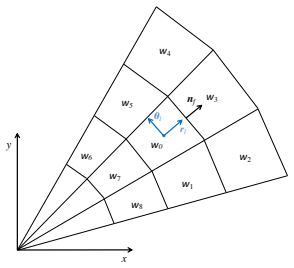
The load-bearing object is the velocity-aligned local orthonormal basis $(r_l,\theta_l)$: $r_l=(u,v)/\sqrt{u^2+v^2}$ and $\theta_l=(-v,u)/\sqrt{u^2+v^2}$, encoded in the transformation matrix $B$ of Eq. (7). Rotating each stencil's physical gradients into this basis makes the smoothness indicator $o_i = \max(o_i(\nu_{pl}), o_i(u_{pl}), o_i(v_{pl}), o_i(\tau_{pl}))$, with $o_i(q_{pl}) = (\partial q_{pl}/\partial r)^2 + (\partial q_{pl}/\partial\theta)^2$, a rotational invariant for a one-dimensional radial flow: the basis is the same up to rotation on mirror-symmetric cells, so each cell receives equal WENO weights and the limited polynomial retains circular symmetry. Strategy 2 replaces that basis rotation with a four-face local characteristic decomposition whose indicator sum, Eq. (15), likewise reduces to functions of radius only.
What would settle it
Run the same limiter on a radially symmetric flow in which the radial velocity changes sign (e.g., a converging-diverging radial wave), so some cell-average velocities vanish; if the measured symmetry error rises far above machine precision, the rotation-invariance of the indicator fails exactly where the local basis is undefined.
Extended reading notes
Core claim
The central claim is that the smoothness indicator, not the reconstruction stencils or the DG discretization, is what destroys cylindrical symmetry. The paper demonstrates that by changing only Step 3 of the WENO algorithm—computing the indicator from gradients in a velocity-aligned local basis, or from locally decomposed characteristic fields—the resulting limiter treats mirror-symmetric cells identically. In the polar Sod test, the largest symmetry errors drop to machine precision, on the order of $10^{-15}$, for both new strategies, while the canonical WENO limiter cannot preserve symmetry. The same limiters then give accurate shock profiles on the Sedov and Noh problems, with the characteristic-decomposition strategy showing the tightest density scatter on Sedov.
Load-bearing premise
The argument assumes that every cell sees a one-dimensional radial flow with nonzero cell-average velocity, so that the velocity-aligned bases of mirror-symmetric cells are exact rotations of each other and the azimuthal-gradient contribution vanishes.
Editorial extensions
If this is right
- On equal-angle polar meshes, WENO-limited Lagrangian DG can simulate radial shock flows with cylindrical symmetry preserved to machine precision, removing the need for special symmetry fix-ups.
- The same local-basis or characteristic-field indicator can be attached to finite-volume cell-centered hydrodynamics reconstructions, since the paper's stencil construction does not depend on the DG central stencil specifically.
- Strategy 2's characteristic decomposition offers a symmetry-preserving path that also gives the tightest scatter on the Sedov problem, suggesting it is a viable default limiter for multidimensional cylindrical flows.
- The mechanism explains the observed symmetry loss in standard WENO as a property of the smoothness indicator's frame dependence rather than a defect of the underlying DG discretization.
Reading between the lines
- Beyond the tested cases, the symmetry guarantee should degrade near stagnation points, since the local basis is defined by dividing by $\sqrt{u^2+v^2}$; a radial flow that reverses direction would reveal how the scheme behaves when the basis is ill-defined.
- For flows with vorticity, the velocity-aligned bases of mirror-symmetric cells will not in general be rotations of one another, so the indicator would no longer be rotationally invariant; the paper's formal symmetry argument is limited to one-dimensional radial kinematics.
- A natural extension is to align the basis with the geometric radial direction rather than the local velocity, which would remove the need for a nonzero velocity and might extend the construction to three-dimensional spherical coordinates.
- Combining the local-basis indicator with the subcell mesh stabilization used in higher-order Lagrangian DG could let the symmetry property survive through cell reshapes, but this is not tested in the paper.
Editorial analysis
A structured set of objections, weighed in public.
Referee Report
Summary. The manuscript proposes two WENO reconstruction strategies to be used as limiters in a Lagrangian discontinuous Galerkin (DG) hydrodynamic method, with the goal of preserving cylindrical symmetry for radial flows on an equal-angle polar mesh. Strategy 1 projects the reconstructed polynomial onto a local orthonormal basis aligned with the cell-average velocity, while Strategy 2 uses a local characteristic decomposition with face-dependent eigenvectors. The authors claim that both strategies preserve symmetry at machine precision for the polar Sod problem, and they also compute the Sedov blast wave and Noh implosion on square meshes to demonstrate robustness and accuracy. The paper is presented as a construction plus numerical demonstration, with the theoretical symmetry argument resting on assertions about the smoothness indicator depending only on the radius in the local-basis formulation.
Significance. If the central claim is correct, the paper provides a conceptually appealing explanation for the loss of cylindrical symmetry in WENO-limited Lagrangian DG methods, namely that the standard smoothness indicator is frame-dependent, and it offers two concrete fixes. The strength of the manuscript is the simplicity of the proposed indicator and the fact that the symmetry test is performed against the exact solution of the polar Sod problem. However, the machine-precision claim rests on a single quantitative test, key steps of the invariance argument are asserted rather than proven, and one algorithmic ingredient (the local basis) is undefined precisely in the initial state of that test. The paper does not provide code or data, so the reported errors cannot be independently reproduced from the manuscript.
major comments (4)
- [Section 3.1 (Step 3.1) and Section 4 (polar Sod initial condition)] The local orthonormal basis is defined as r_l = [u,v]^T/sqrt(u^2+v^2) and theta_l = [-v,u]^T/sqrt(u^2+v^2), which is undefined when the cell-average velocity vanishes. The polar Sod initial condition specifies u0 = v0 = 0 everywhere, so the basis is singular at the beginning of the computation. The paper does not state a regularization, a skip rule, or an epsilon to avoid division by zero for this case; the only epsilon mentioned (Section 3.3) is in the WENO weights. Since the symmetry-preservation claim depends on the basis being a well-defined, rotationally equivariant object, this omission is load-bearing. The authors must specify the algorithmic rule used at zero velocity and either prove that the rule preserves equivariance or provide an explicit statement of when the limiter is skipped and why that does not affect the reported machine-precision symmetry error.
- [Section 3.1 (Step 3.2) and Section 3.2 (Step 3.2, Eq. (15))] The assertion that the smoothness indicator 'only depend[s] on radius' is not demonstrated. For Strategy 1, one must show that the full pipeline—stencil selection, least-squares reconstruction, and the local-basis transformation B in Eq. (7)—commutes with the rotational congruence of the polar mesh and the radial flow. The paper provides only a verbal statement and the final scatter plot, without a derivation or a numerical verification that cells at the same radius but different angles produce identical indicators. For Strategy 2, Eq. (15) introduces coefficients d2 that depend on the total kinetic energy and uses face normals in the characteristic projection, so the claim that the combined expression depends only on the radius requires an analogous equivariance argument. Please provide a proof or a concrete numerical test, for example comparing the computed smoothness indicator for two cells on the same radial ring, to substantiate the central symmetry argument.
- [Section 4 (Fig. 3c)] The symmetry-error metric is not defined. The text states that 'velocity deviations from the radial direction' are used, but the exact expression—for instance, the azimuthal velocity component, the angle between the velocity and the radial unit vector, or a normalized projection—is never given, nor is the normalization of the plotted values described. Without a precise definition and a statement of how the error is computed (which cells are included, how the radial direction is determined, whether the exact radial-flow solution is used as a reference), the claim that the largest errors are on the order of 10^-15 cannot be independently verified. Please define the metric and report the computation procedure.
- [Section 4 (Table 1 and Fig. 3)] Only the polar Sod test is performed on the equal-angle polar mesh described in the abstract; the Sedov and Noh problems are computed on square Cartesian meshes, where, as the authors note, symmetry is enforced by the problem and mesh being symmetric about the 45-degree line. These two tests therefore do not exercise the new schemes in the setting for which the symmetry-preservation property is claimed. The generality of the result would be strengthened by adding polar-mesh versions of the Sedov or Noh problems, or at least a resolution study on the polar Sod problem demonstrating that the machine-precision symmetry errors persist across mesh refinements.
minor comments (4)
- [Section 3.1 (Eq. (7))] The matrix B is defined using the cell-average velocity (u,v), but it is not specified whether these are the DG coefficients µu and µv at the beginning of the time step, after the predictor stage, or after the WENO reconstruction in the previous step. Please clarify the timing and the origin of the velocity used to construct the local basis.
- [Section 3 generally] The notation is inconsistent across the steps: the reconstructed polynomial is sometimes denoted q^r_p, sometimes U^r_p, and the local-basis variables in Eq. (8) appear with bars (e.g., ¯u_{pl}) that are not defined. Aligning the notation among Steps 1–4 would improve readability.
- [Section 4] The simulations are not accompanied by the time step, CFL number, quadrature order, or limiter-application frequency, which are necessary for a reader to assess the accuracy and robustness results and to reproduce the computations.
- [Equations throughout] There are numerous typesetting errors in the equations, for example misplaced parentheses and brackets in Eq. (11), which should be corrected in a revised version.
Circularity Check
No significant circularity: the symmetry-preserving WENO limiters are a frame-invariant construction verified against the exact polar-Sod solution.
full rationale
The symmetry-preserving WENO schemes are constructed, not fitted. The central step is the rotation of the physical-gradient smoothness indicator into a velocity-aligned orthonormal basis (Section 3.1, Step 3.1, Eq. 7); for rotationally congruent stencils this makes the indicator equivariant, and the paper's assertion that the transformed derivatives 'only depend on radius' (Step 3.2) is an algebraic consequence of that coordinate change together with the radial-flow test configuration. The characteristic-field strategy applies standard eigenvector projections (Eqs. 11-15) rather than any data-fitted parameter. The only tunables, epsilon = 1e-6 and omega_l0 = 0.5, are conventional WENO parameters and do not encode the symmetry target. The machine-precision symmetry claim is checked against the exact polar-Sod profile, an external benchmark, and the original-WENO comparison provides the counterexample. Citations to the authors' prior Lagrangian DG work ([1], [23-25]) supply the base discretization but are not the source of the WENO symmetry mechanism, so they are not load-bearing. The zero-velocity normalization issue at t=0 in the polar-Sod initial condition is a genuine robustness/correctness caveat, but it is not a circular step: the derivation concerns nonzero radial-velocity configurations, and no input quantity is renamed as a prediction.
Assumptions & free parameters
free parameters (2)
- WENO regularization epsilon =
1e-6
- Central stencil linear weight omega_l0 =
0.5
assumptions (5)
- domain assumption The DG solution is a Taylor polynomial about the cell mass center with time-constant basis functions (from Ref. [1]).
- standard math The local orthonormal basis B in Eq. (7) is a rotation matrix, so the sum of squared gradient components is rotationally invariant.
- domain assumption The cell-average velocity is nonzero wherever the WENO limiter is applied.
- domain assumption The flow is exactly 1D radial on a rotationally congruent equal-angle polar mesh, so symmetric cells have rotated stencils, rotated least-squares reconstructions, and vanishing azimuthal gradient components.
- domain assumption Gamma-law equation of state for all three test problems.
Cite this review
Pith. "Pith review of Symmetry-preserving WENO limiters." pith.science (2026). https://pith.science/paper/GITBDK2Z
@misc{pith2026190807698,
  author       = {Pith},
  title        = {Pith review of: Symmetry-preserving WENO limiters},
  year         = {2026},
  howpublished = {\url{https://pith.science/paper/GITBDK2Z}},
  note         = {Machine review of arXiv:1908.07698}
}
read the original abstract
Weighted essentially non-oscillatory (WENO) reconstruction schemes are presented that preserve cylindrical symmetry for radial flows on an equal-angle polar mesh. These new WENO schemes are used with a Lagrangian discontinuous Galerkin (DG) hydrodynamic method. The solution polynomials are reconstructed using the WENO schemes where the DG solution is the central stencil. A suite of challenging test problems are calculated to demonstrate the accuracy and robustness of the new WENO schemes.
Figures


Reference graph
Works this paper leans on
-
[32]
J. Cheng and C.-W. Shu. A cell-centered Lagrangian scheme with the preservation of symmetry and conservation properties for compressible fluid flows in two-dimensional cylindrical geometry. Journal of Computational Physics , 229:7091–7206, 2010
work page 2010
-
[1]
X. Liu, N. Morgan, and D. Burton. A Lagrangian discontinuous Galerkin hydrodynamic method. Computers & Fluids, 163:68–85, 2018
work page 2018
-
[2]
A method for the calculation of hydrodynamics shocks
J von Neumann and R Richtmyer. A method for the calculation of hydrodynamics shocks. Journal of Applied Physics, 21:232–237, 1950
work page 1950
-
[3]
M. Wilkins. Use of artificial viscosity in multidimensional shock wave problems. Journal of Computa- tional Physics, 36:281–303, 1980. 8
work page 1980
-
[4]
D. Burton. Multidimensional discretization of conservation laws for unstructured polyhedral grids. Technical Report UCRL-JC-118306, Lawrence Livermore National Laboratory, 1994
work page 1994
-
[5]
E. Caramana, D. Burton, M. Shashkov, and P. Whalen. The construction of compatible hydrodynamic algorithms utilizing conservation of total energy. Journal of Applied Physics , 146:227–262, 1998
work page 1998
- [6]
-
[7]
S.K. Godunov, A. Zabrodine, M. Ivanov, A. Kraiko, and G. Prokopov. R´ esolution numr´ eque des probl` emes multidimensionnels de la dynamique des gaz. Mir, 1979
work page 1979
Show all 36 references
-
[8]
S. Godunov. Reminiscences about difference schemes. Journal of Computational Physics , 153:6–25, 1999
1999
-
[9]
Despr´ es and C
B. Despr´ es and C. Mazeran. Lagrangian gas dynamics in two dimensions and Lagrangian systems. Arch. Rational Mech. Anal., 178:327–372, 2005
2005
-
[10]
Maire, R
P-H. Maire, R. Abgrall, J. Breil, and J. Ovadia. A cell-centered Lagrangian scheme for two-dimensional compressible flow problems. SIAM Journal Scientific Computing , 29:1781–1824, 2007
2007
-
[11]
P-H. Maire. A high-order cell-centered Lagrangian scheme for two-dimensional compressible fluid flows on unstructured mesh. Journal Computational Physics , 228:2391–2425, 2009
2009
-
[12]
Burton, T
D. Burton, T. Carney, N. Morgan, S. Sambasivan, and M. Shashkov. A cell centered Lagrangian Godunov-like method of solid dynamics. Computers & Fluids, 83:33–47, 2013
2013
-
[13]
Boscheri and M
W. Boscheri and M. Dumbser. A direct Arbitrary-Lagrangian-Eulerian ADER-WENO finite volume scheme on unstructured tetrahedral meshes for conservative and non-conservative hyperbolic systems in 3D. Journal of Computational Physics , 275:484–523, 2014
2014
-
[14]
Morgan, M
N. Morgan, M. Kenamond, D. Burton, T. Carney, and D. Ingraham. An approach for treating contact surfaces in Lagrangian cell-centered hydrodynamics. Journal of Computational Physics , 250:527–554, 2013
2013
-
[15]
Cockburn, S
B. Cockburn, S. Hou, and C.-W. Shu. The Runge-Kutta local projection discontinuous Galerkin finite element method for conservation laws. IV. The multidimensional case. Mathematics of Computation , 54:545–581, 1990
1990
-
[16]
Cockburn and C.-W
B. Cockburn and C.-W. Shu. The Runge-Kutta discontinuous Galerkin method for conservation laws V: multidimensional systems. Journal of Computational Physics , 141:199–224, 1998
1998
-
[17]
H. Luo, J. Baum, and R. L¨ ohner. A discontinuous Galerkin method based on a Taylor basis for the compressible flows on arbitrary grids. Journal of Computational Physics , 227:8875–8893, 2008
2008
-
[18]
X. Liu, L. Xuan, Y. Xia, and H. Luo. A reconstructed discontinuous Galerkin method for the com- pressible Navier-Stokes equations on three-dimensional hybrid grids. Computers & Fluids, 152:271–230, 2017
2017
-
[19]
Jia and S
Z. Jia and S. Zhang. A new high-order discontinuous Galerkin spectral finite element method for Lagrangian gas dynamics in two-dimensions. Journal of Computational Physics , 230:2496–2522, 2011
2011
-
[20]
F. Vilar. Cell-centered discontinuous Galerkin discretization for two-dimensional Lagrangian hydrody- namics. Computers & Fluids, 64:64–73, 2012
2012
-
[21]
Vilar, P-H
F. Vilar, P-H. Maire, and R. Abgrall. A discontinuous Galerkin discretization for solving the two- dimensional gas dynamics equations written under total Lagrangian formulation on general unstruc- tured grids. Journal of Computational Physics , 276:188–234, 2014
2014
-
[22]
Lieberman, N
E. Lieberman, N. Morgan, D. Luscher, and D. Burton. A higher-order Lagrangian discontinuous Galerkin hydrodynamic method for elastic-plastic flows. submitted to Computers & Fluids
-
[23]
X. Liu, N. Morgan, and D. Burton. Lagrangian discontinuous Galerkin hydrodynamic methods in axisymmetric coordinates. Journal of Computational Physics , 373:253–283, 2018
2018
-
[24]
Morgan, X
N. Morgan, X. Liu, and D. Burton. Reducing spurious mesh motion in Lagrangian finite volume and discontinuous Galerkin hydrodynamic methods. Journal of Computational Physics , 372:35–61, 2018
2018
-
[25]
X. Liu, N. Morgan, and D. Burton. A high-order Lagrangian discontinuous Galerkin hydrodynamic method for quadratic cells using a subcell mesh stabilization scheme.Journal of Computational Physics, 386:110–157, 2019
2019
-
[26]
Barth and D.C
T. Barth and D.C. Jespersen. The design and application of upwind schemes on unstructured meshes. 9 27th Aerospace Sciences Meeting, AIAA 1989-366, Reno, NV, 1989
1989
-
[27]
D. Kuzmin. A vertex-based hierarchical slope limiter for p-adaptive discontinuous Galerkin methods. Journal of Computational and Applied Mathematics , 233(12):3077–3085, 2010
2010
-
[28]
R. Abgrall. On essential non-oscillatory schemes on unstructured meshes. Journal of Computational Physics, 114:45–58, 1994
1994
-
[29]
G-S Jiang and C.-W. Shu. Efficient implementation of weighted ENO schemes. Journal of Computa- tional Physics, 126:202–228, 1996
1996
-
[30]
H. Luo, J. Baum, and R. L¨ ohner. A Hermite WENO-based limiter for discontinuous Galerkin method on unstructured grids. Journal of Computational Physics , 225:686–713, 2007
2007
-
[31]
Qiu and C.-W
J. Qiu and C.-W. Shu. Hermite WENO schemes and their application as limiters for Runge-Kutta discontinuous Galerkin method: one-dimensional case. Journal of Computational Physics , 193:115– 135, 2004
2004
-
[33]
Maire, R
P-H. Maire, R. Loub` ere, and P. Vachal. Staggered Lagrangian discretization based on cell-centered Riemann solver and associated hydrodynamics scheme. Communications in Computational Physics , 10:940–978, 2011
2011
-
[34]
C.-W. Shu. Essentially non-oscillatory and weighted essentially non-oscillatory schemes for hyperbolic conservation laws, in: B. Cockburn, C. Johnson, C.-W. Shu, E. Tadmor, A. Quarteroni (Eds.), Ad- vanced Numerical Approximation of Nonlinear Hyperbolic Equations, Lecture Note...
1998
-
[35]
L. Sedov. Similarity and dimensional methods in mechanics, 1959
1959
-
[36]
W. Noh. Errors for calculations of strong shocks using an artificial viscosity and an artificial heat flux. Journal of Applied Physics , 72:78–120, 1987. 10
1987
Reviewed August 14, 2026 · model on record in the stance chip above.
Discussion (0). Continue with ORCID to comment.