Rethinking Conditional Generation for Underwater Salient Object Detection
Pith reviewed 2026-07-03 16:06 UTC · model grok-4.3
The pith
DCGNet restores degradation-aware RGB features from pseudo-depth to improve underwater salient object detection.
A machine-rendered reading of the paper's core claim, the machinery that carries it, and where it could break.
Core claim
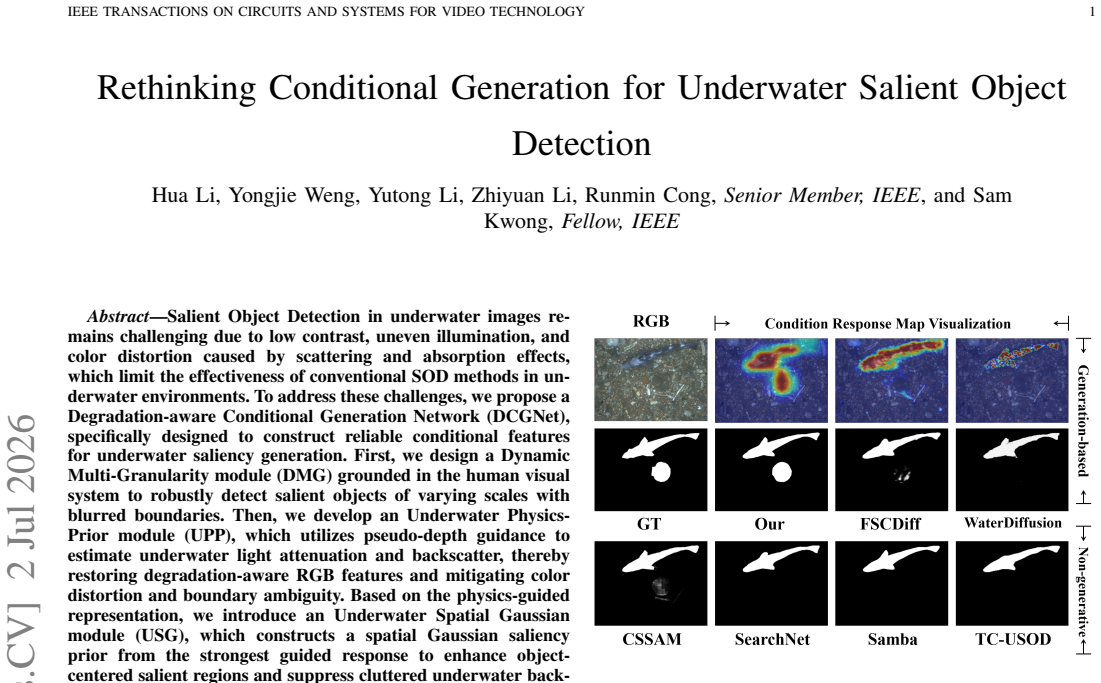
DCGNet constructs reliable conditional features for underwater saliency generation through an Underwater Physics-Prior module that uses pseudo-depth guidance to estimate light attenuation and backscatter, restoring degradation-aware RGB features, together with a Dynamic Multi-Granularity module for blurred boundaries, an Underwater Spatial Gaussian module for object-centered priors, and a timestep-adaptive Diffusion Transformer in the denoising decoder; this yields superior performance on USOD10K, USOD, CSOD10K, MAS3K, and RMAS.
What carries the argument
The Underwater Physics-Prior module (UPP), which estimates underwater light attenuation and backscatter from pseudo-depth guidance to restore degradation-aware RGB features.
If this is right
- DCGNet outperforms existing state-of-the-art methods on USOD10K, USOD, CSOD10K, MAS3K, and RMAS.
- The Dynamic Multi-Granularity module detects salient objects of varying scales despite blurred boundaries.
- The Underwater Spatial Gaussian module enhances object-centered regions while suppressing cluttered backgrounds.
- The timestep-adaptive Diffusion Transformer refines fused features across diffusion steps.
- The overall architecture shows potential for complex underwater visual applications.
Where Pith is reading between the lines
- Similar pseudo-depth-guided restoration could be tested on other scattering-heavy domains such as foggy or hazy scenes.
- The conditional generation framing suggests that diffusion-based decoders may benefit from domain physics at multiple timesteps.
- If pseudo-depth estimation itself improves, the downstream saliency gains would likely increase without changing the rest of the network.
Load-bearing premise
Pseudo-depth guidance supplies enough information to estimate light attenuation and backscatter accurately enough to restore useful RGB features.
What would settle it
On a new underwater dataset with ground-truth saliency maps, if DCGNet does not produce higher accuracy metrics than the previous best method, the claim that the physics-prior restoration enables better detection would be undermined.
Figures


read the original abstract
Salient Object Detection in underwater images remains challenging due to low contrast, uneven illumination, and color distortion caused by scattering and absorption effects, which limit the effectiveness of conventional SOD methods in underwater environments. To address these challenges, we propose a Degradation-aware Conditional Generation Network (DCGNet), specifically designed to construct reliable conditional features for underwater saliency generation. First, we design a Dynamic Multi-Granularity module (DMG) grounded in the human visual system to robustly detect salient objects of varying scales with blurred boundaries. Then, we develop an Underwater Physics-Prior module (UPP), which utilizes pseudo-depth guidance to estimate underwater light attenuation and backscatter, thereby restoring degradation-aware RGB features and mitigating color distortion and boundary ambiguity. Based on the physics-guided representation, we introduce an Underwater Spatial Gaussian module (USG), which constructs a spatial Gaussian saliency prior from the strongest guided response to enhance object-centered salient regions and suppress cluttered underwater backgrounds. In addition, a lightweight timestep-adaptive Diffusion Transformer (DiT) bottleneck is inserted into the denoising decoder to refine fused features at different diffusion timesteps. Comprehensive experiments on USOD10K, USOD, CSOD10K, MAS3K, and RMAS demonstrate that DCGNet significantly outperforms existing state-of-the-art methods, verifying its potential for complex underwater visual applications.
Editorial analysis
A structured set of objections, weighed in public.
Referee Report
Summary. The manuscript proposes DCGNet, a Degradation-aware Conditional Generation Network for underwater salient object detection. It introduces four components: a Dynamic Multi-Granularity (DMG) module for detecting salient objects at varying scales with blurred boundaries, an Underwater Physics-Prior (UPP) module that uses pseudo-depth guidance to estimate light attenuation and backscatter for restoring degradation-aware RGB features, an Underwater Spatial Gaussian (USG) module to build a spatial Gaussian saliency prior from the strongest guided response, and a lightweight timestep-adaptive Diffusion Transformer (DiT) bottleneck in the denoising decoder. The central claim is that this architecture significantly outperforms existing state-of-the-art methods on the USOD10K, USOD, CSOD10K, MAS3K, and RMAS datasets.
Significance. If the reported gains prove robust under standard evaluation protocols with ablations and statistical controls, the work could contribute a physics-informed conditional generation pipeline tailored to underwater domain challenges such as scattering and absorption. The explicit use of pseudo-depth for attenuation/backscatter estimation and the insertion of a timestep-adaptive DiT are architecture-specific choices that differentiate it from generic SOD or diffusion baselines.
major comments (1)
- [Abstract] Abstract: the assertion that DCGNet 'significantly outperforms existing state-of-the-art methods' on five named datasets is presented without any quantitative metrics, tables, error bars, ablation results, or statistical tests. This absence makes the central empirical claim impossible to evaluate from the supplied text.
minor comments (2)
- [Abstract] Abstract: the description of the UPP module states that it 'utilizes pseudo-depth guidance to estimate underwater light attenuation and backscatter' but provides no equation, loss term, or implementation detail for how the estimation is performed or how the restored features are fused.
- [Abstract] Abstract: the DiT is described as 'lightweight' and 'timestep-adaptive' without specifying the number of layers, attention mechanism, or how timestep conditioning is injected.
Simulated Author's Rebuttal
We thank the referee for their comments on our manuscript. We address the single major comment below.
read point-by-point responses
-
Referee: [Abstract] Abstract: the assertion that DCGNet 'significantly outperforms existing state-of-the-art methods' on five named datasets is presented without any quantitative metrics, tables, error bars, ablation results, or statistical tests. This absence makes the central empirical claim impossible to evaluate from the supplied text.
Authors: We agree that the abstract, as a concise summary, states the performance claim without accompanying numbers. The full manuscript contains the supporting evidence: Tables 1–5 report quantitative results (mIoU, F-measure, MAE, etc.) on USOD10K, USOD, CSOD10K, MAS3K, and RMAS, with comparisons to prior SOTA methods, plus ablation studies and statistical controls in Section 4. To make the abstract self-contained and address the concern directly, we will revise it in the next version to include the key average gains (e.g., +X% mIoU across datasets) while preserving its brevity. revision: yes
Circularity Check
No significant circularity detected
full rationale
The provided abstract and module descriptions introduce architectural components (DMG, UPP, USG, DiT) for conditional generation in underwater SOD. No equations, fitted parameters, predictions, self-citations, uniqueness theorems, or ansatzes are present that would reduce any claimed result to its inputs by construction. The central claim of outperformance is presented as an empirical result on external datasets and is therefore externally falsifiable rather than internally forced. This is the most common honest non-finding for papers whose load-bearing steps are architectural and experimental.
Axiom & Free-Parameter Ledger
Reference graph
Works this paper leans on
-
[1]
Vit-uwa: Vision transformer underwater-adapter for dense predictions beneath the water surface,
Y . Jia, Q. Lin, H. Li, Y . Li, S. Kwong, and R. Cong, “Vit-uwa: Vision transformer underwater-adapter for dense predictions beneath the water surface,”IEEE Transactions on Image Processing, 2026
work page 2026
-
[2]
Underwater salient object detection via dual-stage self-paced learning and depth emphasis,
J. Jin, Q. Jiang, Q. Wu, B. Xu, and R. Cong, “Underwater salient object detection via dual-stage self-paced learning and depth emphasis,”IEEE Transactions on Circuits and Systems for Video Technology, vol. 35, no. 3, pp. 2147–2160, 2025
work page 2025
-
[3]
Sea-thru: A method for removing water from underwater images,
D. Akkaynak and T. Treibitz, “Sea-thru: A method for removing water from underwater images,” inProceedings of the IEEE/CVF Conference on Computer Vision and Pattern Recognition, 2019, pp. 1682–1691
work page 2019
-
[4]
Real-world underwater enhancement: Challenges, benchmarks, and solutions under natural light,
R. Liu, X. Fan, M. Zhu, M. Hou, and Z. Luo, “Real-world underwater enhancement: Challenges, benchmarks, and solutions under natural light,”IEEE Transactions on Circuits and Systems for Video Technology, vol. 30, no. 12, pp. 4861–4875, 2020
work page 2020
-
[5]
Underwater image enhancement via weighted wavelet visual perception fusion,
W. Zhang, L. Zhou, P. Zhuang, G. Li, X. Pan, W. Zhao, and C. Li, “Underwater image enhancement via weighted wavelet visual perception fusion,”IEEE Transactions on Circuits and Systems for Video Technol- ogy, vol. 34, no. 4, pp. 2469–2483, 2023
work page 2023
-
[6]
Learning heavily- degraded prior for underwater object detection,
C. Fu, X. Fan, J. Xiao, W. Yuan, R. Liu, and Z. Luo, “Learning heavily- degraded prior for underwater object detection,”IEEE Transactions on Circuits and Systems for Video Technology, vol. 33, no. 11, pp. 6887– 6896, 2023
work page 2023
-
[7]
Usod10k: a new benchmark dataset for underwater salient object detection,
L. Hong, X. Wang, G. Zhang, and M. Zhao, “Usod10k: a new benchmark dataset for underwater salient object detection,”IEEE Transactions on Image Processing, vol. 34, pp. 1602–1615, 2023
work page 2023
-
[8]
G. Yuan, J. Song, and J. Li, “If-usod: Multimodal information fusion in- teractive feature enhancement architecture for underwater salient object detection,”Information Fusion, vol. 117, p. 102806, 2025
work page 2025
-
[9]
Generative transformer for accurate and reliable salient object detection,
Y . Mao, J. Zhang, Z. Wan, X. Tian, A. Li, Y . Lv, and Y . Dai, “Generative transformer for accurate and reliable salient object detection,”IEEE Transactions on Circuits and Systems for Video Technology, vol. 35, no. 2, pp. 1041–1054, 2025
work page 2025
-
[10]
Speed-up DDPM for real-time underwater image enhancement,
S. Lu, F. Guan, H. Zhang, and H. Lai, “Speed-up DDPM for real-time underwater image enhancement,”IEEE Transactions on Circuits and Systems for Video Technology, vol. 34, no. 5, pp. 3576–3588, 2024
work page 2024
-
[11]
L. Chang, Y . Wang, L. Deng, B. Du, and C. Xu, “Waterdiffusion: Learn- ing a prior-involved unrolling diffusion for joint underwater saliency detection and visual restoration,” inProceedings of the AAAI Conference on Artificial Intelligence, vol. 39, no. 2, 2025, pp. 1998–2006
work page 2025
-
[12]
H. Li, G. Lin, Z. Li, S. Kwong, and R. Cong, “FSCDiff: Frequency- spatial entangled conditional diffusion model for underwater salient object detection,” inProceedings of the 33rd ACM International Con- ference on Multimedia, 2025, pp. 8379–8388
work page 2025
-
[13]
WaterFlow: Explicit physics-prior rectified flow for underwater saliency mask generation,
R. Li, S. Lian, H. Li, Y . Li, W. Wu, and S. Kwong, “WaterFlow: Explicit physics-prior rectified flow for underwater saliency mask generation,” in ICASSP, 2026
work page 2026
-
[14]
SV AM: Saliency-guided visual attention modeling by autonomous underwater robots,
M. J. Islam, R. Wang, and J. Sattar, “SV AM: Saliency-guided visual attention modeling by autonomous underwater robots,” inRobotics: Science and Systems, New York, NY , USA, 2022
work page 2022
-
[15]
W. Zhou, B. Tang, R. Cong, and Q. Jiang, “Turbidity-similarity decou- pling: Feature-consistent mutual learning for underwater salient object detection,”IEEE Transactions on Image Processing, vol. 35, pp. 495– 510, 2026
work page 2026
-
[16]
Conditional text image generation with diffusion models,
Y . Zhu, Z. Li, T. Wang, M. He, and C. Yao, “Conditional text image generation with diffusion models,” inProceedings of the IEEE/CVF Conference on Computer Vision and Pattern Recognition, 2023, pp. 14 235–14 245
work page 2023
-
[17]
Codi: Conditional diffusion distillation for higher-fidelity and faster image generation,
K. Mei, M. Delbracio, H. Talebi, Z. Tu, V . M. Patel, and P. Milanfar, “Codi: Conditional diffusion distillation for higher-fidelity and faster image generation,” inProceedings of the IEEE/CVF Conference on Computer Vision and Pattern Recognition, 2024, pp. 9048–9058
work page 2024
-
[18]
Residual diffusion deblurring model for single image defocus deblurring,
H. Feng, H. Zhou, T. Ye, S. Chen, and L. Zhu, “Residual diffusion deblurring model for single image defocus deblurring,” inProceedings of the AAAI Conference on Artificial Intelligence, vol. 39, no. 3, 2025, pp. 2960–2968
work page 2025
-
[19]
Hierarchical integration diffusion model for realistic image deblurring,
Z. Chen, Y . Zhang, D. Liu, J. Gu, L. Kong, X. Yuanet al., “Hierarchical integration diffusion model for realistic image deblurring,”Advances in Neural Information Processing Systems, vol. 36, pp. 29 114–29 125, 2023
work page 2023
-
[20]
Medsegdiff-v2: Diffusion- based medical image segmentation with transformer,
J. Wu, W. Ji, H. Fu, M. Xu, Y . Jin, and Y . Xu, “Medsegdiff-v2: Diffusion- based medical image segmentation with transformer,” inProceedings of the AAAI Conference on Artificial Intelligence, vol. 38, no. 6, 2024, pp. 6030–6038
work page 2024
-
[21]
Camodiffusion: Camouflaged object detection via conditional diffusion models,
Z. Chen, K. Sun, and X. Lin, “Camodiffusion: Camouflaged object detection via conditional diffusion models,” inProceedings of the AAAI Conference on Artificial Intelligence, vol. 38, no. 2, 2024, pp. 1272– 1280
work page 2024
-
[22]
Conditional diffusion models for camouflaged and salient object detection,
K. Sun, Z. Chen, X. Lin, X. Sun, H. Liu, and R. Ji, “Conditional diffusion models for camouflaged and salient object detection,”IEEE Transactions on Pattern Analysis and Machine Intelligence, 2025
work page 2025
-
[23]
Diffusion models, image super-resolution, and everything: A survey,
B. B. Moser, A. S. Shanbhag, F. Raue, S. Frolov, S. Palacio, and A. Dengel, “Diffusion models, image super-resolution, and everything: A survey,”IEEE Transactions on Neural Networks and Learning Systems, 2024
work page 2024
-
[24]
Scalable diffusion models with transformers,
W. Peebles and S. Xie, “Scalable diffusion models with transformers,” inProceedings of the IEEE/CVF International Conference on Computer Vision, 2023, pp. 4195–4205
work page 2023
-
[25]
Pvt v2: Improved baselines with pyramid vision transformer,
W. Wang, E. Xie, X. Li, D.-P. Fan, K. Song, D. Liang, T. Lu, P. Luo, and L. Shao, “Pvt v2: Improved baselines with pyramid vision transformer,” Computational Visual Media, vol. 8, no. 3, pp. 415–424, 2022. IEEE TRANSACTIONS ON CIRCUITS AND SYSTEMS FOR VIDEO TECHNOLOGY 11
work page 2022
-
[26]
Focal attention for long-range interactions in vision transformers,
J. Yang, C. Li, P. Zhang, X. Dai, B. Xiao, L. Yuan, and J. Gao, “Focal attention for long-range interactions in vision transformers,” inAdvances in Neural Information Processing Systems, vol. 34, 2021, pp. 30 008– 30 022
work page 2021
-
[27]
Transnext: Robust foveal visual perception for vision transform- ers,
D. Shi, “Transnext: Robust foveal visual perception for vision transform- ers,” inProceedings of the IEEE/CVF Conference on Computer Vision and Pattern Recognition, 2024, pp. 17 773–17 783
work page 2024
-
[28]
Lsnet: See large, focus small,
A. Wang, H. Chen, Z. Lin, J. Han, and G. Ding, “Lsnet: See large, focus small,” inProceedings of the Computer Vision and Pattern Recognition Conference, 2025, pp. 9718–9729
work page 2025
-
[29]
Hi- danet: Rgb-d salient object detection via hierarchical depth awareness,
Z. Wu, G. Allibert, F. Meriaudeau, C. Ma, and C. Demonceaux, “Hi- danet: Rgb-d salient object detection via hierarchical depth awareness,” IEEE Transactions on Image Processing, vol. 32, pp. 2160–2173, 2023
work page 2023
-
[30]
Point-aware interaction and cnn-induced refinement network for rgb-d salient object detection,
R. Cong, H. Liu, C. Zhang, W. Zhang, F. Zheng, R. Song, and S. Kwong, “Point-aware interaction and cnn-induced refinement network for rgb-d salient object detection,” inProceedings of the 31st ACM International Conference on Multimedia, 2023, pp. 406–416
work page 2023
-
[31]
Catnet: A cascaded and aggregated transformer network for rgb-d salient object detection,
F. Sun, P. Ren, B. Yin, F. Wang, and H. Li, “Catnet: A cascaded and aggregated transformer network for rgb-d salient object detection,”IEEE Transactions on Multimedia, vol. 26, pp. 2249–2262, 2023
work page 2023
-
[32]
Salient object detection in optical remote sensing images driven by transformer,
G. Li, Z. Bai, Z. Liu, X. Zhang, and H. Ling, “Salient object detection in optical remote sensing images driven by transformer,”IEEE Trans- actions on Image Processing, vol. 32, pp. 5257–5269, 2023
work page 2023
-
[33]
Separate first, then segment: An integrity segmentation network for salient object detection,
G. Zhu, J. Li, and Y . Guo, “Separate first, then segment: An integrity segmentation network for salient object detection,”Pattern Recognition, vol. 150, p. 110328, 2024
work page 2024
-
[34]
VSCode: General visual salient and camouflaged object detection with 2d prompt learning,
Z. Luoet al., “VSCode: General visual salient and camouflaged object detection with 2d prompt learning,” inProceedings of the IEEE/CVF Conference on Computer Vision and Pattern Recognition, 2024, pp. 17 169–17 180
work page 2024
-
[35]
Fantastic animals and where to find them: Segment any marine animal with dual sam,
P. Zhang, T. Yan, Y . Liu, and H. Lu, “Fantastic animals and where to find them: Segment any marine animal with dual sam,” inProceedings of the IEEE/CVF Conference on Computer Vision and Pattern Recognition, 2024, pp. 2578–2587
work page 2024
-
[36]
K. Wang, D. Lin, C. Li, Z. Tu, and B. Luo, “Alignment-free rgbt salient object detection: Semantics-guided asymmetric correlation network and a unified benchmark,”IEEE Transactions on Multimedia, vol. 26, pp. 10 692–10 707, 2024
work page 2024
-
[37]
C. Hao, Z. Yu, X. Liu, J. Xu, H. Yue, and J. Yang, “A simple yet effective network based on vision transformer for camouflaged object and salient object detection,”IEEE Transactions on Image Processing, 2025
work page 2025
-
[38]
Dc-net: Divide-and-conquer for salient object detection,
J. Zhu, X. Qin, and A. Elsaddik, “Dc-net: Divide-and-conquer for salient object detection,”Pattern Recognition, vol. 157, p. 110903, 2025
work page 2025
-
[39]
Samba: A unified mamba-based framework for general salient object detection,
J. He, K. Fu, X. Liu, and Q. Zhao, “Samba: A unified mamba-based framework for general salient object detection,” inProceedings of the Computer Vision and Pattern Recognition Conference, 2025, pp. 25 314– 25 324
work page 2025
-
[40]
Perceptual localization and focus refinement network for rgb-d salient object detection,
J. Han, M. Wang, W. Wu, and X. Jia, “Perceptual localization and focus refinement network for rgb-d salient object detection,”Expert Systems with Applications, vol. 259, p. 125278, 2025
work page 2025
-
[41]
R. Cong, Z. Chen, H. Fang, S. Kwong, and W. Zhang, “Breaking barriers, localizing saliency: A large-scale benchmark and baseline for condition-constrained salient object detection,”IEEE Transactions on Pattern Analysis and Machine Intelligence, vol. 48, no. 4, pp. 4167– 4183, 2026
work page 2026
-
[42]
MAS3K: An open dataset for marine animal segmentation,
L. Li, E. Rigall, J. Dong, and G. Chen, “MAS3K: An open dataset for marine animal segmentation,” inBenchmarking, Measuring, and Optimizing, ser. Lecture Notes in Computer Science, vol. 12614. Cham: Springer, 2021, pp. 194–212
work page 2021
-
[43]
MASNet: A robust deep marine animal segmentation network,
Z. Fu, R. Chen, Y . Huang, E. Cheng, X. Ding, and K.-K. Ma, “MASNet: A robust deep marine animal segmentation network,”IEEE Journal of Oceanic Engineering, vol. 49, no. 3, pp. 1104–1115, 2023
work page 2023
-
[44]
Imagenet: A large-scale hierarchical image database,
J. Deng, W. Dong, R. Socher, L.-J. Li, K. Li, and L. Fei-Fei, “Imagenet: A large-scale hierarchical image database,” in2009 IEEE Conference on Computer Vision and Pattern Recognition. IEEE, 2009, pp. 248–255
work page 2009
-
[45]
Saliency filters: Contrast based filtering for salient region detection,
F. Perazzi, P. Kr ¨ahenb¨uhl, Y . Pritch, and A. Hornung, “Saliency filters: Contrast based filtering for salient region detection,” in2012 IEEE Conference on Computer Vision and Pattern Recognition. IEEE, 2012, pp. 733–740
work page 2012
-
[46]
Frequency-tuned salient region detection,
R. Achanta, S. Hemami, F. Estrada, and S. Susstrunk, “Frequency-tuned salient region detection,” in2009 IEEE Conference on Computer Vision and Pattern Recognition. IEEE, 2009, pp. 1597–1604
work page 2009
-
[47]
How to evaluate foreground maps?
R. Margolin, L. Zelnik-Manor, and A. Tal, “How to evaluate foreground maps?” inProceedings of the IEEE Conference on Computer Vision and Pattern Recognition, 2014, pp. 248–255
work page 2014
-
[48]
Enhanced-alignment measure for binary foreground map evaluation,
D.-P. Fan, C. Gong, Y . Cao, B. Ren, M.-M. Cheng, and A. Borji, “Enhanced-alignment measure for binary foreground map evaluation,” inProceedings of the Twenty-Seventh International Joint Conference on Artificial Intelligence, 2018, pp. 698–704
work page 2018
-
[49]
Structure-measure: A new way to evaluate foreground maps,
D.-P. Fan, M.-M. Cheng, Y . Liu, T. Li, and A. Borji, “Structure-measure: A new way to evaluate foreground maps,” inProceedings of the IEEE International Conference on Computer Vision, 2017, pp. 4548–4557
work page 2017
-
[50]
Suppress and balance: A simple gated network for salient object detection,
X. Zhao, Y . Pang, L. Zhang, H. Lu, and L. Zhang, “Suppress and balance: A simple gated network for salient object detection,” in Proceedings of the European Conference on Computer Vision. Springer, 2020, pp. 35–51
work page 2020
-
[51]
Multi-scale interactive network for salient object detection,
Y . Pang, X. Zhao, L. Zhang, and H. Lu, “Multi-scale interactive network for salient object detection,” inProceedings of the IEEE/CVF Conference on Computer Vision and Pattern Recognition, 2020, pp. 9413–9422
work page 2020
-
[52]
Label decoupling framework for salient object detection,
J. Wei, S. Wang, Z. Wu, C. Su, Q. Huang, and Q. Tian, “Label decoupling framework for salient object detection,” inProceedings of the IEEE/CVF Conference on Computer Vision and Pattern Recognition, 2020, pp. 13 025–13 034
work page 2020
-
[53]
N. Liu, N. Zhang, K. Wan, L. Shao, and J. Han, “Visual saliency transformer,” inProceedings of the IEEE/CVF International Conference on Computer Vision, 2021, pp. 4722–4732
work page 2021
-
[54]
EDN: Salient object detection via extremely-downsampled network,
Y .-H. Wu, Y . Liu, L. Zhang, M.-M. Cheng, and B. Ren, “EDN: Salient object detection via extremely-downsampled network,”IEEE Transactions on Image Processing, vol. 31, pp. 3125–3136, 2022
work page 2022
-
[55]
TRACER: Extreme attention guided salient object tracing network,
M. S. Lee, W. Shin, and S. W. Han, “TRACER: Extreme attention guided salient object tracing network,” inProceedings of the AAAI Conference on Artificial Intelligence, vol. 36, 2022, pp. 12 993–12 994
work page 2022
-
[56]
Salient object detection via integrity learning,
M. Zhuge, D.-P. Fan, N. Liu, D. Zhang, D. Xu, and L. Shao, “Salient object detection via integrity learning,”IEEE Transactions on Pattern Analysis and Machine Intelligence, vol. 45, no. 3, pp. 3738–3752, 2022
work page 2022
-
[57]
Towards a complete and detail-preserved salient object detection,
Y . K. Yun and W. Lin, “Towards a complete and detail-preserved salient object detection,”IEEE Transactions on Multimedia, vol. 26, pp. 4667– 4680, 2024
work page 2024
-
[58]
Boosting broader receptive fields for salient object detection,
M. Ma, C. Xia, C. Xie, X. Chen, and J. Li, “Boosting broader receptive fields for salient object detection,”IEEE Transactions on Image Processing, vol. 32, pp. 1026–1038, 2023
work page 2023
-
[59]
F. Liet al., “Size-invariance matters: Rethinking metrics and losses for imbalanced multi-object salient object detection,” inProceedings of the International Conference on Machine Learning, 2024, pp. 28 989– 29 021
work page 2024
-
[60]
Multi-scale and detail-enhanced segment anything model for salient object detection,
S. Gao, P. Zhang, T. Yan, and H. Lu, “Multi-scale and detail-enhanced segment anything model for salient object detection,” inProceedings of the 32nd ACM International Conference on Multimedia, 2024, pp. 9894–9903
work page 2024
-
[61]
Modeling aleatoric uncertainty for camouflaged object detection,
J. Liu, J. Zhang, and N. Barnes, “Modeling aleatoric uncertainty for camouflaged object detection,” inProceedings of the IEEE/CVF Winter Conference on Applications of Computer Vision, 2022, pp. 1445–1454
work page 2022
-
[62]
Zoom in and out: A mixed-scale triplet network for camouflaged object detection,
Y . Pang, X. Zhao, T.-Z. Xiang, L. Zhang, and H. Lu, “Zoom in and out: A mixed-scale triplet network for camouflaged object detection,” inProceedings of the IEEE/CVF Conference on Computer Vision and Pattern Recognition, 2022, pp. 2160–2170
work page 2022
-
[63]
Rethinking semantic segmen- tation from a sequence-to-sequence perspective with transformers,
S. Zheng, J. Lu, H. Zhao, X. Zhu, Z. Luo, Y . Wang, Y . Fu, J. Feng, T. Xiang, P. H. S. Torr, and L. Zhang, “Rethinking semantic segmen- tation from a sequence-to-sequence perspective with transformers,” in Proceedings of the IEEE/CVF Conference on Computer Vision and Pattern Recognition, 2021, pp. 6881–6890
work page 2021
-
[64]
H2Former: An effi- cient hierarchical hybrid transformer for medical image segmentation,
A. He, K. Wang, T. Li, C. Du, S. Xia, and H. Fu, “H2Former: An effi- cient hierarchical hybrid transformer for medical image segmentation,” IEEE Transactions on Medical Imaging, vol. 42, no. 9, pp. 2763–2775, 2023
work page 2023
-
[65]
A. Kirillov, E. Mintun, N. Ravi, H. Mao, C. Rolland, L. Gustafson, T. Xiao, S. Whitehead, A. C. Berg, W.-Y . Lo, P. Doll´ar, and R. Girshick, “Segment anything,” inProceedings of the IEEE/CVF International Conference on Computer Vision, 2023, pp. 4015–4026
work page 2023
-
[66]
SAM-Adapter: Adapting segment anything in underperformed scenes,
T. Chen, L. Zhu, C. Deng, R. Cao, Y . Wang, S. Zhang, Z. Li, L. Sun, Y . Zang, and P. Mao, “SAM-Adapter: Adapting segment anything in underperformed scenes,” inProceedings of the IEEE/CVF International Conference on Computer Vision Workshops, 2023, pp. 3367–3375
work page 2023
-
[67]
Cross-modal fusion and progressive decoding network for rgb-d salient object detection,
X. Hu, F. Sun, J. Sun, F. Wang, and H. Li, “Cross-modal fusion and progressive decoding network for rgb-d salient object detection,” International Journal of Computer Vision, vol. 132, no. 8, pp. 3067– 3085, 2024
work page 2024
-
[68]
Mas-sam: segment any marine animal with aggregated features,
T. Yan, Z. Wan, X. Deng, P. Zhang, Y . Liu, and H. Lu, “Mas-sam: segment any marine animal with aggregated features,” inProceedings of the Thirty-Third International Joint Conference on Artificial Intelligence, 2024, pp. 6886–6894
work page 2024
discussion (0)
Sign in with ORCID, Apple, or X to comment. Anyone can read and Pith papers without signing in.