REVIEW 3 major objections 4 minor 44 references
Cascaded Lattice Boltzmann Modeling and Simulations of Three-Dimensional Non-Newtonian Fluid Flows
T0 review · 3 major / 4 minor · reviewed 2026-08-14 · deepseek-v4-flash
Pith's one-line read A new D3Q19 cascaded lattice Boltzmann scheme with locally varied relaxation times accurately and stably simulates three-dimensional power-law non-Newtonian flows, with second-order grid convergence and better stability than SRT and…
desk verdict A solid, well-validated 3D cascaded LBM for power-law fluids, but the printed strain-rate formulas in Eq. (43) have a factor error that must be fixed before the paper is usable. read the letter →
The pith
A machine-rendered reading of the paper's core claim, the machinery that carries it, and where it could break.
The reading
What carries the argument
The central object is the cascaded collision operator based on central moments: distribution functions are transformed into moments shifted by the local fluid velocity, relaxed toward attractors at different rates, and mapped back through an orthogonal matrix built from Gram-Schmidt-orthogonalized D3Q19 basis vectors. The non-Newtonian feedback loop is carried by two coupled local formulas: one sets the second-order relaxation parameter $\omega_\nu$ from the power-law effective viscosity, and the other reconstructs the six strain-rate components from non-equilibrium second-order moments divided by that same local relaxation parameter. This loop replaces any finite-difference computation of the velocity gradient, so the constitutive relation is evaluated with information already available in the collision step, preserving locality and parallelizability.
What would settle it
Simulate the same power-law channel flow twice, once computing the local strain rate from the paper's non-equilibrium-moment formula with a simple one-step update and once iterating the viscosity-strain-rate feedback to convergence; if the two velocity fields differ by more than discretization error, the closure as implemented carries an unresolved implicit dependence.
Extended reading notes
Core claim
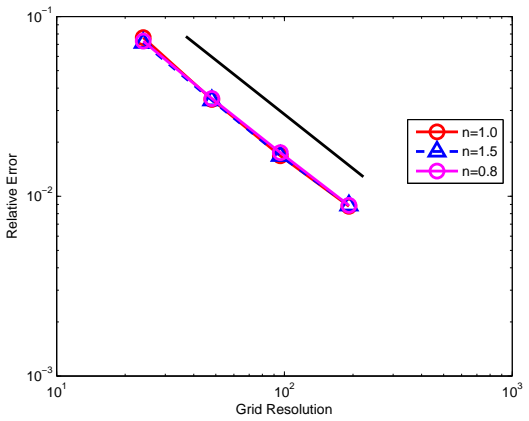
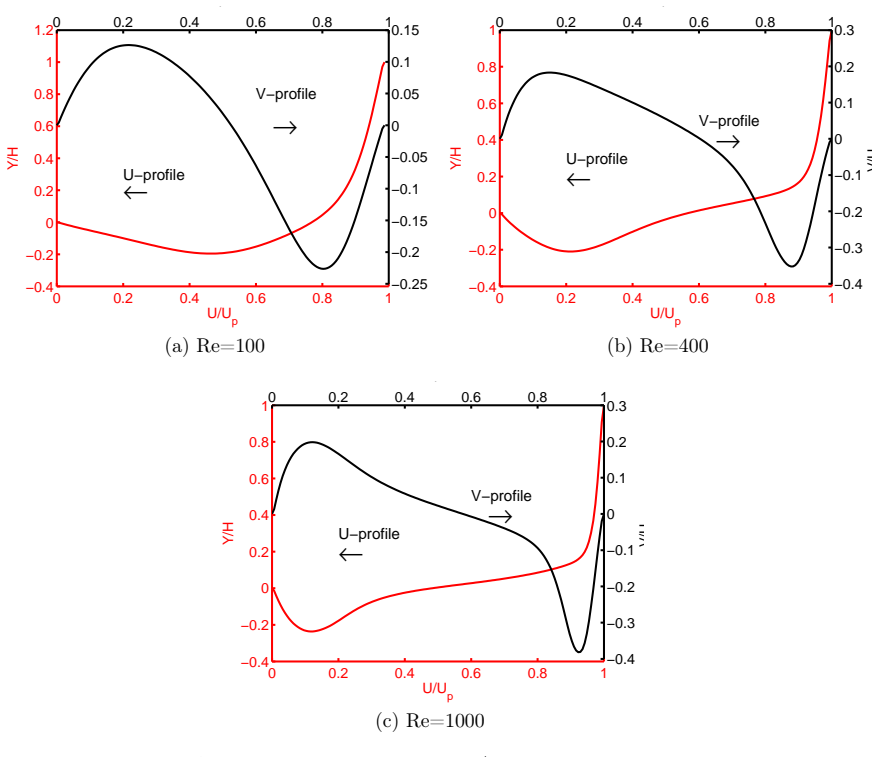
The central claim is that the cascaded lattice Boltzmann method on the D3Q19 lattice, with its second-order relaxation times set locally by the power-law viscosity formula $\mu = \mu_p |\dot{\gamma}|^{n-1}$ and strain-rate components extracted from non-equilibrium moments, reproduces benchmark three-dimensional non-Newtonian flows to second-order grid accuracy while remaining stable at Reynolds numbers where single-relaxation-time and raw-moment multiple-relaxation-time collision models diverge. The paper derives the full cascaded collision step for D3Q19, presents the local strain-rate reconstruction, and demonstrates agreement with analytic Poiseuille and duct-flow solutions and with the cubic-cavity benchmark for $n = 0.8$, $1.0$, and $1.5$ at $Re = 100$, $400$, and $1000$. It also reports that the cascaded scheme reaches maximum stable Reynolds numbers several times larger than the single-relaxation-time scheme at the same resolution and sustains higher lid velocities than either comparison scheme in a fixed-resolution stability test.
Load-bearing premise
The method assumes that the usual way lattice Boltzmann reads the local strain rate from the departure of the particle populations from equilibrium remains valid even though the relaxation time is now itself a function of that strain rate; the paper states this relation without deriving it or explaining how the feedback between viscosity and strain rate is resolved.
Editorial extensions
If this is right
- The local strain-rate reconstruction keeps the constitutive relation within the collision step, so the method stays naturally suitable for parallel computing without extra neighbor stencils for viscosity.
- At equal resolution, the cascaded scheme is stable at considerably higher Reynolds numbers than single-relaxation-time LBM; for $n=1$, matching the cascaded scheme's stable Reynolds number on a $64^3$ grid requires the single-relaxation-time scheme on a $96^3$ grid, about 3.4 times as many nodes.
- The formulation extends to any generalized Newtonian or strain-rate-dependent viscosity model, including subgrid-scale closures, because the local viscosity feedback enters only through the relaxation parameter $\omega_\nu$.
- Second-order grid convergence is demonstrated for shear-thinning ($n=0.8$), Newtonian ($n=1$), and shear-thickening ($n=1.5$) fluids, so the scheme is not limited to mild nonlinearities.
Reading between the lines
- A testable consequence of the local closure is that the strain-rate-to-viscosity feedback is only as accurate as the one-step update used to resolve it; if the update is not iterated, the effective viscosity may lag the strain rate by one time step, an error that would appear as a small shift in velocity profiles at high shear rates.
- Because the relaxation parameter appears on both sides of the strain-rate reconstruction, a fixed-point or implicit evaluation could change results in strongly shear-thinning cases; comparing the two implementations on the cubic cavity would reveal whether the omitted derivation hides a first-order lag.
- The reported stability gain at fixed resolution suggests that tuning the higher-order moment relaxation parameters, which the paper sets to unity, could extend the method to even higher Reynolds numbers or finer effective viscosities in non-Newtonian flows.
Signed reviews
Editorial analysis
A structured set of objections, weighed in public.
Referee Report
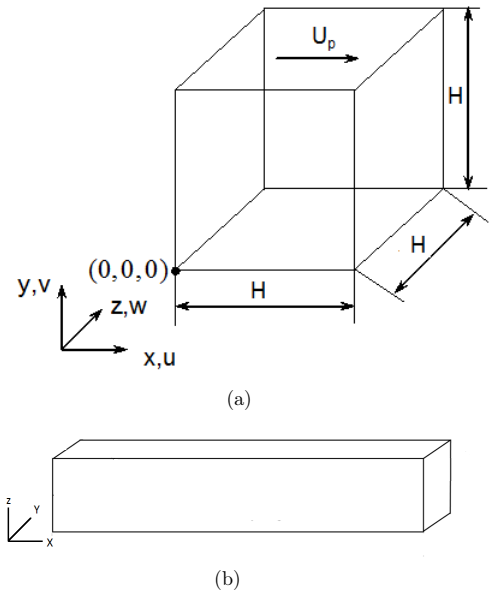
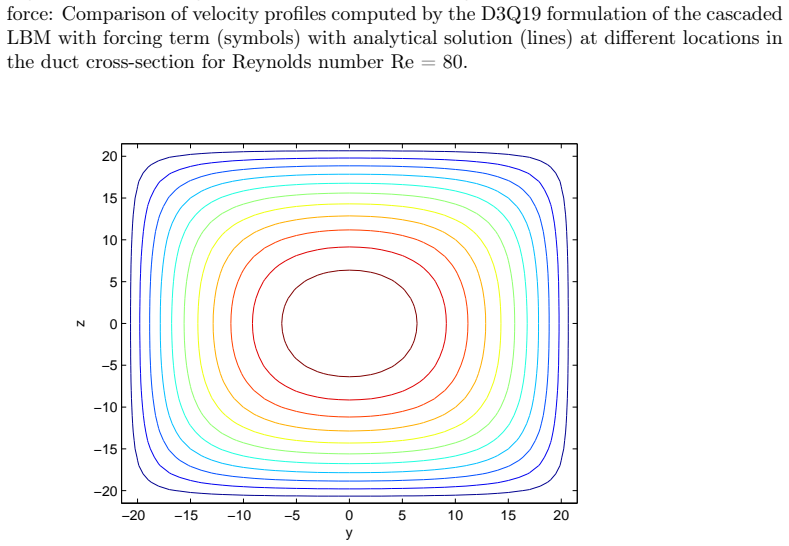
Summary. The paper develops a cascaded lattice Boltzmann method based on central moments and multiple relaxation times on a D3Q19 lattice for three-dimensional power-law non-Newtonian flows. It constructs an orthogonal moment basis, derives the cascaded collision step for the D3Q19 lattice, sets the second-order relaxation parameters locally from the power-law constitutive relation, and computes the strain-rate tensor locally from non-equilibrium moments. The method is validated against analytical solutions for channel and square-duct flows and against the finite-volume benchmark of Jin et al. (2017) for cubic lid-driven cavity flows at Reynolds numbers 100, 400, and 1000 with power-law indices 0.8, 1.0, and 1.5. The paper also reports second-order grid convergence and demonstrates improved numerical stability relative to SRT-LBM and raw-moment MRT-LBM, with a reported computational overhead of about 30-40% per node update.
Significance. If the formulation is correct, the paper makes a useful contribution: it provides a D3Q19 cascaded LBM for generalized Newtonian fluids, a local (moment-based) strain-rate evaluation that avoids non-local finite differences, and an independent benchmark comparison against established FVM data. The benchmark results, second-order convergence study, and stability comparisons are concrete strengths, and the central claim is not circular because the validation uses analytical solutions and independent FVM data rather than the method's own outputs. However, the paper's central strain-rate closure is internally inconsistent as printed, and the Chapman-Enskog justification for variable local relaxation times is omitted. These issues are load-bearing because the non-Newtonian viscosity feedback in Eq. (41) depends directly on the strain-rate formula in Eq. (43).
major comments (3)
- [Section 3.2, Eq. (43a)-(43c)] The off-diagonal strain-rate formulas are algebraically inconsistent with Eq. (42). From Eq. (42a), m4^(1) ≈ -(1/(3ω4))ρ(∂_y u_x + ∂_x u_y) = -(2/(3ω4))ρ S_xy, which gives S_xy = -(3ω4/(2ρ)) m4^(1). Equation (43a) instead prints S_xy = -3/(2ρ ων) m4^(1), with ων in the denominator; the same error appears in Eqs. (43b) and (43c). Substituting Eq. (42a) into Eq. (43a) yields S_xy = S_xy/ων^2, an identity only at ων = 1. Since Eq. (41) computes the effective viscosity from the shear-rate magnitude built from these components, a reader implementing the printed formulas would compute the wrong apparent viscosity, with the error scaling roughly as ων^{2(n-1)}. The diagonal components in Eqs. (43d)-(43f) are consistent with Eq. (42), so the error is localized, but the manuscript does not state that Eq. (43a)-(43c) contains a typo, and no code is released. As written, the central strain-rate closure of the paper is not reproducible from the text alone.
- [Section 3.2, Eqs. (41) and (43)] The update of the relaxation parameter is not fully specified. Equation (41) determines ων from the local shear-rate magnitude, while Eq. (43) computes the strain-rate components from non-equilibrium moments and ων itself. The paper does not state whether this implicit relation is resolved by fixed-point iteration, by a lagged value from the previous time step, or by some other procedure. This distinction is not merely an implementation detail: a lagged update introduces a first-order-in-time coupling between the strain rate and the viscosity, whereas iteration changes the cost and the effective consistency of the scheme. The good benchmark agreement in Section 4 suggests that the implementation resolves this coupling successfully, but the algorithm as described in Section 3.4 is incomplete without specifying the update order.
- [Section 3.2, paragraph before Eq. (42)] The Chapman-Enskog relations in Eq. (42) are asserted with the statement that 'details are omitted here for brevity,' with the derivation deferred to prior constant-relaxation-time analyses. This is a load-bearing omission because Eq. (42) is the basis for the local strain-rate closure, and the standard Chapman-Enskog expansion does not automatically carry over when ων varies in space and time through Eq. (41). The authors should either provide the derivation in an appendix or state precisely under what assumptions on the variation of ων the relation (42) remains valid. Without this, the central claim that the D3Q19 cascaded collision recovers the generalized Newtonian Navier-Stokes equations is not fully established in this manuscript.
minor comments (4)
- [Abstract and Introduction] The abstract and the introduction both contain the phrase 'limited to mainly to two dimensions'; the duplicated 'to' should be removed.
- [Section 4.3, Figure 12] In Figure 12, the caption states that the results are compared with the benchmark solution of Jin et al. (2017) using symbols, but the rendered figure for n = 0.8 does not appear to show the benchmark symbols or a corresponding legend. Please verify that the symbols are included and legible.
- [Section 5, Figure 13] The stability comparison in Figure 13 reports a 'maximum Reynolds number,' but the text does not specify the precise instability criterion (e.g., the threshold on the global error growth rate or the number of time steps considered). Adding this criterion would make the stability comparison reproducible.
- [Section 3.4] The sentence 'The body force is implementation is discussed in Ref. [26]' contains a grammatical error ('is implementation is') and should read 'The body force implementation is discussed in Ref. [26]'.
Circularity Check
No material circularity: the scheme is validated externally against analytical solutions and an independent finite-volume benchmark; the only self-referential reduction is a localized printed algebraic inconsistency in Eqs. (43a)-(43c).
-
self definitional
[Sec. 3.2, Eqs. (42a) and (43a)-(43c)]
"m̂(1)4 ≈ −(1/(3ω4))ρ(∂y ux + ∂x uy) ... Sxy = −3/(2ρ ων(x,t)) m̂(1)4"
With ω4 = ων, Eq. (42a) gives m̂4(1) ≈ −(2/(3ων))ρ Sxy. Eq. (43a) then defines Sxy = −(3/(2ρ ων))m̂4(1); substituting gives Sxy = Sxy/ων^2, an identity only at ων = 1. The printed off-diagonal formulas return a rescaled version of the strain rate they claim to determine; the correct inversion needs ων in the numerator. This is a localized algebraic/textual defect, not a fitted-input prediction: Sec. 3.4 reuses already-available non-equilibrium moments, making the update explicit, and the external benchmarks anchor the results independently.
full rationale
I walked the claimed derivation chain: the cascaded central-moment collision (Eqs. (26)-(40)) is derived in-paper; the Chapman-Enskog closure (Eq. (42)) is quoted with details omitted but traced to the authors' prior works [16,21]; the strain-rate formulas (Eq. (43)) are intended to invert that closure; and the effective viscosity is then set through Eq. (41) and used in the next collision. The only point where the chain loops back on itself is the printed 1/ων in Eqs. (43a)-(43c), which, combined with Eq. (42), reduces the off-diagonal shear-rate expression to itself divided by ων^2. That is a self-referential reduction of the printed formula, but it is localized, contradicted by the diagonal formulas, and does not reflect a fitted input being renamed as a prediction. The validation against analytical channel/duct solutions and the independent finite-volume benchmark of Jin et al. (2017) shows the central results are externally anchored. The self-citations for the omitted Chapman-Enskog details are not load-bearing because the resulting relations are displayed and benchmarked. Overall circularity score is therefore low.
Assumptions & free parameters
free parameters (1)
- Higher-order relaxation parameters omega_9 through omega_18 =
1.0
assumptions (3)
- ad hoc to paper The D3Q19 cascaded collision with central moments recovers the Navier-Stokes equations for generalized Newtonian fluids when relaxation times vary locally.
- domain assumption The factorized central-moment attractors in Eq. (22), with post-collision lower moments entering higher equilibria, are appropriate for non-Newtonian flows.
- domain assumption Half-way bounce-back with momentum correction yields accurate no-slip and moving-lid boundary conditions for variable-viscosity fluids.
Cite this review
Pith. "Pith review of Cascaded Lattice Boltzmann Modeling and Simulations of Three-Dimensional Non-Newtonian Fluid Flows." pith.science (2026). https://pith.science/paper/GJL7YU4L
@misc{pith2026190805396,
  author       = {Pith},
  title        = {Pith review of: Cascaded Lattice Boltzmann Modeling and Simulations of Three-Dimensional Non-Newtonian Fluid Flows},
  year         = {2026},
  howpublished = {\url{https://pith.science/paper/GJL7YU4L}},
  note         = {Machine review of arXiv:1908.05396}
}
read the original abstract
Non-Newtonian fluid flows, especially in three dimensions (3D), arise in numerous settings of interest to physics. Prior studies using the lattice Boltzmann method (LBM) of such flows have so far been limited to mainly to two dimensions and used less robust collision models. In this paper, we develop a new 3D cascaded LBM based on central moments and multiple relaxation times on a three-dimensional, nineteen velocity (D3Q19) lattice for simulation of generalized Newtonian (power law) fluid flows. The relaxation times of the second order moments are varied locally based on the local shear rate and parameterized by the consistency coefficient and the power law index of the nonlinear constitutive relation of the power law fluid. Numerical validation study of the 3D cascaded LBM for various benchmark problems, including the complex 3D non-Newtonian flow in a cubic cavity at different Reynolds numbers and power law index magnitudes encompassing shear thinning and shear thickening fluids, are presented. Furthermore, numerical stability comparisons of the proposed advanced LBM scheme against the LBM based on other collision models, such as the SRT model and MRT model based on raw moments, are made. Numerical results demonstrate the accuracy, second order grid convergence and significant improvements in stability of the 3D cascaded LBM for simulation of 3D non-Newtonian flows of power law fluids.
Figures


Figures from the paper (11 more)






Reference graph
Works this paper leans on
-
[1]
Benzi, R., Succi, S., and Vergassola, M., Phys. Rep.222 (1992) 145
work page 1992
- [2]
-
[3]
Succi, S., The lattice Boltzmann equation: for fluid dynamics and be- yond, Oxford university press, 2001
work page 2001
-
[4]
Aidun, C. and Clausen, J., Annu. Rev. Fluid Mech.42 (2010) 439. 38
work page 2010
-
[5]
et al.,The lattice Boltzmann method: principles and practice, Springer: Berlin, Germany, 2016
Timm, K. et al.,The lattice Boltzmann method: principles and practice, Springer: Berlin, Germany, 2016
work page 2016
- [6]
-
[7]
Qian, Y., d’Humières, D., and Lallemand, P., Europhys. Lett.17 (1992) 479
work page 1992
- [8]
Show all 44 references
-
[9]
d’Humières, D., Phil. Trans. Roy. Soc. London A360 (2002) 437
2002
-
[10]
V., Ferrante, A., and Öttinger, H
Karlin, I. V., Ferrante, A., and Öttinger, H. C., Europhys. Lett.47 (1999) 182
1999
-
[11]
V., Phys
Chikatamarla, S., Ansumali, S., and Karlin, I. V., Phys. Rev. Lett.97 (2006) 010201
2006
-
[12]
S., and Karlin, I
Bösch, F., Chikatamarla, S. S., and Karlin, I. V., Phys. Rev. E 92 (2015) 043309
2015
-
[13]
S., and Karlin, I
Frapolli, N., Chikatamarla, S. S., and Karlin, I. V., Phys. Rev. E93 (2016) 063302
2016
-
[14]
Geier, M., Greiner, J., and Korvink, F., Phys. Rev. E73 (2006) 066705
2006
-
[15]
Asinari, P., Phys. Rev. E78 (2008) 016701
2008
-
[16]
Premnath, K. N. and Banerjee, S., Phys. Rev. E80 (2009) 036702
2009
-
[17]
Geier, M., Schonherr, M., Pasquali, A., and Krafczyk, M., Comp. Math. Appl. 704 (2015) 507
2015
-
[18]
Ning, Y., Premnath, K., and Patil, D., Int. J. Numer. Meth. Fluids82 (2015) 59
2015
-
[19]
Premnath, K. N. and Banerjee, S., J. Stat. Phys.143 (2011) 747
2011
-
[20]
D., Europhys
Rosis, A. D., Europhys. Lett.116 (2016) 44003
2016
-
[21]
and Premnath, K
Hajabdollahi, F. and Premnath, K. N., Phys. Rev. E97 (2018) 053303. 39
2018
-
[22]
H., Lin, C., and Li, Q., Int
Fei, L., Luo, K. H., Lin, C., and Li, Q., Int. J. Heat Mass Transf.120 (2018) 624
2018
-
[23]
M., Welch, S
Elseid, F. M., Welch, S. W., and Premnath, K. N., Int. J. Heat Fluid Flow 70 (2018) 279
2018
-
[24]
and Premnath, K
Hajabdollahi, F. and Premnath, K. N., Int. J. Heat Mass Transf.120 (2018) 838
2018
-
[25]
H., and Li, Q., Phys
Fei, L., Luo, K. H., and Li, Q., Phys. Rev. E97 (2018) 053309
2018
-
[26]
and Premnath, K
Hajabdollahi, F. and Premnath, K. N., Phys. Rev. E97 (2018) 063303
2018
-
[27]
Méc.343(2015) 599
Dubois, F., Février, T., and Graille, B., Comptes Rend. Méc.343(2015) 599
2015
-
[28]
Fluids172 (2018) 397
Chávez-Modena, M., Ferrer, E., and Rubio, G., Comput. Fluids172 (2018) 397
2018
-
[29]
I.,Engineering rheology, volume 52, Oxford University Press, Oxford, 2000
Tanner, R. I.,Engineering rheology, volume 52, Oxford University Press, Oxford, 2000
2000
-
[30]
and Gatski, T
Deville, M. and Gatski, T. B.,Mathematical modeling for complex fluids and flows, Springer Science & Business Media, 2012
2012
-
[31]
and W Roberts, G., IMA J
Phillips, T. and W Roberts, G., IMA J. Appl. Math.76 (2011) 790
2011
-
[32]
Gabbanelli, S., Drazer, G., and Koplik, J., Phys. Rev. E 72 (2005) 046312
2005
-
[33]
Non-Newtonian Fluid Mech
Chai, Z., Shi, B., Guo, Z., and Rong, F., J. Non-Newtonian Fluid Mech. 166 (2011) 332
2011
-
[34]
Conrad, D., Schneider, A., and Böhle, M., J. Comput. Phys.301 (2015) 218
2015
-
[35]
and Premnath, K
Adam, S. and Premnath, K. N., J. Non-Newtonian Fluid Mech.274 (2019) 104188
2019
-
[36]
and Reddy, J., Int
Reddy, M. and Reddy, J., Int. J. Non-linear Mech.27 (1992) 9
1992
-
[37]
N., Martins, M
Elias, R. N., Martins, M. A., and Coutinho, A. L., Comput. Mech.38 (2006) 365. 40
2006
-
[38]
Jin, K., Vanka, S., Agarwal, R., and Thomas, B., Int. J. Comput. Fluid Dyn. 31 (2017) 36
2017
-
[39]
and Shu, C., Int
Chen, Z. and Shu, C., Int. J. Numer. Methods Fluids92 (2020) 38
2020
-
[40]
Geier, M., Greiner, A., and Korvink, J., Euro. Phys. J. – Spl. Topics 171 (2009) 55
2009
-
[41]
and Cowling, T
Chapman, S. and Cowling, T. G., The mathematical theory of non- uniform gases: an account of the kinetic theory of viscosity, thermal conduction and diffusion in gases, Cambridge university press, 1990
1990
-
[42]
White, F. M. and Corfield, I.,Viscous fluid flow, volume 3, McGraw-Hill New York, 2006
2006
-
[43]
N., and Welch, S
Hajabdollahi, F., Premnath, K. N., and Welch, S. W., Int. J. Heat Mass Transf.128 (2019) 999
2019
-
[44]
et al., Phys
Luo, L.-S. et al., Phys. Rev. E83 (2011) 056710. 41
2011
Reviewed August 14, 2026 · model on record in the stance chip above.
Discussion (0). Continue with ORCID to comment.