REVIEW 4 major objections 6 minor 1 cited by
The Evolution of Embedding Table Optimization and Multi-Epoch Training in Pinterest Ads Conversion
T0 review · 4 major / 6 minor · reviewed 2026-08-15 · deepseek-v4-flash
Pith's one-line read A frequency-adaptive learning rate reduces multi-epoch overfitting in ads conversion models as well as embedding re-initialization, except on the sparsest objective.
desk verdict A useful industrial case study with a genuinely new trick in FAL, but the quantitative claims rest on single runs of a noisy metric and need stronger statistical support. read the letter →
The pith
A machine-rendered reading of the paper's core claim, the machinery that carries it, and where it could break.
The reading
What carries the argument
The load-bearing object is the row-wise frequency-adaptive learning rate (FAL) schedule: each embedding row's learning rate is the table-level learning rate multiplied by $\log(F_T[i]+1)/\max_j \log(F_T[j]+1)$. FAL accumulates per-row frequencies during training as a 32-bit integer tensor, adds about 3.125% memory overhead at embedding dimension 32, and works with gradient clipping and adaptive optimizers because it only scales the gradient. The complementary object is the Sparse Optimizer, a layer-specific multiplier (tuned to 50x) on the embedding-table learning rate that counters slow convergence from gradient sparsity. Together they split the frequency spectrum: the Sparse Optimizer accelerates high- and medium-frequency rows, while FAL slows down the low-frequency rows that drive overfitting.
What would settle it
Run each configuration (1-epoch baseline, 2-epoch baseline, FAL, and MEDA) with several independent seeds and shuffles on the same training window, and compute confidence intervals for the epoch-boundary loss jumps and cumulative AUC gains; if the FAL-versus-baseline and FAL-versus-MEDA gaps on objectives such as $p(\text{checkout}|\text{click})$ overlap zero, the central empirical claim collapses.
Extended reading notes
Core claim
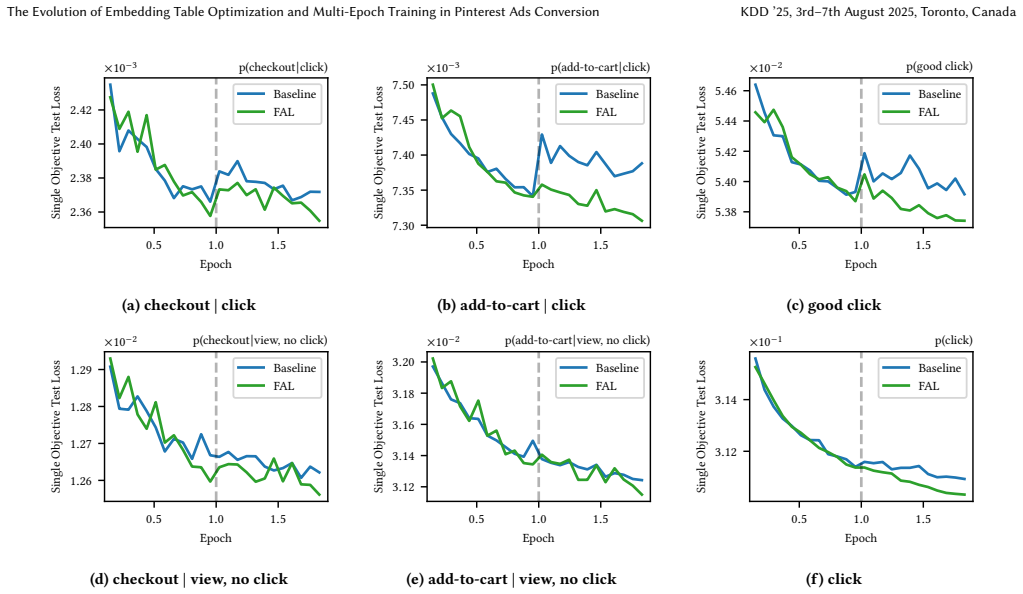
On its own terms, the paper discovers that multi-epoch overfitting in a multi-task conversion model is concentrated in low-frequency embedding rows, and that a row-wise learning-rate schedule can counteract it. FAL sets the learning rate of embedding row $i$ in table $T$ to $\eta^*_T \cdot \log(F_T[i]+1) / \max_j \log(F_T[j]+1)$, where $F_T[i]$ is the cumulative frequency of that row; the multiplier is applied to the row's gradient before the optimizer update. On the May-Aug 2024 training window, FAL shrinks the epoch-boundary loss jump for $p(\text{add-to-cart}|\text{click})$ from +1.19% to +0.23% and for $p(\text{checkout}|\text{click})$ from +0.75% to +0.65%, and ends batch training with lower loss than the 2-epoch baseline on those objectives. On a second, 25% larger Aug-Dec window, FAL matches embedding re-initialization (MEDA) on every objective except the sparsest, $p(\text{checkout}|\text{click})$, where MEDA ends 0.27% lower in loss; over continual training, FAL's cumulative AUC gains on $p(\text{checkout}|\text{click})$ are 0.07% and 0.20% on the two windows. The paper reads these results as showing both that FAL is a viable anti-overfitting tool and that, once fresh daily data is available, the plain 2-epoch baseline catches up, so solving multi-epoch overfitting may be unnecessary when overfitting is mild.
Load-bearing premise
The load-bearing premise is that the reported single-run differences in test-loss jumps and 0.07% to 0.20% cumulative AUC gains are real method effects rather than run-to-run noise, since the evaluation reports no repeated seeds, confidence intervals, or significance tests.
Editorial extensions
If this is right
- A per-row log-frequency learning-rate schedule is a cheap, drop-in mitigation for multi-epoch overfitting: one integer counter per embedding row, no change to the dense network or optimizer state.
- Overfitting severity in multi-task models is tied to label density: sparser objectives such as $p(\text{checkout}|\text{click})$ need stronger treatment, while dense heads like $p(\text{click})$ can be left on a plain schedule.
- The plain 2-epoch baseline catches up with FAL and MEDA after several days of continual training on fresh data, so in a batch-then-continual production setup anti-overfitting machinery is only needed when overfitting is severe or data is scarce.
- FAL keeps test loss approximately monotonically decreasing through the second epoch, which enables mid-epoch early stopping; MEDA's re-initialization creates a discontinuity that rules this out.
- A frequency-aware extension of MEDA or regularization, one that re-initializes or penalizes mainly frequent rows, could combine the strengths of both methods and address the sparsest objective where FAL is weakest.
Reading between the lines
- The FAL formula depends only on cumulative row exposure, so the same schedule could be applied to any embedding-based model, not just ads conversion; the paper demonstrates it on a single production architecture, so transferability is untested.
- Because the method treats log-frequency as a proxy for overfitting propensity, a natural extension is to replace it with a per-row uncertainty estimate or gradient-norm history; that might fix the sparsest objective, where FAL fails to beat the baseline.
- The paper's continual-learning result implies that end-of-batch loss is the wrong yardstick for judging multi-epoch fixes: an evaluator should report loss and AUC after several days of fresh-data training, where the differences between methods largely collapse.
- The interaction between the Sparse Optimizer's 50x embedding learning rate and FAL's down-scaling suggests a single frequency-dependent net learning-rate curve; sweeping the scaling exponent could find a schedule that beats MEDA even on $p(\text{checkout}|\text{click})$.
Signed reviews
Editorial analysis
A structured set of objections, weighed in public.
Referee Report
Summary. The paper reports industrial lessons from Pinterest Ads conversion models on two challenges: slow convergence of embedding tables due to gradient sparsity, and multi-epoch overfitting ('one-epoch phenomenon'). It proposes a Sparse Optimizer that applies a higher layer-specific learning rate to embedding tables, and a Frequency-Adaptive Learning Rate (FAL) that scales the learning rate of each embedding row by its relative log frequency. The authors evaluate both methods on two large production datasets (May–Aug 2024 and Aug–Dec 2024), comparing FAL against an embedding-re-initialization baseline (MEDA) and against 1-epoch and 2-epoch baselines. They report faster convergence, reduced test-loss jumps at epoch boundaries for most objectives, cumulative AUC gains of 0.07–0.20% during continual training, and a conclusion that multi-epoch overfitting mitigation may be unnecessary when fresh data is available.
Significance. If the empirical claims hold, the paper makes a useful contribution: FAL is a simple, near-parameter-free per-row learning-rate schedule that could cheaply mitigate multi-epoch overfitting, and the demonstration that overfitting severity tracks label density in a multi-task model is valuable for practitioners. The paper's strengths include its industrial scale (298M parameters, 60 embedding tables, two disjoint datasets), a direct comparison to an external baseline (MEDA), an implementation-ready algorithm, and an unusually honest discussion of when multi-epoch overfitting mitigation is unnecessary. However, the central empirical support is currently weak because all comparisons are based on single training runs with no confidence intervals or significance tests, on a metric the paper itself calls noisy. The promising ideas deserve publication, but only after the statistical support is strengthened or the claims are appropriately softened.
major comments (4)
- [§4.4, §5.2–5.3, Figures 5–9] The central empirical claims are supported only by single training runs per configuration. Section 4.4 states that 'AUC values can be very noisy,' yet Figures 5–9 report loss and cumulative AUC point estimates without confidence intervals, repeated seeds, or significance tests. The reported effects are small (loss increases reduced by 0.2–0.5 percentage points; cumulative AUC gains of 0.07–0.20%), and the sparsest objective, where noise is highest, is exactly where FAL fails to beat the baseline. Without a noise model—for example, bootstrap over days for the cumulative metric or repeated runs with different seeds—the observed differences cannot be attributed to the methods rather than to run-to-run variation. Please add repeated runs or at least a variance analysis over the daily evaluation points, and temper statements such as 'significantly higher' in Section 5.1.
- [§3.2, Table 1, Algorithm 1] FAL's log scaling is selected based on a single comparison reported in the first Table 1 ('Log Scaling (Control) 0.00%; Linear Scaling -0.13%'). This data-dependent choice is a design decision, not a fitted parameter, but it means the method's success relies on a hyperparameter selected on the same cumulative AUC metric with no repeated runs. Please include a small sensitivity analysis over the scaling form (e.g., log vs linear vs sqrt) and over the Sparse Optimizer multiplier (50x) used in Section 5.1, or explicitly present the log choice as a heuristic whose uncertainty is not quantified.
- [§5.1, Figure 4] The Sparse Optimizer's advantage over the retrained baseline is reported as a cumulative AUC gain of 0.10% and over the production model as 0.017%, with no significance test. The production comparison is additionally confounded by the production model having four extra months of continual training, which the authors interpret as a disadvantage for the Sparse Optimizer; that is not a controlled comparison. Please state whether these differences are within the day-to-day variability visible in Figure 4 and provide paired statistics or a different evaluation design if the 'significantly higher cumulative AUC' claim is to be maintained.
- [§4.4, Eq. (cumulative AUC gain)] The cumulative AUC gain is defined as the ratio of sums of daily AUCs, not as an average of per-day gains. This formula does not account for autocorrelation across days and gives no direct estimate of the variance of the cumulative gain; two methods whose daily AUCs differ by a small correlated shift will show a small aggregate difference that could be reproducible, while methods with large daily swings could appear similar. Report per-day differences with standard errors (or a bootstrap over days) and specify the number of evaluation days for each figure. This will also help interpret the 'gains vanish after continual training' conclusion in Section 5.4.
minor comments (6)
- [§3.2 and §4.1] The label 'Table 1' is used twice: once for the log-versus-linear scaling comparison in Section 3.2 and once for the label-density table in Section 4.1. Please renumber the tables.
- [§3.2] The text refers to 'FAD' once in the sentence 'and FAD, which punishes convergence speed'; this should be 'FAL'.
- [§5.2] The phrase 'the increase is insignificant' for the 0.13% total-loss jump is not supported by a statistical test and conflicts with the later use of 'significantly higher' in Section 5.1; make the use of 'significant' consistent with the evidence presented.
- [Figures 5 and 7] The x-axis is labeled 'Epoch' but the range is 0.2 to 1.8; clarify where the epoch boundary occurs and whether evaluation points are sampled within epochs or only at epoch boundaries.
- [Algorithm 1] Algorithm 1 accumulates frequencies over the entire training run, so in the second epoch the learning-rate scale reflects the first epoch's frequencies plus ongoing accumulation. Please clarify whether F_T is reset between epochs; if it is not reset, the schedule is history-dependent in a way that is not discussed.
- [References] Reference [3] is cited as an arXiv preprint; if a peer-reviewed version exists, update the citation to the published venue.
Circularity Check
No circularity: FAL and Sparse Optimizer are evaluated against external baselines, and no fitted parameter or self-cited result is repackaged as a prediction.
full rationale
The paper's central claims are empirical comparisons, not derivations from fitted inputs. The Sparse Optimizer is a layer-specific learning-rate multiplier (50x) whose effect is measured directly by training-loss curves and cumulative AUC against a retrained production baseline; the multiplier is a hand-tuned training configuration, not a parameter fitted to the evaluation metric and then presented as a prediction. FAL is defined by Equation (1), which contains no free constants: the per-row learning rate is the layer learning rate scaled by relative log frequency. This is a stated design choice, and the paper's evidence for it is a direct offline comparison against a 2-epoch baseline and against MEDA [3], an external method from the literature. The only data-dependent design decision is the choice of log scaling over linear scaling, supported by Table 1; this is model selection on a validation-style comparison, not the construction of a prediction from its own target. The paper also reports that gains vanish under continual training, which is a falsifiable and non-circular outcome. No load-bearing step reduces by definition to its inputs, and no self-citation chain is invoked to justify the approach. Accordingly, the paper is self-contained with respect to its empirical evaluation, and there is no significant circularity.
Assumptions & free parameters
free parameters (2)
- Embedding learning-rate multiplier for Sparse Optimizer =
50x the base Adam learning rate (base 0.00015)
- FAL scaling form =
log(1 + F_T[i]) / max_j log(1 + F_T[j])
assumptions (4)
- domain assumption Multi-epoch overfitting is caused by overfitting of infrequent rows in the embedding layer, followed by rapid adaptation of downstream layers.
- domain assumption Cumulative next-day AUC gain is a valid proxy for online conversion performance, with +0.1% AUC treated as meaningful.
- domain assumption Relative label sparsity across objectives, rather than some other confound, explains the differential multi-epoch overfitting.
- domain assumption Accumulated per-row frequencies over training are a good enough estimator of true frequencies for FAL.
Cite this review
Pith. "Pith review of The Evolution of Embedding Table Optimization and Multi-Epoch Training in Pinterest Ads Conversion." pith.science (2026). https://pith.science/paper/GK5NIK3T
@misc{pith2026250505605,
  author       = {Pith},
  title        = {Pith review of: The Evolution of Embedding Table Optimization and Multi-Epoch Training in Pinterest Ads Conversion},
  year         = {2026},
  howpublished = {\url{https://pith.science/paper/GK5NIK3T}},
  note         = {Machine review of arXiv:2505.05605}
}
read the original abstract
Deep learning for conversion prediction has found widespread applications in online advertising. These models have become more complex as they are trained to jointly predict multiple objectives such as click, add-to-cart, checkout and other conversion types. Additionally, the capacity and performance of these models can often be increased with the use of embedding tables that encode high cardinality categorical features such as advertiser, user, campaign, and product identifiers (IDs). These embedding tables can be pre-trained, but also learned end-to-end jointly with the model to directly optimize the model objectives. Training these large tables is challenging due to: gradient sparsity, the high cardinality of the categorical features, the non-uniform distribution of IDs and the very high label sparsity. These issues make training prone to both slow convergence and overfitting after the first epoch. Previous works addressed the multi-epoch overfitting issue by using: stronger feature hashing to reduce cardinality, filtering of low frequency IDs, regularization of the embedding tables, re-initialization of the embedding tables after each epoch, etc. Some of these techniques reduce overfitting at the expense of reduced model performance if used too aggressively. In this paper, we share key learnings from the development of embedding table optimization and multi-epoch training in Pinterest Ads Conversion models. We showcase how our Sparse Optimizer speeds up convergence, and how multi-epoch overfitting varies in severity between different objectives in a multi-task model depending on label sparsity. We propose a new approach to deal with multi-epoch overfitting: the use of a frequency-adaptive learning rate on the embedding tables and compare it to embedding re-initialization. We evaluate both methods offline using an industrial large-scale production dataset.
Figures


Figures from the paper (6 more)




Forward citations
Cited by 1 Pith paper
-
Decoupled Entity Representation Learning for Pinterest Ads Ranking
Pre-computed user and Pin embeddings from multi-tower models improve Pinterest ad ranking by small but statistically significant margins.
Reference graph
Works this paper leans on
-
[1]
Paul Covington, Jay Adams, and Emre Sargin. 2016. Deep neural networks for youtube recommendations. In Proceedings of the 10th ACM conference on recommender systems. 191–198
2016
-
[2]
John Duchi, Elad Hazan, and Yoram Singer. 2011. Adaptive Subgradient Methods for Online Learning and Stochastic Optimization. Journal of Machine Learning Research 12, 61 (2011), 2121–2159. http://jmlr.org/papers/v12/duchi11a.html
work page 2011
-
[3]
Zhongxiang Fan, Zhaocheng Liu, Jian Liang, Dongying Kong, Han Li, Peng Jiang, Shuang Li, and Kun Gai. 2024. Multi-Epoch learning with Data Augmentation for Deep Click-Through Rate Prediction. arXiv preprint arXiv:2407.01607 (2024)
arXiv 2024
-
[4]
Jingyue Gao, Shuguang Han, Han Zhu, Siran Yang, Yuning Jiang, Jian Xu, and Bo Zheng. 2023. Rec4Ad: A Free Lunch to Mitigate Sample Selection Bias for Ads CTR Prediction in Taobao. In Proceedings of the 32nd ACM International Conference on Information and Knowledge Management . 4574–4580
work page 2023
-
[5]
Mihajlo Grbovic and Haibin Cheng. 2018. Real-time personalization using em- beddings for search ranking at airbnb. In Proceedings of the 24th ACM SIGKDD international conference on knowledge discovery & data mining . 311–320
2018
-
[7]
Xingzhuo Guo, Junwei Pan, Ximei Wang, Baixu Chen, Jie Jiang, and Mingsheng Long. 2024. On the Embedding Collapse when Scaling up Recommendation Models. arXiv:2310.04400 [cs.LG] https://arxiv.org/abs/2310.04400
arXiv 2024
-
[8]
Yi-Ping Hsu, Po-Wei Wang, Chantat Eksombatchai, and Jiajing Xu. 2024. Taming the One-Epoch Phenomenon in Online Recommendation System by Two-stage Contrastive ID Pre-training. In Proceedings of the 18th ACM Conference on Rec- ommender Systems. 838–840
2024
-
[9]
Diederik P. Kingma and Jimmy Ba. 2017. Adam: A Method for Stochastic Opti- mization. arXiv:1412.6980 [cs.LG] https://arxiv.org/abs/1412.6980 The Evolution of Embedding Table Optimization and Multi-Epoch Training in Pinterest Ads Conversion KDD ’25, 3rd–7th August 2025, Toronto, Canada 0.0 2.5 5.0 7.5 10.0 12.5 15.0 Days of continual training −0.1 0.0 0.1 ...
arXiv 2017
Show all 34 references
-
[10]
Yan Li, Dhruv Choudhary, Xiaohan Wei, Baichuan Yuan, Bhargav Bhushanam, Tuo Zhao, and Guanghui Lan. 2021. Frequency-aware SGD for Efficient Em- bedding Learning with Provable Benefits. arXiv:2110.04844 [cs.LG] https: //arxiv.org/abs/2110.04844
2021 arXiv
-
[11]
Zhutian Lin, Junwei Pan, Haibin Yu, Xi Xiao, Ximei Wang, Zhixiang Feng, Shifeng Wen, Shudong Huang, Lei Xiao, and Jie Jiang. 2024. Disentangled Representation with Cross Experts Covariance Loss for Multi-Domain Recommendation. arXiv preprint arXiv:2405.12706 (2024)
2024 arXiv
-
[12]
Qinyi Luo, Penghan Wang, Wei Zhang, Fan Lai, Jiachen Mao, Xiaohan Wei, Jun Song, Wei-Yu Tsai, Shuai Yang, Yuxi Hu, and Xuehai Qian. 2024. Fine-Grained Embedding Dimension Optimization During Training for Recommender Systems. arXiv:2401.04408 [cs.IR] https://arxiv.org/abs/2401.04408
2024 arXiv
-
[13]
Kelong Mao, Jieming Zhu, Liangcai Su, Guohao Cai, Yuru Li, and Zhenhua Dong
-
[14]
Junwei Pan, Wei Xue, Ximei Wang, Haibin Yu, Xun Liu, Shijie Quan, Xueming Qiu, Dapeng Liu, Lei Xiao, and Jie Jiang. 2024. Ads recommendation in a collapsed and entangled world. In Proceedings of the 30th ACM SIGKDD Conference on Knowledge Discovery and Data Mining . 5566–5577
2024
-
[15]
Vardan Papyan, X. Y. Han, and David L. Donoho. 2020. Prevalence of neural collapse during the terminal phase of deep learning training. Proceedings of the National Academy of Sciences 117, 40 (Sept. 2020), 24652–24663. https://doi.org/ 10.1073/pnas.2015509117
2020 doi
-
[16]
Hao-Jun Michael Shi, Dheevatsa Mudigere, Maxim Naumov, and Jiyan Yang. 2020. Compositional embeddings using complementary partitions for memory-efficient recommendation systems. In Proceedings of the 26th ACM SIGKDD International Conference on Knowledge Discovery & Data Mining...
2020
-
[17]
Weiping Song, Chence Shi, Zhiping Xiao, Zhijian Duan, Yewen Xu, Ming Zhang, and Jian Tang. 2019. Autoint: Automatic feature interaction learning via self- attentive neural networks. InProceedings of the 28th ACM international conference on information and knowledge management ...
2019
-
[18]
Tom Tirer and Joan Bruna. 2022. Extended Unconstrained Features Model for Exploring Deep Neural Collapse. arXiv:2202.08087 [cs.LG] https://arxiv.org/abs/ 2202.08087
2022 arXiv
-
[19]
Dan Tito Svenstrup, Jonas Hansen, and Ole Winther. 2017. Hash embeddings for efficient word representations. Advances in neural information processing systems 30 (2017)
2017
-
[20]
A Vaswani. 2017. Attention is all you need. Advances in Neural Information Processing Systems (2017)
2017
-
[21]
Ruoxi Wang, Rakesh Shivanna, Derek Cheng, Sagar Jain, Dong Lin, Lichan Hong, and Ed Chi. 2021. Dcn v2: Improved deep & cross network and practical lessons for web-scale learning to rank systems. In Proceedings of the web conference 2021 . 1785–1797
2021
-
[22]
Yuhao Wang, Ha Tsz Lam, Yi Wong, Ziru Liu, Xiangyu Zhao, Yichao Wang, Bo Chen, Huifeng Guo, and Ruiming Tang. 2023. Multi-Task Deep Recommender Systems: A Survey. arXiv:2302.03525 [cs.IR] https://arxiv.org/abs/2302.03525
2023 arXiv
-
[23]
Zhiqiang Wang, Qingyun She, and Junlin Zhang. 2021. Masknet: Introducing feature-wise multiplication to CTR ranking models by instance-guided mask. arXiv preprint arXiv:2102.07619 (2021)
2021 arXiv
-
[24]
Kilian Weinberger, Anirban Dasgupta, John Langford, Alex Smola, and Josh Attenberg. 2009. Feature hashing for large scale multitask learning. InProceedings of the 26th annual international conference on machine learning . 1113–1120
2009
-
[25]
Xiaoxiao Xu, Chen Yang, Qian Yu, Zhiwei Fang, Jiaxing Wang, Chaosheng Fan, Yang He, Changping Peng, Zhangang Lin, and Jingping Shao. 2022. Alleviating cold-start problem in CTR prediction with a variational embedding learning framework. In Proceedings of the ACM Web Conference...
2022
-
[26]
Bencheng Yan, Pengjie Wang, Jinquan Liu, Wei Lin, Kuang-Chih Lee, Jian Xu, and Bo Zheng. 2021. Binary code based hash embedding for web-scale applications. In Proceedings of the 30th ACM International Conference on Information & Knowledge Management. 3563–3567
2021
-
[27]
Buyun Zhang, Liang Luo, Xi Liu, Jay Li, Zeliang Chen, Weilin Zhang, Xiaohan Wei, Yuchen Hao, Michael Tsang, Wenjun Wang, Yang Liu, Huayu Li, Yasmine Badr, Jongsoo Park, Jiyan Yang, Dheevatsa Mudigere, and Ellie Wen. 2022. DHEN: A Deep and Hierarchical Ensemble Network for Larg...
2022 arXiv
-
[28]
Caojin Zhang, Yicun Liu, Yuanpu Xie, Sofia Ira Ktena, Alykhan Tejani, Akshay Gupta, Pranay Kumar Myana, Deepak Dilipkumar, Suvadip Paul, Ikuhiro Ihara, et al. 2020. Model size reduction using frequency based double hashing for recommender systems. InProceedings of the 14th ACM...
2020
-
[29]
Pengtao Zhang, Zheng Zheng, and Junlin Zhang. 2023. FiBiNet++: Reducing model size by low rank feature interaction layer for CTR prediction. In Proceed- ings of the 32nd ACM International Conference on Information and Knowledge Management. 4425–4429
2023
-
[30]
Weinan Zhang, Jiarui Qin, Wei Guo, Ruiming Tang, and Xiuqiang He. 2021. Deep learning for click-through rate estimation.arXiv preprint arXiv:2104.10584 (2021)
2021 arXiv
-
[31]
Yuan Zhang, Fei Sun, Xiaoyong Yang, Chen Xu, Wenwu Ou, and Yan Zhang. 2020. Graph-based regularization on embedding layers for recommendation. ACM Transactions on Information Systems (TOIS) 39, 1 (2020), 1–27
2020
-
[32]
Zhao-Yu Zhang, Xiang-Rong Sheng, Yujing Zhang, Biye Jiang, Shuguang Han, Hongbo Deng, and Bo Zheng. 2022. Towards understanding the overfitting phenomenon of deep click-through rate models. In Proceedings of the 31st ACM international conference on information & knowledge mana...
2022
-
[33]
Kui Zhao, Yuechuan Li, Zhaoqian Shuai, and Cheng Yang. 2018. Learning and transferring ids representation in e-commerce. In Proceedings of the 24th ACM SIGKDD International Conference on Knowledge Discovery & Data Mining . 1031– 1039
2018
-
[34]
Guorui Zhou, Xiaoqiang Zhu, Chenru Song, Ying Fan, Han Zhu, Xiao Ma, Yanghui Yan, Junqi Jin, Han Li, and Kun Gai. 2018. Deep interest network for click-through rate prediction. In Proceedings of the 24th ACM SIGKDD international conference on knowledge discovery & data mining ...
2018
-
[2023]
In Proceedings of the AAAI Conference on Artificial Intelligence , Vol
FinalMLP: an enhanced two-stream MLP model for CTR prediction. In Proceedings of the AAAI Conference on Artificial Intelligence , Vol. 37. 4552–4560
Reviewed August 15, 2026 · model on record in the stance chip above.
Discussion (0). Continue with ORCID to comment.