REVIEW 3 major objections 6 minor 44 references
No Train Yet Gain: Towards Generic Multi-Object Tracking in Sports and Beyond
T0 review · 3 major / 6 minor · reviewed 2026-08-07 · deepseek-v4-flash
Pith's one-line read The paper claims that a segmentation mask propagated across frames, gated by four conditions and fused into the IoU cost matrix, makes multi-object tracking generalizable across sports and pedestrian scenes without per-video tuning.
desk verdict Solid modular contribution: a gated, temporally propagated mask cue that improves tracking-by-detection across four benchmarks; the main gaps are a missing sensitivity sweep and an overbroad abstract claim. read the letter →
The pith
A machine-rendered reading of the paper's core claim, the machinery that carries it, and where it could break.
The reading
What carries the argument
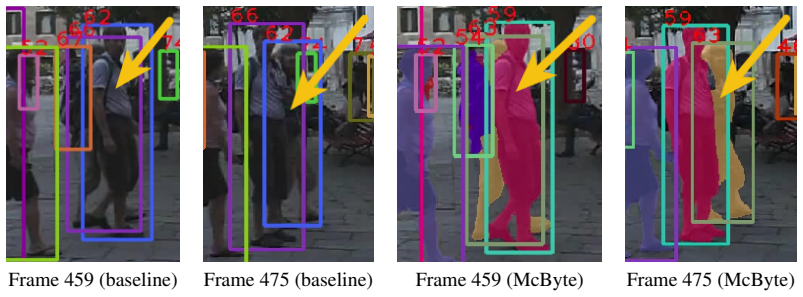
The load-bearing object is the temporally propagated segmentation mask used as an association cue, with the update rule of Eq. (3): for each tracklet-detection pair, the final cost is the IoU-based cost minus $m_f$ when all four gating conditions hold, and the IoU cost otherwise. Here $m_f = |\text{mask} \cap \text{bbox}| / |\text{bbox}|$ is the fraction of the detection bounding box filled by the tracklet's propagated mask, and $m_c = |\text{mask} \cap \text{bbox}| / |\text{mask}|$ is the fraction of the mask that lies inside the box; $m_c$ is used only as a gate because several masks could fully fit in one box, while $m_f$ directly rewards a mask that explains the detection. The four conditions are mask visibility, average mask confidence above 0.6, $m_f$ above 0.05, and $m_c$ above 0.9, applied only in the two situations where IoU alone is unreliable: ambiguity (several similar low costs) and isolation (all costs too high). The mask is therefore never allowed to override the bounding-box pipeline; it can only break ties or bridge gaps that IoU leaves ambiguous.
What would settle it
One concrete test: run McByte with its fixed thresholds on a held-out sports dataset while swapping a fraction of propagated masks between nearby players, and compare HOTA and IDF1 with the uncorrupted run. A second check sweeps the $m_f$ and $m_c$ thresholds: sharp performance swings over a small range around 0.05 and 0.9 would show the claimed insensitivity is false.
Extended reading notes
Core claim
The paper's central discovery is that a temporally propagated segmentation mask, carried alongside each tracklet and matched against current detections through two pixel-ratio statistics, supplies information that IoU alone lacks under occlusion and blur. The tracker assigns each tracklet a mask, initialized with SAM and updated each frame by Cutie; whenever a tracklet-detection pair is ambiguous (several low IoU costs compete) or isolated (the IoU cost is too high to match), the mask may lower the entry in the cost matrix by the mask fill ratio $m_f$, but only if four conditions hold: the mask is present, its average pixel confidence is above threshold, $m_f$ exceeds a small floor, and the mask is mostly inside the bounding box ($m_c$ above threshold). McByte then runs the usual Hungarian assignment. The authors report that this regulated fusion lifts HOTA and IDF1 on four diverse person-tracking datasets, including sports scenes with frequent occlusions and camera shake, and requires no training and no per-sequence parameter tuning beyond fixed thresholds.
Load-bearing premise
The claim stands on the assumption that the four fixed gating thresholds keep erroneous propagated masks from corrupting the cost matrix; if the mask propagator returns a confident but wrong mask during an occlusion, or the thresholds require per-dataset adjustment, the reported gains would shrink or reverse.
Editorial extensions
If this is right
- Tracking-by-detection can become tuning-free: the fixed thresholds (0.6 confidence, $m_f > 0.05$, $m_c > 0.9$) transfer across four datasets without per-sequence adjustment.
- Occlusions and camera-shake blur, the main failure modes for IoU association, are exactly where the propagated mask helps, so sports settings benefit most.
- Because McByte inherits standard tracklet management and Hungarian matching, the mask-based cue can be added to existing trackers without retraining.
- On MOT17 the same fixed settings stay competitive with per-sequence-tuned trackers, so the method generalizes beyond sports to ordinary pedestrian scenes.
Reading between the lines
- If the fixed thresholds truly transfer, the mask cue should also help on new sports such as hockey or rugby, and on dense crowd footage, without any retuning; a quick test would be running McByte with its default thresholds on an unseen benchmark.
- The method's 3-5 FPS speed indicates a practical direction: distilling the mask propagator or propagating masks less frequently, which the paper itself flags as future optimization.
- Because the cue is orthogonal to appearance and motion models, combining it with re-identification or learned motion could compound gains beyond what IoU-plus-mask achieves alone.
- A failure mode the paper does not explore is mask drift onto a neighboring player with a similar jersey; an adversarial stress test that deliberately swaps masks between nearby players would show whether the gates actually filter such errors.
Editorial analysis
A structured set of objections, weighed in public.
Referee Report
Summary. The paper proposes McByte, a tracking-by-detection framework that augments a ByteTrack-style baseline with temporally propagated segmentation masks, using SAM for mask initialization and Cutie for propagation. The mask signal is applied to the IoU cost matrix only under conditions of association ambiguity or isolation, and only when four gating checks pass: mask visibility, average mask confidence, a minimum mask fill ratio (mf), and a minimum bounding-box coverage (mc). The authors fix all thresholds across sequences and datasets, avoiding per-video tuning. They evaluate on SportsMOT, DanceTrack, SoccerNet-tracking 2022, and MOT17, reporting consistent gains over the baseline on all four datasets and strong HOTA/IDF1 results relative to other tracking-by-detection methods. The paper also contains an ablation on DanceTrack isolating each gating condition, comparisons with mask-based trackers, and additional experiments in the appendix.
Significance. If the results hold, this is a useful empirical contribution: it shows that a pre-trained video-object-segmentation model can serve as a training-free association cue that improves MOT robustness in challenging sports settings. The paper's strengths are its systematic ablation (Table 1, variants a1 through a6), the use of held-out test sets for the main comparisons, fixed hyperparameters across four datasets, and fair detector usage with other methods. The HOTA/IDF1 gains on DanceTrack and SoccerNet are large, and the comparison with other mask-based methods using the same YOLOX detector is informative. However, the central no-per-video-tuning claim rests on two unverified points: that the fixed thresholds are insensitive to reasonable perturbations, and that the four gating conditions actually block corrupted propagated masks from altering the association. The paper asserts both but does not measure either directly. These gaps are fixable and do not undermine the basic observation that the mask cue helps, so the contribution is meaningfully positive.
major comments (3)
- [Section 4.1] The claim that 'changing these parameters around these values does not affect much performance of McByte' is asserted without evidence. The fixed thresholds (detection confidence 0.6, mask confidence 0.6, mc 0.9, mf 0.05) are load-bearing for the central no-per-video-tuning claim. Please add a sensitivity sweep on at least DanceTrack and SportsMOT validation sets, varying each threshold independently (for example, mask confidence in {0.4, 0.5, 0.6, 0.7, 0.8}, mc in {0.7, 0.8, 0.9, 0.95}, mf in {0.0, 0.05, 0.1, 0.2}) and reporting HOTA, IDF1, and MOTA. If the gains are stable, the fixed-threshold claim is supported; if not, the robustness claim needs to be revised or scoped.
- [Section 3.3 / Eq. (3)] The four gating conditions are presented as sufficient to ensure that the mask cue is applied only when reliable, but the paper never measures how often a gated mask update selects the correct association. The mf threshold of 0.05 is especially permissive: a confident but wrong mask leaked onto a nearby, similar-looking player will typically satisfy visibility, confidence, and mc >= 0.9, and can satisfy mf >= 0.05 whenever it covers even a small part of the detection box. The ablation in Table 1 shows that each gate helps on DanceTrack, which is real evidence, but it does not quantify the correctness of the gated updates. Please add a diagnostic on a validation set reporting, for all entries modified by Eq. (3), the fraction of times the mask-modified cost changes the Hungarian assignment and the accuracy of those changes relative to ground-truth identity. Without this, the central mechanism that justifies the robustness gain remains an unverified sufficiency condition.
- [Section 1 / Section 4.4] The introduction states that 'Our method outperforms tracking-by-detection algorithms on SportsMOT, DanceTrack, SoccerNet-tracking 2022 and MOT17.' This is not supported by the tables when all metrics are considered: on SoccerNet-tracking 2022 (Table 5), OC-SORT has higher MOTA (98.3 vs 96.8), and on MOT17 (Table 6), GeneralTrack has higher MOTA (80.6 vs 80.2). The more careful statement in Section 4.4, which scopes the claim to HOTA and IDF1 and notes second-best MOTA, is accurate and should be used in the introduction as well. Similarly, the sentence 'Among non-tuned trackers, McByte achieves the best scores' should be qualified because GeneralTrack has higher MOTA on MOT17.
minor comments (6)
- [Title] The title 'No Train Y et Gain' appears to contain a typo; it should read 'No Train Yet Gain'.
- [Section 4.3] There is a typo in the phrase 'substantial occlussions'; it should be 'occlusions'.
- [Table 1] The header 'basline' should be 'baseline'.
- [Figure 2] The label 'Mask-enahnced matching' contains a typo; it should be 'Mask-enhanced matching'.
- [Section 1] The phrase 'i.e. it is not parametric' overstates the property: the method uses fixed thresholds and is better described as 'not requiring per-video tuning' rather than 'not parametric'.
- [Section 4.2] The sentence 'MOTA, which primarily evaluates detection quality' would be more precise as 'MOTA, which is dominated by detection quality but also penalizes identity switches'.
Circularity Check
No significant circularity: McByte's gain is an externally evaluated empirical result, with no equation or fitted parameter reducing the prediction to its inputs.
full rationale
McByte's central claim is that a temporally propagated mask, gated by visibility, confidence, mc, and mf, improves association without per-video tuning. This is tested on SportsMOT, DanceTrack, SoccerNet-tracking 2022, and MOT17 using fixed thresholds and no per-sequence tuning. Equation (3) defines how the mask cue modifies the IoU cost, but the reported metrics (HOTA, IDF1, MOTA) are computed from predicted trajectories against ground truth, not from the mask cue itself. The mask is an independent input (SAM-initialized, Cutie-propagated), and the ablation in Table 1 shows incremental gains as gates are added, which is empirical evidence rather than a definitional identity. No load-bearing step relies on the present authors' prior work; citations to ByteTrack, Cutie, SAM, and other baselines are external and are evaluated on public benchmarks. The unsupported assertion in Sec. 4.1 that the thresholds are insensitive is a robustness/correctness concern, not circularity, because no threshold was fitted to the target metric in a way that makes the result hold by construction. The paper is self-contained against external benchmarks, so the appropriate circularity score is 0.
Assumptions & free parameters
free parameters (5)
- high-confidence detection threshold =
0.6
- mask confidence threshold =
0.6
- minimum mask fill ratio (mf) =
0.05
- minimum bounding box coverage (mc) =
0.9
- IoU association threshold =
not reported
assumptions (5)
- domain assumption The pre-trained models (YOLOX detector, SAM, Cutie) transfer to the target datasets without fine-tuning.
- domain assumption Cutie's propagated masks preserve the identity of a specific tracklet across occlusions and camera motion.
- ad hoc to paper The four gating conditions and their thresholds are sufficient to prevent erroneous masks from corrupting the cost matrix.
- standard math A linear Kalman filter is an adequate motion predictor for the tracklet state in these datasets.
- standard math Hungarian matching on the final cost matrix yields a globally optimal assignment.
Cite this review
Pith. "Pith review of No Train Yet Gain: Towards Generic Multi-Object Tracking in Sports and Beyond." pith.science (2026). https://pith.science/paper/GKIGQ6SB
@misc{pith2026250601373,
  author       = {Pith},
  title        = {Pith review of: No Train Yet Gain: Towards Generic Multi-Object Tracking in Sports and Beyond},
  year         = {2026},
  howpublished = {\url{https://pith.science/paper/GKIGQ6SB}},
  note         = {Machine review of arXiv:2506.01373}
}
read the original abstract
Multi-object tracking (MOT) is essential for sports analytics, enabling performance evaluation and tactical insights. However, tracking in sports is challenging due to fast movements, occlusions, and camera shifts. Traditional tracking-by-detection methods require extensive tuning, while segmentation-based approaches struggle with track processing. We propose McByte, a tracking-by-detection framework that integrates temporally propagated segmentation mask as an association cue to improve robustness without per-video tuning. Unlike many existing methods, McByte does not require training, relying solely on pre-trained models and object detectors commonly used in the community. Evaluated on SportsMOT, DanceTrack, SoccerNet-tracking 2022 and MOT17, McByte demonstrates strong performance across sports and general pedestrian tracking. Our results highlight the benefits of mask propagation for a more adaptable and generalizable MOT approach. Code will be made available at https://github.com/tstanczyk95/McByte.
Figures


Figures from the paper (6 more)



Reference graph
Works this paper leans on
-
[1]
R.C. Atkinson and R.M. Shiffrin. Human memory: A pro- posed system and its control processes. pages 89–195. Aca- demic Press, 1968. 2
work page 1968
-
[2]
Evaluating mul- tiple object tracking performance: The clear mot metrics
Keni Bernardin and Rainer Stiefelhagen. Evaluating mul- tiple object tracking performance: The clear mot metrics. EURASIP Journal on Image and Video Processing, 2008,
2008
-
[3]
Vision transformer adapters for generalizable multi- task learning, 2023
Deblina Bhattacharjee, Sabine S ¨usstrunk, and Mathieu Salz- mann. Vision transformer adapters for generalizable multi- task learning, 2023. 3
work page 2023
-
[4]
Observation-centric sort: Rethink- ing sort for robust multi-object tracking
Jinkun Cao, Jiangmiao Pang, Xinshuo Weng, Rawal Khi- rodkar, and Kris Kitani. Observation-centric sort: Rethink- ing sort for robust multi-object tracking. InProceedings of the IEEE/CVF Conference on Computer Vision and Pattern Recognition (CVPR), pages 9686–9696, 2023. 1, 2, 3, 7, 8, 12, 13
work page 2023
-
[5]
Uni- fying short and long-term tracking with graph hierarchies
Orcun Cetintas, Guillem Bras ´o, and Laura Leal-Taix´e. Uni- fying short and long-term tracking with graph hierarchies. In Proceedings of the IEEE/CVF Conference on Computer Vi- sion and Pattern Recognition (CVPR), pages 22877–22887,
-
[6]
Ho Kei Cheng and Alexander G. Schwing. XMem: Long- term video object segmentation with an atkinson-shiffrin memory model. InProceedings of the European Conference on Computer Vision (ECCV), 2022. 2, 3, 4
work page 2022
-
[7]
Tracking anything with decoupled video segmentation
Ho Kei Cheng, Seoung Wug Oh, Brian Price, Alexan- der Schwing, and Joon-Young Lee. Tracking anything with decoupled video segmentation. InProceedings of the IEEE/CVF International Conference on Computer Vision (ICCV), 2023. 1, 3, 8, 11, 12
work page 2023
-
[8]
Putting the object back into video object segmentation
Ho Kei Cheng, Seoung Wug Oh, Brian Price, Joon-Young Lee, and Alexander Schwing. Putting the object back into video object segmentation. InProceedings of the IEEE/CVF Conference on Computer Vision and Pattern Recognition (CVPR), 2024. 2, 3, 4, 5
work page 2024
Show all 44 references
-
[9]
Soccernet-tracking: Multiple object tracking dataset and benchmark in soccer videos
Anthony Cioppa, Silvio Giancola, Adrien Deliege, Le Kang, Xin Zhou, Zhiyu Cheng, Bernard Ghanem, and Marc Van Droogenbroeck. Soccernet-tracking: Multiple object tracking dataset and benchmark in soccer videos. InPro- ceedings of the IEEE/CVF Conference on Computer Vision and P...
2022
-
[10]
Sportsmot: A large multi- object tracking dataset in multiple sports scenes.Proceed- ings of the IEEE/CVF International Conference on Com- puter Vision (ICCV), 2023
Yutao Cui, Chenkai Zeng, Xiaoyu Zhao, Yichun Yang, Gangshan Wu, and Limin Wang. Sportsmot: A large multi- object tracking dataset in multiple sports scenes.Proceed- ings of the IEEE/CVF International Conference on Com- puter Vision (ICCV), 2023. 1, 2, 5, 7, 8, 11, 12, 13, 14, 15
2023
-
[11]
Motchal- lenge: A benchmark for single-camera multiple target track- ing.International Journal of Computer Vision, 129:1–37,
Patrick Dendorfer, Aljossa Ossep, Anton Milan, Daniel Cre- mers, Ian Reid, Stefan Roth, and Laura Leal-Taixe. Motchal- lenge: A benchmark for single-camera multiple target track- ing.International Journal of Computer Vision, 129:1–37,
-
[12]
Giaotracker: A compre- hensive framework for mcmot with global information and optimizing strategies in visdrone 2021
Yunhao Du, Junfeng Wan, Yanyun Zhao, Binyu Zhang, Zhi- hang Tong, and Junhao Dong. Giaotracker: A compre- hensive framework for mcmot with global information and optimizing strategies in visdrone 2021. InProceedings of the IEEE/CVF International Conference on Computer Vision (...
2021
-
[13]
Strongsort: Make deep- sort great again.IEEE Transactions on Multimedia, 2023
Yunhao Du, Zhicheng Zhao, Yang Song, Yanyun Zhao, Fei Su, Tao Gong, and Hongying Meng. Strongsort: Make deep- sort great again.IEEE Transactions on Multimedia, 2023. 1, 2, 3, 5, 7, 8, 13
2023
-
[14]
MeMOTR: Long-term memory-augmented transformer for multi-object tracking
Ruopeng Gao and Limin Wang. MeMOTR: Long-term memory-augmented transformer for multi-object tracking. In Proceedings of the IEEE/CVF International Conference on Computer Vision (ICCV), pages 9901–9910, 2023. 2, 8, 12, 13
2023
-
[15]
Multiple ob- ject tracking as id prediction, 2024
Ruopeng Gao, Yijun Zhang, and Limin Wang. Multiple ob- ject tracking as id prediction, 2024. 2, 8, 12, 13
2024
-
[16]
Yolox: Exceeding yolo series in 2021.arXiv preprint arXiv:2107.08430, 2021
Zheng Ge, Songtao Liu, Feng Wang, Zeming Li, and Jian Sun. Yolox: Exceeding yolo series in 2021.arXiv preprint arXiv:2107.08430, 2021. 2, 5, 8, 11
2021 arXiv
-
[17]
Deep Residual Learning for Image Recognition
Kaiming He, Xiangyu Zhang, Shaoqing Ren, and Jian Sun. Deep Residual Learning for Image Recognition. InProceed- ings of 2016 IEEE Conference on Computer Vision and Pat- tern Recognition, pages 770–778. IEEE, 2016. 11
2016
-
[18]
Parameter-efficient transfer learning for NLP
Neil Houlsby, Andrei Giurgiu, Stanislaw Jastrzebski, Bruna Morrone, Quentin De Laroussilhe, Andrea Gesmundo, Mona Attariyan, and Sylvain Gelly. Parameter-efficient transfer learning for NLP. InProceedings of the 36th International Conference on Machine Learning, pages 2790–2799. PMLR,
-
[19]
R. E. Kalman. A New Approach to Linear Filtering and Pre- diction Problems.Journal of Basic Engineering, 82(1):35– 45, 1960. 1, 2, 3, 5
1960
-
[20]
Berg, Wan-Yen Lo, Piotr Doll ´ar, and Ross Girshick
Alexander Kirillov, Eric Mintun, Nikhila Ravi, Hanzi Mao, Chloe Rolland, Laura Gustafson, Tete Xiao, Spencer White- head, Alexander C. Berg, Wan-Yen Lo, Piotr Doll ´ar, and Ross Girshick. Segment anything.Proceedings of the IEEE/CVF International Conference on Computer Vision ...
2023
-
[21]
H. W. Kuhn. The hungarian method for the assignment problem.Naval Research Logistics Quarterly, 2(1-2):83–97,
-
[22]
Matching anything by segmenting anything.CVPR, 2024
Siyuan Li, Lei Ke, Martin Danelljan, Luigi Piccinelli, Mattia Segu, Luc Van Gool, and Fisher Yu. Matching anything by segmenting anything.CVPR, 2024. 3, 8, 11, 12
2024
-
[23]
Belongie, Lubomir D
Tsung-Yi Lin, Michael Maire, Serge J. Belongie, Lubomir D. Bourdev, Ross B. Girshick, James Hays, Pietro Perona, Deva Ramanan, Piotr Doll´ar, and C. Lawrence Zitnick. Microsoft coco: Common objects in context.CoRR, abs/1405.0312,
-
[24]
Grounding dino: Marrying dino with grounded pre-training for open-set object detection.arXiv preprint arXiv:2303.05499, 2023
Shilong Liu, Zhaoyang Zeng, Tianhe Ren, Feng Li, Hao Zhang, Jie Yang, Chunyuan Li, Jianwei Yang, Hang Su, Jun Zhu, et al. Grounding dino: Marrying dino with grounded pre-training for open-set object detection.arXiv preprint arXiv:2303.05499, 2023. 3, 8, 11, 12
2023 arXiv
-
[25]
Swin transformer: Hierarchical vision transformer using shifted windows
Ze Liu, Yutong Lin, Yue Cao, Han Hu, Yixuan Wei, Zheng Zhang, Stephen Lin, and Baining Guo. Swin transformer: Hierarchical vision transformer using shifted windows. In Proceedings of the IEEE/CVF International Conference on Computer Vision (ICCV), 2021. 11
2021
-
[26]
Hota: A higher order metric for evaluating multi-object tracking.International Journal of Computer Vision, pages 1–31, 2020
Jonathon Luiten, Aljosa Osep, Patrick Dendorfer, Philip Torr, Andreas Geiger, Laura Leal-Taix´e, and Bastian Leibe. Hota: A higher order metric for evaluating multi-object tracking.International Journal of Computer Vision, pages 1–31, 2020. 6
2020
-
[27]
Diffmot: A real-time diffusion-based multiple object tracker with non-linear prediction
Weiyi Lv, Yuhang Huang, Ning Zhang, Ruei-Sung Lin, Mei Han, and Dan Zeng. Diffmot: A real-time diffusion-based multiple object tracker with non-linear prediction. InPro- ceedings of the IEEE/CVF Conference on Computer Vision and Pattern Recognition, pages 19321–19330, 2024. 7, 12, 13
2024
-
[28]
Deep oc-sort: Multi-pedestrian tracking by adaptive re-identification.arXiv preprint arXiv:2302.11813, 2023
Gerard Maggiolino, Adnan Ahmad, Jinkun Cao, and Kris Kitani. Deep oc-sort: Multi-pedestrian tracking by adaptive re-identification.arXiv preprint arXiv:2302.11813, 2023. 1, 2, 3, 5, 7, 8, 13
2023 arXiv
-
[29]
Milan, L
A. Milan, L. Leal-Taix ´e, I. Reid, S. Roth, and K. Schindler. MOT16: A benchmark for multi-object tracking. arXiv:1603.00831 [cs], 2016. arXiv: 1603.00831. 2, 5, 7, 8, 11, 12, 13, 14, 16
2016 arXiv
-
[30]
Towards generalizable multi-object track- ing
Zheng Qin, Le Wang, Sanping Zhou, Panpan Fu, Gang Hua, and Wei Tang. Towards generalizable multi-object track- ing. InProceedings of the IEEE/CVF Conference on Com- puter Vision and Pattern Recognition (CVPR), pages 18995– 19004, 2024. 7, 12, 13
2024
-
[31]
Sam 2: Segment anything in images and videos
Nikhila Ravi, Valentin Gabeur, Yuan-Ting Hu, Ronghang Hu, Chaitanya Ryali, Tengyu Ma, Haitham Khedr, Roman R¨adle, Chloe Rolland, Laura Gustafson, Eric Mintun, Junt- ing Pan, Kalyan Vasudev Alwala, Nicolas Carion, Chao- Yuan Wu, Ross Girshick, Piotr Doll´ar, and Christoph Feic...
2024 arXiv
-
[32]
Performance measures and a data set for multi-target, multi-camera tracking
Ergys Ristani, Francesco Solera, Roger Zou, Rita Cucchiara, and Carlo Tomasi. Performance measures and a data set for multi-target, multi-camera tracking. InComputer Vi- sion – ECCV 2016 Workshops, pages 17–35, Cham, 2016. Springer International Publishing. 6
2016
-
[33]
Orb: an efficient alternative to sift or surf
Ethan Rublee, Vincent Rabaud, Kurt Konolige, and Gary Bradski. Orb: an efficient alternative to sift or surf. pages 2564–2571, 2011. 5
2011
-
[34]
Dancetrack: Multi-object track- ing in uniform appearance and diverse motion.Proceedings of the IEEE/CVF Conference on Computer Vision and Pat- tern Recognition (CVPR), 2021
Peize Sun, Jinkun Cao, Yi Jiang, Zehuan Yuan, Song Bai, Kris Kitani, and Ping Luo. Dancetrack: Multi-object track- ing in uniform appearance and diverse motion.Proceedings of the IEEE/CVF Conference on Computer Vision and Pat- tern Recognition (CVPR), 2021. 2, 5, 7, 8, 11, 12, 13, 14
2021
-
[35]
The second-place solution for cvpr 2022 soccernet tracking challenge.arXiv preprint arXiv:2211.13481, 2022
Fan Yang, Shigeyuki Odashima, Shoichi Masui, and Shan Jiang. The second-place solution for cvpr 2022 soccernet tracking challenge.arXiv preprint arXiv:2211.13481, 2022. 8
2022 arXiv
-
[36]
Hard to track objects with irregular motions and sim- ilar appearances? make it easier by buffering the matching space
Fan Yang, Shigeyuki Odashima, Shoichi Masui, and Shan Jiang. Hard to track objects with irregular motions and sim- ilar appearances? make it easier by buffering the matching space. InProceedings of the IEEE/CVF Winter Conference on Applications of Computer Vision (WACV), pages...
2023
-
[37]
Hybrid-sort: Weak cues matter for online multi-object tracking
Mingzhan Yang, Guangxin Han, Bin Yan, Wenhua Zhang, Jinqing Qi, Huchuan Lu, and Dong Wang. Hybrid-sort: Weak cues matter for online multi-object tracking. InPro- ceedings of the AAAI Conference on Artificial Intelligence, pages 6504–6512, 2024. 1, 2, 3, 7, 8, 13
2024
-
[38]
Relationtrack: Relation-aware multiple object tracking with decoupled representation.IEEE Transactions on Multime- dia, 25:2686–2697, 2022
En Yu, Zhuoling Li, Shoudong Han, and Hongwei Wang. Relationtrack: Relation-aware multiple object tracking with decoupled representation.IEEE Transactions on Multime- dia, 25:2686–2697, 2022. 2, 8, 13
2022
-
[39]
Motr: End-to-end multiple- object tracking with transformer
Fangao Zeng, Bin Dong, Yuang Zhang, Tiancai Wang, Xi- angyu Zhang, and Yichen Wei. Motr: End-to-end multiple- object tracking with transformer. InEuropean Conference on Computer Vision (ECCV), 2022. 2, 8, 13
2022
-
[40]
Fairmot: On the fairness of detection and re-identification in multiple object tracking.International Journal of Computer Vision, 129:3069–3087, 2021
Yifu Zhang, Chunyu Wang, Xinggang Wang, Wenjun Zeng, and Wenyu Liu. Fairmot: On the fairness of detection and re-identification in multiple object tracking.International Journal of Computer Vision, 129:3069–3087, 2021. 2, 8, 12, 13
2021
-
[41]
Bytetrack: Multi-object tracking by associating every detection box
Yifu Zhang, Peize Sun, Yi Jiang, Dongdong Yu, Fucheng Weng, Zehuan Yuan, Ping Luo, Wenyu Liu, and Xinggang Wang. Bytetrack: Multi-object tracking by associating every detection box. 2022. 1, 2, 3, 5, 6, 7, 8, 11, 12, 13, 14
2022
-
[42]
Motrv2: Bootstrapping end-to-end multi-object tracking by pre- trained object detectors
Yuang Zhang, Tiancai Wang, and Xiangyu Zhang. Motrv2: Bootstrapping end-to-end multi-object tracking by pre- trained object detectors. InProceedings of the IEEE/CVF Conference on Computer Vision and Pattern Recognition (CVPR), pages 22056–22065, 2023. 2, 8, 13
2023
-
[43]
Tracking objects as points.Proceedings of the European Conference on Computer Vision (ECCV), 2020
Xingyi Zhou, Vladlen Koltun, and Philipp Kr ¨ahenb¨uhl. Tracking objects as points.Proceedings of the European Conference on Computer Vision (ECCV), 2020. 12, 13
2020
-
[44]
Detecting twenty-thousand classes using image-level supervision
Xingyi Zhou, Rohit Girdhar, Armand Joulin, Philipp Kr¨ahenb¨uhl, and Ishan Misra. Detecting twenty-thousand classes using image-level supervision. InProceedings of the European Conference on Computer Vision (ECCV), 2022. 11 Appendices This supplementary material contains the f...
2022
Reviewed August 7, 2026 · model on record in the stance chip above.
Discussion (0). Sign in to comment.