REVIEW 4 major objections 5 minor 51 references
Hartman effect from layered $PT$-symmetric system
T0 review · 4 major / 5 minor · reviewed 2026-08-14 · deepseek-v4-flash
Pith's one-line read This paper shows analytically that a layered PT-symmetric stack has a tunneling time independent of its total length for thick barriers, and equal to free-flight time for infinitely many thin layers.
desk verdict A nice free-propagation consistency check, but the Hartman-effect derivation collapses at the asymptotic ansatz: ξ's leading coefficient oscillates with b, so the b-independent limit is not proven. read the letter →
The pith
A machine-rendered reading of the paper's core claim, the machinery that carries it, and where it could break.
The reading
What carries the argument
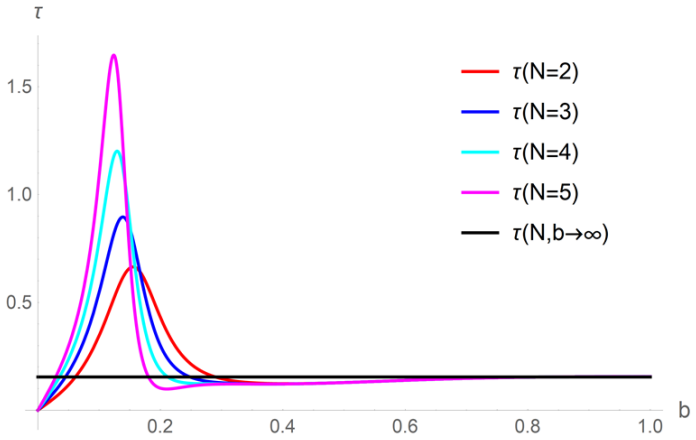
The central object is the unit-cell transfer matrix for the pair of conjugate complex barriers, composed N times to yield the transmission amplitude t=$e^{{-ikL}}$/G(k), where G(k)=(ξ−iχ)U_{N−1}(ξ)−U_{N−2}(ξ) and U_N are Chebyshev polynomials of the second kind. The phase of the transmitted wave is θ=$tan^{{-1}}$(qχ)−kL with q=U_{N−1}(ξ)/T_N(ξ), and the tunneling time is obtained by differentiating that phase with respect to energy. The Hartman limit works because for large b the real combination ξ grows as $f1e^{{2β}}$, χ grows as (1/4)U_−$e^{{2β}}$sinφ, and the coefficient of the linear-in-b term in τ is exactly g2−γf4, which vanishes. In the fixed-L, large-N limit the same closed form collapses, after trigonometric identities, to L/(2k).
What would settle it
Evaluate the exact tunneling time in eq. (25) numerically, without asymptotic approximations, for fixed V and E (for example V=20, E=1) at b=10,20,40,80 and for two values of N; if the difference from eq. (45) does not decrease as b grows, or if including the subleading oscillatory contribution from cos2α in the expansion of ξ changes the b-independent limit, the Hartman claim for this system is not established.
Extended reading notes
Core claim
The paper's central claim is an exact asymptotic result for the tunneling time τ through N unit cells, each made of a +iV barrier followed by a −iV barrier of width b. From the transfer-matrix transmission coefficient t=$e^{{-ikL}}$/G(k), it derives a closed form for τ and then shows that as b→∞ the b-dependent terms cancel through g2−γf4=0, leaving τ→(1/(2k(1+γ²)))[(g3−γf2)/f1], independent of b and N. This is the Hartman effect for the layered PT-symmetric system. In the opposite limit, L fixed and N→∞ with b=L/(2N), the same expression reduces to τ→L/(2k), the free-particle traversal time. The paper takes both results as analytically established statements about the phase θ=$tan^{{-1}}$(qχ)−kL of the transmission amplitude.
Load-bearing premise
The load-bearing premise is that the asymptotic expansions used for large b, in particular the treatment of the oscillatory term cos2α in ξ, are valid, so that the cancelled b-dependent term g2−γf4 truly vanishes and no equally large correction is discarded; if that balance changed, the claimed b-independence could fail.
Editorial extensions
If this is right
- For sufficiently thick layers, the transmitted wave-packet peak arrives after a time that does not grow with the number of stacked unit cells, so the standard Hartman paradox of apparent superluminal traversal would appear in this PT-symmetric structure too.
- Adding more repetitions N at fixed large b leaves the tunneling time unchanged, so the saturation is a property of each unit cell's complex-conjugate balance rather than of the total width.
- In the continuum-like limit N→∞ with L fixed, the stack becomes effectively transparent: the peak delay equals L/(2k), the same as propagation through vacuum, even though each individual barrier is complex.
- The analytical reduction to free propagation provides a consistency check for the stationary-phase definition of tunneling time, since a finely interlaced gain-loss medium should behave as empty space.
Reading between the lines
- A natural testable extension would be to simulate wave-packet propagation through the stack numerically and check whether the peak arrival time matches eq. (45) at large b, since the paper only compares with its own analytic curves.
- The same transfer-matrix expansion could be applied to non-uniform unit cells, such as unequal widths or unequal |V| in the gain and loss layers, to see whether the b-independent limit survives when the unit cell is no longer exactly PT-symmetric.
- If the free-propagation limit is robust, it suggests that a sufficiently fine PT-symmetric multilayer could act as a dispersion-free delay line for wave packets, a property that might be probed in photonic or electronic heterostructures.
- One could check the size of the leading correction to eq. (45): if it decays as e^{-2β} with β=bρ sinφ, the Hartman limit has a well-defined approach; if the oscillatory cos2α term contributes at the same order, the asymptotic expansion would need revision.
Signed reviews
Editorial analysis
A structured set of objections, weighed in public.
Referee Report
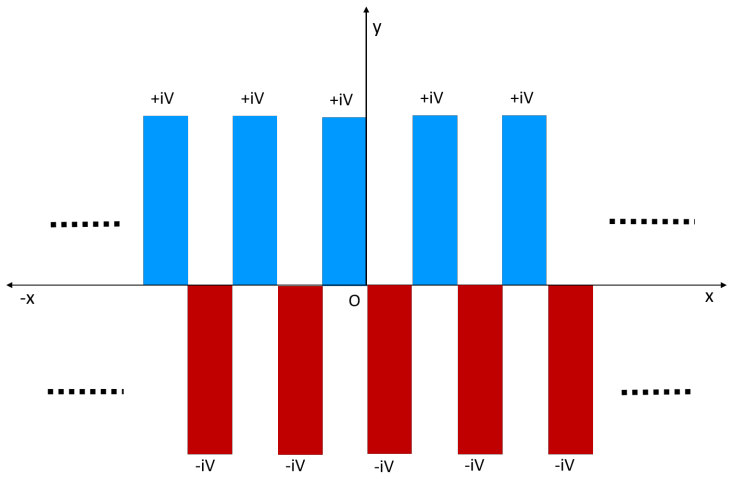
Summary. The manuscript studies tunneling time through a periodic PT-symmetric array of N unit cells, each composed of a +iV and a -iV barrier of width b, with total length L=2Nb. Using the transfer-matrix method and the stationary-phase definition of tunneling time, the authors derive a closed-form expression for the phase delay and consider two limits: b→∞, for which they claim the tunneling time becomes independent of b, N, and L (the Hartman effect), and N→∞ with L fixed, for which they claim the tunneling time reduces to the free-propagation time L/(2k). The paper also argues that the latter limit supports the consistency of the stationary-phase method. The central derivation is algebraic, and the paper contains no numerical algorithm or machine-checkable proof.
Significance. If the claims were established, the paper would extend the Hartman effect to layered PT-symmetric systems and provide a nontrivial consistency check for stationary-phase tunneling times. The free-propagation limit is a nice target result, and the closed-form transfer-matrix expressions are potentially useful. However, the key asymptotic analysis is not carried out in the text and, where it is given, appears inconsistent with the printed definitions of ξ and χ. The paper therefore does not, as written, prove the Hartman effect for this system, and the significance of the claimed result is contingent on a corrected derivation.
major comments (4)
- [§3.2, Eqs. (18)-(22)] The reduction from the unit-cell transfer matrix to the transmission coefficient is the entire foundation of the paper, but the text only states the final expressions and says the exercise is left to the reader. In particular, Eqs. (19)-(20) and the definitions of ξ and χ in Eqs. (21)-(22) are asserted without derivation. A referee cannot verify the correctness of Eq. (25) or the later limits from the information given. Please provide the full algebra or an appendix with the complete derivation.
- [§3.3, Eqs. (21), (26), (28)-(34)] The asymptotic expansion in Eqs. (28)-(33) is not supported by Eq. (21). Expanding Eq. (21) with cosh2β and sinh2β both behaving as e^{2β}/2 gives a leading coefficient 1/4 − (cos2φ/2)(sin²α + cos2α), which depends on α = bρ cosφ; if the second bracket is meant to be sin²α + cos²α, the coefficient is 1/4 − cos2φ/2. In neither case is it the constant f1 = 1/2 sin2φ of Eq. (34). Moreover, Eq. (26) is not the derivative of Eq. (21): differentiating the term −cos2φ(...) produces additional contributions proportional to φ′, α′, and β′ that are absent from Eq. (26). Consequently Eqs. (28)-(33), and the cancellation leading to Eq. (45), cannot be taken as established.
- [§3.3, Eq. (44)] The identity g2 − γf4 = 0 in Eq. (44) is actually correct under the printed definitions: with V = ρ² sin2φ and k² = ρ² cos2φ one obtains U− = −2ρ sin²φ/k, γ = −ρ sinφ/k, f4 = −k sin³φ/ρ, and g2 = sin⁴φ, so g2 − γf4 = 0. The b-linear term in Eq. (43) is therefore not the source of the problem; the problem is the incorrect asymptotic forms used for f1, f2, f4, and g2 in Eqs. (28)-(33).
- [§3.4, Eq. (46)] The limit N→∞ with L fixed is asserted with the words 'it can be shown,' but no derivation is given. One must specify how the Chebyshev-polynomial ratio q behaves when b = L/(2N) → 0 and how the oscillatory dependence on α is controlled in Eq. (25). Without this, Eq. (46) cannot be checked; the final simplification to L/(2k) in Eq. (48) is straightforward once Eq. (46) is granted, but the load-bearing step is missing.
minor comments (5)
- [§3.3, Eq. (43)] The denominator in Eq. (43) reads 1 + γ, whereas Eqs. (42) and (45) use 1 + γ²; this is a typo and should be corrected.
- [Abstract and §4] The phrase 'phase space method' should be 'stationary phase method' (or 'phase-delay method'); the paper's method uses stationary-phase integration, not phase-space techniques.
- [Figures 3 and 4] The figures would benefit from axis labels, units, and a statement of the numerical method used to generate the curves; as it stands, the claimed agreement with Eqs. (45) and (48) cannot be reproduced from the text.
- [References] Reference [18] is an arXiv e-print; if it is used for a key formula, please cite the published version, if one exists. Some reference entries also contain formatting errors (e.g., [28]).
- [Eq. (14)] The transfer-matrix convention in Eq. (14) should be spelled out: the factors e^{−ikb} and e^{ikb(1+2j)} and the meaning of j need a sentence of explanation.
Circularity Check
No significant circularity: the Hartman and free-propagation limits are algebraic limits of the paper's self-contained transfer-matrix/stationary-phase formula, not fitted inputs or renamed prior results.
full rationale
Walking the derivation chain: the tunneling time in Eq. (25) is obtained from the transfer-matrix transmission phase, Eqs. (19)-(24), via the stationary-phase time formula, Eq. (4). No parameter is fitted to data, and the central result is not imported from a prior paper. The Hartman limit is an asymptotic evaluation of this same formula: Eqs. (28)-(33) give the large-b behavior of xi, chi, and q, and Eq. (44) is a direct algebraic consequence of the printed definitions, since g2/f4 = U_-/(2 sin phi) = gamma. Thus the b-linear term in Eq. (43) cancels and Eq. (45) is an algebraic limit, not an assumed input. The fixed-L, N-to-infinity limit is checked against the known free-propagation time L/(2k); that benchmark is external and is not assumed in deriving Eqs. (46)-(48). The self-citations [18], [19], [48], and [51] are used as background statements or methodological references; the current Hartman claim does not rest on an unverified uniqueness theorem or on a fitted parameter from those works. Omitted algebra, such as 'the detail exercise of the above is left to the interested reader,' is a presentation or completeness issue, not circularity. Even if one doubted the asymptotic expansion, that would be a correctness concern rather than a circular reduction. The derivation is self-contained against an external benchmark, so the circularity score is 0.
Assumptions & free parameters
assumptions (4)
- domain assumption The stationary phase method gives the physically relevant traversal time.
- standard math The transfer matrix composition rule and Chebyshev-polynomial representation of periodic systems are applicable to complex potentials.
- domain assumption In the N→∞ with L fixed limit, the alternating +iV and -iV barriers combine to give free propagation, and the limit can be evaluated from eq. (25).
- ad hoc to paper The asymptotic expansions for ξ, χ, q, ξ', χ' as b→∞ (eqs. 28-33) are valid and the leading terms dominate uniformly.
Cite this review
Pith. "Pith review of Hartman effect from layered $PT$-symmetric system." pith.science (2026). https://pith.science/paper/GKVDNIAD
@misc{pith2026190802147,
  author       = {Pith},
  title        = {Pith review of: Hartman effect from layered $PT$-symmetric system},
  year         = {2026},
  howpublished = {\url{https://pith.science/paper/GKVDNIAD}},
  note         = {Machine review of arXiv:1908.02147}
}
abstract
The time taken by a wave packet to cross through a finite layered $PT$-symmetric system is calculated by stationary phase method. We consider the $PT$- symmetric system of fix spatial length $L$ consisting of $N$ units of the potential system `$+iV$' and `$-iV$' of equal width `$b$' such that $L=2Nb$. In the limit of large `$b$', the tunneling time is found to be independent of $L$ and therefore the layered $PT$-symmetric system display the Hartman effect. The interesting limit of $N \rightarrow \infty$ such that $L$ remains finite is investigated analytically. In this limit the tunneling time matches with the time taken to cross an empty space of length $L$. The result of this limiting case $N \rightarrow \infty$ also shows the consistency of phase space method of calculating the tunneling time despite the existence of controversial Hartman effect. The reason of Hartman effect is unknown to present day however the other definitions of tunneling time that indicate a delay which depends upon the length of traversing region have been effectively ruled out by recent attosecond measurements.
Figures

Figures from the paper (1 more)

Reference graph
Works this paper leans on
-
[18]
Hartman-Fletcher effect for array of complex barriers
A. Ghatak, M. Hasan, B. P. Mandal, Hartman-Fletcher effect for array of complex barriers, arXiv: 1505.03163
- [1]
-
[2]
R. W. Gurney, E.U. Condon, Nature, 122,439 (1928)
work page 1928
- [3]
- [4]
-
[5]
Bohm, Quantum Theory, Prentice-Hall, New York (1951)
D. Bohm, Quantum Theory, Prentice-Hall, New York (1951)
1951
-
[6]
T. E. Hartman, J. App. Phys. 33, 3427 (1962)
work page 1962
-
[7]
J. R. Fletcher, J. Phys. C, 18, L55 (1985)
work page 1985
Show all 51 references
-
[8]
H. G. Winful, Physics Reports, 436 ,1-69 (2006) and references therein
2006
-
[9]
Aquino V.M., Navarro A., Goto M., Iwamoto H., Phys. Rev. A, 58, 6, 4359 (1998)
1998
-
[10]
V. S. Olkhovsky1, E. Recami and G. Salesi, Euro. Phys. Lett. 57, 879 (2002)
2002
-
[11]
Esposito, Phy
S. Esposito, Phy. Rev. E 67, 016609 (2003)
2003
-
[12]
Kudaka, S
S. Kudaka, S. Matsumoto, Phys. Lett. A, 375, 3259 (2011)
2011
-
[13]
Milanovic, J
V. Milanovic, J. Ranovanovic, Phys. Lett. A, 376, 16, 1401 (2012)
2012
-
[14]
Kudaka, S
S. Kudaka, S. Matsumoto, Phys. Lett. A, 376, 1403 (2012)
2012
-
[15]
Pereyra P., Phys. Rev. Lett., 84, 8, 1772 (2000)
2000
-
[16]
Raciti, G
F. Raciti, G. Salesi, Journal de Physique I, EDP Sciences, 4 (12), 1783 (1994)
1994
-
[17]
A. Paul, A. Saha, S. Bandopadhyay and B. Dutta-Roy, Euro. Phys. Jour. D, 42, 495 (2007)
2007
-
[19]
Hasan, B
M. Hasan, B. P. Mandal, Tunneling time from locally periodic potential in space fractional quantum mechanics, arXiv: 1902.00381
1902 arXiv
-
[20]
Steinberg, P.G
A.M. Steinberg, P.G. Kwiat, R.Y. Chiao, Phys. Rev. Lett., 71, 708 (1993)
1993
-
[21]
G. Nimtz H. Spieker, H.M. Brodowsky, Phys. Lett. A 222, 125 (1996)
1996
-
[22]
Balcou and L
Ph. Balcou and L. Dutriaux Phys. Lett. A,78, 851 (1997)
1997
-
[23]
Ragni, Phys
L. Ragni, Phys. Rev. E, 79, 046609 (2009)
2009
-
[24]
Sattari and E
F. Sattari and E. Faizabadi AIP Advances 2, 12123 (2012)
2012
-
[25]
Longhi, M
S. Longhi, M. Marano, P. Laporta, and M. Belmonte Phys. Rev. E, 64, 055602 (2001)
2001
-
[26]
Olindo, M.A
C. Olindo, M.A. Sagioro, F.M. Matinaga, A. Delgado, C.H. Monken, S. Padua , Optics Comm., 272, 161 (2007)
2007
-
[27]
Longhi, P
S. Longhi, P. Laporta, M. Belmonte, E. Recami, Phys. Rev. E, 65, 046610 (2002). 13
2002
-
[28]
U. S. Sainadh1, H. Xu, X. Wang, A. A. Noor, W. C. Wallace, N. Douguet, A. Bray, I. Ivanov, K. Bartschat, A. Kheifets, R. T. Sang , I. V. Litvinyuk , Nature , 568, 75 (2019)
2019
-
[29]
PT Symmetry in Quantum and Classical Physics , C. M. Bender, World Scientific (2019)
2019
-
[30]
M. V. Berry, Czech. J. Phys. 54, 1039 (2004)
2004
-
[31]
W. D. Heiss, Phys. Rep. 242, 443 (1994)
1994
-
[32]
Mostafazadeh, Phys
A. Mostafazadeh, Phys. Rev. Lett. 102, 220402 (2009)
2009
-
[33]
Ghatak, R
A. Ghatak, R. D. Ray Mandal, B. P. Mandal, Ann. of Phys. 336, 540 (2013)
2013
-
[34]
C. F. Gmachl, Nature 467, 37 (2010)
2010
-
[35]
W. Wan, Y. Chong, L. Ge, H. Noh, A. D. Stone, H. Cao, Science 331, 889 (2011)
2011
-
[36]
N. Liu, M. Mesch, T. Weiss, M. Hentschel, and H. Giessen, Nano Lett. 10, 2342 (2010)
2010
-
[37]
H. Noh, Y. Chong, A. Douglas Stone, and Hui Cao, Phys. Rev. Lett. 108, 6805 (2011)
2011
-
[38]
Mostafazadeh and M
A. Mostafazadeh and M. Sarisaman, Proc. R. Soc. A 468, 3224 (2012)
2012
-
[39]
M. Cai, O. Painter, and K. J. Vahala, Phys. Rev. Lett. 85, 74 (2000)
2000
-
[40]
J. R. Tischler, M. S. Bradley, and V. Bulovic, Opt. Lett. 31, 2045 (2006)
2006
-
[41]
Dutta Gupta, Opt
S. Dutta Gupta, Opt. Lett. 32, 1483 (2007)
2007
-
[42]
Balci, C
S. Balci, C. Kocabas, and A. Aydinli, Opt. Lett. 36, 2770 (2011)
2011
-
[43]
Mostafazadeh, Ann of Physics 375, 265 (2016)
A. Mostafazadeh, Ann of Physics 375, 265 (2016)
2016
-
[44]
Longhi, J
S. Longhi, J. Phys. A: Math. Theor. 44, 485302 (2011)
2011
-
[45]
Mostafazadeh, Phys
A. Mostafazadeh, Phys. Rev. A 87, 012103 (2013)
2013
-
[46]
Loran, Opt
F. Loran, Opt. Lett. 42, 5250 (2017)
2017
-
[47]
L. Deak, T. Fulop, Ann. of Phys. 327, 1050 (2012)
2012
-
[48]
Hasan, B
M. Hasan, B. P. Mandal, Ann. of Phys. , 396, 371 (2018)
2018
-
[49]
Dutta Roy, New Age Science Ltd
Elements of Quantum Mechanics , B. Dutta Roy, New Age Science Ltd. (2009)
2009
-
[50]
D. J. Griffiths and C. A. Steinkea, Am. J. Phys. 69 (2), 137,(2001)
2001
-
[51]
Hasan and B.P
M. Hasan and B.P. Mandal, Ann. of Phys. , 391, 240 (2018). 14
2018
Reviewed August 14, 2026 · model on record in the stance chip above.
Discussion (0). Continue with ORCID to comment.