REVIEW 3 major objections 5 minor 46 references
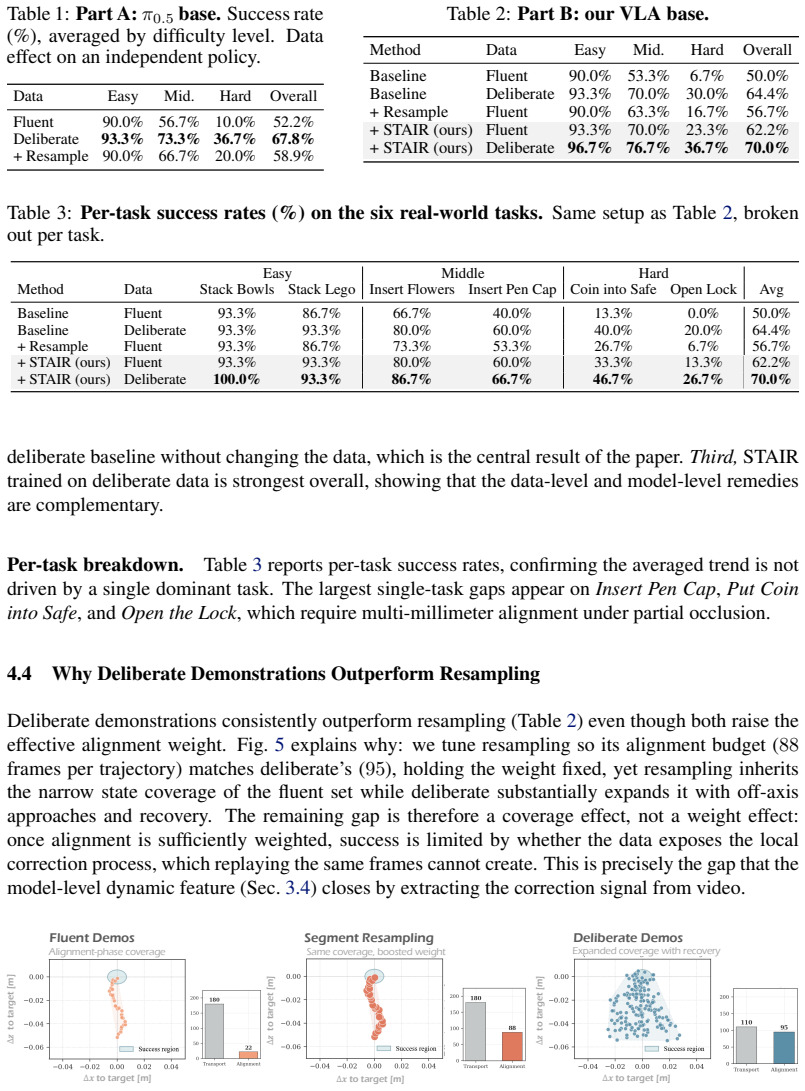
Fluent expert demonstrations under-supervise the critical alignment phase, and a compact dynamic feature distilled from local video recovers most of the deliberate-demonstration gain on six fine-manipulation tasks.
Reviewed by Pith at T0; open to challenge. T0 means a machine referee read the full paper against a public rubric. the ladder, T0–T4 →
T0 review · deepseek-v4-flash
2026-08-02 11:16 UTC pith:GLDXNWHN
load-bearing objection A conceptually nice paper whose central quantitative claim is not yet statistically supported: the 12.2 pp STAIR gain is within sampling noise at n=15/task, but the idea deserves a serious look. the 3 major comments →
Perfect Demo Makes Poor Teacher: Learning Robust Alignment from Critical Motion Segments
The pith
A machine-rendered reading of the paper's core claim, the machinery that carries it, and where it could break.
Core claim
The central claim is that fluent expert demonstrations fail as teachers for fine manipulation because the alignment/recovery phase occupies a small fraction of the trajectory and the uniform imitation loss allocates almost all its weight to easy transport, leaving the decisive corrections under-supervised. To address this, the paper introduces STAIR, which distills short-horizon motion from a brief video neighborhood into compact dynamic tokens and feeds them to the action expert through cross-attention, while a query module on the vision-language model learns to predict these tokens from the current frame alone. With this dynamic conditioning, a policy trained purely on fluent data recovers
What carries the argument
STAIR (Spatio-Temporal feature As an Interface for Robot learning) is a compact dynamic feature. For each training sample, a short future observation neighborhood is encoded by a frozen video encoder and compressed by a trainable 3D convolution plus attention-based projector into a few tokens; after an MLP projection, these tokens condition a flow-matching action expert via cross-attention. In a second stage, a query module on the vision-language model's hidden states is trained to predict the frozen dynamic condition from the current observation and instruction, so at deployment the video neighborhood is no longer needed and the standard single-image VLA interface is preserved. The dynamic
Load-bearing premise
The central comparison assumes that 15 evaluation trials per task can distinguish the reported success-rate differences, and that the STAIR gain comes from the dynamic feature rather than from the extra trainable query and projector modules.
What would settle it
Run the six tasks with 100–200 trials per condition and report confidence intervals, and compare STAIR against a baseline with the same trainable modules but no dynamic target; if STAIR no longer approaches the deliberate baseline or the additional modules alone match its success, the central claim is refuted.
If this is right
- A policy trained on fluent demonstrations can approach deliberate-demonstration performance simply by adding a motion-condensing module, so expensive slow-at-alignment data collection is not required to close most of the gap.
- The finding that resampling raises alignment weight but not recovery-state coverage implies that future data-collection protocols should deliberately include off-axis approaches and recoveries rather than merely filming more alignment frames.
- Since the dynamic feature is predicted from the current frame at inference, the method keeps the standard single-image vision-language-action interface and can be integrated into existing robot policies without changing the observation space.
- The same dynamic-conditioning principle shows gains beyond the six fine-alignment tasks on a standard simulated manipulation benchmark, suggesting the motion-aware representation is broadly useful, not just for tight-tolerance tasks.
Where Pith is reading between the lines
- The coverage result suggests that synthetically injecting off-axis approaches and recovery states into fluent trajectories could reproduce much of the deliberate-demonstration gain at low collection cost; this is a testable extension the paper does not run.
- Predicting the dynamic feature deterministically at inference commits to one future; allowing multiple sampled futures could improve robustness in partially observed contact situations, a direction the paper itself flags.
- Because the dynamic feature is visual-only, combining it with tactile or force feedback would likely further help in heavy-contact tasks; the paper names this as a limitation rather than an explored direction.
- A simpler motion summary (e.g., optical flow or frame differences) may capture a large share of the benefit; the paper does not compare against such baselines, so the specific tokenization is not yet isolated.
Editorial analysis
A structured set of objections, weighed in public.
Referee Report
Summary. The paper argues that fluent expert demonstrations are poor teachers for fine-grained manipulation because the decisive alignment/recovery phase occupies a small fraction of frames, and the standard per-frame imitation loss under-supervises exactly those frames. It proposes two data-level remedies—deliberate slow-at-alignment demonstrations and critical-segment resampling—and a representation-level remedy, STAIR, a compact spatio-temporal dynamic feature distilled from short video neighborhoods and used to condition a flow-matching action expert. The central empirical claim is that STAIR trained on fluent data alone recovers most of the deliberate-demonstration gain on six real-world tasks (50.0% to 62.2% overall, approaching the 64.4% of deliberate demonstrations), while remaining competitive with generalist policies on SimplerEnv. The paper includes a limitations section acknowledging the inference-time determinism of the dynamic feature, its reliance on visual dynamics, and the hyperparameter status of keyframe/window selection.
Significance. If the central empirical claim holds, the paper makes a useful contribution to imitation learning for fine manipulation: it identifies a concrete failure mode, gives a mechanistic explanation, and proposes a representation that does not change the deployment-time observation interface. Credit is due for evaluating the data-level effect on an independent base policy (pi-0.5), for comparing against SimplerEnv baselines, and for being largely self-contained: the success metric is not fitted to the method, and no external benchmark is used to define STAIR's success. The main weaknesses are statistical: the headline gains rest on 15 trials per task with no confidence intervals, repeated seeds, or significance tests, and the controlled architecture comparison is less controlled than claimed.
major comments (3)
- [§4.3, Tables 2 and 3] The central quantitative claim—STAIR trained on fluent data recovers most of the deliberate-demonstration gain—is not supported at conventional significance. Pooling the six tasks gives 15 trials/task, i.e., 90 trials per condition. Baseline-Fluent is 45/90 (50.0%), STAIR-Fluent 56/90 (62.2%), and Baseline-Deliberate 58/90 (64.4%). The headline difference STAIR-Fluent minus Baseline-Fluent is 11/90 = 12.2 percentage points; with a pooled standard error of roughly 7.4 pp, this is z ≈ 1.65, two-sided p ≈ 0.10. The difference between STAIR-Fluent and Baseline-Deliberate is only 2.2 pp, well below one SE. Per-task n=15 gives per-task SE ≈ 12.9 pp for a 50% success rate, so task-level gaps such as Insert Flowers 66.7% vs 80.0% reflect 2/15 trials. The 85% recovery ratio is thus compatible with a wide range of true effects, including no improvement. Please provide confidence intervals or Bayes
- [§4.1, §3.5] The paper states that Baseline and STAIR differ by exactly one factor—whether the conditioning tokens are supervised by the dynamic feature—but they differ in at least three ways: (i) the presence of the trainable projector P_psi and MLP adapter, (ii) the two-stage training procedure, in which Stage I conditions the action expert on the dynamic feature c_dyn and trains the projector, and (iii) the dynamic-target prediction loss L_dyn in Stage II. Holding the VLM and query module fixed does not isolate the dynamic feature. The improvement could come from the extra trainable capacity, from training-time access to a short future video clip (even though the clip is removed at inference), or from the auxiliary objective. To support the attribution, please add ablations such as: Baseline with the same extra modules but a static/random target for the query module, or STAIR without Stage I. With
- [§4.4, Fig. 5] The claim that deliberate demonstrations outperform resampling because of expanded recovery-state coverage, rather than because of increased alignment weight, is supported only by a qualitative scatter plot and a single tuned operating point that matches the alignment budget of resampling to deliberate (88 vs 95 frames). No quantitative coverage metric (e.g., hull area, state-space entropy) or sensitivity analysis over the resampling radius r and weight lambda is reported. This coverage claim is load-bearing for contribution 2. Please quantify coverage and vary the alignment budget to show that the remaining gap is not sensitive to the matching procedure.
minor comments (5)
- [Eq. (5), §3.4] In Eq. (5) the dynamic condition is written c_dyn without a time subscript, while the text defines c_dyn_t; please make the subscript consistent. Also, 'WanV AE' appears with irregular spacing in several places.
- [Tables 4 and 5] The SimplerEnv evaluations report 30 closed-loop rollouts per task but give no confidence intervals or seed variance. At minimum, per-task n and a variance measure should be reported, especially for the 'Ours' rows where the gains over strong baselines are often a few successes out of 30.
- [§3.4] N_t is described as a 'future observation neighbourhood', but the offsets Delta are 'temporal offsets around the action chunk'. Please clarify whether Delta includes past offsets and how the neighborhood is defined at trajectory boundaries.
- [§6] The Limitations section explicitly notes that keyframe and neighborhood selection are hyperparameters. Given that the method's gains depend on r, lambda, lambda_dyn, and Delta, a small sensitivity table would materially help the reader judge robustness.
- [§2] The related-work section cites the authors' own concurrent work [10, 11] without a positioning sentence. A sentence explaining the relationship of STAIR to those works would help readers.
Circularity Check
No significant circularity; the central claims are supported by controlled ablations and external benchmarks.
full rationale
The paper's derivation chain is not circular. Eq. (1) is a definitional decomposition of the uniform behavior-cloning loss into transport and alignment terms; it frames the problem but does not by itself produce the measured gains, which come from controlled empirical comparisons (Tables 1-3). STAIR's dynamic feature is not fitted to the success metric: the target c_dyn is distilled from the trajectory's own short video neighborhood (Eqs. 3-5), and the query module (Eqs. 6-8) is trained to predict that frozen representation; the claim that this helps is an empirical result against an ablation that keeps the VLM, action expert, and query module fixed. The data-level comparison in Sec. 4.4 matches alignment weight (88 vs 95 frames) precisely so that the remaining gap is attributed to coverage, not to construction. Self-citations (StaMo [31], World Guidance [27], Bridge [10]) appear in related work as positioning or contrast, not as load-bearing justifications; no uniqueness theorem or ansatz is imported from them. External baselines (pi-0.5) and SimplerEnv provide independent checkpoints. The fragility of 15 trials per task is a statistical-power/reporting concern, not a circularity.
Axiom & Free-Parameter Ledger
free parameters (4)
- Critical-segment window radius r and upweight lambda =
Not specified
- Temporal offsets Delta for the observation neighborhood =
Not specified
- Keyframe moments K (gripper change, contact, insertion, placement) =
Not specified
- lambda_dyn loss weight =
Not specified
axioms (5)
- domain assumption The imitation loss weights every frame equally (uniform BC loss), yielding the decomposition in Eq. 1.
- domain assumption Action sensitivity in alignment phase is much larger than in transport: sigma_al >> sigma_tr.
- domain assumption The frozen WanVAE video encoder preserves the short-horizon motion cues needed for alignment (contact, slip, correction).
- domain assumption The query module can predict the dynamic feature from current RGB alone at inference without losing most of the benefit.
- domain assumption Coverage of recovery states, as visualized in Fig. 5, is the causal explanation for the remaining gap between deliberate and resampling.
invented entities (1)
-
STAIR dynamic feature tokens (f_dyn)
no independent evidence
read the original abstract
Expert demonstrations are widely assumed to be the gold standard for robot imitation learning. Yet for fine-grained manipulation such as insertion, stacking, and alignment, we uncover a counterintuitive failure mode: fluent demonstrations can be poor teachers. A skilled teleoperator compresses the decisive moments of alignment and recovery into a brief temporal window, leaving the policy flooded with redundant free-space motion and starved of supervision exactly where precision determines success. We address this bottleneck at two levels. At the data level, slowing down near alignment and resampling critical segments both help, yet the gain comes mainly from broadening the coverage of recovery states the policy must learn, not from reweighting frames it already has. Such data-side fixes, however, leave the policy's per-frame view untouched: a single image still maps directly to an action, and the local motion that governs correction stays implicit. We therefore turn to the representation level and introduce STAIR (\textbf{S}patio-\textbf{T}emporal feature \textbf{A}s an \textbf{I}nterface for \textbf{R}obot learning), a compact dynamic feature that bridges the vision-language model and the action expert, distilling the short-horizon motion already recorded in each trajectory into dense, motion-aware supervision. Trained on fluent data alone, STAIR recovers most of the deliberate-demonstration gain ($50.0$ to $62.2\%$ overall, approaching the $64.4\%$ of deliberate demonstrations). These results call for a more pedagogical view of robot data, optimized for machine learnability rather than human efficiency alone.
Figures


Reference graph
Works this paper leans on
-
[1]
Ravichandar, A
H. Ravichandar, A. S. Polydoros, S. Chernova, and A. Billard. Recent advances in robot learning from demonstration.Annual review of control, robotics, and autonomous systems, 3 (1):297–330, 2020
2020
-
[2]
Laskey, J
M. Laskey, J. Lee, R. Fox, A. Dragan, and K. Goldberg. Dart: Noise injection for robust imitation learning. InConference on robot learning, pages 143–156. PMLR, 2017
2017
-
[3]
Akgun, M
B. Akgun, M. Cakmak, K. Jiang, and A. L. Thomaz. Keyframe-based learning from demonstra- tion: Method and evaluation.International Journal of Social Robotics, 4(4):343–355, 2012
2012
-
[4]
L. Kou, F. Ni, Y . ZHENG, J. Liu, Y . Yuan, Z. Dong, and J. HAO. KISA: A unified keyframe identifier and skill annotator for long-horizon robotics demonstrations. InForty-first Interna- tional Conference on Machine Learning, 2024. URLhttps://openreview.net/forum? id=oCI9gHocws
2024
-
[5]
J. Hejna, S. Mirchandani, A. Balakrishna, A. Xie, A. Wahid, J. Tompson, P. Sanketi, D. Shah, C. Devin, and D. Sadigh. Robot data curation with mutual information estimators.arXiv preprint arXiv:2502.08623, 2025
Pith/arXiv arXiv 2025
-
[6]
J. Hejna, C. Bhateja, Y . Jiang, K. Pertsch, and D. Sadigh. Re-mix: Optimizing data mixtures for large scale imitation learning.arXiv preprint arXiv:2408.14037, 2024
Pith/arXiv arXiv 2024
-
[7]
M. J. Kim, K. Pertsch, S. Karamcheti, T. Xiao, A. Balakrishna, S. Nair, R. Rafailov, E. Foster, G. Lam, P. Sanketi, et al. Openvla: An open-source vision-language-action model.arXiv preprint arXiv:2406.09246, 2024
Pith/arXiv arXiv 2024
-
[8]
Zitkovich, T
B. Zitkovich, T. Yu, S. Xu, P. Xu, T. Xiao, F. Xia, J. Wu, P. Wohlhart, S. Welker, A. Wahid, et al. Rt-2: Vision-language-action models transfer web knowledge to robotic control. In Conference on Robot Learning, pages 2165–2183. PMLR, 2023
2023
-
[9]
Y . Wang, H. Zhu, M. Liu, J. Yang, H.-S. Fang, and T. He. Vq-vla: Improving vision-language- action models via scaling vector-quantized action tokenizers. InProceedings of the IEEE/CVF International Conference on Computer Vision, pages 11089–11099, 2025
2025
-
[10]
M. Liu, Z. Huang, X. Lin, M. Zhu, C. Zhao, Z. Du, Y . Wang, H. Zhu, H. Chen, and C. Shen. Bridge thinking and acting: Unleashing physical potential of vlm with generalizable action expert.arXiv preprint arXiv:2510.03896, 2025
Pith/arXiv arXiv 2025
-
[11]
Z. Huang, M. Liu, X. Lin, M. Zhu, C. Zhao, Z. Du, Y . Lin, X. Li, Y . Jia, H. Zhong, et al. Notvla: Semantics-preserving robot adaptation via narrative action interfaces.arXiv preprint arXiv:2510.03895, 2025
Pith/arXiv arXiv 2025
-
[12]
K. Wang, L. Lu, M. Liu, J. Jiang, Z. Li, B. Zhang, W. Zheng, X. Yu, H. Chen, and C. Shen. Odyssey: Open-world quadrupeds exploration and manipulation for long-horizon tasks. In Proceedings of the AAAI Conference on Artificial Intelligence, volume 40, pages 18602–18610, 2026
2026
-
[13]
P. Intelligence, K. Black, N. Brown, J. Darpinian, K. Dhabalia, D. Driess, A. Esmail, M. Equi, C. Finn, N. Fusai, et al.π 0.5: A vision-language-action model with open-world generalization. arXiv preprint arXiv:2504.16054, 2025
Pith/arXiv arXiv 2025
-
[15]
J. Bjorck, F. Casta ˜neda, N. Cherniadev, X. Da, R. Ding, L. Fan, Y . Fang, D. Fox, F. Hu, S. Huang, et al. Gr00t n1: An open foundation model for generalist humanoid robots.arXiv preprint arXiv:2503.14734, 2025. 9
Pith/arXiv arXiv 2025
-
[16]
Q. Bu, Y . Yang, J. Cai, S. Gao, G. Ren, M. Yao, P. Luo, and H. Li. Univla: Learning to act anywhere with task-centric latent actions.arXiv preprint arXiv:2505.06111, 2025
Pith/arXiv arXiv 2025
-
[17]
J. Cen, C. Yu, H. Yuan, Y . Jiang, S. Huang, J. Guo, X. Li, Y . Song, H. Luo, F. Wang, et al. Worldvla: Towards autoregressive action world model.arXiv preprint arXiv:2506.21539, 2025
Pith/arXiv arXiv 2025
-
[18]
Zhang, H
W. Zhang, H. Liu, Z. Qi, Y . Wang, X. Yu, J. Zhang, R. Dong, J. He, H. Wang, Z. Zhang, et al. Dreamvla: a vision-language-action model dreamed with comprehensive world knowledge. Advances in Neural Information Processing Systems, 38:24195–24228, 2026
2026
- [19]
-
[20]
S. Liu, L. Wu, B. Li, H. Tan, H. Chen, Z. Wang, K. Xu, H. Su, and J. Zhu. Rdt-1b: a diffu- sion foundation model for bimanual manipulation. InInternational Conference on Learning Representations, volume 2025, pages 29982–30009, 2025
2025
-
[21]
J. Yang, Y . Shi, H. Zhu, M. Liu, K. Ma, Y . Wang, G. Wu, T. He, and L. Wang. Como: Learning continuous latent motion from internet videos for scalable robot learning. InProceedings of the IEEE/CVF Conference on Computer Vision and Pattern Recognition, pages 42352–42363, 2026
2026
-
[22]
S. Nair, A. Rajeswaran, V . Kumar, C. Finn, and A. Gupta. R3m: A universal visual represen- tation for robot manipulation.arXiv preprint arXiv:2203.12601, 2022
Pith/arXiv arXiv 2022
-
[23]
Y . J. Ma, S. Sodhani, D. Jayaraman, O. Bastani, V . Kumar, and A. Zhang. Vip: Towards universal visual reward and representation via value-implicit pre-training.arXiv preprint arXiv:2210.00030, 2022
Pith/arXiv arXiv 2022
-
[24]
Caron, H
M. Caron, H. Touvron, I. Misra, H. J ´egou, J. Mairal, P. Bojanowski, and A. Joulin. Emerging properties in self-supervised vision transformers. InProceedings of the IEEE/CVF interna- tional conference on computer vision, pages 9650–9660, 2021
2021
-
[25]
M. Oquab, T. Darcet, T. Moutakanni, H. V o, M. Szafraniec, V . Khalidov, P. Fernandez, D. Haz- iza, F. Massa, A. El-Nouby, et al. Dinov2: Learning robust visual features without supervision. arXiv preprint arXiv:2304.07193, 2023
Pith/arXiv arXiv 2023
-
[26]
S. Karamcheti, S. Nair, A. S. Chen, T. Kollar, C. Finn, D. Sadigh, and P. Liang. Language- driven representation learning for robotics.arXiv preprint arXiv:2302.12766, 2023
Pith/arXiv arXiv 2023
-
[27]
Y . Su, S. Chen, H. Shi, M. Liu, Z. Zhang, N. Huang, W. Zhong, Z. Zhu, Y . Liu, and X. Liu. World guidance: World modeling in condition space for action generation.arXiv preprint arXiv:2602.22010, 2026
arXiv 2026
-
[28]
S. Ye, J. Jang, B. Jeon, S. J. Joo, J. Yang, B. Peng, A. Mandlekar, R. Tan, Y .-W. Chao, B. Y . Lin, et al. Latent action pretraining from videos. InInternational Conference on Learning Representations, volume 2025, pages 28213–28239, 2025
2025
-
[29]
Y . Chen, Y . Ge, W. Tang, Y . Li, Y . Ge, M. Ding, Y . Shan, and X. Liu. Moto: Latent motion token as the bridging language for learning robot manipulation from videos. InProceedings of the IEEE/CVF International Conference on Computer Vision, pages 19752–19763, 2025
2025
-
[30]
Y . Wang, X. Li, W. Wang, J. Zhang, Y . Li, Y . Chen, X. Wang, and Z. Zhang. Unified vision- language-action model.arXiv preprint arXiv:2506.19850, 2025
Pith/arXiv arXiv 2025
-
[31]
M. Liu, J. Shu, H. Chen, Z. Li, C. Zhao, J. Yang, S. Gao, H. Chen, and C. Shen. StaMo: Unsupervised learning of generalizable robot motion from compact state representation.arXiv preprint arXiv:2510.05057, 2025. 10
Pith/arXiv arXiv 2025
-
[32]
O’Neill, A
A. O’Neill, A. Rehman, A. Maddukuri, A. Gupta, A. Padalkar, A. Lee, A. Pooley, A. Gupta, A. Mandlekar, A. Jain, et al. Open x-embodiment: Robotic learning datasets and rt-x models: Open x-embodiment collaboration 0. In2024 IEEE International Conference on Robotics and Automation (ICRA), pages 6892–6903. IEEE, 2024
2024
-
[33]
A. Khazatsky, K. Pertsch, S. Nair, A. Balakrishna, S. Dasari, S. Karamcheti, S. Nasiriany, M. K. Srirama, L. Y . Chen, K. Ellis, et al. Droid: A large-scale in-the-wild robot manipulation dataset.arXiv preprint arXiv:2403.12945, 2024
Pith/arXiv arXiv 2024
-
[34]
F. Ebert, Y . Yang, K. Schmeckpeper, B. Bucher, G. Georgakis, K. Daniilidis, C. Finn, and S. Levine. Bridge data: Boosting generalization of robotic skills with cross-domain datasets. arXiv preprint arXiv:2109.13396, 2021
Pith/arXiv arXiv 2021
-
[35]
C. Chi, Z. Xu, C. Pan, E. Cousineau, B. Burchfiel, S. Feng, R. Tedrake, and S. Song. Universal manipulation interface: In-the-wild robot teaching without in-the-wild robots.arXiv preprint arXiv:2402.10329, 2024
Pith/arXiv arXiv 2024
-
[36]
J. Yang, C. Finn, and D. Sadigh. Data analogies enable efficient cross-embodiment transfer. arXiv preprint arXiv:2603.06450, 2026
arXiv 2026
-
[37]
Kuhar, S
S. Kuhar, S. Cheng, S. Chopra, M. Bronars, and D. Xu. Learning to discern: Imitating hetero- geneous human demonstrations with preference and representation learning. InConference on Robot Learning, pages 1437–1449. PMLR, 2023
2023
-
[38]
M. Du, S. Nair, D. Sadigh, and C. Finn. Behavior retrieval: Few-shot imitation learning by querying unlabeled datasets.arXiv preprint arXiv:2304.08742, 2023
Pith/arXiv arXiv 2023
-
[39]
L.-H. Lin, Y . Cui, A. Xie, T. Hua, and D. Sadigh. Flowretrieval: Flow-guided data retrieval for few-shot imitation learning.arXiv preprint arXiv:2408.16944, 2024
Pith/arXiv arXiv 2024
-
[40]
Y . Cui, D. Isele, S. Niekum, and K. Fujimura. Uncertainty-aware data aggregation for deep imitation learning. In2019 International Conference on Robotics and Automation (ICRA), pages 761–767. IEEE, 2019
2019
-
[41]
R. Hoque, A. Balakrishna, E. Novoseller, A. Wilcox, D. S. Brown, and K. Goldberg. Thriftydagger: Budget-aware novelty and risk gating for interactive imitation learning.arXiv preprint arXiv:2109.08273, 2021
Pith/arXiv arXiv 2021
-
[42]
X. Li, K. Hsu, J. Gu, K. Pertsch, O. Mees, H. R. Walke, C. Fu, I. Lunawat, I. Sieh, S. Kir- mani, et al. Evaluating real-world robot manipulation policies in simulation.arXiv preprint arXiv:2405.05941, 2024
Pith/arXiv arXiv 2024
-
[43]
A. Brohan, N. Brown, J. Carbajal, Y . Chebotar, J. Dabis, C. Finn, K. Gopalakrishnan, K. Haus- man, A. Herzog, J. Hsu, et al. Rt-1: Robotics transformer for real-world control at scale.arXiv preprint arXiv:2212.06817, 2022
Pith/arXiv arXiv 2022
-
[44]
O. M. Team, D. Ghosh, H. Walke, K. Pertsch, K. Black, O. Mees, S. Dasari, J. Hejna, T. Kreiman, C. Xu, et al. Octo: An open-source generalist robot policy.arXiv preprint arXiv:2405.12213, 2024
Pith/arXiv arXiv 2024
-
[45]
K. Black, N. Brown, D. Driess, A. Esmail, M. Equi, C. Finn, N. Fusai, L. Groom, K. Hausman, B. Ichter, et al.π0: A vision-language-action flow model for general robot control. corr, abs/2410.24164, 2024. doi: 10.48550.arXiv preprint ARXIV .2410.24164
Pith/arXiv arXiv 2024
-
[46]
K. Pertsch, K. Stachowicz, B. Ichter, D. Driess, S. Nair, Q. Vuong, O. Mees, C. Finn, and S. Levine. Fast: Efficient action tokenization for vision-language-action models.arXiv preprint arXiv:2501.09747, 2025
Pith/arXiv arXiv 2025
-
[47]
D. Wu, F. Liu, Y .-H. Hung, and Y . Duan. Spatial-mllm: Boosting mllm capabilities in visual- based spatial intelligence.arXiv preprint arXiv:2505.23747, 2025. 11
Pith/arXiv arXiv 2025
discussion (0)
Sign in with ORCID, Apple, or X to comment. Anyone can read and Pith papers without signing in.