REVIEW 2 major objections 5 minor 31 references
Short-depth trial-wavefunctions for the variational quantum eigensolver based on the problem Hamiltonian
T0 review · 2 major / 5 minor · reviewed 2026-08-14 · deepseek-v4-flash
Pith's one-line read A tiny subset of the problem Hamiltonian's Pauli terms can build VQE trial wavefunctions that reach chemical accuracy for H2, LiH, and H2O.
desk verdict A useful VQE ansatz construction with honest numerical capacity claims, but the imaginary-time variant's X-to-Y rule is mathematically under-specified and needs fixing before the headline LiH numbers can be taken at face value. read the letter →
The pith
A machine-rendered reading of the paper's core claim, the machinery that carries it, and where it could break.
The reading
What carries the argument
The machinery is a Hamiltonian-derived ansatz: write the Hamiltonian as $H = \sum_j h_j H_j$ with Pauli terms $H_j$, choose a subset $S$ of $K$ terms, and form products of exponentials $e^{-i\gamma H'_j}$, optionally interleaved with single-qubit $Z$ rotations in the QAOA-inspired variant. The imaginary-time variant replaces one $X$ with one $Y$ in each selected $H_j$, giving the Pauli string a factor of $i$; this converts the non-unitary decay $e^{-tH_j}$ into a unitary rotation $e^{-itH'_j}$ that can be implemented with standard one- and two-qubit gates. For H2 the replacement turns the optimal term $XX$ into the coupled-cluster excitation $XY$. The construction is carried by two observations: only a small fraction of the $M$ possible terms are needed, and a greedy sequential search can find them in polynomial time.
What would settle it
Apply the imaginary-time-inspired ansatz to LiH using the reported first optimal term $YXXYXXXX$, and optimize the energy for each of the six possible single-$X$-to-$Y$ substitutions instead of just the paper's $YYXYXXXX$; if any substitution fails to reach 1.6 mHartree, the claim that the choice of substituted qubit is irrelevant is refuted.
Extended reading notes
Core claim
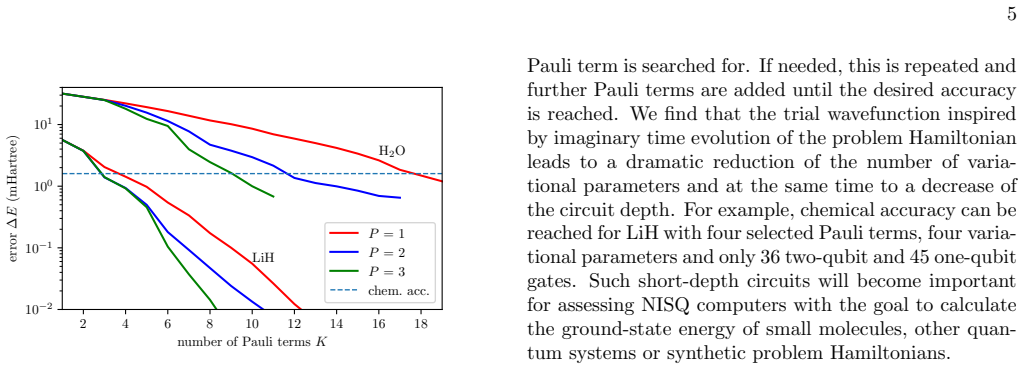
The central claim is that the trial wavefunction in VQE can be generated from a curated subset of Pauli terms of the problem Hamiltonian itself, with the variational parameters absorbing the effect of all omitted terms. In the numerical study, based on the STO-3G basis and the parity fermion-to-qubit mapping with two-qubit reduction, one Pauli term solves H2, four of the 276 Pauli terms solve LiH, and 18 of the 551 terms solve H2O to within 1.6 mHartree. For the imaginary-time-inspired ansatz, each selected term contributes exactly one variational parameter, so the LiH trial state is prepared with four parameters, 36 two-qubit gates, and 45 one-qubit gates; increasing the number of Trotter steps reduces the number of required terms. Because the selected terms are Pauli strings derived from pairs of creation and annihilation operators, the resulting trial state automatically preserves particle number. The terms are chosen one at a time by a greedy search, fixing the best term before looking for the next, which keeps the selection cost polynomial in the total number of Pauli terms.
Load-bearing premise
The method's accuracy rests on the heuristic that replacing one Pauli $X$ with one Pauli $Y$ in any selected Hamiltonian term produces a unitary that mimics imaginary-time evolution; this rule is demonstrated only for the two-qubit H2 example before being applied to LiH and H2O.
Editorial extensions
If this is right
- VQE circuits for small molecules can shrink from hundreds of two-qubit gates to a few dozen, which is the regime where noisy intermediate-scale quantum hardware can hold a computation.
- The number of variational parameters can drop to one per selected Pauli term (four for LiH), substantially simplifying the classical optimization loop that often dominates VQE.
- Adding Trotter steps trades depth for parameters: for H2O the imaginary-time ansatz needs 18 terms with one step, 12 terms with two steps, and 9 terms with three steps.
- The greedy term-selection procedure scales polynomially in the total Pauli-term count, so the same ansatz-construction principle applies in principle to other Hamiltonians beyond H2, LiH, and H2O.
- Particle number is conserved automatically in the trial state because the Hamiltonian's Pauli terms preserve it, avoiding a symmetry-violation problem common in hardware-heuristic ansätze.
Reading between the lines
- If the single-operator $X$-to-$Y$ replacement heuristic holds beyond the molecules tested, the same construction would apply to any fermionic Hamiltonian mapped to qubits, including multi-reference systems where fixed coupled-cluster ansätze typically fail; the paper does not test such cases.
- The reported gate counts cover only trial-state preparation as compiled from Pauli exponentials; an actual device run would add measurement overhead and hardware-specific compilation, so the practical advantage could differ from the headline numbers.
- The Hamiltonian-subset idea is not chemistry-specific: applied to an Ising or MaxCut cost Hamiltonian it would yield a QAOA variant that uses a few selected terms of the cost function rather than the full cost Hamiltonian, a direction the paper mentions but does not explore.
- A fully adaptive variant could re-optimize earlier parameters after each new Pauli term is added instead of freezing them, potentially reducing $K$ further; this extension is not examined in the paper.
Signed reviews
Editorial analysis
A structured set of objections, weighed in public.
Referee Report
Summary. The paper proposes two Hamiltonian-term-based ansatze for VQE: a QAOA-inspired ansatz that interleaves evolutions under selected problem-Hamiltonian Pauli terms with single-qubit Z-rotations (Eq. (2)), and an imaginary-time-inspired ansatz obtained by replacing one X by Y in each selected Pauli term and evolving under the resulting Hermitian operator (Eq. (9)). For H2, LiH, and H2O in STO-3G with parity mapping and frozen-core reduction, the authors use exact classical diagonalization as the energy target and a greedy, one-term-at-a-time selection heuristic. They report chemical accuracy with K=1 (H2), K=4 (LiH), and K=18 (H2O) Pauli terms at P=1, with correspondingly small gate counts; for LiH the imaginary-time ansatz uses four variational parameters, 36 two-qubit gates, and 45 one-qubit gates. Scaling formulas for parameters and gate counts are given as functions of N, K, and P.
Significance. Should the construction be robust, the practical impact is real: it provides concrete, small circuit-resource counts for VQE on NISQ hardware and reduces the variational-parameter count relative to the UCC ansatz in the numerical examples. The numerics are transparent and honest in the sense that all reported energies are variational upper bounds compared against exact diagonalization, so the error curves are valid capacity statements for the ansatz. The main risk is that the imaginary-time-inspired substitution rule is asserted rather than proven; if that rule is under-specified or fails for LiH/H2O, the headline K=4 LiH result is not a well-defined algorithm.
major comments (2)
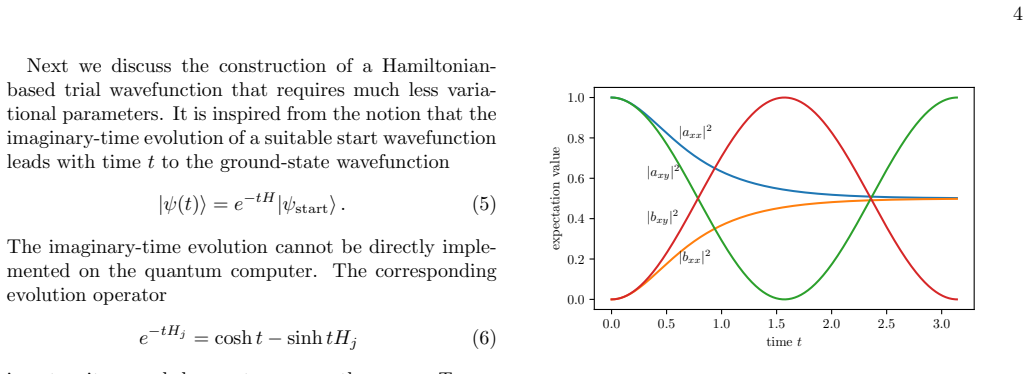
- [Imaginary-time ansatz, Eqs. (5)–(9)] The justification for the X→Y replacement is not correct as stated. With the standard Pauli relation Y = i X Z (up to an irrelevant sign convention), replacing X on qubit q in H_j gives H'_j = ± i H_j Z_q, so e^{-iγ H'_j} = e^{±γ H_j Z_q}, i.e. evolution generated by H_j Z_q rather than by H_j. The statement that "it does not matter for which qubit we exchange X with Y" therefore requires proof. In the two-qubit H2 example the extra Z_q acts on the two-dimensional subspace as a constant (up to a sign), which is why Eqs. (7)–(8) and Fig. 3 do not expose the problem; for N≥3, different choices of q define genuinely different variational manifolds. The example H'_j = YYXYXXXX for LiH shows one particular choice but no selection rule is given, and the appendix in which the optimal terms are listed is absent from this version. The K=4, four-parameter LiH result in Fig. 4 and Table I is therefore not a well-specified construction unless a canonical choice of q is fixed and its impact, or a proof of invariance, is supplied.
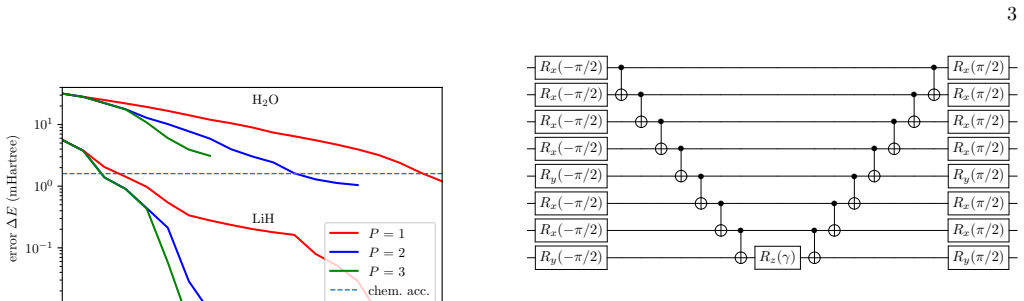
- [Term-selection algorithm, Figs. 1 and 4 and following paragraph] The claim that the term-search increases computational load "only polynomially" is not substantiated. The greedy algorithm makes O(KM) candidate-term evaluations, but each evaluation is itself a VQE minimization with an uncharacterized number of quantum-circuit calls and classical optimization steps. The polynomial statement applies to the number of Hamiltonian terms tried, not to the total computational cost, and the paper does not report the number of optimizer iterations or measurements per candidate. Without this information, the "favorable scaling for larger molecules" in the abstract is supported for circuit depth and parameter count, but not for the full VQE workflow.
minor comments (5)
- [Paragraph after Fig. 4 and Table I] The sentence "for LiH with K = 1, only 45 one-qubit gates and 36 two-qubit gates are enough to obtain chemical accuracy with only 4 variational parameters" is inconsistent with the abstract and Table I, where the four-parameter LiH entry corresponds to K=4 and P=1; please correct the K value or provide the consistent K=1, P=4 data.
- [Appendix reference] The text states that "the optimal Pauli terms are listed in the appendix," but no appendix appears in this version; since the X-to-Y replacement choices are part of the circuit specification, the accepted manuscript should include the full list.
- [Introduction, particle-number claim] The assertion that a Hamiltonian-based generation "automatically preserves the particle-number of the trial wavefunction" is not demonstrated for the individual Pauli terms H_j after the fermion-to-qubit mapping; each selected H_j should be shown to commute with the particle-number operator, or the statement should be qualified.
- [Table I] The column header "H20" should be "H2O", and the table caption should define P (the number of discretization steps) and distinguish it from the parameter count.
- [Bond-length scan] The LiH bond-length statement is given without supporting data; a figure or table showing the same four terms work across the stated bond-length range would strengthen the claim.
Circularity Check
No significant circularity: the numerical VQE results are obtained by energy minimization and greedy term selection, not by fitting the target answer; the questionable X-to-Y heuristic is a correctness issue rather than a circular reduction.
full rationale
None of the claimed results is equivalent by construction to its inputs. The QAOA-inspired and imaginary-time-inspired wavefunctions are variational families; the paper's greedy term-selection procedure minimizes the VQE energy, and the reported chemical-accuracy crossing is a numerical property of those families, not a parameter fitted to the exact energy afterwards. In particular, replacing X by Y in H_j gives H'_j = i H_j Z_q (up to sign), not i H_j as stated near Eqs. (7)-(8), so the assertion that 'it does not matter for which qubit we exchange X with Y' is unsupported and the imaginary-time motivation is fragile; this is a correctness and robustness issue, not a circular step. Self-citations [12], [16], [21], and [28] provide standard VQE, gate-implementation, and Qiskit background and are not load-bearing, and no uniqueness theorem is imported from the authors' prior work. The appendix referenced as 'The optimal Pauli terms are listed in the appendix' is absent from this version, which is a reproducibility limitation but does not make the derivation circular.
Assumptions & free parameters
free parameters (3)
- Variational angles gamma_lj (imaginary-time ansatz) =
H2 example: gamma = -0.1118; LiH/H2O values not listed
- Variational angles gamma_lj and beta_ljq (QAOA-inspired ansatz) =
H2: gamma=-0.1118, beta1=0.5448, beta2=-0.2406
- Number of selected Pauli terms K =
K=1 (H2), 4 (LiH), 18 (H2O) for P=1; 3 (LiH), 12 (H2O) for P=2
assumptions (5)
- domain assumption The parity fermion-to-qubit mapping as implemented in Qiskit correctly represents the molecular Hamiltonian on qubits.
- standard math Imaginary-time evolution e^{-tH}|psi_start> converges to the ground state for large t.
- ad hoc to paper Replacing one X with Y in a Pauli term yields a unitary operator whose action mimics the imaginary-time evolution of the original term.
- domain assumption The classical optimizer used in the numerical VQE reaches a global minimum (or at least an energy below chemical accuracy) for each candidate ansatz.
- ad hoc to paper The greedy sequential addition of Pauli terms (keeping previously selected terms) is sufficient to find a compact set reaching chemical accuracy.
invented entities (1)
-
Modified Pauli terms H'_j (one X replaced by Y in each selected Hamiltonian Pauli term)
Cite this review
Pith. "Pith review of Short-depth trial-wavefunctions for the variational quantum eigensolver based on the problem Hamiltonian." pith.science (2026). https://pith.science/paper/GLMZ4Y47
@misc{pith2026190809533,
  author       = {Pith},
  title        = {Pith review of: Short-depth trial-wavefunctions for the variational quantum eigensolver based on the problem Hamiltonian},
  year         = {2026},
  howpublished = {\url{https://pith.science/paper/GLMZ4Y47}},
  note         = {Machine review of arXiv:1908.09533}
}
read the original abstract
For the variational quantum eigensolver we propose to generate trial wavefunctions from a small amount of selected Pauli terms of the problem Hamiltonian. Two different approaches, one inspired by the quantum approximate optimization algorithm and the other by imaginary-time evolution, are proposed and studied in detail. Using numerical calculations, we study the efficiency of these trial wavefunctions for finding the ground-state energy of three molecules: H2, LiH and H2O. We find that only a small number of Pauli terms are needed to reach chemical accuracy, leading to short-depth quantum circuits with a small number of variational parameters. For the LiH molecule, the quantum circuit consists of 36 two-qubit gates, 45 one-qubit gates, and four variational parameters, with a favorable scaling for larger molecules.
Figures
Reference graph
Works this paper leans on
-
[1]
R. P. Feynman, Int J Theor Phys 21, 467 (1982)
1982
-
[2]
The num- ber of gates reduces when there are identity operators in the Pauli terms
The quantum circuit to create our QAOA-inspired trial wavefunction consists at most of (3 N + 1)KP one- qubit gates and 2(N− 1)KP two-qubit gates. The num- ber of gates reduces when there are identity operators in the Pauli terms. The four Pauli terms needed for LiH to obtain chemical accuracy with one discretion step result in only 80 one-qubit gates and...
-
[3]
D. S. Abrams and S. Lloyd, Phys. Rev. Lett. 83, 5162 (1999)
1999
-
[4]
Aspuru-Guzik, A
A. Aspuru-Guzik, A. D. Dutoi, P. J. Love, and M. Head- Gordon, Science 309, 1704 (2005)
2005
-
[5]
B. P. Lanyon, J. D. Whitfield, G. G. Gillett, M. E. Goggin, M. P. Almeida, I. Kassal, J. D. Biamonte, M. Mohseni, B. J. Powell, M. Barbieri, A. Aspuru-Guzik, and A. G. White, Nat Chem 2, 106 (2010)
work page 2010
-
[6]
J. D. Whitfield, J. Biamonte, and A. Aspuru-Guzik, Molecular Physics 109, 735 (2011)
work page 2011
-
[7]
P. OMalley, R. Babbush, I. Kivlichan, J. Romero, J. Mc- Clean, R. Barends, J. Kelly, P. Roushan, A. Tranter, N. Ding, B. Campbell, Y. Chen, Z. Chen, B. Chiaro, A. Dunsworth, A. Fowler, E. Jeffrey, E. Lucero, A. Megrant, J. Mutus, M. Neeley, C. Neill, C. Quin- tana, D. Sank, A. Vainsencher, J. Wenner, T. White, P. Coveney, P. Love, H. Neven, A. Aspuru-Guzik...
work page 2016
- [8]
Show all 31 references
-
[9]
Colless, V
J. Colless, V. Ramasesh, D. Dahlen, M. Blok, M. Kimchi- Schwartz, J. McClean, J. Carter, W. de Jong, and I. Sid- diqi, Phys. Rev. X 8, 011021 (2018)
2018
-
[10]
Wecker, B
D. Wecker, B. Bauer, B. K. Clark, M. B. Hastings, and M. Troyer, Phys. Rev. A 90, 022305 (2014)
2014
-
[11]
Peruzzo, J
A. Peruzzo, J. McClean, P. Shadbolt, M.-H. Yung, X.-Q. Zhou, P. J. Love, A. Aspuru-Guzik, and J. L. OBrien, Nature Communications 5, 4213 (2014)
2014
-
[12]
J. R. McClean, J. Romero, R. Babbush, and A. Aspuru- Guzik, New J. Phys. 18, 023023 (2016)
2016
-
[13]
N. Moll, P. Barkoutsos, L. S. Bishop, J. M. Chow, A. Cross, D. J. Egger, Stefan Filipp, A. Fuhrer, J. M. Gambetta, M. Ganzhorn, A. Kandala, A. Mezzacapo, Peter Mller, W. Riess, G. Salis, J. Smolin, I. Tavernelli, and K. Temme, Quantum Sci. Technol.3, 030503 (2018)
2018
-
[14]
Y. Li, J. Hu, X.-M. Zhang, Z. Song, and M.-H. Yung, Advanced Theory and Simulations 0, 1800182 (2019)
2019
-
[15]
R. M. Parrish, E. G. Hohenstein, P. L. McMahon, and 6 T. J. Martinez, arXiv:1901.01234 [quant-ph] (2019)
2019 arXiv
-
[16]
Kandala, A
A. Kandala, A. Mezzacapo, K. Temme, M. Takita, M. Brink, J. M. Chow, and J. M. Gambetta, Nature 549, 242 (2017)
2017
-
[17]
P. K. Barkoutsos, J. F. Gonthier, I. Sokolov, N. Moll, G. Salis, A. Fuhrer, M. Ganzhorn, D. J. Egger, M. Troyer, A. Mezzacapo, S. Filipp, and I. Tavernelli, Phys. Rev. A 98, 022322 (2018)
2018
-
[18]
Romero, R
J. Romero, R. Babbush, J. R. McClean, C. Hempel, P. J. Love, and A. Aspuru-Guzik, Quantum Sci. Technol. 4, 014008 (2018)
2018
- [19]
- [20]
-
[21]
Dallaire-Demers, J
P.-L. Dallaire-Demers, J. Romero, L. Veis, S. Sim, and A. Aspuru-Guzik, arXiv:1801.01053 [quant-ph] (2018)
2018 arXiv
-
[22]
Ganzhorn, D
M. Ganzhorn, D. Egger, P. Barkoutsos, P. Ollitrault, G. Salis, N. Moll, M. Roth, A. Fuhrer, P. Mueller, S. Wo- erner, I. Tavernelli, and S. Filipp, Phys. Rev. Applied 11, 044092 (2019)
2019
-
[23]
D. I. Lyakh and R. J. Bartlett, J. Chem. Phys. 133, 244112 (2010)
2010
-
[24]
H. R. Grimsley, S. E. Economou, E. Barnes, and N. J. Mayhall, Nature Communications 10, 3007 (2019)
2019
-
[25]
Hempel, C
C. Hempel, C. Maier, J. Romero, J. McClean, T. Monz, H. Shen, P. Jurcevic, B. P. Lanyon, P. Love, R. Babbush, A. Aspuru-Guzik, R. Blatt, and C. F. Roos, Phys. Rev. X 8, 031022 (2018)
2018
-
[26]
I. G. Ryabinkin, T.-C. Yen, S. N. Genin, and A. F. Izmaylov, J. Chem. Theory Comput. 14, 6317 (2018)
2018
-
[27]
J. Lee, W. J. Huggins, M. Head-Gordon, and K. B. Whaley, J. Chem. Theory Comput. 15, 311 (2019)
2019
-
[28]
Nam, J.-S
Y. Nam, J.-S. Chen, N. C. Pisenti, K. Wright, C. Delaney, D. Maslov, K. R. Brown, S. Allen, J. M. Amini, J. Apis- dorf, K. M. Beck, A. Blinov, V. Chaplin, M. Chmielewski, C. Collins, S. Debnath, A. M. Ducore, K. M. Hudek, M. Keesan, S. M. Kreikemeier, J. Mizrahi, P. Solomon, M...
2019 arXiv
-
[29]
Qiskit: An Open-source Framework for Quantum Computing,
I. Y. Akhalwaya, G. Aleksandrowicz, T. Alexander, P. Barkoutsos, L. Bello, Y. Ben-Haim, D. Bucher, F. J. Cabrera-Herndez, J. Carballo-Franquis, A. Chen, C.-F. Chen, J. M. Chow, A. D. Crcoles-Gonzales, A. J. Cross, A. Cross, J. Cruz-Benito, C. Culver, S. D. L. P. Gonzlez, E. D....
2019
-
[30]
Bravyi, J
S. Bravyi, J. M. Gambetta, A. Mezzacapo, and K. Temme, arXiv:1701.08213 [quant-ph] (2017)
2017 arXiv
-
[31]
Sugisaki, S
K. Sugisaki, S. Yamamoto, S. Nakazawa, K. Toyota, K. Sato, D. Shiomi, and T. Takui, Chemical Physics Letters: X 1, 100002 (2019)
2019
Reviewed August 14, 2026 · model on record in the stance chip above.
Discussion (0). Continue with ORCID to comment.