REVIEW 5 major objections 6 minor 16 references
Unsupervised Construction of Knowledge Graphs From Text and Code
T0 review · 5 major / 6 minor · reviewed 2026-08-14 · deepseek-v4-flash
Pith's one-line read Unsupervised clustering links code identifiers to science concepts.
desk verdict A promising unsupervised pipeline for connecting code identifiers to text concepts, but the evaluation is too thin to back the central claim. read the letter →
The pith
A machine-rendered reading of the paper's core claim, the machinery that carries it, and where it could break.
The reading
What carries the argument
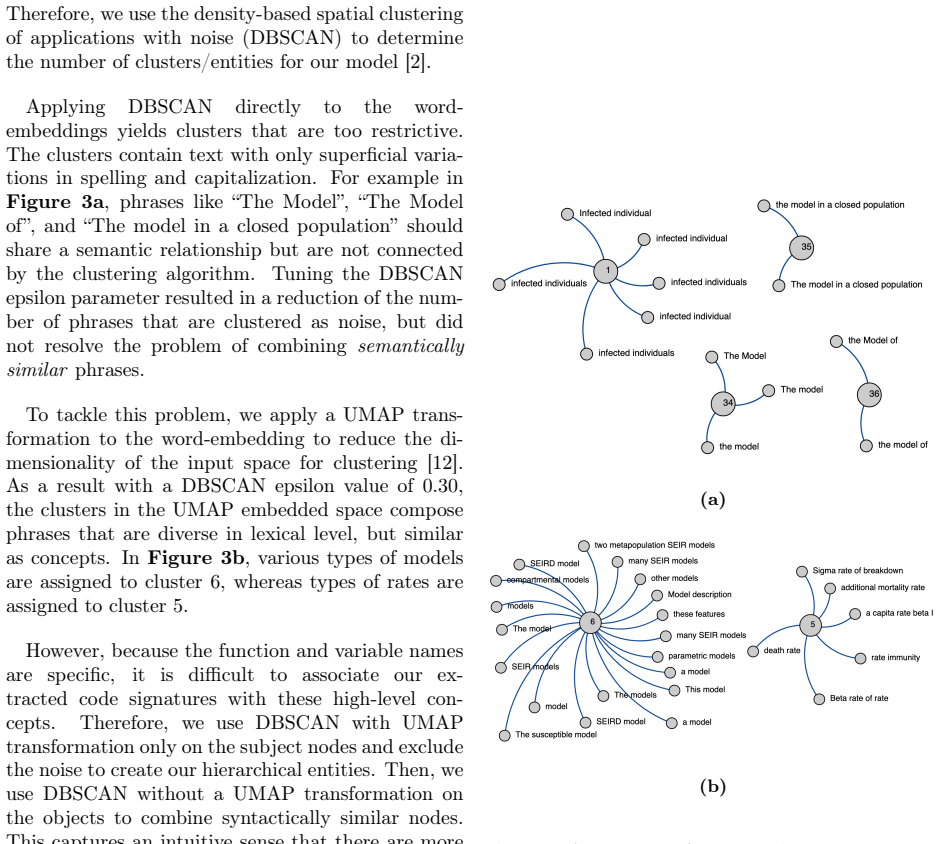
The load-bearing mechanism is a three-stage embedding-and-clustering operation: word embeddings of phrase tokens; UMAP nonlinear dimensionality reduction before density-based clustering (DBSCAN) of subject nodes, which groups lexically different but conceptually similar phrases; and raw-space DBSCAN over object nodes, preserving syntactic variants that code names can match. The final step compares each function or variable name embedding with object nodes and adds an edge when cosine similarity exceeds a fixed threshold. The contrast between the two clustering spaces is the key design choice: UMAP gives coarse conceptual clusters for subjects, while the object space stays fine-grained so that code-to-concept matching remains possible.
What would settle it
Run the pipeline on a corpus where all identifiers have been replaced by arbitrary tokens such as f1, tmp, and x7 while the text is unchanged. If concept-code edges survive, the method's success does not depend on naming conventions; if they disappear, the naming-convention assumption is doing the work.
Extended reading notes
Core claim
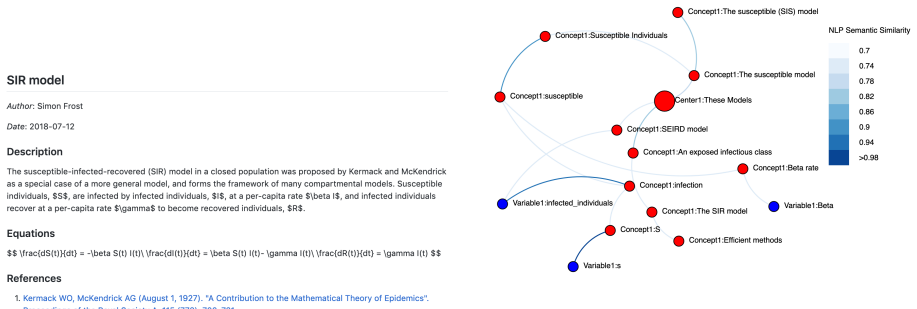
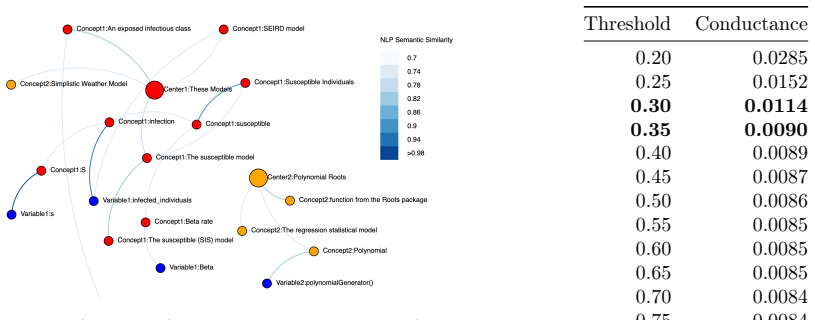
The central claim is that a knowledge graph over scientific concepts and code can be built entirely unsupervised: entities are not predefined but emerge from clustering word embeddings of phrases in the text, and code entities are matched to those clusters by cosine similarity of their names. The authors demonstrate this on epidemiological modeling text with scientific code, producing a graph with 93 subject nodes and 115 object nodes, where variables such as infected_individuals and Beta attach to concepts like an exposed infectious class and a rate. A second textbook introduces mostly disjoint clusters, and the conductance between the two corpora drops as the matching threshold rises, indicating a transition from broad cross-disciplinary edges to precise within-discipline edges. The result is a procedure for making the procedural knowledge in code addressable through the conceptual vocabulary of the literature.
Load-bearing premise
The whole mapping rests on the assumption that code identifiers are named consistently enough with the concepts they implement that their embeddings resemble the words used in prose; the authors themselves note that storage and placeholder variables degrade accuracy.
Editorial extensions
If this is right
- A knowledge graph built this way lets a scientist search a code base by the concepts a model implements, rather than by file names or documentation.
- Adding a new textbook to the graph yields a quantitative comparison: conductance between the two corpora measures how much interdisciplinary connection the construction introduces.
- Because no paired text-code examples are needed, the method can be applied to any open-science corpus whose code follows descriptive naming conventions.
- Threshold selection can be guided either by precision-recall against small hand labels or by the conductance transition observed when a second corpus is added.
- Downstream model-suggestion systems could use the conceptual nodes to detect semantically similar models and support model transformation.
Reading between the lines
- The conductance transition between thresholds could serve as a label-free threshold selector on new corpora, though the paper only observes it on one second corpus.
- Because the method relies on an English word-embedding space, multilingual or heavily abbreviated code would likely need an embedding trained on identifiers themselves; the paper's English-only setup is a scope limit, not a proof of impossibility.
- A natural stress test is to run the pipeline on code with systematically anonymized identifiers: if the concept-code edges collapse, the naming-convention assumption is confirmed as the active ingredient.
- The same architecture could be extended to link equations or figures in a textbook to code, since current extraction relies only on textual subject-verb-object triples and code signatures.
Signed reviews
Editorial analysis
A structured set of objections, weighed in public.
Referee Report
Summary. The manuscript proposes an unsupervised pipeline that extracts <subject, verb, object> triples from expository text in online textbooks, builds a text knowledge graph, extracts variable and function names from associated Julia code, and links code entities to text concepts via word embeddings combined with UMAP and DBSCAN clustering. The central claim is that this process can construct a knowledge graph connecting scientific text concepts to source code entities without paired training examples or a handcrafted ontology. Evaluation is based on a hand-labeled set of expected variable/object edges, a precision-recall curve, and a conductance analysis when a second textbook corpus is added.
Significance. If the pipeline's mapping were validated, it would be a useful contribution to semantic software engineering and open-science knowledge graph construction: it is unsupervised, it uses publicly available corpora, and it addresses a real gap in connecting prose descriptions to code. The paper also makes a genuine effort at grounded evaluation, including a hand-labeled ground truth set and an exploratory conductance analysis. However, the evidence presented is not sufficient to establish the central claim: the only quantitative evaluation is a precision-recall figure with no numeric values, the threshold is tuned on the same labels used for evaluation, no baseline is reported, and the admitted dependence on naming quality is not quantified. The contribution is therefore plausible but unproven.
major comments (5)
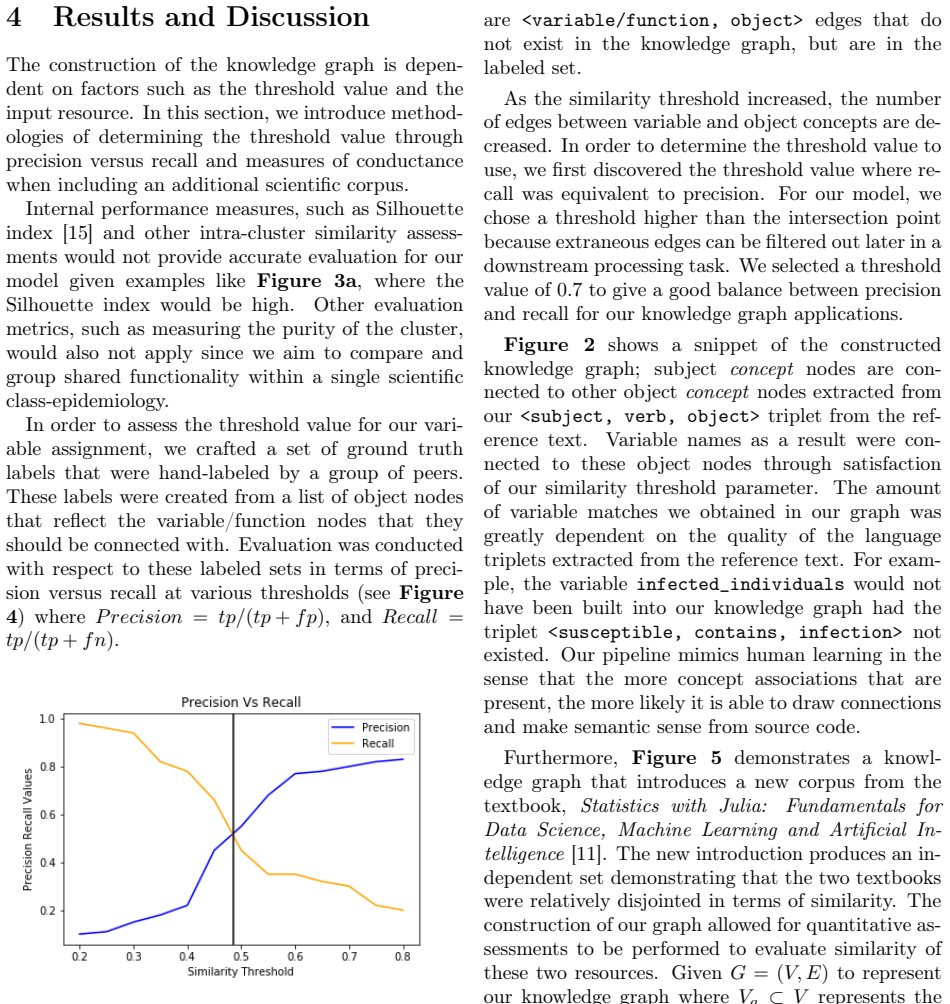
- [Section 4, Figure 4] The paper reports no numeric precision or recall values, no size of the hand-labeled set, and no inter-annotator agreement. The sentence 'We selected a threshold value of 0.7 to give a good balance between precision and recall' is therefore not supportable from the text, and the reader cannot determine whether the operating point is above chance. This is load-bearing because the threshold controls the central claim that variable and function names are reliably associated with object concepts.
- [Section 4] The threshold selection and the evaluation use the same hand-labeled ground truth. The hand-labeled edges define tp, fp, and fn, and the threshold value 0.7 is chosen as 'higher than the intersection point' of the precision-recall curve computed on those same edges. Consequently, the reported precision-recall behavior is an estimate fit to the labels, not an independent prediction. A held-out test set, cross-validation, or a separate tuning set is required.
- [Sections 3 and 4] No baseline or ablation is reported. The paper claims a 'novel process for joint clustering' combining word embeddings, UMAP, and DBSCAN, but it does not compare against alternatives such as a fixed cosine-similarity threshold on raw word embeddings, k-means, or agglomerative clustering. Without such a comparison, the contribution of UMAP and DBSCAN to mapping quality is not established.
- [Section 4, Table 1] The conductance analysis is presented as a second threshold-selection method, but the criteria conflict. The text first selects 0.7 from precision-recall, then claims that 'the transition point between 0.30 and 0.35' shows a method for choosing a threshold. The conductance values decrease monotonically with threshold, and no statistical test, error bar, or null model supports calling 0.30/0.35 a transition point. The two procedures would recommend different thresholds.
- [Section 5, Future Work] The paper concedes that 'the performance of our model relies on the quality of function and variable names' and that terse placeholder variables diminish accuracy. Because the evaluation is conducted on Epirecipes, which the authors themselves describe as having 'high-quality' pedagogical naming, the results do not support the broader claim about the open-source ecosystem. The limitation is acknowledged but never quantified, so the scope of the central claim is unclear.
minor comments (6)
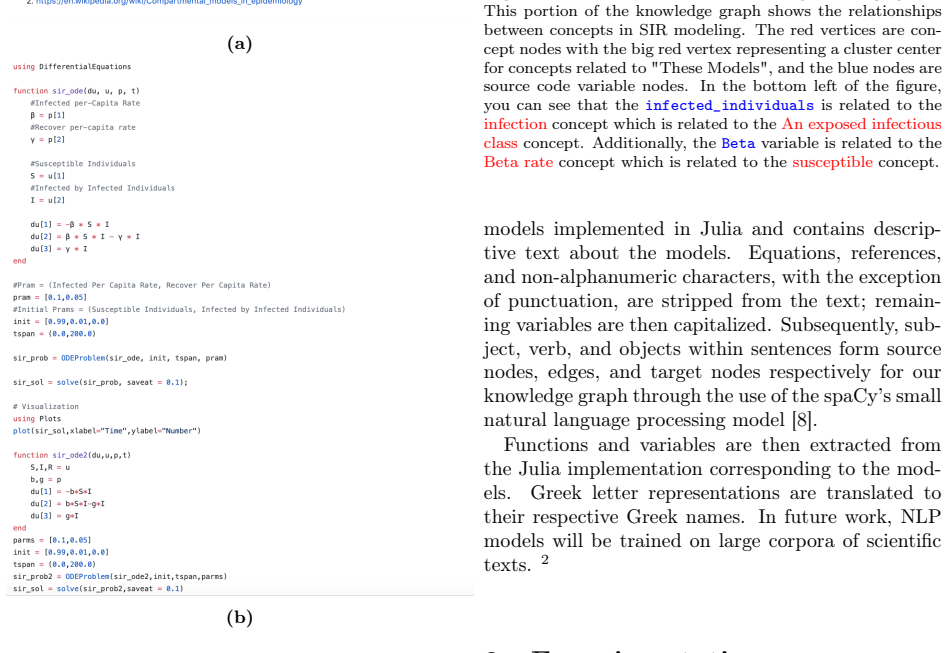
- [Section 2] The phrase 'spaCy's small natural language processing model' should specify the exact model (e.g., en_core_web_sm) and version for reproducibility.
- [Section 3] The distinction between UMAP/DBSCAN producing 'semantically significant clusters' for subjects and DBSCAN-only producing 'syntactically similar' object nodes is not operationalized; define the similarity measure used for objects.
- [Figure 2 caption] The caption mentions 'the big red vertex' but does not explain what cluster centers are or how colors map to node types; state this for accessibility.
- [Section 4] The hand-labeled set is described only as 'crafted by a group of peers'; report the number of annotators, the instructions, and inter-annotator agreement so the evaluation is interpretable.
- [Table 1] The row said to be 'indicated in bold' is not actually bold in the typeset table; correct the formatting and mention the specific conductance values used for the claimed transition.
- [Abstract and Section 3] The term 'joint clustering text concepts' is used, but the procedure clusters subject nodes and object nodes separately; reword to avoid implying a joint optimization.
Circularity Check
Pipeline is largely self-contained; the main circularity is that the similarity threshold is selected and evaluated on the same hand-labeled set.
-
fitted input called prediction
[Section 4, Results and Discussion (threshold selection and precision/recall evaluation)]
"In order to assess the threshold value for our variable assignment, we crafted a set of ground truth labels that were hand-labeled by a group of peers. ... Evaluation was conducted with respect to these labeled sets in terms of precision versus recall at various thresholds ... We selected a threshold value of 0.7 to give a good balance between precision and recall for our knowledge graph applications."
The same hand-labeled set is used both to choose the edge-similarity threshold and to compute the precision/recall behavior that justifies that choice. Selecting 0.7 because it balances precision and recall on these labels means the reported operating point is fitted to the evaluation yardstick rather than predicted independently. No held-out labels, cross-validation, or separate test set is described, so the precision/recall evidence for the variable-to-concept mapping is optimistically biased and does not independently demonstrate that the mapping generalizes. This is an evaluation-circularity concern, not a derivation that reduces the whole KG construction to the labels; the clustering pipeline itself is independent of the labeled set.
full rationale
The central construction is not circular by definition: text-to-code association is performed by word embeddings, UMAP, and DBSCAN clustering, with variables and functions connected to object nodes when embedding similarity exceeds a threshold. No target quantity in that pipeline is defined in terms of the final knowledge graph. The self-citation to SemanticModels.jl appears only as motivation and is not load-bearing evidence for the method. The main circular step is in Section 4: threshold selection and precision/recall evaluation use the same hand-labeled ground truth, so the reported precision-recall trade-off is fitted rather than predictive. The paper also omits numeric precision/recall values and baselines, which weakens the empirical claim but is a correctness/rigor issue rather than a definitional circularity. The Future Work concession that performance relies on the quality of function and variable names is an acknowledged limitation, not a circular step. Overall, the derivation preserves independent content, and the only identifiable circularity is localized to threshold evaluation, so the score is 2.
Assumptions & free parameters
free parameters (5)
- DBSCAN epsilon for subject clusters in UMAP space =
0.30
- Similarity threshold for variable/function to object edges =
0.70
- Subject component size cutoff =
5
- UMAP hyperparameters =
not specified
- DBSCAN parameters for object clustering =
not specified
assumptions (4)
- domain assumption Function and variable names reflect the concepts they implement.
- domain assumption The spaCy small NLP model produces correct subject-verb-object triples from textbook sentences.
- domain assumption Word embedding distances capture semantic similarity between text phrases and code identifiers.
- domain assumption UMAP preserves semantic cluster structure while removing superficial lexical variation.
Cite this review
Pith. "Pith review of Unsupervised Construction of Knowledge Graphs From Text and Code." pith.science (2026). https://pith.science/paper/GLQFBWI3
@misc{pith2026190809354,
  author       = {Pith},
  title        = {Pith review of: Unsupervised Construction of Knowledge Graphs From Text and Code},
  year         = {2026},
  howpublished = {\url{https://pith.science/paper/GLQFBWI3}},
  note         = {Machine review of arXiv:1908.09354}
}
read the original abstract
The scientific literature is a rich source of information for data mining with conceptual knowledge graphs; the open science movement has enriched this literature with complementary source code that implements scientific models. To exploit this new resource, we construct a knowledge graph using unsupervised learning methods to identify conceptual entities. We associate source code entities to these natural language concepts using word embedding and clustering techniques. Practical naming conventions for methods and functions tend to reflect the concept(s) they implement. We take advantage of this specificity by presenting a novel process for joint clustering text concepts that combines word-embeddings, nonlinear dimensionality reduction, and clustering techniques to assist in understanding, organizing, and comparing software in the open science ecosystem. With our pipeline, we aim to assist scientists in building on existing models in their discipline when making novel models for new phenomena. By combining source code and conceptual information, our knowledge graph enhances corpus-wide understanding of scientific literature.
Figures
Figures from the paper (2 more)
Reference graph
Works this paper leans on
-
[1]
A survey of machine learning for big code and naturalness
Miltiadis Allamanis, Earl T Barr, Premkumar Devanbu, and Charles Sutton. A survey of machine learning for big code and naturalness. ACM Computing Surveys (CSUR) , 51(4):81, 2018
work page 2018
-
[2]
A density-based algorithm for discovering clusters in large spatial databases with noise
Martin Ester, Hans-Peter Kriegel, Jörg Sander, Xiaowei Xu, et al. A density-based algorithm for discovering clusters in large spatial databases with noise. In Kdd, volume 96, pages 226–231, 1996
work page 1996
-
[3]
Towards ontology-based natural lan- guage processing
Dominique Estival, Chris Nowak, and Andrew Zschorn. Towards ontology-based natural lan- guage processing. In Proceeedings of the Work- shop on NLP and XML (NLPXML-2004): RD- F/RDFS and OWL in Language Technology , pages 59–66. Association for Computational Lin- guistics, 2004
work page 2004
-
[4]
James Fairbanks and other contributors. Seman- ticmodels.jl, 2018
work page 2018
-
[5]
NSEEN: Neural Semantic Embedding for Entity Normalization
Shobeir Fakhraei and Jose Luis Ambite. Nseen: Neural semantic embedding for entity normal- ization. arXiv preprint arXiv:1811.07514, 2018
work page Pith review arXiv 2018
-
[6]
Simon Frost, Allyson Walsh, and Jade Thomp- son. Epirecipes text book
-
[7]
Long short-term memory
Sepp Hochreiter and Jürgen Schmidhuber. Long short-term memory. Neural computation, 9(8):1735–1780, 1997
1997
-
[8]
spacy 2: Natural language understanding with bloom em- beddings
Matthew Honnibal and Ines Montani. spacy 2: Natural language understanding with bloom em- beddings. Convolutional Neural Networks and Incremental Parsing, 2017
work page 2017
Show all 16 references
-
[9]
Deep code comment generation
Xing Hu, Ge Li, Xin Xia, David Lo, and Zhi Jin. Deep code comment generation. InProceedings of the 26th Conference on Program Comprehen- sion, pages 200–210. ACM, 2018
2018
-
[10]
Mapping text to knowledge graph entities using multi-sense lstms
Dimitri Kartsaklis, Mohammad Taher Pilehvar, and Nigel Collier. Mapping text to knowledge graph entities using multi-sense lstms. arXiv preprint arXiv:1808.07724, 2018
2018 arXiv
-
[11]
Statistics with julia: Fundamentals for data science, ma- chine learning and artificial intelligence., May 2019
Hayden Klok and Yoni Nazarathy. Statistics with julia: Fundamentals for data science, ma- chine learning and artificial intelligence., May 2019. 7
2019
-
[12]
Umap: Uniform manifold approxi- mation and projection for dimension reduction
Leland McInnes, John Healy, and James Melville. Umap: Uniform manifold approxi- mation and projection for dimension reduction. arXiv preprint arXiv:1802.03426, 2018
2018 arXiv
-
[13]
Efficient estimation of word rep- resentations in vector space
Tomas Mikolov, Kai Chen, Greg Corrado, and Jeffrey Dean. Efficient estimation of word rep- resentations in vector space. arXiv preprint arXiv:1301.3781, 2013
2013 arXiv
-
[14]
An overview of embed- ding models of entities and relationships for knowledge base completion
Dat Quoc Nguyen. An overview of embed- ding models of entities and relationships for knowledge base completion. arXiv preprint arXiv:1703.08098, 2017
2017 arXiv
-
[15]
Silhouettes: a graphical aid to the interpretation and validation of cluster analysis
Peter J Rousseeuw. Silhouettes: a graphical aid to the interpretation and validation of cluster analysis. Journal of computational and applied mathematics, 20:53–65, 1987
1987
-
[16]
Simple- owl: a generative lexicon ontology for nlp and the semantic web
Antonio Toral, Monica Monachini, et al. Simple- owl: a generative lexicon ontology for nlp and the semantic web. In Workshop on Coopera- tive Construction of Linguistic Knowledge Bases (AIIA 2007), 2007. 8
2007
Reviewed August 14, 2026 · model on record in the stance chip above.
Discussion (0). Continue with ORCID to comment.