Dynamic magnetic features of a mixed ferro-ferrimagnetic ternary alloy in the form of AB_pC_(1-p)
Pith reviewed 2026-05-25 10:18 UTC · model grok-4.3
The pith
In this ternary alloy model the critical temperature depends on the concentration ratio of its components.
A machine-rendered reading of the paper's core claim, the machinery that carries it, and where it could break.
Core claim
Within the mean-field treatment of Glauber dynamics the dynamic critical temperature of the AB_p C_{1-p} alloy is always dependent on the concentration ratio p that sets the relative numbers of B and C ions.
What carries the argument
Mean-field approximation based on Glauber stochastic dynamics applied to the ternary-alloy Hamiltonian with spins 1/2, 1 and 3/2
If this is right
- Changing the concentration ratio p moves the dynamic critical temperature to a new value.
- The Hamiltonian parameters control both the shape of the dynamic hysteresis loops and the location of the phase boundary.
- The system remains ferro-ferrimagnetic for any p, but the temperature window of ordered behavior narrows or widens with p.
Where Pith is reading between the lines
- If the dependence holds, synthesis recipes could deliberately adjust p to place the operating temperature of a magnetic device just below the transition.
- The same mean-field framework could be reused to scan other spin combinations or to add next-nearest-neighbor couplings without changing the code structure.
- A direct test would be to prepare thin-film samples at several p values and measure their AC susceptibility peaks.
Load-bearing premise
The chosen mean-field plus Glauber dynamics on the fixed spin values correctly reproduces the dynamic critical behavior of the real alloy.
What would settle it
An exact Monte Carlo simulation or a laboratory measurement on a physical AB_p C_{1-p} sample that finds the critical temperature independent of p would falsify the dependence.
Figures
read the original abstract
Dynamic magnetic features of a mixed ferro-ferrimagnetic ternary alloy in the form of AB$_p$C$_{1-p}$, especially. The effect of Hamiltonian parameters on the dynamic magnetic features of the system are investigated. For this aim, an AB$_p$C$_{1-p}$ ternary alloy system was simulated within the mean-field approximation based on a Glauber type stochastic dynamic and for simplicity, A, B and C ions as SA = 1/2, SB = 1 and SC = 3/2, were chosen respectively. It was found that in our dynamic system the critical temperature was always dependent on the concentration ratio of the ternary alloy.
Editorial analysis
A structured set of objections, weighed in public.
Referee Report
Summary. The manuscript examines the dynamic magnetic properties of a mixed ferro-ferrimagnetic ternary alloy of the form AB_p C_{1-p} within the mean-field approximation using Glauber-type stochastic dynamics. Spins are fixed at SA = 1/2, SB = 1, SC = 3/2. The central claim is that the critical temperature depends on the concentration ratio p.
Significance. Within the chosen mean-field Glauber framework the reported p-dependence of Tc is expected by construction and adds little beyond the model definition itself. The approach may still serve as a simple illustration of concentration effects in ternary alloys, but the mean-field limitation and absence of comparisons to Monte Carlo or experiment restrict its quantitative relevance for real materials.
major comments (1)
- [Abstract] Abstract: the statement that 'the critical temperature was always dependent on the concentration ratio of the ternary alloy' is an algebraic consequence of the mean-field equations. The self-consistent equations for the three sublattice magnetizations contain explicit factors of p and (1-p) multiplying the exchange terms; linearization around m=0 therefore produces a characteristic equation whose roots depend on p by definition, not as an independent dynamic discovery.
minor comments (2)
- The abstract provides no quantitative Tc(p) values, no range of p, and no mention of the specific Hamiltonian parameters or anisotropy terms used.
- No error analysis, stability checks on the mean-field solutions, or comparison against Monte Carlo results for the same Hamiltonian are presented.
Simulated Author's Rebuttal
We thank the referee for their review. We respond to the single major comment below.
read point-by-point responses
-
Referee: [Abstract] Abstract: the statement that 'the critical temperature was always dependent on the concentration ratio of the ternary alloy' is an algebraic consequence of the mean-field equations. The self-consistent equations for the three sublattice magnetizations contain explicit factors of p and (1-p) multiplying the exchange terms; linearization around m=0 therefore produces a characteristic equation whose roots depend on p by definition, not as an independent dynamic discovery.
Authors: We agree that the p-dependence of the critical temperature is an algebraic consequence of the mean-field equations, arising directly from the explicit concentration factors p and (1-p) in the exchange terms. The linearization around the disordered state yields this dependence by construction, independent of the specific Glauber dynamics employed. While the manuscript applies stochastic dynamics to examine time-dependent behavior, the reported statement about Tc does not constitute an independent dynamic result. We will revise the abstract to clarify that this dependence follows from the mean-field model definition and to better emphasize the dynamic features under study. revision: yes
Circularity Check
Tc(p) dependence is algebraic consequence of model definition
specific steps
-
self definitional
[Abstract]
"It was found that in our dynamic system the critical temperature was always dependent on the concentration ratio of the ternary alloy."
The AB_p C_{1-p} Hamiltonian and mean-field Glauber equations contain p and (1-p) multipliers on the interaction terms by definition. Solving the linearized critical-point equation therefore yields Tc(p) as an algebraic identity of the chosen model; the dependence is not discovered but built into the starting equations.
full rationale
The paper's headline result states that critical temperature depends on concentration p. The mean-field equations for the ternary alloy AB_p C_{1-p} are constructed with explicit p and (1-p) factors multiplying the exchange terms between sublattices. Linearization around the disordered state therefore produces a characteristic equation whose roots depend on p by direct algebra. The reported dependence follows immediately from the model setup rather than from any independent computation or external input.
Axiom & Free-Parameter Ledger
free parameters (2)
- exchange couplings J_AB, J_AC, J_BC and anisotropy terms
- concentration p
axioms (2)
- domain assumption Mean-field approximation is sufficient to describe the dynamic critical behavior
- domain assumption Glauber stochastic dynamics correctly models the time evolution of the spins
Reference graph
Works this paper leans on
- [1]
- [2]
-
[3]
N. Shimamoto, S. I. Ohkoshi, O. Sato, K. Hashimoto, Inorg. Chem. 41 (2002) 678
work page 2002
-
[4]
O. Sato, S. Hayami, Y. Einaga, Z. Gu, Bull. Chem. Soc. Jpn. 76 (2003) 443
work page 2003
-
[5]
E. Codjovi, H. Tokoro, S. I. Ohkoshi, K. Hashimoto, J. Phys. Chem. B 109 (2005) 8251
work page 2005
-
[6]
J.-H. Park, F. Frye, N. E. Anderson, D. M. Pajerowski, Y. D. Huh, D. R. Talham, M. W. Meisel, J. Magn. Magn. Mater. 310 (2007) 1458
work page 2007
-
[7]
O. Sato, T. Iyoda, A. Fujishima, K. Hashimoto, Science 272 (1996) 704
work page 1996
-
[8]
D. A. Pejakovic, J. L. Manson, J. S. Miller, A. J. Epstein, Curr. Appl. Phys. 1 (2001) 15
work page 2001
-
[9]
S. Ohkoshi, T. Iyoda, A. Fujishima, K. Hashimoto, Phys. Rev. B 56 (1997) 11642
work page 1997
-
[10]
S. Ohkoshi, Y. Abe, A. Fujishima, K. Hashimoto, Phys. Rev. Lett. 82 (1999) 1285
work page 1999
-
[11]
S. S. Kaye, J. R. Long, J. Am. Chem. Soc. 127 (2005) 8590
work page 2005
- [12]
- [13]
- [14]
- [15]
-
[16]
W. Liu, Z. Xin, X. Wang, Phys. Lett. A 372 (2008) 1114
work page 2008
-
[17]
H. N. Motlagh, G. Rezaei, J. Alloys Comp. 711 (2017) 677
work page 2017
- [18]
- [19]
-
[20]
G. M. Buendía, J. E.Villarroel, J. Magn. Magn. Mater. 310 (2007) e495
work page 2007
-
[21]
H. Hu, Z. Xin, W. Liu, Phys. Lett. A 357 (2006) 388
work page 2006
- [22]
-
[23]
J. Dely, A. Bobák, J. Magn. Magn. Mater. 305 (2006) 464
work page 2006
-
[24]
E. K. Çam, E. Aydiner, J. Magn. Magn. Mater. 322 (2010) 1706
work page 2010
-
[25]
Z. D. Vatansever, Phys. Lett. A 381 (2017) 3450
work page 2017
- [26]
-
[27]
J. Dely, A. Bobák, M. Zukovic, Journal of Physics: Conference Series 200 (2010) 022005
work page 2010
-
[28]
J. Dely, A. Bobák, D. Horvath, Acta Phys. Pol. A 113 (2008) 461
work page 2008
-
[29]
J. Dely, A. Bobák, Physica B 399 (2007) 155
work page 2007
-
[30]
S. I. Ohkoshi, T. Iyoda, A. Fujishima, K. Hashimoto, Phys. Rev. B 56 (1997) 11642
work page 1997
- [31]
- [32]
-
[33]
W. Dong, W. Zhang, Y.-O. Yang, L.-N. Zhu, D.-Z. Liao, K. Yoshimura, Z.-H. Jiang, S.-P. Yan, P. Cheng, J. Magn. Magn. Mater. 309 (2007) 7
work page 2007
-
[34]
M. Arai, M. Miyake, M. Yamada, J. Phys. Chem. C 112 (2008) 1953
work page 2008
-
[35]
T. Matsuda, J. E. Kim, K. Ohoyama, Y. Moritomo, Phys. Rev. B 79 (2009) 172302
work page 2009
-
[36]
C. P. Krap, J. Balmaseda, B. Zamora, E. Reguera, Int. J. Hydrogen Energ. 35 (2010) 10381
work page 2010
- [37]
-
[38]
J.D. Alzate-Cardona, E. Restrepo-Parra, C.D. Acosta-Medina, Mater. Chem. Phys. 213 (2018) 362e367
work page 2018
- [39]
- [40]
- [41]
- [42]
- [43]
- [44]
- [45]
- [46]
-
[47]
Z. A. Samoilenko, V. D. Okunev, E. I. Pushenko, V. A. Isaev, P. Gierlowski, K. Kolwas, S. J. Lewandowski, Inorg. Mater. 39 (2003) 836
work page 2003
- [48]
-
[49]
D. T. Robb, Y. H. Xu, O. Hellwing, J. McCord, A. Berger, M. A. Novotny, and P. A. Rikvold, Phys. Rev. B 78 (2008) 134422
work page 2008
-
[50]
L. O’Malley, G. Korniss, S. S. P. Mungara and T. Caraco, Evol. Ecol. Res. 12 (2010) 279
work page 2010
- [51]
-
[52]
P. Jurcevic, H. Shen, P. Hauke, C. Maier, T. Brydges, C. Hempel, B. P. Lanyon, M. Heyl, R. Blatt, and C. F. Roos, Phys. Rev. Lett. 119 (2017) 080501
work page 2017
-
[53]
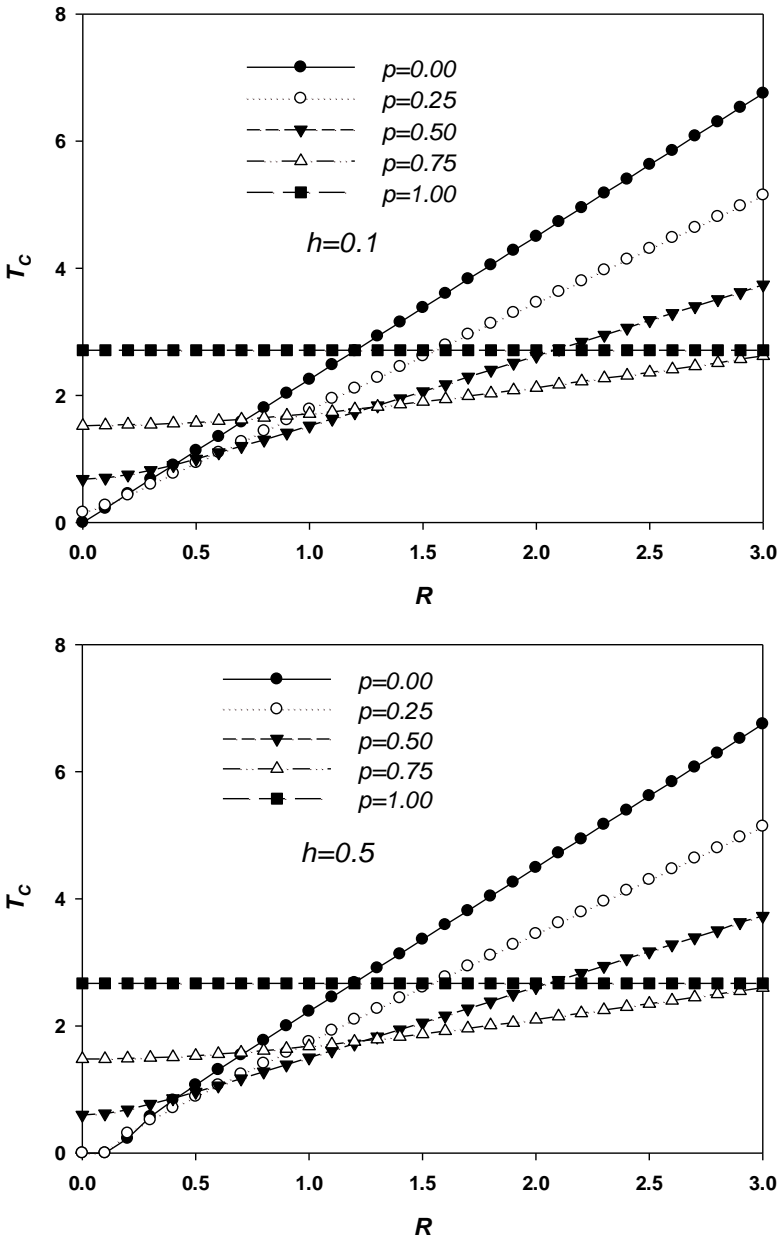
M. Heyl, Rep. Prog. Phys. 81 (2018) 054001 List of the Figure Captions Fig. 1: (color online) Schematic representation of ternary alloy spin model the type of ABpC1-p defined on a square lattice. A, B and C represented in yellow, blue and red respectively. Interaction between A and B sites is ferromagnetic (FM) and A and C antiferromagnetic (AFM). Fig. 2:...
work page 2018
discussion (0)
Sign in with ORCID, Apple, or X to comment. Anyone can read and Pith papers without signing in.