REVIEW 4 major objections 4 minor 12 references
Interplay of energy and charge transfer in WSe2/CrSBr heterostructures
T0 review · 4 major / 4 minor · reviewed 2026-08-05 · deepseek-v4-flash
Pith's one-line read Stacking WSe2 on the magnetic semiconductor CrSBr, this paper finds that a magnetic field brightens each WSe2 emission line exactly when CrSBr's B exciton crosses its energy.
desk verdict A solid experimental report of a new correlation—magnetic-field-tuned CrSBr B-exciton energy crossing WSe2 states with PL enhancements—but the RET mechanism is inferred, not proven; deserves peer review. read the letter →
The pith
A machine-rendered reading of the paper's core claim, the machinery that carries it, and where it could break.
The reading
What carries the argument
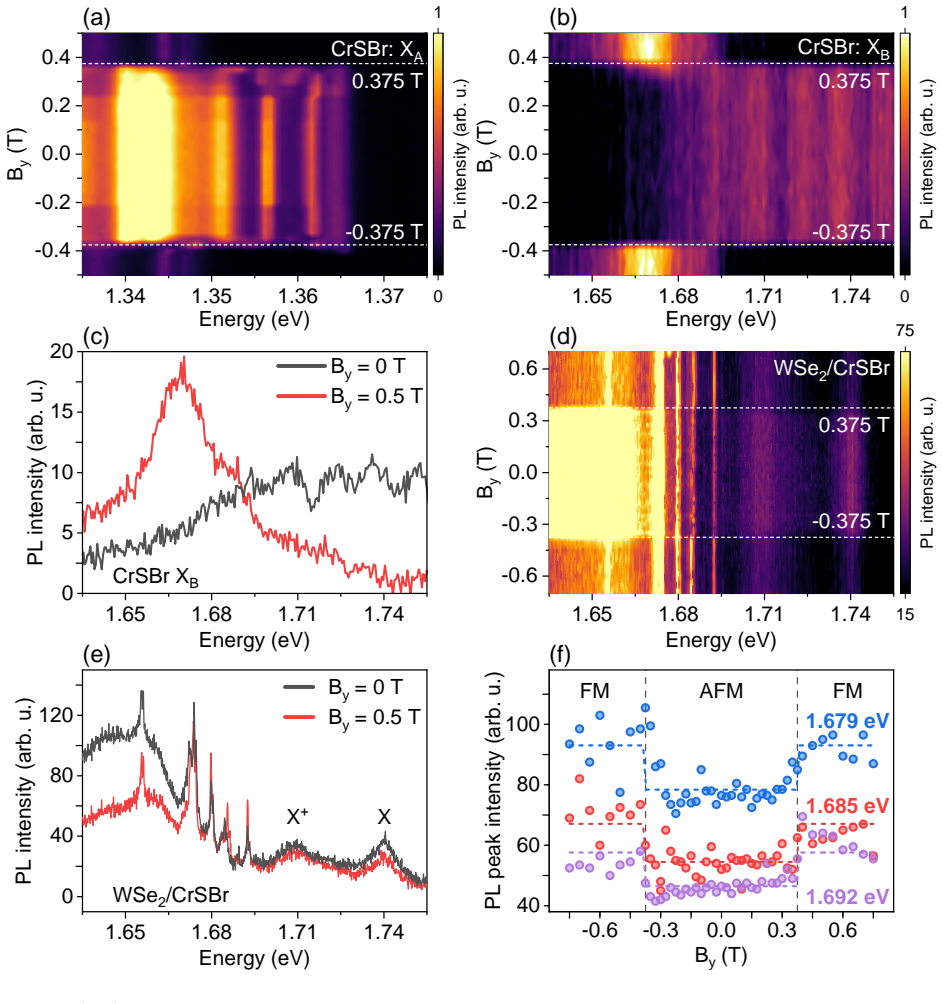
The load-bearing object is the B exciton (XB) of CrSBr, a higher-energy exciton whose emission energy shifts by ~80 meV with out-of-plane magnetic field; because the shift is large and monotonic, the field can tune XB across the WSe2 exciton, trion, and defect states. The argument then reads the coincidences between XB energy and WSe2 PL-peak variations as signatures of resonant energy transfer — dipole-dipole (Förster) or wavefunction-overlap (Dexter) transfer — working alongside the type-III band alignment charge transfer.
What would settle it
Spatially and spectrally resolve the PL of the WSe2/CrSBr stack while the CrSBr XB line is visible through the same stack: the RET claim predicts that each WSe2 intensity maximum occurs at the exact field where XB crosses the corresponding WSe2 peak, at the same laser spot.
Extended reading notes
Core claim
On its own terms, the paper reports that in a WSe2/CrSBr heterostructure, every PL feature of WSe2 responds differently to a magnetic field, and the differences line up with the field-dependent energy of the CrSBr B exciton (XB). Because XB redshifts strongly (~80 meV) under out-of-plane field, the applied field sweeps XB through resonance with the WSe2 exciton (X), trion (X+), and localized defect dark exciton (DDE) states one by one; at each crossing the corresponding WSe2 PL peak intensifies. For fields that do not create such a resonance, WSe2 PL weakens after the CrSBr field-induced ferromagnetic transition, which the authors attribute to a change in charge transfer. The sharp DDE lines
Load-bearing premise
The resonance condition is reconstructed using XB energies measured in a separate pristine CrSBr flake and then assumed to hold inside the WSe2/CrSBr stack at each WSe2 spot; the paper never measures XB directly through the stack.
Editorial extensions
If this is right
- A magnetic field can selectively enhance a chosen WSe2 emission line by parking XB at its resonance energy, giving in-situ control of which exciton channel dominates.
- Sharp defect-emission peaks, candidates for single-photon sources, brighten sharply at the CrSBr saturation field, suggesting a field-control knob for quantum-light emission.
- The RET contribution is short-range (<2 nm) and anisotropic, so engineering the spacer and crystal orientation controls whether energy transfer couples to WSe2.
- When CrSBr and WSe2 are off resonance, charge transfer still suppresses WSe2 emission after the magnetic phase transition, so the two mechanisms can be separated by field.
- These results extend magneto-optical tuning from valley and exciton energies to interlayer energy flow in magnetic van der Waals heterostructures.
Reading between the lines
- Beyond the paper: a spacer-thickness series (0–3 nm) would distinguish Dexter from Förster transfer; the paper only tests a single ~2 nm spacer, which suppresses both effects.
- Beyond the paper: because XB's resonance window is fixed by CrSBr's band structure, the same protocol should work in MoSe2/CrSBr or other TMDs whose exciton energies lie in the XB tuning range, allowing a family of field-tunable energy-transfer devices.
- Beyond the paper: the anisotropy of the enhancement suggests that RET directionality follows CrSBr's b-axis; one could test this by rotating the detection polarization and comparing transfer efficiency along a and b.
- Beyond the paper: a direct measurement of XB inside the heterostructure at the same spots would test the resonance coincidence assumption.
Editorial analysis
A structured set of objections, weighed in public.
Referee Report
Summary. The paper reports a magneto-photoluminescence study of a monolayer WSe2 flake placed on bulk CrSBr, with an hBN cap. The authors characterize the magnetic-field evolution of the WSe2 neutral exciton (X), positively charged trion (X+), defect band (D), and several sharp localized dark-exciton (DDE) emission lines under both out-of-plane (Bz) and in-plane (By) magnetic fields. They observe magnetic-field-dependent PL intensity changes in the WSe2 layer that differ from pristine WSe2, including intensity enhancements that appear when the CrSBr B-exciton (XB) energy, measured on a separate pristine CrSBr flake, is tuned close to WSe2 emission energies. These features are interpreted as a possible contribution of magnetic-field-controlled resonant energy transfer (RET) between CrSBr and WSe2, alongside charge-transfer changes across the field-induced magnetic phase transition. The authors also report that the DDE PL enhancement is anisotropic and suppressed when a ~2 nm hBN spacer is inserted between WSe2 and CrSBr.
Significance. If the central RET interpretation is valid, the work demonstrates a new magneto-optical control knob for interlayer energy transfer in van der Waals heterostructures, with potential relevance for light harvesting and single-photon emitter engineering. The experimental data set is rich: circularly and linearly resolved magneto-PL for two field geometries, DDE g-factors near 9, power-saturation evidence for localization, TRPL measurements, and an hBN-spacer control. These are genuine strengths and the paper is a useful observational contribution regardless of the final mechanistic label. However, the manuscript's headline claim depends on a resonance-matching analysis in which the CrSBr XB energy is not measured inside the WSe2/CrSBr stack at the same positions as the WSe2 signals. This weakens the evidential link between the observed PL enhancements and a specific RET process.
major comments (4)
- [Fig. 2(b),(d),(g); §'Here, we investigate'] The central resonance correlation rests on the XB dispersion measured on a pristine CrSBr flake (Fig. 2b), which is then assumed to hold inside the WSe2/CrSBr stack at positions S2–S6. Strain, charge transfer, and interface reconstruction can shift the XB energy and its field dependence. If the in-stack XB shift exceeds the relevant linewidth, the 'each time' correlations in Fig. 2(g) may be coincidental. The authors do not provide in-stack XB spectroscopy at the same spots or a quantitative estimate of the expected shift. Without this, the resonance condition is not secured.
- [§'There are different types of RET' and Fig. S21–S22] The hBN-spacer control suppresses both charge transfer and RET simultaneously. The observation that a ~2 nm spacer removes the effects therefore only establishes that the interaction is short-range, not that the mechanism is RET. In particular, it does not distinguish Dexter-type RET from a charge-transfer or proximity-driven process. This control cannot be used as evidence for RET without an additional probe that isolates energy transfer.
- [§'In order to understand our results' (TRPL discussion)] The authors report a reduction of the PL decay time under the resonant condition, yet for a Förster-type RET the acceptor should show a longer decay. They note that the donor/acceptor assignment is not straightforward, but this issue is central: the only dynamical measurement reported is not in the direction expected for the simplest RET picture. Either a concrete assignment of donor and acceptor, with modeled lifetimes, or a clear caveat that the TRPL data do not support a specific RET channel should be included.
- [Fig. 2(d),(g); text near 'For Bz < Bz_sat'] The claim that XB is tuned into resonance with X and X+ 'each time' before saturation is not quantified. The XB redshift is about 80 meV across the field range, while X and X+ are separated by about 30 meV; the specific crossing fields are not identified numerically, and the integrated-intensity traces in Fig. 2(g) show broad features rather than clearly separated resonances. A quantitative peak-by-peak analysis, including linewidths and error bars, would make the correlation testable and less dependent on visual inspection of the color maps.
minor comments (4)
- [Abstract and summary] The abstract states that intensity enhancement is observed 'each time' resonance occurs, while the main text repeatedly says 'possible contribution' and 'detailed mechanism is still unknown'. Please align the strength of the wording with the evidence level.
- [Fig. 3(f)] In the text accompanying Fig. 3(f), 'WSe2/CrSB' should read 'WSe2/CrSBr'.
- [References] Ref. 24 is incomplete ('ACS Nano 0, 0, null'); Ref. 23 has an unusual 'accessed' date format. Please update these entries.
- [Supporting Information line] The line 'Supporting Information A vail able' is a typo; should be 'Supporting Information Available'.
Circularity Check
No significant circularity; the resonance/RET claim rests on independently measured XB energies and WSe2 PL, not on fitted parameters or self-referential logic.
full rationale
The central claim — WSe2 PL intensity is enhanced when the CrSBr XB exciton is magnetically tuned into resonance with WSe2 optical states — is built from two separately measured quantities: the XB PL energy as a function of field in a pristine CrSBr flake (Fig. 2b) and the WSe2 PL peak energies and intensities in the heterostructure (Fig. 2d,g). Neither quantity is fitted to the other, and the enhancement is not used to define the resonance. The paper's interpretive attribution (brightening = possible RET; dimming = charge transfer) is a physical model, not a derivation that reduces to its inputs. The few self-citations (refs 21, 32, 36) support background assignments (charge transfer, DDE identification, proximity-induced spin canting) rather than the core resonance correlation; even if those citations were set aside, the observed field-dependent PL changes and the control sample remain. The hBN-spacer experiment is an actual experimental control, and the authors explicitly acknowledge the mechanism is not settled: 'the detailed mechanism for the RET in the WSe2/CrSBr is still unknown' and 'additional studies are necessary to fully understand.' The skeptic's objection that the pristine-flake XB energy may not represent the in-stack XB energy at the same spots is a legitimate experimental caveat about transferability of the resonance condition, but it is an evidence-quality issue, not a circularity: the XB field-dependence is an independent input, not re-derived from the WSe2 PL response. No step in the paper's reasoning makes the predicted quantity equal to a fitted parameter or to a self-citation by construction.
Assumptions & free parameters
assumptions (4)
- domain assumption CrSBr has a type-III band alignment with WSe2 that drives ground-state charge transfer and explains PL intensity changes via changes in the degree of charge transfer.
- domain assumption The XB exciton of CrSBr redshifts by about 80 meV with magnetic field following the field-induced magnetic phase transition around |Bz_sat| = 2.2 T, and this field dependence is the same in the pristine crystal and inside the heterostructure.
- domain assumption Weakly localized defective dark excitons in WSe2 near 1.68 eV possess an in-plane dipole moment, which allows Förster-type RET coupling.
- domain assumption For Bz > Bz_sat, valley Zeeman effect and carrier thermalization between K and K' valleys dominate the WSe2 PL changes.
Cite this review
Pith. "Pith review of Interplay of energy and charge transfer in WSe2/CrSBr heterostructures." pith.science (2026). https://pith.science/paper/GM6RH3CM
@misc{pith2026250900810,
  author       = {Pith},
  title        = {Pith review of: Interplay of energy and charge transfer in WSe2/CrSBr heterostructures},
  year         = {2026},
  howpublished = {\url{https://pith.science/paper/GM6RH3CM}},
  note         = {Machine review of arXiv:2509.00810}
}
read the original abstract
Van der Waals heterostructures (vdWHs) composed of transition-metal dichalcogenides (TMDs) and layered magnetic semiconductors offer great opportunities to manipulate exciton and valley properties of TMDs. Here, we present magneto-photoluminescence (PL) studies in a WSe2 monolayer (ML) on a CrSBr crystal, an anisotropic layered antiferromagnetic semiconductor. Our results reveal unique behavior of each of the ML-WSe2 PL peaks under magnetic field that is distinct from the pristine case. An intriguing feature is the clear enhancement of the PL intensity that we observe each time the external magnetic field tunes the energy of an exciton in CrSBr into resonance with one of the optical states of WSe2. This result suggests a magnetic field-controlled resonant energy transfer (RET) beyond other effects reported in similar structures. Our work provides deep insight on the importance of different mechanisms into magnetic vdWHs and underscores its great potential for light harvesting and emission enhancement of two-dimensional materials.
Figures


Figures from the paper (1 more)

Reference graph
Works this paper leans on
-
[1]
(1) Gong, C.; Li, L.; Li, Z.; Ji, H.; Stern, A.; Xia, Y.; Cao, T.; Bao, W.; Wang, C.; Wang, Y.; Qiu, Z. Q.; Cava, R. J.; Louie, S. G.; Xia, J.; Zhang, X. Discov- ery of intrinsic ferromagnetism in two- dimensional van der Waals crystals.Na- ture 2017, 546, 265–269. (2) Gibertini, M.; Koperski, M.; Mor- purgo, A. F.; Novoselov, K. S. Magnetic 2D materials ...
work page 2017
-
[2]
(58) de Oliveira, R.; Yoshida, A
Physical review letters2014, 113, 266804. (58) de Oliveira, R.; Yoshida, A. B. B.; Rabahi, C. R.; Freitas, R. O.; Teix- eira,V.C.; deMatos,C.J.; Gobato,Y.G.; Barcelos, I. D.; Cadore, A. R. Ultrathin natural biotite crystals as a dielectric layer for van der Waals heterostructure applica- tions. Nanotechnology 2024, 35, 505703. (59) Chen, S.-Y.; Goldstein,...
work page 2024
-
[8]
(4) Wang, Q. H. et al. The magnetic genome of two-dimensional van der Waals materi- als. ACS Nano 2022, 16, 6960–7079. (5) Huang, B.; Clark, G.; Navarro- Moratalla, E.; Klein, D. R.; Cheng, R.; Seyler, K. L.; Zhong, D.; Schmidgall, E.; McGuire, M. A.; Cobden, D. H.; Yao, W.; Xiao, D.; Jarillo-Herrero, P.; Xu, X. Layer-dependent ferromagnetism in a van der...
work page 2022
-
[118]
L.; Chaves, A.; Cavalini, C.; Rabahi, C
(36) Serati de Brito, C.; Rosa, B. L.; Chaves, A.; Cavalini, C.; Rabahi, C. R.; Franco, D. F.; Nalin, M.; Barcelos, I. D.; Reitzenstein, S.; Gobato, Y. G. Prob- ing the nature of single-photon emit- ters in a WSe2 monolayer by magneto- photoluminescence spectroscopy. Nano Letters 2024, 24, 13300–13306. (37) Alapatt, V.; Marques-Moros, F.; Boix-Constant, C...
work page 2024
-
[123]
(8) Glazov, M.; Arora, A.; Chaves, A.; Go- bato, Y. G. Excitons in two-dimensional materials and heterostructures: Opti- cal and magneto-optical properties.MRS Bulletin 2024, 1–15. (9) Wilson, N. P.; Lee, K.; Cenker, J.; Xie, K.; Dismukes, A. H.; Telford, E. J.; Fon- seca, J.; Sivakumar, S.; Dean, C.; Cao, T.; Roy, X.; Xu, X.; Zhu, X. Interlayer electroni...
work page 2024
-
[124]
(44) Kern, J.; Niehues, I.; Tonndorf, P.; Schmidt, R.; Wigger, D.; Schneider, R.; Stiehm, T.; Michaelis de Vasconcellos, S.; Reiter, D. E.; Kuhn, T.; Bratschitsch, R. Nanoscale Positioning of Single-Photon Emitters in Atomically Thin WSe2. Ad- vanced Materials (Deerfield Beach, Fla.) 2016, 28, 7101–7105. (45) Branny, A.; Kumar, S.; Proux, R.; Ger- ardot, ...
work page 2016
-
[1134]
(11) Nessi, L.; Occhialini, C. A.; Demir, A. K.; Powalla, L.; Comin, R. Magnetic Field Tunable Polaritons in the Ultrastrong Coupling Regime in CrSBr. ACS Nano 2024, 18, 34235–34243, PMID: 39639608. (12) Klein, J.; Pingault, B.; Florian, M.; Heißenbüttel, M.-C.; Steinhoff, A.; Song, Z.; Torres, K.; Dirnberger, F.; Curtis, J. B.; Weile, M.; others The bulk...
work page 2024
-
[3717]
(60) Li, Z.; Wang, T.; Lu, Z.; Kha- toniar, M.; Lian, Z.; Meng, Y.; Blei, M.; Taniguchi, T.; Watanabe, K.; McGill, S. A.; Tongay, S.; Menon, V. M.; Smirnov, D.; Shi, S.-F. Direct observation of gate-tunable dark trions in monolayer WSe2. Nano Letters2019, 19, 6886–6893. (61) Prando, G. A.; Severijnen, M. E.; Barce- los, I. D.; Zeitler, U.; Christianen, P....
work page 2021
Show all 12 references
-
[4163]
P.; Gillard, D.; Molina- Sánchez, A.; Misra, A.; Withers, F.; Keat- ley, P
(31) Lyons, T. P.; Gillard, D.; Molina- Sánchez, A.; Misra, A.; Withers, F.; Keat- ley, P. S.; Kozikov, A.; Taniguchi, T.; Watanabe, K.; Novoselov, K. S.; others Interplay between spin proximity effect andcharge-dependentexcitondynamicsin MoSe2/CrBr3 van der Waals heterostruc-...
2020
-
[4745]
Layer- dependent interlayer antiferromagnetic spin reorientation in air-stable semicon- ductor CrSBr
(16) Ye, C.; Wang, C.; Wu, Q.; Liu, S.; Zhou, J.; Wang, G.; Söll, A.; Sofer, Z.; Yue, M.; Liu, X.; Tian, M.; Xiong, Q.; Ji, W.; Renshaw Wang, X. Layer- dependent interlayer antiferromagnetic spin reorientation in air-stable semicon- ductor CrSBr. ACS Nano 2022, 16, 11876–11883...
-
[6021]
E.; Parzefall, P.; Ghi- asi, T
(32) Beer, A.; Zollner, K.; Serati de Brito, C.; Faria Junior, P. E.; Parzefall, P.; Ghi- asi, T. S.; Ingla-Aynés, J.; Mañas- Valero, S.; Boix-Constant, C.; Watan- abe, K.; others Proximity-Induced Ex- change Interaction and Prolonged Val- ley Lifetime in MoSe2/CrSBr Van-Der- ...
2024
-
[9783]
Fine structure and lifetime of dark excitons in transition metal dichalcogenide monolayers.Physical Review B 2017, 96, 155423
(48) Robert, C.; Amand, T.; Cadiz, F.; La- garde, D.; Courtade, E.; Manca, M.; Taniguchi, T.; Watanabe, K.; Ur- baszek, B.; Marie, X. Fine structure and lifetime of dark excitons in transition metal dichalcogenide monolayers.Physical Review B 2017, 96, 155423. (49) Srivastava,...
2017
Reviewed August 5, 2026 · model on record in the stance chip above.
Discussion (0). Sign in to comment.