REVIEW 3 major objections 6 minor 1 cited by
SDDiff: Boost Radar Perception via Spatial-Doppler Diffusion
T0 review · 3 major / 6 minor · reviewed 2026-08-15 · deepseek-v4-flash
Pith's one-line read SDDiff is a single diffusion model that jointly extracts dense radar point clouds and estimates ego velocity, reporting 4x density and 59% better velocity accuracy.
desk verdict Genuinely novel joint radar PCE/EVE diffusion with an untested static-scene assumption and a couple of unsupported claims, but worth serious review. read the letter →
The pith
A machine-rendered reading of the paper's core claim, the machinery that carries it, and where it could break.
The reading
What carries the argument
The load-bearing object is the Spatial-Doppler Domain Representation (SDDR): a compact 4D tensor $C=[u;v]\in\mathbb{R}^{R\times A\times E\times 2}$ built from raw radar signals by a fast Fourier transform (FFT), where $u$ is peak intensity (spatial occupancy) and $v$ is the Doppler-bin index (radial velocity) at each range-azimuth-elevation cell. SDDiff treats point cloud extraction and ego velocity estimation as one purification task on this tensor. The forward process diffuses LiDAR-aligned target occupancy $x_0$ toward the radar prior $u_0$ rather than to Gaussian noise, $q(x_t|x_{t-1},u_0)=\mathcal{N}(x_t;\alpha_t x_{t-1}+(1-\alpha_t)u_0,\lambda_t^2 I)$, with a closed-form posterior mean used for fast sampling. In parallel, Iterative Doppler Refinement forms a soft mask from the refined occupancy, projects it onto the Doppler profile, and enforces the physical relation $v_r=[\cos a\cos e,\sin a\cos e,\sin e]\cdot v_{\text{ego}}$ through a learned velocity critic $f_\psi$, producing the Doppler-consistency loss $\mathcal{L}_{\text{Doppler}}$ that ties the two tasks together.
What would settle it
Collect radar frames from scenes where moving targets occupy most of the field of view, such as a busy intersection with many vehicles, run SDDiff, and compare its ego-velocity mean absolute error and point-cloud validity against near-static scenes; if performance collapses or the Doppler-consistency loss rises sharply, the static-dominance premise is the limiting factor. A direct ablation on such scenes with and without the Doppler-consistency loss would settle whether the loop helps or hurts.
Extended reading notes
Core claim
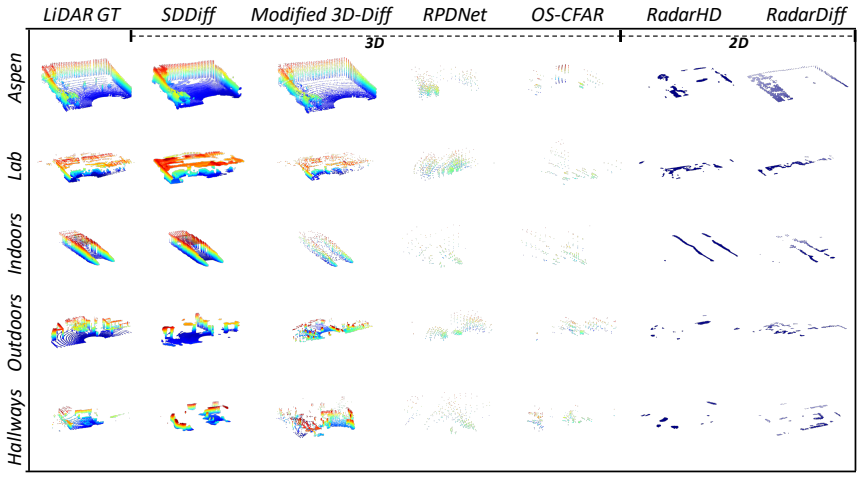
The paper's central claim is that point cloud extraction and ego velocity estimation in millimeter-wave radar are not separate tasks: each improves the other. SDDiff demonstrates this by learning to purify a coarse radar representation—a tensor holding both spatial occupancy and Doppler velocity—into a fine, ghost-free version, while a trained Doppler-consistency critic reads ego velocity off the refined points and feeds the physical constraint back into the refinement. The reported results are the concrete form of the claim: ego-velocity mean absolute error drops to 0.09 m/s indoors and 0.11 m/s outdoors, and generated point clouds align with LiDAR ground truth at about half the Earth Mover's Distance and Chamfer Distance (EMD/CD) error of the best prior generative method, with a 4x gain in valid generation density.
Load-bearing premise
The Doppler-consistency loss assumes that static targets dominate the radar field of view, so that a point's measured speed toward or away from the radar (radial velocity) is almost always the projection of the radar's own velocity; in scenes dominated by moving objects this critic would push the refinement in the wrong direction.
Editorial extensions
If this is right
- Point cloud extraction (PCE) and ego velocity estimation (EVE) are mutually beneficial in the same pass: denser, cleaner point clouds improve velocity estimates, and the physical Doppler-consistency constraint suppresses ghost points.
- Radar-only perception can bypass sparse onboard CFAR points, since SDDiff operates directly on raw radar signals and produces dense 3D points with reliable velocities for downstream localization, mapping, and detection.
- Directional diffusion reduces sampling cost: starting from radar priors rather than pure Gaussian noise speeds generation by 3.13x over a modified standard 3D diffusion while keeping EMD/CD roughly half of the best prior method.
- EVE accuracy on the reported benchmarks reaches 0.09 m/s indoors and 0.11 m/s outdoors, with 95% of outdoor errors under 0.25 m/s, a range usable for radar odometry and motion compensation.
Reading between the lines
- A natural extension is to feed SDDiff's refined point clouds into a radar odometry or SLAM pipeline to test whether the PCE/EVE gains translate into lower trajectory drift; the paper does not report this end-to-end result itself.
- The same directional-diffusion idea—anchoring a generative process on a cheap physical prior instead of Gaussian noise—could apply to other sparse-to-dense sensor problems, such as ultrasonic arrays or quantized LiDAR, whenever a physically consistent coarse observation exists.
- Because the Doppler-consistency loss assumes static targets dominate, the method's boundary likely shows up in dynamic scenes; a stress-test split by moving-object fraction would map where the reciprocal loop stops being beneficial.
Signed reviews
Editorial analysis
A structured set of objections, weighed in public.
Referee Report
Summary. The paper introduces SDDiff, a latent diffusion model that jointly performs point cloud extraction (PCE) and ego velocity estimation (EVE) from single-chip radar ADC data. The contribution is a Spatial-Doppler Domain Representation (SDDR) that encodes both intensity and Doppler velocity, a directional diffusion process that uses the radar SDDR as a prior to reduce sampling steps, and an Iterative Doppler Refinement module that couples spatial occupancy and ego velocity through a Doppler-consistency loss. Experiments on the ColoRadar dataset and a self-collected dataset report large gains over baselines, e.g., EVE MAE of 0.09/0.11 m/s indoors/outdoors and roughly halved EMD/CD relative to the best prior method.
Significance. If the results hold, this is a useful step toward unified radar perception: it is, to the best of the authors' knowledge, the first method to address PCE and EVE jointly from raw ADC data, and the directional-diffusion formulation is an interesting variant of DDPM with a closed-form posteriors. The paper provides closed-form expressions for the forward and reverse processes, a clear physical motivation for Doppler consistency, and extensive quantitative comparisons. The claimed reciprocal PCE/EVE benefit is a falsifiable and practically relevant claim. However, the central Doppler-consistency mechanism relies on an untested static-target dominance assumption, and there are internal inconsistencies in the diffusion schedule and in Eq. (6) that need correction.
major comments (3)
- [§3.2, Eqs. (8)-(9)] The Doppler-consistency loss assumes every Doppler return is generated by ego motion, v_r = [cos(a)cos(e), sin(a)cos(e), sin(e)]·v_ego, and Eq. (9) penalizes the discrepancy between a learned f_ψ(M_t⊙v) and the ego velocity. In scenes with moving objects, those objects contribute Doppler measurements that violate this model, biasing the velocity critic; the wrong ego velocity is then fed back into the iterative refinement, degrading both PCE and EVE coherently. The paper states that "static targets dominate the radar field of view in scene-level PCE" but provides no experiment that varies the static/dynamic composition: ColoRadar sequences are not annotated for dynamic-object ratio, the self-collected dataset is not characterized in this respect, and no ablation isolates performance under moving-target-dominated conditions. This assumption is load-bearing for the claimed 59% EVE improvement and the reciprocal PCE/EVE benefit, so the paper should either stress-test this regime or explicitly scope its claims.
- [§4.2, forward-process schedule] The implementation description says "forward process variances are set to constants increasing linearly from \bar{\alpha}_1 = 0.01 to \bar{\alpha}_T = 0.99," but \bar{\alpha}_t is defined in Theorem 1 as the cumulative product of α_k. With each α_k multiplying the previous state in Eq. (1), α_k < 1 implies \bar{\alpha}_t decreases with t; an increasing sequence from 0.01 to 0.99 is impossible under the stated definitions. The text also leaves unclear whether λ_k is a constant schedule or varies with t. This inconsistency affects the forward process, the posterior mean in Eq. (5), and the sampling procedure, so it must be clarified and corrected.
- [§3.1, Eq. (6)] The parameterized reverse mean in Eq. (6) appears to have an incorrect sign on the noise term. Starting from the exact posterior mean in Eq. (5) and substituting x_0 = (x_t − (1−\bar{\alpha}_t)u_0 − β_t ε)/\bar{\alpha}_t, the coefficient of ε is −λ_t^2/(α_t β_t), not +λ_t^2/(α_t β_t) as printed. Since the training objective in Eq. (7) trains ε_θ to predict ε, the reverse sampling step in Eq. (6) should subtract the ε_θ term rather than add it. This is a central derivation point for the generative process and must be fixed or justified.
minor comments (6)
- [§A.1/theorems] The proofs of Theorems 1 and 2 are deferred to the supplementary material; if the appendix is not part of the published version, the main text should at least sketch the derivation or the supplementary should be referenced clearly.
- [Abstract] The abstract states "59% higher EVE accuracy" and "4X greater in valid generation density" without naming the baseline for each comparison; specify the reference method or table.
- [§4.3] The PCE section introduces MHD in Table 2 but does not define it in the evaluation metrics; either define it in §4.3 or remove it from the table.
- [§4.2] The sentence "We apply Gaussian filtering with sigma values of [0.2, 0.5, 1] as the filter encoder" is unclear; explain what the filter encoder is and how the three sigmas are used.
- [§5.3, Table 4] The abbreviation "V.E." in Table 4 is not defined in the caption; it should be spelled out or referenced to §4.3.
- [Throughout] Several references are cited with years rather than author names (e.g., "OS-CFAR [1988]", "RPDNet [2022]"), which is nonstandard; the bibliography should be formatted consistently.
Circularity Check
No significant circularity: SDDiff's predictions are supervised against external LiDAR and odometry ground truth.
full rationale
The paper's claimed derivation chain is self-contained against external benchmarks. The directional diffusion (Sec. 3.1, Eq. 1-7) defines a conditional generative process from radar prior u0 to LiDAR target x0; Theorem 1 and 2 are standard closed-form Gaussian manipulations and do not reduce to their inputs by construction. The Iterative Doppler Refinement (Sec. 3.2, Eq. 8-9) uses the physical Doppler relation v_r = [cos a cos e, sin a cos e, sin e] · v_ego and supervises f_psi with ground-truth ego velocity; the loss LDoppler is not a self-defined target. The only self-citation is Fan et al. 2024 (with co-author Wei Wang) in Related Work, where it is mentioned as prior work predicting Range-Doppler maps; it is not load-bearing for any central claim. The ablation study (Tab. 4) empirically demonstrates the reciprocal PCE/EVE gains rather than assuming them. The static-dominance assumption underlying Eq. 8 is a domain assumption about scene composition, not a circular step, since it is not used to define the prediction targets.
Assumptions & free parameters
free parameters (5)
- omega (weight for Doppler loss) =
0.01
- Gaussian filter sigmas for LiDAR softening =
[0.2, 0.5, 1]
- Forward process schedule =
bar_alpha_1=0.01, bar_alpha_T=0.99, lambda_k=0.1
- Sampling steps T =
20
- PCE metric thresholds tau_1, tau_2 =
not specified in text
assumptions (5)
- domain assumption Static targets dominate the radar field of view in scene-level PCE.
- domain assumption The maximum value along the Doppler axis is at least 6x greater than the second maximum when a point exists.
- domain assumption LiDAR point clouds are treated as ground truth for radar point cloud extraction.
- domain assumption Odometry (ColoRadar) and Fast-Livo (self-collected) provide ground truth ego velocity.
- standard math Standard linear-Gaussian posterior tractability in Theorem 2.
Cite this review
Pith. "Pith review of SDDiff: Boost Radar Perception via Spatial-Doppler Diffusion." pith.science (2026). https://pith.science/paper/GM75KHK7
@misc{pith2026250616936,
  author       = {Pith},
  title        = {Pith review of: SDDiff: Boost Radar Perception via Spatial-Doppler Diffusion},
  year         = {2026},
  howpublished = {\url{https://pith.science/paper/GM75KHK7}},
  note         = {Machine review of arXiv:2506.16936}
}
read the original abstract
Point cloud extraction (PCE) and ego velocity estimation (EVE) are key capabilities gaining attention in 3D radar perception. However, existing work typically treats these two tasks independently, which may neglect the interplay between radar's spatial and Doppler domain features, potentially introducing additional bias. In this paper, we observe an underlying correlation between 3D points and ego velocity, which offers reciprocal benefits for PCE and EVE. To fully unlock such inspiring potential, we take the first step to design a Spatial-Doppler Diffusion (SDDiff) model for simultaneously dense PCE and accurate EVE. To seamlessly tailor it to radar perception, SDDiff improves the conventional latent diffusion process in three major aspects. First, we introduce a representation that embodies both spatial occupancy and Doppler features. Second, we design a directional diffusion with radar priors to streamline the sampling. Third, we propose Iterative Doppler Refinement to enhance the model's adaptability to density variations and ghosting effects. Extensive evaluations show that SDDiff significantly outperforms state-of-the-art baselines by achieving 59% higher in EVE accuracy, 4X greater in valid generation density while boosting PCE effectiveness and reliability.
Figures


Figures from the paper (4 more)



Forward citations
Cited by 1 Pith paper
-
Sem-RaDiff: Diffusion-Based 3D Radar Semantic Perception in Cluttered Agricultural Environments
Sem-RaDiff uses frame accumulation, a sparse coarse-to-fine network, and a diffusion model with one-step consistency sampling to generate LiDAR-like 3D semantic point clouds from mmWave radar in agricultural fields, o...
Reference graph
Works this paper leans on
-
[1]
Cfear radarodometry-conservative filtering for efficient and accurate radar odometry
[Adolfsson et al., 2021] Daniel Adolfsson, Martin Magnus- son, Anas Alhashimi, Achim J Lilienthal, and Henrik An- dreasson. Cfear radarodometry-conservative filtering for efficient and accurate radar odometry. In 2021 IEEE/RSJ International Conference on Intelligent Robots and Sys- tems (IROS), pages 5462–5469. IEEE,
work page 2021
-
[15]
Denoising diffusion probabilistic models
[Ho et al., 2020] Jonathan Ho, Ajay Jain, and Pieter Abbeel. Denoising diffusion probabilistic models. Advances in neural information processing systems , 33:6840–6851,
2020
-
[16]
Instantaneous ego-motion estimation using doppler radar
[Kellner et al., 2013] Dominik Kellner, Michael Barjen- bruch, Jens Klappstein, J¨urgen Dickmann, and Klaus Diet- mayer. Instantaneous ego-motion estimation using doppler radar. In 16th International IEEE Conference on Intelli- gent Transportation Systems (ITSC 2013), pages 869–874. IEEE,
work page 2013
-
[18]
Col- oradar: The direct 3d millimeter wave radar dataset
[Kramer et al., 2022] Andrew Kramer, Kyle Harlow, Christopher Williams, and Christoffer Heckman. Col- oradar: The direct 3d millimeter wave radar dataset. The International Journal of Robotics Research , 41(4):351– 360,
work page 2022
-
[19]
Enabling visual recognition at radio fre- quency
[Lai et al., 2024] Haowen Lai, Gaoxiang Luo, Yifei Liu, and Mingmin Zhao. Enabling visual recognition at radio fre- quency. In Proceedings of the 30th Annual International Conference on Mobile Computing and Networking, pages 388–403,
work page 2024
-
[20]
On robust capon beamforming and diagonal loading
[Li et al., 2003] Jian Li, Petre Stoica, and Zhisong Wang. On robust capon beamforming and diagonal loading. IEEE transactions on signal processing , 51(7):1702– 1715,
work page 2003
-
[21]
See through smoke: robust indoor mapping with low-cost mmwave radar
[Lu et al., 2020] Chris Xiaoxuan Lu, Stefano Rosa, Peijun Zhao, Bing Wang, Changhao Chen, John A Stankovic, Niki Trigoni, and Andrew Markham. See through smoke: robust indoor mapping with low-cost mmwave radar. In Proceedings of the 18th International Conference on Mo- bile Systems, Applications, and Services , pages 14–27,
work page 2020
-
[22]
Diffusion- based point cloud super-resolution for mmwave radar data
[Luan et al., 2024] Kai Luan, Chenghao Shi, Neng Wang, Yuwei Cheng, Huimin Lu, and Xieyuanli Chen. Diffusion- based point cloud super-resolution for mmwave radar data. In 2024 IEEE International Conference on Robotics and Automation (ICRA), pages 11171–11177,
work page 2024
Show all 37 references
-
[23]
Constant-false-alarm- rate signal processors for several types of interference
[Nitzberg, 1972] Ramon Nitzberg. Constant-false-alarm- rate signal processors for several types of interference. IEEE Transactions on Aerospace and Electronic Systems, (1):27–34,
1972
-
[25]
High resolution point clouds from mmwave radar
[Prabhakara et al., 2023] Akarsh Prabhakara, Tao Jin, Arnav Das, Gantavya Bhatt, Lilly Kumari, Elahe Soltanaghai, Jeff Bilmes, Swarun Kumar, and Anthony Rowe. High resolution point clouds from mmwave radar. In 2023 IEEE International Conference on Robotics and Automa- tion (IC...
2023
-
[27]
High-resolution image synthesis with latent diffusion models
[Rombach et al., 2022] Robin Rombach, Andreas Blattmann, Dominik Lorenz, Patrick Esser, and Bj ¨orn Ommer. High-resolution image synthesis with latent diffusion models. In Proceedings of the IEEE/CVF conference on computer vision and pattern recognition , pages 10684–10695,
2022
-
[28]
U-net: Convolutional networks for biomedical image segmentation
[Ronneberger et al., 2015] Olaf Ronneberger, Philipp Fis- cher, and Thomas Brox. U-net: Convolutional networks for biomedical image segmentation. In Medical image computing and computer-assisted intervention–MICCAI 2015: 18th international conference, Munich, Germany, October ...
2015
-
[33]
Fol- lowupar: Enabling follow-up effects in mobile ar appli- cations
[Xu et al., 2021] Jingao Xu, Guoxuan Chi, Zheng Yang, Danyang Li, Qian Zhang, Qiang Ma, and Xin Miao. Fol- lowupar: Enabling follow-up effects in mobile ar appli- cations. In Proceedings of the 19th Annual International Conference on Mobile Systems, Applications, and Ser- vice...
2021
-
[34]
Sira: Scalable inter- frame relation and association for radar perception
[Yataka et al., 2024] Ryoma Yataka, Pu Wang, Petros Boufounos, and Ryuhei Takahashi. Sira: Scalable inter- frame relation and association for radar perception. InPro- ceedings of the IEEE/CVF Conference on Computer Vision and Pattern Recognition, pages 15024–15034,
2024
-
[35]
Sar- to-optical image translation via neural partial differential equations
[Zhang et al., 2022] Mingjin Zhang, Chengyu He, Jing Zhang, Yuxiang Yang, Xiaoqi Peng, and Jie Guo. Sar- to-optical image translation via neural partial differential equations. In IJCAI, pages 1644–1650,
2022
-
[36]
Towards dense and ac- curate radar perception via efficient cross-modal diffusion model
[Zhang et al., 2024] Ruibin Zhang, Donglai Xue, Yuhan Wang, Ruixu Geng, and Fei Gao. Towards dense and ac- curate radar perception via efficient cross-modal diffusion model. IEEE Robotics and Automation Letters, 9(9):7429– 7436,
2024
-
[37]
Fast-livo: Fast and tightly-coupled sparse-direct lidar-inertial-visual odome- try
[Zheng et al., 2022] Chunran Zheng, Qingyan Zhu, Wei Xu, Xiyuan Liu, Qizhi Guo, and Fu Zhang. Fast-livo: Fast and tightly-coupled sparse-direct lidar-inertial-visual odome- try. In 2022 IEEE/RSJ international conference on intelli- gent robots and systems (IROS), pages 4003–40...
2022
-
[1972]
Radarmoseve: A spatial-temporal transformer network for radar-only mov- ing object segmentation and ego-velocity estimation
[Pang et al., 2024] Changsong Pang, Xieyuanli Chen, Yimin Liu, Huimin Lu, and Yuwei Cheng. Radarmoseve: A spatial-temporal transformer network for radar-only mov- ing object segmentation and ego-velocity estimation. In Proceedings of the AAAI Conference on Artificial Intelli- ...
2024
-
[1981]
Gen- erative adversarial nets
[Goodfellow et al., 2014] Ian Goodfellow, Jean Pouget- Abadie, Mehdi Mirza, Bing Xu, David Warde-Farley, Sherjil Ozair, Aaron Courville, and Yoshua Bengio. Gen- erative adversarial nets. Advances in neural information processing systems, 27,
2014
-
[1984]
Method for registration of 3-d shapes
[Besl and McKay, 1992] Paul J Besl and Neil D McKay. Method for registration of 3-d shapes. In Sensor fusion IV: control paradigms and data structures , volume 1611, pages 586–606. Spie,
1992
-
[1986]
Generalized-icp
[Segal et al., 2009] Aleksandr Segal, Dirk Haehnel, and Se- bastian Thrun. Generalized-icp. In Robotics: science and systems, volume 2, page
2009
-
[1988]
Precise ego-motion estimation with millimeter-wave radar under diverse and challenging conditions
[Cen and Newman, 2018] Sarah H Cen and Paul Newman. Precise ego-motion estimation with millimeter-wave radar under diverse and challenging conditions. In 2018 IEEE International Conference on Robotics and Automation (ICRA), pages 6045–6052. IEEE,
2018
-
[1989]
Multiple emitter location and signal parameter estimation
[Schmidt, 1986] Ralph Schmidt. Multiple emitter location and signal parameter estimation. IEEE transactions on an- tennas and propagation, 34(3):276–280,
1986
-
[1992]
The normal distributions transform: A new approach to laser scan matching
[Biber and Straßer, 2003] Peter Biber and Wolfgang Straßer. The normal distributions transform: A new approach to laser scan matching. In Proceedings 2003 IEEE/RSJ International Conference on Intelligent Robots and Sys- tems (IROS 2003)(Cat. No. 03CH37453), volume 3, pages 274...
2003
-
[2003]
Os-cfar theory for multiple targets and nonuniform clutter
[Blake, 1988] Stephen Blake. Os-cfar theory for multiple targets and nonuniform clutter. IEEE transactions on aerospace and electronic systems, 24(6):785–790,
1988
-
[2008]
A novel radar point cloud generation method for robot environment perception
[Cheng et al., 2022] Yuwei Cheng, Jingran Su, Mengxin Jiang, and Yimin Liu. A novel radar point cloud generation method for robot environment perception. IEEE Transac- tions on Robotics, 38(6):3754–3773,
2022
-
[2009]
3drimr: 3d recon- struction and imaging via mmwave radar based on deep learning
[Sun et al., 2021] Yue Sun, Zhuoming Huang, Honggang Zhang, Zhi Cao, and Deqiang Xu. 3drimr: 3d recon- struction and imaging via mmwave radar based on deep learning. In 2021 IEEE International Performance, Com- puting, and Communications Conference (IPCCC), pages 1–8. IEEE,
2021
-
[2013]
Instantaneous ego-motion estimation using multi- ple doppler radars
[Kellner et al., 2014] Dominik Kellner, Michael Barjen- bruch, Jens Klappstein, J¨urgen Dickmann, and Klaus Diet- mayer. Instantaneous ego-motion estimation using multi- ple doppler radars. In2014 IEEE International Conference on Robotics and Automation (ICRA) , pages 1592–1597. IEEE,
2014
-
[2014]
Through fog high-resolution imaging using millimeter wave radar
[Guan et al., 2020] Junfeng Guan, Sohrab Madani, Suraj Jog, Saurabh Gupta, and Haitham Hassanieh. Through fog high-resolution imaging using millimeter wave radar. In Proceedings of the IEEE/CVF Conference on Computer Vision and Pattern Recognition , pages 11464–11473,
2020
-
[2015]
Esprit-estimation of signal parameters via rotational in- variance techniques
[Roy and Kailath, 1989] Richard Roy and Thomas Kailath. Esprit-estimation of signal parameters via rotational in- variance techniques. IEEE Transactions on acoustics, speech, and signal processing, 37(7):984–995,
1989
-
[2018]
Radar-only ego-motion estimation in difficult settings via graph matching
[Cen and Newman, 2019] Sarah H Cen and Paul Newman. Radar-only ego-motion estimation in difficult settings via graph matching. In 2019 International Conference on Robotics and Automation (ICRA) , pages 298–304. IEEE,
2019
-
[2019]
An icp variant using a point- to-line metric
[Censi, 2008] Andrea Censi. An icp variant using a point- to-line metric. In 2008 IEEE international conference on robotics and automation, pages 19–25. Ieee,
2008
-
[2020]
A new wave in robotics: Survey on recent mmwave radar appli- cations in robotics
[Harlow et al., 2024] Kyle Harlow, Hyesu Jang, Timothy D Barfoot, Ayoung Kim, and Christoffer Heckman. A new wave in robotics: Survey on recent mmwave radar appli- cations in robotics. IEEE Transactions on Robotics,
2024
-
[2021]
Developments in radar imaging
[Ausherman et al., 1984] Dale A Ausherman, Adam Kozma, Jack L Walker, Harrison M Jones, and Enrico C Poggio. Developments in radar imaging. IEEE Transactions on Aerospace and Electronic Systems, (4):363–400,
1984
-
[2022]
Enhancing mmwave radar point cloud via visual-inertial supervision
[Fan et al., 2024] Cong Fan, Shengkai Zhang, Kezhong Liu, Shuai Wang, Zheng Yang, and Wei Wang. Enhancing mmwave radar point cloud via visual-inertial supervision. arXiv preprint arXiv:2404.17229,
2024 arXiv
-
[2023]
3d point cloud generation with millimeter-wave radar
[Qian et al., 2020] Kun Qian, Zhaoyuan He, and Xinyu Zhang. 3d point cloud generation with millimeter-wave radar. Proceedings of the ACM on Interactive, Mobile, Wearable and Ubiquitous Technologies, 4(4):1–23,
2020
-
[2024]
Random sample consensus: a paradigm for model fitting with applications to image analysis and automated cartography
[Fischler and Bolles, 1981] Martin A Fischler and Robert C Bolles. Random sample consensus: a paradigm for model fitting with applications to image analysis and automated cartography. Communications of the ACM , 24(6):381– 395,
1981
Reviewed August 15, 2026 · model on record in the stance chip above.
Discussion (0). Continue with ORCID to comment.