REVIEW 3 major objections 4 minor 42 references
Charge density wave with anomalous temperature dependence in UPt2Si2
T0 review · 3 major / 4 minor · reviewed 2026-08-14 · deepseek-v4-flash
Pith's one-line read Using neutron and x-ray diffraction, this paper reports the discovery of a charge density wave in UPt2Si2 below 320 K, attributed to the long-sought heat-capacity and resistivity anomalies.
desk verdict A clean diffraction discovery of a superlattice modulation in UPt2Si2 with an unusually evolving wavevector, but the CDW label and the causal link to bulk anomalies are inferred rather than directly measured. read the letter →
The pith
A machine-rendered reading of the paper's core claim, the machinery that carries it, and where it could break.
The reading
What carries the argument
The key machinery is single-crystal neutron and x-ray diffraction combined with neutron polarization analysis, which distinguishes charge/lattice scattering from magnetic scattering. The diffraction intensity of satellite peaks is modeled by the formula I(q) ≈ |Σν (q·εν) fν(q ± Qmod)|² δ(q − G ± Qmod), where εν is the atomic displacement and fν the partial structure factor, explaining the observed polarization dependence. Density-functional-theory supercell relaxations (4×1×1, 5×1×1, 6×1×1) reproduce the displacement pattern and show an energy gain of 8.6 meV per unit cell for the 5×1×1 case, supporting a unidirectional CDW.
What would settle it
A measurement that would settle the claim is a direct probe of the electronic charge modulation, for example resonant x-ray scattering at the U or Pt absorption edges to detect a charge-order signal, or scanning tunneling microscopy to image the modulation on the surface. If no electronic charge modulation is found associated with the superlattice peaks, the CDW interpretation would be in doubt. Also, a careful check that the superlattice peaks disappear in a completely annealed, stoichiometric sample would rule out an impurity-phase origin.
Extended reading notes
Core claim
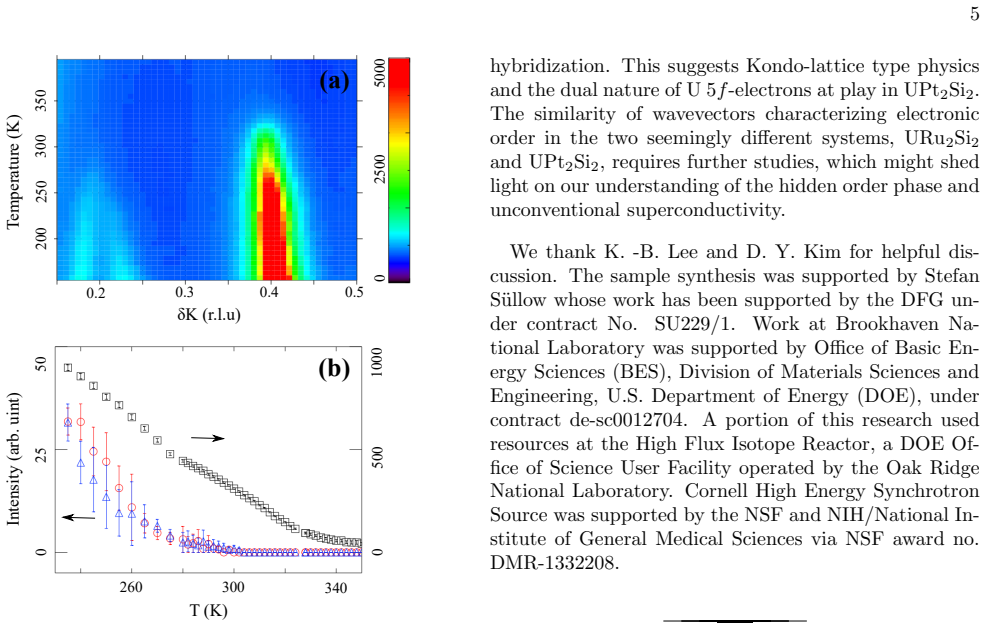
The central discovery is a periodic lattice modulation in UPt2Si2, identified as a charge density wave by single-crystal neutron and synchrotron x-ray diffraction. Superlattice reflections appear below a second-order-like transition at Ts = 319(8) K, with the displacement pattern being mostly transverse and confined largely to the Si(2)-Pt(2)-Si(2) layers. Polarization analysis shows the reflections are non-magnetic. The modulation wavevector Qmod = (τ, 0, 0) evolves with temperature, shifting from τ ≈ 0.40 just below Ts to a lock-in value τ ≈ 0.42 below about 180 K. This unusual commensurate-to-incommensurate shift on cooling is linked to the onset of Kondo-lattice-like coherence, and the CDW coexists with antiferromagnetic order below TN = 35 K.
Load-bearing premise
The identification of the superlattice peaks as a charge density wave rests on the assumption that the observed atomic displacement modulation is accompanied by an electronic charge modulation and that this modulation is intrinsic to stoichiometric UPt2Si2, rather than a purely structural superstructure or an impurity phase.
Editorial extensions
If this is right
- The heat capacity and resistivity anomalies near 320 K in UPt2Si2, previously attributed to structural disorder, are instead caused by a charge density wave, resolving a longstanding controversy about this compound.
- The CDW coexists with antiferromagnetic order below 35 K, establishing UPt2Si2 as a system where charge order and magnetic order occur simultaneously.
- The temperature-dependent wavevector, shifting from commensurate to incommensurate on cooling, challenges conventional expectations that lock-in to commensurate values is favored at low temperature.
- The similarity between the CDW wavevector and the incommensurate wavevector in URu2Si2 suggests a common electronic instability in these two uranium compounds.
- The coupling of the CDW to the Kondo-lattice coherence crossover near 180 K indicates that charge order can be influenced by the development of heavy-fermion behavior.
Reading between the lines
- If the CDW is intrinsic, it could be a generic feature of UT2M2 compounds with CaBe2Ge2 structure, and similar superlattice reflections might be found in other members of this family.
- The identification of the CDW as the cause of the room-temperature anomalies could be tested by measuring a Fermi-surface gap or a lattice distortion directly with ARPES or resonant x-ray scattering, which the paper does not report.
- The shift of the wavevector with temperature might reflect a change in the nesting vector as the electronic structure evolves from localized to itinerant, a mechanism that could be explored with temperature-dependent DFT or dynamical mean-field theory.
- The coexistence of CDW and antiferromagnetism suggests a possible competition or interplay between these orders under applied pressure or magnetic field, which could be probed in future experiments.
Signed reviews
Editorial analysis
A structured set of objections, weighed in public.
Referee Report
Summary. The manuscript reports single-crystal neutron and x-ray diffraction measurements on UPt2Si2 that reveal a set of non-magnetic superlattice peaks at the modulation wavevector Qmod=(τ,0,0) with τ(T) evolving from approximately 0.400 near 300 K to a locked-in incommensurate value near 0.418 below roughly 180 K. The superlattice onset is fit as a second-order-like transition at Ts=319(8) K, and higher harmonics of the modulation develop below about 270 K. The authors interpret this periodic lattice displacement as a charge density wave (CDW), argue that it resolves the previously reported crystallographic "disorder" in UPt2Si2, and propose that it accounts for the long-standing heat capacity and resistivity anomalies in this compound. They also note a possible connection to the incommensurate wavevector of URu2Si2 and suggest an interplay with Kondo-lattice coherence. DFT relaxation in a 5x1x1 supercell yields a total-energy gain and a displacement pattern concentrated in the Si(2)-Pt(2)-Si(2) layers.
Significance. If the CDW identification is accepted, this is a significant experimental discovery: it provides a structural/electronic order parameter for the previously unexplained room-temperature anomalies in UPt2Si2, documents a rare commensurate-to-incommensurate evolution on cooling in a uranium intermetallic, and adds a high-temperature CDW coexisting with antiferromagnetic order. The diffraction analysis itself is strong and internally consistent: the polarization analysis establishes the non-magnetic character of the superlattice peaks, the extinction rules match a transverse atomic displacement pattern, the higher harmonics follow 2τ and 3τ, and the onset temperature is consistent with earlier bulk measurements. The DFT calculation provides an independent, parameter-free indication that a displacive superstructure is energetically favored. However, the direct evidence for a periodic modulation of the electronic charge density, as opposed to a purely structural (displacive) superstructure, is not presented, and the causal connection to the heat capacity and resistivity anomalies rests on the agreement of transition temperatures rather than on simultaneous or quantitative data.
major comments (3)
- [Abstract; Eq. (1) and Fig. 1] The paper overstates the evidential support for labeling the modulation a charge density wave. The diffraction data establish a periodic, transverse, non-magnetic lattice displacement: Eq. (1) contains only atomic-displacement form factors and gives the observed (q·epsilon) polarization extinction, while the polarization analysis rules out magnetic scattering. Nothing in this chain detects a periodic modulation of the electronic charge density, and the DFT total-energy gain shows that the displacive superstructure is energetically stable, not that it is electronically driven. A purely structural (displacive) superstructure would produce the same diffraction signature, including higher harmonics. The manuscript itself hedges in the introduction--"an periodic lattice modulation that most likely results from a charge density wave"--yet the title and abstract assert that a CDW was discovered and that it accounts for the bulk anomalies. Because the CDW identification is the central claim, I ask the authors either to add direct electronic evidence (STM, ARPES, or resonant x-ray scattering) or to consistently frame the result as a periodic lattice modulation that is fully consistent with a CDW but not yet proven to be one.
- [Fig. 3 and the paragraph on the second-order transition] The causal claim that the CDW "accounts for" the long-sought heat capacity and resistivity anomalies rests on a single coincidence: Ts = 319(8) K from the superlattice intensity is consistent with the anomaly temperature reported in Ref. [13]. No bulk measurements are shown on the same crystal, and no quantitative connection is made between the growth of the order parameter and the size or shape of the thermodynamic/transport anomalies (for example, an excess heat capacity scaling with the order-parameter squared, or a resistivity change tracking the superlattice intensity). Since a structural transition would also produce a heat capacity anomaly, the data as presented support "a lattice transition at the same temperature as the previously reported anomalies" but not the stronger statement that the CDW is their origin. I recommend either presenting simultaneous bulk and diffraction data or softening the causal language throughout the manuscript.
- [Fig. 4(b) and text near "There is also a hint of a second phase transition around 270 K"] The statement that the CDW order parameter becomes "two-component, with two displacement polarizations" is not supported by the presented analysis. The observation is that the second- and third-harmonic intensities increase on cooling; that is also the expected behavior of a single, increasingly anharmonic displacive modulation. To claim a change of the order-parameter symmetry or polarization components, the authors need to show the polarization of the harmonics or a model fit that distinguishes increasing anharmonicity from a new displacement mode. This is a secondary claim, but as written it goes beyond the data.
minor comments (4)
- [Main text, paragraph after Fig. 1] The weak reflections at (H K 0) with H+K odd are attributed to internal strain in Ref. [5], which is listed as "to be published." No data or model for these peaks are shown; please either provide this information in the main text or supplement, or state explicitly why these peaks cannot affect the Qmod assignment.
- [Introduction, first full paragraph] There is a grammatical error in "an periodic lattice modulation" in the second full paragraph of the introduction; it should be "a periodic lattice modulation."
- [Fig. 4 and the discussion of the URu2Si2 comparison] The comparison with URu2Si2 is intriguing, but no Fermi-surface nesting calculation is presented for UPt2Si2. If this analogy is to be used as more than a remark, please include the calculated susceptibility or nesting function, or explicitly label the comparison as speculative.
- [Fig. 3(c) and the order-parameter fit] The highest measured temperature in Fig. 3(c) is 317 K, while the fitted transition temperature is Ts = 319(8) K. Please comment on how the critical fit constrains the position of Ts when the fitting range does not extend above the transition.
Circularity Check
No significant circularity: the central CDW claim rests on direct diffraction observations and independent DFT calculations, not on fitted inputs or self-citations.
full rationale
The paper's central claim is a measured superlattice modulation: satellite peaks at Qmod = (0.42 0 0) are observed directly in neutron and x-ray diffraction, and the temperature dependence of Qmod is read from Gaussian fits to peak positions. Equation (1) is a standard kinematic diffraction formula used to interpret the polarization dependence of the satellite intensities; it does not determine Qmod from any fitted parameter, and Qmod is not defined in terms of the heat capacity or resistivity anomalies. The reported transition temperature Ts = 319(8) K is extracted from the diffraction order parameter and then compared with the previously reported bulk anomaly temperature [13]; this is a consistency check, not a fit of bulk data to produce the diffraction result. The DFT relaxation is an independent ab initio calculation with a standard functional, performed in supercells of different sizes, and it reproduces the displacement pattern rather than being tuned to match the measured intensities. Self-citations (for example [5] for internal strain, [9] for the dual nature of 5f electrons, and [22] for Eq. 1) are contextual or methodological and are not load-bearing for the existence or wavevector of the modulation. The interpretation of the lattice modulation as a charge density wave is an inference, since electronic charge density is not directly measured, but this is an evidence-strength concern, not a circularity: the CDW claim is not made true by construction, nor does any predicted quantity reduce to a fitted input. No circular step can be exhibited, so the score is 0.
Assumptions & free parameters
free parameters (1)
- Order-parameter critical fit (Ts, beta) =
Ts = 319(8) K, beta = 0.39(10)
assumptions (4)
- standard math Superlattice peak intensity follows the standard Jacobi-Anger/Fourier expansion with intensity proportional to (q dot epsilon)^2 (Eq. 1).
- domain assumption Dominance of non-spin-flip neutron intensity proves the superlattice peaks are of charge/lattice origin, with magnetic contribution negligible within the measured flipping ratio of about 15.
- domain assumption Static DFT-GGA relaxation in finite supercells captures the ground-state displacement pattern of the real CDW.
- domain assumption The single crystal is bulk and stoichiometric, and the observed superlattice peaks are intrinsic rather than from an impurity phase or multiple-scattering artifact.
Cite this review
Pith. "Pith review of Charge density wave with anomalous temperature dependence in UPt2Si2." pith.science (2026). https://pith.science/paper/GMKAQXEL
@misc{pith2026190803160,
  author       = {Pith},
  title        = {Pith review of: Charge density wave with anomalous temperature dependence in UPt2Si2},
  year         = {2026},
  howpublished = {\url{https://pith.science/paper/GMKAQXEL}},
  note         = {Machine review of arXiv:1908.03160}
}
read the original abstract
Using single crystal neutron and x-ray diffraction, we discovered a charge density wave (CDW) below 320 K, which accounts for the long-sought origin of the heat capacity and resistivity anomalies in UPt2Si2. The modulation wavevector, Qmod, is intriguingly similar to the Fermi surface nesting wavevector of URu2Si2. Qmod shows an unusual temperature dependence, shifting from commensurate to incommensurate position upon cooling and becoming locked at ~ (0.42 0 0) near 180 K. Bulk measurements indicate a cross-over toward a correlated coherent state around the same temperature, suggesting an interplay between the CDW and Kondo-lattice-like coherence before coexisting antiferromagnetic order sets in at TN = 35 K.
Figures


Figures from the paper (1 more)
Reference graph
Works this paper leans on
-
[13]
S. S¨ ullow, A. Otop, A. Loose, J. Klenke, O. Prokhnenko, R. Feyerherm, R. W. A. Hendrikx, J. A. Mydosh, and H. Amitsuka J. Phys. Soc. Jpn 77, 024708 (2008)
work page 2008
-
[1]
and (2 1.58 0) satellite peaks at 50 K at HB1 triple-axis spectrometer as shown in Fig. 1 (e) and (f), respectively. NSF scattering dominates the intensity of both reflec- tions, confirming their non-magnetic, charge/lattice ori- gin. Our findings thus correct the previous reports on the atomic disorder [11], which in fact resulted from the mis- assignment o...
work page 2000
-
[2]
and (4 5-3Qmod 2), whileQmod is commensurate, with τ = 0.4. As the temperature decreases, the second and third harmonic peaks get stronger in intensity and split apart as the incommensurability increases. Below T coh, their positions lock-in at the corresponding incommensu- rate values, 2τ and 3τ, confirming their higher harmonics origin. In Fig. 4 (b), we...
-
[3]
G. R. Stewart, Rev. Mod. Phys. 73, 797 (2001)
2001
-
[4]
J. A. Mydosh, and P. M. Oppeneer, Rev. Mod. Phys. 83, 1301 (2011)
work page 2011
-
[5]
R. A. Steeman, E. Frikkee, S. A. M. Mentink, A. A. Men- ovsky, G. J. Nieuwenhuys, and J. A. Mydosh, J. Phys. Condens. Matter 2, 4059 (1990)
work page 1990
-
[6]
G. J. Nieuwenhuys, Phys. Rev. B 35, 5260 (1987)
work page 1987
-
[7]
K. Prokeˇ s, O. Fabelo, S. S¨ ullow, J. Lee, J. Mydosh, Z. Kristallogr. to be published
Show all 42 references
-
[8]
Schulze Grachtrup, M
D. Schulze Grachtrup, M. Bleckmann, B. Willenberg, S. S¨ ullow, M. Bartkowiak, Y. Skourski, H. Rakoto, I. Sheikin, and J. A. Mydosh, Phys. Rev. B 85, 054410 (2012)
2012
-
[9]
Elgazzar, J
S. Elgazzar, J. Rusz, P. M. Oppeneer, and J. A. Mydosh, Phys. Rev. B 86, 075104 (2012)
2012
-
[10]
D. S. Grachtrup, N. Steinki, S. S¨ ullow, Z. Cakir, G. Zwicknagl, Y. Krupko, I. Sheikin, M. Jaime, and J. A. Mydosh, Phys. Rev. B 95, 134422 (2017)
2017
-
[11]
J. Lee, M. Matsuda, J. A. Mydosh, I. Zaliznyak, A. I. Kolesnikov, S. S¨ ullow, J. P. C. Ruff, and G. E. Granroth Phys. Rev. Lett. 121, 057201(2018)
2018
-
[12]
A. Otop, F. J. Litterst, R. W. A. Hendrikx, J. A. Mydosh, and S. S¨ ullow,J. Appl. Phys. 95, 6702 (2004)
2004
-
[14]
S¨ ullow, I
S. S¨ ullow, I. Maksimov, A. Otop, F. J. Litterst, A. Pe- rucchi, L. Degiorgi, and J. A. Mydosh, Phys. Rev. Lett. 93, 266602 (2004)
2004
-
[15]
Bleckmann, A
M. Bleckmann, A. Otop, S. S¨ ullow, R. Feyerherm, J. Klenke, A. Loose, R. W. A. Hendrikx, J. A. Mydosh, and H. Amitsuka, J. Magn. Magn. Mater. 322, 2447 (2010)
2010
-
[16]
Endstra, G
T. Endstra, G. J. Nieuwenhuys, A. A. Menovsky, and J. A. Mydosh, J. Appl. Phys. 69, 4816 (1991)
1991
-
[17]
Elgazzar, J
S. Elgazzar, J. Rusz, M. Amft, P. M. Oppeneer, and J. 6 A. Mydosh, Nat. Mater. 8, 337 (2009)
2009
-
[18]
Bareille, F
C. Bareille, F. L. Boariu, H. Schwab, P. Lejay, F. Reinert, and A. F. Santander-Syro, Nat. Commun. 5, 4326 (2014)
2014
-
[19]
Prokes and F
K. Prokes and F. Yokaichiya, JLSRF 3, A104 (2017)
2017
-
[20]
J. P. Perdew, K. Burke, and M. Ernzerhof, Phys. Rev. Lett. 77, 3865 (1996)
1996
-
[21]
Kresse and J
G. Kresse and J. Furthm¨ uller, Phys. Rev. B 54, 11169 (1996)
1996
-
[22]
See Supplemental Material for experimental setup and calculation details
-
[23]
G. F. Giuliani and A. W. Overhauser, Phys. Rev. B 26, 1660 (1982)
1982
-
[24]
I. A. Zaliznyak, J. M. Tranquada, R. Erwin, and Y. Moritomo, Phys. Rev. B 64, 195117 (2001)
2001
-
[25]
J. A. Wilson, F. J. Di Salvo, and S. Mahajan, Phys. Rev. Lett. 32, 882 (1974)
1974
-
[26]
S. Kim, K. Kim, and B. I. Min, Sci. Rep. 5, 15052 (2015)
2015
-
[27]
Nagano, N
Y. Nagano, N. Araoka, A. Mitsuda, H. Yayama, H. Wada, M. Ichihara, M. Isobe, and Y. Ueda, J. Phys. Soc. Jpn 82, 064715 (2013)
2013
-
[28]
Falkowski , P
M. Falkowski , P. Doleˇ zal, A. V. Andreev, E. Duverger- N´ edellec, and L. Havela, Phys. Rev. B 100, 064103 (2019)
2019
-
[29]
Ishizaka, T
K. Ishizaka, T. Arima, Y. Murakami, R. Kajimoto, H. Yoshizawa, N. Nagaosa, and Y. Tokura, Phys. Rev. Lett. 92, 196404 (2004)
2004
-
[30]
H. Miao, R. Fumagalli, M. Rossi, J. Lorenzana, G. Sei- bold, F. Yakhou-Harris, K. Kummer, N. B. Brookes, G. D. Gu, L. Braicovich, G. Ghiringhelli, and M. P. M. Dean, Phys. Rev. X 9, 031042 (2019)
2019
-
[31]
Amitsuka, T
H. Amitsuka, T. Sakakibara, K. Sugiyama, T.Ikeda, Y. Miyako, M. Date, and A. Yamagishi, Physica B 177, 173 (1992)
1992
-
[32]
See Supplemental Material for the resistivity and suscep- tibility measurements of UPt 2Si2
-
[33]
Hossain, M
Z. Hossain, M. Schmidt, W. Schnelle, H. S. Jeevan, C. Geibel, S. Ramakrishnan, J. A. Mydosh, and Y. Grin, Phys. Rev. B 71, 060406(R) (2005)
2005
-
[34]
Barua, M
S. Barua, M. C. Hatnean, M. R. Lees, and G. Balakrish- nan, Sci. Rep. 7, 10964 (2017)
2017
-
[35]
Amitsuka, M
H. Amitsuka, M. Sato, N. Metoki, M. Yokoyama, K. Kuwahara, T. Sakakibara, H. Morimoto, S. Kawarazaki, Y. Miyako, and J. A. Mydosh, Phys. Rev. Lett. 83, 5114 (1999)
1999
-
[36]
Knafo et al., Nat
W. Knafo et al., Nat. Commun. 7, 13075 (2016)
2016
-
[37]
Johannsen, S
N. Johannsen, S. S¨ ullow, A. V. Sologubenko, T. Lorenz, and J. A. Mydosh, Phys. Rev. B 78, 121103(R) (2008)
2008
-
[38]
See Supplemental Material for the comparison of URu2Si2 and UPt2Si2
-
[39]
See Supplemental Material for a discussion on the anal- ogy of ground state wavevectors of URu2Si2 and UPt2Si2
-
[40]
Broholm, J
C. Broholm, J. K. Kjems, W. J. L. Buyers, P. Matthews, T. T. M. Palstra, A. A. Menovsky, and J. A. Mydosh, Phys. Rev. Lett. 58, 1467 (1987)
1987
-
[41]
C. R. Wiebe et al, Nat. Phys. 3, 96 (2007)
2007
-
[42]
Herrera, Jos´ e Castilla, Dai Aoki, Jacques Flouquet, and Hermann Suderow, arXiv:2003.07881
Edwin Herrera, V´ ıctor Barrena, Isabel Guillam´ on, Jos´ e Augusto Galvis, William J. Herrera, Jos´ e Castilla, Dai Aoki, Jacques Flouquet, and Hermann Suderow, arXiv:2003.07881
2003 arXiv
Reviewed August 14, 2026 · model on record in the stance chip above.
Discussion (0). Continue with ORCID to comment.