REVIEW 4 major objections 5 minor 53 references
Revisiting Graph Contrastive Learning on Anomaly Detection: A Structural Imbalance Perspective
T0 review · 4 major / 5 minor · reviewed 2026-08-06 · deepseek-v4-flash
Pith's one-line read Unsupervised graph anomaly detection can be made to catch low-degree tail anomalies, not just high-degree head anomalies, by forging tail nodes from head-node neighborhoods and completing tail neighborhoods from similar nodes.
desk verdict Solid empirical GAD paper with a genuine structural-imbalance angle; the core result holds, but the completion module's self-supervision loop and a few reporting overstatements need fixing. read the letter →
The pith
A machine-rendered reading of the paper's core claim, the machinery that carries it, and where it could break.
The reading
What carries the argument
Two paired augmentation modules drive the method. Neighbor pruning samples $K$ neighbors for a head node $u$ from $\text{Multinomial}(K; p(\cdot|u)\cdot p_{\text{sim}}(\cdot|u))$, dropping noisy edges to forge a tail-like node. Anomaly-guided neighbor completion forms $p_{\text{mix}}(\cdot|v) = (1-\varphi)p(\cdot|v)p_{\text{nc}}(\cdot|v) + \varphi\, p(\cdot|a)p_{\text{nc}}(\cdot|a)$, where $p_{\text{nc}} = p_{\text{sim}}\cdot p_{\text{ano}}$ and the anomaly-similarity term $p_{\text{ano}}(u,v) = S_u \cdot S_v^{\top}$ uses discriminator scores from a sliding window of the past $w$ epochs; this mixes a tail node's ego network with the ego network of a similar auxiliary node. These two augmentations generate two contrastive views, and the training objective combines intra-view binary cross-entropy contrast on node-neighbor pairs with inter-view InfoNCE contrast on features and anomaly scores.
What would settle it
Build or select a benchmark where low-degree normal nodes and low-degree anomalous nodes have nearly identical features but different local connectivity, then compare anomaly-guided completion against completion using feature similarity only or random auxiliary selection; if random or feature-only completion matches AD-GCL's tail AUC, the anomaly-score guidance is not carrying the result, and if performance collapses when the first epochs' scores are frozen, the feedback loop is a liability.
Extended reading notes
Core claim
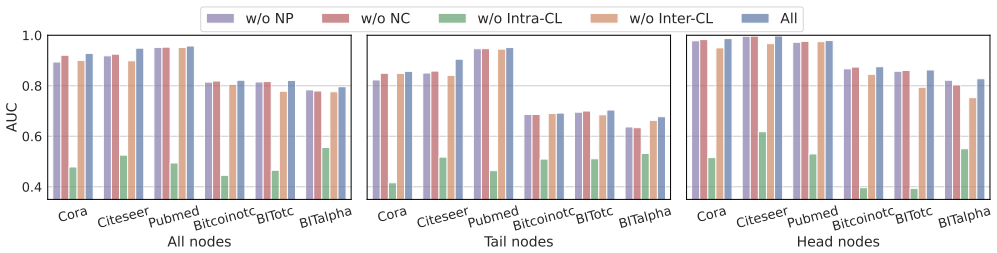
On its own terms, the paper claims that the reason GCL anomaly detectors fail on tail nodes is not insufficient model capacity but a shortage of local structure: low-degree nodes cannot generate enough diverse contrast pairs, so the discriminator overfits their sparse neighborhoods and mistakes them for normal. AD-GCL addresses this with two asymmetric augmentations. For head nodes, it samples K edges using joint neighbor-frequency and feature-saliency information so that a head node is forged into a tail-like node; aligning original head nodes with these forged tail nodes in both feature and score space transfers head-node discriminative knowledge to the tail regime. For genuine tail nodes, it samples auxiliary nodes using the product of feature similarity and an anomaly-similarity score built from a sliding window of discriminator outputs, then mixes the ego networks to enlarge the tail receptive field while preserving degree statistics. The paper reports that this scheme outperforms ten baselines on six datasets, with the largest gains on tail AUC, and that removing either augmentation degrades tail performance.
Load-bearing premise
The pipeline stands on the model's own anomaly scores from the most recent few training epochs being accurate enough to pick which neighborhoods to borrow, even though early in training those scores are noisy and the borrowed neighborhoods feed back into the same scorer.
Editorial extensions
If this is right
- Existing GCL anomaly detectors' low tail AUC is a structural-imbalance problem, not just a capacity problem, so methods that ignore degree bias will keep missing low-degree anomalies on power-law graphs.
- Head nodes can act as label-free teachers for tail detection: aligning original head nodes with forged tail nodes transfers discriminative knowledge without any anomaly labels.
- Anomaly-guided neighbor completion enlarges tail receptive fields while preserving degree statistics, and the ablation study says removing it degrades tail AUC by about 1.9 percent.
- The two augmentations and the intra/inter-view losses are complementary; removing intra-view contrast causes the largest degradation, about 30.6 percent on tail nodes, indicating it is the dominant learning signal.
- The added modules keep the time complexity at $O(|V|d^2 + |E|d + |V|^2d)$, comparable to existing GCL anomaly detectors.
Reading between the lines
- Testable extension: replace the sliding-window self-scores with a momentum encoder or exponentially smoothed scores; if early-training score noise is the limiting factor, tail performance should improve beyond the paper's windowed version.
- On heterophilic graphs, the discriminator's neighbor-matching assumption is inverted, so the same pruning and completion recipes would likely need reversed similarity signals; the paper leaves this open.
- The method implies a general design rule: structural imbalance in graphs can be attacked by deliberately reshaping degree distributions during augmentation rather than by reweighting the final loss.
- A self-adaptive degree threshold could replace the fixed Pareto-based $K$ and extend the gains to graphs with very different degree distributions.
Editorial analysis
A structured set of objections, weighed in public.
Referee Report
Summary. The paper proposes AD-GCL, an unsupervised graph contrastive learning method for anomaly detection that targets structural imbalance. The method has two main components: neighbor pruning, which samples K salient neighbors for head nodes to create 'forged tail nodes' and aligns them with the original head nodes via inter-view contrast, and anomaly-guided neighbor completion, which enlarges the receptive field of tail nodes by mixing their ego networks with those of auxiliary nodes selected using both feature similarity and the model's own anomaly scores. The training objective combines intra-view BCE losses and inter-view InfoNCE losses. Experiments on six citation/bitcoin datasets (plus two in the appendix) report AUC for all, tail, and head nodes, and show that AD-GCL often outperforms ten baselines. The paper also provides ablations, parameter studies, complexity analysis, and a limitations appendix.
Significance. If the reported results are reliable, the paper makes a useful contribution to unsupervised graph anomaly detection by identifying a real weakness of existing GCL methods on low-degree nodes and by demonstrating a practical remedy with consistent tail-node AUC gains. The empirical study is fairly extensive: ten baselines, six main datasets, head/tail breakdowns, ablations, parameter sensitivity, and an appendix with further metrics. The authors also state that source code and datasets are released, which strengthens reproducibility. The main value is the demonstration that structural imbalance can be explicitly addressed within the GCL framework without labels. The core empirical claim is largely supported, though some overstatements and underspecified components need to be corrected.
major comments (4)
- [Main Results and Analysis] The claim that 'AD-GCL achieves the best anomaly detection performance on these six datasets' and 'the best AUC scores for both tail nodes and head nodes on most of the datasets' is overstated. In Table 1, on Pubmed, ANEMONE has a higher head AUC (98.20) than AD-GCL (97.88). In Appendix Table 3, on Tolokers, GAD-NR has higher overall AUPRC/AP (30.20/30.21) and higher head AUPRC/AP (31.62/31.63) than AD-GCL (27.02/27.05 and 27.14/27.19, respectively). These exceptions should be explicitly acknowledged, and the abstract/conclusion wording of 'comprehensive superiority' should be tempered to reflect the actual win/loss pattern.
- [Anomaly-Guided Neighbor Completion, Eq. (2)] The mixing ratio φ in Eq. (2) is not defined. The text says only that φ 'increases with the similarity to the tail node v' and is 'at most 0.5', but no formula or algorithmic specification is given. This makes the neighbor completion step irreproducible and leaves open the possibility that for highly similar auxiliary nodes φ is close to 0.5, which would substantially destroy the anchor node's own neighborhood and contradict the stated goal of enlarging the receptive field. Please provide an exact definition of φ and report the values used in the experiments, ideally with a sensitivity analysis.
- [Graph Contrastive Network] The training schedule is ambiguous. The text says that during the initial stage view1 is the original graph and view2 is the neighbor-pruned graph, and that 'in the later stage of training, we use the neighbor completion strategy ... generating two augmented graphs (referred to as view1 and view2)'. It is unclear (a) at what epoch or by what criterion the switch occurs, (b) whether view1 in the later stage remains the original graph or is also the result of completion, and (c) which view(s) are used when computing the anomaly scores S_{v} that feed into p_ano. This underspecification affects both reproducibility and the interpretation of the inter-view contrastive loss.
- [Anomaly-Guided Neighbor Completion and Parameter Study] The evidence that anomaly-guided selection, rather than the mixup augmentation itself, drives the tail-node improvement is incomplete. The distribution p_ano is computed from the discriminator's own scores over a sliding window; early in training these scores are noisy, and because the completed neighborhoods are fed back into the same discriminator, selection errors could be amplified. The w=0 ablation in Figure 4d is only shown for Cora and does not isolate feedback effects. Please add control experiments, for example sampling auxiliary nodes by feature similarity alone (without the p_ano term) and reporting the w=0 ablation on all datasets, or providing an analysis of how p_ano evolves during training.
minor comments (5)
- [Anomaly Score Calculation, Eq. (10)] The symbol S is used both for the sliding-window anomaly-score matrix in the completion section and for the final anomaly score in Eq. (10); please use distinct notations to avoid confusion.
- [Neighbor Pruning Strategy, Eq. (1)] The product p(·|u) · psim(·|u) is described as sampling from a multinomial distribution; please state explicitly that the product is normalized to form a valid probability distribution, or define Multinomial to accept unnormalized weights.
- [Ablation Study] The numerical degradation percentages (2.46%, 1.87%, 30.62%, 1.89%) reported in the text are not tied to a specific table or figure; please include the underlying values in Figure 3 or a supplementary table for reproducibility.
- [Appendix, Table 3] The main text consistently refers to 'six datasets', while the appendix reports results on eight datasets; please harmonize the dataset counts and clarify that Table 3 covers a subset of datasets with AUPRC/AP.
- [Limitations] The limitations section is a welcome addition; consider also mentioning that the anomaly-guided completion depends on the quality of the discriminator's early training scores, which is currently not analyzed.
Circularity Check
No circularity found: the central claims are benchmark measurements, and the self-referential training signal does not reduce to the test-time prediction.
full rationale
The paper is an empirical method paper. Its central claim is that AD-GCL achieves the best AUC on six benchmark datasets, which is established by direct measurement against ten baselines, not derived from the method's definitions. The only self-referential element is the anomaly-guided neighbor completion: the model uses the discriminator's own training-time scores S to define p_ano(u,v) = S_u · S_v^T, and then trains the discriminator on the completed neighborhoods. This is a bootstrap-style augmentation, but it is not circular in the sense required here. The final anomaly score in Eq. (10) is computed at inference on the original graph from positive and negative discriminator scores, so it is not by construction equal to the training-time selection scores. The w=0 ablation in Figure 4d shows that removing the anomaly-guidance term causes a significant performance drop, and Table 4 shows that naive edge completion degrades performance, providing non-vacuous checks that the completion component contributes beyond simply adding edges. No fitted parameter is renamed as a prediction: the tunable hyperparameters (w, alpha, R, d) are studied via parameter experiments, and none of the paper's claims is an algebraic identity with them. The self-citations to the authors' prior works (e.g., Xu et al. 2023b, 2024) are used only for standard readout choices and related-work context, and are not load-bearing for the anomaly detection results. The paper also acknowledges its limitations regarding heterophilic graphs and the lack of theoretical bounds, which further indicates that the claims are empirical rather than disguised derivations. Consequently, no circular step can be exhibited from the paper's own equations or self-citations.
Assumptions & free parameters
free parameters (6)
- Degree threshold K =
6 (Cora, Citeseer, Pubmed, Bitcoinotc, BITotc, BITalpha), 9 (Reddit), 90 (Tolokers)
- Sliding window w =
5
- Trade-off parameter alpha =
0.2
- Mixing ratio phi =
unspecified function of similarity, capped at 0.5
- Sampling rounds R =
256
- Hidden dimension d =
64
assumptions (4)
- domain assumption Normal nodes match their neighbors; anomalous nodes deviate from local patterns (homophily)
- domain assumption Real-world graphs follow power-law degree distributions
- domain assumption Random walk with restart yields representative local subgraphs for contrast pairs
- domain assumption Sliding-window discriminator scores are informative for selecting auxiliary nodes
Cite this review
Pith. "Pith review of Revisiting Graph Contrastive Learning on Anomaly Detection: A Structural Imbalance Perspective." pith.science (2026). https://pith.science/paper/GN2X7YH7
@misc{pith2026250714677,
  author       = {Pith},
  title        = {Pith review of: Revisiting Graph Contrastive Learning on Anomaly Detection: A Structural Imbalance Perspective},
  year         = {2026},
  howpublished = {\url{https://pith.science/paper/GN2X7YH7}},
  note         = {Machine review of arXiv:2507.14677}
}
read the original abstract
The superiority of graph contrastive learning (GCL) has prompted its application to anomaly detection tasks for more powerful risk warning systems. Unfortunately, existing GCL-based models tend to excessively prioritize overall detection performance while neglecting robustness to structural imbalance, which can be problematic for many real-world networks following power-law degree distributions. Particularly, GCL-based methods may fail to capture tail anomalies (abnormal nodes with low degrees). This raises concerns about the security and robustness of current anomaly detection algorithms and therefore hinders their applicability in a variety of realistic high-risk scenarios. To the best of our knowledge, research on the robustness of graph anomaly detection to structural imbalance has received little scrutiny. To address the above issues, this paper presents a novel GCL-based framework named AD-GCL. It devises the neighbor pruning strategy to filter noisy edges for head nodes and facilitate the detection of genuine tail nodes by aligning from head nodes to forged tail nodes. Moreover, AD-GCL actively explores potential neighbors to enlarge the receptive field of tail nodes through anomaly-guided neighbor completion. We further introduce intra- and inter-view consistency loss of the original and augmentation graph for enhanced representation. The performance evaluation of the whole, head, and tail nodes on multiple datasets validates the comprehensive superiority of the proposed AD-GCL in detecting both head anomalies and tail anomalies.
Figures


Figures from the paper (1 more)

Reference graph
Works this paper leans on
-
[1]
, " * write output.state after.block = add.period write newline
ENTRY address archivePrefix author booktitle chapter edition editor eid eprint howpublished institution isbn journal key month note number organization pages publisher school series title type volume year label extra.label sort.label short.list INTEGERS output.state before.all mid.sentence after.sentence after.block FUNCTION init.state.consts #0 'before.a...
-
[2]
write newline
" write newline "" before.all 'output.state := FUNCTION n.dashify 't := "" t empty not t #1 #1 substring "-" = t #1 #2 substring "--" = not "--" * t #2 global.max substring 't := t #1 #1 substring "-" = "-" * t #2 global.max substring 't := while if t #1 #1 substring * t #2 global.max substring 't := if while FUNCTION word.in bbl.in capitalize " " * FUNCT...
-
[3]
Bandyopadhyay, S.; Lokesh, N.; and Murty, M. N. 2019. Outlier aware network embedding for attributed networks. In Proceedings of the AAAI conference on artificial intelligence, volume 33, 12--19
work page 2019
-
[4]
Bandyopadhyay, S.; N, L.; Vivek, S. V.; and Murty, M. N. 2020. Outlier resistant unsupervised deep architectures for attributed network embedding. In Proceedings of the 13th international conference on web search and data mining, 25--33
work page 2020
-
[5]
Chen, J.; Zhu, G.; Yuan, C.; and Huang, Y. 2024. Boosting Graph Anomaly Detection with Adaptive Message Passing. In The Twelfth International Conference on Learning Representations
work page 2024
-
[6]
Chen, Z.; Liu, B.; Wang, M.; Dai, P.; Lv, J.; and Bo, L. 2020. Generative adversarial attributed network anomaly detection. In Proceedings of the 29th ACM International Conference on Information & Knowledge Management, 1989--1992
work page 2020
-
[7]
Ding, K.; Li, J.; Agarwal, N.; and Liu, H. 2021. Inductive anomaly detection on attributed networks. In Proceedings of the twenty-ninth international conference on international joint conferences on artificial intelligence, 1288--1294
work page 2021
-
[8]
Ding, K.; Li, J.; Bhanushali, R.; and Liu, H. 2019. Deep anomaly detection on attributed networks. In SDM, 594--602. SIAM
work page 2019
Show all 53 references
-
[9]
Dou, Y.; Liu, Z.; Sun, L.; Deng, Y.; Peng, H.; and Yu, P. S. 2020. Enhancing graph neural network-based fraud detectors against camouflaged fraudsters. In Proceedings of the 29th ACM international conference on information & knowledge management, 315--324
2020
-
[10]
Duan, J.; Wang, S.; Zhang, P.; Zhu, E.; Hu, J.; Jin, H.; Liu, Y.; and Dong, Z. 2023. Graph anomaly detection via multi-scale contrastive learning networks with augmented view. In AAAI, volume 37, 7459--7467
2023
-
[11]
Goga, O.; Venkatadri, G.; and Gummadi, K. P. 2015. The doppelg \"a nger bot attack: Exploring identity impersonation in online social networks. In Proceedings of the 2015 internet measurement conference, 141--153
2015
-
[12]
He, K.; Fan, H.; Wu, Y.; Xie, S.; and Girshick, R. 2020. Momentum contrast for unsupervised visual representation learning. In CVPR, 9729--9738
2020
-
[13]
A.; Beutel, A.; Shah, N.; and Faloutsos, C
Hooi, B.; Shin, K.; Song, H. A.; Beutel, A.; Shah, N.; and Faloutsos, C. 2017. Graph-based fraud detection in the face of camouflage. ACM Transactions on Knowledge Discovery from Data (TKDD), 11(4): 1--26
2017
-
[14]
Hu, J.; Xiao, B.; Jin, H.; Duan, J.; Wang, S.; Lv, Z.; Wang, S.; Liu, X.; and Zhu, E. 2023. SAMCL: Subgraph-Aligned Multiview Contrastive Learning for Graph Anomaly Detection. IEEE Transactions on Neural Networks and Learning Systems
2023
-
[15]
Jin, M.; Liu, Y.; Zheng, Y.; Chi, L.; Li, Y.-F.; and Pan, S. 2021. Anemone: Graph anomaly detection with multi-scale contrastive learning. In CIKM, 3122--3126
2021
-
[16]
P.; and Ba, J
Kingma, D. P.; and Ba, J. 2015. Adam: A method for stochastic optimization
2015
-
[17]
N.; and Welling, M
Kipf, T. N.; and Welling, M. 2017. Semi-supervised classification with graph convolutional networks
2017
-
[18]
Kumar, S.; Hooi, B.; Makhija, D.; Kumar, M.; Faloutsos, C.; and Subrahmanian, V. 2018. Rev2: Fraudulent user prediction in rating platforms. In Proceedings of the Eleventh ACM International Conference on Web Search and Data Mining, 333--341
2018
-
[19]
Kumar, S.; Spezzano, F.; Subrahmanian, V.; and Faloutsos, C. 2016. Edge weight prediction in weighted signed networks. In ICDM, 221--230. IEEE
2016
-
[20]
Li, J.; Dani, H.; Hu, X.; and Liu, H. 2017. Radar: Residual analysis for anomaly detection in attributed networks. In IJCAI, volume 17, 2152--2158
2017
-
[21]
Liao, J.; Li, J.; Chen, L.; Wu, B.; Bian, Y.; and Zheng, Z. 2023. SAILOR: Structural Augmentation Based Tail Node Representation Learning. In Proceedings of the 32nd ACM International Conference on Information and Knowledge Management, 1389--1399
2023
-
[22]
Liu, K.; Dou, Y.; Zhao, Y.; Ding, X.; Hu, X.; Zhang, R.; Ding, K.; Chen, C.; Peng, H.; Shu, K.; et al. 2022. Bond: Benchmarking unsupervised outlier node detection on static attributed graphs. Advances in Neural Information Processing Systems, 35: 27021--27035
2022
-
[23]
Liu, Y.; Ao, X.; Qin, Z.; Chi, J.; Feng, J.; Yang, H.; and He, Q. 2021 a . Pick and choose: a GNN-based imbalanced learning approach for fraud detection. In Proceedings of the web conference 2021, 3168--3177
2021
-
[24]
Liu, Y.; Li, Z.; Pan, S.; Gong, C.; Zhou, C.; and Karypis, G. 2021 b . Anomaly detection on attributed networks via contrastive self-supervised learning. TNNLS, 33(6): 2378--2392
2021
-
[25]
Liu, Z.; Li, Y.; Chen, N.; Wang, Q.; Hooi, B.; and He, B. 2023. A survey of imbalanced learning on graphs: Problems, techniques, and future directions. arXiv preprint arXiv:2308.13821
2023 arXiv
-
[26]
Liu, Z.; Nguyen, T.-K.; and Fang, Y. 2021. Tail-gnn: Tail-node graph neural networks. In Proceedings of the 27th ACM SIGKDD Conference on Knowledge Discovery & Data Mining, 1109--1119
2021
-
[27]
Liu, Z.; Zhang, W.; Fang, Y.; Zhang, X.; and Hoi, S. C. 2020. Towards locality-aware meta-learning of tail node embeddings on networks. In Proceedings of the 29th ACM International Conference on Information & Knowledge Management, 975--984
2020
-
[28]
Z.; Xiong, H.; and Akoglu, L
Ma, X.; Wu, J.; Xue, S.; Yang, J.; Zhou, C.; Sheng, Q. Z.; Xiong, H.; and Akoglu, L. 2021. A comprehensive survey on graph anomaly detection with deep learning. TKDE
2021
-
[29]
Pacini, C.; Hopwood, W.; Young, G.; and Crain, J. 2018. The role of shell entities in fraud and other financial crimes. Managerial Auditing Journal, 34(3): 247--267
2018
-
[30]
Park, J.; Song, J.; and Yang, E. 2022. Graphens: Neighbor-aware ego network synthesis for class-imbalanced node classification. In The Tenth International Conference on Learning Representations, ICLR 2022. International Conference on Learning Representations (ICLR)
2022
-
[31]
D.; Noghre, G
Pazho, A. D.; Noghre, G. A.; Purkayastha, A. A.; Vempati, J.; Martin, O.; and Tabkhi, H. 2023. A Survey of Graph-based Deep Learning for Anomaly Detection in Distributed Systems. IEEE Transactions on Knowledge and Data Engineering
2023
-
[32]
W.; Francis, M
Pennebaker, J. W.; Francis, M. E.; and Booth, R. J. 2001. Linguistic inquiry and word count: LIWC 2001. Mahway: Lawrence Erlbaum Associates, 71(2001): 2001
2001
-
[33]
Platonov, O.; Kuznedelev, D.; Diskin, M.; Babenko, A.; and Prokhorenkova, L. 2023. A critical look at the evaluation of GNNs under heterophily: Are we really making progress? ICLR
2023
-
[34]
Roy, A.; Shu, J.; Li, J.; Yang, C.; Elshocht, O.; Smeets, J.; and Li, P. 2023. GAD-NR: Graph Anomaly Detection via Neighborhood Reconstruction. Proceedings of the 17th ACM International Conference on Web Search and Data Mining (WSDM)
2023
-
[35]
Sanders, R. 1987. The Pareto principle: its use and abuse. Journal of Services Marketing, 1(2): 37--40
1987
-
[36]
Skillicorn, D. B. 2007. Detecting anomalies in graphs. In 2007 IEEE Intelligence and Security Informatics, 209--216. IEEE
2007
-
[37]
Song, X.; Wu, M.; Jermaine, C.; and Ranka, S. 2007. Conditional anomaly detection. IEEE Transactions on knowledge and Data Engineering, 19(5): 631--645
2007
-
[38]
Tang, J.; Hua, F.; Gao, Z.; Zhao, P.; and Li, J. 2024. Gadbench: Revisiting and benchmarking supervised graph anomaly detection. Advances in Neural Information Processing Systems, 36
2024
-
[39]
Tang, X.; Yao, H.; Sun, Y.; Wang, Y.; Tang, J.; Aggarwal, C.; Mitra, P.; and Wang, S. 2020. Investigating and mitigating degree-related biases in graph convoltuional networks. In Proceedings of the 29th ACM International Conference on Information & Knowledge Management, 1435--1444
2020
-
[40]
Tong, H.; Faloutsos, C.; and Pan, J.-Y. 2006. Fast random walk with restart and its applications. In Sixth international conference on data mining (ICDM'06), 613--622. IEEE
2006
-
[41]
Van den Oord, A.; Li, Y.; and Vinyals, O. 2018. Representation learning with contrastive predictive coding. arXiv e-prints, arXiv--1807
2018
-
[42]
L.; Li \`o , P.; Bengio, Y.; and Hjelm, R
Veli c kovi \'c , P.; Fedus, W.; Hamilton, W. L.; Li \`o , P.; Bengio, Y.; and Hjelm, R. D. 2019. Deep graph infomax. ICLR
2019
-
[43]
Wang, R.; Wang, X.; Shi, C.; and Song, L. 2022. Uncovering the Structural Fairness in Graph Contrastive Learning. Advances in Neural Information Processing Systems, 35: 32465--32473
2022
-
[44]
Wu, J.; He, J.; and Xu, J. 2019. Net: Degree-specific graph neural networks for node and graph classification. In Proceedings of the 25th ACM SIGKDD International Conference on Knowledge Discovery & Data Mining, 406--415
2019
-
[45]
Wu, T.; Ren, H.; Li, P.; and Leskovec, J. 2020. Graph information bottleneck. Advances in Neural Information Processing Systems, 33: 20437--20448
2020
-
[46]
Xu, H.; Xiang, L.; Huang, F.; Weng, Y.; Xu, R.; Wang, X.; and Zhou, C. 2023 a . Grace: Graph Self-Distillation and Completion to Mitigate Degree-Related Biases. In Proceedings of the 29th ACM SIGKDD Conference on Knowledge Discovery and Data Mining, 2813--2824
2023
-
[47]
Xu, X.; Yuruk, N.; Feng, Z.; and Schweiger, T. A. 2007. Scan: a structural clustering algorithm for networks. In Proceedings of the 13th ACM SIGKDD international conference on Knowledge discovery and data mining, 824--833
2007
-
[48]
Xu, Y.; Peng, Z.; Shi, B.; Hua, X.; and Dong, B. 2024. Learning dynamic graph representations through timespan view contrasts. Neural Networks, 176: 106384
2024
-
[49]
Xu, Y.; Shi, B.; Ma, T.; Dong, B.; Zhou, H.; and Zheng, Q. 2023 b . CLDG: Contrastive Learning on Dynamic Graphs. In 2023 IEEE 39th International Conference on Data Engineering (ICDE), 696--707. IEEE
2023
-
[50]
Ye, G.; Yin, H.; Chen, T.; Chen, H.; Cui, L.; and Zhang, X. 2021. FENet: a frequency extraction network for obstructive sleep apnea detection. IEEE Journal of Biomedical and Health Informatics, 25(8): 2848--2856
2021
-
[51]
Zeng, L.; Li, L.; Gao, Z.; Zhao, P.; and Li, J. 2023. Imgcl: Revisiting graph contrastive learning on imbalanced node classification. In Proceedings of the AAAI Conference on Artificial Intelligence, volume 37, 11138--11146
2023
-
[52]
Zhang, J.; and et al. 2022. Reconstruction enhanced multi-view contrastive learning for anomaly detection on attributed networks. IJCAI
2022
-
[53]
Zheng, Q.; Xu, Y.; Liu, H.; Shi, B.; Wang, J.; and Dong, B. 2023. A Survey of Tax Risk Detection Using Data Mining Techniques. Engineering
2023
Reviewed August 6, 2026 · model on record in the stance chip above.
Discussion (0). Continue with ORCID to comment.