RIS-Empowered OTFS Modulation With Faster-than-Nyquist Signaling in High-Mobility Wireless Communications
Pith reviewed 2026-05-21 15:46 UTC · model grok-4.3
The pith
Integrating reconfigurable intelligent surfaces into OTFS modulation with faster-than-Nyquist signaling improves reliability and spectral efficiency in high-mobility wireless systems.
A machine-rendered reading of the paper's core claim, the machinery that carries it, and where it could break.
Core claim
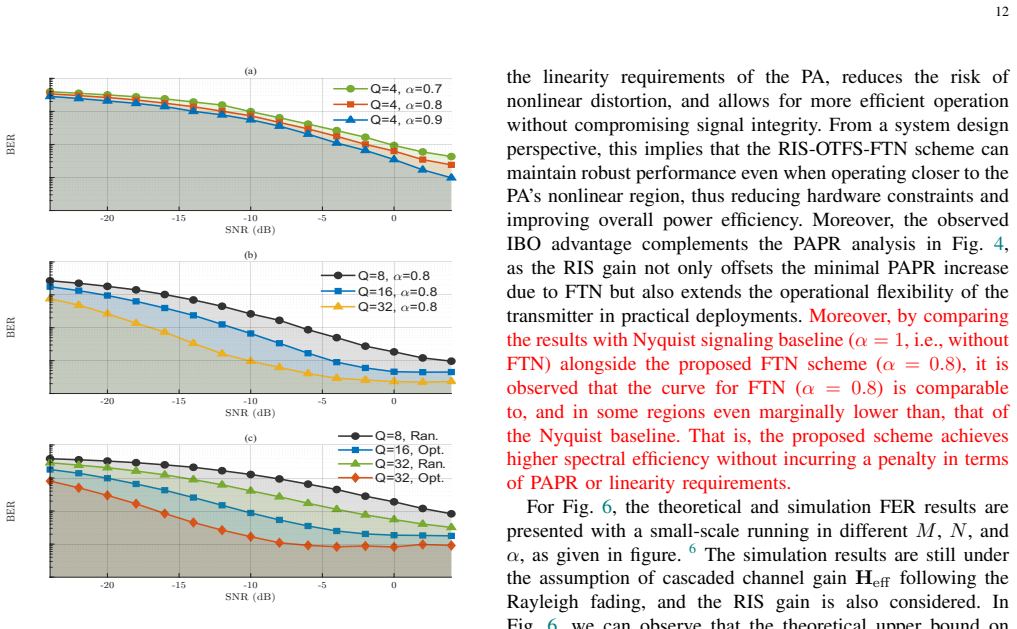
The authors establish a unified delay-Doppler domain input-output relationship that jointly accounts for RIS passive beamforming, FTN-induced inter-symbol interference, and DD-domain channel characteristics, then use it to obtain analytical performance expressions and a practical quantized RIS phase adjustment strategy; Monte Carlo simulations under the extended vehicular A channel confirm that the resulting RIS-OTFS-FTN scheme yields measurable gains in frame error rate and spectral efficiency compared with baselines.
What carries the argument
The unified DD-domain input-output relationship that jointly accounts for RIS passive beamforming, FTN-induced inter-symbol interference, and DD-domain channel characteristics.
If this is right
- Analytical expressions for frame error rate become available once the unified DD-domain model is in place.
- Spectral efficiency rises with the intentional symbol packing of FTN while the RIS compensates for the added interference.
- A quantized phase selection procedure maximizes the effective channel gain without requiring continuous phase control.
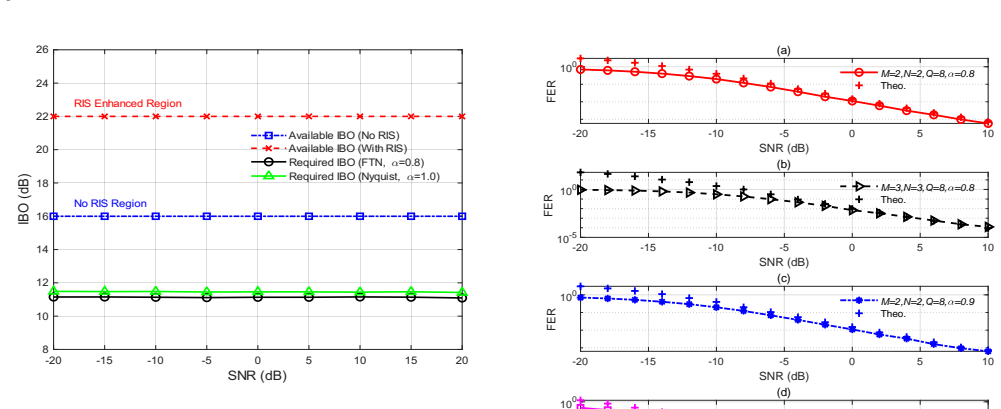
- Trade-offs appear among spectral efficiency, PAPR, input back-off, and error performance that can be explored through the same model.
Where Pith is reading between the lines
- The same modeling approach could be tested in other high-mobility settings such as high-speed rail or low-Earth-orbit satellite links to see whether the gains persist.
- Because the phase adjustment uses only a finite set of values, the scheme may be implementable on low-cost RIS hardware with limited control resolution.
- The derived expressions for PAPR and IBO suggest that power-amplifier back-off requirements can be traded directly against the chosen FTN packing factor.
Load-bearing premise
The unified DD-domain input-output relationship accurately captures RIS beamforming, FTN interference, and channel effects without significant unmodeled distortions that would change the derived performance expressions.
What would settle it
If Monte Carlo simulations under the standardized extended vehicular A channel model show no improvement in frame error rate or spectral efficiency when the proposed RIS phase adjustment and FTN packing are added to plain OTFS, the claimed performance gains would not hold.
Figures




read the original abstract
High-mobility wireless communication systems suffer from severe Doppler spread and multi-path delay, which degrade the reliability and spectral efficiency of conventional modulation schemes. Orthogonal time frequency space (OTFS) modulation offers strong robustness in such environments by representing symbols in the delay-Doppler (DD) domain, while faster-than-Nyquist (FTN) signaling can further enhance spectral efficiency through intentional symbol packing. Meanwhile, reconfigurable intelligent surfaces (RIS) provide a promising means to improve link quality via passive beamforming. Motivated by these advantages, we propose a novel RIS-empowered OTFS modulation with FTN signaling (RIS-OTFS-FTN) scheme. First, we establish a unified DD-domain input-output relationship that jointly accounts for RIS passive beamforming, FTN-induced inter-symbol interference, and DD-domain channel characteristics. Based on this model, we provide comprehensive analytical performance for the frame error rate, spectral efficiency, and peak-to-average power ratio (PAPR), etc. Furthermore, a practical RIS phase adjustment strategy with quantized phase selection is designed to maximize the effective channel gain. Extensive Monte Carlo simulations under a standardized extended vehicular A (EVA) channel model validate the theoretical results and provide key insights into the trade-offs among spectral efficiency, PAPR, input back-off (IBO), and error performance, with some interesting insights.The proposed RIS-OTFS-FTN scheme demonstrates notable performance gains in both reliability and spectral efficiency, offering a viable solution for future high-mobility and spectrum-constrained wireless systems.
Editorial analysis
A structured set of objections, weighed in public.
Referee Report
Summary. The manuscript proposes a RIS-empowered OTFS modulation scheme with faster-than-Nyquist (FTN) signaling for high-mobility wireless communications. It derives a unified delay-Doppler (DD) domain input-output relationship that incorporates RIS passive beamforming, FTN-induced inter-symbol interference, and DD-domain channel effects. Closed-form analytical expressions are provided for frame error rate (FER), spectral efficiency (SE), and peak-to-average power ratio (PAPR). A quantized RIS phase selection strategy is designed to maximize effective channel gain. Monte Carlo simulations under the standardized extended vehicular A (EVA) channel model are used to validate the analysis and illustrate trade-offs among SE, PAPR, input back-off, and error performance.
Significance. If the unified DD-domain model is free of unexamined linearizations or truncations in the cross-terms, the work would usefully combine three established techniques (OTFS Doppler resilience, FTN spectral-efficiency gain, and RIS passive beamforming) and supply both analytical performance metrics and practical design guidelines for spectrum-constrained high-mobility links. The explicit treatment of PAPR/IBO trade-offs and the quantized phase strategy add engineering relevance.
major comments (2)
- [§III-B, Eq. (8)–(11)] §III-B, Eq. (8)–(11): the unified DD-domain input-output relation is presented as jointly embedding the RIS phase matrix, the non-orthogonal FTN pulse-shaping matrix, and the time-varying EVA Doppler shifts. It is not shown whether higher-order Doppler–FTN coupling terms are retained exactly or linearized/truncated; any such approximation would directly affect the accuracy of the subsequent closed-form FER and SE expressions in §IV.
- [§IV-A, Eq. (15)] §IV-A, Eq. (15): the frame-error-rate expression is derived from the effective channel gain after RIS phase selection. If the phase-selection procedure (described as “quantized phase selection”) is performed after observing the instantaneous channel rather than being a fixed, non-adaptive rule, the reported FER curves become optimistic relative to a practical implementation that must choose phases without future channel knowledge.
minor comments (2)
- Notation for the FTN acceleration factor α and the RIS phase quantization levels is introduced without a consolidated table; a single reference table would improve readability.
- Figure 4 (PAPR vs. IBO) uses the same legend style as Figure 3; distinguishing line styles or markers would reduce visual ambiguity when printed in black-and-white.
Simulated Author's Rebuttal
We thank the referee for the constructive and detailed comments. We address each major comment point by point below, providing clarifications on the model derivation and performance analysis. Revisions have been made to improve clarity and add relevant discussion where appropriate.
read point-by-point responses
-
Referee: [§III-B, Eq. (8)–(11)] §III-B, Eq. (8)–(11): the unified DD-domain input-output relation is presented as jointly embedding the RIS phase matrix, the non-orthogonal FTN pulse-shaping matrix, and the time-varying EVA Doppler shifts. It is not shown whether higher-order Doppler–FTN coupling terms are retained exactly or linearized/truncated; any such approximation would directly affect the accuracy of the subsequent closed-form FER and SE expressions in §IV.
Authors: The unified DD-domain input-output relation in Section III-B is obtained by direct discretization of the time-domain received signal expression that incorporates the RIS phase matrix, the FTN pulse-shaping matrix, and the time-varying channel matrix. All cross terms arising from Doppler shifts interacting with the non-orthogonal FTN pulses are retained exactly in the resulting effective channel matrix; no linearization or truncation is performed. This exact formulation underpins the closed-form FER and SE expressions in Section IV. We have added an explicit remark in the revised Section III-B confirming that Eqs. (8)–(11) contain no approximations. revision: yes
-
Referee: [§IV-A, Eq. (15)] §IV-A, Eq. (15): the frame-error-rate expression is derived from the effective channel gain after RIS phase selection. If the phase-selection procedure (described as “quantized phase selection”) is performed after observing the instantaneous channel rather than being a fixed, non-adaptive rule, the reported FER curves become optimistic relative to a practical implementation that must choose phases without future channel knowledge.
Authors: The quantized phase selection is performed adaptively using instantaneous channel state information to maximize the effective gain, consistent with standard RIS beamforming assumptions. The FER expression in Eq. (15) is therefore derived under perfect instantaneous CSI. We acknowledge that this yields an optimistic bound relative to scenarios with CSI delay or estimation error. In the revised manuscript we have added a new discussion subsection and corresponding EVA-channel simulations that quantify the performance loss under delayed CSI, thereby clarifying the gap between the analytical curves and practical non-causal implementations. revision: yes
Circularity Check
Derivation chain is self-contained with independent modeling and simulation validation
full rationale
The paper establishes a new unified DD-domain input-output relationship jointly incorporating RIS passive beamforming, FTN-induced ISI, and DD-domain channel effects under the EVA model. From this model it derives closed-form expressions for frame error rate, spectral efficiency, and PAPR, then proposes a quantized phase selection strategy. These steps are followed by Monte Carlo simulations that validate the analytics. No quoted equations or self-citations reduce any load-bearing claim to a fitted parameter, prior ansatz, or self-referential definition; the central results rest on the newly stated model plus external channel statistics rather than circular reduction.
Axiom & Free-Parameter Ledger
axioms (2)
- domain assumption The delay-Doppler domain accurately captures high-mobility channel effects including Doppler spread and multi-path delay
- domain assumption RIS passive beamforming can be jointly modeled with FTN-induced ISI in the DD domain
Lean theorems connected to this paper
-
IndisputableMonolith/Cost/FunctionalEquation.leanwashburn_uniqueness_aczel unclear?
unclearRelation between the paper passage and the cited Recognition theorem.
unified DD-domain input-output relationship that jointly accounts for RIS passive beamforming, FTN-induced inter-symbol interference, and DD-domain channel characteristics
-
IndisputableMonolith/Foundation/AbsoluteFloorClosure.leanabsolute_floor_iff_bare_distinguishability unclear?
unclearRelation between the paper passage and the cited Recognition theorem.
AFER upper bound ... det(I + σ_h²/4 ΔΔ^H ⊗ Σ_z^{-1})^{-1}
What do these tags mean?
- matches
- The paper's claim is directly supported by a theorem in the formal canon.
- supports
- The theorem supports part of the paper's argument, but the paper may add assumptions or extra steps.
- extends
- The paper goes beyond the formal theorem; the theorem is a base layer rather than the whole result.
- uses
- The paper appears to rely on the theorem as machinery.
- contradicts
- The paper's claim conflicts with a theorem or certificate in the canon.
- unclear
- Pith found a possible connection, but the passage is too broad, indirect, or ambiguous to say the theorem truly supports the claim.
Reference graph
Works this paper leans on
-
[1]
Q. Deng, Y . Ge, and Z. Ding, ”A unifying view of OTFS and its many variants,”IEEE Commun. Surveys Tuts., vol. 27, no. 6, pp. 3561–3586, Dec. 2025
work page 2025
-
[2]
Fractional delay and Doppler estimation for OTFS systems with Doppler squint effect,
M. Zhanget al., “Fractional delay and Doppler estimation for OTFS systems with Doppler squint effect,” inProc. IEEE Wireless Commun. Netw. Conf. (WCNC), Milan, Italy, 2025, pp. 1–6
work page 2025
-
[3]
A survey on orthogonal time frequency space modulation,
M. Aldababsa,et al., “A survey on orthogonal time frequency space modulation,”IEEE Open J. Commun. Soc., vol. 5, pp. 4483–4518, 2024
work page 2024
-
[4]
OTFS vs. OFDM in the pres- ence of sparsity: A fair comparison,
L. Gaudio, G. Colavolpe, and G. Caire, “OTFS vs. OFDM in the pres- ence of sparsity: A fair comparison,”IEEE Trans. Wireless Commun., vol. 21, no. 6, pp. 4410–4423, Jun. 2022
work page 2022
-
[5]
Z. Zhou, L. Liu, J. Xu, and R. Calderbank, ”Learning to equalize OTFS,” IEEE Trans. Wireless Commun., vol. 21, no. 9, pp. 7723–7736, Sep. 2022
work page 2022
-
[6]
Orthogonal time frequency space modulation,
R. Hadaniet al., “Orthogonal time frequency space modulation,” in Proc. IEEE Wireless Commun. Netw. Conf. (WCNC), San Francisco, CA, USA, 2017, pp. 1–6
work page 2017
-
[7]
W. Yuanet al., “New delay Doppler communication paradigm in 6G era: A survey of orthogonal time frequency space (OTFS),”China Commun., vol. 20, no. 6, pp. 1–25, Jun. 2023
work page 2023
-
[8]
X. Zhouet al., “Active terminal identification, channel estimation, and signal detection for grant-free NOMA-OTFS in LEO satellite Internet-of-Things,”IEEE Trans. Wireless Commun., vol. 22, no. 4, pp. 2847–2866, Apr. 2023
work page 2023
-
[9]
Faster-than-Nyquist signaling for MIMO communications,
Z. Zhang, M. Yuksel, and H. Yanikomeroglu, “Faster-than-Nyquist signaling for MIMO communications,”IEEE Trans. Wireless Commun., vol. 22, no. 4, pp. 2379–2392, Apr. 2023
work page 2023
-
[10]
Exploiting faster-than-Nyquist signaling,
A. D. Liveris and C. N. Georghiades, “Exploiting faster-than-Nyquist signaling,”IEEE Trans. Commun., vol. 51, no. 9, pp. 1502–1511, Sep. 2003
work page 2003
-
[11]
H. Xu, C. Zhang, Q. Wu, B. K. Ng, C.-T. Lam, and H. Yanikomeroglu, “FTN-assisted SWIPT-NOMA design for IoT wireless networks: A paradigm in wireless efficiency and energy utilization,”IEEE Sensors J., vol. 25, no. 4, pp. 7431–7444, Feb. 2025
work page 2025
-
[12]
M. Kulhandjian, E. Bedeer, H. Kulhandjian, C. D’Amours, and H. Yanikomeroglu, “Low-complexity detection for faster-than-Nyquist sig- naling based on probabilistic data association,”IEEE Commun. Lett., vol. 24, no. 4, pp. 762–766, Apr. 2020
work page 2020
-
[13]
T. Bacchielli, L. Pucci, E. Paolini, and A. Giorgetti, ”A low-complexity detector for OTFS-based sensing,”IEEE Trans. Wireless Commun., vol. 24, no. 6, pp. 5227–5240, Jun. 2025
work page 2025
- [14]
-
[15]
M.-S. Baek, E.-S. Jung, Y . S. Park, and Y .-T. Lee, “FTN-based non- orthogonal signal detection technique with machine learning in quasi- static multipath channel,”IEEE Trans. Broadcast., vol. 70, no. 1, pp. 78–86, Mar. 2024
work page 2024
-
[16]
H. Yang,et al., ”Frequency diverse array-enabled RIS-aided integrated sensing and communication,”IEEE Trans. Wireless Commun., vol. 24, no. 9, pp. 7546–7562, Sep. 2025
work page 2025
-
[17]
Pan et al., ”An overview of signal processing techniques for RIS/IRS- aided wireless systems,”IEEE J
C. Pan et al., ”An overview of signal processing techniques for RIS/IRS- aided wireless systems,”IEEE J. Sel. Topics Signal Process., vol. 16, no. 5, pp. 883-917, Aug. 2022
work page 2022
-
[18]
K. Wang, C.-T. Lam, B. K. Ng, and Y . Liu, ”On the impact of phase errors in phase-dependent amplitudes of near-field RISs,”IEEE Trans. Veh. Technol., Dec., 2025, early access
work page 2025
-
[19]
RIS-assisted differential transmitted spatial modulation design,
C. Zhang, Y . Liu, B. K. Ng, and C.-T. Lam, “RIS-assisted differential transmitted spatial modulation design,”Signal Process., vol. 230, p. 109767, 2025
work page 2025
-
[20]
How phase errors influence phase-dependent amplitudes in near-field RISs?,
K. Wang, R. Chen, C.-T. Lam, B. K. Ng, and C. Zhang, “How phase errors influence phase-dependent amplitudes in near-field RISs?,” in Proc. IEEE V eh. Technol. Conf. (VTC2024-Fall), Washington, DC, USA, 2024, pp. 1–6
work page 2024
-
[21]
RIS-aided OTFS modulation in high-Doppler channels,
G. Harshavardhan, V . S. Bhat, and A. Chockalingam, “RIS-aided OTFS modulation in high-Doppler channels,” inProc. IEEE 33rd Annu. Int. Symp. Pers. Indoor Mobile Radio Commun. (PIMRC), Kyoto, Japan, 2022, pp. 409–415
work page 2022
-
[22]
IRS-assisted OTFS system: Design and analysis,
A. Thomas, K. Deka, S. Sharma, and N. Rajamohan, “IRS-assisted OTFS system: Design and analysis,”IEEE Trans. V eh. Technol., vol. 72, no. 3, pp. 3345–3358, Mar. 2023
work page 2023
-
[23]
Reconfigurable- intelligent-surface-aided OTFS: Transmission scheme and channel es- timation,
Z. Li, W. Yuan, B. Li, J. Wu, C. You, and F. Meng, “Reconfigurable- intelligent-surface-aided OTFS: Transmission scheme and channel es- timation,”IEEE Internet Things J., vol. 10, no. 22, pp. 19518–19532, Nov. 2023
work page 2023
-
[24]
IRS-assisted high mobility communications using OTFS modulation,
A. S. Bora, K. T. Phan, and Y . Hong, “IRS-assisted high mobility communications using OTFS modulation,”IEEE Wireless Commun. Lett., vol. 12, no. 2, pp. 376–380, Feb. 2023
work page 2023
-
[25]
C. Xuet al., “OTFS-aided RIS-assisted SAGIN systems outperform their OFDM counterparts in doubly selective high-Doppler scenarios,”IEEE Internet Things J., vol. 10, no. 1, pp. 682–703, Jan. 2023
work page 2023
-
[26]
RIS-aided OTFS with index modu- lation,
V . S. Bhat and A. Chockalingam, “RIS-aided OTFS with index modu- lation,” inProc. IEEE Wireless Commun. Netw. Conf. (WCNC), Dubai, United Arab Emirates, 2024, pp. 1–6
work page 2024
-
[27]
Precoded faster-than- Nyquist signaling for OTFS,
Z. Hong, S. Sugiura, C. Xu, and L. Hanzo, “Precoded faster-than- Nyquist signaling for OTFS,”IEEE Wireless Commun. Lett., vol. 14, no. 1, pp. 173–177, Jan. 2025
work page 2025
-
[28]
M. Tong, X. Huang, J. Andrew Zhang, and L. Hanzo, ”Adaptive FTN signaling over rapidly-fading channels,”IEEE Trans. Commun., vol. 73, no. 9, pp. 7166–7178, Sep. 2025
work page 2025
-
[29]
X. Wang, S. Gong, W. Shen, C. Xing, and J. A. Zhang, ”Multi-carrier faster-than-Nyquist signaling for OTFS systems,”IEEE Trans. Veh. Technol., vol. 74, no. 12, pp. 19339–19354, Dec. 2025
work page 2025
-
[30]
Adaptive damping log-domain message-passing algorithm for FTN-OTFS in V2X communications,
H. Xu, C. Zhang, Q. Wu, B. K. Ng, and C.-T. Lam, “Adaptive damping log-domain message-passing algorithm for FTN-OTFS in V2X communications,”Sensors, vol. 25, no. 12, p. 3692, Jun. 2025
work page 2025
-
[31]
Z. Hong and S. Sugiura, ”Reduced-complexity MIMO faster-than- Nyquist signaling transceiver for OTFS modulation,”IEEE Open J. Commun. Soc., vol. 6, pp. 6126–6141, 2025
work page 2025
-
[32]
Low complexity iterative rake decision feedback equalizer for zero-padded OTFS systems,
T. Thaj and E. Viterbo, “Low complexity iterative rake decision feedback equalizer for zero-padded OTFS systems,”IEEE Trans. V eh. Technol., vol. 69, no. 12, pp. 15606–15622, Dec. 2020
work page 2020
-
[33]
M. K. Simon and M.-S. Alouini,Digital Communication over Fading Channels, 2nd ed. Wiley, 2005
work page 2005
-
[34]
J. G. Proakis and M. Salehi,Digital Communications, 5th ed. McGraw- Hill, 2008
work page 2008
-
[35]
Peak-to-average power ratio of OTFS modulation,
G. D. Surabhi, R. M. Augustine, and A. Chockalingam, “Peak-to-average power ratio of OTFS modulation,”IEEE Commun. Lett., vol. 23, no. 6, pp. 999–1002, Jun. 2019
work page 2019
-
[36]
3GPP TS 36.101, “Evolved Universal Terrestrial Radio Access (E- UTRA); User Equipment (UE) radio transmission and reception,”3GPP, 2023
work page 2023
discussion (0)
Sign in with ORCID, Apple, or X to comment. Anyone can read and Pith papers without signing in.