REVIEW 3 major objections 4 minor 1 cited by
One-arm domination time in Cylindrical Hastings-Levitov$(0)$
T0 review · 3 major / 4 minor · reviewed 2026-08-06 · deepseek-v4-flash
Pith's one-line read In the cylindrical Hastings–Levitov process, the expected time until one tree permanently dominates is of exact order N²/λ³.
desk verdict Genuinely new scaling law with a repairable gap in the upper tail: the main theorem stands, but (4.6) needs the honest binomial tail. read the letter →
The pith
A machine-rendered reading of the paper's core claim, the machinery that carries it, and where it could break.
The reading
What carries the argument
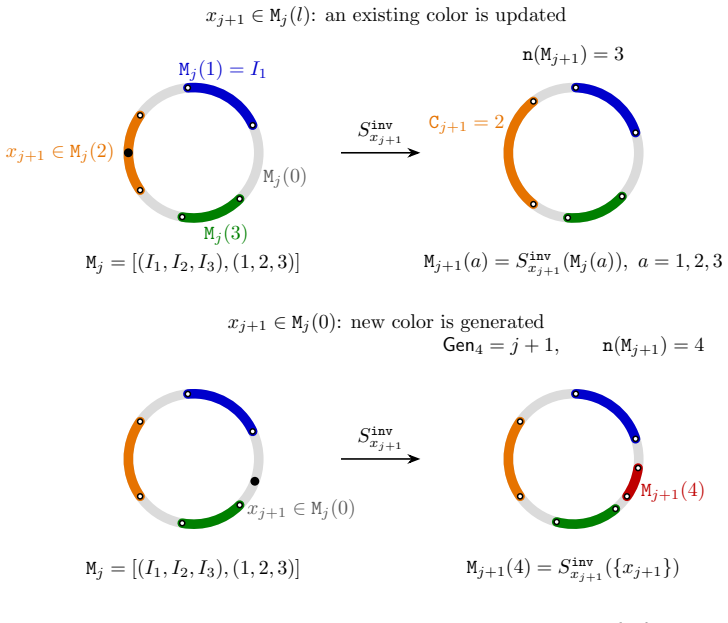
The argument runs on two coupled mechanisms. First is the interval characterization: after rescaling the width-$N$ cylinder to a unit circle, each slit map is inverted on boundary arcs, and the length $|I_k|$ of any tracked interval evolves as a Markov jump process. That length is a positive martingale converging almost surely to $0$ or $2\pi$ (Proposition 2.1), and its one-step variance is of order $\delta^3$, where $\delta \asymp \lambda/N$; explicitly $m_\delta = \frac{32}{3\pi}\delta^3 - 2\delta^4 + O(\delta^5)$ (Lemma 2.3). Lemma 2.4 converts this variance scale into gambler's-ruin exit times of order $\delta^{-3}$, the quantitative heart of the $N^2/\lambda^3$ result. Second is the marked-configuration coupling (Definitions 3.2–3.3): each tree is represented by a boundary interval whose length equals that tree's share of the harmonic measure — the chance that the next incoming particle attaches to that tree — so the event 'everything is captured by one tree' becomes 'one marked interval occupies almost the whole circle.' The upper bound launches independent explorations of $\delta$-length intervals, each needing $\sim\delta^{-2}$ steps and succeeding with probability $\sim\delta$; the lower bound compares domination against a semicircular interval's first exit from a macroscopic range.
What would settle it
Run the rescaled CHL(1, λ/N) process in simulation, record the first particle index after which only one tree is ever hit again, and compare mean takeover times for several widths $N$ at fixed $\lambda$: Theorem 1.3 requires $\mathbb{E}[\upsilon]$ to lie between two universal constants times $N^2/\lambda^3$ with no residual $N$-dependence. A cheaper and sharper check targets the microscopic estimate: measure the one-step variance of the length of a $\delta$-length interval in the embedded chain, $\delta \approx \lambda/(2N)$, and verify it equals $\frac{32}{3\pi}\delta^3 - 2\delta^4 + O(\delta^5)$; since every exit-time bound in the paper is built on this $\delta^3$ scale, a failure of the cubic law there would falsify the whole hierarchy.
Extended reading notes
Core claim
The paper's central claim is Theorem 1.3: for every fixed particle size $\lambda$ there are universal constants $c, C > 0$ and a threshold $N_0(\lambda)$ such that for all cylinder widths $N \ge N_0(\lambda)$, the one-arm domination time $\upsilon_{N,\lambda}$ — the first time after which the unique infinite tree receives every new particle — satisfies $cN^2/\lambda^3 \le \mathbb{E}[\upsilon_{N,\lambda}] \le CN^2/\lambda^3$. The same statement comes with an exponential tail (Theorem 1.4): $C_3 e^{-C_4 t} \le P(\upsilon_{N,\lambda} > \lambda^{-3}N^2 t) \le C_1 e^{-C_2 t}$. The mechanism producing this is that the pull-back of any boundary interval under the random slit maps has length that is a positive martingale converging almost surely to $0$ or $2\pi$, with one-step variance of order $\delta^3$ where $\delta \asymp \lambda/N$; gambler's-ruin exit estimates then give a $\delta^{-3}$ particle count, and at Poisson rate $2\pi N$ this is $N^2/\lambda^3$ time. Two further results follow from the same marked-interval machinery: the last time a new tree ever appears has expectation at most $(1+\varepsilon)\log N/(2\lambda)$, and the total number of trees converges almost surely to $N_\infty$ with $\mathbb{E}[N_\infty] = \frac{\pi}{2\arctan(\delta/\sqrt{1-\delta^2})} \sim \frac{\pi N}{\lambda}$, implying each particle spawns exactly one child in expectation.
Load-bearing premise
The central quantity presumes the cited result [NT12] that a single infinite tree exists and is unique in this process; the paper's own Proposition 2.1 proves only that a tracked interval's length converges almost surely to $0$ or $2\pi$, which by itself does not construct the persistent tree that defines $\upsilon_{N,\lambda}$.
Editorial extensions
If this is right
- At fixed particle size $\lambda$, doubling the cylinder width multiplies the expected domination time by four; the law $N^2/\lambda^3$ identifies the microscopic slit-map coalescence scale as the single determinant of macroscopic takeover.
- The exponential tail makes domination a sharp cut-off phenomenon: with probability approaching 1 the takeover is complete within a bounded factor of $N^2/\lambda^3$, and the matching lower tail shows no provably earlier universal takeover time exists.
- The expected total number of trees is asymptotically $\pi N/\lambda$, so the forest has a well-defined linear density in the width, and each particle has exactly one child on average — the genealogy of trees is balanced at criticality.
- New trees stop appearing after at most $(1+\varepsilon)\log N/(2\lambda)$ time in expectation, so the active frontier of the process shrinks logarithmically slowly relative to the quadratic domination time.
Reading between the lines
- The same one-step variance $m_\delta \asymp \delta^3$ should control the fluctuations of every tree's harmonic-measure share on the $N^2/\lambda^3$ time scale; the paper does not state this consequence, but Lemma 2.3 supplies the quantity needed to attempt it.
- Replacing $(1+\varepsilon)$ by $1+o(1)$ in Theorem 1.5 would prove the conjecture of Remark 1.6, $\lim_N \mathbb{E}[\omega_{N,\lambda}]/\log N = 1/(2\lambda)$; the Section 5 recursion is a plausible route to that sharper constant.
- Numerical simulation of CHL(0) over a range of widths and particle sizes should collapse the takeover time onto a single curve in $\lambda^3 t/N^2$; the paper contains no such experiments, so this is a direct testable prediction.
- The paper is explicit that no rigorous link between CHL and lattice DLA on a cylinder is known; transferring the $N^2/\lambda^3$ law to the lattice model would require a new coupling, and would make the domination time there tractable for the first time.
Editorial analysis
A structured set of objections, weighed in public.
Referee Report
Summary. The paper studies the cylindrical Hastings-Levitov(0) process on a cylinder of width N with particle size λ. It defines the one-arm domination time υ_{N,λ} as the first time after which only the unique infinite tree receives particles, and proves that E[υ_{N,λ}] is of order N²/λ³ (Theorem 1.3), that υ_{N,λ} possesses exponential upper and lower tails (Theorem 1.4), that the tree completion time satisfies E[ω_{N,λ}] ≤ (1+ε) log N/(2λ) (Theorem 1.5), and that the expected number of trees tends to πN/λ (Theorem 1.7). The proofs are based on a pull-back interval process on the unit circle, on marked configurations coding the intervals of all trees, and on a backward-process recursion.
Significance. If the results are correct, this is a substantive contribution to the rigorous theory of off-lattice aggregation: it gives the first sharp quantitative control of the time to single-arm domination in a continuum DLA-type model, with universal constants and no fitted parameters. The interval characterization and the marked-configuration coupling are natural and potentially reusable tools. I emphasize that the main expectation theorem is supported by a martingale structure and explicit second-moment estimates that are largely self-contained; the exponential tail currently has a gap in the written proof (see major comment 1) but appears repairable with the authors' own estimates. The paper also builds on [NT12] for the existence of the unique infinite tree, although the text overstates the degree to which that fact is reproved.
major comments (3)
- [Section 4, Eq. (4.6)] The inequality '≤ C9 e^{-Kx/2}' does not follow from the preceding display. The additive term 200δ²x is of order one when x ≍ δ^{-2}, while the asserted right-hand side is exponentially small in δ^{-2}; for any C9 independent of δ the displayed bound fails in that regime. This step is the only place where the exponential upper tail of the sum of the bT_j variables is extracted, so the upper bound in Theorem 1.4 is not proved as written. A fix is available: replace the crude bound P(NUM>[x]+1)≤200δ²x by the honest tail P(NUM>k)≤(4δ²)^{k+1}/(1-4δ²), which is exponentially small in k log(1/δ) and can be absorbed into the desired e^{-Kx} form after choosing K appropriately. The expectation result Theorem 1.3 is unaffected.
- [Definition 1.2 and Proposition 2.1] The parenthetical claim that Proposition 2.1 supplies a self-contained proof of the uniqueness of the infinite tree is an overstatement. Proposition 2.1(3) shows that the length of a tracked interval converges almost surely to 0 or 2π; it does not construct a persistent tree nor prove that exactly one tree survives forever. The existence and uniqueness of the infinite tree is imported from [NT12] and is also used implicitly in the success event of the upper-bound construction. This should be stated accurately; if [NT12] is assumed, the definition of υ_{N,λ} is legitimate, but the text should not claim that Proposition 2.1 reproves it.
- [Section 6, recursion for X_k] The recursion X_{k+1}=1+Σ_{j=1}^{X_k} 1_{B_j} and the subsequent conditional expectation E[X_{k+1}|G_k]=1+(1-2/π arctan(δ/√(1-δ²)))X_k presuppose that each tree in the backward process has a unique base interval whose covering set under a new backward slit has length exactly 4 arctan(δ/√(1-δ²)), independently of the tree. This uniqueness is not proved anywhere in Section 6; without it, a tree could intersect the boundary in several intervals, and the probability that a new backward slit covers it would not be linear in the tree count. The authors should add a lemma establishing the unique-base-interval property for the backward construction, or justify it from the marked-configuration coupling, since Theorem 1.7 and Corollary 1.8 rely on this linearity.
minor comments (4)
- [Proof of Proposition 2.1(3)] The displayed identity |Sinv_x(I)|-|I| = ∫_{I^c}(1-Dθ)dθ is not correct as written for x∈I; the increment is nonnegative and the formula should include the endpoint contribution from Sinv_x({x}). The proof should be re-derived with the correct expression.
- [Section 2 notations] The notation PPI appears repeatedly in Section 2 without being defined; it presumably denotes the law of the embedded interval chain and should be defined at first use.
- [Eq. (2.14)] The Chernoff/ Bernstein estimate in the proof of Lemma 2.2(7) is applied with parameters that should be displayed more explicitly; the resulting constants 200 and the range m≥200 seem to rely on δ being small, which is fine, but the reader should be able to verify the numeric domination step.
- [Section 4, sentence near Eq. (4.6)] The sentence 'Note that δx decays faster than e^{-x}' is misleading: δ²x is not small in the regime x≍δ^{-2}. This is part of the error in Eq. (4.6) and should be corrected along with the bound.
Circularity Check
No circularity: the main estimates are self-contained; the only self-citation is a non-load-bearing model definition, and the Proposition 2.1 overstatement is a correctness issue, not a circular reduction.
full rationale
The central derivation is self-contained. Theorem 1.3 is proved from explicit Markov-chain estimates on interval lengths (Lemmas 2.2-2.5) and the marked-configuration coupling (Proposition 3.4); no parameter is fitted to the target observable and all constants are universal. The upper tail in Theorem 1.4 iterates the same mechanism, and Theorems 1.5 and 1.7 are direct recursions from the slit-map dynamics. The only external inputs are the CHL model definition from [PZ23], one of whose authors is the present second author, and the infinite-tree uniqueness from [NT12] used to define the one-arm domination time. The paper's assertion that Proposition 2.1 gives a self-contained proof of that uniqueness is an overstatement: Proposition 2.1 shows interval lengths converge to 0 or 2 pi and that a zero limit stops receiving particles, but it does not by itself construct a persistent tree. However, this is a completeness or correctness issue about an external theorem, not a circular reduction: the cited [NT12] result is independent, does not depend on the paper's estimates, and is not produced by fitting. The suspicious bound at (4.6) is a quantitative gap in the tail proof, not a circularity. Therefore no step reduces a prediction to its own input.
Assumptions & free parameters
assumptions (5)
- domain assumption Definition of CHL(0) as in Procaccia and Zhuchenko [PZ23], including the cylindrical slit maps.
- domain assumption Existence and uniqueness of a single infinite tree in CHL(0) (Norris and Turner [NT12]).
- domain assumption The backward CHL process C̃_t is equidistributed with the forward process at any fixed time (Berger et al. [BPT22]).
- standard math Standard properties of conformal slit maps, including the derivative formula (2.7).
- standard math Martingale convergence, optional stopping, and Chernoff-type exponential bounds.
Cite this review
Pith. "Pith review of One-arm domination time in Cylindrical Hastings-Levitov$(0)$." pith.science (2026). https://pith.science/paper/GNKY7H66
@misc{pith2026250711028,
  author       = {Pith},
  title        = {Pith review of: One-arm domination time in Cylindrical Hastings-Levitov$(0)$},
  year         = {2026},
  howpublished = {\url{https://pith.science/paper/GNKY7H66}},
  note         = {Machine review of arXiv:2507.11028}
}
abstract
The cylindrical Hastings-Levitov$(0)$ admits a single infinite connected tree (arm). For a cylinder of width $N$ and particles of size $\lambda$, {we consider the first time $\upsilon_{N, \lambda}$ after which only the unique infinite tree receives particles}. We prove that $\frac{cN^2}{\lambda^3} \le \mathbb{E}[\upsilon_{N, \lambda}]\le\frac{CN^2}{\lambda^3}$, and establish an exponential tail for $\upsilon_{N, \lambda}$. Moreover, we obtain an asymptotic bound to the expected total number of trees, and the last time a new tree emerges.
Figures


Figures from the paper (2 more)

Forward citations
Cited by 1 Pith paper
-
Sharp asymptotics for the tree-completion time in cylindrical Hastings--Levitov$(0)$
The expected time until no new tree is born in cylindrical Hastings-Levitov(0) aggregation is asymptotically log(N)/(2λ), confirming the conjectured sharp constant.
Reference graph
Works this paper leans on
-
[1]
Logarithmic fluctuations of stationary hastings-levitov
Noam Berger and Eviatar B Procaccia. Logarithmic fluctuations of stationary hastings-levitov. arXiv preprint arXiv:2502.03554 , 2025
arXiv 2025
- [2]
-
[3]
Diffusion limited aggregation on a cylinder
Itai Benjamini and Ariel Yadin. Diffusion limited aggregation on a cylinder. Communications in Mathematical Physics , 279(1):187--223, 2008
2008
-
[4]
Laplacian growth as one-dimensional turbulence
Matthew B Hastings and Leonid S Levitov. Laplacian growth as one-dimensional turbulence. Physica D: Nonlinear Phenomena , 116(1-2):244--252, 1998
work page 1998
-
[5]
Solution of diffusion limited aggregation in a narrow cylindrical geometry
Boaz Kol and Amnon Aharony. Solution of diffusion limited aggregation in a narrow cylindrical geometry. Physical Review E , 58(4):4716, 1998
work page 1998
-
[6]
Y. Mu, E. B. Procaccia, and Y. Zhang. Scaling limit of dla on a long line segment. Transactions of the American Mathematical Society , 2022
work page 2022
-
[7]
Stationary growth and unique invariant harmonic measure of cylindrical diffusion limited aggregation
Riccardo Marchetti, Alessandro Taloni, Emanuele Caglioti, Vittorio Loreto, and Luciano Pietronero. Stationary growth and unique invariant harmonic measure of cylindrical diffusion limited aggregation. Physical Review Letters , 109(6):065501, 2012
work page 2012
-
[8]
J. Norris and A. Turner. Hastings--levitov aggregation in the small-particle limit. Communications in Mathematical Physics , 316(3):809--841, 2012
work page 2012
Show all 13 references
-
[9]
Dimension of diffusion-limited aggregates grown on a line
Eviatar B Procaccia and Itamar Procaccia. Dimension of diffusion-limited aggregates grown on a line. Physical Review E , 103(2):L020101, 2021
2021
-
[10]
Stabilization of dla in a wedge
Eviatar B Procaccia, Ron Rosenthal, and Yuan Zhang. Stabilization of dla in a wedge. Electronic Journal of Probability , 25, 2020
2020
-
[11]
E. B. Procaccia, J. Ye, and Y. Zhang. Stationary dla is well defined. Journal of Statistical Physics , 181:1089--1111, 2020
2020
-
[12]
Stationary harmonic measure and dla in the upper half plane
Eviatar B Procaccia and Yuan Zhang. Stationary harmonic measure and dla in the upper half plane. Journal of Statistical Physics , 176(4):946--980, 2019
2019
-
[13]
Cylindrical hastings levitov
Eviatar B Procaccia and Anna Zhuchenko. Cylindrical hastings levitov. arXiv preprint arXiv:2301.12737 , 2023
2023 arXiv
Reviewed August 6, 2026 · model on record in the stance chip above.
Discussion (0). Continue with ORCID to comment.