REVIEW 4 major objections 5 minor 29 references
Lightweight Relational Embedding in Task-Interpolated Few-Shot Networks for Enhanced Gastrointestinal Disease Classification
T0 review · 4 major / 5 minor · reviewed 2026-08-07 · deepseek-v4-flash
Pith's one-line read The paper proposes a few-shot network that reaches 90.1% accuracy on Kvasir gastrointestinal images by combining task interpolation, self- and cross-correlational embedding, and bi-level routing attention.
desk verdict Fine-tuning on Hyper-Kvasir contaminates the test set: the reported 90.1% accuracy is not few-shot generalization. read the letter →
The pith
A machine-rendered reading of the paper's core claim, the machinery that carries it, and where it could break.
The reading
What carries the argument
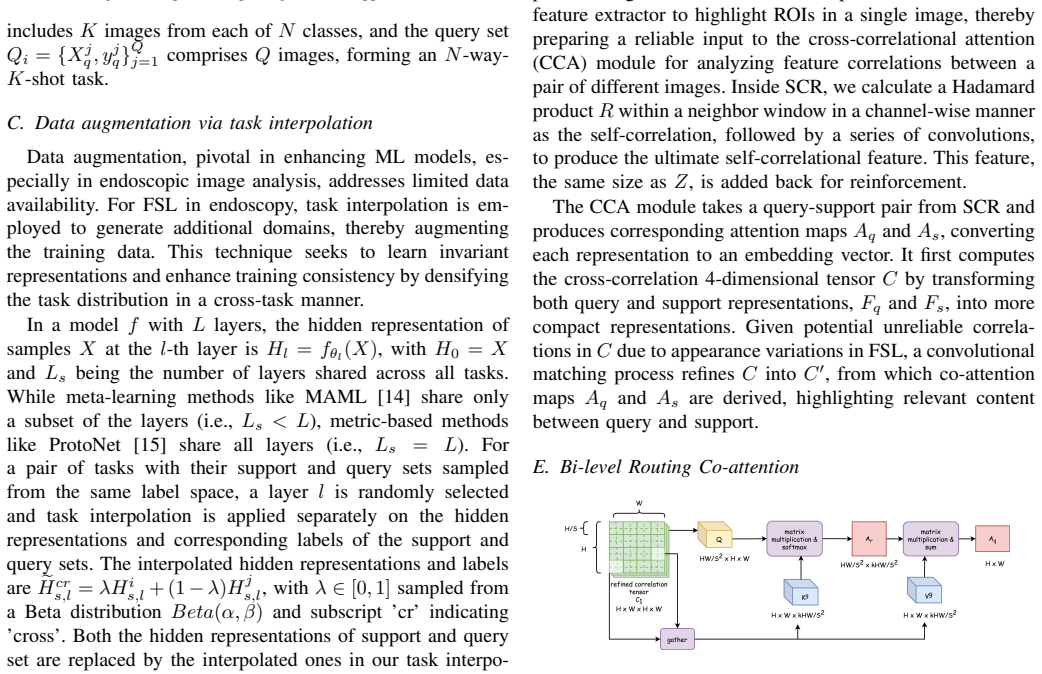
The load-bearing object is the task-interpolated relational embedding pipeline. Task interpolation densifies the task distribution by mixing hidden representations and labels of two tasks at a random layer; the self-correlational representation (SCR) module highlights intra-image regions of interest via a channel-wise Hadamard product inside a neighbor window, and the cross-correlational attention (CCA) module captures inter-image transitions by refining a 4-dimensional cross-correlation tensor between query and support. The bi-level routing attention mechanism prunes a coarse region-region affinity graph to top-k key-value pairs, keeping the co-attention computation at lower cost than full $O(N^2)$ attention. Together these components are what the paper credits for the reported accuracy gain over the Conv4 and ResNet50 baselines.
What would settle it
Compare the eight Kvasir-v2 class names (ulcerative colitis, polyps, normal cecum, normal pylorus, normal z-line, esophagitis, dyed resection margins, dyed lifted polyps) against the 23 Hyper-Kvasir classes; if any of these eight appears in the fine-tuning set, the reported 90.1% accuracy is not a measure of few-shot generalization. Then retrain on Hyper-Kvasir classes strictly excluding those eight and test on held-out images; if accuracy falls materially below 90.1%, the few-shot generalization claim is refuted.
Extended reading notes
Core claim
The paper's central claim is that its architecture, not a larger backbone, is what drives performance on Kvasir-v2. The feature extractor is Conv4 with 640 channels; tasks are drawn as N-way K-shot episodes, and at a randomly chosen layer the hidden representations of two tasks are interpolated as $\tilde{H}^{cr}_{s,l} = \lambda H^i_{s,l} + (1-\lambda) H^j_{s,l}$ with $\lambda \sim \mathrm{Beta}(\alpha,\beta)$, replacing both support and query representations. The self-correlational representation module computes a channel-wise Hadamard product within a neighbor window followed by convolutions, and the cross-correlational attention module builds a 4-dimensional cross-correlation tensor between query and support, refines it by convolutional matching, and derives co-attention maps. A bi-level routing attention then selects top-k key-value pairs from a coarse region-region affinity graph. In the paper's ablations, removing cross-correlational representation drops accuracy from 0.901 to 0.857, removing task interpolation drops it to 0.870, and replacing the routing attention with vanilla attention drops it to 0.895; these are presented as evidence for the contribution of each component.
Load-bearing premise
The load-bearing premise is that the eight Kvasir-v2 test classes never appeared in the Hyper-Kvasir images used for fine-tuning, yet the paper does not show that the two class lists are disjoint.
Editorial extensions
If this is right
- The reported scores beat the paper's own Conv4-based ProtoNet baseline by 11 accuracy points, so the relational modules and task interpolation, rather than the backbone, are the source of the gain.
- Removing the cross-correlational representation costs 4.4 accuracy points (0.901 to 0.857), the largest single ablation penalty, which points to inter-image transitions as the most important modeling choice.
- Task interpolation outperforms MixUp by 2.3 points (0.901 vs 0.878), so synthesizing new tasks rather than mixing inputs is the more effective augmentation for endoscopic viewpoints.
- The bi-level routing attention adds 0.6 points over vanilla attention while cutting inference time from 0.61 ms to 0.52 ms, indicating that the pruning mechanism is both accurate and faster.
- Ablating ISIC 2018 lowers accuracy to 0.869 and ablating Cholec80 lowers it to 0.873, so cross-domain pretraining contributes to the final result beyond the few-shot architecture itself.
Reading between the lines
- If the reported class-disjointness is verified, the same pipeline transfers naturally to other low-data medical imaging domains where visually similar classes dominate, such as dermoscopy and laparoscopic video analysis; the pretraining ablations already show cross-domain gains from ISIC and Cholec80.
- A stricter episodic benchmark on Hyper-Kvasir itself, holding out the eight classes that resemble the Kvasir-v2 labels and training on the remaining fifteen, would separate the few-shot machinery's contribution from any benefit of having seen related classes during fine-tuning.
- The top-k parameter of the bi-level routing attention can be treated as a latency-accuracy dial for real-time endoscopy, since reducing k should lower computation further at an unmeasured accuracy cost.
Editorial analysis
A structured set of objections, weighed in public.
Referee Report
Summary. The paper proposes a few-shot learning pipeline for gastrointestinal endoscopy image classification, combining a wide Conv4 feature extractor (640 channels), task interpolation, self- and cross-correlational relational embeddings, and a bi-level routing attention mechanism. The authors fine-tune on Hyper-Kvasir and report 90.1% accuracy, 0.845 precision, 0.942 recall, and 0.891 F1 on Kvasir-v2, claiming state-of-the-art performance. Ablation studies remove or replace individual components to attribute contributions. The central claim is that this architecture surpasses MAML, ProtoNet, Transformer, and ResNet50 under the few-shot paradigm described in Section II-B.
Significance. If the reported results were obtained under a valid few-shot protocol, the paper would offer a useful composition of existing components (Conv4, task interpolation from Yao et al., relational embedding from Kang et al., and BiFormer-style attention) applied to a clinically relevant domain. The task-interpolation idea is a reasonable response to limited medical data, and the ablation study is internally consistent. However, the manuscript provides no code, no variance estimates, and most importantly the experimental protocol does not satisfy the few-shot disjoint-class requirement. As it stands, the evaluation does not support the state-of-the-art claim, and the main contribution cannot be assessed without redoing the experiments under a proper split.
major comments (4)
- [II-B and III-A] The FSL formulation in Section II-B explicitly requires Ctrain ∩ Ctest = ∅, but Section III-A fine-tunes on Hyper-Kvasir (10,662 images, 23 classes) and tests on Kvasir-v2 (8,000 images, 8 classes). The Hyper-Kvasir dataset, cited as reference [20], is publicly documented to include the Kvasir-v2 images, so the exact test images and all test classes are contained in the fine-tuning set. This violates both the image-level and class-level disjointness requirements. The reported 90.1% accuracy therefore does not measure few-shot generalization, and the comparisons in Table III are invalid. Please provide an evaluation with a truly disjoint class split, or report results under a conventional transfer-learning protocol without claiming few-shot generalization.
- [III-B and Table III] Tables III and IV report point estimates with no standard deviations, confidence intervals, or number of seeds. Few-shot evaluation is stochastic because tasks, support sets, and augmentations are randomly sampled; a single run cannot support a claim of superiority, especially when the margin over the Transformer baseline is only 0.031 in accuracy (0.901 vs. 0.870). Report mean ± std over at least five independent runs and, if possible, a paired significance test across the same task draws.
- [III-B] The authors state that they 'eliminated the validation process,' and the final configuration appears to be selected using the Kvasir-v2 test set: Table IV compares architectural choices such as 640 versus 64 channels, ResNet12 versus Conv4, and attention variants, and the best accuracy is then reported as the final result. This is a form of test-set model selection that inflates the reported accuracy. A held-out validation split or nested cross-validation is needed to make the reported 90.1% an unbiased estimate.
- [III-C] The baseline comparison is underspecified. No implementation details are given for MAML, ProtoNet, Transformer, or ResNet50: the backbone, optimizer, learning rate, episode count, data preprocessing, or whether the baselines were subjected to the same Hyper-Kvasir fine-tuning. Without matched protocols, the numbers in Table III are uninterpretable. In particular, 'Transformer' needs a concrete architecture and training schedule, and each baseline should be evaluated under the same split and with the same number of seeds.
minor comments (5)
- [II-E] The phrase 'Nature Language Processing' should be 'Natural Language Processing'.
- [III-B and Table IV] There are typos and grammatical errors: 'Keeping Con4 64 layer channels and change relational layer to 64' should be 'Keeping Conv4 with 64 channels and changing the relational layer to 64 channels,' and 'Con4' should be 'Conv4'.
- [I] The sentence about 'the static size of the structuring element in the morphological operator' complicating segmentation, with vessels evolving 'along the periphery of the liver,' appears tangential and confusing; it should be removed or substantially clarified.
- [III-A] The phrase 'following the criteria in [1]' is vague because reference [1] is a classification paper, not a dataset curation standard; specify what criteria are meant.
- [Tables and Abstract] The abstract and several places say 'Kvasir dataset' while the experimental section uses 'Kvasir-v2'; use the versioned name consistently throughout.
Circularity Check
No equation-level circularity; the Kvasir/Hyper-Kvasir overlap is a data-leakage validity concern, not a circular derivation step.
full rationale
The derivation chain is not circular in the equation-level sense. The feature extractor is an off-the-shelf Conv4 with adjusted channel count; the few-shot task construction follows the standard Dtrain/Dtest split definition in Section II-B; task interpolation is imported from MLTI [25]; the self- and cross-correlational embedding modules are imported from [16]; and the bi-level routing attention is imported from BiFormer [18]. No reported metric is algebraically defined in terms of a fitted parameter, and no load-bearing premise is supported only by a self-citation. The main risk is experimental, not derivational: Section II-B requires Ctrain ∩ Ctest = ∅, but Section III-A fine-tunes on Hyper-Kvasir [20] and tests on Kvasir-v2 [19]. If, as publicly documented for the cited datasets, Hyper-Kvasir contains the Kvasir-v2 images/classes, then the 90.1% accuracy is training-set performance rather than few-shot generalization to unseen classes; that is data leakage, not a circular derivation. Additionally, ablations in Section IV were used to select the final configuration on the same test set, another evaluation concern. These issues undermine confidence in the empirical claim but do not make the method's construction self-referential or equivalent to its inputs by definition.
Assumptions & free parameters
free parameters (7)
- Conv4 channel width =
640
- Learning rate =
0.0001 (fixed)
- Weight decay =
0.002
- Batch size =
128
- Total episodes =
5000
- Beta distribution parameters (alpha, beta) for task interpolation =
not specified
- Routing top-k region count =
not specified
assumptions (4)
- domain assumption Test classes are disjoint from all training and fine-tuning classes (Ctrain ∩ Ctest = ∅)
- domain assumption Hyper-Kvasir fine-tuning labels and Kvasir-v2 test labels do not overlap
- domain assumption ImageNet normalization statistics transfer to endoscopic images
- ad hoc to paper Conv4 with 640 channels is a sufficient feature extractor for the relational modules
Cite this review
Pith. "Pith review of Lightweight Relational Embedding in Task-Interpolated Few-Shot Networks for Enhanced Gastrointestinal Disease Classification." pith.science (2026). https://pith.science/paper/GNNHF2Z2
@misc{pith2026250524792,
  author       = {Pith},
  title        = {Pith review of: Lightweight Relational Embedding in Task-Interpolated Few-Shot Networks for Enhanced Gastrointestinal Disease Classification},
  year         = {2026},
  howpublished = {\url{https://pith.science/paper/GNNHF2Z2}},
  note         = {Machine review of arXiv:2505.24792}
}
read the original abstract
Traditional diagnostic methods like colonoscopy are invasive yet critical tools necessary for accurately diagnosing colorectal cancer (CRC). Detection of CRC at early stages is crucial for increasing patient survival rates. However, colonoscopy is dependent on obtaining adequate and high-quality endoscopic images. Prolonged invasive procedures are inherently risky for patients, while suboptimal or insufficient images hamper diagnostic accuracy. These images, typically derived from video frames, often exhibit similar patterns, posing challenges in discrimination. To overcome these challenges, we propose a novel Deep Learning network built on a Few-Shot Learning architecture, which includes a tailored feature extractor, task interpolation, relational embedding, and a bi-level routing attention mechanism. The Few-Shot Learning paradigm enables our model to rapidly adapt to unseen fine-grained endoscopic image patterns, and the task interpolation augments the insufficient images artificially from varied instrument viewpoints. Our relational embedding approach discerns critical intra-image features and captures inter-image transitions between consecutive endoscopic frames, overcoming the limitations of Convolutional Neural Networks (CNNs). The integration of a light-weight attention mechanism ensures a concentrated analysis of pertinent image regions. By training on diverse datasets, the model's generalizability and robustness are notably improved for handling endoscopic images. Evaluated on Kvasir dataset, our model demonstrated superior performance, achieving an accuracy of 90.1\%, precision of 0.845, recall of 0.942, and an F1 score of 0.891. This surpasses current state-of-the-art methods, presenting a promising solution to the challenges of invasive colonoscopy by optimizing CRC detection through advanced image analysis.
Figures


Figures from the paper (2 more)

Reference graph
Works this paper leans on
-
[25]
H. Yao, L. Zhang, and C. Finn, Meta-learning with fewer tasks through task interpolation , Mar. 17, 2022. arXiv: 2106.02695[cs]
work page Pith review arXiv 2022
-
[16]
D. Kang, H. Kwon, J. Min, and M. Cho, Relational em- bedding for few-shot classification , 2021. arXiv: 2108. 09666 [cs.CV]
work page 2021
-
[18]
L. Zhu, X. Wang, Z. Ke, W. Zhang, and R. Lau, BiFormer: Vision Transformer with Bi-Level Routing Attention, arXiv:2303.08810 [cs], Mar. 2023
work page Pith review arXiv 2023
-
[20]
HyperKvasir, a comprehensive multi-class image and video dataset for gastrointestinal endoscopy,
H. Borgli, V . Thambawita, P. H. Smedsrud, et al. , “HyperKvasir, a comprehensive multi-class image and video dataset for gastrointestinal endoscopy,” Scientific Data, vol. 7, no. 1, p. 283, Aug. 2020, Number: 1 Publisher: Nature Publishing Group
work page 2020
-
[1]
K. Ramamurthy, T. T. George, Y . Shah, and P. Sasidhar, “A novel multi-feature fusion method for classification of gastrointestinal diseases using endoscopy images,” Diagnostics, vol. 12, no. 10, p. 2316,
-
[2]
A. Akilandeswari, D. Sungeetha, C. Joseph, et al. , “Automatic detection and segmentation of colorectal cancer with deep residual convolutional neural net- work,” Evidence-Based Complementary and Alternative Medicine, vol. 2022, 2022
work page 2022
-
[3]
Z. Lu, Y . Xu, L. Yao, et al. , “Real-time automated diagnosis of colorectal cancer invasion depth using a deep learning model with multimodal data (with video),” Gastrointestinal Endoscopy , vol. 95, no. 6, pp. 1186–1194, 2022
work page 2022
-
[4]
A Combined Corner and Edge Detector,
C. Harris and M. Stephens, “A Combined Corner and Edge Detector,” in Procedings of the Alvey Vision Con- ference 1988, Alvey Vision Club, 1988, pp. 23.1–23.6
work page 1988
Show all 29 references
-
[5]
Surf: Speeded up robust features,
H. Bay, T. Tuytelaars, and L. Van Gool, “Surf: Speeded up robust features,” Lecture notes in computer science , vol. 3951, pp. 404–417, 2006
2006
-
[6]
Orb: An efficient alternative to sift or surf,
E. Rublee, V . Rabaud, K. Konolige, and G. Bradski, “Orb: An efficient alternative to sift or surf,” in 2011 In- ternational conference on computer vision , Ieee, 2011, pp. 2564–2571
2011
-
[7]
Simonyan and A
K. Simonyan and A. Zisserman, Very deep convolu- tional networks for large-scale image recognition, 2015. arXiv: 1409.1556 [cs.CV]
2015 arXiv
-
[8]
Efficient detection of lesions during endoscopy,
A. Dutta, R. K. Bhattacharjee, and F. A. Barbhuiya, “Efficient detection of lesions during endoscopy,” in Pattern Recognition. ICPR International Workshops and Challenges: Virtual Event, January 10-15, 2021, Pro- ceedings, Part VIII, Springer, 2021, pp. 315–322
2021
-
[9]
An image classification model based on transfer learning for ulcerative proctitis,
F. Zeng, X. Li, X. Deng, L. Yao, and G. Lian, “An image classification model based on transfer learning for ulcerative proctitis,” Multimedia Systems, pp. 1–10, 2021
2021
-
[10]
Chollet, Xception: Deep learning with depthwise separable convolutions , 2017
F. Chollet, Xception: Deep learning with depthwise separable convolutions , 2017. arXiv: 1610 . 02357 [cs.CV]
2017
-
[11]
K. He, X. Zhang, S. Ren, and J. Sun, Deep residual learning for image recognition , 2015. arXiv: 1512 . 03385 [cs.CV]
2015
-
[12]
Huang, Z
G. Huang, Z. Liu, L. van der Maaten, and K. Q. Weinberger, Densely connected convolutional networks,
-
[13]
Diagnosis of ulcerative colitis from endoscopic images based on deep learning,
X. Luo, J. Zhang, Z. Li, and R. Yang, “Diagnosis of ulcerative colitis from endoscopic images based on deep learning,” Biomedical Signal Processing and Control , vol. 73, p. 103 443, 2022
2022
-
[14]
C. Finn, P. Abbeel, and S. Levine, Model-agnostic meta- learning for fast adaptation of deep networks , Jul. 18,
-
[15]
Prototypical net- works for few-shot learning,
J. Snell, K. Swersky, and R. Zemel, “Prototypical net- works for few-shot learning,” in Advances in Neural Information Processing Systems , vol. 30, Curran Asso- ciates, Inc., 2017
2017
-
[17]
Vaswani, N
A. Vaswani, N. Shazeer, N. Parmar, et al., Attention Is All You Need, arXiv:1706.03762 [cs], Aug. 2023
2023 arXiv
-
[19]
Kvasir: A multi-class image dataset for computer aided gas- trointestinal disease detection,
K. Pogorelov, K. R. Randel, C. Griwodz, et al., “Kvasir: A multi-class image dataset for computer aided gas- trointestinal disease detection,” in Proceedings of the 8th ACM on Multimedia Systems Conference , ACM, 2017, pp. 164–169
2017
-
[21]
The ham10000 dataset, a large collection of multi-source dermatoscopic images of common pigmented skin le- sions,
P. Tschandl, C. Rosendahl, and H. Kittler, “The ham10000 dataset, a large collection of multi-source dermatoscopic images of common pigmented skin le- sions,” Scientific data, vol. 5, no. 1, pp. 1–9, 2018
2018
-
[22]
Skin lesion analysis toward melanoma detection 2018: A challenge hosted by the international skin imaging collaboration (isic),
N. Codella, V . Rotemberg, P. Tschandl, et al. , “Skin lesion analysis toward melanoma detection 2018: A challenge hosted by the international skin imaging collaboration (isic),” arXiv preprint arXiv:1902.03368 , 2019
2018 arXiv
-
[23]
A. P. Twinanda, S. Shehata, D. Mutter, J. Marescaux, M. de Mathelin, and N. Padoy, Endonet: A deep ar- chitecture for recognition tasks on laparoscopic videos ,
-
[24]
ImageNet Large Scale Visual Recognition Challenge,
O. Russakovsky, J. Deng, H. Su, et al. , “ImageNet Large Scale Visual Recognition Challenge,” Interna- tional Journal of Computer Vision (IJCV) , vol. 115, no. 3, pp. 211–252, 2015
2015
-
[26]
Mixup: Beyond empirical risk minimization,
H. Zhang, M. Cisse, Y . N. Dauphin, and D. Lopez-Paz, “Mixup: Beyond empirical risk minimization,” arXiv preprint arXiv:1710.09412, 2017
2017 arXiv
-
[2016]
arXiv: 1602.03012 [cs.CV]
-
[2017]
arXiv: 1703.03400[cs]
-
[2018]
arXiv: 1608.06993 [cs.CV]
Reviewed August 7, 2026 · model on record in the stance chip above.
Discussion (0). Sign in to comment.