Statistical Field Theory for Weak Gravitational Lensing
Pith reviewed 2026-06-26 19:32 UTC · model grok-4.3
The pith
Weak lensing is formulated as a stochastic field theory for Sachs optical scalars driven by random Ricci-focusing and Weyl-shearing fields.
A machine-rendered reading of the paper's core claim, the machinery that carries it, and where it could break.
Core claim
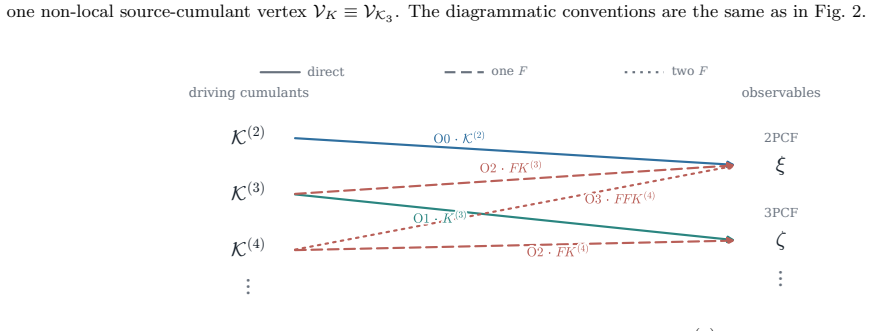
We formulate lensing as a stochastic field theory for the Sachs optical scalars, driven by random Ricci-focusing and Weyl-shearing fields. The resulting path integral generates a diagrammatic expansion for arbitrary n-point correlation functions of lensing observables, organised into linear response, nonlinear propagation, and driving-field cumulants. The conventional calculation emerges as the lowest-order, linear-propagation limit. Beyond it, nonlinear Sachs evolution couples to driving-field non-Gaussianity, mixing the matter cumulant hierarchy into the lensing hierarchy. A selection rule governs the couplings: an n-point observable receives a direct contribution from the n-point driving-
What carries the argument
The path integral over Sachs optical scalars whose evolution is sourced by independent stochastic Ricci-focusing and Weyl-shearing fields, together with the selection rule that organises how driving-field cumulants enter the lensing hierarchy at successive orders.
If this is right
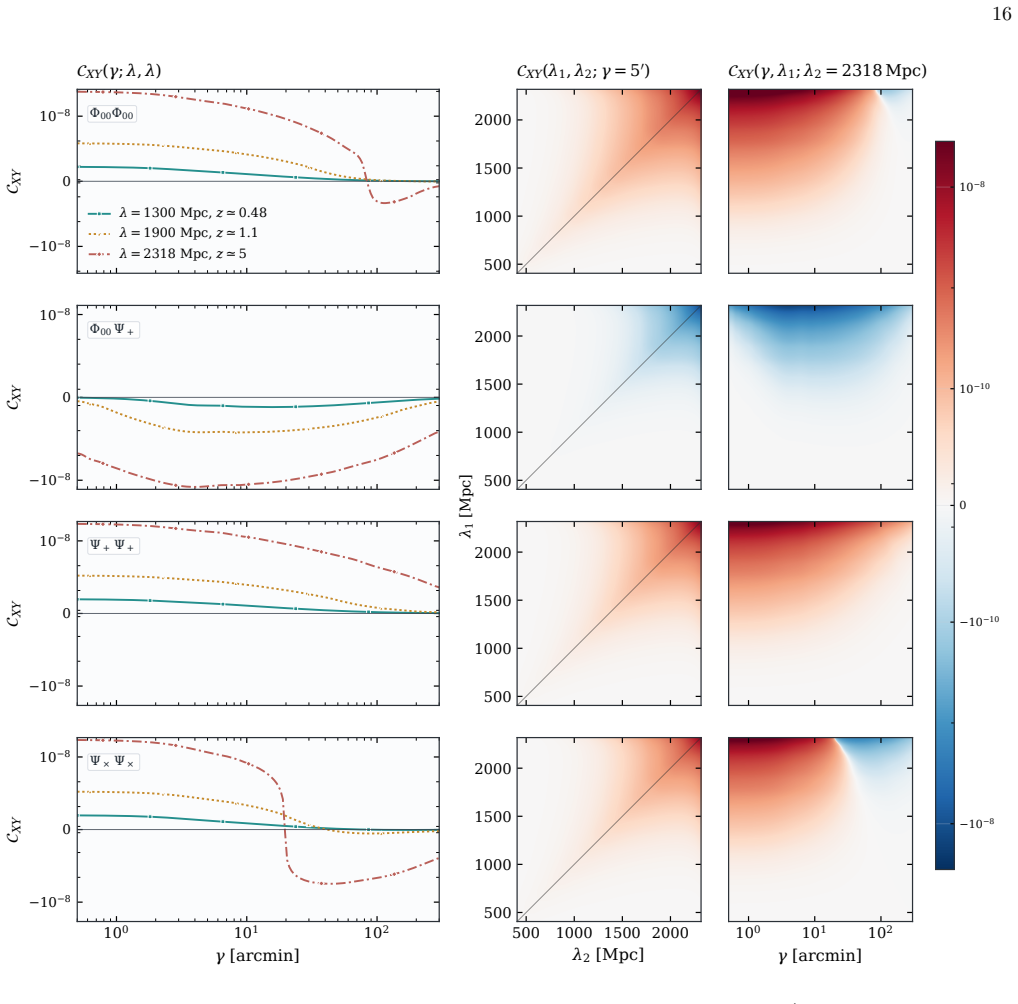
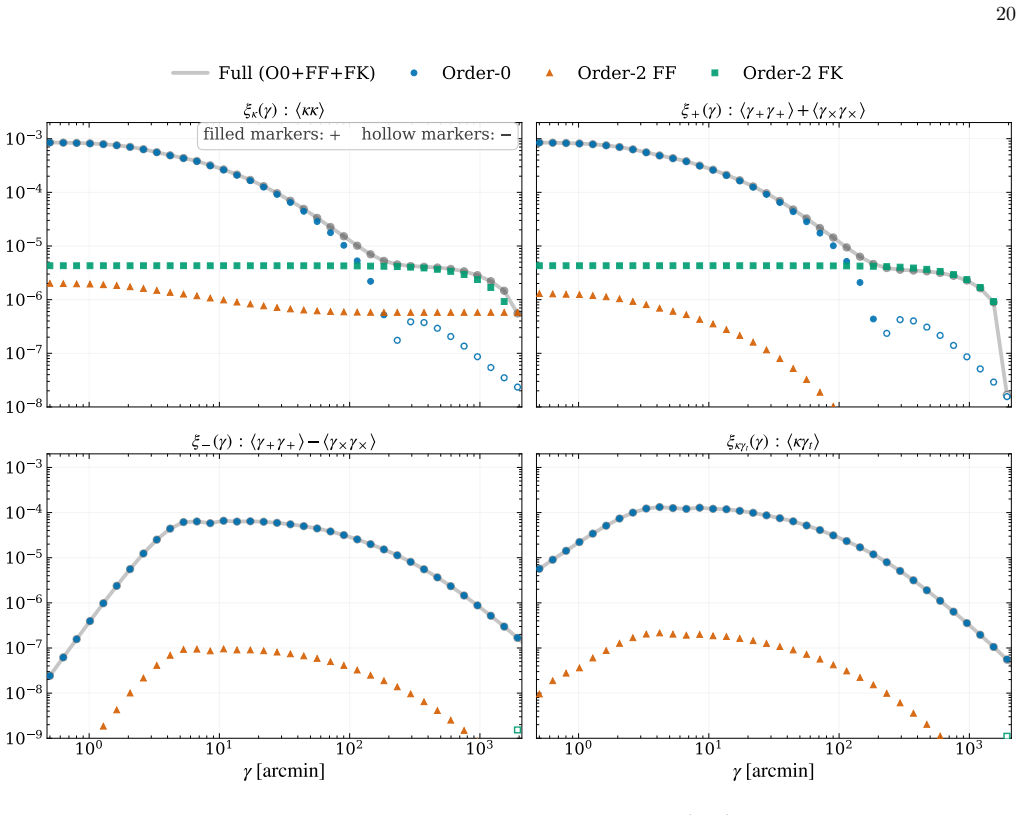
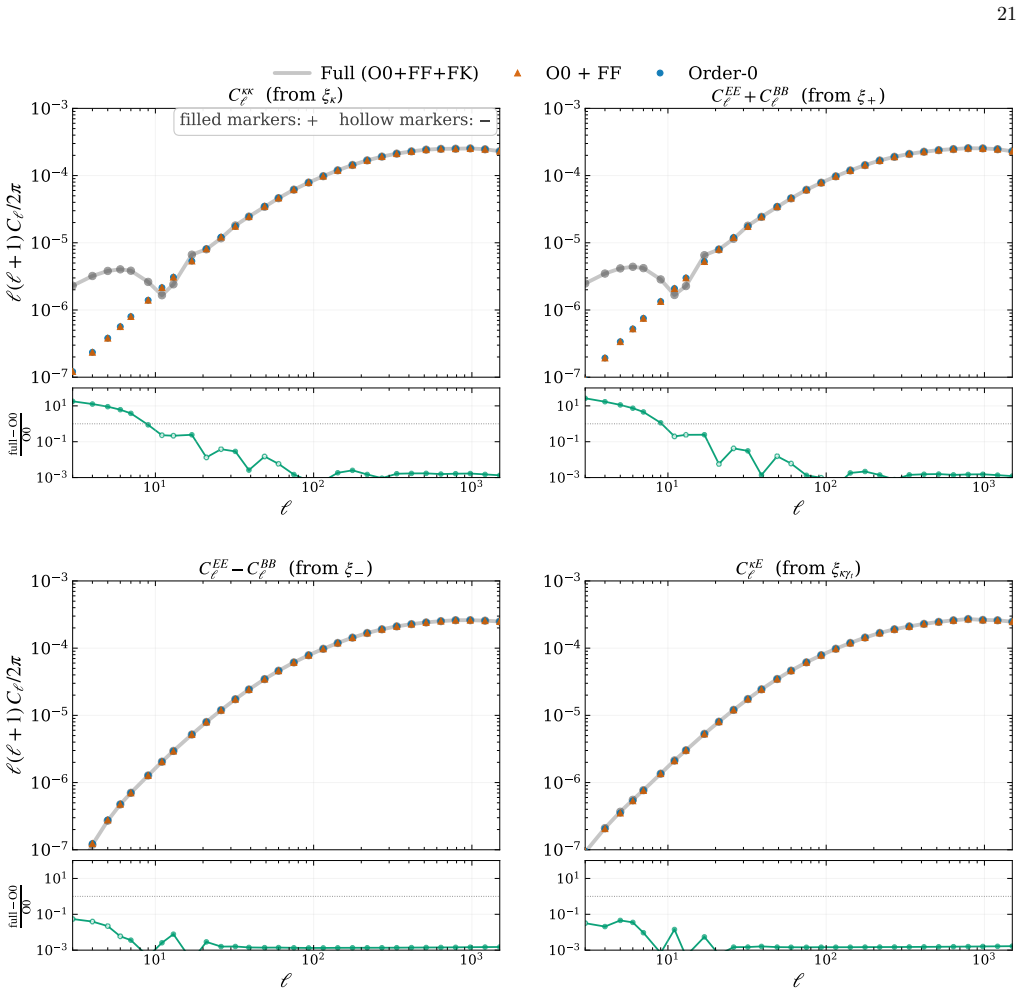
- The two-point lensing function receives corrections from squeezed three-point cumulants of Ricci focusing and Weyl shearing, allowing small-scale modes to source larger-scale power.
- These corrections feed the lensing E- and B-modes equally.
- Higher-order lensing statistics automatically mix contributions from higher driving-field cumulants without separate modeling.
- Path corrections and stochasticity appear at the same perturbative order as nonlinear propagation effects.
Where Pith is reading between the lines
- The selection rule suggests that measurements of lensing bispectra could be used to constrain the three-point statistics of the driving fields rather than treating them as nuisance parameters.
- Because the formalism keeps the driving fields explicit, it offers a route to include baryonic or other small-scale physics by modifying only the cumulants of Ricci and Weyl fields.
- The same diagrammatic structure could be applied to other line-of-sight integrals in cosmology, such as the integrated Sachs-Wolfe effect or cosmic magnification, by identifying the analogous optical scalars.
Load-bearing premise
The Sachs optical scalars can be treated as a stochastic field whose statistics are fully determined by the cumulants of independent random Ricci and Weyl driving fields, with those cumulants entering the lensing observables according to the stated selection rule.
What would settle it
A direct numerical extraction, from ray-tracing through N-body simulations, of the squeezed three-point cumulants of the Ricci and Weyl fields along lines of sight and a test of whether they produce the predicted correction to the lensing two-point function at the amplitude and scale dependence given by the selection rule.
Figures
read the original abstract
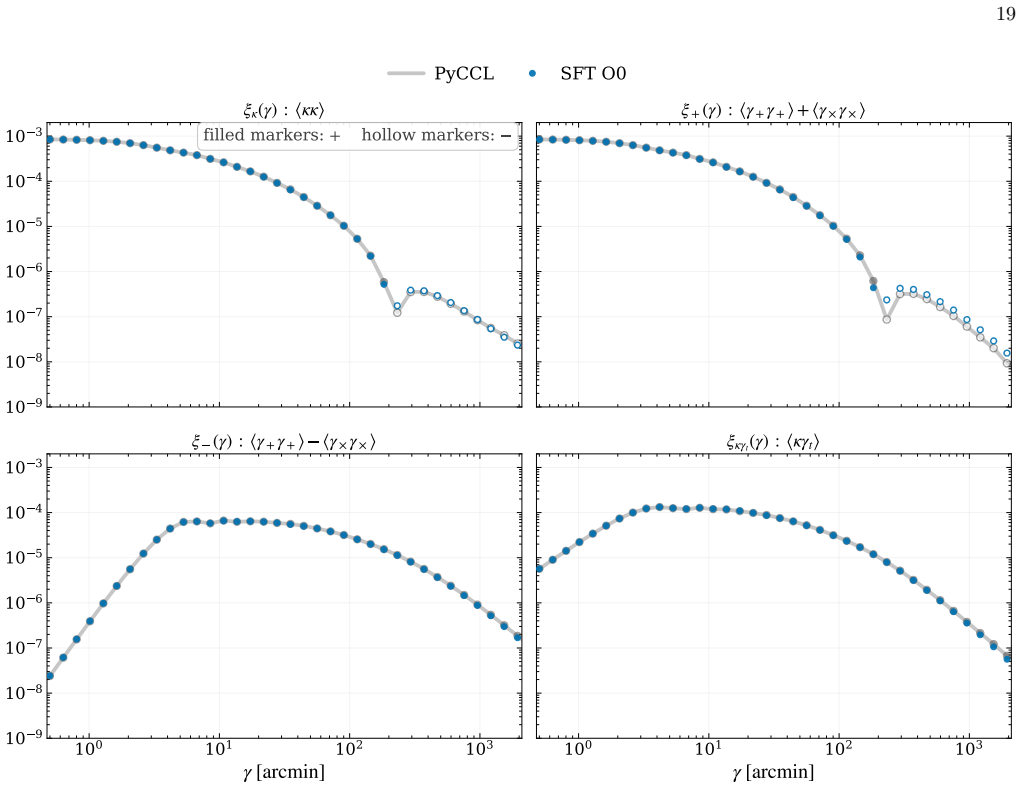
Standard weak-lensing calculations treat lensing as a linear remapping of the matter field along the line of sight. We instead formulate lensing as a stochastic field theory for the Sachs optical scalars, driven by random Ricci-focusing and Weyl-shearing fields. The resulting path integral generates a diagrammatic expansion for arbitrary $n$-point correlation functions of lensing observables, organised into linear response, nonlinear propagation, and driving-field cumulants. The conventional calculation emerges as the lowest-order, linear-propagation limit. Beyond it, nonlinear Sachs evolution couples to driving-field non-Gaussianity, mixing the matter cumulant hierarchy into the lensing hierarchy. A selection rule governs the couplings: an $n$-point observable receives a direct contribution from the $n$-point driving-field cumulant, and its leading hierarchy-mixing correction from the $(n+1)$-point cumulant via one nonlinear Sachs interaction, with higher cumulants entering only at higher order. The two-point function, for instance, is corrected by squeezed three-point cumulants of Ricci focusing and Weyl shearing, letting small-scale modes source larger scales and feeding the lensing $E$- and $B$-modes equally. Rather than a restrictive approximation scheme, the formalism is a paradigm shift: a unified framework naturally accommodating path corrections, higher-order matter statistics, stochasticity, and small-scale effects.
Editorial analysis
A structured set of objections, weighed in public.
Referee Report
Summary. The paper formulates weak gravitational lensing as a stochastic field theory for the Sachs optical scalars, driven by random Ricci-focusing and Weyl-shearing fields. The resulting path integral yields a diagrammatic expansion for n-point lensing correlation functions organized by linear response, nonlinear propagation, and driving-field cumulants. The standard linear remapping result is recovered as the lowest-order limit. A selection rule is stated whereby an n-point lensing observable receives a direct drive from the n-point driving cumulant and its leading correction from the (n+1)-point cumulant via a single nonlinear Sachs interaction; this is illustrated for the two-point function by squeezed three-point cumulants of Ricci and Weyl fields that source E- and B-modes equally. The framework is presented as a paradigm shift that unifies path corrections, higher-order matter statistics, stochasticity, and small-scale effects.
Significance. If the selection rule and the underlying stochastic action can be derived explicitly from the Sachs equations, the approach would supply a systematic, non-perturbative organizing principle for incorporating non-Gaussian matter statistics and nonlinear propagation into weak-lensing observables. This could affect the interpretation of small-scale signals in upcoming surveys and the separation of E/B modes without ad-hoc cutoffs.
major comments (2)
- [Abstract] Abstract, final paragraph: the selection rule (n-point observable driven directly by n-point cumulant, leading correction from (n+1)-point cumulant via exactly one nonlinear Sachs interaction) is asserted without an explicit derivation from the nonlinear terms in the Sachs optical-scalar evolution or from the stochastic measure. Because this rule is the sole justification for the claim that the formalism 'automatically and exactly accommodates arbitrary higher-order matter statistics,' its status as a theorem rather than an assumption must be demonstrated before the paradigm-shift assertion can be evaluated.
- [Abstract] Abstract: the statement that 'the two-point function... is corrected by squeezed three-point cumulants... feeding the lensing E- and B-modes equally' is presented as a direct consequence of the selection rule, yet no explicit vertex or propagator is shown that would enforce equal E/B feeding at this order. Without the interaction Lagrangian or the resulting Feynman rules, it is impossible to confirm that lower-order mixings are forbidden at the claimed perturbative order.
minor comments (1)
- The abstract refers to 'the stated selection rule' but supplies neither the explicit Sachs equations nor the form of the stochastic action; a dedicated section deriving the vertices from the optical-scalar evolution would clarify the construction.
Simulated Author's Rebuttal
We thank the referee for their careful reading and constructive comments. We address each major comment below.
read point-by-point responses
-
Referee: [Abstract] Abstract, final paragraph: the selection rule (n-point observable driven directly by n-point cumulant, leading correction from (n+1)-point cumulant via exactly one nonlinear Sachs interaction) is asserted without an explicit derivation from the nonlinear terms in the Sachs optical-scalar evolution or from the stochastic measure. Because this rule is the sole justification for the claim that the formalism 'automatically and exactly accommodates arbitrary higher-order matter statistics,' its status as a theorem rather than an assumption must be demonstrated before the paradigm-shift assertion can be evaluated.
Authors: The selection rule is derived explicitly from the nonlinear Sachs equations and the stochastic path-integral measure in Sections 3–4 of the manuscript. The abstract summarizes this derived result. To make its status as a theorem unambiguous, we will revise the abstract to reference the relevant sections and add a concise statement that the rule follows from the explicit construction. revision: yes
-
Referee: [Abstract] Abstract: the statement that 'the two-point function... is corrected by squeezed three-point cumulants... feeding the lensing E- and B-modes equally' is presented as a direct consequence of the selection rule, yet no explicit vertex or propagator is shown that would enforce equal E/B feeding at this order. Without the interaction Lagrangian or the resulting Feynman rules, it is impossible to confirm that lower-order mixings are forbidden at the claimed perturbative order.
Authors: The interaction Lagrangian, vertices, and resulting Feynman rules are derived in Section 5; the equal E/B feeding at this order follows directly from the symmetry properties of the Weyl and Ricci terms under the selection rule, with no lower-order mixings permitted. We will revise the manuscript to include an explicit illustrative diagram and short calculation of this term, making the connection self-contained. revision: yes
Circularity Check
Derivation chain self-contained; no circular reductions identified
full rationale
The abstract presents the stochastic field theory and selection rule as generated by the path integral over Sachs optical scalars driven by Ricci/Weyl fields, with the linear result recovered as the explicit lowest-order limit. No equations are shown reducing a claimed prediction to a fitted input, self-citation, or definitional tautology. The selection rule is asserted to follow from the diagrammatic expansion rather than being presupposed as an input; absent any quoted reduction of the form 'n-point observable equals n-point cumulant by construction,' the framework remains non-circular. This is the expected outcome for a paper whose central construction is an independent reformulation rather than a re-labeling of prior results.
Axiom & Free-Parameter Ledger
axioms (1)
- domain assumption Lensing observables are generated by a path integral over stochastic Sachs optical scalars driven by random Ricci and Weyl fields.
Reference graph
Works this paper leans on
-
[1]
Asgari, C.-A
M. Asgari, C.-A. Lin, B. Joachimi, B. Giblin, C. Hey- mans, H. Hildebrandt, A. Kannawadi, B. St¨ olzner, T. Tr¨ oster, J. L. van den Busch,et al., Kids-1000 cos- mology: Cosmic shear constraints and comparison be- tween two point statistics, Astronomy & Astrophysics 645, A104 (2021). 29 1 3 10 30 100 300 [arcmin] 397 1823 2261 2314 2327affine shell [Mpc] ...
2021
-
[2]
A. Amon, D. Gruen, M. A. Troxel, N. MacCrann, S. Do- delson, A. Choi, C. Doux, L. F. Secco, S. Samuroff, E. Krause,et al., Dark energy survey year 3 results: Cos- mology from cosmic shear and robustness to data calibra- tion, Physical Review D105, 023514 (2022)
2022
-
[3]
Ivezi´ c, S
ˇZ. Ivezi´ c, S. M. Kahn, J. A. Tyson, B. Abel, E. Acosta, R. Allsman, D. Alonso, Y. AlSayyad, S. F. Anderson, J. Andrew,et al., Lsst: from science drivers to reference design and anticipated data products, The Astrophysical Journal873, 111 (2019)
2019
-
[4]
R. Laureijs, J. Amiaux, S. Arduini, J.-L. Augueres, J. Brinchmann, R. Cole, M. Cropper, C. Dabin, L. Du- vet, A. Ealet,et al., Euclid definition study report, arXiv preprint arXiv:1110.3193 (2011)
Pith/arXiv arXiv 2011
-
[5]
Spergel, N
D. Spergel, N. Gehrels, C. Baltay, D. Bennett, J. Breckin- ridge, M. Donahue, A. Dressler, B. S. Gaudi, T. Greene, O. Guyon,et al., Wide-field infrarred survey telescope- astrophysics focused telescope assets wfirst-afta 2015 re- port, ArXiv e-prints , arXiv (2015)
2015
-
[6]
Bartelmann and P
M. Bartelmann and P. Schneider, Weak gravitational lensing, Physics Reports340, 291 (2001)
2001
-
[7]
Kilbinger, Cosmology with cosmic shear observations: a review, Reports on Progress in Physics78, 086901 (2015)
M. Kilbinger, Cosmology with cosmic shear observations: a review, Reports on Progress in Physics78, 086901 (2015)
2015
-
[8]
Mandelbaum, Weak lensing for precision cosmology, Annual Review of Astronomy and Astrophysics56, 393 (2018)
R. Mandelbaum, Weak lensing for precision cosmology, Annual Review of Astronomy and Astrophysics56, 393 (2018)
2018
-
[9]
Cooray and W
A. Cooray and W. Hu, Second-order corrections to weak lensing by large-scale structure, The Astrophysical Jour- nal574, 19 (2002)
2002
-
[10]
Dodelson, C
S. Dodelson, C. Shapiro, and M. White, Reduced shear power spectrum, Physical Review D—Particles, Fields, Gravitation, and Cosmology73, 023009 (2006)
2006
-
[11]
Bernardeau, C
F. Bernardeau, C. Bonvin, and F. Vernizzi, Full-sky lens- ing shear at second order, Physical Review D—Particles, Fields, Gravitation, and Cosmology81, 083002 (2010)
2010
-
[12]
Krause and C
E. Krause and C. M. Hirata, Weak lensing power spec- tra for precision cosmology-multiple-deflection, reduced shear, and lensing bias corrections, Astronomy & Astro- physics523, A28 (2010)
2010
-
[13]
Pratten and A
G. Pratten and A. Lewis, Impact of post-born lensing on the CMB, Journal of Cosmology and Astroparticle Physics2016(08), 047
-
[14]
Fabbian, M
G. Fabbian, M. Calabrese, and C. Carbone, Cmb weak- lensing beyond the born approximation: a numerical ap- proach, Journal of Cosmology and Astroparticle Physics 2018(02), 050
2018
-
[15]
Marozzi, G
G. Marozzi, G. Fanizza, E. Di Dio, and R. Durrer, Cmb lensing beyond the leading order: Temperature and po- larization anisotropies, Physical Review D98, 023535 (2018)
2018
-
[16]
Fry, Gravity, bias, and the galaxy three-point correla- tion function, Physical Review Letters73, 215 (1994)
J. Fry, Gravity, bias, and the galaxy three-point correla- tion function, Physical Review Letters73, 215 (1994)
1994
-
[17]
Scoccimarro, H
R. Scoccimarro, H. A. Feldman, J. N. Fry, and J. A. Frieman, The bispectrum of iras redshift catalogs, The Astrophysical Journal546, 652 (2001)
2001
-
[18]
Jeong and E
D. Jeong and E. Komatsu, Primordial non-gaussianity, scale-dependent bias, and the bispectrum of galaxies, The Astrophysical Journal703, 1230 (2009)
2009
-
[19]
Halder, O
A. Halder, O. Friedrich, S. Seitz, and T. N. Varga, The in- tegrated three-point correlation function of cosmic shear, Monthly Notices of the Royal Astronomical Society506, 2780 (2021)
2021
-
[20]
P. Lemos, A. Challinor, and G. Efstathiou, The effect of Limber and flat-sky approximations on galaxy weak lens- ing, JCAP2017, 014 (2017), arXiv:1704.01054 [astro- ph.CO]
Pith/arXiv arXiv 2017
-
[21]
X. Fang, E. Krause, T. Eifler, and N. MacCrann, Beyond Limber: efficient computation of angular power spectra for galaxy clustering and weak lensing, JCAP2020, 010 (2020), arXiv:1911.11947 [astro-ph.CO]
arXiv 2020
-
[22]
T. D. Kitching, J. Alsing, A. F. Heavens, R. Jimenez, 30 J. D. McEwen, and L. Verde, The limits of cosmic shear, MNRAS469, 2737 (2017), arXiv:1611.04954 [astro- ph.CO]
Pith/arXiv arXiv 2017
-
[23]
C. Cuesta-Lazaro, A. Quera-Bofarull, R. Reischke, and B. M. Sch¨ afer, Gravitational corrections to light propa- gation in a perturbed FLRW universe and correspond- ing weak-lensing spectra, MNRAS477, 741 (2018), arXiv:1801.03325 [astro-ph.CO]
Pith/arXiv arXiv 2018
-
[24]
Hilbert, S., Hartlap, J., White, S. D. M., and Schneider, P., Ray-tracing through the millennium simulation: Born corrections and lens-lens coupling in cosmic shear and galaxy-galaxy lensing, A&A499, 31 (2009)
2009
-
[25]
A. Petri, Z. Haiman, L. Hui, M. May, and J. M. Kra- tochvil, Cosmology with Minkowski functionals and mo- ments of the weak lensing convergence field, Phys. Rev. D88, 123002 (2013), arXiv:1309.4460 [astro-ph.CO]
Pith/arXiv arXiv 2013
-
[26]
R. Takahashi, T. Hamana, M. Shirasaki, T. Namikawa, T. Nishimichi, K. Osato, and K. Shiroyama, Full-sky Gravitational Lensing Simulation for Large-area Galaxy Surveys and Cosmic Microwave Background Experi- ments, Astrophys. J.850, 24 (2017), arXiv:1706.01472 [astro-ph.CO]
Pith/arXiv arXiv 2017
-
[27]
Sachs, Gravitational waves in general relativity
R. Sachs, Gravitational waves in general relativity. vi. the outgoing radiation condition, Proceedings of the Royal Society of London. Series A. Mathematical and Physical Sciences264, 309 (1961)
1961
-
[28]
P. C. Martin, E. D. Siggia, and H. A. Rose, Statisti- cal Dynamics of Classical Systems, Phys. Rev. A8, 423 (1973)
1973
-
[29]
H.-K. Janssen, On a Lagrangean for classical field dynam- ics and renormalization group calculations of dynamical critical properties, Zeitschrift fur Physik B Condensed Matter23, 377 (1976)
1976
-
[30]
J. A. Krommes, Fundamental statistical descriptions of plasma turbulence in magnetic fields, Phys. Rep.360, 1 (2002)
2002
-
[31]
Z. Zhang, sft-wick: A formalism and package for feynman-diagram expansion and evaluation in stochas- tic field theories (2026), arXiv:2606.19480 [physics.comp- ph]
Pith/arXiv arXiv 2026
-
[32]
Bernardeau, S
F. Bernardeau, S. Colombi, E. Gazta˜ naga, and R. Scoc- cimarro, Large-scale structure of the universe and cos- mological perturbation theory, Physics reports367, 1 (2002)
2002
-
[33]
M. P. van Daalen, J. Schaye, C. M. Booth, and C. Dalla Vecchia, The effects of galaxy formation on the mat- ter power spectrum: a challenge for precision cosmol- ogy, MNRAS415, 3649 (2011), arXiv:1104.1174 [astro- ph.CO]
Pith/arXiv arXiv 2011
-
[34]
J. M. Diego, T. Broadhurst, and G. F. Smoot, Evidence for lensing of gravitational waves from LIGO-Virgo data, Phys. Rev. D104, 103529 (2021), arXiv:2106.06545 [gr- qc]
arXiv 2021
-
[35]
G. F. Ellis, R. Maartens, and M. A. MacCallum,Rela- tivistic cosmology(Cambridge University Press, 2012)
2012
-
[36]
Maartens, Covariant cosmology: galaxy worldlines and lightrays (2026), working draft
R. Maartens, Covariant cosmology: galaxy worldlines and lightrays (2026), working draft
2026
-
[37]
Planck Collaboration, P. A. R. Ade, N. Aghanim, M. Arnaud, M. Ashdown, J. Aumont, C. Bacci- galupi, A. J. Banday, R. B. Barreiro, J. G. Bartlett, N. Bartolo, E. Battaner, R. Battye, K. Benabed, A. Benoˆ ıt, A. Benoit-L´ evy, J.-P. Bernard, M. Bersanelli, P. Bielewicz, J. J. Bock, A. Bonaldi, L. Bonavera, J. R. Bond, J. Borrill, F. R. Bouchet, F. Boulanger...
Pith/arXiv arXiv 2015
-
[38]
Zhang, P
Z. Zhang, P. Bull, and A. Nicola,CANOES: Cosmologi- cal ANgular Observables and Estimator Suite, (compan- ion paper, in preparation) (2026)
2026
-
[39]
Clarkson, G
C. Clarkson, G. F. Ellis, A. Faltenbacher, R. Maartens, O. Umeh, and J.-P. Uzan, (mis) interpreting supernovae observations in a lumpy universe, Monthly Notices of the Royal Astronomical Society426, 1121 (2012)
2012
-
[40]
N. E. Chisari, D. Alonso, E. Krause, C. D. Leonard, P. Bull, J. Neveu, A. Villarreal, S. Singh, T. McClintock, J. Ellison,et al., Core cosmology library: Precision cos- mological predictions for lsst, The Astrophysical Journal Supplement Series242, 2 (2019)
2019
-
[41]
Fleury, J
P. Fleury, J. Larena, and J.-P. Uzan, The theory of stochastic cosmological lensing, Journal of Cosmology and Astroparticle Physics2015(11), 022
-
[42]
Fleury, J
P. Fleury, J. Larena, and J.-P. Uzan, Weak gravitational lensing of finite beams, Physical Review Letters119, 191101 (2017)
2017
-
[43]
J. M. Martin-Garcia, A. Garc´ ıa-Parrado, A. Stecchina, 31 B. Wardell, C. Pitrou, D. Brizuela,et al., xact: Efficient tensor computer algebra for the wolfram language (2020)
2020
-
[44]
J. M. Mart´ ın-Garc´ ıa, xperm: fast index canonicalization for tensor computer algebra, Computer physics commu- nications179, 597 (2008)
2008
-
[45]
D. W. Hogg, Distance measures in cosmology, arXiv preprint astro-ph/9905116 (1999)
Pith/arXiv arXiv 1999
discussion (0)
Sign in with ORCID, Apple, or X to comment. Anyone can read and Pith papers without signing in.