REVIEW 3 major objections 5 minor 22 references
Strategy-Following Multi-Agent Deep Reinforcement Learning Considering Control Strategies Provided to Other Agents
T0 review · 3 major / 5 minor · reviewed 2026-08-01 · deepseek-v4-flash
Pith's one-line read This paper claims that a multi-agent reinforcement learning team can be steered by instructing only some members when each agent also receives a summed map of the instructions given to the others.
desk verdict A small but real architectural step—adding a summed view of other agents' destination channels—with plausible results that are undermeasured; worth a referee but needs stronger empirics. read the letter →
The pith
A machine-rendered reading of the paper's core claim, the machinery that carries it, and where it could break.
The reading
What carries the argument
The aggregated destination channel (ADC), a single binary-valued matrix formed by summing the destination channel matrices of all other agents (Eq. 1). It encodes, at every cell, how many teammates are directed to that region, discarding identities and exact maps. This fixed-size input lets the policy reason about what the rest of the team is covering without knowing team size, and is fed alongside the agent's own destination channel into the conditional attention module.
What would settle it
Run the same training and execution protocol with the number of agents changed to 3 and 6, or with a richer set of destination shapes; if the team-level improvement disappears or the spatial heatmap shows no gap-filling, the central claim is not general. A sharper test: randomize the order of the summed channels (which is harmless to the sum) while keeping the sum fixed; if agent behavior changes, identity information matters and the aggregated representation is incomplete.
Extended reading notes
Core claim
The paper's central claim is that a multi-agent reinforcement learning agent can learn to complement its teammates when it receives a lossy, aggregated representation of their current instructions. The aggregated destination channel (ADC) is defined as the element-wise sum of the binary matrices that encode the other agents' target regions. Because the sum has fixed shape regardless of team size, the learned policy does not need to know how many agents exist. The paper demonstrates in an object collection game that an agent with no specific instruction, seeing only the ADC, learns to concentrate on areas that other agents' directions omit, improving team performance by 8% in scenes where thr
Load-bearing premise
The load-bearing premise is that the element-wise sum of other agents' destination-channel matrices retains enough spatial information for an agent to infer which area to complement; the paper only tests this with four agents and two destination shapes.
Editorial extensions
If this is right
- Uninstructed agents learn to cover areas that instructed agents are ignoring, reducing redundant collection.
- The improvement appears without extra training cost: learning speed is comparable to baseline despite the extra input (Table II).
- The method is agnostic to the number of agents in principle, because the ADC has fixed shape; the paper argues this makes scaling to larger teams feasible.
- Performance under biased instructions improves by 8% objects and 6.76% reward over the baseline during the execution phase.
- The ADC can be manipulated at execution time, e.g., setting all ADC cells to zero makes an agent behave as if it ignores others' instructions.
Reading between the lines
- Since the ADC counts how many teammates target each cell, an agent may infer gaps but not which gaps are due to which teammate; if future tasks require role-specific complementarity, the summed representation may need per-teammate attention.
- The identity-free representation should make the policy transferable to different team sizes without retraining, but the paper does not test this; a natural extension is to train with N=4 and evaluate with N=3 and N=6.
- The method only uses two destination shapes in evaluation; richer instruction sets (halves, quadrants, arbitrary polygons) could test whether the complementarity signal remains readable in the sum.
- If the ADC were normalized or weighted by agent reliability, the same architecture could handle heterogeneous teammates, which the paper doesn't address.
Editorial analysis
A structured set of objections, weighed in public.
Referee Report
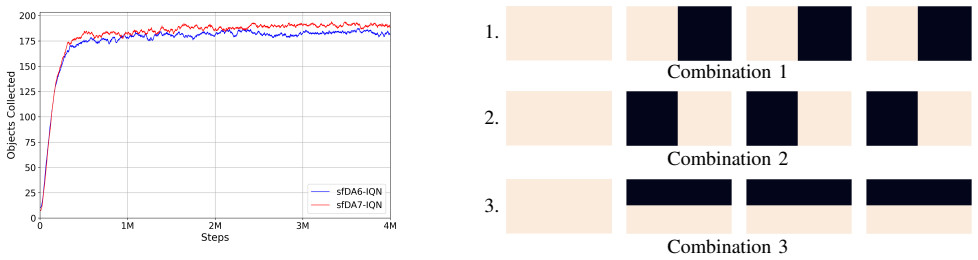
Summary. The paper proposes sfDA7-X, an extension of the authors' earlier sfDA6-X method for multi-agent deep reinforcement learning in an object-collection game. Each agent receives its own destination channel (DC) plus an aggregated DC (ADC), defined in Eq. (1) as the element-wise sum of the DCs assigned to all other agents. The ADC is intended to let uninstructed agents infer where instructed agents are working and to complement neglected areas, while keeping the input representation independent of the number of agents. Experiments compare sfDA7-IQN against sfDA6-IQN in a 49x25 grid with N=4 and two DC types (entire, half). The paper reports roughly 8% more objects collected by sfDA7-IQN during execution and presents heatmaps suggesting that the uninstructed agent shifts its collection activity to the areas not covered by instructed agents.
Significance. If the claimed effect is real, the contribution is a simple and potentially useful extension of strategy-following MADRL: encoding the other agents' instructions as a single additive matrix could reduce the burden of instructing every agent and may generalize to larger teams. The main strength is the clearly specified architectural extension and the use of a concrete evaluation domain with qualitative behavioral analysis. However, the evidence as presented does not yet establish the central mechanism. The comparison between sfDA7-IQN and sfDA6-IQN conflates the presence of the ADC with additional network input capacity, no statistical uncertainty is reported, and the claimed invariance to the number of agents is untested. I do not see a circular step in the derivation; the issue is an uncontrolled and under-powered evaluation.
major comments (3)
- [Section V-B2, Table III] The headline 8.00% improvement is the mean over three seeds with no standard deviation, confidence interval, or significance test. More importantly, the comparison sfDA7-IQN vs. sfDA6-IQN changes two variables at once: the presence of the ADC input and the number of input channels/learned parameters. The observed gain therefore cannot be attributed specifically to the sum-aggregation defined in Eq. (1). An appropriate control would be an sfDA7 variant whose extra input is a zero/constant matrix, or a variant that receives the individual DCs of the other agents, or another symmetric aggregation (e.g., max) with matched input count and capacity.
- [Section IV, Eq. (1) and Section V-A] The paper motivates ADC as ensuring 'independence from the agent numbers,' but all experiments fix N=4 and D={entire, half}. Eq. (1) is a sum of binary matrices, so its entries scale with N and with the number of agents sharing the same DC; a policy trained on entries in {0,...,3} need not transfer to N=8, where entries can reach {0,...,7}. Moreover, the local observation matrices in Section III-C have N_c=N+2 channels, so the full observation is not agent-number invariant either. The authors should vary N and the richness of D, and at minimum report the ADC value distribution encountered during training and execution.
- [Section V-C1, Figs. 10, 11, 14] The qualitative evidence for the complementarity mechanism is based on 'two experimental runs were selected' without a stated selection rule or seed identification. The heatmap-based claims (e.g., Agent 0 'collected objects mainly in the upper-half area') are visual interpretations, not quantified findings. There is no metric for complementarity, no aggregation over the three seeds used in Table III, and no analysis of all four DC combinations in Fig. 7. Provide quantitative measures such as per-region collection counts, overlap between agents' collection maps, or coverage entropy, reported over all seeds and all evaluation patterns.
minor comments (5)
- [Throughout] There are several typographical and formatting issues: 'Z +' should be a math symbol, 'sfDA6-X' appears with inconsistent hyphenation, and some sentences are missing articles. A careful proofread is needed.
- [Section III-C] The statement that local information uses N_c=N+2 channels implies that the network architecture changes with N. This should be reconciled with the 'independence from agent numbers' claim, or the claim should be narrowed to the DC aggregation only.
- [Section V-C2] The sentence 'The values in the ADC matrix generated from the DCs of Agents 1, 2, and 3 were 1 or 2. This shows that the entire area was covered...' is not self-explanatory. Since ADC values are counts of agents assigned to each cell, the inference from counts to spatial coverage needs a brief formal statement.
- [Section V-C3] The 'Remark: Other Usages of DCs and ADCs' presents untested claims about setting ADC elements to N-1 and 0 and about using DC combinations to bias movement without increasing rewards. If these are intended as features of the method, they should be validated experimentally; otherwise, the passage should be removed or clearly labeled as speculation.
- [Figures 6, 9, 13] The learning curves and execution-time curves show only an EMA line without per-seed variation or a shaded region. Reporting the three individual seeds would improve transparency and help the reader assess the stability of the claimed improvements.
Circularity Check
No significant circularity: Eq. (1) defines an input representation, and the claimed complementary behavior is an empirically measured learning outcome, not a consequence of the definition.
full rationale
The paper contains no derivation chain that reduces a claimed prediction to its own inputs. The only formal object introduced is the aggregated DC (ADC) in Eq. (1), which sums the destination channels assigned to other agents. That is an architectural input representation, not a predicted quantity. The central claim—that an uninstructed agent learns to complement instructed agents—is supported by training sfDA7-IQN and comparing it with sfDA6-IQN under held-out biased DC combinations in the execution phase. No parameter is fitted to the evaluation data, and the reported 8.00% improvement in objects collected is an empirical outcome rather than an algebraic identity. The paper relies on the authors' prior work [9,10] for the baseline architecture and the DC mechanism, but both models are retrained and compared in the same experimental environment, so these citations are descriptive and not load-bearing as unverified theorems. The reward definition (positive reward only inside the beige DC region) makes DCs meaningful by construction, but it does not by itself entail the learned complementary behavior; that behavior still has to emerge from training. Concerns about baseline confounding due to additional input channels and the untested N-invariance of the ADC are legitimate threats to external validity, but they are not circularity.
Assumptions & free parameters
free parameters (4)
- Reward values =
r_o=1, r_c=-1, r_m=0
- Discount factor gamma =
0.9
- Learning rate and batch size =
1e-3, 32
- Exploration schedule =
epsilon 1.0 -> 0.05, decay 0.998
assumptions (5)
- domain assumption Reward is obtained only when collecting an object in the agent's designated DC area.
- domain assumption Agents can obtain the DCs of other agents during the execution phase.
- ad hoc to paper A lossy sum of other agents' DCs preserves enough coordination information.
- domain assumption Random DC assignment during training transfers to biased execution-time combinations.
- domain assumption The object collection game is a sufficient proxy for multi-agent coordination and controllability.
invented entities (1)
-
Aggregated DC (ADC)
Cite this review
Pith. "Pith review of Strategy-Following Multi-Agent Deep Reinforcement Learning Considering Control Strategies Provided to Other Agents." pith.science (2026). https://pith.science/paper/GOA2RQ44
@misc{pith2026260718719,
  author       = {Pith},
  title        = {Pith review of: Strategy-Following Multi-Agent Deep Reinforcement Learning Considering Control Strategies Provided to Other Agents},
  year         = {2026},
  howpublished = {\url{https://pith.science/paper/GOA2RQ44}},
  note         = {Machine review of arXiv:2607.18719}
}
read the original abstract
This study proposes a learning method for multi-agent systems that allows agents to be controlled through human manager instructions after learning and enables uninstructed agents to implicitly complement the overall work based on the actions of other agents. Multi-agent applications using deep learning have shown potential; thus, to achieve extensive social applications, humans should be able to control learned agents using simple methods to respond to environmental and social changes. Even without such changes, learned coordination often does not match the expectations of human managers, making it preferable to control coordination structures to match human intentions. Some studies have aimed to control agent behavior using simple instructions. However, they assumed that instructions are provided to all agents, which is time-consuming and not evident when designing a better cooperation regime. Ideally, specific agents should receive key action instructions, while others should automatically complete the remaining tasks. The proposed method, which extends previous work on controllability in multi-agent deep reinforcement learning, enables uninstructed agents to adaptively complement overlooked tasks and areas. The experimental results show that agents using the proposed method can shift to another cooperative structure and achieve better performance than those using conventional methods.
Figures


Figures from the paper (10 more)




Reference graph
Works this paper leans on
-
[1]
Learning to understand goal specifications by modelling reward,
D. Bahdanau, F. Hill, J. Leike, E. Hughes, A. Hosseini, P. Kohli, and E. Grefenstette, “Learning to understand goal specifications by modelling reward,”arXiv preprint arXiv:1806.01946, 2018
arXiv 2018
-
[2]
Ask your humans: Using human instructions to improve generalization in reinforcement learning,
V . Chen, A. Gupta, and K. Marino, “Ask your humans: Using human instructions to improve generalization in reinforcement learning,”arXiv preprint arXiv:2011.00517, 2020
arXiv 2011
-
[3]
Implicit quantile networks for distributional reinforcement learning,
W. Dabney, G. Ostrovski, D. Silver, and R. Munos, “Implicit quantile networks for distributional reinforcement learning,” inInternational conference on machine learning. PMLR, 2018, pp. 1096–1105
2018
-
[4]
Speaker- follower models for vision-and-language navigation,
D. Fried, R. Hu, V . Cirik, A. Rohrbach, J. Andreas, L.-P. Morency, T. Berg-Kirkpatrick, K. Saenko, D. Klein, and T. Darrell, “Speaker- follower models for vision-and-language navigation,”Advances in neu- ral information processing systems, vol. 31, 2018
2018
-
[5]
Hierarchical program- triggered reinforcement learning agents for automated driving,
B. Gangopadhyay, H. Soora, and P. Dasgupta, “Hierarchical program- triggered reinforcement learning agents for automated driving,”IEEE Transactions on Intelligent Transportation Systems, vol. 23, no. 8, pp. 10 902–10 911, 2021
2021
-
[6]
Cirl: Controllable imitative reinforcement learning for vision-based self-driving,
X. Liang, T. Wang, L. Yang, and E. Xing, “Cirl: Controllable imitative reinforcement learning for vision-based self-driving,” inProceedings of the European conference on computer vision (ECCV), 2018, pp. 584– 599
2018
-
[7]
Mapping instructions to actions in 3d environments with visual goal prediction,
D. Misra, A. Bennett, V . Blukis, E. Niklasson, M. Shatkhin, and Y . Artzi, “Mapping instructions to actions in 3d environments with visual goal prediction,”arXiv preprint arXiv:1809.00786, 2018
arXiv 2018
-
[8]
Analysis of coordinated behavior structures with multi-agent deep reinforcement learning,
Y . Miyashita and T. Sugawara, “Analysis of coordinated behavior structures with multi-agent deep reinforcement learning,”Applied In- telligence, vol. 51, pp. 1069–1085, 2021
2021
Show all 22 references
-
[9]
Interpretability for conditional co- ordinated behavior in multi-agent reinforcement learning,
Y . Motokawa and T. Sugawara, “Interpretability for conditional co- ordinated behavior in multi-agent reinforcement learning,” in2023 International Joint Conference on Neural Networks (IJCNN). IEEE, 2023, pp. 1–8
2023
-
[10]
Strategy-following multi-agent deep reinforcement learning through external high-level instruction,
——, “Strategy-following multi-agent deep reinforcement learning through external high-level instruction,”Procedia Computer Science, vol. 225, pp. 2798–2807, 2023
2023
-
[11]
M. L. Puterman,Markov decision processes: discrete stochastic dynamic programming. John Wiley & Sons, 2014
2014
-
[12]
Epopt: Learning robust neural network policies using model ensembles,
A. Rajeswaran, S. Ghotra, B. Ravindran, and S. Levine, “Epopt: Learning robust neural network policies using model ensembles,”arXiv preprint arXiv:1610.01283, 2016
2016 arXiv
-
[13]
A reduction of imitation learning and structured prediction to no-regret online learning,
S. Ross, G. Gordon, and D. Bagnell, “A reduction of imitation learning and structured prediction to no-regret online learning,” inProceedings of the fourteenth international conference on artificial intelligence and statistics. JMLR Workshop and Conference Proceedings, 2011, p...
2011
-
[14]
The starcraft multi-agent challenge,
M. Samvelyan, T. Rashid, C. S. De Witt, G. Farquhar, N. Nardelli, T. G. Rudner, C.-M. Hung, P. H. Torr, J. Foerster, and S. Whiteson, “The starcraft multi-agent challenge,”arXiv preprint arXiv:1902.04043, 2019
1902 arXiv
-
[15]
Safe, multi- agent, reinforcement learning for autonomous driving,
S. Shalev-Shwartz, S. Shammah, and A. Shashua, “Safe, multi- agent, reinforcement learning for autonomous driving,”arXiv preprint arXiv:1610.03295, 2016
2016 arXiv
-
[16]
Task offloading and trajectory scheduling for uav-enabled mec networks: An madrl algorithm with prioritized experience replay,
H. Shi, Y . Tian, H. Li, J. Huang, L. Shi, and Y . Zhou, “Task offloading and trajectory scheduling for uav-enabled mec networks: An madrl algorithm with prioritized experience replay,”Ad Hoc Networks, vol. 154, p. 103371, 2024
2024
-
[17]
Program guided agent,
S.-H. Sun, T.-L. Wu, and J. J. Lim, “Program guided agent,” in International Conference on Learning Representations, 2020
2020
-
[18]
Attention is all you need,
A. Vaswani, “Attention is all you need,”Advances in Neural Information Processing Systems, 2017
2017
-
[19]
Understanding natural language,
T. Winograd, “Understanding natural language,”Cognitive psychology, vol. 3, no. 1, pp. 1–191, 1972
1972
-
[20]
Toward human-in-the-loop ai: Enhancing deep reinforcement learning via real-time human guidance for autonomous driving,
J. Wu, Z. Huang, Z. Hu, and C. Lv, “Toward human-in-the-loop ai: Enhancing deep reinforcement learning via real-time human guidance for autonomous driving,”Engineering, 2023
2023
-
[21]
Program synthesis guided reinforcement learning for partially observed environments,
Y . Yang, J. P. Inala, O. Bastani, Y . Pu, A. Solar-Lezama, and M. Rinard, “Program synthesis guided reinforcement learning for partially observed environments,” inAdvances in Neural Information Processing Systems, A. Beygelzimer, Y . Dauphin, P. Liang, and J. W. Vaughan, Eds., 2021
2021
-
[22]
Joint sensing and communication optimization in target-mounted stars-assisted vehicular networks: A madrl approach,
H. Zhang, R. Liu, M. Li, W. Wang, and Q. Liu, “Joint sensing and communication optimization in target-mounted stars-assisted vehicular networks: A madrl approach,”IEEE Transactions on Vehicular Technol- ogy, 2024
2024
Reviewed August 1, 2026 · model on record in the stance chip above.
Discussion (0). Continue with ORCID to comment.