REVIEW 2 major objections 5 minor 2 cited by
TFLOP: Table Structure Recognition Framework with Layout Pointer Mechanism
T0 review · 2 major / 5 minor · reviewed 2026-08-10 · deepseek-v4-flash
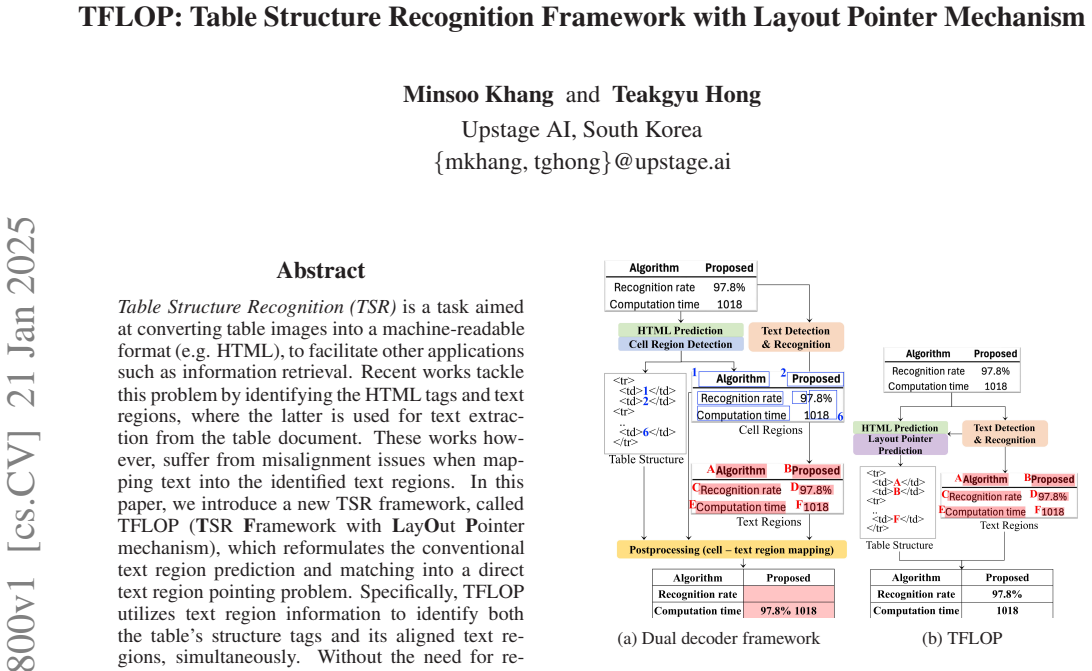
Pith's one-line read TFLOP claims that a single decoder can output a table's HTML tags and, at the same time, point each tag at the text region that belongs in that cell, removing the box-matching post-processing used by dual-decoder systems.
desk verdict A genuinely different TSR architecture whose headline SOTA claim is undermined by oracle box input on two of three benchmarks and a missing pointer ablation. read the letter →
The pith
A machine-rendered reading of the paper's core claim, the machinery that carries it, and where it could break.
The reading
What carries the argument
The load-bearing mechanism is the layout pointer: the decoder's final hidden states are split into box features $\{\bar{b}_j\}$ and tag features $\{\bar{t}_k\}$, and the pointer loss $$L_{ptr} = -\frac{1}{B}\sum_{j=1}^{B} \log \frac{\exp(\bar{b}_j\cdot \bar{t}_{k^*}/\tau)}{\sum_{k'\in D}\exp(\bar{b}_j\cdot \bar{t}_{k'}/\tau)}$$ forces each text box to point to its corresponding data tag, with a second binary-cross-entropy term using a learned empty-box embedding $\bar{b}_0$ for tags that have no text. The supporting mechanism is span-aware contrastive supervision, which treats boxes in the same row or column as positives and weights each positive by the span coefficient $c_p(j)=\mathrm{overlap}(p,j)^2/(\mathrm{span}(p)\,\mathrm{span}(j))$, so cells sharing only part of a row or column are still aligned according to their true coverage. These losses are combined with the tag-classification loss, and the resulting box embeddings form row-wise and column-wise clusters in the ablations, which is what lets the pointer work on tables with complex spans.
What would settle it
Run TFLOP on a fixed set of table images under two OCR conditions: once with cell-level text regions and once with those regions deliberately corrupted by merging two adjacent cells' boxes into one and by deleting one cell's box. If TEDS stays unchanged, the central claim that the pointer removes misalignment would be undercut; if every corrupted-box table loses a measurable amount of TEDS, the framework's advantage over dual decoders would depend on input-box quality rather than on the pointer itself.
Extended reading notes
Core claim
The central claim is that a sequence decoder can serve as both the logical structure predictor and the alignment module. After encoding the table image and a set of text-region bounding boxes, TFLOP auto-regressively generates compact tag sequences in OTSL notation and, from the decoder's last hidden states, computes a dot-product similarity between each box feature and each table-data-tag feature; a pointer loss trains each box to point to its correct tag. Empty cells are handled by a special embedding, and a span-aware contrastive loss organizes box embeddings by row and column overlap so cells participating in rowspans or colspans are pulled together in proportion to their shared span. The paper reports that this design reaches the highest TEDS scores among compared methods on all three benchmarks and interprets the small TEDS-versus-TEDS-Struct gap as evidence that text misalignment errors, which dual-decoder baselines suffer, are largely eliminated.
Load-bearing premise
The load-bearing premise is that the input text-region bounding boxes, whether from cell annotations or an off-the-shelf OCR engine, are complete and accurate enough to serve as pointing targets; if OCR misses, splits, or merges text regions (or leaves watermark boxes), the pointer can only associate the tags it is given with those imperfect boxes.
Editorial extensions
If this is right
- On the reported benchmarks, the full TFLOP model reaches 96.66 TEDS on PubTabNet test, 99.45 on FinTabNet, and 99.40 on SynthTabNet, all above the compared dual-decoder baselines.
- Because the TEDS-versus-TEDS-Struct gap is much smaller for TFLOP than for prior methods on FinTabNet, most remaining errors are structural tag errors rather than text-placement errors.
- The ablation shows span-aware contrastive supervision helps complex tables more than simple tables, implying rowspan/colspan recognition is the part of the problem this addition is solving.
- The watermark experiment suggests that unwanted text can be handled by filtering input bounding boxes with a small classifier before layout pointing, without changing the decoder or the pointer.
Reading between the lines
- An implication the authors leave implicit is that the alignment burden is shifted, not removed: the pointer is only as good as the input text-region boxes, so the framework relocates the failure mode of dual decoders into the OCR or annotation stage.
- The pointer formulation is not tied to HTML; because the decoder emits OTSL tokens with a one-to-one HTML mapping, the same layout-pointer loss could be trained toward LaTeX or a graph representation of the table.
- The cross-lingual result is suggestive but rests on only 30 self-annotated Korean tables; a systematic multilingual dataset would be needed to establish that the pointer mechanism, rather than the specific encoder-decoder weights, is what transfers.
- The small QA experiment links TSR quality to downstream table QA, which implies that pointer-based alignment could be worth testing in end-to-end document question-answering systems that currently rely on separate structure and text extraction.
Signed reviews
Editorial analysis
A structured set of objections, weighed in public.
Referee Report
Summary. The paper introduces TFLOP, a table structure recognition (TSR) framework that replaces the conventional dual-decoder design (predicting HTML tags and cell bounding boxes, then matching OCR text regions to boxes) with a single decoder that generates OTSL/HTML structure tags while a layout pointer mechanism directly associates each input text-region bounding box with the corresponding data tag. A span-aware contrastive loss is added to improve handling of row/column spans. Experiments report state-of-the-art TEDS/TEDS-Struct on PubTabNet, FinTabNet, and SynthTabNet, with additional demonstrations on watermarked documents and Korean tables.
Significance. The core idea, if validated, is a worthwhile simplification: TFLOP avoids the heuristic box-matching post-processing of dual-decoder systems, and the public release of code supports reproducibility. The span-aware contrastive loss is a reasonable and ablated contribution. However, the headline state-of-the-art claims are not yet convincingly established, because on two of the three main benchmarks TFLOP is evaluated with ground-truth cell boxes, while the dual-decoder baselines must predict them; moreover, the layout pointer mechanism itself is never ablated against a matched baseline that does not use it. The significance of the proposed architecture is therefore contingent on additional controlled experiments.
major comments (2)
- [§4.1, §4.4, Table 2] The state-of-the-art claims on FinTabNet and SynthTabNet are confounded by an input asymmetry. Section 4.1 states that these datasets provide cell-level annotations, and Section 4.4 indicates that on PubTabNet test, where annotations are absent, OCR boxes are used. Thus TFLOP receives ground-truth cell boxes as test-time input on FinTabNet and SynthTabNet, while the dual-decoder baselines (TableFormer, VAST, DRCC) must predict cell boxes and then match OCR text. Because the layout embedding conditions the structure decoder, even the TEDS-Struct scores are not on equal footing. Please provide a controlled comparison: either evaluate TFLOP on FinTabNet/SynthTabNet with OCR-derived boxes, or give a dual-decoder baseline the same ground-truth boxes, or both. Without one of these controls, the 1.24-point FinTabNet TEDS advantage over VAST cannot be attributed to the proposed framework.
- [§3.5, §4.5, Table 3] The central mechanism, the layout pointer, is never ablated. TFLOP BASE differs from TFLOP FULL only by the removal of image ROI alignment and span-aware contrastive supervision, so both variants include the pointer. Table 3 therefore measures the contribution of ROI and contrastive losses, not the contribution of the pointer over a dual-decoder head. To support the paper's central claim, an ablation should replace the pointer with a box-predicting head (or otherwise remove the pointer) while keeping the same encoder, layout embeddings, and OTSL tokenization, and should compare end-to-end TEDS after the same (or no) matching post-processing. The discussion in §4.4 describing the TEDS-Struct improvement as a "side-effect of layout embedding" is a plausible hypothesis but is not a substitute for this experiment.
minor comments (5)
- [§5.2] The word "non-Engligh" should be "non-English".
- [Figure 3 caption] The word "constrastive" should be "contrastive".
- [§3.5, §4.2] The symbol N is used both for the total hidden-state length (B+T) in §3.5 and for the fixed output sequence length in §4.2; please disambiguate (e.g., N_max).
- [§3.3] The text "2 x 2 ROIAlign" should read "2×2 ROIAlign".
- [§4.2] Please clarify how the temperature τ=0.1 was chosen and confirm whether it is used consistently in Eq. (2) and Eq. (5).
Circularity Check
No circular derivation: pointer supervision is trained on held-out annotations and SOTA is benchmarked externally.
full rationale
TFLOP's central contribution is a layout pointer loss (Eq. 2) that directly associates generated table tags with input text-region embeddings. The target pairing b_j ↔ k* is supplied by the training annotations, and the model is evaluated with standard TEDS/TEDS-Struct against held-out ground-truth HTML on external benchmarks; no fitted value is later renamed as a prediction, and no claimed result is defined in terms of the quantity it is said to predict. The only author-overlapping citation is Donut (Kim et al., 2022; shared author Hong), which is used as an encoder/decoder architectural starting point; this is not load-bearing for the SOTA claim, which rests on external benchmark comparisons. The FinTabNet/SynthTabNet evaluations do give TFLOP ground-truth cell boxes at test time while dual-decoder baselines must predict boxes, and this is a legitimate fairness concern for the empirical SOTA claim; however, it is not circular in the derivation sense, because TEDS is still computed against ground-truth HTML and the model must predict the tag sequence and pointer associations rather than reading them off from the input boxes. Consequently, no step satisfies the quoting standard for circularity, and the honest finding is no significant circularity.
Assumptions & free parameters
free parameters (4)
- lambda_1 to lambda_5 loss weights =
1, 1, 1, 0.5, 0.5
- temperature tau =
0.1
- layout sequence length B =
640 (PubTabNet, FinTabNet), 864 (SynthTabNet)
- input image resolution =
768 x 768
assumptions (5)
- domain assumption Text region bounding boxes are available at inference and are complete enough to cover all table cells.
- domain assumption Each text bounding box belongs to exactly one table data tag (one-to-one or many-to-one), never one-to-many.
- domain assumption OTSL token sequences have a 1-to-1 mapping to the target HTML structure.
- domain assumption Padding bounding boxes are masked in attention and do not affect pointer predictions.
- ad hoc to paper The span-coefficient formula cp(j) = overlap(p,j)^2 / (span(p) * span(j)) correctly captures row/column proximity for contrastive supervision.
Cite this review
Pith. "Pith review of TFLOP: Table Structure Recognition Framework with Layout Pointer Mechanism." pith.science (2026). https://pith.science/paper/GOC7E5Z7
@misc{pith2026250111800,
  author       = {Pith},
  title        = {Pith review of: TFLOP: Table Structure Recognition Framework with Layout Pointer Mechanism},
  year         = {2026},
  howpublished = {\url{https://pith.science/paper/GOC7E5Z7}},
  note         = {Machine review of arXiv:2501.11800}
}
read the original abstract
Table Structure Recognition (TSR) is a task aimed at converting table images into a machine-readable format (e.g. HTML), to facilitate other applications such as information retrieval. Recent works tackle this problem by identifying the HTML tags and text regions, where the latter is used for text extraction from the table document. These works however, suffer from misalignment issues when mapping text into the identified text regions. In this paper, we introduce a new TSR framework, called TFLOP (TSR Framework with LayOut Pointer mechanism), which reformulates the conventional text region prediction and matching into a direct text region pointing problem. Specifically, TFLOP utilizes text region information to identify both the table's structure tags and its aligned text regions, simultaneously. Without the need for region prediction and alignment, TFLOP circumvents the additional text region matching stage, which requires finely-calibrated post-processing. TFLOP also employs span-aware contrastive supervision to enhance the pointing mechanism in tables with complex structure. As a result, TFLOP achieves the state-of-the-art performance across multiple benchmarks such as PubTabNet, FinTabNet, and SynthTabNet. In our extensive experiments, TFLOP not only exhibits competitive performance but also shows promising results on industrial document TSR scenarios such as documents with watermarks or in non-English domain.
Figures


Figures from the paper (8 more)


Forward citations
Cited by 2 Pith papers
-
TEN: Table Explicitization, Neurosymbolically
A neurosymbolic system with structural decomposition prompting and a checker-driven self-debug loop improves table extraction from semistructured text over purely neural baselines.
-
TableMoE: Neuro-Symbolic Routing for Structured Expert Reasoning in Multimodal Table Understanding
TableMoE is a multimodal table model whose role-aware router sends table tokens to HTML, JSON, and code experts and reports state-of-the-art results on its own WildStruct benchmarks and MMMU-Table.
Reference graph
Works this paper leans on
-
[1]
End-to-end object detection with transformers
[Carion et al., 2020] Nicolas Carion, Francisco Massa, Gabriel Synnaeve, Nicolas Usunier, Alexander Kirillov, and Sergey Zagoruyko. End-to-end object detection with transformers. In European conference on computer vision, pages 213–229. Springer,
2020
-
[7]
Ocr-free document understanding trans- former
[Kim et al., 2022] Geewook Kim, Teakgyu Hong, Moonbin Yim, JeongY eon Nam, Jinyoung Park, Jinyeong Yim, Wonseok Hwang, Sangdoo Y un, Dongyoon Han, and Se- unghyun Park. Ocr-free document understanding trans- former. In European Conference on Computer Vision , pages 498–517. Springer,
work page 2022
-
[8]
[Lewis et al., 2019] Mike Lewis, Yinhan Liu, Naman Goyal, Marjan Ghazvininejad, Abdelrahman Mohamed, Omer Levy, V es Stoyanov, and Luke Zettlemoyer. Bart: De- noising sequence-to-sequence pre-training for natural la n- guage generation, translation, and comprehension. arXiv preprint arXiv:1910.13461,
arXiv 2019
-
[9]
Tsr- former: Table structure recognition with transformers
[Lin et al., 2022] Weihong Lin, Zheng Sun, Chixiang Ma, Mingze Li, Jiawei Wang, Lei Sun, and Qiang Huo. Tsr- former: Table structure recognition with transformers. In Proceedings of the 30th ACM International Conference on Multimedia, pages 6473–6482,
work page 2022
-
[11]
Master: Multi-aspect non-local network for scene text recognition
[Lu et al., 2021] Ning Lu, Wenwen Y u, Xianbiao Qi, Yihao Chen, Ping Gong, Rong Xiao, and Xiang Bai. Master: Multi-aspect non-local network for scene text recognition . Pattern Recognition, 117:107980,
work page 2021
-
[12]
Optimized Table Tokenization for Table Structure Recognition
[Lysak et al., 2023] Maksym Lysak, Ahmed Nassar, Niko- laos Livathinos, Christoph Auer, and Peter Staar. Opti- mized table tokenization for table structure recognition. arXiv preprint arXiv:2305.03393 ,
work page Pith review arXiv 2023
-
[13]
Gridformer: Towards accurate table structure recognition via grid prediction
[Lyu et al., 2023] Pengyuan Lyu, Weihong Ma, Hongyi Wang, Y uechen Y u, Chengquan Zhang, Kun Y ao, Y ang Xue, and Jingdong Wang. Gridformer: Towards accurate table structure recognition via grid prediction. In Proceed- ings of the 31st ACM International Conference on Multi- media, pages 7747–7757,
work page 2023
-
[14]
Robust table detection and structure recogni- tion from heterogeneous document images
[Ma et al., 2023] Chixiang Ma, Weihong Lin, Lei Sun, and Qiang Huo. Robust table detection and structure recogni- tion from heterogeneous document images. Pattern Recog- nition, 133:109006,
work page 2023
Show all 29 references
-
[15]
Tableformer: Table struc- ture understanding with transformers
[Nassar et al., 2022] Ahmed Nassar, Nikolaos Livathinos, Maksym Lysak, and Peter Staar. Tableformer: Table struc- ture understanding with transformers. In Proceedings of the IEEE/CVF Conference on Computer Vision and Pat- tern Recognition, pages 4614–4623,
2022
-
[16]
Gpt-4v(ision) system card
[OpenAI, 2023] OpenAI. Gpt-4v(ision) system card
2023
-
[17]
Tablenet: Deep learning model for end-to-end table detec- tion and tabular data extraction from scanned document images
[Paliwal et al., 2019] Shubham Singh Paliwal, D Vish- wanath, Rohit Rahul, Monika Sharma, and Lovekesh Vig. Tablenet: Deep learning model for end-to-end table detec- tion and tabular data extraction from scanned document images. In 2019 International Conference on Document Ana...
2019
-
[18]
Lgpma: Complicated table structure recognition with local and global pyramid mask alignment
[Qiao et al., 2021] Liang Qiao, Zaisheng Li, Zhanzhan Cheng, Peng Zhang, Shiliang Pu, Yi Niu, Wenqi Ren, Wenming Tan, and Fei Wu. Lgpma: Complicated table structure recognition with local and global pyramid mask alignment. In International conference on document anal- ysis and...
2021
-
[19]
Table structure recognition using top-down and bottom-up cues
[Raja et al., 2020] Sachin Raja, Ajoy Mondal, and CV Jawa- har. Table structure recognition using top-down and bottom-up cues. In Computer Vision–ECCV 2020: 16th European Conference, Glasgow, UK, August 23–28, 2020, Proceedings, Part XXVIII 16 , pages 70–86. Springer,
2020
-
[20]
Deepdesrt: Deep learning for detection and structure recognition of tables in document images
[Schreiber et al., 2017] Sebastian Schreiber, Stefan Agne, Ivo Wolf, Andreas Dengel, and Sheraz Ahmed. Deepdesrt: Deep learning for detection and structure recognition of tables in document images. In 2017 14th IAPR interna- tional conference on document analysis and recogniti...
2017
-
[21]
Divide rows and conquer cells: Towards structure recognition for large tables
[Shen et al., 2023] Huawen Shen, Xiang Gao, Jin Wei, Liang Qiao, Y u Zhou, Qiang Li, and Zhanzhan Cheng. Divide rows and conquer cells: Towards structure recognition for large tables. In Proceedings of the Thirty-Second Inter- national Joint Conference on Artificial Intelligenc...
2023
-
[22]
Deep split- ting and merging for table structure decomposition
[Tensmeyer et al., 2019] Chris Tensmeyer, Vlad I Morariu, Brian Price, Scott Cohen, and Tony Martinez. Deep split- ting and merging for table structure decomposition. In 2019 International Conference on Document Analysis and Recognition (ICDAR), pages 114–121. IEEE,
2019
-
[23]
Pingan- vcgroup’s solution for icdar 2021 competition on scientific literature parsing task b: table recognition to html
[Y eet al., 2021] Jiaquan Y e, Xianbiao Qi, Y elin He, Yihao Chen, Dengyi Gu, Peng Gao, and Rong Xiao. Pingan- vcgroup’s solution for icdar 2021 competition on scientific literature parsing task b: table recognition to html. arXiv preprint arXiv:2105.01848,
2021 arXiv
-
[24]
Split, embed and merge: An accurate table structure recognizer
[Zhang et al., 2022] Zhenrong Zhang, Jianshu Zhang, Jun Du, and Fengren Wang. Split, embed and merge: An accurate table structure recognizer. Pattern Recognition, 126:108565,
2022
-
[25]
Global table extractor (gte): A framework for joint table identification and cell structure recognition using visual context
[Zheng et al., 2021] Xinyi Zheng, Douglas Burdick, Lucian Popa, Xu Zhong, and Nancy Xin Ru Wang. Global table extractor (gte): A framework for joint table identification and cell structure recognition using visual context. In Pro- ceedings of the IEEE/CVF winter conference on a...
2021
-
[26]
Image-based table recognition: data, model, and evaluation
[Zhong et al., 2020] Xu Zhong, Elaheh ShafieiBavani, and Antonio Jimeno Y epes. Image-based table recognition: data, model, and evaluation. In European conference on computer vision, pages 564–580. Springer,
2020
-
[27]
Figure 7: Layout information ordering prior to layout encod ing. To keep the bounding box feature sequence length constant at B, after the text bounding boxes of the table, BImage are prefixed with a special bounding box, they are padded with padding bounding boxes BP ad to for...
2023
-
[28]
The remainder of the data flow matches that of the original framework. GPT-4VTableMaster TFLOP GPT-4V Image-to-HTML prompt Table Question prompt Input Image Table Answer Table Answer Table Answer Figure 10: Flow diagram illustration of Korean table TSR and QA across GPT-4V , Ta...
2023
-
[29]
No information provided
Based on Figure 11, HTML sequence generated by GPT-4V and TableMaster results in incorrect calculation of the tar get row’s median value (highlighted in blue bounding box). The HTML generated by GPT-4V has displaced column headers where the year “2018” is on the column of row ...
2018
-
[2017]
Improving table structure recog- nition with visual-alignment sequential coordinate mod- eling
[Huang et al., 2023] Y ongshuai Huang, Ning Lu, Dapeng Chen, Yibo Li, Zecheng Xie, Shenggao Zhu, Liangcai Gao, and Wei Peng. Improving table structure recog- nition with visual-alignment sequential coordinate mod- eling. In Proceedings of the IEEE/CVF Conference on Computer Vi...
2023
-
[2019]
Trust: An accurate and end-to-end table structure recognizer using splitting-ba sed transformers
[Guo et al., 2022] Zengyuan Guo, Y uechen Y u, Pengyuan Lv, Chengquan Zhang, Haojie Li, Zhihui Wang, Kun Y ao, Jingtuo Liu, and Jingdong Wang. Trust: An accurate and end-to-end table structure recognizer using splitting-ba sed transformers. arXiv preprint arXiv:2208.14687 ,
2022 arXiv
-
[2020]
Challenges in end-to-end neural scientific table recognition
[Deng et al., 2019] Y untian Deng, David Rosenberg, and Gideon Mann. Challenges in end-to-end neural scientific table recognition. In 2019 International Conference on Document Analysis and Recognition (ICDAR), pages 894–
2019
-
[2021]
Neural collaborative graph ma- chines for table structure recognition
[Liu et al., 2022] Hao Liu, Xin Li, Bing Liu, Deqiang Jiang, Yinsong Liu, and Bo Ren. Neural collaborative graph ma- chines for table structure recognition. In Proceedings of the IEEE/CVF Conference on Computer Vision and Pat- tern Recognition, pages 4533–4542,
2022
-
[2022]
Mask r-cnn
[He et al., 2017] Kaiming He, Georgia Gkioxari, Piotr Doll´ ar, and Ross Girshick. Mask r-cnn. In Proceedings of the IEEE international conference on computer vision , pages 2961–2969,
2017
-
[2023]
Supervised con- trastive learning
[Khosla et al., 2020] Prannay Khosla, Piotr Teterwak, Chen Wang, Aaron Sarna, Y onglong Tian, Phillip Isola, Aaron Maschinot, Ce Liu, and Dilip Krishnan. Supervised con- trastive learning. Advances in neural information process- ing systems, 33:18661–18673,
2020
Reviewed August 10, 2026 · model on record in the stance chip above.
Discussion (0). Continue with ORCID to comment.