REVIEW 3 major objections 5 minor 131 references
Parameterized and Consistency Tests of Gravity with Gravitational Waves: Current and Future
T0 review · 3 major / 5 minor · reviewed 2026-08-14 · deepseek-v4-flash
Pith's one-line read Future and multi-band gravitational-wave observations could tighten tests of general relativity by orders of magnitude.
desk verdict A competent, clearly written proceedings review of theory-agnostic GW tests of GR, but the headline projections rest on an unpublished companion paper and should be treated as preliminary. read the letter →
The pith
A machine-rendered reading of the paper's core claim, the machinery that carries it, and where it could break.
The reading
What carries the argument
The central object is the parameterized post-Einsteinian (ppE) waveform, which writes the frequency-domain signal as the GR waveform times an amplitude correction $(1+\alpha u^a)$ and a phase correction $e^{i\beta u^b}$, with $u=(\pi \mathcal{M} f)^{1/3}$ the binary's effective velocity; the ppE parameters $(\alpha,a,\beta,b)$ encode generic non-GR effects that can be mapped onto specific modified theories. For projections, the machinery is the Fisher information matrix, which converts detector noise curves and a GR template into expected $1\sigma$ measurement errors on the waveform parameters. For the IMR consistency test, the same Fisher framework is applied separately to the inspiral and merger-ringdown portions before numerical-relativity fits translate component masses and spins into remnant mass and spin estimates presented in the $(\epsilon,\sigma)$ plane.
What would settle it
Run full Bayesian parameter estimation on simulated GW150914-like signals injected into Cosmic Explorer and LISA noise curves and compare the resulting 90% credible areas in the $(\epsilon,\sigma)$ plane with the Fisher-based forecasts of $3.6\times10^{-4}$ and $5.0\times10^{-5}$; if the Bayesian areas are substantially larger, the projected orders-of-magnitude improvements are optimistic.
Extended reading notes
Core claim
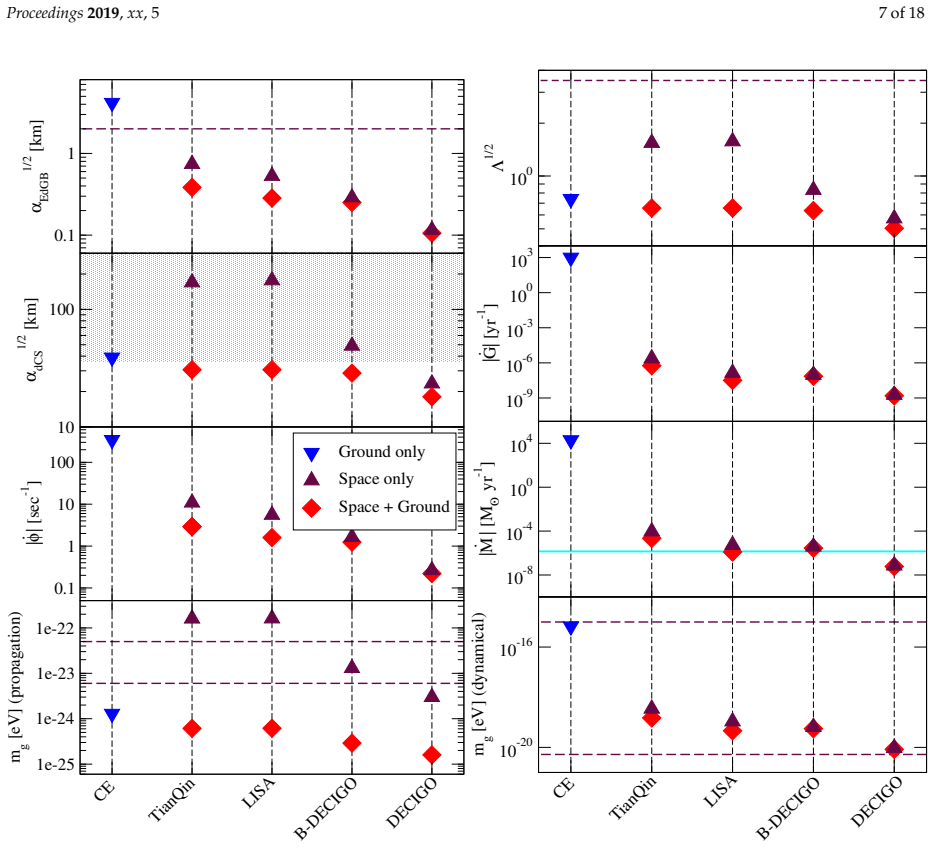
On the paper's own terms, the discovery is a set of projected bounds: using Fisher-matrix forecasts with injected GR signals, the authors find that a future third-generation ground detector alone can improve current constraints on ppE parameters and on theories such as EdGB gravity, dCS gravity, scalar-tensor theories, noncommutative gravity, time-varying G and mass theories, and massive gravitons by several orders of magnitude, with space-based detectors best for low-frequency (negative post-Newtonian-order) corrections and ground-based detectors best for high-frequency (positive post-Newtonian-order) corrections. Multi-band observation of the same event in both bands improves bounds over either band alone and even makes some theories, like dCS gravity, testable in a regime where single-band observations would violate the small-coupling approximation used to derive the waveform corrections. For the IMR consistency test, the 90% credible area for a GW150914-like event shrinks from about 0.25 with LIGO O1 to $3.6\times10^{-4}$ with Cosmic Explorer and to $5.0\times10^{-5}$ when LISA is added, and the paper verifies that its simplified Fisher-based contours agree with Bayesian analyses for O1 within about 10%.
Load-bearing premise
The projections assume that today's statistical forecasting tools, applied to simulated general-relativity signals and assumed detector noise curves, accurately predict how tightly future detectors will measure modified-gravity parameters.
Editorial extensions
If this is right
- If the projections hold, a single GW150914-like event observed by Cosmic Explorer would shrink the IMR consistency-test credible region by about three orders of magnitude relative to LIGO O1.
- Adding a space-based detector such as LISA to the same event would further shrink that region by a factor of roughly seven to ten, depending on the space detector.
- Multi-band observations would make it possible to constrain non-GR corrections at both negative and positive post-Newtonian orders in a single event, and would bring dCS gravity into the regime where valid bounds can be placed.
- Projected bounds on theories such as EdGB gravity, scalar-tensor theories, noncommutative gravity, time-varying G, and massive graviton would approach or beat current non-GW constraints, providing the first strong-field probes of these theories.
Reading between the lines
- The Fisher-Bayesian agreement demonstrated for a single O1 event is not a guarantee for future events; a natural stress test is to run full Bayesian analyses on simulated Cosmic Explorer and LISA events, and if those credible regions grow faster than the Fisher forecasts, the multiplicative gains would be somewhat smaller.
- The multi-band synergy described here points toward stacking many events, since statistical errors shrink with event number; hierarchical multi-event combination could push the same tests below the single-event forecasts in this paper.
- The paper's formalism assumes non-precessing, circular binaries, so extending these forecasts to precessing or eccentric binaries could change which theories are best constrained, especially for space-based detectors that observe long inspirals.
- Early space-based detection of an inspiral could be used to schedule ground-based detectors and electromagnetic follow-up, making the multi-band test not only a statistics boost but also a coordination tool.
Signed reviews
Editorial analysis
A structured set of objections, weighed in public.
Referee Report
Summary. This proceedings paper reviews two theory-agnostic approaches to testing general relativity with gravitational waves: parameterized post-Einsteinian (ppE) waveform tests and inspiral-merger-ringdown (IMR) consistency tests. It describes the Fisher-matrix formalism (Eqs. (2)-(8)), summarizes current bounds from LIGO/Virgo events, and presents projected future bounds for upgraded ground-based detectors (Cosmic Explorer) and space-based detectors (LISA, TianQin, B-DECIGO, DECIGO), including multi-band observation combinations. The central claim is that future single-band and multi-band GW observations can improve constraints on modified-gravity parameters such as the EdGB coupling, dCS coupling, scalar-tensor dipole radiation, graviton mass, and others by several orders of magnitude, and that the IMR consistency test's resolving power between GR and non-GR effects improves by a similar amount. The paper is a concise review that draws heavily on the authors' own prior work, including an in-preparation manuscript cited as [88].
Significance. If the projected numbers are correct, the paper provides a useful and compact illustration of the potential discovery reach of next-generation gravitational-wave detectors for testing gravity. The theoretical framework is standard, the literature coverage is appropriate for a proceedings article, and the presentation of the O1 Fisher-versus-Bayesian comparison for the IMR consistency test (Figure 4, Table 2) is a valuable internal consistency check. However, the main quantitative results—the future ppE bounds and multi-band projections—are not independently reproducible from the text because they are taken from the authors' own unpublished companion paper [88]. This limits the paper's standalone significance and makes the headline claims dependent on external material.
major comments (3)
- [Sections 2.3 and 2.4, Figure 2, Table 2] The central future projections are not reproducible from this manuscript. The text states that the future bounds are 'summarized' from refs. [87,88], and the caption of Figure 2 says it is 'taken and edited from [88]' (an 'In preparation' reference). The manuscript does not specify the detector noise curves, frequency cutoffs, priors, the treatment of waveform systematics, the multi-detector Fisher combination beyond Eq. (8), or the detailed ppE-to-theory mappings needed to recompute the plotted bounds. Since the paper's headline claim ('improve upon current bounds on theories beyond general relativity by many orders of magnitude') rests on exactly these numbers, the reader cannot verify the central result from the paper itself. The authors should either include the necessary calculation details in an appendix, cite a published and publicly available version of the companion work, or clearly delimit this paper as a review that defers all quantitative forecasts to [88].
- [Section 3.2, Figure 4, Table 2] The Fisher-versus-Bayesian validation performed here covers only the 90% contour area in the (epsilon, sigma) plane of the IMR consistency test. It does not validate the ppE parameter bounds in Figure 2 and Table 1 that support the parameterized-test improvements claimed in Sections 2.3 and 2.4. The O1 comparison shows agreement to about 10% for the IMR contour area, but the ppE bounds for individual theory parameters are a different observable, with different parameter correlations, priors, and waveform dependence. Therefore this validation does not by itself justify the Fisher-based forecasts for ppE parameters. The authors should provide an analogous Fisher-versus-Bayesian check for at least one ppE parameter, or explicitly state why such a check is not feasible, and qualify the projected ppE bounds accordingly.
- [Section 2.1 and Figure 2] The regime of validity of the ppE mapping is not treated consistently. For EdGB, dCS, and scalar-tensor theories, the bounds in Figure 2 are meaningful only outside the small-coupling region, as the caption notes. Yet in Section 2.4 the text says that for dCS gravity, multi-band observations make the small-coupling approximation valid and thereby allow bounds 'several orders-of-magnitude stronger than the current constraints.' This statement conflates the validity of the theory mapping with the statistical precision of the Fisher estimate. The authors should clarify, for each theory and detector configuration, whether the projected bound lies inside or outside the regime where the ppE waveform correction itself is a valid perturbative expansion, and whether the Fisher result is therefore physically meaningful.
minor comments (5)
- [Section 1] There are several typos, including 'Einsteins'' which should be 'Einstein's', and 'byy estimated' which should be 'by estimated' or 'estimated'.
- [Section 3.3] The sentence beginning 'with upgraded third-generation ground-based GW detectors CE We do not consider...' is missing a period after 'CE'; it should read 'CE. We do not consider...'.
- [Section 4] In the open-questions list, 'one needs to to carry out' contains a duplicated 'to'; it should read 'one needs to carry out'.
- [Table 1] The table is poorly formatted: the massive-graviton row is split across two rows with confusing alignment, and some entries are difficult to parse. Please reformat the table for clarity.
- [References] Reference [88] is cited as 'In preparation' but is a key source for the main quantitative results. If the paper is now available, the reference should be updated; if it is still unavailable, the authors should make clear that all future projections in Sections 2.3, 2.4, and 3.4 are taken from that unpublished work.
Circularity Check
Future-forecast results are imported wholesale from the authors' own companion papers ([87,88], the latter 'In preparation'), making the headline orders-of-magnitude improvements load-bearing on self-citation rather than on an in-paper derivation; no definitional or fitted-input circularity is present.
-
self citation load bearing
[Section 2.3 'Future Bounds' and Section 2.4 'Multi-Band Bounds' (Figures 2-3); similarly Section 3.4 and Table 2.]
"In this document, we summarize the results of [87,88], displaying constraints on the following modified theories of gravity ... This figure is taken and edited from [88]. ... The red data points in Figure 2 summarize the results determined in [87,88] ... We refer to [88] for a comprehensive list of constraints presented here for both single- and multi-band observations."
The paper's headline claim—future single- and multi-band GW observations improve parameterized-test bounds by many orders of magnitude—is not derived in this manuscript. Every future-constraint plot and table is taken from refs. [87,88], both by the same authors, with [88] explicitly '(In preparation)'. The detector noise curves, ppE-to-theory mappings, frequency cutoffs, priors, and multi-detector Fisher combination underlying Figure 2 are not reproduced, so the projected numbers cannot be checked from the text. This makes the authors' own companion papers the sole support for the central forecast.
full rationale
The paper is a proceedings review that consolidates the authors' own recent forecasts. There is no self-definitional reduction: the ppE waveform of Eq. (1) and the Fisher formalism of Eqs. (2)-(8) are standard and are not defined in terms of the future bounds they produce. There is no fitted-input-called-prediction step: the future constraints come from injecting GR signals into assumed detector noise curves, not from fitting parameters to the quantities being predicted. The in-paper O1 Fisher-versus-Bayesian comparison (Figure 4, Table 2) is genuine external validation, although it checks only the IMR contour area, not the ppE parameter bounds that carry the central parameterized-test claims. The main weakness is provenance: the central numerical results of Figures 2 and Table 2 are 'taken and edited from [88]', and [88] is an unpublished companion paper by the same authors, while [87] is also by the same authors. The paper repeatedly says it 'summarizes the results of [87,88]' rather than deriving them, so accepting the headline orders-of-magnitude improvements requires trusting a self-citation chain. This is a reproducibility gap and a self-citation burden, not a logical circularity in the projection methodology; hence the score is moderate rather than high.
Assumptions & free parameters
assumptions (3)
- domain assumption GR is the correct theory and the IMRPhenomD waveform accurately models BBH signals
- domain assumption Fisher information matrix approximates the Bayesian posterior well for loud signals
- domain assumption The small-coupling approximation is valid for the modified gravity theories in the projected detection regimes
Cite this review
Pith. "Pith review of Parameterized and Consistency Tests of Gravity with Gravitational Waves: Current and Future." pith.science (2026). https://pith.science/paper/GOFAXBSC
@misc{pith2026190807103,
  author       = {Pith},
  title        = {Pith review of: Parameterized and Consistency Tests of Gravity with Gravitational Waves: Current and Future},
  year         = {2026},
  howpublished = {\url{https://pith.science/paper/GOFAXBSC}},
  note         = {Machine review of arXiv:1908.07103}
}
read the original abstract
Gravitational wave observations offer unique opportunities to probe gravity in the strong and dynamical regime, which was difficult to access previously. We here review two theory-agnostic ways to carry out tests of general relativity with gravitational waves, namely (i) parameterized waveform tests and (ii) consistency tests between the inspiral and merger-ringdown portions. For each method, we explain the formalism, followed by results from existing events, and finally we discuss future prospects with upgraded detectors, including the possibility of using multi-band gravitational-wave observations with ground-based and space-borne interferometers. We show that such future observations have the potential to improve upon current bounds on theories beyond general relativity by many orders of magnitude. We conclude by listing several open questions that remain to be addressed.
Figures


Figures from the paper (1 more)

Reference graph
Works this paper leans on
-
[88]
Future prospects for strong-field tests of gravity with multi-band gravitational wave observations
Carson, Z.; Yagi, K. Future prospects for strong-field tests of gravity with multi-band gravitational wave observations. (In preparation)
-
[1]
Clifton, T.; Ferreira, P .G.; Padilla, A.; Skordis, C. Modified Gravity and Cosmology. Phys. Rept. 2012, 513, 1–189. doi:10.1016/j.physrep.2012.01.001
-
[2]
Beyond the Cosmological Standard Model
Joyce, A.; Jain, B.; Khoury, J.; Trodden, M. Beyond the Cosmological Standard Model. Phys. Rept. 2015, 568, 1–98, doi:10.1016/j.physrep.2014.12.002
-
[3]
Modified Newtonian Dynamics (MOND): Observational Phenomenology and Relativistic Extensions
Famaey, B.; McGaugh, S. Modified Newtonian Dynamics (MOND): Observational Phenomenology and Relativistic Extensions. Living Rev. Rel. 2012, 15, 10, doi:10.12942/lrr-2012-10
- [4]
-
[5]
Jain, B.; Khoury , J. Cosmological Tests of Gravity. Ann. Phys. 2010, 325, 1479–1516, doi:10.1016/j.aop.2010.04.002. Proceedings 2019, xx, 5 13 of 18
-
[6]
Cosmological Tests of Modified Gravity
Koyama, K. Cosmological Tests of Modified Gravity. Rept. Prog. Phys. 2016, 79, 046902, doi:10.1088/0034-4885/79/4/046902
-
[7]
A modification of the Newtonian dynamics as a possible alternative to the hidden mass hypothesis
Milgrom, M. A modification of the Newtonian dynamics as a possible alternative to the hidden mass hypothesis. Astrophys. J. 1983, 270, 365–370. doi:10.1086/161130
doi:10.1086/161130 1983
Show all 131 references
-
[8]
Constraints on modified gravity from Planck 2015: When the health of your theory makes the difference.JCAP 2016, 1609, 027, doi:10.1088/1475-7516/2016/09/027
Salvatelli, V .; Piazza, F.; Marinoni, C. Constraints on modified gravity from Planck 2015: When the health of your theory makes the difference.JCAP 2016, 1609, 027, doi:10.1088/1475-7516/2016/09/027
2015 doi
-
[9]
Testing general relativity with pulsar timing
Stairs, I.H. Testing general relativity with pulsar timing. Living Rev. Relativ. 2003, 6, 5, doi:10.12942/lrr-2003-5
2003 doi
-
[10]
Testing Relativistic Gravity with Radio Pulsars
Wex, N. Testing Relativistic Gravity with Radio Pulsars. arXiv 2014, arXiv:gr-qc/1402.5594
2014 arXiv
-
[11]
Cosmological Tests of Gravity
Ferreira, P .G. Cosmological Tests of Gravity. arXiv 2019, arXiv:astro-ph.CO/1902.10503
2019 arXiv
-
[12]
Properties of the Binary Black Hole Merger GW150914
Abbott, B.P .; Abbott R.; Abbott, T.D.; Abernathy, M.R.; Acernese, F.; Ackley, K.; Adams, C.; Adams, T.; Addesso, P .; Adhikari, R.X.; et al. Properties of the Binary Black Hole Merger GW150914. Phys. Rev. Lett. 2016, 116, 241102, doi:10.1103/PhysRevLett.116.241102
2016 doi
-
[13]
GWTC-1: A Gravitational-Wave Transient Catalog of Compact Binary Mergers Observed by LIGO and Virgo during the First and Second Observing Runs
Abbott, B.P .; Abbott, R.; Abbott, T.D.; Abraham, S.; Acernese, F.; Ackley, K.; Adams, C.; Adhikari, R.X.; Adya, V .B.; Affeldt, C.; et al. GWTC-1: A Gravitational-Wave Transient Catalog of Compact Binary Mergers Observed by LIGO and Virgo during the First and Second Observing...
2018 arXiv
-
[14]
GW170817: Observation of Gravitational W aves from a Binary Neutron Star Inspiral.Phys
Abbott, B.P .; LIGO Scientific Collaboration; Virgo Collaboration. GW170817: Observation of Gravitational W aves from a Binary Neutron Star Inspiral.Phys. Rev. Lett.2017, 119, 161101, doi:10.1103/PhysRevLett.119.161101
2017 doi
-
[15]
Tests of general relativity with GW150914
Abbott, B.P .; Abbott, R.; Abbott, T.D.; Abernathy, M.R.; Acernese, F.; Ackley, K.; Adams, C.; Adams, T.; Addesso, P .; Adhikari, R.X.; et al. Tests of general relativity with GW150914. Phys. Rev. Lett. 2016, 116, 221101, doi:10.1103/PhysRevLett.116.221101
2016 doi
-
[16]
Tests of General Relativity with the Binary Black Hole Signals from the LIGO-Virgo Catalog GWTC-1
Abbott, B.P .; Abbott, R.; Abbott, T.D.; Abraham, S.; Acernese, F.; Ackley, K.; Adams, C.; Adhikari, R.X.; Adya, V .B.; Affeldt, C.; et al. Tests of General Relativity with the Binary Black Hole Signals from the LIGO-Virgo Catalog GWTC-1. arXiv 2019, arXiv:gr-qc/1903.04467
2019 arXiv
-
[17]
Available online: https://www.advancedligo.mit.edu/ (accessed on 10 January 2019)
Advanced LIGO. Available online: https://www.advancedligo.mit.edu/ (accessed on 10 January 2019)
2019
-
[18]
Available online: https://dcc.ligo.org/ligo-T1400316/public (accessed on 10 January 2019)
Ligo-t1400316-v4: Instrument Science White Paper. Available online: https://dcc.ligo.org/ligo-T1400316/public (accessed on 10 January 2019)
2019
-
[19]
Available online: http://www.et-gw.eu/ (accessed on 10 January 2019)
The ET Project Website. Available online: http://www.et-gw.eu/ (accessed on 10 January 2019)
2019
-
[20]
The construction and use of LISA sensitivity curves
Robson, T.; Cornish, N.; Liu, C. The construction and use of LISA sensitivity curves. Class. Quant. Grav. 2019, 36, 105011, doi:10.1088/1361-6382/ab1101
2019 doi
-
[21]
TianQin: A space-borne gravitational wave detector
Luo, J.; Chen, L.S.; Duan, H.Z.; Gong, Y.G.; Hu, S.; Ji, J.; Liu, Q.; Mei, J.; Milyukov, V .; Sazhin, M.; et al. TianQin: A space-borne gravitational wave detector. Class. Quantum Gravity 2016, 33, 035010, doi:10.1088/0264-9381/33/3/035010
2016 doi
-
[22]
Science with TianQin: Preliminary Results on Testing the No-hair Theorem with Ringdown Signals
Shi, C.; Bao, J.; Wang, H.; Zhang, J.d.; Hu, Y.; Sesana, A.; Barausse, E.; Mei, J.; Luo, J. Science with TianQin: Preliminary Results on Testing the No-hair Theorem with Ringdown Signals. arXiv 2019, arXiv:gr-qc/1902.08922
2019 arXiv
-
[23]
Detector configuration of DECIGO/BBO and identification of cosmological neutron-star binaries
Yagi, K.; Seto, N. Detector configuration of DECIGO/BBO and identification of cosmological neutron-star binaries. Phys. Rev. 2011, D83, 044011, doi:10.1103/PhysRevD.95.109901
2011 doi
-
[24]
Multiband Gravitational-Wave Astronomy: Observing binary inspirals with a decihertz detector, B-DECIGO.PTEP 2018, 2018, 073E01, doi:10.1093/ptep/pty078
Isoyama, S.; Nakano, H.; Nakamura, T. Multiband Gravitational-Wave Astronomy: Observing binary inspirals with a decihertz detector, B-DECIGO.PTEP 2018, 2018, 073E01, doi:10.1093/ptep/pty078
2018 doi
-
[25]
Black Hole Solutions in String Theory with Gauss-Bonnet Curvature Correction
Maeda, K.i.; Ohta, N.; Sasagawa, Y. Black Hole Solutions in String Theory with Gauss-Bonnet Curvature Correction. Phys. Rev. 2009, D80, 104032, doi:10.1103/PhysRevD.80.104032
2009 doi
-
[26]
Post-Newtonian, Quasi-Circular Binary Inspirals in Quadratic Modified Gravity
Yagi, K.; Stein, L.C.; Yunes, N.; Tanaka, T. Post-Newtonian, Quasi-Circular Binary Inspirals in Quadratic Modified Gravity. Phys. Rev. 2012, D85, 064022, doi:10.1103/PhysRevD.93.029902
2012 doi
-
[27]
Chern-Simons modification of general relativity
Jackiw, R.; Pi, S.Y. Chern-Simons modification of general relativity. Phys. Rev. 2003, D68, 104012, doi:10.1103/PhysRevD.68.104012
2003 doi
-
[28]
Chern-Simons Modified General Relativity
Alexander, S.; Yunes, N. Chern-Simons Modified General Relativity. Phys. Rept. 2009, 480, 1–55, [arXiv:hep-th/0907.2562]. doi:10.1016/j.physrep.2009.07.002
2009 arXiv
-
[29]
Gravitational Waves from Quasi-Circular Black Hole Binaries in Dynamical Chern-Simons Gravity
Yagi, K.; Yunes, N.; Tanaka, T. Gravitational Waves from Quasi-Circular Black Hole Binaries in Dynamical Chern-Simons Gravity. Phys. Rev. Lett. 2012, 109, 251105, doi:10.1103/PhysRevLett.116.169902. Proceedings 2019, xx, 5 14 of 18
2012 doi
-
[30]
Fundamental physics implications on higher-curvature theories from the binary black hole signals in the LIGO-Virgo Catalog GWTC-1
Nair, R.; Perkins, S.; Silva, H.O.; Yunes, N. Fundamental physics implications on higher-curvature theories from the binary black hole signals in the LIGO-Virgo Catalog GWTC-1. arXiv 2019, arXiv:gr-qc/1905.00870
2019 arXiv
-
[31]
Cosmic Black-Hole Hair Growth and Quasar OJ287
Horbatsch, M.W.; Burgess, C.P . Cosmic Black-Hole Hair Growth and Quasar OJ287. JCAP 2012, 1205, 010, doi:10.1088/1475-7516/2012/05/010
2012 doi
-
[32]
Primordial black hole evolution in tensor scalar cosmology
Jacobson, T. Primordial black hole evolution in tensor scalar cosmology. Phys. Rev. Lett. 1999, 83, 2699–2702, doi:10.1103/PhysRevLett.83.2699
1999 doi
-
[33]
Noncommutative Gravity
Harikumar, E.; Rivelles, V .O. Noncommutative Gravity. Class. Quant. Grav. 2006, 23, 7551–7560, doi:10.1088/0264-9381/23/24/024
2006 doi
-
[34]
Constraining noncommutative spacetime from GW150914
Kobakhidze, A.; Lagger, C.; Manning, A. Constraining noncommutative spacetime from GW150914. Phys. Rev. 2016, D94, 064033, doi:10.1103/PhysRevD.94.064033
2016 doi
-
[35]
The Confrontation between General Relativity and Experiment
Will, C.M. The Confrontation between General Relativity and Experiment. Living Rev. Relativ. 2014, 17, 4, doi:10.12942/lrr-2014-4
2014 doi
-
[36]
Constraining the evolutionary history of Newton’s constant with gravitational wave observations
Yunes, N.; Pretorius, F.; Spergel, D. Constraining the evolutionary history of Newton’s constant with gravitational wave observations. Phys. Rev. 2010, D81, 064018, doi:10.1103/PhysRevD.81.064018
2010 doi
-
[37]
Parameterized Post-Einsteinian Gravitational Waveforms in Various Modified Theories of Gravity
Tahura, S.; Yagi, K. Parameterized Post-Einsteinian Gravitational Waveforms in Various Modified Theories of Gravity. Phys. Rev. 2018, D98, 084042, doi:10.1103/PhysRevD.98.084042
2018 doi
-
[38]
Probing the size of extra dimension with gravitational wave astronomy
Yagi, K.; Tanahashi, N.; Tanaka, T. Probing the size of extra dimension with gravitational wave astronomy. Phys. Rev. 2011, D83, 084036, doi:10.1103/PhysRevD.83.084036
2011 doi
-
[39]
Extreme Gravity Tests with Gravitational Waves from Compact Binary Coalescences: (I) Inspiral-Merger
Berti, E.; Yagi, K.; Yunes, N. Extreme Gravity Tests with Gravitational Waves from Compact Binary Coalescences: (I) Inspiral-Merger. Gen. Rel. Grav. 2018, 50, 46, doi:10.1007/s10714-018-2362-8
2018 doi
-
[40]
Bounding the mass of the graviton using gravitational wave observations of inspiralling compact binaries
Will, C.M. Bounding the mass of the graviton using gravitational wave observations of inspiralling compact binaries. Phys. Rev. 1998, D57, 2061–2068, doi:10.1103/PhysRevD.57.2061
1998 doi
-
[41]
Constraining Generic Lorentz Violation and the Speed of the Graviton with Gravitational Waves
Mirshekari, S.; Yunes, N.; Will, C.M. Constraining Generic Lorentz Violation and the Speed of the Graviton with Gravitational Waves. Phys. Rev. 2012, D85, 024041, doi:10.1103/PhysRevD.85.024041
2012 doi
-
[42]
Massive Gravity
De Rham, C. Massive Gravity. Living Rev. Relativ. 2014, 17, 7, doi:10.12942/lrr-2014-7
2014 doi
-
[43]
Can the graviton have a large mass near black holes? Phys
Zhang, J.; Zhou, S.Y. Can the graviton have a large mass near black holes? Phys. Rev. 2018, D97, 081501, doi:10.1103/PhysRevD.97.081501
2018 doi
-
[44]
Testing post-Newtonian theory with gravitational wave observations
Arun, K.G.; Iyer, B.R.; Qusailah, M.S.S.; Sathyaprakash, B.S. Testing post-Newtonian theory with gravitational wave observations. Class. Quant. Grav. 2006, 23, L37–L43, doi:10.1088/0264-9381/23/9/L01
2006 doi
-
[45]
Probing the non-linear structure of general relativity with black hole binaries
Arun, K.G.; Iyer, B.R.; Qusailah, M.S.S.; Sathyaprakash, B.S. Probing the non-linear structure of general relativity with black hole binaries. Phys. Rev. 2006, D74, 024006, doi:10.1103/PhysRevD.74.024006
2006 doi
-
[46]
Parametrized tests of post-Newtonian theory using Advanced LIGO and Einstein Telescope
Mishra, C.K.; Arun, K.G.; Iyer, B.R.; Sathyaprakash, B.S. Parametrized tests of post-Newtonian theory using Advanced LIGO and Einstein Telescope. Phys. Rev. 2010, D82, 064010, doi:10.1103/PhysRevD.82.064010
2010 doi
-
[47]
Fundamental Theoretical Bias in Gravitational Wave Astrophysics and the Parameterized Post-Einsteinian Framework
Yunes, N.; Pretorius, F. Fundamental Theoretical Bias in Gravitational Wave Astrophysics and the Parameterized Post-Einsteinian Framework. Phys. Rev. 2009, D80, 122003, doi:10.1103/PhysRevD.80.122003
2009 doi
-
[48]
TIGER: A data analysis pipeline for testing the strong-field dynamics of general relativity with gravitational wave signals from coalescing compact binaries
Agathos, M.; Del Pozzo, W.; Li, T.G.F.; Van Den Broeck, C.; Veitch, J.; Vitale, S. TIGER: A data analysis pipeline for testing the strong-field dynamics of general relativity with gravitational wave signals from coalescing compact binaries. Phys. Rev. 2014, D89, 082001, doi:10....
2014 doi
-
[49]
Testing the no-hair theorem with black hole ringdowns using TIGER
Meidam, J.; Agathos, M.; Van Den Broeck, C.; Veitch, J.; Sathyaprakash, B.S. Testing the no-hair theorem with black hole ringdowns using TIGER. Phys. Rev. 2014, D90, 064009, doi:10.1103/PhysRevD.90.064009
2014 doi
-
[50]
Frequency-domain gravitational waves from nonprecessing black-hole binaries
Husa, S.; Khan, S.; Hannam, M.; Pürrer, M.; Ohme, F.; Forteza, X.J.; Bohé, A. Frequency-domain gravitational waves from nonprecessing black-hole binaries. I. New numerical waveforms and anatomy of the signal. Phys. Rev. D 2016, 93, 044006, doi:10.1103/PhysRevD.93.044006
2016 doi
-
[51]
Frequency-domain gravitational waves from nonprecessing black-hole binaries
Khan, S.; Husa, S.; Hannam, M.; Ohme, F.; Pürrer, M.; Forteza, X.J.; Bohé, A. Frequency-domain gravitational waves from nonprecessing black-hole binaries. II. A phenomenological model for the advanced detector era. Phys. Rev. D 2016, 93, 044007, doi:10.1103/PhysRevD.93.044007
2016 doi
-
[52]
Gravitational waves from merging compact binaries: How accurately can one extract the binary’s parameters from the inspiral waveform? Phys
Cutler, C.; Flanagan, E.E. Gravitational waves from merging compact binaries: How accurately can one extract the binary’s parameters from the inspiral waveform? Phys. Rev. D 1994, 49, 2658–2697, doi:10.1103/PhysRevD.49.2658. Proceedings 2019, xx, 5 15 of 18
1994 doi
-
[53]
Gravitational waves from inspiraling compact binaries: Parameter estimation using second-post-Newtonian waveforms
Poisson, E.; Will, C.M. Gravitational waves from inspiraling compact binaries: Parameter estimation using second-post-Newtonian waveforms. Phys. Rev. D 1995, 52, 848–855, doi:10.1103/PhysRevD.52.848
1995 doi
-
[54]
Estimating spinning binary parameters and testing alternative theories of gravity with LISA
Berti, E.; Buonanno, A.; Will, C.M. Estimating spinning binary parameters and testing alternative theories of gravity with LISA. Phys. Rev. 2005, D71, 084025, doi:10.1103/PhysRevD.71.084025
2005 doi
-
[55]
Constraining alternative theories of gravity by gravitational waves from precessing eccentric compact binaries with LISA
Yagi, K.; Tanaka, T. Constraining alternative theories of gravity by gravitational waves from precessing eccentric compact binaries with LISA. Phys. Rev. 2010, D81, 064008, doi:10.1103/PhysRevD.81.109902
2010 doi
-
[56]
Rosetta stone for parametrized tests of gravity
Sampson, L.; Yunes, N.; Cornish, N. Rosetta stone for parametrized tests of gravity. Phys. Rev. 2013, D88, 064056, doi:10.1103/PhysRevD.88.064056
2013 doi
-
[57]
Binary Pulsar Constraints on the Parameterized post-Einsteinian Framework
Yunes, N.; Hughes, S.A. Binary Pulsar Constraints on the Parameterized post-Einsteinian Framework. Phys. Rev. 2010, D82, 082002, doi:10.1103/PhysRevD.82.082002
2010 doi
-
[58]
Theoretical physics implications of the binary black-hole mergers GW150914 and GW151226
Yunes, N.; Yagi, K.; Pretorius, F. Theoretical physics implications of the binary black-hole mergers GW150914 and GW151226. Phys. Rev. D 2016, 94, 084002, doi:10.1103/PhysRevD.94.084002
2016 doi
-
[59]
Testing Gravity with Gravitational Waves from Binary Black Hole Mergers: Contributions from Amplitude Corrections
Tahura, S.; Yagi, K.; Carson, Z. Testing Gravity with Gravitational Waves from Binary Black Hole Mergers: Contributions from Amplitude Corrections. arXiv 2019, arXiv:gr-qc/1907.10059
2019 arXiv
-
[60]
Testing General Relativity with Present and Future Astrophysical Observations
Berti, E.; Barausse, E.; Cardoso, V .; Gualtieri, L.; Pani, P .; Sperhake, U.; Stein, L.C.; Wex, N.; Yagi, K.; Baker, T.; et al. Testing General Relativity with Present and Future Astrophysical Observations. Class. Quant. Grav. 2015, 32, 243001, doi:10.1088/0264-9381/32/24/243001
2015 doi
-
[61]
DECIGO/BBO as a probe to constrain alternative theories of gravity
Yagi, K.; Tanaka, T. DECIGO/BBO as a probe to constrain alternative theories of gravity. Prog. Theor. Phys. 2010, 123, 1069–1078, doi:10.1143/PTP .123.1069
2010 doi
-
[62]
Tests of General Relativity with GW170817.arXiv2018, arXiv:gr-qc/1811.00364
Abbott, B.P .; Abbott, R.; Abbott, T.D.; Acernese, F.; Ackley , K.; Adams, C.; Adams, T.; Addesso, P .; Adhikari, R.X.; Adya, V .B.; et al. Tests of General Relativity with GW170817.arXiv2018, arXiv:gr-qc/1811.00364
-
[63]
Testing massive-field modifications of gravity via gravitational waves
Yamada, K.; Narikawa, T.; Tanaka, T. Testing massive-field modifications of gravity via gravitational waves. arXiv 2019, arXiv:gr-qc/1905.11859
2019 arXiv
-
[64]
Solar System Constraints on Gauss-Bonnet Mediated Dark Energy
Amendola, L.; Charmousis, C.; Davis, S. Solar System Constraints on Gauss-Bonnet Mediated Dark Energy. JCAP 2007, 0710, 004, doi:10.1088/1475-7516/2007/10/004
2007 doi
-
[65]
Dilatonic black holes in higher curvature string gravity
Kanti, P .; Mavromatos, N.E.; Rizos, J.; Tamvakis, K.; Winstanley, E. Dilatonic black holes in higher curvature string gravity. Phys. Rev. 1996, D54, 5049–5058, doi:10.1103/PhysRevD.54.5049
1996 doi
-
[66]
A New constraint on scalar Gauss-Bonnet gravity and a possible explanation for the excess of the orbital decay rate in a low-mass X-ray binary
Yagi, K. A New constraint on scalar Gauss-Bonnet gravity and a possible explanation for the excess of the orbital decay rate in a low-mass X-ray binary. Phys. Rev. 2012, D86, 081504, doi:10.1103/PhysRevD.86.081504
2012 doi
-
[67]
Are black holes in alternative theories serious astrophysical candidates? The Case for Einstein-Dilaton-Gauss-Bonnet black holes
Pani, P .; Cardoso, V . Are black holes in alternative theories serious astrophysical candidates? The Case for Einstein-Dilaton-Gauss-Bonnet black holes. Phys. Rev. 2009, D79, 084031, doi:10.1103/PhysRevD.79.084031
2009 doi
-
[68]
Slowly-rotating stars and black holes in dynamical Chern-Simons gravity
Ali-Haimoud, Y.; Chen, Y. Slowly-rotating stars and black holes in dynamical Chern-Simons gravity. Phys. Rev. 2011, D84, 124033, doi:10.1103/PhysRevD.84.124033
2011 doi
-
[69]
Slowly Rotating Black Holes in Dynamical Chern-Simons Gravity: Deformation Quadratic in the Spin
Yagi, K.; Yunes, N.; Tanaka, T. Slowly Rotating Black Holes in Dynamical Chern-Simons Gravity: Deformation Quadratic in the Spin. Phys. Rev. 2012, D86, 044037, doi:10.1103/PhysRevD.89.049902
2012 doi
-
[70]
Pulsars and Gravity
Manchester, R.N. Pulsars and Gravity. Int. J. Mod. Phys. 2015, D24, 1530018, doi:10.1142/S0218271815300189
2015 doi
-
[71]
Mars High Resolution Gravity Fields from MRO, Mars Seasonal Gravity, and Other Dynamical Parameters
Konopliv, A.S.; Asmar, S.; Folkner, W.M.; Karatekin, Z.; Nunes, D.; Smrekar, S.; Yoder, C.F.; Zuber, M.T. Mars High Resolution Gravity Fields from MRO, Mars Seasonal Gravity, and Other Dynamical Parameters. Icarus 2011, 211, 401–428. doi:10.1016/j.icarus.2010.10.004
2011 doi
-
[72]
A New nucleosynthesis constraint on the variation of G
Copi, C.J.; Davis, A.N.; Krauss, L.M. A New nucleosynthesis constraint on the variation of G. Phys. Rev. Lett. 2004, 92, 171301, doi:10.1103/PhysRevLett.92.171301
2004 doi
-
[73]
The Response of primordial abundances to a general modification of G(N) and/or of the early Universe expansion rate
Bambi, C.; Giannotti, M.; Villante, F.L. The Response of primordial abundances to a general modification of G(N) and/or of the early Universe expansion rate. Phys. Rev. 2005, D71, 123524, doi:10.1103/PhysRevD.71.123524
2005 doi
-
[74]
Chung, K.W.; Li, T.G.F. A Phenomenological Inclusion of Alternative Dispersion Relations to the Teukolsky Equation and its Application to Bounding the Graviton Mass with Gravitational-wave Measurements.arXiv 2018, arXiv:gr-qc/1808.04050
2018 arXiv
-
[75]
Bounding the mass of the graviton using binary pulsar observations
Finn, L.S.; Sutton, P .J. Bounding the mass of the graviton using binary pulsar observations. Phys. Rev. 2002, D65, 044022, doi:10.1103/PhysRevD.65.044022. Proceedings 2019, xx, 5 16 of 18
2002 doi
-
[76]
Bounding the mass of graviton in a dynamic regime with binary pulsars
Miao, X.; Shao, L.; Ma, B.Q. Bounding the mass of graviton in a dynamic regime with binary pulsars. arXiv 2019, arXiv:astro-ph.CO/1905.12836
2019 arXiv
-
[77]
Binary Black Hole Mergers in the first Advanced LIGO Observing Run
Abbott, B.P .; Abbott, R.; Abbott, T.D.; Abernathy, M.R.; Acernese, F.; Ackley, K.; Adams, C.; Adams, T.; Addesso, P .; Adhikari, R.X.; et al. Binary Black Hole Mergers in the first Advanced LIGO Observing Run. Phys. Rev. 2016, X6, 041015, doi:10.1103/PhysRevX.6.041015
2016 doi
-
[78]
Model-Independent Constraints on Possible Modifications of Newtonian Gravity
Talmadge, C.; Berthias, J.P .; Hellings, R.W.; Standish, E.M. Model-Independent Constraints on Possible Modifications of Newtonian Gravity. Phys. Rev. Lett. 1988, 61, 1159–1162. doi:10.1103/PhysRevLett.61.1159
1988 doi
-
[79]
Mass of the graviton
Goldhaber, A.S.; Nieto, M.M. Mass of the graviton. Phys. Rev. D 1974, 9, 1119–1121. doi:10.1103/PhysRevD.9.1119
1974 doi
-
[80]
Mass of the Graviton
Hare, M.G. Mass of the Graviton. Can. J. Phys. 1973, 51, 431–433, doi:10.1139/p73-056
1973 doi
-
[81]
Massive spin-2 fields on black hole spacetimes: Instability of the Schwarzschild and Kerr solutions and bounds on the graviton mass
Brito, R.; Cardoso, V .; Pani, P . Massive spin-2 fields on black hole spacetimes: Instability of the Schwarzschild and Kerr solutions and bounds on the graviton mass. Phys. Rev. 2013, D88, 023514, doi:10.1103/PhysRevD.88.023514
2013 doi
-
[82]
Limit on graviton mass from galaxy cluster Abell 1689
Desai, S. Limit on graviton mass from galaxy cluster Abell 1689. Phys. Lett. 2018, B778, 325–331, doi:10.1016/j.physletb.2018.01.052
2018 doi
-
[83]
Limit on graviton mass using stacked galaxy cluster catalogs from SPT-SZ, Planck-SZ and SDSS-redMaPPer
Gupta, S.; Desai, S. Limit on graviton mass using stacked galaxy cluster catalogs from SPT-SZ, Planck-SZ and SDSS-redMaPPer. Annals Phys. 2018, 399, 85–92, doi:10.1016/j.aop.2018.09.017
2018 doi
-
[84]
Testing General Relativity with Low-Frequency, Space-Based Gravitational-Wave Detectors
Gair, J.R.; Vallisneri, M.; Larson, S.L.; Baker, J.G. Testing General Relativity with Low-Frequency, Space-Based Gravitational-Wave Detectors. Living Rev. Rel. 2013, 16, 7, doi:10.12942/lrr-2013-7
2013 doi
-
[85]
Scientific Potential of DECIGO Pathfinder and Testing GR with Space-Borne Gravitational Wave Interferometers
Yagi, K. Scientific Potential of DECIGO Pathfinder and Testing GR with Space-Borne Gravitational Wave Interferometers. Int. J. Mod. Phys. 2013, D22, 1341013, doi:10.1142/S0218271813410137
2013 doi
-
[86]
Theoretical Physics Implications of Gravitational Wave Observation with Future Detectors
Chamberlain, K.; Yunes, N. Theoretical Physics Implications of Gravitational Wave Observation with Future Detectors. Phys. Rev. 2017, D96, 084039, doi:10.1103/PhysRevD.96.084039
2017 doi
-
[87]
Multi-band gravitational wave tests of general relativity .arXiv2019, arXiv:gr-qc/1905.13155
Carson, Z.; Yagi, K. Multi-band gravitational wave tests of general relativity .arXiv2019, arXiv:gr-qc/1905.13155
1905 arXiv
-
[89]
Future Prospects for Probing Scalar-Tensor Theories with Gravitational Waves from Mixed Binaries
Carson, Z.; Seymour, B.C.; Yagi, K. Future Prospects for Probing Scalar-Tensor Theories with Gravitational Waves from Mixed Binaries. arXiv 2019, arXiv:gr-qc/1907.03897
2019 arXiv
-
[90]
Synergy between ground and space based gravitational wave detectors for estimation of binary coalescence parameters
Nair, R.; Jhingan, S.; Tanaka, T. Synergy between ground and space based gravitational wave detectors for estimation of binary coalescence parameters. PTEP 2016, 2016, 053E01, doi:10.1093/ptep/ptw043
2016 doi
-
[91]
Theory-Agnostic Constraints on Black-Hole Dipole Radiation with Multiband Gravitational-Wave Astrophysics
Barausse, E.; Yunes, N.; Chamberlain, K. Theory-Agnostic Constraints on Black-Hole Dipole Radiation with Multiband Gravitational-Wave Astrophysics. Phys. Rev. Lett. 2016, 116, 241104, doi:10.1103/PhysRevLett.116.241104
2016 doi
-
[92]
Multiband Gravitational-Wave Astronomy: Parameter Estimation and Tests of General Relativity with Space- and Ground-Based Detectors.Phys
Vitale, S. Multiband Gravitational-Wave Astronomy: Parameter Estimation and Tests of General Relativity with Space- and Ground-Based Detectors.Phys. Rev. Lett. 2016, 117, 051102, doi:10.1103/PhysRevLett.117.051102
2016 doi
-
[93]
Bounding Alternative Theories of Gravity with Multi-Band GW Observations
Gnocchi, G.; Maselli, A.; Abdelsalhin, T.; Giacobbo, N.; Mapelli, M. Bounding Alternative Theories of Gravity with Multi-Band GW Observations. arXiv 2019, arXiv:gr-qc/1905.13460
2019 arXiv
-
[94]
Prospects for Multiband Gravitational-Wave Astronomy after GW150914
Sesana, A. Prospects for Multiband Gravitational-Wave Astronomy after GW150914. Phys. Rev. Lett. 2016, 116, 231102, doi:10.1103/PhysRevLett.116.231102
2016 doi
-
[95]
Multiband gravitational-wave event rates and stellar physics.Phys
Gerosa, D.; Ma, S.; Wong, K.W.K.; Berti, E.; O’Shaughnessy , R.; Chen, Y .; Belczynski, K. Multiband gravitational-wave event rates and stellar physics.Phys. Rev.2019, D99, 103004, doi:10.1103/PhysRevD.99.103004
2019 doi
-
[96]
What we can learn from multi-band observations of black hole binaries
Cutler, C.; Berti, E.; Jani, K.; Kovetz, E.D.; Randall, L.; Vitale, S.; Wong, K.W.K.; Holley-Bockelmann, K.; Larson, S.L.; Littenberg, T.; et al. What we can learn from multi-band observations of black hole binaries. arXiv 2019, arXiv:astro-ph.HE/1903.04069
2019 arXiv
-
[97]
Detection of IMBHs with ground-based gravitational wave observatories: A biography of a binary of black holes, from birth to death
Amaro-Seoane, P .; Santamaria, L. Detection of IMBHs with ground-based gravitational wave observatories: A biography of a binary of black holes, from birth to death. Astrophys. J. 2010, 722, 1197–1206, doi:10.1088/0004-637X/722/2/1197
2010 doi
-
[98]
Optimizing LIGO with LISA forewarnings to improve black-hole spectroscopy
Tso, R.; Gerosa, D.; Chen, Y. Optimizing LIGO with LISA forewarnings to improve black-hole spectroscopy. arXiv 2018, arXiv:gr-qc/1807.00075
2018 arXiv
-
[99]
Expanding the LISA Horizon from the Ground
Wong, K.W.K.; Kovetz, E.D.; Cutler, C.; Berti, E. Expanding the LISA Horizon from the Ground. Phys. Rev. Lett. 2018, 121, 251102, doi:10.1103/PhysRevLett.121.251102. Proceedings 2019, xx, 5 17 of 18
2018 doi
-
[100]
Are stellar-mass black-hole binaries too quiet for LISA? arXiv 2019, arXiv:astro-ph.HE/1905.11998
Moore, C.J.; Gerosa, D.; Klein, A. Are stellar-mass black-hole binaries too quiet for LISA? arXiv 2019, arXiv:astro-ph.HE/1905.11998
2019
-
[101]
Synergy between ground and space based gravitational wave detectors
Nair, R.; Tanaka, T. Synergy between ground and space based gravitational wave detectors. Part II: Localisation. JCAP 2018, 1808, 033, doi:10.1088/1475-7516/2018/08/033
2018 doi
-
[102]
Testing general relativity using golden black-hole binaries
Ghosh, A.; Ghosh, A.; Johnson-McDaniel, N.K.; Mishra, C.K.; Ajith, P .; Del Pozzo, W.; Nichols, D.A.; Chen, Y.; Nielsen, A.B.; Berry, C.P .L.; et al. Testing general relativity using golden black-hole binaries. Phys. Rev. 2016, D94, 021101, doi:10.1103/PhysRevD.94.021101
2016 doi
-
[104]
Testing general relativity using gravitational wave signals from the inspiral, merger and ringdown of binary black holes
Ghosh, A.; Johnson-McDaniel, N.K.; Ghosh, A.; Mishra, C.K.; Ajith, P .; Pozzo, W.D.; Berry, C.P .L.; Nielsen, A.B.; London, L. Testing general relativity using gravitational wave signals from the inspiral, merger and ringdown of binary black holes. Class. Quantum Gravity 2017,...
2017 doi
-
[105]
Golden binaries for LISA: Robust probes of strong-field gravity
Hughes, S.A.; Menou, K. Golden binaries for LISA: Robust probes of strong-field gravity. Astrophys. J. 2005, 623, 689–699, doi:10.1086/428826
2005 doi
-
[106]
Late Inspiral and Merger of Binary Black Holes in Scalar-Tensor Theories of Gravity
Healy, J.; Bode, T.; Haas, R.; Pazos, E.; Laguna, P .; Shoemaker, D.; Yunes, N. Late Inspiral and Merger of Binary Black Holes in Scalar-Tensor Theories of Gravity. Class. Quantum Gravity 2012, 29, 232002, doi:10.1088/0264-9381/29/23/232002
2012 doi
-
[107]
Neutron-star mergers in scalar-tensor theories of gravity
Barausse, E.; Palenzuela, C.; Ponce, M.; Lehner, L. Neutron-star mergers in scalar-tensor theories of gravity. Phys. Rev. 2013, D87, 081506, doi:10.1103/PhysRevD.87.081506
2013 doi
-
[108]
Coalescence of binary neutron stars in a scalar-tensor theory of gravity
Shibata, M.; Taniguchi, K.; Okawa, H.; Buonanno, A. Coalescence of binary neutron stars in a scalar-tensor theory of gravity. Phys. Rev. 2014, D89, 084005, doi:10.1103/PhysRevD.89.084005
2014 doi
-
[109]
Numerical simulations of single and binary black holes in scalar-tensor theories: Circumventing the no-hair theorem
Berti, E.; Cardoso, V .; Gualtieri, L.; Horbatsch, M.; Sperhake, U. Numerical simulations of single and binary black holes in scalar-tensor theories: Circumventing the no-hair theorem. Phys. Rev. 2013, D87, 124020, doi:10.1103/PhysRevD.87.124020
2013 doi
-
[110]
Black Hole Dynamics in Einstein-Maxwell-Dilaton Theory
Hirschmann, E.W.; Lehner, L.; Liebling, S.L.; Palenzuela, C. Black Hole Dynamics in Einstein-Maxwell-Dilaton Theory. Phys. Rev. 2018, D97, 064032, doi:10.1103/PhysRevD.97.064032
2018 doi
-
[111]
Numerical binary black hole mergers in dynamical Chern-Simons gravity: Scalar field.Phys
Okounkova, M.; Stein, L.C.; Scheel, M.A.; Hemberger, D.A. Numerical binary black hole mergers in dynamical Chern-Simons gravity: Scalar field.Phys. Rev.2017, D96, 044020, doi:10.1103/PhysRevD.96.044020
2017 doi
-
[112]
Evolving Metric Perturbations in dynamical Chern-Simons Gravity
Okounkova, M.; Scheel, M.A.; Teukolsky, S.A. Evolving Metric Perturbations in dynamical Chern-Simons Gravity. Phys. Rev. 2019, D99, 044019, doi:10.1103/PhysRevD.99.044019
2019 doi
-
[113]
Numerical binary black hole collisions in dynamical Chern-Simons gravity
Okounkova, M.; Stein, L.C.; Scheel, M.A.; Teukolsky, S.A. Numerical binary black hole collisions in dynamical Chern-Simons gravity. arXiv 2019, arXiv:gr-qc/1906.08789
2019 arXiv
-
[114]
Black holes and binary mergers in scalar Gauss-Bonnet gravity: Scalar field dynamics
Witek, H.; Gualtieri, L.; Pani, P .; Sotiriou, T.P . Black holes and binary mergers in scalar Gauss-Bonnet gravity: Scalar field dynamics. Phys. Rev. 2019, D99, 064035, doi:10.1103/PhysRevD.99.064035
2019 doi
-
[115]
Two-body problem in Scalar-Tensor theories as a deformation of General Relativity: An Effective-One-Body approach
Julié, F.L.; Deruelle, N. Two-body problem in Scalar-Tensor theories as a deformation of General Relativity: An Effective-One-Body approach. Phys. Rev. 2017, D95, 124054, doi:10.1103/PhysRevD.95.124054
2017 doi
-
[116]
Reducing the two-body problem in scalar-tensor theories to the motion of a test particle: A scalar-tensor effective-one-body approach
Julié, F.L. Reducing the two-body problem in scalar-tensor theories to the motion of a test particle: A scalar-tensor effective-one-body approach. Phys. Rev. 2018, D97, 024047, doi:10.1103/PhysRevD.97.024047
2018 doi
-
[117]
Hairy binary black holes in Einstein-Maxwell-dilaton theory and their effective-one-body description
Khalil, M.; Sennett, N.; Steinhoff, J.; Vines, J.; Buonanno, A. Hairy binary black holes in Einstein-Maxwell-dilaton theory and their effective-one-body description. Phys. Rev. 2018, D98, 104010, doi:10.1103/PhysRevD.98.104010
2018 doi
-
[118]
Scalar Tops and Perturbed Quadrupoles: Probing Fundamental Physics with Spin-Precessing Binaries
Loutrel, N.; Tanaka, T.; Yunes, N. Scalar Tops and Perturbed Quadrupoles: Probing Fundamental Physics with Spin-Precessing Binaries. Class. Quantum Gravity 2019, 36, 10LT02, doi:10.1088/1361-6382/ab15fa
2019 doi
-
[119]
Spin-Precessing Black Hole Binaries in Dynamical Chern-Simons Gravity.Phys
Loutrel, N.; Tanaka, T.; Yunes, N. Spin-Precessing Black Hole Binaries in Dynamical Chern-Simons Gravity.Phys. Rev. 2018, D98, 064020, doi:10.1103/PhysRevD.98.064020
2018 doi
-
[120]
Probing Screening and the Graviton Mass with Gravitational Waves.Class
Perkins, S.; Yunes, N. Probing Screening and the Graviton Mass with Gravitational Waves.Class. Quantum Gravity 2019, 36, 055013, doi:10.1088/1361-6382/aafce6
2019 doi
-
[121]
Gravitational radiation from compact binary systems in screened modified gravity
Zhang, X.; Liu, T.; Zhao, W. Gravitational radiation from compact binary systems in screened modified gravity. Phys. Rev. 2017, D95, 104027, doi:10.1103/PhysRevD.95.104027. Proceedings 2019, xx, 5 18 of 18
2017 doi
-
[122]
Hairy Waves: Gravitational Waves in the presence of Screening Mechanism
Honardoost, M.; Khosravi, N.; Rahmanpour, N. Hairy Waves: Gravitational Waves in the presence of Screening Mechanism. arXiv 2019, arXiv:gr-qc/1905.12946
2019 arXiv
-
[123]
Graviton mass bounds from space-based gravitational-wave observations of massive black hole populations
Berti, E.; Gair, J.; Sesana, A. Graviton mass bounds from space-based gravitational-wave observations of massive black hole populations. Phys. Rev. 2011, D84, 101501, doi:10.1103/PhysRevD.84.101501
2011 doi
-
[124]
Testing Brans-Dicke gravity using the Einstein telescope
Zhang, X.; Yu, J.; Liu, T.; Zhao, W.; Wang, A. Testing Brans-Dicke gravity using the Einstein telescope. Phys. Rev. 2017, D95, 124008, doi:10.1103/PhysRevD.95.124008
2017 doi
-
[125]
On combining information from multiple gravitational wave sources
Zimmerman, A.; Haster, C.J.; Chatziioannou, K. On combining information from multiple gravitational wave sources. Phys. Rev. 2019, D99, 124044, doi:10.1103/PhysRevD.99.124044
2019 doi
-
[126]
A hierarchical test of general relativity with gravitational waves.arXiv 2019, arXiv:gr-qc/1904.08011
Isi, M.; Chatziioannou, K.; Farr, W.M. A hierarchical test of general relativity with gravitational waves.arXiv 2019, arXiv:gr-qc/1904.08011
2019 arXiv
-
[127]
Observable effects of a scalar gravitational field in a binary pulsar
Eardley, D.M. Observable effects of a scalar gravitational field in a binary pulsar. Astrophys. J. Lett. 1975, 196, L59–L62. doi:10.1086/181744
1975 doi
-
[128]
Strong Binary Pulsar Constraints on Lorentz Violation in Gravity
Yagi, K.; Blas, D.; Yunes, N.; Barausse, E. Strong Binary Pulsar Constraints on Lorentz Violation in Gravity. Phys. Rev. Lett. 2014, 112, 161101, doi:10.1103/PhysRevLett.112.161101
2014 doi
-
[129]
Constraints on Einstein-AEther theory and Horava gravity from binary pulsar observations
Yagi, K.; Blas, D.; Barausse, E.; Yunes, N. Constraints on Einstein-AEther theory and Horava gravity from binary pulsar observations. Phys. Rev. 2014, D89, 084067, doi:10.1103/PhysRevD.90.069902
2014 doi
-
[130]
Challenging the Presence of Scalar Charge and Dipolar Radiation in Binary Pulsars
Yagi, K.; Stein, L.C.; Yunes, N. Challenging the Presence of Scalar Charge and Dipolar Radiation in Binary Pulsars. Phys. Rev. 2016, D93, 024010, doi:10.1103/PhysRevD.93.024010
2016 doi
-
[131]
Scalar Charges and Scaling Relations in Massless Scalar-Tensor Theories
Anderson, D.; Yunes, N. Scalar Charges and Scaling Relations in Massless Scalar-Tensor Theories. arXiv 2019, arXiv:gr-qc/1901.00937
2019 arXiv
-
[132]
Constraints on Einstein-aether theory after GW170817
Oost, J.; Mukohyama, S.; Wang, A. Constraints on Einstein-aether theory after GW170817. Phys. Rev. 2018, D97, 124023, doi:10.1103/PhysRevD.97.124023. c© 2019 by the authors. Licensee MDPI, Basel, Switzerland. This article is an open access article distributed under the terms a...
2018 doi
Reviewed August 14, 2026 · model on record in the stance chip above.
Discussion (0). Continue with ORCID to comment.