REVIEW 3 major objections 4 minor 30 references
MORFEO: Advancing Towards Final Design
T0 review · 3 major / 4 minor · reviewed 2026-08-02 · deepseek-v4-flash
Pith's one-line read MORFEO's simulated Strehl ratios meet ELT requirement targets
desk verdict Solid FDR status report; the compliance claim in Table 2 is stronger than the evidence supports. read the letter →
The pith
A machine-rendered reading of the paper's core claim, the machinery that carries it, and where it could break.
The reading
What carries the argument
The load-bearing machinery is the SPECULA end-to-end adaptive-optics simulation framework. It combines a pseudo-open-loop control (POLC) estimator with tomographic reconstruction, models the six LGS Shack-Hartmann sensors and three low-order/reference wavefront sensors, and computes point-spread functions and ensquared energies for specified ELT turbulence profiles. Supporting hardware that the simulation must represent faithfully includes the two fifth-generation voice-coil post-focal deformable mirrors (930 mm and 1224 mm, with 1026 and 1147 actuators, conjugated at about 17.5 km and 6.5 km), the telecentric LGS objective with a linear stage to track sodium-layer focus, and the split hard-
What would settle it
Measure the on-sky K-band point-spread function of MICADO+MORFEO at commissioning, and compare Strehl ratio, FWHM, and 16×16 mas ensquared energy to Table 2 for the same atmospheric profile and asterism; a systematic deficit (for example, median Strehl 0.40 rather than 0.45) would falsify the claim. A cheaper pre-commissioning check is to compare SPECULA predictions against end-to-end measurements taken with the Test Unit and Test and Alignment Camera during integration in the facility.
Extended reading notes
Core claim
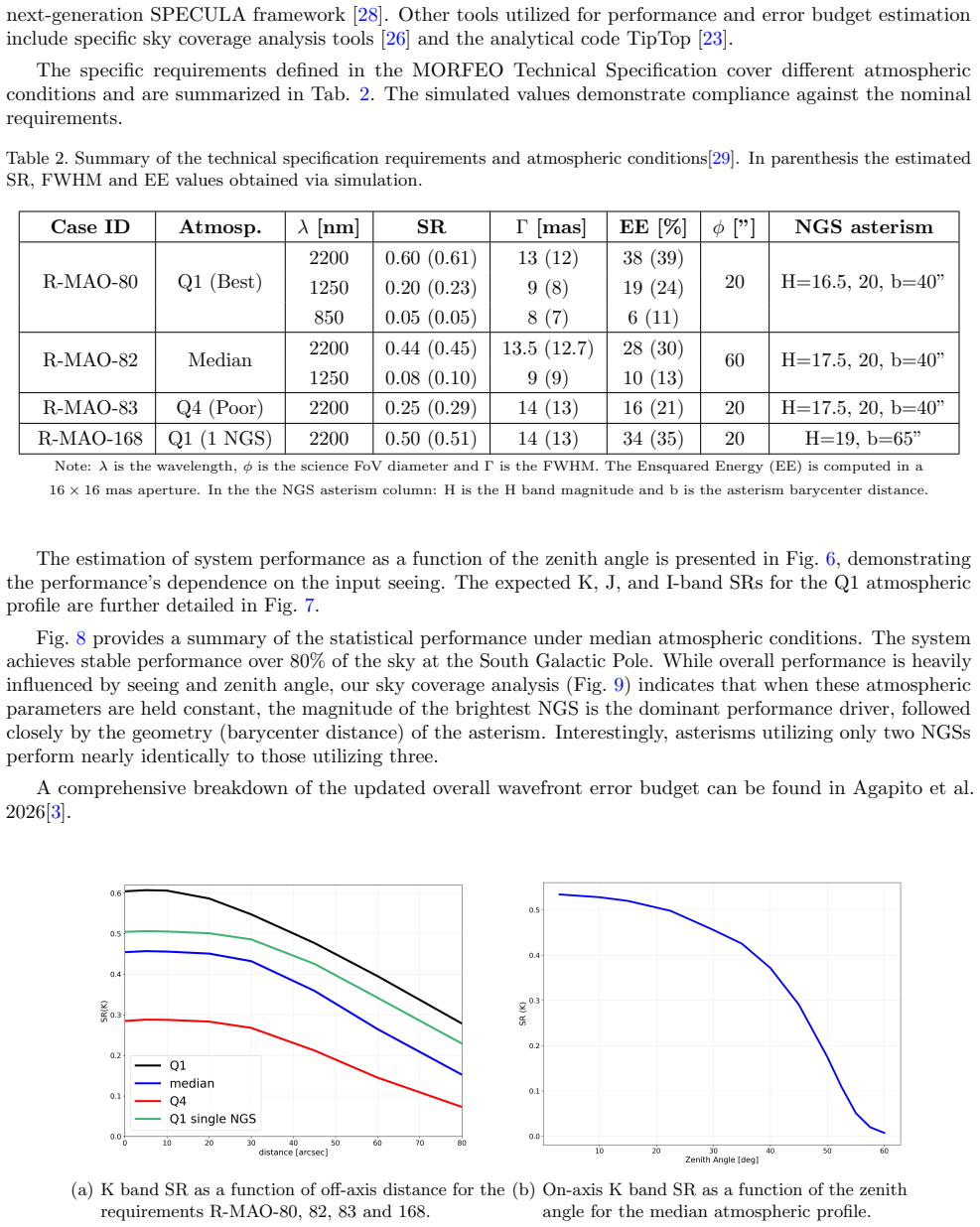
The paper's central claim is that MORFEO meets its top-level adaptive-optics requirements, quantified in Table 2 as Strehl ratio, FWHM, and 16×16 mas ensquared energy for several atmospheric cases. In every listed case the simulated value equals or exceeds the requirement: K-band Strehl of 0.61 against a 0.60 requirement in the best profile, 0.45 against 0.44 in the median profile, and 0.51 against 0.50 in a single-NGS configuration; J- and I-band values are likewise within reach. The paper further claims that under median seeing at a zenith angle of 30 degrees, stable performance is achieved over more than 80% of pointings at the South Galactic Pole, and that performance is governed mainly
Load-bearing premise
The compliance conclusion depends on SPECULA's end-to-end model being a faithful surrogate for the as-built instrument and the real ELT atmosphere; no laboratory or on-sky validation is presented, and the wavefront error budget that would anchor the simulation is deferred to a companion paper.
Editorial extensions
If this is right
- If the simulated compliance holds, MICADO will receive diffraction-limited, uniform K-band images over a 53×53 arcsec field, with the specified FWHM and ensquared energy, under median ELT atmospheric conditions.
- The sky-coverage result of over 80% at the South Galactic Pole means a large fraction of extragalactic fields, not just bright calibrators, would be accessible to the wide-field AO mode.
- The near-equivalence of two- and three-NGS asterisms suggests target selection can be relaxed, potentially increasing the usable sky fraction for a given guide-star catalog.
- The staged final-design review and assembly/integration schedule, with deformable mirrors already in assembly, implies the design is considered mature enough to proceed into manufacturing and integration.
Reading between the lines
- The compliance claim rests entirely on SPECULA simulation; the first laboratory tests with the Test Unit and the Test and Alignment Camera during integration will be the earliest chance to check whether the simulated point-spread function, and therefore the Table 2 margins, survive contact with the as-built optics.
- If the two-versus-three-NGS result transfers to operations, the MORFEO scheduler could prioritize brighter two-star asterisms over fainter three-star triangles, trading field coverage for sky coverage; the paper hints at this but does not state it as an operational rule.
- The LIFT-based sensing of segmented-mirror petal modes, if validated, could give ELT-class instruments a phasing capability without a dedicated pupil-plane sensor, a design choice other diffraction-limited instruments may adopt.
- The paper's performance drivers—brightest NGS magnitude and asterism geometry—suggest that real-time optimized NGS selection, rather than only loop control, is the next lever for improving sky coverage; a testable extension would be to simulate an intelligent NGS-picking algorithm on the same atmospheric ensemble.
Editorial analysis
A structured set of objections, weighed in public.
Referee Report
Summary. The paper presents a status update for MORFEO, the ELT's multiconjugate adaptive optics module, as it approaches Final Design Review. It describes the opto-mechanical architecture (relay optics, thermal control), the two post-focal deformable mirrors (DM1/DM2), the LGS WFS system with its sodium-following zoom objective, the NGS low-order/reference WFS units, and the pseudo-open-loop control strategy implemented on a split hard/soft real-time computer. The central quantitative claim is in Section 5 and Table 2, where end-to-end simulations with the new SPECULA framework are said to 'demonstrate compliance' with the MORFEO top-level Strehl ratio, FWHM, and ensquared-energy requirements under median and other atmospheric conditions. The paper also summarizes the project's FDR roadmap and AIT/commissioning schedule.
Significance. If the performance-compliance claim is established, the result is significant: MORFEO would be on track to deliver diffraction-limited wide-field correction for MICADO, with concrete implications for ELT first-light science. The paper is strong on hardware concreteness: DM actuator counts and conjugation altitudes, LGS WFS pixel scales, LOR WFS configurations, FEA eigenfrequencies, and thermoelastic centroid drifts are all specified. The use of the SPECULA framework is a clear step forward relative to prior status reports, and the paper names the relevant companion analytical codes (TipTop, dedicated sky-coverage tools). The weakness is that the load-bearing compliance numbers rest entirely on an unvalidated simulation framework, with no error bars or sensitivity analysis, and the detailed wavefront error budget is deferred to a companion paper. Thus the headline claim is not yet supported to the level implied by the word 'demonstrate.'
major comments (3)
- [§5, Table 2] The compliance margins are extremely small in several rows: R-MAO-82 K-band SR is 0.45 vs 0.44 required; R-MAO-168 K-band SR is 0.51 vs 0.50; R-MAO-80 K-band SR is 0.61 vs 0.60; R-MAO-82 J-band SR is 0.10 vs 0.08. No error bars, statistical ensembles, or sensitivity analyses are given for any of these point estimates. A systematic bias in the simulation of only 0.01–0.02 in K-band SR (from, e.g., DM fitting-error calibration, LGS spot-elongation modeling, sodium-layer profile assumptions, or tomographic reconstructor errors) would flip R-MAO-82 and R-MAO-168 from compliant to non-compliant. The text in §5 and the abstract says the simulations 'demonstrate compliance'; given these margins, this is an overstatement without an uncertainty estimate. Please either provide such an estimate or explicitly soften the claim to a provisional indication of compliance.
- [§5 and Ref. [28]] All performance numbers in Table 2 come from SPECULA, which the paper describes as a new next-generation framework that replaced PASSATA. No cross-calibration of SPECULA against PASSATA, against laboratory measurements, or against on-sky data is reported anywhere in the manuscript. Because the compliance claim depends on the credibility of SPECULA to a precision better than the smallest requirement margin, this is a load-bearing gap. I would like to see at least a representative cross-validation against PASSATA or a lab/on-sky dataset, or an explicit statement of which model inputs dominate the uncertainty and how they were bounded. Without this, the paper supports a design-status report but not a demonstrated performance compliance.
- [§5, before Table 2] The paragraph introducing the simulations states that a comprehensive wavefront error budget is deferred to the companion paper Agapito et al. 2026 [3]. Yet Table 2 and Figures 6–9 are presented as the evidence for the 'demonstration' claim. Since the reader cannot verify the error-budget contributions or the atmospheric/turbulence inputs behind the simulated values, the paper should either include a summary decomposition of the error budget and its uncertainties, or clearly label the results as preliminary and dependent on the companion paper. The current wording 'simulated values demonstrate compliance' is not supportable from what is in this manuscript alone.
minor comments (4)
- [References] Reference [10] cites the same title and same proceedings ('MORFEO: Advancing Towards Final Design', these proceedings) as this manuscript itself. This appears to be a self-reference or a duplicate citation; please clarify the relationship or replace with a distinct prior-publication reference.
- [Table 1] The header 'LO 1×1 F ALO 2×2 SH' appears to be a formatting/typo issue; it should read 'LO FA (1×1)' and 'LO 2×2 SH' for clarity. Also, the units for FoV and pixel scale are given but should be defined consistently (arcsec vs milliarcsec) across columns.
- [§3.1] The claim that DM1/DM2 provide 'a fitting error below 40 nm RMS' and 'pre-calibrated shape within 10 hours... below 25 nm RMS surface' would benefit from a footnote or reference explaining how these numbers feed into the end-to-end budget, since they are not connected to Table 2.
- [§5, Fig. 8] The sentence 'The system achieves stable performance over 80% of the sky at the South Galactic Pole' is ambiguous: does '80% of the sky' mean 80% of the region around the SGP, or 80% of pointings with a certain magnitude limit? Please define the exact CDF threshold and the NGS asterism constraints used in the figure.
Circularity Check
No significant circularity found: compliance numbers are simulation outputs compared with external requirements, not derived from the requirements or from fitted parameters.
full rationale
The paper's central performance claim is that SPECULA end-to-end simulations in Table 2 and Figs. 6-9 meet MORFEO's Strehl, FWHM, ensquared-energy, and sky-coverage requirements. Those requirements and atmospheric conditions are external inputs, taken from the MORFEO Technical Specification and reference turbulence profiles [29]. The parenthetical values in Table 2 are explicitly 'estimated ... values obtained via simulation'; no equation in the paper defines those simulated quantities as equal to the requirements, and no fitted parameter is renamed as a prediction. The self-citations to Ref. [28] (the SPECULA framework paper, by project members) and Ref. [3] (companion wavefront error budget paper) provide provenance and deferred detail for the simulation tools, but they do not by construction force the compliance conclusion: the reported numbers are new outputs of a time-domain AO simulation, not identities derived from the requirements. The absence of SPECULA cross-validation against PASSATA, laboratory, or on-sky data, and the deferral of the detailed error budget to a companion paper, are genuine verification/correctness risks that weaken 'demonstrate compliance', but they are not circularity under the stated rubric. No specific reduction of an output to an input, and no load-bearing uniqueness theorem imported from the authors' prior work, can be quoted, so the circularity score is 0.
Assumptions & free parameters
assumptions (5)
- domain assumption Reference turbulence profiles Q1/median/Q4 and median seeing 0.64 arcsec at Z=30 deg represent real ELT conditions.
- domain assumption SPECULA faithfully simulates the AO loop, including LGS WFS, DMs, control, and PSF formation.
- domain assumption Manufacturer-specified DM performance (1026/1147 actuators, 500 Hz, fitting error <40 nm RMS, 10-hour stability <25 nm RMS) is assumed in the error budget.
- domain assumption The LGS sodium-layer altitude range 80-200 km and the LGSO telecentric zoom plus 16 arcsec FoV are sufficient to avoid defocus and spot truncation.
- domain assumption Pseudo-open-loop control with the HRTC/SRTC split achieves the assumed bandwidth and latency at 500 Hz.
Cite this review
Pith. "Pith review of MORFEO: Advancing Towards Final Design." pith.science (2026). https://pith.science/paper/GP2ZBNYB
@misc{pith2026260713258,
  author       = {Pith},
  title        = {Pith review of: MORFEO: Advancing Towards Final Design},
  year         = {2026},
  howpublished = {\url{https://pith.science/paper/GP2ZBNYB}},
  note         = {Machine review of arXiv:2607.13258}
}
read the original abstract
The Multiconjugate adaptive Optics Relay For ELT Observations (MORFEO) is a first-generation adaptive optics module for the Extremely Large Telescope (ELT), designed to deliver a diffraction-limited, highly uniform 53x53 arcsec field of view to the MICADO near-infrared camera. As the project advances toward its Final Design Review (FDR), significant consolidations have been achieved across all subsystems. This paper presents an updated overview of the MORFEO system, highlighting its dual operational modes (MCAO and SCAO) and recent developments in its opto-mechanical architecture. We dedicate specific focus to the core adaptive hardware, detailing the fifth-generation post-focal deformable mirrors, the highly complex Laser Guide Star (LGS) objective zoom system required to track sodium layer variations, and the Natural Guide Star (NGS) low-order and reference sensing strategies. Furthermore, we detail the advanced pseudo-open-loop control strategy managed by a split Hard and Soft Real-Time Computer architecture. Finally, we report the latest end-to-end performance estimations obtained via the SPECULA simulation framework, demonstrating compliance with the stringent Strehl Ratio and sky coverage requirements under median atmospheric conditions.
Figures


Figures from the paper (6 more)




Reference graph
Works this paper leans on
-
[3]
MORFEO wavefront error budget
Guido Agapito et al. “MORFEO wavefront error budget”. In: these proceedings
-
[1]
PASSATA: object oriented numerical simulation software for adaptive optics
G. Agapito, A. Puglisi, and S. Esposito. “PASSATA: object oriented numerical simulation software for adaptive optics”. In:Adaptive Optics Systems V. Ed. by Enrico Marchetti, Laird M. Close, and Jean-Pierre V´ eran. Vol. 9909. Society of Photo-Optical Instrumentation Engineers (SPIE) Conference Series. July 2016, 99097E, 99097E.doi:10.1117/12.2233963. arXi...
arXiv 2016
-
[2]
MORFEO control strategy
Guido Agapito et al. “MORFEO control strategy”. in preparation
-
[4]
MAORY/MORFEO and LIFT: can the low order wavefront sensors become phasing sensors?
Guido Agapito et al. “MAORY/MORFEO and LIFT: can the low order wavefront sensors become phasing sensors?” In:Adaptive Optics Systems VIII. Ed. by Laura Schreiber, Dirk Schmidt, and Elise Vernet. Vol. 12185. Society of Photo-Optical Instrumentation Engineers (SPIE) Conference Series. Aug. 2022, 1218556, p. 1218556.doi:10.1117/12.2629352. arXiv:2208.02662 [...
arXiv 2022
-
[6]
Guido Agapito et al. “NGSs acquisition in MORFEO”. In:Adaptive Optics for Extremely Large Telescopes (AO4ELT7). June 2023, 10, p. 10.doi: 10.13009/AO4ELT7-2023-011. arXiv: 2310.08181 [astro-ph.IM]
arXiv 2023
-
[7]
Rolling shutter-induced aberrations in laser guide star wavefront sensing
Guido Agapito et al. “Rolling shutter-induced aberrations in laser guide star wavefront sensing”. In: Journal of Astronomical Telescopes, Instruments, and Systems8, 021505 (Apr. 2022), p. 021505.doi: 10.1117/1.JATIS.8.2.021505. arXiv:2208.02661 [astro-ph.IM]
arXiv 2022
-
[8]
MAORY/MORFEO at ELT: Thermal Control System preliminary design
Matteo Aliverti et al. “MAORY/MORFEO at ELT: Thermal Control System preliminary design”. In: Adaptive Optics Systems VIII. Ed. by Laura Schreiber, Dirk Schmidt, and Elise Vernet. Vol. 12185. Society of Photo-Optical Instrumentation Engineers (SPIE) Conference Series. Aug. 2022, 121854P, 121854P.doi: 10.1117/12.2629908
-
[9]
Fifth generation AdOptica deformable mirrors for adaptive optics systems: Subaru ASM, GMT ASMS, MORFEO DM1/DM2, VLT 2GDSM
Roberto Biasi et al. “Fifth generation AdOptica deformable mirrors for adaptive optics systems: Subaru ASM, GMT ASMS, MORFEO DM1/DM2, VLT 2GDSM.” In: these proceedings
Show all 30 references
-
[10]
MORFEO: Advancing Towards Final Design
Lorenzo Busoni et al. “MORFEO: Advancing Towards Final Design”. In: these proceedings
-
[11]
MAORY: A Multi-conjugate Adaptive Optics RelaY for ELT
Paolo Ciliegi et al. “MAORY: A Multi-conjugate Adaptive Optics RelaY for ELT”. In:The Messenger182 (Mar. 2021), pp. 13–16.doi:10.18727/0722-6691/5216. arXiv:2103.11219 [astro-ph.IM]
2021 arXiv
-
[12]
MORFEO at ELT: the adaptive optics module for ELT
Paolo Ciliegi et al. “MORFEO at ELT: the adaptive optics module for ELT”. In:Adaptive Optics Systems IX. Ed. by Kathryn J. Jackson, Dirk Schmidt, and Elise Vernet. Vol. 13097. Society of Photo-Optical Instrumentation Engineers (SPIE) Conference Series. Aug. 2024, 1309722, p. 1...
2024 doi
-
[13]
The Rise of the Giant: ESO’s Extremely Large Telescope
M. Cirasuolo et al. “The Rise of the Giant: ESO’s Extremely Large Telescope”. In:The Messenger192 (Mar. 2024), pp. 3–3.doi:10.18727/0722-6691/5346
2024 doi
-
[14]
Advances in the Instrument Control System Software Design for MORFEO: Integration with MICADO and the post-focal Deformable Mirrors in the ELT Environment
Elia Costa et al. “Advances in the Instrument Control System Software Design for MORFEO: Integration with MICADO and the post-focal Deformable Mirrors in the ELT Environment.” In: these proceedings
-
[15]
Design and challenges for the HARMONI Laser Guide Star Sensors
Anne Costille et al. “Design and challenges for the HARMONI Laser Guide Star Sensors”. In:Adaptive Optics for Extremely Large Telescopes (AO4ELT7). June 2023, 9, p. 9.doi:10.13009/AO4ELT7-2023-010
2023 doi
-
[16]
MICADO: The Multi-Adaptive Optics Camera for Deep Observations
R. Davies et al. “MICADO: The Multi-Adaptive Optics Camera for Deep Observations”. In:The Messenger 182 (Mar. 2021), pp. 17–21.doi:10.18727/0722-6691/5217. arXiv:2103.11631 [astro-ph.IM]
2021 arXiv
-
[17]
Main structure general overview: mechanical design update from PDR towards the final design phase
Vincenzo De Caprio et al. “Main structure general overview: mechanical design update from PDR towards the final design phase”. In:Ground-based and Airborne Instrumentation for Astronomy X. Ed. by Julia J. Bryant, Kentaro Motohara, and Jo¨ el. R. D. Vernet. Vol. 13096. Society ...
2024 doi
-
[18]
2022.url: https://ftp.eso.org/pub/elt/repos/docs/ RTCTK/documents/v3.0.0/sphinx_doc/html/index.html
ESO.RTC Toolkit v.3.0.0 Documentation. 2022.url: https://ftp.eso.org/pub/elt/repos/docs/ RTCTK/documents/v3.0.0/sphinx_doc/html/index.html
2022
-
[19]
Real-Time Regulator Optimization for Tip-Tilt Compensation on Extremely Large Telescopes
Marco Falotico et al. “Real-Time Regulator Optimization for Tip-Tilt Compensation on Extremely Large Telescopes”. In: these proceedings
-
[20]
Key wavefront sensors features for laser-assisted tomographic adaptive optics systems on the Extremely Large Telescope
Thierry Fusco et al. “Key wavefront sensors features for laser-assisted tomographic adaptive optics systems on the Extremely Large Telescope”. In:Journal of Astronomical Telescopes, Instruments, and Systems8, 021514 (Apr. 2022), p. 021514.doi:10.1117/1.JATIS.8.2.021514. arXiv:...
2022 arXiv
-
[21]
Final optical design of MORFEO for the ELT
D. Magrin et al. “Final optical design of MORFEO for the ELT”. In:Adaptive Optics Systems IX. Ed. by Kathryn J. Jackson, Dirk Schmidt, and Elise Vernet. Vol. 13097. Society of Photo-Optical Instrumentation Engineers (SPIE) Conference Series. Aug. 2024, 1309754, p. 1309754.doi:...
2024 doi
-
[22]
MORFEO LGSO optical design
M. Munari et al. “MORFEO LGSO optical design”. In:Ground-based and Airborne Instrumentation for Astronomy X. Ed. by Julia J. Bryant, Kentaro Motohara, and Jo¨ el. R. D. Vernet. Vol. 13096. Society of Photo-Optical Instrumentation Engineers (SPIE) Conference Series. July 2024, ...
2024 doi
-
[23]
TIPTOP: a new tool to efficiently predict your favorite AO PSF
Benoit Neichel et al. “TIPTOP: a new tool to efficiently predict your favorite AO PSF”. In:Adaptive Optics Systems VII. Ed. by Laura Schreiber, Dirk Schmidt, and Elise Vernet. Vol. 11448. Society of Photo-Optical Instrumentation Engineers (SPIE) Conference Series. Dec. 2020, 1...
2020 arXiv
-
[24]
Interfacing adaptive optics simulations with the optical model: a powerful tool for MORFEO
G. Pariani et al. “Interfacing adaptive optics simulations with the optical model: a powerful tool for MORFEO”. In:Adaptive Optics Systems IX. Ed. by Kathryn J. Jackson, Dirk Schmidt, and Elise Vernet. Vol. 13097. Society of Photo-Optical Instrumentation Engineers (SPIE) Confe...
2024 doi
-
[25]
MORFEO and LIFT: are you allergic to petals?
C´ edric Plantet et al. “MORFEO and LIFT: are you allergic to petals?” In: these proceedings
-
[26]
Sky coverage assessment for the European ELT: a joint evaluation for MAORY/MICADO and HARMONI
C´ edric Plantet et al. “Sky coverage assessment for the European ELT: a joint evaluation for MAORY/MICADO and HARMONI”. In:Journal of Astronomical Telescopes, Instruments, and Systems8, 021509 (Apr. 2022), p. 021509.doi:10.1117/1.JATIS.8.2.021509
2022 doi
-
[27]
LOR optomechanical design and analyses
Edoardo Redaelli et al. “LOR optomechanical design and analyses.” In: these proceedings
-
[28]
Introducing a new generation adaptive optics simulation framework: from PASSATA to SPECULA
Fabio Rossi, Alfio Puglisi, and Guido Agapito. “Introducing a new generation adaptive optics simulation framework: from PASSATA to SPECULA”. In:Journal of Astronomical Telescopes, Instruments, and Systems12.1 (2026), p. 019001.doi: 10.1117/1.JATIS.12.1.019001.url: https://doi....
2026 doi
-
[29]
Defining reference turbulence profiles for E-ELT AO performance simulations
Marc Sarazin et al. “Defining reference turbulence profiles for E-ELT AO performance simulations”. In: Proceedings of the Third AO4ELT Conference. Ed. by Simone Esposito and Luca Fini. Dec. 2013, 89, p. 89. doi:10.12839/AO4ELT3.13383
2013 doi
-
[30]
The MAORY laser guide star wavefront sensor: design status
Laura Schreiber et al. “The MAORY laser guide star wavefront sensor: design status”. In:Adaptive Optics Systems VI. Ed. by Laird M. Close, Laura Schreiber, and Dirk Schmidt. Vol. 10703. Society of Photo-Optical Instrumentation Engineers (SPIE) Conference Series. July 2018, 107...
2018 doi
-
[31]
HEART: Herzberg Extensible Adaptive Real-time Toolkit (HEART): internal structure: blocks, pipes, and composition of a new RTC
Malcolm Smith et al. “HEART: Herzberg Extensible Adaptive Real-time Toolkit (HEART): internal structure: blocks, pipes, and composition of a new RTC”. In:Software and Cyberinfrastructure for Astronomy VII. Vol. 12189. Society of Photo-Optical Instrumentation Engineers (SPIE) C...
2022 doi
Reviewed August 2, 2026 · model on record in the stance chip above.
Discussion (0). Sign in to comment.