Electron scattering and the distribution of electric charge and magnetization inside nuclei
Pith reviewed 2026-06-26 12:36 UTC · model grok-4.3
The pith
Electron scattering translates measured cross sections into maps of electric charge and magnetization distributions inside nuclei.
A machine-rendered reading of the paper's core claim, the machinery that carries it, and where it could break.
Core claim
Electron-nucleus scattering measurements are related to the distribution of the electric charge and magnetization inside nuclei, and these distributions reveal about nuclear structure when presented through ab initio approaches that describe nuclei as interacting many-body quantum systems with many-nucleon interactions and electroweak currents derived from first principles.
What carries the argument
The connection between electron scattering observables and the nuclear charge and magnetization densities, obtained via ab initio many-body calculations.
Load-bearing premise
The electromagnetic interaction is well understood and electron beams can be prepared and detected with high precision.
What would settle it
Systematic disagreement between ab initio predictions and measured electron scattering cross sections or form factors over a range of nuclei and momentum transfers would show that the mapping from data to distributions does not hold.
Figures
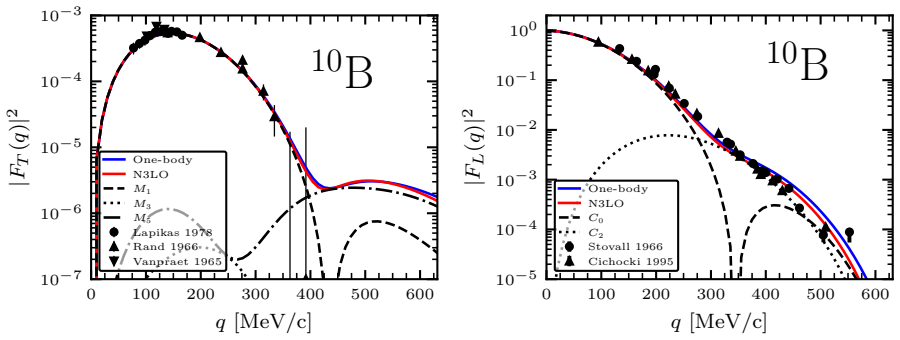
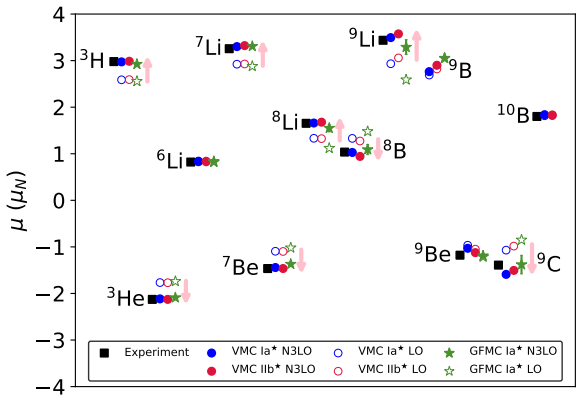
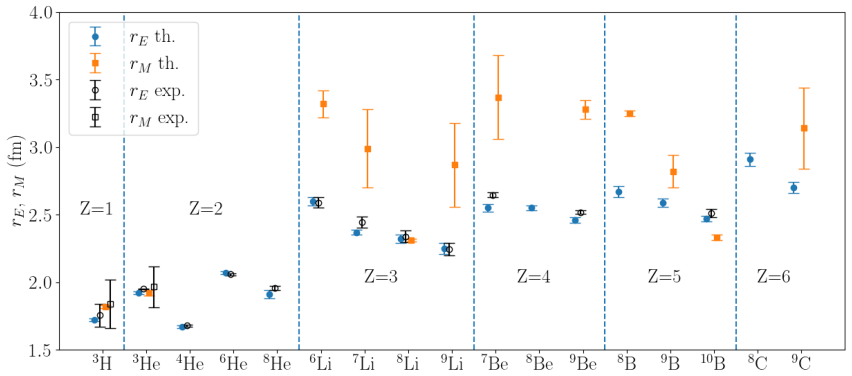
read the original abstract
How are the electric and magnetic distributions carried by protons and neutrons arranged inside an atomic nucleus? One of the most reliable ways to answer this question is to scatter electrons from nuclei. Because the electromagnetic interaction is well understood and electron beams can be prepared and detected with high precision, electron scattering acts as a microscope that probes nuclear structure across a wide range of length scales. In this chapter we discuss how electron-nucleus scattering measurements are related to the distribution of the electric charge and magnetization inside nuclei, and what these distributions reveal about nuclear structure. We present this discussion through modern theoretical tools based on ab initio approaches, which describe nuclei as interacting many-body quantum systems, with many-nucleon interactions and electroweak currents derived from first principles.
Editorial analysis
A structured set of objections, weighed in public.
Referee Report
Summary. The manuscript is a review chapter explaining how electron-nucleus scattering measurements relate to the distributions of electric charge and magnetization inside nuclei. It argues that the well-understood electromagnetic interaction and high-precision electron beams allow scattering to serve as a microscope for nuclear structure over a wide range of length scales, with the relations presented via modern ab initio many-body methods that derive nucleon interactions and electroweak currents from first principles.
Significance. If the synthesis holds, the review is significant for providing a coherent account of how ab initio approaches connect scattering data directly to nuclear charge and magnetization distributions, thereby illustrating what these distributions reveal about nuclear structure. It explicitly credits the use of first-principles derivations and reproducible ab initio frameworks as the modern theoretical tools.
minor comments (1)
- [Abstract] Abstract, first paragraph: the phrasing 'electron scattering acts as a microscope' is standard but could be supplemented with a parenthetical reference to the momentum-transfer range (e.g., q ~ 0.1–2 fm⁻¹) to make the length-scale claim more quantitative for readers.
Simulated Author's Rebuttal
We thank the referee for their positive summary, assessment of significance, and recommendation to accept the manuscript. No major comments were provided in the report.
Circularity Check
No significant circularity identified
full rationale
This is a review chapter summarizing established relations between electron-nucleus scattering and nuclear charge/magnetization distributions. The provided text contains no equations, fitted parameters, or derivation steps that reduce by construction to self-referential inputs, self-citations, or ansatzes. The central premise—that the electromagnetic interaction is well understood and ab initio methods relate data to distributions—rests on standard external physics rather than any internal loop or load-bearing self-citation chain. The paper is self-contained as a presentation of prior first-principles results without evident circular reduction.
Axiom & Free-Parameter Ledger
axioms (2)
- domain assumption The electromagnetic interaction is well understood.
- domain assumption Ab initio approaches describe nuclei as interacting many-body quantum systems with interactions derived from first principles.
Reference graph
Works this paper leans on
-
[1]
Electromagnetic reactions on light nuclei.Journal of Physics G: Nuclear and Particle Physics, 41(12):123002, nov 2014
Sonia Bacca and Saori Pastore. Electromagnetic reactions on light nuclei.Journal of Physics G: Nuclear and Particle Physics, 41(12):123002, nov 2014
2014
-
[2]
J. D. Walecka.Theoretical nuclear and subnuclear physics, volume 16. 1995
1995
-
[3]
Carlson, S
J. Carlson, S. Gandolfi, F. Pederiva, Steven C. Pieper, R. Schiavilla, K. E. Schmidt, and R. B. Wiringa. Quantum Monte Carlo methods for nuclear physics.Rev. Mod. Phys., 87:1067, 2015
2015
-
[4]
Schiavilla et al
R. Schiavilla et al. Local chiral interactions and magnetic structure of few-nucleon systems.Phys. Rev. C, 99(3):034005, 2019
2019
-
[5]
T. W. Donnelly and I. Sick. ELASTIC MAGNETIC ELECTRON SCATTERING FROM NUCLEI. Rev. Mod. Phys., 56:461–566, 1984
1984
-
[6]
Peterson
G.A. Peterson. Magnetic form-factors by 180°electron scattering.Physics Letters, 2(3):162–163, 1962
1962
-
[7]
Goldemberg and Y
J. Goldemberg and Y. Torizuka. Magnetic elastic scattering of electrons by light nuclei.Phys. Rev., 129:312–315, Jan 1963
1963
-
[8]
Van Niftrik, L
G.J.C. Van Niftrik, L. Lapik´ as, H. De Vries, and G. Box. Magnetization distribution of the 7li nucleus as obtained from electron scattering through 180°. the electric quadrupole moment of 7li.Nuclear Physics A, 174(1):173–192, 1971
1971
-
[9]
Lichtenstadt, J
J. Lichtenstadt, J. Alster, M.A. Moinester, J. Dubach, R.S. Hicks, G.A. Peterson, and S. Kowalski. The low lying levels of 7li studied by electron scattering.Physics Letters B, 121(6):377–380, 1983
1983
-
[10]
Lichtenstadt, J
J. Lichtenstadt, J. Alster, M. A. Moinester, J. Dubach, R. S. Hicks, G. A. Peterson, and S. Kowalski. High Momentum Transfer Longitudinal and Transverse Form-factors of the 7Li Ground State Doublet. Phys. Lett. B, 219:394–398, 1989
1989
-
[11]
Chambers-Wall, A
G. Chambers-Wall, A. Gnech, G. B. King, S. Pastore, M. Piarulli, R. Schiavilla, and R. B. Wiringa. Quantum Monte Carlo Calculations of Magnetic Form Factors in Light Nuclei.Phys. Rev. Lett., 133(21):212501, 2024
2024
-
[12]
Chambers-Wall, A
G. Chambers-Wall, A. Gnech, G. B. King, S. Pastore, M. Piarulli, R. Schiavilla, and R. B. Wiringa. Magnetic structure of A≤10 nuclei using the Norfolk nuclear models with quantum Monte Carlo meth- ods.Phys. Rev. C, 110(5):054316, 2024
2024
-
[13]
G. B. King, G. Chambers-Wall, A. Gnech, S. Pastore, M. Piarulli, and R. B. Wiringa. Longitudinal form factors of A≤10 nuclei in a chiral effective field theory approach.Phys. Rev. C, 110(5):054325, 2024
2024
-
[14]
H. Hergert. A Guided Tour ofab initioNuclear Many-Body Theory.Front. in Phys., 8:379, 2020
2020
-
[15]
Hammer, Sebastian K¨ onig, and U
H.-W. Hammer, Sebastian K¨ onig, and U. van Kolck. Nuclear effective field theory: Status and perspec- tives.Rev. Mod. Phys., 92:025004, Jun 2020
2020
-
[16]
Pastore, R
S. Pastore, R. Schiavilla, and J. L. Goity. Electromagnetic two-body currents of one- and two-pion range.Phys. Rev. C, 78:064002, Dec 2008
2008
-
[17]
Pastore, L
S. Pastore, L. Girlanda, R. Schiavilla, M. Viviani, and R. B. Wiringa. Electromagnetic currents and magnetic moments in chiral effective field theory (χEFT).Phys. Rev. C, 80:034004, Sep 2009
2009
-
[18]
Pastore, L
S. Pastore, L. Girlanda, R. Schiavilla, and M. Viviani. Two-nucleon electromagnetic charge operator in chiral effective field theory (χeft) up to one loop.Phys. Rev. C, 84:024001, Aug 2011
2011
-
[19]
K¨ olling, E
S. K¨ olling, E. Epelbaum, H. Krebs, and U. G. Meißner. Two-pion exchange electromagnetic current in chiral effective field theory using the method of unitary transformation.Phys. Rev. C, 80:045502, Oct 2009. 12
2009
-
[20]
K¨ olling, E
S. K¨ olling, E. Epelbaum, H. Krebs, and U.-G. Meißner. Two-nucleon electromagnetic current in chiral effective field theory: One-pion exchange and short-range contributions.Phys. Rev. C, 84:054008, Nov 2011
2011
-
[21]
Krebs, E
H. Krebs, E. Epelbaum, and U.-G. Meißner. Nuclear electromagnetic currents to fourth order in chiral effective field theory.Few-Body Systems, 60(2), May 2019
2019
-
[22]
Lapik´ as.Proceedings of the Conference on Modern Trends in Elastic Electron Scattering
L. Lapik´ as.Proceedings of the Conference on Modern Trends in Elastic Electron Scattering. C. deVries, NIKHEF-K, Amsterdam, 1978
1978
-
[23]
R. E. Rand, R. Frosch, and M. R. Yearian. Elastic electron scattering from the magnetic multipole distributions of li 6, li7, be9, b10, b11, and n 14.Phys. Rev., 144:859–873, Apr 1966
1966
-
[24]
Vanpraet and P
G.J. Vanpraet and P. Kossanyi-Demay. Magnetic elastic electron scattering from 9be, 10b and 11b.Il Nuovo Cimento A, 63(1):388–390, 1965
1965
-
[25]
Coulomb form factors of 10b and 11b.Nuclear Physics, 86(1):225–240, 1966
T Stovall, J Goldemberg, and DB Isabelle. Coulomb form factors of 10b and 11b.Nuclear Physics, 86(1):225–240, 1966
1966
-
[26]
Cichocki, J
A. Cichocki, J. Dubach, R. S. Hicks, G. A. Peterson, C. W. de Jager, H. de Vries, N. Kalantar- Nayestanaki, and T. Sato. Electron scattering from B-10.Phys. Rev. C, 51:2406–2426, 1995
1995
-
[27]
de Forest Jr
T. de Forest Jr. and J.D. Walecka. Electron scattering and nuclear structure.Advances in Physics, 15(57):1–109, 1966
1966
-
[28]
Carlson and R
J. Carlson and R. Schiavilla. Structure and Dynamics of Few Nucleon Systems.Rev. Mod. Phys., 70:743–842, 1998
1998
-
[29]
Magnetic structure of few-nucleon systems at high momentum trans- fers in a chiral effective field theory approach.Phys
Alex Gnech and Rocco Schiavilla. Magnetic structure of few-nucleon systems at high momentum trans- fers in a chiral effective field theory approach.Phys. Rev. C, 106(4):044001, 2022
2022
-
[30]
Miyagi, X
T. Miyagi, X. Cao, R. Seutin, S. Bacca, R. F. Garcia Ruiz, K. Hebeler, J. D. Holt, and A. Schwenk. Impact of Two-Body Currents on Magnetic Dipole Moments of Nuclei.Phys. Rev. Lett., 132(23):232503, 2024
2024
-
[31]
J. D. Martin, S. J. Novario, D. Lonardoni, J. Carlson, S. Gandolfi, and I. Tews. Auxiliary field dif- fusion Monte Carlo calculations of magnetic moments of light nuclei with chiral effective field theory interactions.Phys. Rev. C, 108(3):L031304, 2023
2023
-
[32]
Tropiano, and Alessandro Lovato
Alex Gnech, Bryce Fore, Anthony J. Tropiano, and Alessandro Lovato. Distilling the Essential Elements of Nuclear Binding via Neural-Network Quantum States.Phys. Rev. Lett., 133(14):142501, 2024
2024
-
[33]
M¨ uller et al
P. M¨ uller et al. Electromagnetic moments of the odd-mass nickel isotopes 59−67Ni.Phys. Lett. B, 854:138737, 2024
2024
-
[34]
E. F. Zhou, C. R. Ding, Q. Y. Luo, J. M. Yao, and H. Hergert. Ab initio mapping of the boundary of theN= 20 island of inversion. 3 2026
2026
-
[35]
N.J. Stone. Table of nuclear magnetic dipole and electric quadrupole moments, February 2014
2014
-
[36]
A. A. Filin, D. M¨ oller, V. Baru, E. Epelbaum, H. Krebs, and P. Reinert. High-accuracy calculation of the deuteron charge and quadrupole form factors in chiral effective field theory.Phys. Rev. C, 103(2):024313, 2021
2021
-
[37]
Zemach radii and nuclear structure effects in hyperfine splitting of Lithium
Yilong Yang, Evgeny Epelbaum, Chen Ji, and Pengwei Zhao. Zemach radii and nuclear structure effects in hyperfine splitting of Lithium. 9 2025
2025
-
[38]
Filin, Evgeny Epelbaum, Hermann Krebs, Ulf-G
Xiang-Xiang Sun, Vadim Baru, Arseniy A. Filin, Evgeny Epelbaum, Hermann Krebs, Ulf-G. Meißner, and Andreas Nogga. Ab initio charge form factors and radii of light isoscalar nuclei: Role of the two-body charge density. 1 2026
2026
-
[39]
G. B. King, G. Chambers-Wall, A. Gnech, S. Pastore, M. Piarulli, and R. B. Wiringa. Electromagnetic radii of light nuclei from variational Monte Carlo calculations.Phys. Rev. C, 112(4):L041302, 2025. 13
2025
discussion (0)
Sign in with ORCID, Apple, or X to comment. Anyone can read and Pith papers without signing in.