RG Running of Multiple Neutrino Mixing Parameters at Oscillation Experiments
Pith reviewed 2026-06-26 04:31 UTC · model grok-4.3
The pith
Combining DUNE-ND, JUNO-TAO, and FASERν2 data can disentangle multiple renormalization group running effects on neutrino mixing parameters.
A machine-rendered reading of the paper's core claim, the machinery that carries it, and where it could break.
Core claim
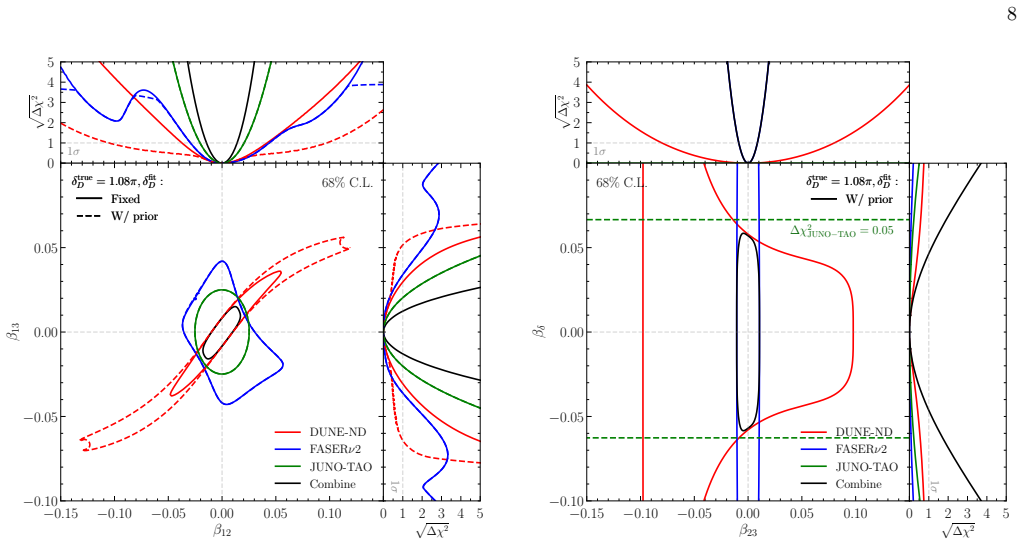
If the new physics scale lies within the energy range of neutrino oscillation experiments, renormalization group running can alter the mixing parameters between production and detection as well as across different experiments. Multiple experiments spanning wide energy ranges and flavor channels then become capable of disentangling several running parameters simultaneously. The study performs this analysis in a model-independent manner for various flavor structures using DUNE-ND, JUNO-TAO, and FASERν2, demonstrating strong sensitivity to the running effects and the ability to address non-trivial degeneracies.
What carries the argument
Renormalization group evolution of multiple neutrino mixing parameters between production and detection, extracted via combined data from experiments with differing energies and flavor compositions.
If this is right
- The combination of DUNE-ND, JUNO-TAO, and FASERν2 produces strong sensitivity to RG running effects.
- Multiple running parameters can be disentangled in a model-independent analysis.
- Non-trivial degeneracies among the parameters can be resolved by the joint dataset.
- The effect applies across a variety of flavor structures.
Where Pith is reading between the lines
- Precision neutrino data may need systematic inclusion of running corrections even in standard oscillation analyses.
- The method could be applied to additional experiments to tighten bounds on low-scale new physics in the neutrino sector.
- Effective field theory operators that modify neutrino mixing would leave detectable energy-dependent signatures in oscillation probabilities.
Load-bearing premise
The new physics scale lies within the energy range of neutrino oscillation experiments and produces observable running of the mixing parameters.
What would settle it
No statistically significant running signal appears in the joint fit of DUNE-ND, JUNO-TAO, and FASERν2 data across the considered flavor structures.
Figures
read the original abstract
If the new physics scale is within the energy scale of neutrino oscillation experiments, it may lead to a renormalization group (RG) running effect between the production and detection processes as well as between different experiments. It is then possible to use multiple neutrino oscillation experiments to disentangle the multiple RG running parameters. We investigate this effect in a general model-independent sense for a variety of flavor structures in the context of upcoming experiments DUNE-ND, JUNO-TAO, and FASER$\nu$2 that span a large range in neutrino energies and many different flavor combinations. We find strong sensitivity to the running effects of new physics with combination of these experiments, especially the possibility of addressing the non-trivial degeneracies.
Editorial analysis
A structured set of objections, weighed in public.
Referee Report
Summary. The manuscript investigates renormalization group (RG) running of neutrino mixing parameters between production and detection if the new physics scale lies within the energy range of oscillation experiments. In a model-independent parameterization for various flavor structures, it analyzes the sensitivity of the combination of upcoming experiments DUNE-ND, JUNO-TAO, and FASERν2—which span a wide energy range and multiple flavor channels—to multiple running parameters, claiming strong sensitivity and the ability to resolve non-trivial degeneracies.
Significance. If the numerical results and statistical analysis support the claims, the work could provide a novel, model-independent probe of new physics scales through energy-dependent running effects in neutrino oscillations. The multi-experiment strategy leveraging diverse energies and flavors is a constructive approach that may break degeneracies inaccessible to individual experiments.
major comments (2)
- [Abstract] Abstract: the central claim of 'strong sensitivity' and 'addressing the non-trivial degeneracies' is presented without any supporting equations, parameterization details, numerical methods, or results. The manuscript must supply the explicit form of the running parameters, the oscillation probability modifications, and the fit or sensitivity calculation to substantiate the claim.
- [Abstract] The weakest assumption (new physics scale inside the oscillation energy window) is load-bearing for any observable effect, yet the abstract provides no quantitative bounds, example scales, or discussion of how the running is implemented between production and detection. This must be addressed with concrete examples or ranges in the main text.
Simulated Author's Rebuttal
We thank the referee for the constructive comments on our manuscript. We address each major comment below, clarifying where the requested details appear in the main text while agreeing to enhance the abstract for better accessibility.
read point-by-point responses
-
Referee: [Abstract] Abstract: the central claim of 'strong sensitivity' and 'addressing the non-trivial degeneracies' is presented without any supporting equations, parameterization details, numerical methods, or results. The manuscript must supply the explicit form of the running parameters, the oscillation probability modifications, and the fit or sensitivity calculation to substantiate the claim.
Authors: The model-independent parameterization of the RG running parameters for various flavor structures is explicitly given in Section 2 (Eqs. 2–5). The resulting modifications to the oscillation probabilities, accounting for running between production and detection, are derived in Section 3 (Eqs. 8–12). The statistical sensitivity analysis, including the combined fit to DUNE-ND, JUNO-TAO, and FASERν2 data and the resolution of degeneracies, is presented in Section 4 with numerical results in Figs. 3–7 and Tables I–II. These elements substantiate the abstract claims. We will revise the abstract to briefly reference the parameterization and multi-experiment fit strategy. revision: partial
-
Referee: [Abstract] The weakest assumption (new physics scale inside the oscillation energy window) is load-bearing for any observable effect, yet the abstract provides no quantitative bounds, example scales, or discussion of how the running is implemented between production and detection. This must be addressed with concrete examples or ranges in the main text.
Authors: The energy ranges of the three experiments (MeV to TeV) and the implementation of running between production and detection energies are discussed in Sections 2.2 and 4.1, with explicit example scales (e.g., new-physics thresholds at 10 GeV and 100 GeV) used in the numerical scans. We agree that a brief quantitative illustration would strengthen the abstract and will add one sentence referencing an example scale together with a pointer to the main-text implementation. revision: yes
Circularity Check
No significant circularity
full rationale
The paper's central claim is a conditional investigation of RG running effects on neutrino mixing parameters when the new physics scale lies inside the oscillation energy window. It parameterizes the running in a model-independent way and examines sensitivity using a combination of experiments spanning different energies and flavors. No derivation step reduces a claimed prediction to a fitted input by construction, no self-citation chain is invoked to force uniqueness, and no ansatz is smuggled in via prior work. The result is therefore self-contained against external benchmarks and receives the default non-finding.
Axiom & Free-Parameter Ledger
axioms (1)
- domain assumption New physics at oscillation energies induces RG running of neutrino mixing parameters between production and detection
Reference graph
Works this paper leans on
-
[1]
The RG run- ning effect appears aboveQ 2 0 whenβ X becomes nonzero
= 0 and there is no running. The RG run- ning effect appears aboveQ 2 0 whenβ X becomes nonzero. For concreteness, the value ofQ 2 0 can originate from a hidden light mediator mass. In this case we generally expectQ 2 0 ≳1 MeV 2 to avoid cosmological bounds [34], which means that there is quite a bit of interesting pa- rameter space probed by neutrino exp...
-
[2]
The oscillation probability from theαflavor to theβ flavor can be obtained asP αβ(L)≡ |A βα|2
+β X ln Q2 Q2 0 .(3) While the exact values of the new physics scaleQ 2 0 and βX depend on the concrete model [13, 21, 24] in the linear regime,Q 2 0 andβ X can be treated as phenomenological parameters to be constrained through experimental data withβ X = 0 returning to the standard physics picture. The oscillation probability from theαflavor to theβ fla...
-
[3]
One can map the new physics into RG running of the four parameters, each with their ownβ X
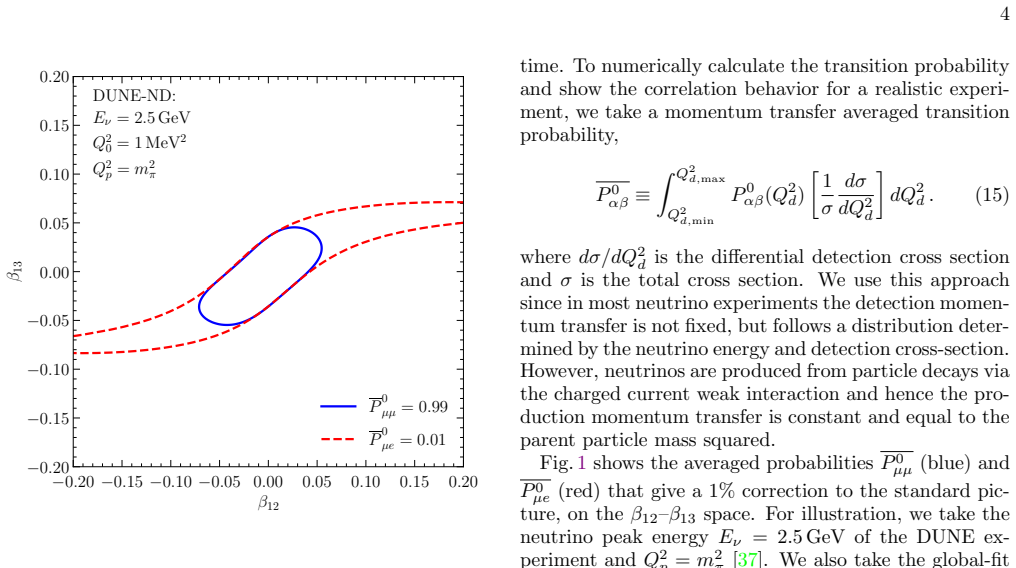
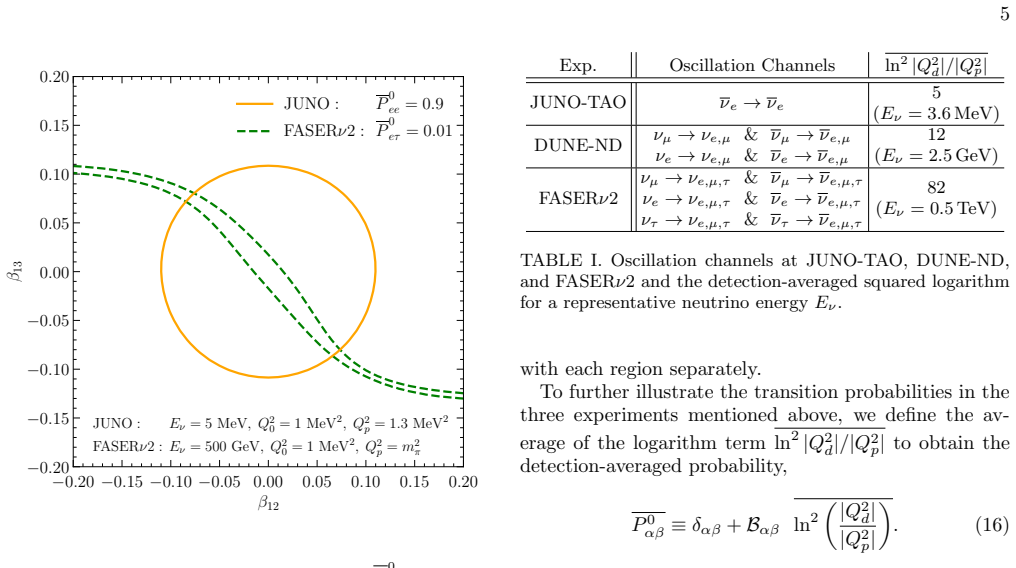
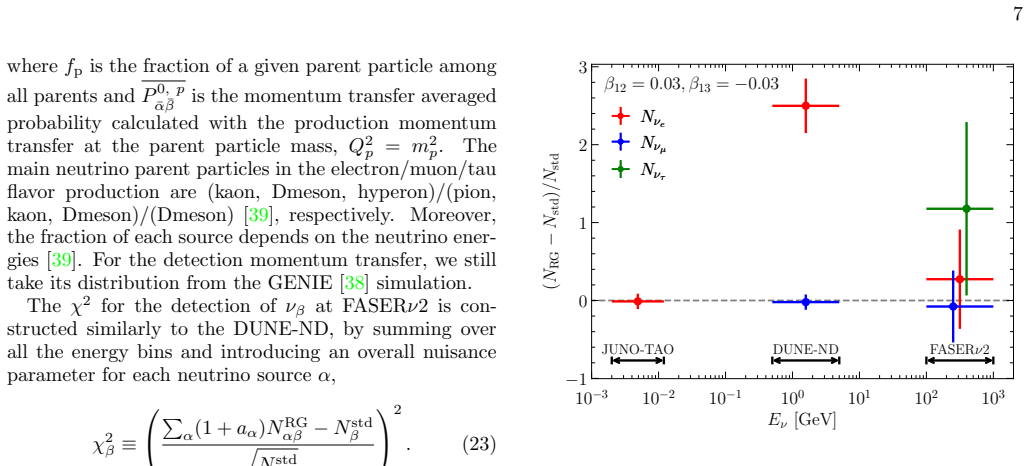
for a discussion of the choice of parameterization. One can map the new physics into RG running of the four parameters, each with their ownβ X. Once taking multiple RG running parameters into account, degenera- cies can exist among them in the transition probabilities. For simplicity, we consider only two RG running param- eters at a time in the following...
-
[4]
C. A. Arg¨ uelles et al., “Snowmass white paper: beyond the standard model effects on neutrino flavor: Submitted to the proceedings of the US community study on the future of particle physics (Snowmass 2021),” Eur. Phys. J. C83no. 1, (2023) 15, [arXiv:2203.10811[hep-ph]]
arXiv 2021
-
[5]
Snowmass Neutrino Frontier: NF01 Topical Group Report on Three-Flavor Neutrino Oscillations,
Peter B. Denton, Megan Friend, Mark D. Messier, Hirohisa A. Tanaka, Sebastian B¨ oser, Jo˜ ao A. B. Coelho, Mathieu Perrin-Terrin, and Tom Stuttard, “Snowmass Neutrino Frontier: NF01 Topical Group Report on Three-Flavor Neutrino Oscillations,” [arXiv:2212.00809[hep-ph]]
-
[6]
Neutrino Oscillations in the Three Flavor Paradigm,
Peter B. Denton, “Neutrino Oscillations in the Three Flavor Paradigm,” [arXiv:2501.08374[hep-ph]]
-
[7]
Neutrino Oscillations in Matter,
L. Wolfenstein, “Neutrino Oscillations in Matter,” Phys. Rev. D17(1978) 2369–2374
1978
-
[8]
SciPost Physics Proceedings, Neutrino Non-Standard Interactions: A Status Report, vol. 2. 2019. [arXiv:1907.00991[hep-ph]]
arXiv 2019
-
[9]
Lepton Flavor Violating Non-Standard Interactions via Light Mediators,
Yasaman Farzan and Ian M. Shoemaker, “Lepton Flavor Violating Non-Standard Interactions via Light Mediators,” JHEP2016no. 07, (2016) 033, [arXiv:1512.09147[hep-ph]]
Pith/arXiv arXiv 2016
-
[10]
Neutrinophilic nonstandard interactions,
Yasaman Farzan and Julian Heeck, “Neutrinophilic nonstandard interactions,” Phys. Rev. D94no. 5, (2016) 053010, [arXiv:1607.07616[hep-ph]]
Pith/arXiv arXiv 2016
-
[11]
Flavor Gauge Models Below the Fermi Scale,
K. S. Babu, A. Friedland, P. A. N. Machado, and I. Mocioiu, “Flavor Gauge Models Below the Fermi Scale,” JHEP2017no. 12, (2017) 096, [arXiv:1705.01822[hep-ph]]
Pith/arXiv arXiv 2017
-
[12]
Neutrino oscillations and Non-Standard Interactions,
Y. Farzan and M. Tortola, “Neutrino oscillations and Non-Standard Interactions,” Front. in Phys.6(2018) 10, [arXiv:1710.09360[hep-ph]]
Pith/arXiv arXiv 2018
-
[13]
Testing large non-standard neutrino interactions with arbitrary mediator mass after COHERENT data,
Peter B. Denton, Yasaman Farzan, and Ian M. Shoemaker, “Testing large non-standard neutrino interactions with arbitrary mediator mass after COHERENT data,” JHEP2018no. 07, (2018) 037, [arXiv:1804.03660[hep-ph]]
Pith/arXiv arXiv 2018
-
[14]
Neutrino nonstandard interactions with arbitrary couplings to u and d quarks,
Nicol´ as Bernal and Yasaman Farzan, “Neutrino nonstandard interactions with arbitrary couplings to u and d quarks,” Phys. Rev. D107no. 3, (2023) 035007, [arXiv:2211.15686[hep-ph]]
arXiv 2023
-
[15]
A model for axial non-standard interactions of neutrinos with quarks,
S. Abbaslu and Yasaman Farzan, “A model for axial non-standard interactions of neutrinos with quarks,” Nucl. Phys. B1018(2025) 117070, [arXiv:2407.13834 [hep-ph]]
arXiv 2025
-
[16]
Energy-dependent neutrino mixing parameters at oscillation experiments,
K. S. Babu, Vedran Brdar, Andr´ e de Gouvˆ ea, and Pedro A. N. Machado, “Energy-dependent neutrino mixing parameters at oscillation experiments,” Phys. Rev. D105no. 11, (2022) 115014, [arXiv:2108.11961 [hep-ph]]
arXiv 2022
-
[17]
Addressing the short-baseline neutrino anomalies with energy-dependent mixing parameters,
K. S. Babu, Vedran Brdar, Andr´ e de Gouvˆ ea, and Pedro A. N. Machado, “Addressing the short-baseline neutrino anomalies with energy-dependent mixing parameters,” Phys. Rev. D107no. 1, (2023) 015017, [arXiv:2209.00031[hep-ph]]
arXiv 2023
-
[18]
Neutrino CP measurement in the presence of RG running with mismatched momentum transfers,
Shao-Feng Ge, Chui-Fan Kong, and Pedro Pasquini, “Neutrino CP measurement in the presence of RG running with mismatched momentum transfers,” Phys. Rev. D110no. 1, (2024) 015003, [arXiv:2310.04077 [hep-ph]]
arXiv 2024
-
[19]
Testing the RG running of the leptonic Dirac CP phase with reactor neutrinos,
Shao-Feng Ge, Chui-Fan Kong, and Pedro Pasquini, “Testing the RG running of the leptonic Dirac CP phase with reactor neutrinos,” Phys. Rev. D111no. 11, (2025) 115031, [arXiv:2411.18251[hep-ph]]
arXiv 2025
-
[20]
General RG equations for physical neutrino parameters and their phenomenological implications,
J. A. Casas, J. R. Espinosa, A. Ibarra, and I. Navarro, “General RG equations for physical neutrino parameters and their phenomenological implications,” Nucl. Phys. B 573(2000) 652–684, [arXiv:hep-ph/9910420]. 10
Pith/arXiv arXiv 2000
-
[21]
Stefan Antusch, J¨ orn Kersten, Manfred Lindner, and Michael Ratz, “Running neutrino masses, mixings and CP phases: Analytical results and phenomenological consequences,” Nucl. Phys. B674(2003) 401–433, [arXiv:hep-ph/0305273]
Pith/arXiv arXiv 2003
-
[22]
Running neutrino mass parameters in see-saw scenarios,
Stefan Antusch, J¨ orn Kersten, Manfred Lindner, Michael Ratz, and Michael Andreas Schmidt, “Running neutrino mass parameters in see-saw scenarios,” JHEP 2005no. 03, (2005) 024, [arXiv:hep-ph/0501272]
Pith/arXiv arXiv 2005
-
[23]
Zhi-zhong Xing and He Zhang, “Distinguishable RGE running effects between Dirac neutrinos and Majorana neutrinos with vanishing Majorana CP-violating phases,” Commun. Theor. Phys.48(2007) 525, [arXiv:hep-ph/0601106]
Pith/arXiv arXiv 2007
-
[24]
Renormalization group evolution of neutrino masses and mixing in seesaw models: A Review,
Shamayita Ray, “Renormalization group evolution of neutrino masses and mixing in seesaw models: A Review,” Int. J. Mod. Phys. A25(2010) 4339–4384, [arXiv:1005.1938[hep-ph]]
Pith/arXiv arXiv 2010
-
[25]
Shu Luo and Zhi-zhong Xing, “Impacts of the observed θ13 on the running behaviors of Dirac and Majorana neutrino mixing angles and CP-violating phases,” Phys. Rev. D86(2012) 073003, [arXiv:1203.3118[hep-ph]]
Pith/arXiv arXiv 2012
-
[26]
Radiative corrections to the leptonic DiracCP-violating phase,
Tommy Ohlsson, He Zhang, and Shun Zhou, “Radiative corrections to the leptonic DiracCP-violating phase,” Phys. Rev. D87no. 1, (2013) 013012, [arXiv:1211.3153[hep-ph]]
Pith/arXiv arXiv 2013
-
[27]
Renormalization group running of neutrino parameters,
Tommy Ohlsson and Shun Zhou, “Renormalization group running of neutrino parameters,” Nature Commun.5(2014) 5153, [arXiv:1311.3846[hep-ph]]
Pith/arXiv arXiv 2014
-
[28]
The µ−τreflection symmetry of Dirac neutrinos and its breaking effect via quantum corrections,
Zhi-zhong Xing, Di Zhang, and Jing-yu Zhu, “The µ−τreflection symmetry of Dirac neutrinos and its breaking effect via quantum corrections,” JHEP2017 no. 11, (2017) 135, [arXiv:1708.09144[hep-ph]]
Pith/arXiv arXiv 2017
-
[29]
Guo-yuan Huang, Zhi-zhong Xing, and Jing-yu Zhu, “Correlation of normal neutrino mass ordering with upper octant ofθ 23 and third quadrant ofδvia RGE-inducedµ-τsymmetry breaking,” Chin. Phys. C 42no. 12, (2018) 123108, [arXiv:1806.06640[hep-ph]]
Pith/arXiv arXiv 2018
-
[30]
Double Bangs at IceCube as a Window to the Neutrino Mass Origin,
Samiur R. Mir, Carlos A. Arg¨ uelles, K. S. Babu, and Vedran Brdar, “Double Bangs at IceCube as a Window to the Neutrino Mass Origin,” [arXiv:2511.07541 [hep-ph]]. [28]DUNECollaboration, V. Hewes et al., “Deep Underground Neutrino Experiment (DUNE) Near Detector Conceptual Design Report,” Instruments5 no. 4, (2021) 31, [arXiv:2103.13910[physics.ins-det]]....
arXiv 2021
-
[31]
The Forward Physics Facility: Sites, experiments, and physics potential,
Luis A. Anchordoqui et al., “The Forward Physics Facility: Sites, experiments, and physics potential,” Phys. Rept.968(2022) 1–50, [arXiv:2109.10905 [hep-ph]]
arXiv 2022
-
[32]
Quantum electrodynamics at small distances,
Murray Gell-Mann and F. E. Low, “Quantum electrodynamics at small distances,” Phys. Rev.95 (1954) 1300–1312
1954
-
[33]
The Renormalization Scale-Setting Problem in QCD,
Xing-Gang Wu, Stanley J. Brodsky, and Matin Mojaza, “The Renormalization Scale-Setting Problem in QCD,” Prog. Part. Nucl. Phys.72(2013) 44–98, [arXiv:1302.0599[hep-ph]]
Pith/arXiv arXiv 2013
-
[34]
SUSY Renormalization Group Effects in Ultra High Energy Neutrinos,
M. Bustamante, A. M. Gago, and Joel Jones Perez, “SUSY Renormalization Group Effects in Ultra High Energy Neutrinos,” JHEP2011no. 05, (2011) 133, [arXiv:1012.2728[hep-ph]]
Pith/arXiv arXiv 2011
-
[35]
Bounds on neutrino-scalar nonstandard interactions from big bang nucleosynthesis,
Jorge Venzor, Abdel P´ erez-Lorenzana, and Josue De-Santiago, “Bounds on neutrino-scalar nonstandard interactions from big bang nucleosynthesis,” Phys. Rev. D103no. 4, (2021) 043534, [arXiv:2009.08104 [hep-ph]]
arXiv 2021
-
[36]
Peter B. Denton and Rebekah Pestes, “The impact of different parameterizations on the interpretation of CP violation in neutrino oscillations,” JHEP05(2021) 139, [arXiv:2006.09384[hep-ph]]
arXiv 2021
-
[37]
2020 global reassessment of the neutrino oscillation picture,
P. F. de Salas, D. V. Forero, S. Gariazzo, P. Mart´ ınez-Mirav´ e, O. Mena, C. A. Ternes, M. T´ ortola, and J. W. F. Valle, “2020 global reassessment of the neutrino oscillation picture,” JHEP 2021no. 2, (2021) 071, [arXiv:2006.11237[hep-ph]]. [37]DUNECollaboration, Babak Abi et al., “Deep Underground Neutrino Experiment (DUNE), Far Detector Technical Des...
Pith/arXiv arXiv 2020
-
[38]
The GENIE Neutrino Monte Carlo Generator,
C. Andreopoulos et al., “The GENIE Neutrino Monte Carlo Generator,” Nucl. Instrum. Meth. A614(2010) 87–104, [arXiv:0905.2517[hep-ph]]. [39]F ASERCollaboration, Roshan Mammen Abraham et al., “Neutrino rate predictions for FASER,” Phys. Rev. D110no. 1, (2024) 012009, [arXiv:2402.13318 [hep-ex]]. [40]JUNOCollaboration, Angel Abusleme et al., “First measureme...
Pith/arXiv arXiv 2010
-
[39]
Potential to identify neutrino mass ordering with reactor antineutrinos at JUNO,
Carlo Giunti and Chung W. Kim, Fundamentals of Neutrino Physics and Astrophysics. Oxford University Press, 2007. [42]JUNOCollaboration, Angel Abusleme et al., “Potential to identify neutrino mass ordering with reactor antineutrinos at JUNO,” Chin. Phys. C49 no. 3, (2025) 033104, [arXiv:2405.18008[hep-ex]]
arXiv 2007
-
[40]
Excess of tau events at SND@LHC, FASERνand FASERν2,
Saeed Ansarifard and Yasaman Farzan, “Excess of tau events at SND@LHC, FASERνand FASERν2,” Eur. Phys. J. C82no. 6, (2022) 568, [arXiv:2112.08799 [hep-ph]]
arXiv 2022
-
[41]
Testing the nonunitarity of the leptonic mixing matrix at FASERv and FASERv2,
Jes´ us Miguel Celestino-Ram´ ırez, F. J. Escrihuela, L. J. Flores, and O. G. Miranda, “Testing the nonunitarity of the leptonic mixing matrix at FASERv and FASERv2,” Phys. Rev. D109no. 1, (2024) L011705, [arXiv:2309.00116[hep-ph]]
arXiv 2024
discussion (0)
Sign in with ORCID, Apple, or X to comment. Anyone can read and Pith papers without signing in.