REVIEW 2 major objections 6 minor 1 cited by
A matrix inequality related to the entanglement distillation problem
T0 review · 2 major / 6 minor · reviewed 2026-08-14 · deepseek-v4-flash
Pith's one-line read The paper proves Conjecture 5, the top-two singular-value bound for $X=A\otimes I+I\otimes B$, whenever at least one of the traceless matrices $A,B$ is normal, and gives sharp examples attaining the bound.
desk verdict A genuine step toward Conjecture 5, but the main proof has a load-bearing gap in Lemma 26: the p=0 case misidentifies a non-normal 2x2 block as antisymmetric, so Theorem 10 is not established as written. read the letter →
The pith
A machine-rendered reading of the paper's core claim, the machinery that carries it, and where it could break.
The reading
What carries the argument
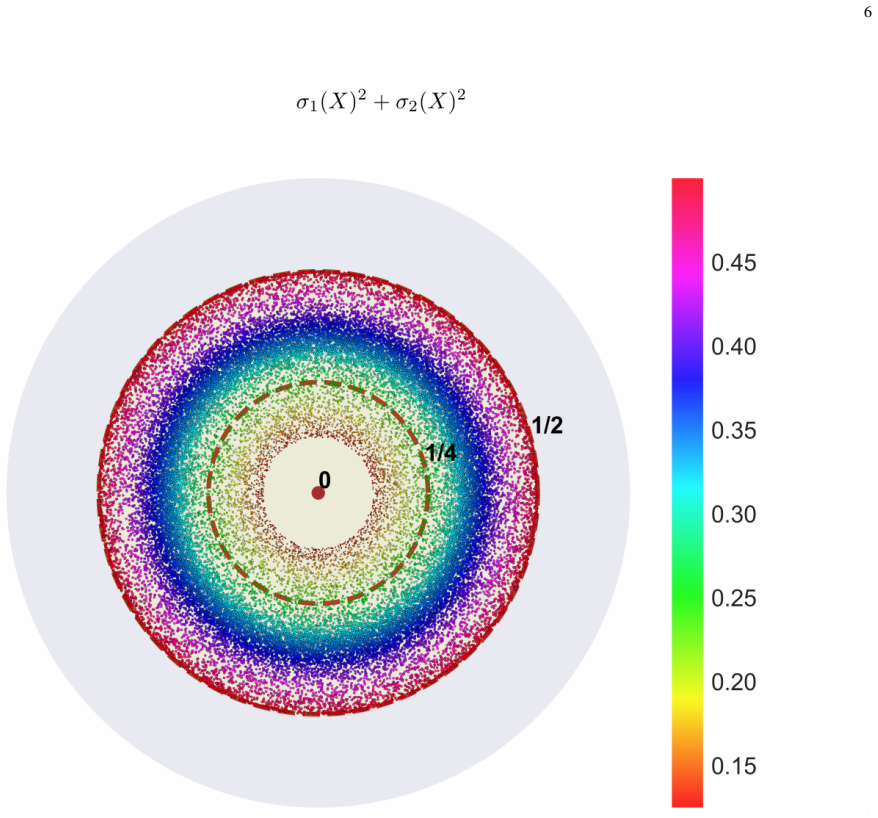
The central object is $X=A\otimes I+I\otimes B$ together with the sum $\sigma_1^2(X)+\sigma_2^2(X)$ of the squares of its two largest singular values. A matrix is normal when it commutes with its adjoint, equivalently when it is unitarily diagonalizable. The argument uses local unitary similarity to make the normal matrix diagonal, which turns $X$ into a direct sum $\oplus_{i=1}^d(a_iI+B)$; the singular values of $X$ are then the singular values of these blocks. A recurring reduction is to the class $\mathcal{P}$ of matrices locally unitarily similar to a direct sum of $1\times 1$ and $2\times 2$ blocks, with the claim that the extremal case can be assumed to lie in $\mathcal{P}$. Two optimization lemmas do the heavy lifting: Lemma 16 shows that in a degree-two homogeneous maximization with extra squared variables under a quadratic constraint, the maximum is either $\eta r$ or occurs when the extra variables vanish; Lemma 17 shows that a scalar-sum constraint forces auxiliary variables to be equal at the optimum. The real case splits according to whether the two largest singular values come from the same block or from two different blocks, and the complex case follows by applying the real result to $\operatorname{Re}(X)$ and $\operatorname{Im}(X)$ separately.
What would settle it
For $d=5$, evaluate the reduced six-variable objective $h(x,y,z,w,p,q)$ from equation (199) over the feasible set (196) restricted to $p=0$ and $z\neq 0$. If the maximum exceeds $11/25$, the claimed bound fails in the excluded configuration; if it does not, the gap is a missing argument rather than a counterexample.
Extended reading notes
Core claim
On its own terms, the paper's central result is Theorem 10: for $d>4$ and traceless $A,B\in \mathbb{C}^{d\times d}$ with $\|A\|_F^2+\|B\|_F^2=1/d$, if at least one of $A$ and $B$ is normal, then $\sigma_1^2(X)+\sigma_2^2(X)\le (3d-4)/d^2$ for $X=A\otimes I+I\otimes B$. The proof begins by using local unitary similarity to assume the normal matrix is diagonal, so $X$ is a direct sum of $d$ blocks $a_iI+B$; it solves the real-matrix case first and then lifts the result to complex matrices by splitting $X$ into real and imaginary parts. As a corollary, the same bound holds in the scale-invariant form $\sigma_1^2(X)+\sigma_2^2(X)\le \frac{3d-4}{d}(\|A\|_F^2+\|B\|_F^2)$, and Theorem 12 shows the constant is optimal by constructing explicit diagonal $A,B$ that attain equality.
Load-bearing premise
The proof of Lemma 26 assumes that when $p=0$ (meaning $b_{12}=-b_{21}$) the matrix $B$ is anti-symmetric and therefore normal, so the known normal-normal theorem applies; but a $2\times 2$ block with nonzero off-diagonal entries and unequal diagonal entries is not normal, and the paper gives no argument excluding a maximizer of that shape.
Editorial extensions
If this is right
- Conjecture 5 is now known whenever at least one of $A,B$ is normal; the remaining open instance is exactly the pair of non-normal matrices.
- Since Conjecture 4 for $d=4$ is a special case of Conjecture 5, the result moves the two-copy undistillability of the one-copy-undistillable $4\times 4$ Werner states closer to resolution.
- The explicit diagonal pair in equations (16)--(18) attains $(3d-4)/d^2$, so the constant cannot be improved in this setting.
- Corollary 11 gives the scale-invariant bound $\sigma_1^2+\sigma_2^2\le \frac{3d-4}{d}(\|A\|_F^2+\|B\|_F^2)$ for all traceless pairs with one normal matrix, independent of the normalization.
Reading between the lines
- A concrete next step would be to test the excluded configuration numerically: search the feasible set with $p=0$ and $z\neq 0$ for local maxima of the objective in Lemma 26. Finding none would suggest the exceptional case is not extremal, while finding one would pinpoint a real gap in the reduction.
- The equality pattern in Lemma 17, where auxiliary variables coalesce at the optimum, hints at a wider extremal principle: for the fully non-normal problem, maximizers might concentrate the spectrum into repeated diagonal blocks, reducing the remaining open case to a finite-dimensional family.
- In the language of the distillability problem, the remaining step is narrow: if the fully non-normal case also satisfies the inequality, the one-copy-undistillable Werner states with non-positive partial transpose in dimension $4$ are two-undistillable, removing a long-standing candidate for NPT bound entanglement.
Signed reviews
Editorial analysis
A structured set of objections, weighed in public.
Referee Report
Summary. The paper claims to prove Theorem 10, namely that Conjecture 5 holds when one of the two matrices A, B in C^{d×d} (d > 4) is normal and the other is arbitrary: for traceless A, B with ||A||_F^2 + ||B||_F^2 = 1/d, the matrix X = A⊗I + I⊗B satisfies σ1^2(X) + σ2^2(X) ≤ (3d-4)/d^2. The proof strategy is to (i) reduce, via local unitary similarity and a real/imaginary splitting, to the case of real diagonal A; (ii) prove the real version (Theorem 18) by splitting into the case where the two largest singular values lie in one block (Lemma 19) and the case where they come from two different blocks (Lemma 21); (iii) reduce general B to block-diagonal form B ∈ P (Lemma 20, with Lemmas 23–27 in Appendix C); and (iv) solve the resulting low-dimensional optimization problem in Lemma 26, using the normal–normal theorem of Pankowski et al. (Theorem 8) as the base case. An explicit example attaining the bound is given in Eqs. (16)–(18).
Significance. If Theorem 10 were correct, the paper would provide real progress on a long-standing open problem: Conjecture 5 generalizes Conjecture 4, which is equivalent to the two-copy undistillability of 4×4 Werner states, and the present result would extend the normal–normal theorem of Pankowski et al. to the much broader setting of one normal and one arbitrary matrix. The reduction architecture is well organized; the algebra up to the reduced optimization problem is mostly explicit and checkable; the attainability example (16)–(18) is correct; and the proof is non-circular, relying on an independent published base theorem rather than on the conjecture itself, with no fitted parameters. These strengths are genuine, but they are contingent: the two load-bearing gaps identified below mean the central theorem is not established by the present argument.
major comments (2)
- [Appendix C, Lemma 26 (case (1), p = 0)] The proof of case (1) with p = 0 asserts that b12 = -b21 makes B anti-symmetric and hence normal, so that Theorem 8 applies. Under the change of variables (189)–(191), the 2×2 block is B1 = [[w+z, q], [-q, w-z]] with q = b12, and anti-symmetry would require w = z = 0, which is not established. A direct computation gives B1B1^T - B1^T B1 = [[0, -4qz], [-4qz, 0]], so B1 is normal if and only if qz = 0; the manuscript gives no argument that a maximizer of the constrained problem (197) with p = 0 must satisfy q = 0 or z = 0. Hence the subcase p = 0, q ≠ 0, z ≠ 0 is covered neither by Theorem 8 nor by any other argument in the paper. Since Lemma 26 is the bridge from the reduced form (169)–(171) to Lemma 20 (via Lemma 27), and since Lemma 21 and Theorem 18 depend on Lemma 20, Theorem 10 is not established by the presented proof.
- [Section III-B, Lemma 21, Eqs. (62)–(64)] The displayed objective h is not the exact value of σ1^2(X) + σ2^2(X) under the stated normalization. After fixing φ = e1 and ψ = cosθ e1 + sinθ e2 and assuming only b1j = 0 for j > 4 and b2j = 0 for j > 5, the expansion of φ^T Y1 φ + ψ^T Y2 ψ contains the additional terms (1+cos^2θ)b14^2, sin^2θ b25^2, and 2 sinθ cosθ b14 b24, none of which appears in (62)–(64). A stronger normalization using the remaining orthogonal freedom in span{e3,...,ed} could force b14 = b25 = 0 and thereby repair the formula, but that is not what the manuscript states. As written, b14 and b25 lie in the set B (Eq. (65)) that the proof declares 'not involved in the objective function h', and the β-rescaling argument that justifies setting those variables to zero depends on exactly that claim, which is false for the true objective. The reduction to the optimization problem (71) and the subsequent application of Lemma 16 therefore do not bound the actual objective.
minor comments (6)
- [Definition 1] 'LOOC' should be 'LOCC', and 'validness' in the abstract should be 'validity'.
- [Appendix C, Lemma 26] In the statement, σ2(X) = σ2(a2I2 + B1) should presumably be σ1(a2I2 + B1) to match the setting of Lemma 20; the proof also writes the second block's Gram matrix as (a2I2 + B1)(a1I2 + B1)^T, where the second factor should be (a2I2 + B1)(a2I2 + B1)^T.
- [Appendix C, Lemma 26] In case (1), the bullet for q = 0 contains a typo: it states p = (b12 - b21)/2 = 0, but it should read q = (b12 - b21)/2 = 0; the conclusion b12 = b21 is correct.
- [Conclusion] The conclusion refers to 'Corollaries 18 and 13'; Corollary 11 and Corollary 13 appear to be meant.
- [Appendix A] In the proof of Lemma 16, the weights are denoted ω_i in the statement but w_i in the proof, and then the ratio ξ_i/ω_i is used; the notation should be made consistent.
- [Throughout] There are numerous typographical slips ('Morevoer', 'matric', 'defied', 'eay to see', 'Conjecture's') that should be corrected in a revision.
Circularity Check
No significant circularity: the main proof reduces to an external normal-normal theorem and independent optimization lemmas.
full rationale
The derivation is self-contained in the relevant sense. Theorem 10 reduces arbitrary normal A plus arbitrary B to the real case by decomposing X into real and imaginary parts and invoking Theorem 18; Theorem 18 is proved from Lemmas 19 and 21; Lemma 19 uses Corollary 9, which is an explicit restatement of the externally published normal-normal theorem of Pankowski et al. [21]; Lemma 21 reduces the two-block case to Lemma 20 via optimization Lemmas 16 and 17, and Lemma 20 (Appendix C) uses the same external theorem after a variable change. No parameter is fitted to data, no 'prediction' is constructed from its own outcome, and no load-bearing conclusion rests solely on a self-citation: the only self-cited equivalence (Theorem 6, from Shen and Chen) is contextual and not used to close the proof. The alleged p=0 anti-symmetric step in Lemma 26 is a possible gap in the proof's coverage, but it is a mathematical soundness issue, not a reduction of the theorem to its inputs, so it does not raise the circularity score.
Assumptions & free parameters
assumptions (6)
- standard math Weyl's singular value inequality (Lemma 14)
- standard math First-order KKT conditions for constrained optimization (Lemma 15)
- domain assumption Theorem 8 of Pankowski et al.: Conjecture 5 holds when both A and B are normal
- domain assumption The reduction of the distillability problem to Conjectures 4 and 5
- ad hoc to paper Relaxation of eigenvector constraints in Lemma 21: the optimized h upper-bounds the true singular-value sum
- domain assumption Local unitary similarity invariance (Theorem 6 of Shen-Chen [38])
Cite this review
Pith. "Pith review of A matrix inequality related to the entanglement distillation problem." pith.science (2026). https://pith.science/paper/GQJCKHWU
@misc{pith2026190802428,
  author       = {Pith},
  title        = {Pith review of: A matrix inequality related to the entanglement distillation problem},
  year         = {2026},
  howpublished = {\url{https://pith.science/paper/GQJCKHWU}},
  note         = {Machine review of arXiv:1908.02428}
}
abstract
The pure entangled state is of vital importance in the field of quantum information. The process of asymptotically extracting pure entangled states from many copies of mixed states via local operations and classical communication is called entanglement distillation. The entanglement distillability problem, which is a long-standing open problem, asks whether such process exists. The 2-copy undistillability of $4\times4$ undistillable Werner states has been reduced to the validness of the a matrix inequality, that is, the sum of the squares of the largest two singular values of matrix $A\otimes I + I \otimes B$ does not exceed $(3d-4)/d^2$ with $A,B$ traceless $d\times d$ matrices and $||A||_F^2+||B||_F^2=1/d$ when $d=4$. The latest progress, made by {\L}.~Pankowski~ et al~[IEEE Trans. Inform. Theory, 56, 4085 (2010)], shows that this conjecture holds when both matrices $A$ and $B$ are normal. In this paper, we prove that the conjecture holds when one of matrices $A$ and $B$ is normal and the other one is arbitrary. Our work makes solid progress towards this conjecture and thus the distillability problem.
Figures
Forward citations
Cited by 1 Pith paper
-
Sharp Plucker Geometry for Three-Copy Werner Distillation
For three-copy Werner states at the critical noise level, every positive-semidefinite or normal rank-two test operator is shown to satisfy q3(C) >= 0, with the remaining nonnormal case reduced to a crossed-Gram criterion.
Reference graph
Works this paper leans on
-
[1]
M. A. Nielsen and I. L. Chuang, Quantum Computation and Quantum Information . Cambridge: Cambridge University Press, 2009. [Online]. Available: http://dx.doi.org/10.1017/cbo9780511976667
-
[2]
Superdense coding of quantum states,
A. Harrow, P. Hayden, and D. Leung, “Superdense coding of quantum states,” Phys. Rev. Lett. , vol. 92, no. 18, May
-
[3]
Experimental quantum teleportation,
D. Bouwmeester, J.-W. Pan, K. Mattle, M. Eibl, H. Weinfurter, and A. Zeilinger, “Experimental quantum teleportation,” Nature, vol. 390, no. 6660, pp. 575–579, Dec. 1997. [Online]. Available: http://dx.doi.org/10.1038/37539
doi:10.1038/37539 1997
-
[4]
On the role of entanglement in quantum-computational speed-up,
R. Jozsa and N. Linden, “On the role of entanglement in quantum-computational speed-up,” Proc. R. Soc. Lond. A , vol. 459, no. 2036, pp. 2011–2032, Aug. 2003. [Online]. Available: http://dx.doi.org/10.1098/rspa.2002.1097
arXiv 2011
-
[5]
Quantum cryptography based on bell’s theorem,
A. K. Ekert, “Quantum cryptography based on bell’s theorem,” Phys. Rev. Lett. , vol. 67, no. 6, pp. 661–663, Aug. 1991. [Online]. Available: http://dx.doi.org/10.1103/physrevlett.67.661
-
[6]
N. Gisin, G. Ribordy, W. Tittel, and H. Zbinden, “Quantum cryptography,” Rev. Mod. Phys., vol. 74, no. 1, pp. 145–195, Mar. 2002. [Online]. Available: http://dx.doi.org/10.1103/revmodphys.74.145
-
[7]
Remote information concentration using a bound entangled state,
M. Murao and V . Vedral, “Remote information concentration using a bound entangled state,” Phys. Rev. Lett. , vol. 86, no. 2, pp. 352–355, Jan. 2001. [Online]. Available: http://dx.doi.org/10.1103/physrevlett.86.352
-
[8]
Teleporting an unknown quantum state via dual classical and Einstein-podolsky-rosen channels,
C. H. Bennett, G. Brassard, C. Cr ´epeau, R. Jozsa, A. Peres, and W. K. Wootters, “Teleporting an unknown quantum state via dual classical and Einstein-podolsky-rosen channels,” Phys. Rev. Lett. , vol. 70, no. 13, pp. 1895–1899, Mar. 1993. [Online]. Available: http://dx.doi.org/10.1103/physrevlett.70.1895
Show all 43 references
-
[9]
Persistent entanglement in arrays of interacting particles,
H. J. Briegel and R. Raussendorf, “Persistent entanglement in arrays of interacting particles,” Phys. Rev. Lett. , vol. 86, no. 5, pp. 910–913, Jan. 2001. [Online]. Available: http://dx.doi.org/10.1103/physrevlett.86.910
2001 doi
-
[10]
Quantum entanglement,
R. Horodecki, P. Horodecki, M. Horodecki, and K. Horodecki, “Quantum entanglement,” Rev. Mod. Phys., vol. 81, no. 2, pp. 865–942, Jun. 2009. [Online]. Available: http://dx.doi.org/10.1103/revmodphys.81.865
2009 doi
-
[11]
Separability of multipartite quantum states with strong positive partial transpose,
L. Qian, “Separability of multipartite quantum states with strong positive partial transpose,” Phys. Rev. A , vol. 98, no. 1, p. 012307, Jul. 2018. [Online]. Available: http://dx.doi.org/10.1103/physreva.98.012307
2018 doi
-
[12]
Decomposition of completely symmetric states,
L. Qian and D. Chu, “Decomposition of completely symmetric states,” Quantum Inf. Process. , vol. 18, no. 7, p. 208, May 2019. [Online]. Available: http://dx.doi.org/10.1007/s11128-019-2318-2
2019 doi
-
[13]
Separability of completely symmetric states in a multipartite system,
L. Chen, D. Chu, L. Qian, and Y . Shen, “Separability of completely symmetric states in a multipartite system,” Phys. Rev. A, vol. 99, no. 3, p. 032312, Mar. 2019. [Online]. Available: http://dx.doi.org/10.1103/physreva.99.032312
2019 doi
-
[14]
Purification of noisy entanglement and faithful teleportation via noisy channels,
C. H. Bennett, G. Brassard, S. Popescu, B. Schumacher, J. A. Smolin, and W. K. Wootters, “Purification of noisy entanglement and faithful teleportation via noisy channels,” Phys. Rev. Lett. , vol. 76, no. 5, pp. 722–725, Jan. 1996. [Online]. Available: http://dx.doi.org/10.1103...
1996 doi
-
[15]
Concentrating partial entanglement by local operations,
C. H. Bennett, H. J. Bernstein, S. Popescu, and B. Schumacher, “Concentrating partial entanglement by local operations,” Phys. Rev. A, vol. 53, no. 4, pp. 2046–2052, Apr. 1996. [Online]. Available: http://dx.doi.org/10.1103/physreva.53.2046
1996 doi
-
[16]
Quantum privacy amplification and the security of quantum cryptography over noisy channels,
D. Deutsch, A. Ekert, R. Jozsa, C. Macchiavello, S. Popescu, and A. Sanpera, “Quantum privacy amplification and the security of quantum cryptography over noisy channels,” Phys. Rev. Lett. , vol. 77, no. 13, pp. 2818–2821, Sep. 1996. [Online]. Available: http://dx.doi.org/10.110...
1996 doi
-
[17]
Hidden quantum nonlocality revealed by local filters,
N. Gisin, “Hidden quantum nonlocality revealed by local filters,” Phys. Lett. A , vol. 210, no. 3, pp. 151–156, Jan. 1996. [Online]. Available: http://dx.doi.org/10.1016/s0375-9601(96)80001-6
1996 doi
-
[18]
Topological quantum distillation,
H. Bombin and M. A. Martin-Delgado, “Topological quantum distillation,” Phys. Rev. Lett. , vol. 97, no. 18, Oct. 2006. [Online]. Available: http://dx.doi.org/10.1103/physrevlett.97.180501 36
2006 doi
-
[19]
Non-asymptotic entanglement distillation,
K. Fang, X. Wang, M. Tomamichel, and R. Duan, “Non-asymptotic entanglement distillation,” IEEE Trans. Inform. Theory, pp. 1–1, 2019. [Online]. Available: http://dx.doi.org/10.1109/tit.2019.2914688
2019
-
[20]
Mixed-state entanglement and distillation: Is there a “Bound
M. Horodecki, P. Horodecki, and R. Horodecki, “Mixed-state entanglement and distillation: Is there a “Bound” entanglement in nature?” Phys. Rev. Lett. , vol. 80, no. 24, pp. 5239–5242, Jun. 1998. [Online]. Available: http://dx.doi.org/10.1103/physrevlett.80.5239
1998 doi
-
[21]
A few steps more towards NPT bound entanglement,
Ł. Pankowski, M. Piani, M. Horodecki, and P. Horodecki, “A few steps more towards NPT bound entanglement,” IEEE Trans. Inform. Theory , vol. 56, no. 8, pp. 4085–4100, Aug. 2010. [Online]. Available: http://dx.doi.org/10.1109/tit.2010. 2050810
2010 doi
-
[22]
Separability of mixed states: Necessary and sufficient conditions,
M. Horodecki, P. Horodecki, and R. Horodecki, “Separability of mixed states: Necessary and sufficient conditions,” Phys. Lett. A, vol. 223, no. 1-2, pp. 1–8, Nov. 1996. [Online]. Available: http://dx.doi.org/10.1016/s0375-9601(96)00706-2
1996 doi
-
[23]
Separability criterion for density matrices,
A. Peres, “Separability criterion for density matrices,” Phys. Rev. Lett. , vol. 77, no. 8, pp. 1413–1415, Aug. 1996. [Online]. Available: http://dx.doi.org/10.1103/physrevlett.77.1413
1996 doi
-
[24]
Evidence for bound entangled states with negative partial transpose,
D. P. DiVincenzo, P. W. Shor, J. A. Smolin, B. M. Terhal, and A. V . Thapliyal, “Evidence for bound entangled states with negative partial transpose,” Phys. Rev. A , vol. 61, no. 6, p. 062312, May 2000. [Online]. Available: http://dx.doi.org/10.1103/physreva.61.062312
-
[25]
Distillability and partial transposition in bipartite systems,
W. D ¨ur, J. I. Cirac, M. Lewenstein, and D. Bruß, “Distillability and partial transposition in bipartite systems,” Phys. Rev. A, vol. 61, no. 6, p. 062313, May 2000. [Online]. Available: http://dx.doi.org/10.1103/physreva.61.062313
-
[26]
Distillability of Werner states using entanglement witnesses and robust semidefinite programs,
R. O. Vianna and A. C. Doherty, “Distillability of Werner states using entanglement witnesses and robust semidefinite programs,” Phys. Rev. A , vol. 74, no. 5, p. 052306, Nov. 2006. [Online]. Available: http: //dx.doi.org/10.1103/physreva.74.052306
2006 doi
-
[27]
Classes of n-copy undistillable quantum states with negative partial transposition,
S. Bandyopadhyay and V . Roychowdhury, “Classes of n-copy undistillable quantum states with negative partial transposition,” Phys. Rev. A, vol. 68, no. 2, p. 022319, Aug. 2003. [Online]. Available: http://dx.doi.org/10.1103/physreva. 68.022319
2003 doi
-
[28]
Rank-three bipartite entangled states are distillable,
L. Chen and Y .-X. Chen, “Rank-three bipartite entangled states are distillable,” Phys. Rev. A , vol. 78, no. 2, p. 022318, Aug. 2008. [Online]. Available: http://dx.doi.org/10.1103/physreva.78.022318
2008 doi
-
[29]
Inseparable two spin-12Density matrices can be distilled to a singlet form,
M. Horodecki, P. Horodecki, and R. Horodecki, “Inseparable two spin-12Density matrices can be distilled to a singlet form,” Phys. Rev. Lett., vol. 78, no. 4, pp. 574–577, Jan. 1997. [Online]. Available: http://dx.doi.org/10.1103/physrevlett.78.574
1997 doi
-
[30]
Bound on distillable entanglement,
E. M. Rains, “Bound on distillable entanglement,” Phys. Rev. A , vol. 60, no. 1, pp. 179–184, Jul. 1999. [Online]. Available: http://dx.doi.org/10.1103/physreva.60.179
1999 doi
-
[31]
Distillability and PPT entanglement of low-rank quantum states,
L. Chen and D. ˇZ. Ðokovi´c, “Distillability and PPT entanglement of low-rank quantum states,” J. Phys. A: Math. Theor. , vol. 44, no. 28, p. 285303, Jun. 2011. [Online]. Available: http://dx.doi.org/10.1088/1751-8113/44/28/285303
2011 doi
-
[32]
Distillability of non-positive-partial-transpose bipartite quantum states of rank four,
——, “Distillability of non-positive-partial-transpose bipartite quantum states of rank four,” Phys. Rev. A , vol. 94, no. 5, p. 052318, Nov. 2016. [Online]. Available: http://dx.doi.org/10.1103/physreva.94.052318
2016 doi
-
[33]
Rank two bipartite bound entangled states do not exist,
P. Horodecki, J. A. Smolin, B. M. Terhal, and A. V . Thapliyal, “Rank two bipartite bound entangled states do not exist,” Theoret. Comput. Sci. , vol. 292, no. 3, pp. 589–596, Jan. 2003. [Online]. Available: http://dx.doi.org/10.1016/s0304-3975(01)00376-0
2003 doi
-
[34]
Reduction criterion of separability and limits for a class of distillation protocols,
M. Horodecki and P. Horodecki, “Reduction criterion of separability and limits for a class of distillation protocols,” Phys. Rev. A, vol. 59, no. 6, pp. 4206–4216, Jun. 1999. [Online]. Available: http://dx.doi.org/10.1103/physreva.59.4206
1999 doi
-
[35]
Qudit entanglement,
P. Rungta, W. Munro, K. Nemoto, P. Deuar, G. J. Milburn, and C. M. Caves, “Qudit entanglement,” inDirections in Quantum Optics. Springer Berlin Heidelberg, 2001, pp. 149–164. [Online]. Available: http://dx.doi.org/10.1007/3-540-40894-0 \ 14
2001 doi
-
[36]
The distillability problem revisited,
L. Clarisse, “The distillability problem revisited,” Quantum Inf. Comput. , vol. 6, no. 6, pp. 539–560, 2006. [Online]. Available: http://portal.acm.org/citation.cfm?id=2011697 37
2006
-
[37]
On two-distillable Werner states,
D. ˇZ. Ðokovi ´c, “On two-distillable Werner states,” Entropy, vol. 18, no. 6, p. 216, Jun. 2016. [Online]. Available: http://dx.doi.org/10.3390/e18060216
2016 doi
-
[38]
On a matrix inequality related to the distillability problem,
Y . Shen and L. Chen, “On a matrix inequality related to the distillability problem,” Entropy, vol. 20, no. 8, p. 588, Aug
-
[39]
R. A. Horn and C. R. Johnson, Topics in matrix analysis . Cambridge University Press, 1991. [Online]. Available: http://dx.doi.org/10.1017/cbo9780511840371
1991 doi
-
[40]
Das asymptotische verteilungsgesetz der eigenwerte linearer partieller differentialgleichungen (mit einer anwendung auf die theorie der hohlraumstrahlung),
H. Weyl, “Das asymptotische verteilungsgesetz der eigenwerte linearer partieller differentialgleichungen (mit einer anwendung auf die theorie der hohlraumstrahlung),” Math. Ann. , vol. 71, no. 4, pp. 441–479, Dec. 1912. [Online]. Available: http://dx.doi.org/10.1007/bf01456804
1912 doi
-
[41]
Minima of functions of several variables with inequalities as side conditions,
W. Karush, “Minima of functions of several variables with inequalities as side conditions,” in Traces and Emergence of Nonlinear Programming . Springer Basel, jul 2013, pp. 217–245. [Online]. Available: https://doi.org/10.1007%2F978-3-0348-0439-4 10 Lilong Qian is currently a ...
2013
-
[2004]
Available: http://dx.doi.org/10.1103/physrevlett.92.187901
[Online]. Available: http://dx.doi.org/10.1103/physrevlett.92.187901
-
[2018]
Available: http://dx.doi.org/10.3390/e20080588
[Online]. Available: http://dx.doi.org/10.3390/e20080588
Reviewed August 14, 2026 · model on record in the stance chip above.
Discussion (0). Continue with ORCID to comment.