REVIEW 3 major objections 5 minor 15 references
On dual-rate consensus under transmission delays
T0 review · 3 major / 5 minor · reviewed 2026-08-07 · deepseek-v4-flash
Pith's one-line read Slower measurement rates can speed consensus — and the paper proves exactly when, by reducing convergence to a graph-spectrum condition.
desk verdict The consensus condition is clean but borrowed; the mode analysis is the real contribution, and the rate-optimization part is honest but less useful than it looks because the dominant-pole proxy can mis-rank candidates. read the letter →
The pith
A machine-rendered reading of the paper's core claim, the machinery that carries it, and where it could break.
The reading
What carries the argument
The carrying object is the eigenvalue decomposition of the normalized Laplacian $L = I - D^{-1}A$ combined with a per-mode characteristic equation $P_i(z)$. Writing the slow-sampled state in Laplacian eigenvectors turns the delayed dual-rate recursion into independent scalar recursions whose decay is controlled by the largest root of $P_i(z)$. The dominant-pole approximation then identifies convergence speed with the largest (or second-largest, for the consensus mode) root modulus across modes. The proof of the rate-selection results reparameterizes the roots as functions of $g = (1-\epsilon)^N$, $b_i = |1-\lambda_i|$, and $c = (1-\epsilon)^{-h}$, which reduces monotonicity and minima of root magnitudes to sign checks on simple quadratic expressions.
What would settle it
On the paper's six-agent graph with $\epsilon = 0.3$ and delay $h = 10$, run the dual-rate protocol from initial conditions that concentrate the consensus error in modes other than $\lambda_1$ and $\lambda_{n-1}$ (for example, align the error vector with the eigenvector of $\lambda_2$ or $\lambda_3$), compute the exact settling time defined in (19) for every integer $N \ge 10$, and compare with $N^* = 16$; if $N^*$ is not faster than rates just below it for such initial conditions, the dominant-pole assumption behind Problem 2 is falsified.
Extended reading notes
Core claim
The paper's central claim is a necessary-and-sufficient consensus condition plus a rate-selection rule. For n single-integrator agents with controller updates every T and neighbor measurements sent every $N T$ with fixed delay $hT$, the closed-loop system reaches consensus if and only if the normalized Laplacian $L = I - D^{-1}A$ has a simple zero eigenvalue; under an undirected connected graph and $\epsilon \in (0,1)$, this holds for all finite $h$ and $N$. In the regime $N \ge h$, the characteristic polynomial of each Laplacian mode is $P_i(z) = z^{\theta+2} - (1-\gamma) z^{\theta+1} - (1-\lambda_i) \gamma (f_0 z + f_1)$, and the largest root modulus $\bar{z}_i(N)$ governs that mode's decay. Modes with $\lambda_i \in (0,1]$ have $\bar{z}_i(N)$ decreasing in $N$, so no communication is fastest; modes with $\lambda_i \in (1,2]$ each have a unique minimizer. The minimax problem over all modes has a finite optimizer if and only if $|1-\lambda_1| \le |1-\lambda_{n-1}|$ (equality only when the two eigenvalues coincide); otherwise the optimizer drives $N$ to infinity and single-rate communication is the better design.
Load-bearing premise
The rate-selection results stand on the assumption that the size of the largest characteristic root—the dominant-pole proxy—faithfully measures how fast the agents actually converge; the paper's own numerical example already shows a rate below the computed optimum converging faster, so if that proxy is not faithful the recommended $N^*$ can miss the true fastest rate.
Editorial extensions
If this is right
- Once the graph is connected, a designer can pick any finite measurement delay and any integer sampling ratio $N$ without breaking consensus, as long as the controller gain lies in $(0,1)$.
- For modes of the normalized Laplacian with eigenvalue at most 1, increasing $N$ makes the dominant root smaller, so sending measurements less often both saves bandwidth and speeds that mode's decay.
- For modes with eigenvalue above 1 and up to 2, each mode has a unique optimal $N = \log(g_1)/\log(1-\epsilon)$, where $g_1$ is the smallest root of equation (13).
- The minimax rate selection has a finite solution exactly when $|1-\lambda_1|$ is no larger than $|1-\lambda_{n-1}|$; in the opposite case, no finite rate is best and the agents should essentially stop communicating or fall back to single-rate.
- Numerical results indicate the computed $N^*$ improves on sending at the delay rate but is an upper bound on the empirically fastest rate, with the gap shrinking as $\epsilon$ approaches 1.
Reading between the lines
- If the observation that $N^*$ is consistently an upper bound on the true optimal rate holds beyond the simulations, then solving (15) gives a safe upper bound that limits the search for the truly fastest rate to $N \in [h, N^*]$.
- The 'never communicate is fastest' result for low modes suggests a bandwidth-saving design rule that is exact for the dominant-pole metric: graphs whose nontrivial Laplacian spectrum lies below 1 should use the longest possible measurement intervals, while graphs with high modes need a finite sweet spot.
- If the paper's conjecture that $\bar{z}_{n-1}$ dominates all high modes is true, the full-spectrum optimization collapses to three modes, so a network would only need estimates of the two extreme nonzero Laplacian eigenvalues.
- For graphs failing the Theorem 3 condition, the simulations point to single-rate always being best; a direct extension would test whether any intermediate rate can ever outperform $N=1$ on such graphs, or whether the theorem's condition exactly separates when dual-rate helps.
Editorial analysis
A structured set of objections, weighed in public.
Referee Report
Summary. The paper studies a dual-rate consensus problem in which single-integrator agents receive neighbor measurements at a slower rate than the controller updates, with a constant transmission delay. The closed-loop dynamics are lifted to a slow sampled system, which is shown (via a reduction to Atay's consensus result) to reach consensus for all delays and all sampling-period ratios whenever the undirected graph is connected and the control gain lies in (0,1). The paper then analyzes the characteristic roots of the lifted system under the dominant-pole approximation, proves monotonicity and minimization results for the largest root modulus as a function of the sampling-period ratio N, and proposes an optimization problem (Problem 2) for selecting N. The main theoretical contributions are Proposition 1 (consensus condition), Theorems 1-2 (behavior of the spectral radius for different eigenvalue ranges), and Theorem 3 (existence of a finite optimizer of the dominant-pole objective). Numerical simulations illustrate the results, but also reveal that the proposed N* is not always the empirically fastest rate.
Significance. If the results are correct, the paper provides a clean necessary and sufficient condition for dual-rate consensus under transmission delays, extending Atay's single-rate analysis to a dual-rate setting, and it gives an analytic, parameter-free procedure for selecting the measurement rate in terms of the graph spectrum. The problem is well motivated, the reduction to Atay's system is a useful structural observation, and the paper is honest about the heuristic nature of the dominant-pole approximation. The main value is therefore in the convergence characterization and in the spectral-root analysis, which are grounded in external benchmarks (Atay, Chung) rather than fitted parameters. However, the practical contribution of the rate-selection part is weakened by the paper's own numerical example showing that N* can be slower than N=h, and by a proof gap in Theorem 3. These issues are fixable but require a substantive revision.
major comments (3)
- [Appendix D, proof of Theorem 3] The 'if' direction of Theorem 3 is not proven. After assuming |1-λ1|<|1-λ_{n-1}|, the proof asserts 'there should be at least a point that is smaller than |1-λ_{n-1}| in the function max_{i∈I>1}(...)' and concludes that a finite minimizer exists. This is a handwave: continuity of the objective and its convergence to |1-λ_{n-1}| do not by themselves imply the existence of a finite N with objective value strictly below that limit, and no such N is constructed. The step can likely be supplied using the monotonicity of \bar z_{n-1} after its minimizer and the convergence of \bar z_1 to |1-λ1|, but as written the central existence criterion is unsupported. Since Theorem 3 is one of the three stated contributions, this gap is load-bearing.
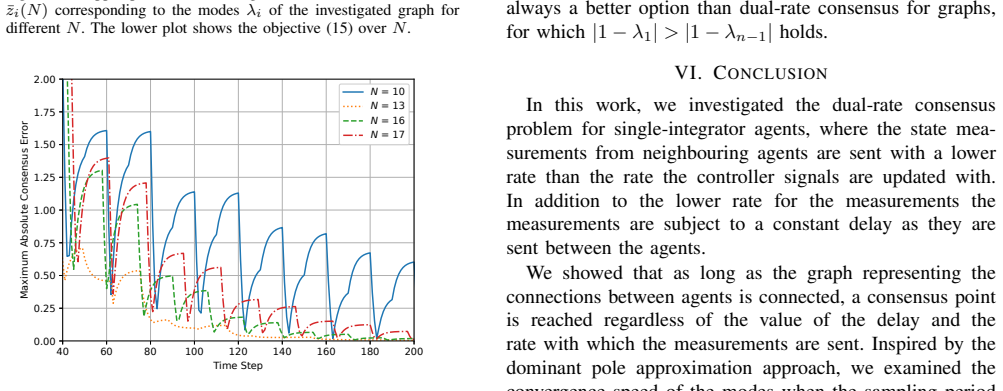
- [Section V, Table I and Figure 3] The numerical results contradict the stated goal of Problem 2, which is to 'determine N such that the convergence to the consensus point is improved.' For ϵ=0.1, Table I gives N*=29 while the empirical optimum over N≥h is N_{h≤N}^{opt}=10=h, so the proposed rate is slower than the baseline N=h. For ϵ=0.3, Figure 3 shows N=13 converges faster than N*=16. The authors acknowledge the gap in one sentence but do not quantify how often N* fails to improve over N=h, nor do they provide conditions on the graph, ϵ, h, or the initial condition under which the dominant-pole proxy is reliable. Because the optimization is a main contribution, the paper should either add a systematic evaluation (e.g., Monte Carlo over initial conditions and graphs) of how often N* actually improves over N=h, or weaken the claim from 'improves convergence' to 'improves the dominant-pole proxy.'
- [Appendix C, proof of Theorem 2] The uniqueness of g_1 and of the local minimizer is asserted rather than proved. From p_1(0)^2-p_2(0)>0 and p_1(g_0)^2-p_2(g_0)<0, continuity gives existence of at least one zero in (0,g_0), not a unique one; the subsequent case analysis treats g_1 and g_2 as the only zeros. Since Theorem 2's 'unique local minimum' is used in Section IV-C and in Theorem 3, the proof should establish that p_1^2-p_2 has exactly one zero in each relevant interval, or argue directly that the derivative of \bar z_i changes sign exactly once.
minor comments (5)
- [Equations (15) and (16)] The notation `max_{i∈I>1} (\bar z_0(N), \bar z_1(N), \bar z_i(N))` is ill-formed because i is the dummy variable; write `max(\bar z_0(N), \bar z_1(N), \max_{i∈I_{>1}} \bar z_i(N))`.
- [Appendix B, proof of Lemma 4] The line `cg=(1-ϵ)^{N-h}<1` should read `≤1`, since N=h is allowed; the subsequent inequality (31) still holds with equality in that case.
- [Proposition 1 proof] The reduction to Atay's Theorem 3.2 is stated in one sentence; please verify explicitly that the two-delay system (6) satisfies the hypotheses of [8, Thm. 3.2] for all h≥0, including h=0 where θ=-1 and f0=0, and justify that convergence of the slow sampled system implies convergence of the original intermediate samples.
- [Section V, paragraph after Figure 3] The sentence 'by solving the optimization problem (15) we obtain a sampling period ratio N* which improves the performance over setting N=h' is not supported for all rows of Table I; please qualify it or restrict it to the case ϵ=0.3.
- [Section IV-C and Theorem 2] Since N is real in the derivations and integer in Assumption 2, please state explicitly in Theorem 2 that the formula N=log(g1)/log(1-ϵ) is the real-valued minimizer and that the integer-valued minimizer is obtained by rounding as described in Section IV-C.
Circularity Check
No significant circularity: the paper's results are forward derivations from stated assumptions and external results, with approximations explicitly acknowledged.
full rationale
The derivation chain is self-contained and non-circular. Proposition 1 reduces the dual-rate closed-loop system (6) to the same delay-difference structure as the external single-rate result of Atay [8], and invokes Theorem 3.2 of that reference as an external, independently published condition; the reduction is mathematically explicit and not a self-citation. Lemma 2 likewise builds on Lemma 3.1 of [8], again an external result. The convergence-mode analysis in Section IV is a direct computation from the characteristic equation (9), with monotonicity statements (Theorem 1, Lemma 4) and the minimizer formula (Theorem 2) proved from the roots of the polynomial rather than fitted to simulation data. The optimization in Problem 2 explicitly minimizes the dominant characteristic-root modulus, and the paper repeatedly labels this a dominant-pole approximation; the observed discrepancy in Figure 3, where N=13 converges faster than the computed N*=16, is acknowledged as an expected consequence of the approximation and is a validation limitation, not a circular reduction. No parameter is fitted to the target output and then renamed a prediction, and no load-bearing premise is justified only by the authors' own prior work. The paper contains no self-citations at all, so the self-citation circularity patterns do not apply. The numerical comparisons in Table I are honest benchmarking of the approximate optimizer against empirically determined rates. Everything claimed as a theorem is derived from the stated assumptions, and everything claimed as approximate is labeled approximate. Under the review rules, this warrants a score of 0.
Assumptions & free parameters
assumptions (6)
- standard math The normalized Laplacian eigenvalues are real and satisfy lambda_i in [0,2] for all i.
- domain assumption Assumption 1: the communication graph is undirected and connected.
- domain assumption Assumption 2: measurements are sent with period T_s = N T with integer N >= 1.
- domain assumption Assumption 3: the transmission delay is constant and equal to h T with integer h >= 0.
- domain assumption Atay's Theorem 3.2 applies to the slow-sampled system (6).
- ad hoc to paper The dominant pole approximation is a valid proxy for convergence speed.
Cite this review
Pith. "Pith review of On dual-rate consensus under transmission delays." pith.science (2026). https://pith.science/paper/GQJJ343W
@misc{pith2026250602840,
  author       = {Pith},
  title        = {Pith review of: On dual-rate consensus under transmission delays},
  year         = {2026},
  howpublished = {\url{https://pith.science/paper/GQJJ343W}},
  note         = {Machine review of arXiv:2506.02840}
}
read the original abstract
In this paper, we investigate the problem of dual-rate consensus under transmission delays, where the control updates happen at a faster rate than the measurements being received. We assume that the measurements are delayed by a fixed delay and show that for all delays and rates, the system reaches a consensus if and only if the communication graph of the agents is connected and the control gain is chosen in a specific interval. Based on these results we dive deeper into the convergence properties and investigate how the convergence changes when we change the rate for sending measurements. We observe that in certain cases there exists a sweet spot for choosing the sampling rate of the measurements, which can improve the convergence to the consensus point. We then formulate an optimization problem to find a sampling rate to improve the convergence speed and provide a necessary and sufficient condition for the existence of a finite optimizer of this problem. Our results are verified with numerical simulations.
Figures


Reference graph
Works this paper leans on
-
[1]
Consensus and cooperation in networked multi-agent systems,
R. Olfati-Saber, J. A. Fax, and R. M. Murray, “Consensus and cooperation in networked multi-agent systems,”Proceedings of the IEEE, vol. 95, no. 1, pp. 215–233, 2007
2007
-
[2]
Comparison of Riemann and Lebesgue sampling for first order stochastic systems,
K. J. ˚Astr¨om and B. M. Bernhardsson, “Comparison of Riemann and Lebesgue sampling for first order stochastic systems,” inProceedings of the 41st IEEE Conference on Decision and Control, 2002., vol. 2. IEEE, 2002, pp. 2011–2016
work page 2002
-
[3]
Consistent event-triggered control for discrete-time linear systems with partial state information,
D. J. Antunes and M. H. Balaghi I., “Consistent event-triggered control for discrete-time linear systems with partial state information,”IEEE Control Systems Letters, vol. 4, no. 1, pp. 181–186, 2020
work page 2020
-
[4]
Event-triggered control for discrete-time systems using a positive systems approach,
F. Mazenc, M. Malisoff, C. Barbalata, and Z.-P. Jiang, “Event-triggered control for discrete-time systems using a positive systems approach,” IEEE Control Systems Letters, vol. 6, pp. 1843–1848, 2021
work page 2021
-
[5]
Event-based broadcasting for multi-agent average consensus,
G. S. Seyboth, D. V . Dimarogonas, and K. H. Johansson, “Event-based broadcasting for multi-agent average consensus,”Automatica, vol. 49, no. 1, pp. 245–252, 2013
2013
-
[6]
Event-triggered communication and control of networked systems for multi-agent consensus,
C. Nowzari, E. Garcia, and J. Cort ´es, “Event-triggered communication and control of networked systems for multi-agent consensus,”Auto- matica, vol. 105, pp. 1–27, 2019
2019
-
[7]
Time- versus event-triggered consensus of a single-integrator multi-agent system,
D. Meister, F. Aurzada, M. A. Lifshits, and F. Allg ¨ower, “Time- versus event-triggered consensus of a single-integrator multi-agent system,” Nonlinear Analysis: Hybrid Systems, vol. 53, p. 101494, 2024
work page 2024
-
[8]
The consensus problem in networks with transmission delays,
F. M. Atay, “The consensus problem in networks with transmission delays,”Philosophical Transactions of the Royal Society A: Mathe- matical, Physical and Engineering Sciences, vol. 371, no. 1999, p. 20120460, 2013
work page 1999
Show all 15 references
-
[9]
Proportional-retarded controller design for single-integrator dynamics against unintentional delays,
H. Fan, A. Ram ´ırez, S. Mondi ´e, and R. Sipahi, “Proportional-retarded controller design for single-integrator dynamics against unintentional delays,”IEEE Control Systems Letters, vol. 7, pp. 514–519, 2023
2023
-
[10]
Faster consensus via a sparser controller,
L. Ballotta and V . Gupta, “Faster consensus via a sparser controller,” IEEE Control Systems Letters, vol. 7, pp. 1459–1464, 2023
2023
-
[11]
A parametrization of stabilizing controllers for multirate sampled-data systems,
D. Meyer, “A parametrization of stabilizing controllers for multirate sampled-data systems,”IEEE Transactions on Automatic Control, vol. 35, no. 2, pp. 233–236, 1990
1990
-
[12]
Consensus control of dual-rate multi-agent systems with quantized communication,
T. Furusaka, T. Sato, N. Kawaguchi, N. Araki, and Y . Konishi, “Consensus control of dual-rate multi-agent systems with quantized communication,”IEEE Access, vol. 8, pp. 97 557–97 563, 2020
2020
-
[13]
Multi-rate design of networked predictive controller and its application for consensus of networked multi-agent systems with delays,
C.-J. Li, X.-R. Yang, and J. Zhao, “Multi-rate design of networked predictive controller and its application for consensus of networked multi-agent systems with delays,” in2019 Chinese Control Conference (CCC), 2019, pp. 5474–5479
2019
-
[14]
Consensus control of dual-rate multi-agent systems,
T. Tanaka, N. Kawaguchi, and T. Sato, “Consensus control of dual-rate multi-agent systems,”Transactions of the Institute of Systems, Control and Information Engineers, vol. 36, no. 11, pp. 375–382, 2023
2023
-
[15]
F. R. Chung,Spectral graph theory. American Mathematical Soc., 1997, vol. 92
1997
Reviewed August 7, 2026 · model on record in the stance chip above.
Discussion (0). Sign in to comment.