REVIEW 3 major objections 5 minor 109 references
Criticality in spreading processes without time-scale separation and the critical brain hypothesis
T0 review · 3 major / 5 minor · reviewed 2026-08-14 · deepseek-v4-flash
Pith's one-line read Spontaneous activation moves spreading transitions from directed to undirected percolation.
desk verdict Solid analytical core and a novel universality-class claim, but the result is conditional on the causal-web merging rule, which is not independently validated and is ambiguously described in the Methods. read the letter →
The pith
A machine-rendered reading of the paper's core claim, the machinery that carries it, and where it could break.
The reading
What carries the argument
The central object is the causal-web avalanche definition: nodes with no active parents start new clusters, and overlapping streams of activity merge their cluster labels, mapping the dynamics onto percolation clusters. The analytic argument uses two coupled probability generating functions, $H_p$ and $H_d$, for cluster sizes reached along daughter and parent branches; their divergence condition yields the critical line $0 = k(1-\sigma)^2 - (k-1)\sigma\sigma_m$, where $\sigma$ is the branching ratio and $\sigma_m$ the merging number. Singly rooted, mergeless avalanches are counted by Fuss-Catalan trees, giving an exponential cutoff $s_m$; combining $s_m \sim (1/k - q)^{-2}$ with the critical-line scaling $(1/k - q)^3 \sim p$ produces the $s_m \sim p^{-2/3}$ crossover that organizes the universal curve collapses.
What would settle it
On a $k$-regular network with $p=10^{-4}$, measure the critical avalanche size distribution at $q=q_c(p)$ out to sizes well above $p^{-2/3}$: if the central claim is right, the tail must follow $s^{-5/2}$ after an $s^{-3/2}$ regime with a sharp crossover near $s_m \sim p^{-2/3}$; observing a single pure directed-percolation power law at all scales would falsify the universality shift.
Extended reading notes
Core claim
In the $\varepsilon$-SIS model with spontaneous activation probability $p$ and spreading probability $q$, adding any $p>0$ destroys the pure directed-percolation transition; the genuine critical line, traced by the divergence of the causal-web susceptibility, belongs to the undirected percolation universality class, with giant-component exponent $\beta=1$, susceptibility exponent $\gamma=1$, and correlation-length exponent $\nu=1$ on $k$-regular networks. Along this line the avalanche size distribution exhibits two power laws: the directed-percolation exponent $\tau=3/2$ for small clusters and the undirected value $\tau=5/2$ above a merging scale $s_m \sim p^{-2/3}$. Only the singular point $p=0$, $q=1/k$ remains in the directed-percolation universality class. The crossover between the two regimes is governed by merging of initially independent cascades, and standard criticality measures such as the branching ratio and the dynamic susceptibility no longer mark the true transition once $p>0$.
Load-bearing premise
The load-bearing premise is that avalanches defined by the causal-web merging rule, where nodes with no active parents start new clusters and overlapping clusters merge, are the physically correct way to separate independent cascades; if that construction mislabels causal structure, the critical line and universality class describe the clustering algorithm rather than the spreading dynamics.
Editorial extensions
If this is right
- For any nonzero spontaneous activation rate, the epidemic or activity threshold is lowered, and a local reproduction number below one can still coexist with a giant component.
- Directed-percolation exponents appear only in avalanches smaller than $s_m \sim p^{-2/3}$; larger avalanches and the giant component follow undirected percolation exponents.
- The branching-ratio line $\sigma=1$ and the dynamic-susceptibility Widom line scale differently near the directed-percolation point, so they cannot locate the true critical point once $p>0$.
- Neuronal avalanche exponents in the range 1.2 to 2.5 can arise from the two-regime distribution near criticality, so fitting a single power-law exponent to data is an unreliable test of sub- or super-critical state.
- A variant with permanent immunity (SIR-like) also shows the two-power-law structure, extending the merging mechanism to diseases with no reinfection.
Reading between the lines
- If the causal-web observable is the right one, whole-brain recordings paired with tractography should show the $p^{-2/3}$ crossover directly: as the spontaneous rate rises, the tail exponent of the avalanche distribution should move from approximately $3/2$ toward $5/2$ at a size controlled by $p^{-2/3}$.
- The merging mechanism is general: any driven branching process with a background initiation rate should exhibit the same shift, so the result likely extends beyond this model to rumor spreading, malware propagation, and neural cultures with external input.
- A direct way to test the claim against alternative observables is to reanalyze the same simulated activity using avalanche definitions based on temporal bins or global quiet periods; if those definitions recover pure directed-percolation exponents at all scales for $p>0$, the universality shift is a property of the causal-web clustering rather than of the underlying dynamics.
Signed reviews
Editorial analysis
A structured set of objections, weighed in public.
Referee Report
Summary. The paper studies a discrete-time epsilon-SIS spreading model with spontaneous activation probability p and network-borne transmission probability q on directed networks. Because p>0 removes time-scale separation and produces overlapping independent cascades, the authors define avalanches through a causal-web merging rule: nodes without active parents are roots of new avalanches, and nodes with active parents inherit and merge cluster labels. Their central claim is that for any p>0 the transition is no longer in the directed-percolation universality class but instead in the undirected-percolation universality class, with directed-percolation exponents surviving only below a merging crossover scale s_m ~ p^{-2/3}. For k-regular networks they derive, via a pair of coupled probability generating functions, the critical line 0 = k(1-σ)^2 - (k-1)σσ_m (Eq. 2), the exponents β=1, γ=1, ν=1, and the crossover scaling. Numerical simulations on small-world, power-law, and hierarchical modular networks show two power-law regimes in the critical avalanche-size distribution and finite-size scaling of the giant component. The paper concludes that standard criticality markers such as the branching ratio and dynamic susceptibility fail in the absence of time-scale separation, and it draws implications for the critical brain hypothesis and for zoonotic disease spreading.
Significance. If the central claim holds, the paper is significant: it identifies a concrete mechanism—merging of independently initiated avalanches—by which a genuinely non-equilibrium directed-percolation transition is converted, for all p>0, into a transition with undirected-percolation exponents, and it makes a falsifiable prediction about two power-law regimes separated by a p-dependent crossover. The analytical generating-function derivation for k-regular networks is a genuine strength: Eq. (2) is derived from the model rather than fitted, and the resulting exponents are checked against simulations on infinite and finite networks. The paper also gives a clear, parameter-light prediction for the critical line and crossover, and the causal-web susceptibility offers a concrete observable for brain-avalanche analysis. The main limitation is that the universality-class claim is established for the particular avalanche-labeling observable defined by the causal-web merging rule, and the evidence for the generality of the undirected-percolation class across non-regular topologies rests on a small number of exponents, several reported without uncertainties.
major comments (3)
- [Section II.A and Appendix A (Simulation of model on finite networks)] The causal-web merging rule is the load-bearing observable of the paper, but its relation to a direct physical separation of avalanches is not validated. The finite-network simulation paragraph specifies that spontaneous nodes with no active parents initiate a new cluster, while the general description in Section II.A states that nodes with active parents inherit labels; however, the label assignment for the case of a spontaneously activated node that also has active parents is not explicitly stated in the Methods paragraph. Since the q=0 endpoint, the critical line Eq. (2), and the p^{-2/3} crossover all depend on this labeling choice, the authors should either state the rule unambiguously and test its sensitivity (for example, by comparing with an alternative rule in which such nodes seed new clusters) or compare the resulting clusters directly with the causal-webs algorithm of reference [30]. The Discussion's admission that 'there is currently no way to recover the correct exponents without access to the network structure' makes the observable-dependence of the claim explicit but does not by itself justify it.
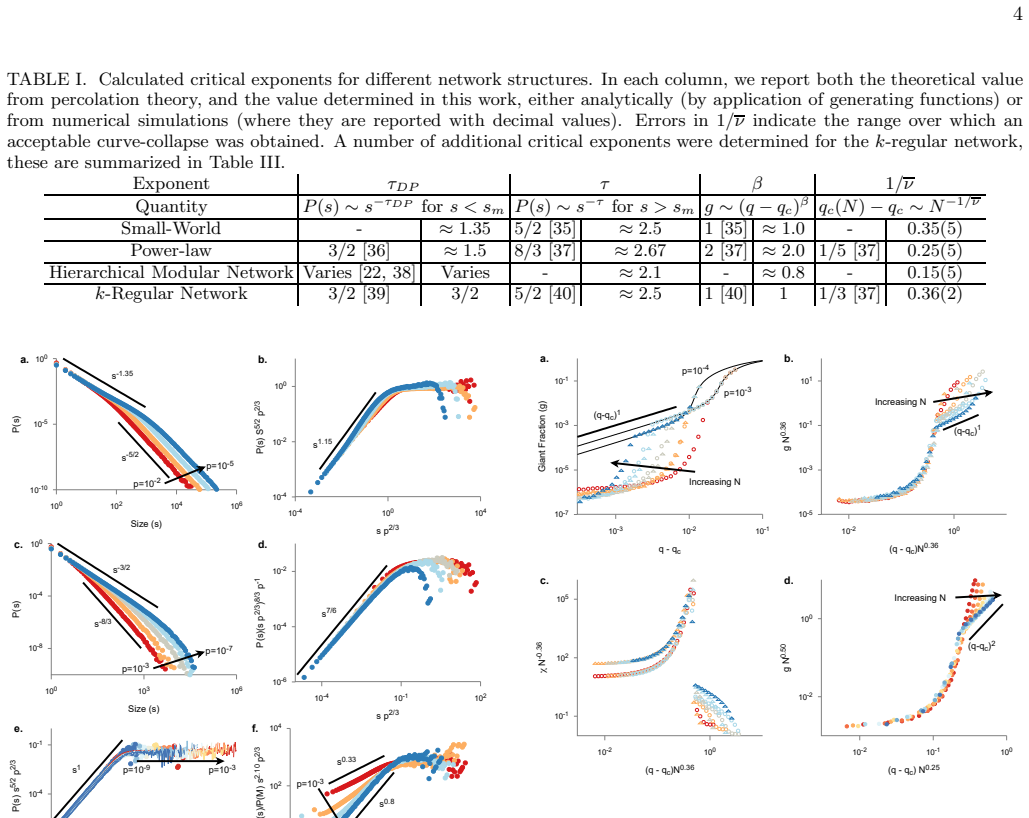
- [Table I and Section II.B] The claim that the entire p>0 critical line belongs to the undirected-percolation universality class for each network topology rests on very few fitted exponents. For the small-world and hierarchical modular networks, Table I reports τ≈2.5 and τ≈2.1, β≈1.0 and β≈0.8, with no uncertainties or goodness-of-fit measures; only the k-regular network has a full analytical exponent set. A two-power-law fit of P(s) and a single β estimate are not sufficient to distinguish undirected percolation from an effective exponent, especially on networks where the directed-percolation and undirected-percolation exponents are close (e.g., small-world τ values). The authors should report exponent estimates with uncertainties and provide at least one additional independent exponent (such as γ or the finite-size exponent 1/ν) for at least one non-regular topology before claiming a full universality class.
- [Section II.C, Eq. (3), Fig. 3, and Table II] The universal p^{-2/3} merging crossover is derived from the mean-field phase-line exponent a=3, but the numerically fitted phase lines in Table II are not all consistent with a=3. In particular, the hierarchical modular network has a≈1.94, and the same argument that gives s_m ~ p^{-2/3} from δ ~ p^{1/3} would give s_m ~ p^{-2/a} ≈ p^{-1} for this network, while the small-world network with rewire probability 10^{-3} is reported in Appendix F to collapse with s_m ~ p^{-0.75}. The statement in Section II.B that 'all critical-avalanche distributions exhibit a universal curve collapse ... by re-scaling the distribution by p^{-2/3}' is therefore internally inconsistent with the fitted phase lines for these topologies. The authors should either justify the p^{-2/3} collapse independently of Eq. (3), or restrict the p^{-2/3} statement to mean-field networks and state the expected topology-dependent exponents explicitly.
minor comments (5)
- [Appendix B, Eq. (B11)] The sentence introducing complementary probabilities says 'using the notation p = 1− p', which is a typographical error; it should introduce a distinct symbol such as \bar p for the complementary probability, since p is already the spontaneous activation rate.
- [References] Reference [64] duplicates reference [30] (Williams-Garcia, Beggs, and Ortiz, 'Unveiling causal activity of complex networks'); one of the two entries should be removed or replaced with the appropriate distinct citation.
- [Table I and Table III] Several numerical exponents in Tables I and III are reported without error bars (for example, τ≈1.35 and β≈1.0 for the small-world network, α≈7 for durations), while the paper elsewhere reports uncertainties such as 0.36(2); a consistent policy of reporting uncertainties for all fitted exponents would strengthen the quantitative claims.
- [Figure 4d and Appendix A] The caption of Fig. 4d says 'Solid line is g ∼ (q−qc)β for β=2', but the text in Section II.B reports β=2 for the power-law network while the finite-size scaling in panel d uses N^{0.50} and (q−q_c)N^{0.25}; clarifying whether the solid line is the infinite-size limit or a finite-size collapsed curve would avoid confusion.
- [Section II.C, paragraph after Eq. (2)] The phrase 'the σ=1 line scales as p∼(1/k−q)^2' and the later statement that the Widom line scales as p∼(1/k−q) are derived only in the appendices; adding a one-sentence pointer to Appendix E at the first occurrence would help the reader.
Circularity Check
No significant circularity: the universality-class claim is derived from the model and an external causal-web observable, not from fitted inputs or self-citation.
full rationale
The paper's central claim is derived from the dynamics in Eq. (1) together with the causal-web cluster rule imported from Williams-Garcia, Beggs and Ortiz (ref. [30]), none of whom are authors of the present paper. The generating-function calculation in Appendix B is a self-contained tree-level computation: it defines H0, Hp and Hd, derives the critical-line condition from the vanishing determinant in Eq. (B10), and obtains the exponents gamma=1, beta=1 and nu_perp=1 analytically. These results are not fitted to the quantities they are used to predict. The undirected-percolation endpoint q=0, p=1/(2k-1) is a known limiting case used as a consistency check, not an input that forces the entire critical line; the intermediate critical line, the p^{-2/3} crossover, and the two-power-law avalanche distribution follow from Eqs. (B27), (3), (C2)-(C4) and are verified by finite-size scaling and curve collapse. The merging rule is definitional, but it does not by itself determine the exponents; the PGF analysis is needed to obtain the critical condition and the distribution shapes. Whether causal webs are the physically appropriate avalanche definition is a modeling and validation question, not a circularity. No load-bearing self-citation is present, and the analytical derivation stands independently of the paper's own conclusions.
Assumptions & free parameters
free parameters (2)
- Merging size scaling exponent b (small-world, rewire 10^-3) =
0.75
- Critical line exponent a (hierarchical modular network) =
1.94
assumptions (2)
- domain assumption Tree-like approximation (no loops and node equivalence) for the analytical generating function derivation.
- domain assumption Causal-web cluster merging is the correct observable for identifying independent avalanches without time-scale separation.
Cite this review
Pith. "Pith review of Criticality in spreading processes without time-scale separation and the critical brain hypothesis." pith.science (2026). https://pith.science/paper/GQK3A2U3
@misc{pith2026190808163,
  author       = {Pith},
  title        = {Pith review of: Criticality in spreading processes without time-scale separation and the critical brain hypothesis},
  year         = {2026},
  howpublished = {\url{https://pith.science/paper/GQK3A2U3}},
  note         = {Machine review of arXiv:1908.08163}
}
read the original abstract
Spreading processes on networks are ubiquitous in both human-made and natural systems. Understanding their behavior is of broad interest; from the control of epidemics to understanding brain dynamics. While in some cases there exists a clear separation of time scales between the propagation of a single spreading cascade and the initiation of the next -- such that spreading can be modelled as directed percolation or a branching process -- there are also processes for which this is not the case, such as zoonotic diseases or spiking cascades in neural networks. For a large class of relevant network topologies, we show here that in such a scenario the nature of the overall spreading fundamentally changes. This change manifests itself in a transition between different universality classes of critical spreading, which determines the onset and the properties of an avalanche turning epidemic or neural activity turning epileptic, for example. We present analytical results in the mean-field limit giving the critical line along which scale-free spreading behaviour can be observed. The two limits of this critical line correspond to the universality classes of directed and undirected percolation, respectively. Outside these two limits, this duality manifests itself in the appearance of critical exponents from the universality classes of both directed and undirected percolation. We find that the transition between these exponents is governed by a competition between merging and propagation of activity, and identify an appropriate scaling relationship for the transition point. Finally, we show that commonly used measures, such as the branching ratio and dynamic susceptibility, fail to establish criticality in the absence of time-scale separation calling for a reanalysis of criticality in the brain.
Figures


Figures from the paper (11 more)


Reference graph
Works this paper leans on
-
[30]
A. Ponce-Alvarez, A. Jouary, M. Privat, G. Deco, and G. Sumbre, Whole-Brain Neuronal Activity Displays Crackling Noise Dynamics., Neuron 100, 1446 (2018)
work page 2018
-
[1]
To proceed further, we must sup- ply Ai/o and Bi/o for a given network
Neighbour generating functions for k-regular networks So far, we’ve been quite generic in developing the gen- erating function H0. To proceed further, we must sup- ply Ai/o and Bi/o for a given network. For simplicity, we focus on the k-regular network. This will allow us to develop expressions for Φ, the active fraction, and Pd, the probability that the ...
-
[2]
Practically speaking, we solve Eqs
Observables from the generating function Here, we summarize how to extract observables, such as the size fraction of the giant component g, suscep- tibility χ , and cluster distribution Pc(s) from the gen- erating function H0(x). Practically speaking, we solve Eqs. (B3) and ( B4) self-consistently for Hd(x) and Hp(x) via a Newton-Raphson scheme for a give...
-
[3]
( B10), and inserting the solution into Eq
Phase-diagram for the k-regular network We can study the divergence of χ ∼⟨ s⟩n by solving Eq. ( B10), and inserting the solution into Eq. ( B9) to obtain ⟨s⟩n = 1− σ k (σ− σm) (1− σ )2− k−1 k σσ m (B27) where σm = A′ i(1) = ( k − 1)Pp1 = ( k −
-
[4]
That is, σm describes the rate of merging of ini- tially independent clusters
Φ Pd ( 1− (1−Pd)2 1−Φ ) is the expected number of other ac- tive parents, to an active node with one already known parent. That is, σm describes the rate of merging of ini- tially independent clusters. Clearly, ⟨s⟩n diverges when k(1− σ )2− (k− 1)σσ m = 0 (Eq. (
-
[5]
This result could also have been arrived at by setting the determinant of Eq
of the main text). This result could also have been arrived at by setting the determinant of Eq. ( B10) to zero. A reparameterization that will be convenient when considering the correlation length is to replace σm with β = (k−1)σ m kσ , meaning that the critical line diverges when (1− σ )2 = σ 2β . (B28) The set of ( pc, q c) that cause this divergence d...
-
[6]
At the critical point, Hp(1) = Hd(1) = 1
The giant component The giant component fraction g is given by g = Φ(1 − H0(1)) = Φ ( 1− Hd(1) [ Pd + PdHp(1) ]) . At the critical point, Hp(1) = Hd(1) = 1. So for δ = q−qc≪ 1, we have that g ≈ ( Φ Pd ∂H p ∂q + Φ ∂H d ∂q ) δ. Since both Hd(1) and Hp(1) are strictly decreasing functions of q, g∼ (q− qc) identifying the critical exponent β = 1. Appendix C: ...
-
[7]
The excluded nodes on the perimeter occur with probability Pd, which is the probability of not activating, despite having an ac- tive parent
Nodes are included in the tree with probability Pd1 = Φ k−1 (1− p q) , (C1) denoting the probability that a given daughter node is activated while having exactly one parent. The excluded nodes on the perimeter occur with probability Pd, which is the probability of not activating, despite having an ac- tive parent. Hence, the probability of observing a mer...
Show all 109 references
-
[8]
line, and line of diverging cluster size all agree as p→ 0, they obey different power laws in their approach to that point (Fig. 11). In this section, we will derive the different scalings associated with these critical and quasi- critical lines. The scaling for the σ = 1 line i...
-
[9]
115333 ± 0. 000010. b The numerically derived critical line is represented with symbols, the black line is the non-linea r least-squares fit to the data. c The average number of roots, exhibits a transition that scales with sm ∼ p−0. 75. d This same sm effects a curve-collapse i...
-
[10]
09×0. 75 = 0 . 43 for the small-world net- work with a re-wire probability 10 −3. When the short- cut density is low, the small-world network is approxi- mately a 1-dimensional circulant graph, which suggests we should use the 1 + 1-dimensional directed percolation exponents. ...
-
[11]
We consider 2d, because when a daughter branch is followed, t ad- vances by one, while a parent branch decreases t by one
Divergence of perpendicular correlation length We can derive the divergence of the perpendicular cor- relation length ξ⊥ by computing g(2d, 0). We consider 2d, because when a daughter branch is followed, t ad- vances by one, while a parent branch decreases t by one. However, ∆...
-
[12]
This can be measured with g(t, t ) = σ t = exp[−t/ξ d] where ξd =−1/ ln(σ ) de- notes the descendant correlation length
Alternative correlation lengths An alternative parallel correlation length ξ‖ for ran- dom graphs is the length characterizing the decay of di- rect descendants of an active site. This can be measured with g(t, t ) = σ t = exp[−t/ξ d] where ξd =−1/ ln(σ ) de- notes the descend...
-
[13]
17 consists of the exponent transitions for 10-regular graphs without the exponent transitions presented in Fig
Similarly, Fig. 17 consists of the exponent transitions for 10-regular graphs without the exponent transitions presented in Fig. 5
-
[14]
M. E. Newman, Spread of epidemic disease on networks, Physical Review E 66, 016128 (2002)
2002
-
[15]
Kenah and J
E. Kenah and J. M. Robins, Second look at the spread of epidemics on networks, Physical Review E 76, 036113 (2007)
2007
-
[16]
Pastor-Satorras, C
R. Pastor-Satorras, C. Castellano, P. Van Mieghem, and A. Vespignani, Epidemic processes in complex networks, Reviews of Modern Physics 87, 925 (2015)
2015
-
[17]
J. C. Wierman and D. J. Marchette, Modeling computer virus prevalence with a susceptible-infected-susceptibl e model with reintroduction, Computational Statistics & Data Analysis 45, 3 (2004)
2004
-
[18]
Nekovee, Y
M. Nekovee, Y. Moreno, G. Bianconi, and M. Marsili, Theory of rumour spreading in complex social networks, Physica A: Statistical Mechanics and its Applications 374, 457 (2007)
2007
-
[19]
Crucitti, V
P. Crucitti, V. Latora, and M. Marchiori, A topological analysis of the italian electric power grid, Physica A: Sta- tistical mechanics and its applications 338, 92 (2004)
2004
-
[20]
X. Wang, Y. Ko¸ c, R. E. Kooij, and P. Van Mieghem, A network approach for power grid robustness against cascading failures, in 2015 7th international workshop on reliable networks design and modeling (RNDM) (IEEE,
2015
-
[21]
D. R. Chialvo, Emergent complex neural dynamics, Na- ture Physics 6, 744 (2010)
2010
-
[22]
Friedman, S
N. Friedman, S. Ito, B. A. Brinkman, M. Shimono, R. L. DeVille, K. A. Dahmen, J. M. Beggs, and T. C. But- ler, Universal critical dynamics in high resolution neu- ronal avalanche data, Physical review letters 108, 208102 (2012)
2012
-
[23]
J. G. Orlandi, J. Soriano, E. Alvarez-Lacalle, S. Teller, and J. Casademunt, Noise focusing and the emergence of coherent activity in neuronal cultures, Nature Physics 9, 582 (2013)
2013
-
[24]
Tagliazucchi, P
E. Tagliazucchi, P. Balenzuela, D. Fraiman, and D. R. Chialvo, Criticality in large-scale brain fmri dynamics unveiled by a novel point process analysis, Frontiers in physiology 3, 15 (2012)
2012
-
[25]
di Santo, P
S. di Santo, P. Villegas, R. Burioni, and M. A. Mu˜ noz, Landauginzburg theory of cortex dynamics: Scale-free avalanches emerge at the edge of synchronization, Pro- ceedings of the National Academy of Sciences of the United States of America 115, E1356 (2018)
2018
-
[26]
Kinouchi and M
O. Kinouchi and M. Copelli, Optimal dynamical range of excitable networks at criticality, Nature Physics 2, 348 (2006)
2006
-
[27]
Yaghoubi, T
M. Yaghoubi, T. de Graaf, J. G. Orlandi, F. Girotto, M. A. Colicos, and J. Davidsen, Neuronal avalanche dy- namics indicates different universality classes in neurona l cultures, Scientific Reports 8, 3417 (2018)
2018
-
[28]
Dahmen, S
D. Dahmen, S. Gr¨ un, M. Diesmann, and M. Helias, Sec- ond type of criticality in the brain uncovers rich multiple- neuron dynamics, Proceedings of the National Academy of Sciences of the United States of America 116, 13051 (2019)
2019
-
[29]
J. M. Beggs and D. Plenz, Neu- ronal avalanches in neocortical circuits., The Journal of neuroscience : the official journal of the Socie ty for Neuroscience 23, 11167 (2003) . 22 10-8 10 10-6 10-5 10-4 10-3 10-2 10-1 100 100 101 102 103 104 s-3/2 s-5/2 P(s) S q=0 q = 0.09 p ! F...
2003
-
[31]
Del Papa, V
B. Del Papa, V. Priesemann, and J. Triesch, Criti- cality meets learning: Criticality signatures in a self- organizing recurrent neural network, PLOS ONE 12, e0178683 (2017)
2017
-
[32]
J. M. Beggs and N. Timme, Being Critical of Criticality in the Brain, Frontiers in Physiology 3, 163 (2012)
2012
-
[33]
Cocchi, L
L. Cocchi, L. L. Gollo, A. Zalesky, and M. Breakspear, Criticality in the brain: A synthesis of neurobiology, models and cognition, Progress in Neurobiology 158, 132 (2017)
2017
-
[34]
J. M. Beggs and D. Plenz, Neuronal Avalanches Are Diverse and Precise Activity Patterns That Are Stable for Many Hours in Cortical Slice Cultures, The Journal of Neuroscience 24, 5216 (2004)
2004
-
[35]
Moretti and M
P. Moretti and M. A. Mu˜ noz, Griffiths phases and the stretching of criticality in brain networks, Nature Com- munications 4, 2521 (2013)
2013
-
[36]
A. J. Fontenele, N. A. P. de Vasconcelos, T. Feli- ciano, L. A. A. Aguiar, C. Soares-Cunha, B. Coimbra, L. Dalla Porta, S. Ribeiro, A. J. a. Rodrigues, N. Sousa, P. V. Carelli, and M. Copelli, Criticality between cortical states, Phys. Rev. Lett. 122, 208101 (2019)
2019
-
[37]
Dalla Porta and M
L. Dalla Porta and M. Copelli, Modeling neuronal avalanches and long-range temporal correlations at the emergence of collective oscillations: Continuously vary- ing exponents mimic m/eeg results, PLoS computational biology 15, e1006924 (2019)
2019
-
[38]
S.-S. Poil, R. Hardstone, H. D. Mansvelder, and K. Linkenkaer-Hansen, Critical-state dynamics of avalanches and oscillations jointly emerge from balanced excitation/inhibition in neuronal networks, Journal of Neuroscience 32, 9817 (2012)
2012
-
[39]
Di Santo, P
S. Di Santo, P. Villegas, R. Burioni, and M. A. Mu˜ noz, Landau–ginzburg theory of cortex dynamics: Scale-free avalanches emerge at the edge of synchronization, Pro- ceedings of the National Academy of Sciences 115, E1356 (2018)
2018
-
[40]
Pinheiro Neto, F
J. Pinheiro Neto, F. P. Spitzner, and V. Priesemann, A unified picture of neuronal avalanches arises from the un- derstanding of sampling effects, arXiv , arXiv (2019)
2019
-
[41]
Das and A
A. Das and A. Levina, Critical neuronal models with re- laxed timescale separation, Physical Review X 9, 021062 (2019)
2019
-
[42]
Ponce-Alvarez, A
A. Ponce-Alvarez, A. Jouary, M. Privat, G. Deco, and G. Sumbre, Whole-Brain Neuronal Activity Displays Crackling Noise Dynamics, Neuron 100, 1446 (2018)
2018
-
[43]
R. V. Williams-Garcia, J. M. Beggs, and G. Ortiz, Un- veiling causal activity of complex networks, EPL (Euro- physics Letters) 119, 18003 (2017)
2017
-
[44]
Van Mieghem and E
P. Van Mieghem and E. Cator, Epidemics in networks with nodal self-infection and the epidemic threshold, Physical Review E 86, 016116 (2012)
2012
-
[45]
Hinrichsen, Non-equilibrium critical phe- nomena and phase transitions into absorb- ing states, Advances in Physics 49, 815 (2000) , https://doi.org/10.1080/00018730050198152
H. Hinrichsen, Non-equilibrium critical phe- nomena and phase transitions into absorb- ing states, Advances in Physics 49, 815 (2000) , https://doi.org/10.1080/00018730050198152
2000 doi
-
[46]
Yanuka, The mixed bond-site percolation problem and its application to capillary phenomena in porous me- dia, Journal of Colloid and Interface Science 134, 198 (1990)
M. Yanuka, The mixed bond-site percolation problem and its application to capillary phenomena in porous me- dia, Journal of Colloid and Interface Science 134, 198 (1990)
1990
-
[47]
H. F. Song and X.-J. Wang, Simple, distance-dependent formulation of the watts-strogatz model for directed and undirected small-world networks, Physical Review E 90, 062801 (2014)
2014
-
[48]
Moore and M
C. Moore and M. E. Newman, Exact solution of site and bond percolation on small-world networks, Physical Re- view E 62, 7059 (2000)
2000
-
[49]
Schwartz, R
N. Schwartz, R. Cohen, D. Ben-Avraham, A.-L. Barab´ asi, and S. Havlin, Percolation in directed scale- free networks, Physical Review E 66, 015104 (2002)
2002
-
[50]
Cohen, D
R. Cohen, D. Ben-Avraham, and S. Havlin, Percolation critical exponents in scale-free networks, Physical Revie w E 66, 036113 (2002)
2002
-
[51]
M. A. Mu˜ noz, R. Juh´ asz, C. Castellano, and G. ´Odor, Griffiths phases on complex networks, Physical Review Letters 105, 128701 (2010)
2010
-
[52]
M. A. Munoz, R. Dickman, A. Vespignani, and S. Zap- peri, Avalanche and spreading exponents in systems with absorbing states, Physical Review E 59, 6175 (1999)
1999
-
[53]
Christensen and N
K. Christensen and N. R. Moloney, Complexity and Crit- icality, Vol. 1 (World Scientific Publishing Company, 2005)
2005
-
[54]
W. Cota, G. ´Odor, and S. C. Ferreira, Griffiths phases in infinite-dimensional, non-hierarchical modular networks , Scientific Reports 8, 9144 (2018)
2018
-
[55]
D. S. Callaway, M. E. Newman, S. H. Strogatz, and D. J. Watts, Network robustness and fragility: Percolation on random graphs, Physical Review Letters 85, 5468 (2000)
2000
-
[56]
Melnik, A
S. Melnik, A. Hackett, M. A. Porter, P. J. Mucha, and J. P. Gleeson, The unreasonable effectiveness of tree- based theory for networks with clustering, Physical Re- view E 83, 036112 (2011)
2011
-
[57]
R. V. Williams-Garc ´ ıa, M. Moore, J. M. Beggs, and G. Ortiz, Quasicritical brain dynamics on a nonequilib- rium widom line, Physical Review E 90, 062714 (2014)
2014
-
[58]
P. Bak, C. Tang, and K. Wiesenfeld, Self-organized crit- icality, Physical review A 38, 364 (1988). 23 10-12 10-10 10-8 10-6 10-4 10-2 100 100 101 102 103 104 105 a. s-3/2 s-5/2 " # $ % -2 & ' ( ) -7 P(s) *+ , . / 0 10-10 10-8 10-6 10-4 10-2 100 100 101 102 103 104 105 b. S1.3...
1988
-
[59]
Massobrio, V
P. Massobrio, V. Pasquale, and S. Martinoia, Self- organized criticality in cortical assemblies occurs in concurrent scale-free and small-world networks, Scientific Reports 5, 10578 (2015)
2015
-
[60]
Tetzlaff, S
C. Tetzlaff, S. Okujeni, U. Egert, F. Wrgt- ter, and M. Butz, Self-Organized Criti- cality in Developing Neuronal Networks, PLoS Computational Biology 6, e1001013 (2010)
2010
-
[61]
Lombardi, H
F. Lombardi, H. Herrmann, C. Perrone-Capano, D. Plenz, and L. d. Arcangelis, Balance between Excita- tion and Inhibition Controls the Temporal Organization of Neuronal Avalanches, Physical Review Letters 108, 10.1103/physrevlett.108.228703 (2012)
2012 doi
-
[62]
Millman, S
D. Millman, S. Mihalas, A. Kirkwood, and E. Niebur, Self-organized criticality occurs in non- conservative neuronal networks during Up states., Nature physics 6, 801 (2010)
2010
-
[63]
Scarpetta, I
S. Scarpetta, I. Apicella, L. Minati, and A. d. Can- dia, Hysteresis, neural avalanches, and critical behavior near a first-order transition of a spiking neural network, Physical Review E 97, 062305 (2018)
2018
-
[64]
Levina, J
A. Levina, J. M. Herrmann, and T. Geisel, Dynamical synapses causing self-organized criticality in neural net - works, Nature Physics 3, nphys758 (2007) , 0712.1003
2007 arXiv
-
[65]
B. D. Papa, V. Priesemann, and J. Triesch, Criticality meets learning: Criticality signatures in a self-organizing recurrent neural network, PLOS ONE 12, e0178683 (2017)
2017
-
[66]
Priesemann, M
V. Priesemann, M. Valderrama, M. Wibral, and M. L. V. Quyen, Neuronal Avalanches Dif- fer from Wakefulness to Deep Sleep Evidence from Intracranial Depth Recordings in Humans, PLoS Computational Biology 9, e1002985 (2013)
2013
-
[67]
Priesemann, M
V. Priesemann, M. Wibral, M. Valderrama, R. Pr¨ opper, M. Le Van Quyen, T. Geisel, J. Triesch, D. Nikoli´ c, and M. H. Munk, Spike avalanches in vivo suggest a driven, slightly subcritical brain state, Frontiers in systems neu - roscience 8, 108 (2014)
2014
-
[68]
Levina and V
A. Levina and V. Priesemann, Subsampling scal- ing, Nature Communications 8, ncomms15140 (2017) , 1701.04277
2017 arXiv
-
[69]
Nonnenmacher, C
M. Nonnenmacher, C. Behrens, P. Berens, M. Bethge, and J. H. Macke, Signatures of criticality arise from random subsampling in simple population mod- els, PLOS Computational Biology 13, e1005718 (2017) , 1603.00097
2017 arXiv
-
[70]
Scott, E
G. Scott, E. D. Fagerholm, H. Mutoh, R. Leech, D. J. Sharp, W. L. Shew, and T. Knpfel, Voltage Imaging of Waking Mouse Cortex Re- veals Emergence of Critical Neuronal Dynamics, The Journal of Neuroscience 34, 16611 (2014)
2014
-
[71]
Touboul and A
J. Touboul and A. Destexhe, Power-law statistics and universal scaling in the absence of criticality, 24 Physical Review E 95, 012413 (2017)
2017
-
[72]
Priesemann and O
V. Priesemann and O. Shriki, Can a time varying ex- ternal drive give rise to apparent criticality in neural systems?, PLOS Computational Biology 14, e1006081 (2018)
2018
-
[73]
Villegas, S
P. Villegas, S. di Santo, R. Burioni, and M. A. Mu˜ noz, Time-series thresholding and the definition of avalanche size, Physical Review E 100, 012133 (2019)
2019
-
[74]
Girardi-Schappo and M
M. Girardi-Schappo and M. H. R. Tragtenberg, Measur- ing neuronal avalanches in disordered systems with ab- sorbing states, Physical Review E 97, 042415 (2018)
2018
-
[75]
T. Bolt, M. L. Anderson, and L. Q. Uddin, Be- yond the evoked/intrinsic neural process dichotomy, Network Neuroscience 2, 1 (2018)
2018
-
[76]
R. V. Williams-Garca, J. M. Beggs, and G. Or- tiz, Unveiling causal activity of complex net- works, EPL (Europhysics Letters) 119, 18003 (2017) , 1603.05659
2017 arXiv
-
[77]
Zierenberg, J
J. Zierenberg, J. Wilting, V. Priesemann, and A. Levina, Tailored ensembles of neural net- works optimize sensitivity to stimulus statistics, Physical Review Research 2, 013115 (2020)
2020
-
[78]
Hu, J.-G
Z.-L. Hu, J.-G. Liu, G.-Y. Yang, and Z.-M. Ren, Effects of the distance among multiple spreaders on the spreading, EPL (Europhysics Letters) 106, 18002 (2014)
2014
-
[79]
J. C. Miller, Epidemics on networks with large initial conditions or changing structure, PLOS ONE 9, e101421 (2014)
2014
-
[80]
Zheng, C
M. Zheng, C. Wang, J. Zhou, M. Zhao, S. Guan, Y. Zou, and Z. Liu, Non-periodic outbreaks of recurrent epi- demics and its network modelling, Scientific Reports 5, 16010 (2015)
2015
-
[81]
Hasegawa and K
T. Hasegawa and K. Nemoto, Outbreaks in susceptible- infected-removed epidemics with multiple seeds, Physical Review E 93, 032324 (2016)
2016
-
[82]
W. Choi, D. Lee, and B. Kahng, Critical behavior of a two-step contagion model with multiple seeds, Physical Review E 95, 062115 (2017)
2017
-
[83]
Hasegawa and K
T. Hasegawa and K. Nemoto, Sudden spreading of infec- tions in an epidemic model with a finite seed fraction, The European Physical Journal B 91, 58 (2018)
2018
-
[84]
Di Muro, L
M. Di Muro, L. Alvarez-Zuzek, S. Havlin, and L. Braun- stein, Multiple outbreaks in epidemic spreading with lo- cal vaccination and limited vaccines, New Journal of Physics 20, 083025 (2018)
2018
-
[85]
Cator and P
E. Cator and P. Van Mieghem, Susceptible-infected- susceptible epidemics on the complete graph and the star graph: Exact analysis, Physical Review E 87, 012811 (2013)
2013
-
[86]
Zhang, J
J. Zhang, J. M. Moura, and J. Zhang, Contact process with exogenous infection and the scaled sis process, Jour- nal of Complex Networks 5, 712 (2017)
2017
-
[87]
A. J. Rodriguez-Morales, A. C. Bandeira, and C. Franco- Paredes, The expanding spectrum of modes of transmis- sion of zika virus: a global concern, Annals of Clinical Microbiology and Antimicrobials 15, 13 (2016)
2016
-
[88]
E. M. Leroy, B. Kumulungui, X. Pourrut, P. Rouquet, A. Hassanin, P. Yaba, A. D´ elicat, J. T. Paweska, J.-P. Gonzalez, and R. Swanepoel, Fruit bats as reservoirs of ebola virus, Nature 438, 575 (2005)
2005
-
[89]
N. D. Wolfe, P. Daszak, A. M. Kilpatrick, and D. S. Burke, Bushmeat hunting, deforestation, and prediction of zoonotic disease, Emerging Infectious Diseases 11, 1822 (2005)
2005
-
[90]
Maxmen, Ebola detectives race to identify hidden sources of infection as outbreak spreads., Nature 564, 174 (2018)
A. Maxmen, Ebola detectives race to identify hidden sources of infection as outbreak spreads., Nature 564, 174 (2018)
2018
-
[91]
H. J. Jensen, Self-organized criticality: emergent com- plex behavior in physical and biological systems , Vol. 10 (Cambridge university press, 1998)
1998
-
[92]
Pruessner, Self-organised criticality: theory, mod- els and characterisation (Cambridge University Press, 2012)
G. Pruessner, Self-organised criticality: theory, mod- els and characterisation (Cambridge University Press, 2012)
2012
-
[93]
Bak, How nature works: the science of self-organized criticality (Springer Science & Business Media, 2013)
P. Bak, How nature works: the science of self-organized criticality (Springer Science & Business Media, 2013)
2013
-
[94]
Corral and M
´A. Corral and M. Paczuski, Avalanche Merg- ing and Continuous Flow in a Sandpile Model, Physical Review Letters 83, 572 (1999)
1999
-
[95]
De Domenico, C
M. De Domenico, C. Granell, M. A. Porter, and A. Are- nas, The physics of spreading processes in multilayer net- works, Nature Physics 12, 901 (2016)
2016
-
[96]
Sanz, C.-Y
J. Sanz, C.-Y. Xia, S. Meloni, and Y. Moreno, Dynam- ics of interacting diseases, Physical Review X 4, 041005 (2014)
2014
-
[97]
Kitsak, L
M. Kitsak, L. K. Gallos, S. Havlin, F. Liljeros, L. Much- nik, H. E. Stanley, and H. A. Makse, Identification of in- fluential spreaders in complex networks, Nature Physics 6, 888 (2010)
2010
-
[98]
Y. Hu, S. Ji, Y. Jin, L. Feng, H. E. Stanley, and S. Havlin, Local structure can identify and quantify in- fluential global spreaders in large scale social networks, Proceedings of the National Academy of Sciences of the United States of America 115, 7468 (2018)
2018
-
[99]
Nagler, A
J. Nagler, A. Levina, and M. Timme, Impact of single links in competitive percolation, Nature Physics 7, 265 (2011)
2011
-
[100]
Grassberger, C
P. Grassberger, C. Christensen, G. Bizhani, S.-W. Son, and M. Paczuski, Explosive percolation is continuous, but with unusual finite size behavior, Physical Review Letters 106, 225701 (2011)
2011
-
[101]
R. M. DSouza and J. Nagler, Anomalous critical and su- percritical phenomena in explosive percolation, Nature Physics 11, 531 (2015)
2015
-
[102]
Morone, K
F. Morone, K. Roth, B. Min, H. E. Stanley, and H. A. Makse, Model of brain activation predicts the neural col- lective influence map of the brain, Proceedings of the National Academy of Sciences of the United States of America 114, 3849 (2017)
2017
-
[103]
Chen and M
N. Chen and M. Olvera-Cravioto, Directed random graphs with given degree distributions, Stochastic Sys- tems 3, 147 (2013)
2013
-
[104]
D. R. De Souza, T. Tom´ e, and R. M. Ziff, A new scale- invariant ratio and finite-size scaling for the stochastic susceptible–infected–recovered model, Journal of Statis - tical Mechanics: Theory and Experiment 2011, P03006 (2011)
2011
-
[105]
Evans and J
G. Evans and J. Webster, A comparison of some methods for the evaluation of highly oscillatory integrals, Jour- nal of Computational and Applied Mathematics 112, 55 (1999)
1999
-
[106]
R. L. Graham, D. E. Knuth, and O. Patashnik, Con- crete Mathematics: A Foundation for Computer Science (Addison-Wesley: New York, 1989)
1989
-
[107]
Y. L. Luke, Special Functions and Their Approximations , Vol. 1 (Academic Press, 1969)
1969
-
[108]
W. N. Watson, Asymptotic expansions of hypergeometric functions, Transactions of the Cambridge Philosophical 25 Society 22, 277 (1918)
1918
-
[109]
Tom´ e and R
T. Tom´ e and R. M. Ziff, Critical behavior of the susceptible-infected-recovered model on a square lattice , Physical Review E 82, 051921 (2010)
2010
Reviewed August 14, 2026 · model on record in the stance chip above.
Discussion (0). Continue with ORCID to comment.