GAMR: Geometric-Aware Manifold Regularization with Virtual Outlier Synthesis for Learning with Noisy Labels
Pith reviewed 2026-05-21 05:13 UTC · model grok-4.3
The pith
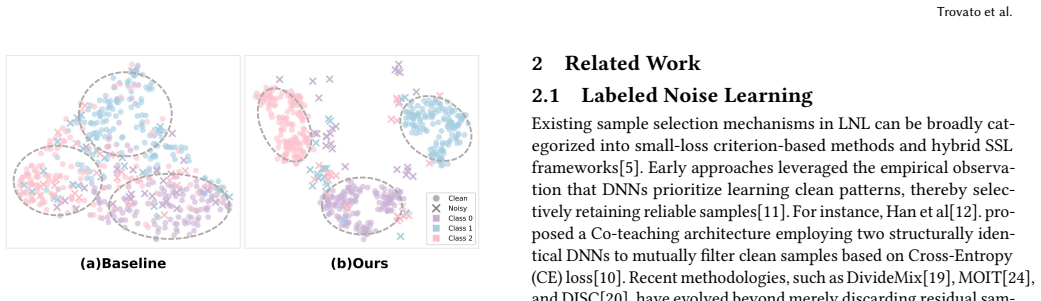
Actively reshaping feature space geometry by synthesizing virtual outliers improves separation of noisy labels from hard samples.
A machine-rendered reading of the paper's core claim, the machinery that carries it, and where it could break.
Core claim
The central claim is that explicitly constructing energy barriers between data manifolds by actively synthesizing virtual outlier samples imposes geometric constraints that promote intra-class compactness and inter-class separation. This reshaping of feature space geometry enhances the discriminability between hard and noisy samples and enables more robust representations for learning with noisy labels.
What carries the argument
Geometry-aware Manifold Regularization with Virtual Outlier Synthesis, which actively generates virtual outliers to build energy barriers that enforce desired geometric structure in the feature space.
If this is right
- The method surpasses current state-of-the-art on multiple noisy-label benchmarks including CIFAR-10.
- Advantages are particularly pronounced under asymmetric noise conditions.
- The regularization improves out-of-distribution detection for safer open-world use.
- Effectiveness holds independently of any prior assumptions about noise patterns.
- It integrates as a standalone mechanism into existing sample selection frameworks.
Where Pith is reading between the lines
- Similar virtual synthesis might help other settings with corrupted data, such as noisy features or inputs.
- The geometric barriers could be tested in fully clean-data regimes to check for generalization gains.
- This suggests exploring architectures that learn to maintain such energy barriers internally rather than adding them externally.
Load-bearing premise
Synthesizing virtual outlier samples will successfully construct energy barriers that enhance discriminability between hard and noisy samples and can be integrated into sample selection frameworks without introducing new failure modes.
What would settle it
If experiments adding virtual outlier synthesis show no measurable gain in feature-space separation metrics or in final accuracy on noisy-label benchmarks, especially under asymmetric noise, the central claim would be falsified.
Figures


read the original abstract
Deep neural networks (DNNs) experience significant performance degradation when processing noisy labels, primarily due to overfitting on mislabeled data. Current mainstream approaches attempt to mitigate this issue by passively filtering clean samples during training. However, simple sample filtering within feature spaces degraded by noise struggles to distinguish between challenging samples and noisy samples, creating a bottleneck for model performance. We highlight for the first time the fundamental importance of actively reshaping feature space geometry for learning from noisy data. We propose a novel Geometry-aware Manifold Regularization Paradigm whose core idea is to explicitly construct energy barriers between data manifolds by actively synthesizing virtual outlier samples. By imposing geometric constraints that promote intra-class compactness and inter-class separation, this approach enhances the discriminability between hard and noisy samples, leading to the learning of more robust representations. Our regularization mechanism exhibits high universality, with effectiveness independent of any prior assumptions about noise patterns. It can be integrated as a standalone mechanism into existing sample selection frameworks, providing stronger robustness against diverse noisy environments. Experiments demonstrate that our paradigm achieves performance surpassing current state-of-the-art (SOTA) methods on multiple benchmarks, including CIFAR-10, with particularly pronounced advantages under more challenging asymmetric noise conditions. Furthermore, this paradigm significantly enhances the model's capability in Out-of-Distribution (OOD) detection, ensuring superior reliability and safety for deployment in open-world scenarios.
Editorial analysis
A structured set of objections, weighed in public.
Referee Report
Summary. The paper proposes GAMR, a Geometry-aware Manifold Regularization paradigm for learning with noisy labels. It actively synthesizes virtual outlier samples to construct energy barriers in feature space, promoting intra-class compactness and inter-class separation to better distinguish hard samples from noisy ones. The method is presented as universal (independent of noise pattern assumptions) and integrable into existing sample selection frameworks. Experiments claim SOTA results on benchmarks including CIFAR-10, with stronger gains under asymmetric noise, plus improved OOD detection.
Significance. If the geometric regularization mechanism is shown to produce the claimed manifold reshaping effects beyond generic regularization, the work could meaningfully advance noisy-label learning by moving from passive sample filtering to active geometry control. The claimed universality and plug-in compatibility with selection frameworks would be practically useful, and the OOD gains address deployment safety. The manuscript would benefit from explicit credit for any reproducible code or ablations that isolate the geometric contribution.
major comments (2)
- [§3] §3 (method description): The virtual outlier synthesis procedure is introduced without a formal definition, loss derivation, or proof that the generated points reliably produce energy barriers yielding intra-class compactness and inter-class separation. The central claim that this geometric effect is independent of noise patterns and improves hard-vs-noisy discriminability therefore rests on downstream empirical performance rather than a demonstrated mechanism.
- [Experimental results section and Table 1] Experimental results section and Table 1 (asymmetric noise rows): The reported advantages under asymmetric noise are load-bearing for the universality claim, yet no ablation isolates the contribution of the manifold regularization term from standard regularization or sample selection effects. Without such controls, it remains possible that gains arise from generic regularization rather than the advertised geometric reshaping.
minor comments (2)
- [Abstract / Introduction] The abstract states 'first-time highlighting' of geometric importance; a brief related-work paragraph should explicitly contrast with prior manifold or energy-based regularization methods for noisy labels to substantiate novelty.
- [§3] Notation for the regularization term and energy barrier construction should be introduced with a single equation early in §3 for clarity.
Simulated Author's Rebuttal
We thank the referee for the constructive comments. We address each major point below and indicate the revisions we will make to strengthen the manuscript.
read point-by-point responses
-
Referee: [§3] §3 (method description): The virtual outlier synthesis procedure is introduced without a formal definition, loss derivation, or proof that the generated points reliably produce energy barriers yielding intra-class compactness and inter-class separation. The central claim that this geometric effect is independent of noise patterns and improves hard-vs-noisy discriminability therefore rests on downstream empirical performance rather than a demonstrated mechanism.
Authors: We agree that §3 would benefit from greater formalization. In the revised manuscript we will add an explicit mathematical definition of the virtual outlier synthesis procedure, including the generation rule in feature space, and derive the manifold regularization loss from first principles. We will also expand the discussion of how the synthesized points create energy barriers that enforce the claimed compactness and separation. A general proof of noise-pattern independence is difficult to obtain given the data-dependent nature of learned representations; we will instead strengthen the theoretical motivation and include additional feature visualizations that illustrate the geometric effect. revision: partial
-
Referee: [Experimental results section and Table 1] Experimental results section and Table 1 (asymmetric noise rows): The reported advantages under asymmetric noise are load-bearing for the universality claim, yet no ablation isolates the contribution of the manifold regularization term from standard regularization or sample selection effects. Without such controls, it remains possible that gains arise from generic regularization rather than the advertised geometric reshaping.
Authors: We acknowledge that isolating the geometric term is necessary to support the universality claim. We will add new ablation experiments in the revised manuscript that compare the full GAMR model against (i) the sample-selection baseline alone and (ii) the same framework with a standard (non-geometric) regularization term, evaluated specifically on the asymmetric-noise rows of Table 1. These controls will clarify whether the reported gains arise from the advertised manifold reshaping. revision: yes
Circularity Check
No significant circularity; derivation is self-contained with empirical validation
full rationale
The paper introduces a Geometry-aware Manifold Regularization Paradigm that synthesizes virtual outliers to reshape feature space geometry, promoting intra-class compactness and inter-class separation. This is presented as an additive regularization mechanism integrable into existing frameworks, with claims supported by benchmark experiments rather than any closed-form derivation or self-referential fitting. No equations, uniqueness theorems, or self-citations are invoked in a load-bearing way that reduces the central geometric effect to a tautology or prior fitted result by construction. The approach relies on downstream performance observations, which are externally falsifiable and independent of the input assumptions about noise patterns.
Axiom & Free-Parameter Ledger
invented entities (1)
-
virtual outlier samples
no independent evidence
Lean theorems connected to this paper
-
IndisputableMonolith/Cost/FunctionalEquation.leanwashburn_uniqueness_aczel unclear?
unclearRelation between the paper passage and the cited Recognition theorem.
explicitly construct energy barriers between data manifolds by actively synthesizing virtual outlier samples... intra-class compactness and inter-class separation
-
IndisputableMonolith/Foundation/AlexanderDuality.leanalexander_duality_circle_linking unclear?
unclearRelation between the paper passage and the cited Recognition theorem.
EVT-Guided Manifold Support Estimation... axis-aligned bounding boxes B_t
What do these tags mean?
- matches
- The paper's claim is directly supported by a theorem in the formal canon.
- supports
- The theorem supports part of the paper's argument, but the paper may add assumptions or extra steps.
- extends
- The paper goes beyond the formal theorem; the theorem is a base layer rather than the whole result.
- uses
- The paper appears to rely on the theorem as machinery.
- contradicts
- The paper's claim conflicts with a theorem or certificate in the canon.
- unclear
- Pith found a possible connection, but the passage is too broad, indirect, or ambiguous to say the theorem truly supports the claim.
Reference graph
Works this paper leans on
-
[1]
Eric Arazo, Diego Ortego, Paul Albert, Noel O’Connor, and Kevin McGuinness
-
[2]
InInternational conference on machine learning
Unsupervised label noise modeling and loss correction. InInternational conference on machine learning. PMLR, 312–321
-
[3]
David Berthelot, Nicholas Carlini, Ian Goodfellow, Nicolas Papernot, Avital Oliver, and Colin A Raffel. 2019. Mixmatch: A holistic approach to semi-supervised learning.Advances in neural information processing systems32 (2019)
work page 2019
-
[4]
Lukas Bossard, Matthieu Guillaumin, and Luc Van Gool. 2014. Food-101–mining discriminative components with random forests. InEuropean conference on com- puter vision. Springer, 446–461
work page 2014
-
[5]
Gaoyu Cao, Zhanquan Sun, Chaoli Wang, Hongquan Geng, Hongliang Fu, Zhong Yin, and Minlan Pan. 2024. RASNet: Renal automatic segmentation using an im- proved U-Net with multi-scale perception and attention unit.Pattern Recognition 150 (2024), 110336
work page 2024
-
[6]
Chen Cheng, Xinzhi Yu, Haodong Wen, Jingsong Sun, Guanzhang Yue, Yihao Zhang, and Zeming Wei. 2025. Exploring the robustness of in-context learning with noisy labels. InICASSP 2025-2025 IEEE International Conference on Acoustics, Speech and Signal Processing (ICASSP). IEEE, 1–5
work page 2025
-
[7]
Filipe R Cordeiro, Ragav Sachdeva, Vasileios Belagiannis, Ian Reid, and Gustavo Carneiro. 2023. Longremix: Robust learning with high confidence samples in a noisy label environment.Pattern recognition133 (2023), 109013
work page 2023
- [8]
-
[9]
Chuanwen Feng, Yilong Ren, and Xike Xie. 2023. Ot-filter: An optimal transport filter for learning with noisy labels. InProceedings of the IEEE/CVF Conference on Computer Vision and Pattern Recognition. 16164–16174
work page 2023
-
[10]
Fahimeh Fooladgar, Minh Nguyen Nhat To, Parvin Mousavi, and Purang Abol- maesumi. 2024. Manifold DivideMix: A semi-supervised contrastive learning framework for severe label noise. InProceedings of the IEEE/CVF Conference on Computer Vision and Pattern Recognition. 4012–4021
work page 2024
-
[11]
Aritra Ghosh, Himanshu Kumar, and P Shanti Sastry. 2017. Robust loss functions under label noise for deep neural networks. InProceedings of the AAAI conference on artificial intelligence, Vol. 31
work page 2017
- [12]
-
[13]
Bo Han, Quanming Yao, Xingrui Yu, Gang Niu, Miao Xu, Weihua Hu, Ivor Tsang, and Masashi Sugiyama. 2018. Co-teaching: Robust training of deep neural networks with extremely noisy labels.Advances in neural information processing systems31 (2018)
work page 2018
-
[14]
Dan Hendrycks, Mantas Mazeika, and Thomas Dietterich. 2018. Deep anomaly detection with outlier exposure.arXiv preprint arXiv:1812.04606(2018)
work page internal anchor Pith review Pith/arXiv arXiv 2018
-
[15]
Nazmul Karim, Mamshad Nayeem Rizve, Nazanin Rahnavard, Ajmal Mian, and Mubarak Shah. 2022. Unicon: Combating label noise through uniform selection and contrastive learning. InProceedings of the IEEE/CVF conference on computer vision and pattern recognition. 9676–9686
work page 2022
-
[16]
Prannay Khosla, Piotr Teterwak, Chen Wang, Aaron Sarna, Yonglong Tian, Phillip Isola, Aaron Maschinot, Ce Liu, and Dilip Krishnan. 2020. Supervised contrastive learning.Advances in neural information processing systems33 (2020), 18661–18673
work page 2020
-
[17]
Daehwan Kim, Kwangrok Ryoo, Hansang Cho, and Seungryong Kim. 2025. Split- Net: Learnable clean-noisy label splitting for learning with noisy labels.Interna- tional Journal of Computer Vision133, 2 (2025), 549–566
work page 2025
-
[18]
Yann LeCun, Sumit Chopra, Raia Hadsell, M Ranzato, and Fu Jie Huang. 2006. A tutorial on energy-based learning. InPredicting Structured Data. MIT Press
work page 2006
-
[19]
Jiahui Li, Tai-Wei Chang, Kun Kuang, Ximing Li, Long Chen, and Jun Zhou
-
[20]
In Proceedings of the AAAI Conference on Artificial Intelligence, Vol
Learning Causal Transition Matrix for Instance-dependent Label Noise. In Proceedings of the AAAI Conference on Artificial Intelligence, Vol. 39. 18305–18313
- [21]
-
[22]
Yifan Li, Hu Han, Shiguang Shan, and Xilin Chen. 2023. Disc: Learning from noisy labels via dynamic instance-specific selection and correction. InProceedings of the IEEE/CVF conference on computer vision and pattern recognition. 24070–24079
work page 2023
-
[23]
Zehui Liao, Shishuai Hu, Yutong Xie, and Yong Xia. 2025. Instance-dependent label distribution estimation for learning with label noise.International Journal of Computer Vision133, 5 (2025), 2568–2580
work page 2025
-
[24]
Sheng Liu, Zhihui Zhu, Qing Qu, and Chong You. 2022. Robust training under label noise by over-parameterization. InInternational Conference on Machine Learning. PMLR, 14153–14172
work page 2022
-
[25]
Weitang Liu, Xiaoyun Wang, John Owens, and Yixuan Li. 2020. Energy-based Out- of-distribution Detection. InAdvances in Neural Information Processing Systems (NeurIPS), Vol. 33. 21464–21475
work page 2020
-
[26]
Diego Ortego, Eric Arazo, Paul Albert, Noel E O’Connor, and Kevin McGuinness
-
[27]
In Proceedings of the IEEE/CVF conference on computer vision and pattern recognition
Multi-objective interpolation training for robustness to label noise. In Proceedings of the IEEE/CVF conference on computer vision and pattern recognition. 6606–6615
-
[28]
Ragav Sachdeva, Filipe Rolim Cordeiro, Vasileios Belagiannis, Ian Reid, and Gustavo Carneiro. 2023. ScanMix: Learning from severe label noise via semantic clustering and semi-supervised learning.Pattern recognition134 (2023), 109121
work page 2023
-
[29]
Hwanjun Song, Minseok Kim, and Jae-Gil Lee. 2019. Selfie: Refurbishing unclean samples for robust deep learning. InInternational conference on machine learning. PMLR, 5907–5915
work page 2019
-
[30]
Haoliang Sun, Chenhui Guo, Qi Wei, Zhongyi Han, and Yilong Yin. 2022. Learning to rectify for robust learning with noisy labels.Pattern Recognition124 (2022), 108467
work page 2022
-
[31]
Haobo Wang, Ruixuan Xiao, Yixuan Li, Lei Feng, Gang Niu, Gang Chen, and Junbo Zhao. 2022. PiCO: Contrastive Label Disambiguation for Partial Label Learning.ICLR1, 2 (2022), 5
work page 2022
- [32]
-
[33]
Hongyi Zhang, Moustapha Cisse, Yann N Dauphin, and David Lopez-Paz. 2017. mixup: Beyond empirical risk minimization.arXiv preprint arXiv:1710.09412 (2017)
work page internal anchor Pith review Pith/arXiv arXiv 2017
-
[34]
Qian Zhang, Yi Zhu, Filipe R Cordeiro, and Qiu Chen. 2025. PSSCL: A progressive sample selection framework with contrastive loss designed for noisy labels. Pattern Recognition161 (2025), 111284
work page 2025
-
[35]
Yue Zhang, Yiyi Chen, Chaowei Fang, Qian Wang, Jiayi Wu, and Jingmin Xin
-
[36]
Pattern Recognition157 (2025), 110902
Learning from open-set noisy labels based on multi-prototype modeling. Pattern Recognition157 (2025), 110902
work page 2025
-
[37]
Zhilu Zhang and Mert Sabuncu. 2018. Generalized cross entropy loss for training deep neural networks with noisy labels.Advances in neural information processing systems31 (2018)
work page 2018
-
[38]
Zhaowei Zhu, Jialu Wang, and Yang Liu. 2022. Beyond images: Label noise transition matrix estimation for tasks with lower-quality features. InInternational Conference on Machine Learning. PMLR, 27633–27653
work page 2022
discussion (0)
Sign in with ORCID, Apple, or X to comment. Anyone can read and Pith papers without signing in.