Intrinsic spectral structure of bipartite nonlocal magic resource
Pith reviewed 2026-06-26 00:08 UTC · model grok-4.3
The pith
Pure-state bipartite nonlocal magic resource is an intrinsic function of the nonzero Schmidt spectrum.
A machine-rendered reading of the paper's core claim, the machinery that carries it, and where it could break.
Core claim
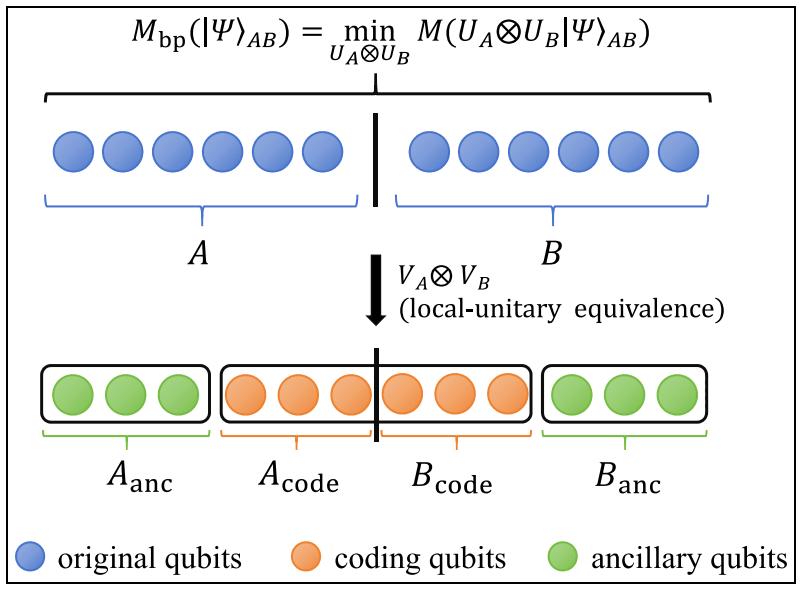
By mapping any bipartite pure state to a minimal encoding core, the BNMR of the original state equals the BNMR of the core; therefore BNMR is completely determined by the nonzero Schmidt spectrum and is invariant under local isometries rather than merely under local unitaries.
What carries the argument
The canonical encoding framework, which exactly confines BNMR computation to a minimal encoding core whose dimension is fixed by the Schmidt rank.
If this is right
- BNMR remains unchanged when the state is transformed by local isometries.
- The leading quadratic response of BNMR to small changes in the Schmidt spectrum is given by an explicit formula.
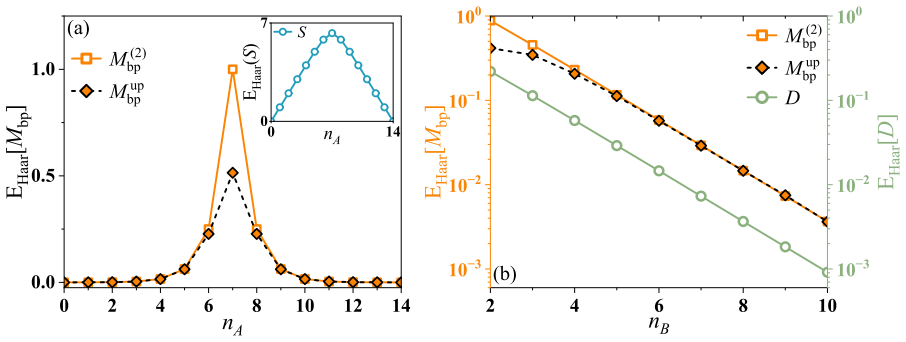
- For Haar-random states the BNMR distribution is sharply peaked at balanced bipartitions and decays exponentially for unbalanced cuts.
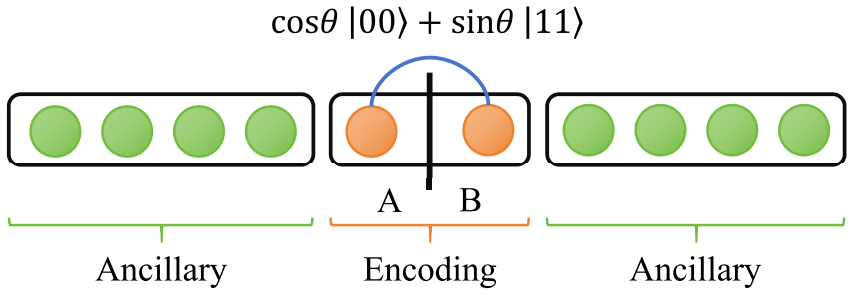
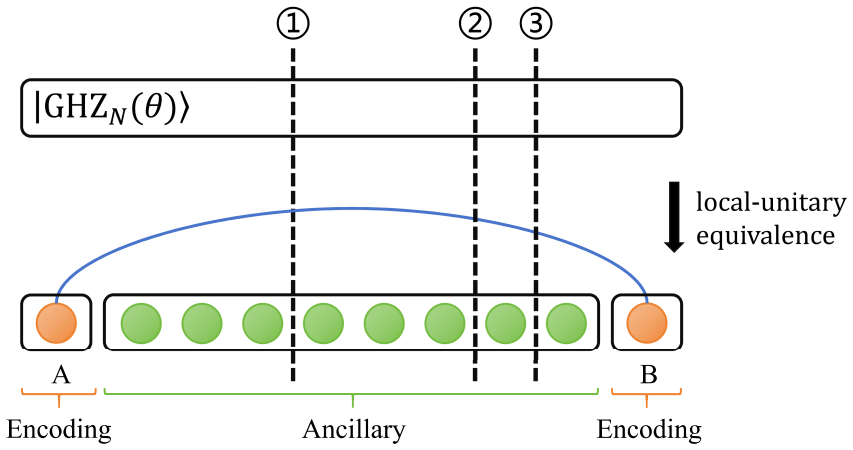
- Schmidt-rank-2 states admit a closed-form BNMR expression, and generalized GHZ states exhibit exact equality between bipartite and global nonlocal magic resources.
Where Pith is reading between the lines
- The spectral dependence supplies a practical route to estimate BNMR for states whose Schmidt values can be obtained numerically without full-state optimization.
- The exponential suppression away from symmetric cuts implies that typical random entanglement carries negligible BNMR once the cut becomes moderately unbalanced.
- The collapse of bipartite and global magic for generalized GHZ states shows that, for this family, the nonlocal magic is fully captured by the bipartite reduction.
Load-bearing premise
The canonical encoding framework exactly confines the BNMR of an arbitrary bipartite pure state within a minimal encoding core.
What would settle it
Compute the full Hilbert-space BNMR for a concrete bipartite pure state whose Schmidt spectrum is known, then check whether the value equals the BNMR obtained from the reduced core that depends only on those same Schmidt numbers.
Figures
read the original abstract
Bipartite nonlocal magic resource (BNMR) quantifies the irreducible nonstabilizerness residing in bipartite entanglement, yet its evaluation is intractable due to the full Hilbert space optimization. Here, we introduce a canonical encoding framework that exactly confines the BNMR of an arbitrary bipartite pure state within a minimal encoding core. This dimension reduction proves that pure-state BNMR is an intrinsic function of the nonzero Schmidt spectrum, extending its invariance from local unitary transformations to local isometries. Leveraging this spectral link, we derive the leading quadratic response of BNMR under spectral perturbations around its zeros. We apply this quadratic response to Haar-random states, deriving and numerically validating the BNMR profile: its distribution is sharply localized at the symmetric bipartition and exponentially suppressed toward asymmetric cuts, in stark contrast to the broadening Page curve of entanglement. Finally, we provide a closed-form expression for the BNMR of Schmidt rank-2 states, uncovering a hierarchy collapse in generalized GHZ states where bipartite and global nonlocal magic resources coincide exactly.
Editorial analysis
A structured set of objections, weighed in public.
Referee Report
Summary. The manuscript introduces a canonical encoding framework that exactly confines the optimization of bipartite nonlocal magic resource (BNMR) for arbitrary bipartite pure states to a minimal encoding core spanned by the Schmidt vectors. This establishes that pure-state BNMR is an intrinsic function of the nonzero Schmidt spectrum, extending its invariance from local unitaries to local isometries. The work derives the leading quadratic response of BNMR to spectral perturbations, applies it to obtain and numerically validate the BNMR distribution over Haar-random states (sharply localized at symmetric bipartitions and exponentially suppressed for asymmetric cuts, in contrast to the Page curve), and supplies a closed-form expression for Schmidt rank-2 states that reveals an exact hierarchy collapse between bipartite and global nonlocal magic in generalized GHZ states.
Significance. If the exact confinement holds, the result would be significant: it supplies an analytical reduction for an otherwise intractable resource measure, directly ties BNMR to the entanglement spectrum, and yields concrete, falsifiable outputs including the closed-form rank-2 expression and the validated Haar distribution. The provision of exact expressions and numerical checks for the distribution profile are particular strengths that would enable further study of nonlocal magic.
major comments (1)
- [Abstract / canonical encoding framework definition] Abstract and the section defining the canonical encoding framework: the claim that the framework 'exactly confines' BNMR to the minimal core (with no residual nonlocal magic outside the Schmidt support) is load-bearing for the spectral-intrinsic claim and all downstream results. The manuscript must supply an explicit equivalence proof showing that the full-space optimization equals the core optimization for arbitrary states, including verification that the chosen encoding maps and isometry extensions introduce no state-dependent leakage.
minor comments (1)
- [Abstract] The abstract would benefit from a brief pointer to the specific section or theorem number where the equivalence proof for the dimension reduction appears.
Simulated Author's Rebuttal
We thank the referee for their detailed review and for identifying the need for greater explicitness in the canonical encoding framework. The comment is well-taken and directly addresses a foundational claim. We will revise the manuscript to include the requested equivalence proof as a dedicated subsection, thereby strengthening the spectral-intrinsic result without altering any existing derivations or numerical validations.
read point-by-point responses
-
Referee: [Abstract / canonical encoding framework definition] Abstract and the section defining the canonical encoding framework: the claim that the framework 'exactly confines' BNMR to the minimal core (with no residual nonlocal magic outside the Schmidt support) is load-bearing for the spectral-intrinsic claim and all downstream results. The manuscript must supply an explicit equivalence proof showing that the full-space optimization equals the core optimization for arbitrary states, including verification that the chosen encoding maps and isometry extensions introduce no state-dependent leakage.
Authors: We agree that an explicit equivalence proof is necessary to make the confinement claim fully rigorous and will add it in revision. The proof will proceed by showing that the BNMR functional, defined via the minimum over stabilizer projectors, vanishes identically on any component orthogonal to the Schmidt support: for any pure state |ψ angle = Σ λ_i |i angle_A |i angle_B, the nonlocal magic is invariant under local isometries that map the support to a minimal core of dimension equal to the Schmidt rank, because any extension operator outside this support commutes with the stabilizer group in a manner that contributes zero to the magic measure. We will explicitly construct the encoding map and verify the absence of state-dependent leakage by direct computation of the overlap terms, confirming equality between full-space and core optimizations for arbitrary Schmidt spectra. This addition will be placed immediately after the framework definition and before the quadratic-response derivation. revision: yes
Circularity Check
No significant circularity; new canonical encoding framework provides independent dimension reduction
full rationale
The paper introduces a canonical encoding framework as a novel construction to confine BNMR to a minimal core spanned by Schmidt vectors, from which the spectral dependence and subsequent quadratic response, Haar distribution, and rank-2 closed form are derived. No equations or steps in the provided abstract reduce a claimed prediction or result to a fitted parameter or prior self-citation by construction. The central claim is self-contained within the paper's own definitions and proofs rather than tautological or externally load-bearing on unverified self-references. This is the expected outcome for a manuscript presenting a new technical framework.
Axiom & Free-Parameter Ledger
Reference graph
Works this paper leans on
-
[1]
Quantum resource theories , author =. Rev. Mod. Phys. , volume =. 2019 , month =. doi:10.1103/RevModPhys.91.025001 , url =
-
[2]
Quantifying Entanglement , author =. Phys. Rev. Lett. , volume =. 1997 , month =. doi:10.1103/PhysRevLett.78.2275 , url =
-
[3]
New Journal of Physics , volume =
Veitch, Victor and Hamed Mousavian, S A and Gottesman, Daniel and Emerson, Joseph , title =. New Journal of Physics , volume =. 2014 , month =
2014
-
[4]
DiVincenzo, David P. , year=. The Physical Implementation of Quantum Computation , volume=. Fortschritte der Physik , publisher=. doi:10.1002/1521-3978(200009)48:9/11<771::aid-prop771>3.0.co;2-e , number=
-
[5]
A One-Way Quantum Computer , author =. Phys. Rev. Lett. , volume =. 2001 , month =. doi:10.1103/PhysRevLett.86.5188 , url =
-
[6]
1998 , eprint=
The Heisenberg Representation of Quantum Computers , author=. 1998 , eprint=
1998
-
[7]
Universal quantum computation with ideal Clifford gates and noisy ancillas , author =. Phys. Rev. A , volume =. 2005 , month =. doi:10.1103/PhysRevA.71.022316 , url =
-
[8]
Quantum entanglement , author =. Rev. Mod. Phys. , volume =. 2009 , month =. doi:10.1103/RevModPhys.81.865 , url =
-
[9]
Entanglement in many-body systems , author =. Rev. Mod. Phys. , volume =. 2008 , month =. doi:10.1103/RevModPhys.80.517 , url =
-
[10]
Conformal field theories are magical , author =. Phys. Rev. B , volume =. 2021 , month =. doi:10.1103/PhysRevB.103.075145 , url =
-
[11]
Journal of Statistical Mechanics: Theory and Experiment , abstract =
Hastings, M B , title =. Journal of Statistical Mechanics: Theory and Experiment , abstract =. 2007 , month =. doi:10.1088/1742-5468/2007/08/P08024 , url =
-
[12]
Colloquium: Area laws for the entanglement entropy , author =. Rev. Mod. Phys. , volume =. 2010 , month =. doi:10.1103/RevModPhys.82.277 , url =
-
[13]
Matrix product states represent ground states faithfully , author =. Phys. Rev. B , volume =. 2006 , month =. doi:10.1103/PhysRevB.73.094423 , url =
-
[14]
Leone, Lorenzo and Oliviero, Salvatore F. E. and Zhou, You and Hamma, Alioscia , journal =. Quantum. doi:10.22331/q-2021-05-04-453 , url =
-
[15]
Magic-state resource theory for the ground state of the transverse-field Ising model , author =. Phys. Rev. A , volume =. 2022 , month =. doi:10.1103/PhysRevA.106.042426 , url =
-
[16]
doi:10.22331/q-2021-12-28-612 , url =
Symmetry-protected sign problem and magic in quantum phases of matter , author =. doi:10.22331/q-2021-12-28-612 , url =
-
[17]
Three qubits can be entangled in two inequivalent ways , author =. Phys. Rev. A , volume =. 2000 , month =. doi:10.1103/PhysRevA.62.062314 , url =
-
[18]
American Journal of Physics , volume =
Bell's theorem without inequalities , author =. American Journal of Physics , volume =. 1990 , publisher =
1990
-
[19]
Distributed entanglement , author =. Phys. Rev. A , volume =. 2000 , month =. doi:10.1103/PhysRevA.61.052306 , url =
-
[20]
Quantum nonlocal nonstabilizerness , author =. Phys. Rev. A , volume =. 2025 , month =. doi:10.1103/PhysRevA.111.052443 , url =
-
[21]
2025 , eprint =
Experimental demonstration of non-local magic in a superconducting quantum processor , author =. 2025 , eprint =
2025
-
[22]
2026 , eprint=
Analytic formulae for non-local magic in bipartite systems of qutrits and ququints , author=. 2026 , eprint=
2026
-
[23]
2004 , eprint=
Entanglement in the stabilizer formalism , author=. 2004 , eprint=
2004
-
[24]
Stabilizer R\'enyi Entropy , author =. Phys. Rev. Lett. , volume =. 2022 , month =. doi:10.1103/PhysRevLett.128.050402 , url =
-
[25]
Stabilizer entropies are monotones for magic-state resource theory , author =. Phys. Rev. A , volume =. 2024 , month =. doi:10.1103/PhysRevA.110.L040403 , url =
-
[26]
Stabilizer entropies and nonstabilizerness monotones , author =. doi:10.22331/q-2023-08-28-1092 , url =
-
[27]
Nonstabilizerness via Perfect Pauli Sampling of Matrix Product States , author =. Phys. Rev. Lett. , volume =. 2023 , month =. doi:10.1103/PhysRevLett.131.180401 , url =
-
[28]
Many-Body Magic Via Pauli-Markov Chains---From Criticality to Gauge Theories , author =. PRX Quantum , volume =. 2023 , month =. doi:10.1103/PRXQuantum.4.040317 , url =
-
[29]
Quantifying nonstabilizerness of matrix product states , author =. Phys. Rev. B , volume =. 2023 , month =. doi:10.1103/PhysRevB.107.035148 , url =
-
[30]
Dynamical magic transitions in monitored Clifford+Tcircuits.PRX Quantum, 5:030332, 2024
Dynamical Magic Transitions in Monitored Clifford+ T Circuits , author =. PRX Quantum , volume =. 2024 , month =. doi:10.1103/PRXQuantum.5.030332 , url =
-
[31]
Nonstabilizerness versus entanglement in matrix product states , author =. Phys. Rev. B , volume =. 2024 , month =. doi:10.1103/PhysRevB.110.045101 , url =
-
[32]
Entanglement--nonstabilizerness separation in hybrid quantum circuits , author =. Phys. Rev. Res. , volume =. 2024 , month =
2024
-
[33]
Invested and Potential Magic Resources in Measurement-Based Quantum Computation , author =. Phys. Rev. Lett. , volume =. 2025 , month =. doi:10.1103/4yyv-hggz , url =
-
[34]
Journal of Physics A: Mathematical and Theoretical , volume =
Huang, Xiao and Chen, Guanhua and Yao, Yao , title =. Journal of Physics A: Mathematical and Theoretical , volume =. 2026 , doi =
2026
-
[35]
Mele, Antonio Anna , journal =. Introduction to. doi:10.22331/q-2024-05-08-1340 , url =
-
[36]
Quantifying nonstabilizerness through entanglement spectrum flatness , author =. Phys. Rev. A , volume =. 2024 , month =. doi:10.1103/PhysRevA.109.L040401 , url =
-
[37]
Entanglement and Stabilizer entropies of random bipartite pure quantum states , author =. Quantum , volume =. 2025 , month =. doi:10.22331/q-2025-07-21-1797 , url =
-
[38]
2026 , eprint=
Magic and Non-Clifford Gates in Topological Quantum Field Theory , author=. 2026 , eprint=
2026
-
[39]
Gravitational Backreaction is Magical , author =. PRX Quantum , volume =. 2025 , month =. doi:10.1103/z3vr-w5c5 , url =
-
[40]
Quantum State Designs with Clifford-Enhanced Matrix Product States , author =. PRX Quantum , volume =. 2025 , month =. doi:10.1103/PRXQuantum.6.010345 , url =
-
[41]
Many-Body Quantum Magic , author =. PRX Quantum , volume =. 2022 , month =. doi:10.1103/PRXQuantum.3.020333 , url =
-
[42]
Negative quasi-probability as a resource for quantum computation , year =
Negative quasi-probability as a resource for quantum computation , author =. New Journal of Physics , volume =. 2012 , month =. doi:10.1088/1367-2630/14/11/113011 , url =
-
[43]
Nonstabilizerness Dynamics in Many-Body Localized Systems , author =. Phys. Rev. Lett. , volume =. 2025 , month =. doi:10.1103/xfp5-hhs4 , url =
-
[44]
npj Quantum Information , volume =
Measuring magic on a quantum processor , author =. npj Quantum Information , volume =. 2022 , month =
2022
-
[45]
Magic spreading in random quantum circuits , author =. Nature Communications , volume =. 2025 , month =. doi:10.1038/s41467-025-57704-x , url =
-
[46]
2025 , eprint =
Universal Spreading of Nonstabilizerness and Quantum Transport , author =. 2025 , eprint =
2025
-
[47]
Evaluating Many-Body Stabilizer R\'enyi Entropy by Sampling Reduced Pauli Strings: Singularities, Volume Law, and Nonlocal Magic , author =. PRX Quantum , volume =. 2025 , month =. doi:10.1103/pyzr-jmvw , url =
-
[48]
Average entropy of a subsystem , author =. Phys. Rev. Lett. , volume =. 1993 , month =. doi:10.1103/PhysRevLett.71.1291 , url =
-
[49]
Proof of Page's conjecture on the average entropy of a subsystem , author =. Phys. Rev. Lett. , volume =. 1994 , month =. doi:10.1103/PhysRevLett.72.1148 , url =
-
[50]
Average Entropy of a Quantum Subsystem , author =. Phys. Rev. Lett. , volume =. 1996 , month =. doi:10.1103/PhysRevLett.77.1 , url =
-
[51]
Karol Zyczkowski and Hans-Jürgen Sommers , title =. 2001 , month =. doi:10.1088/0305-4470/34/35/335 , url =
-
[52]
Matrix Analysis , author =
-
[53]
Efficient classical simulation of slightly entangled quantum computations , author =. Phys. Rev. Lett. , volume =. 2003 , publisher =
2003
-
[54]
Quantum Information & Computation , volume =
Matrix product state representations , author =. Quantum Information & Computation , volume =
-
[55]
Nonstabilizerness in kinetically constrained Rydberg atom arrays , author =. Phys. Rev. B , volume =. 2025 , month =. doi:10.1103/jz4d-vdhj , url =
-
[56]
Periodic Orbits, Entanglement, and Quantum Many-Body Scars in Constrained Models: Matrix Product State Approach , author =. Phys. Rev. Lett. , volume =. 2019 , month =. doi:10.1103/PhysRevLett.122.040603 , url =
-
[57]
Slow Quantum Thermalization and Many-Body Revivals from Mixed Phase Space , author =. Phys. Rev. X , volume =. 2020 , month =. doi:10.1103/PhysRevX.10.011055 , url =
-
[58]
Exact link between nonlocal nonstabilizerness and operator entanglement , author =. Phys. Rev. A , volume =. 2026 , month =. doi:10.1103/9x56-2b45 , url =
-
[59]
Nonlocal nonstabilizerness generation and information scrambling in noisy Clifford circuits , author =. Phys. Rev. A , volume =. 2026 , month =. doi:10.1103/xkhn-d7yv , url =
-
[60]
Quantum states with Einstein-Podolsky-Rosen correlations admitting a hidden-variable model , author =. Phys. Rev. A , volume =. 1989 , month =. doi:10.1103/PhysRevA.40.4277 , url =
-
[61]
Separability Criterion for Density Matrices , author =. Phys. Rev. Lett. , volume =. 1996 , month =. doi:10.1103/PhysRevLett.77.1413 , url =
-
[62]
Mixed-state entanglement and quantum error correction , author =. Phys. Rev. A , volume =. 1996 , month =. doi:10.1103/PhysRevA.54.3824 , url =
-
[63]
Efficient mutual magic and magic capacity with matrix product states , pages =
Tarabunga, Poetri Sonya and Haug, Tobias , journal =. Efficient mutual magic and magic capacity with matrix product states , pages =. 2025 , publisher =. doi:10.21468/SciPostPhys.19.4.085 , url =
-
[64]
Complexity of frustration: A new source of non-local non-stabilizerness , pages =
Odavić, Jovan and Haug, Tobias and Torre, Gianpaolo and Hamma, Alioscia and Franchini, Fabio and Giampaolo, Salvatore Marco , journal =. Complexity of frustration: A new source of non-local non-stabilizerness , pages =. 2023 , publisher =. doi:10.21468/SciPostPhys.15.4.131 , url =
-
[65]
Magic phase transition and non-local complexity in generalized W State , pages =
Catalano, Alberto Giuseppe and Odavić, Jovan and Torre, Gianpaolo and Hamma, Alioscia and Franchini, Fabio and Giampaolo, Salvatore Marco , journal =. Magic phase transition and non-local complexity in generalized W State , pages =. 2025 , publisher =. doi:10.21468/SciPostPhysCore.8.4.078 , url =
-
[66]
Long-Range Nonstabilizerness and Phases of Matter , author =. Phys. Rev. Lett. , volume =. 2025 , month =. doi:10.1103/1hlj-h6t9 , url =
-
[67]
2026 , eprint=
Non-Local Magic Resources for Fermionic Gaussian States , author=. 2026 , eprint=
2026
-
[68]
2026 , eprint=
Nonlocal nonstabilizerness in free fermion models , author=. 2026 , eprint=
2026
-
[69]
2026 , eprint=
Exponentially Accelerated Sampling of Pauli Strings for Nonstabilizerness , author=. 2026 , eprint=
2026
-
[70]
2026 , eprint=
A fast and exact approach for stabilizer R\'enyi entropy via the XOR-FWHT algorithm , author=. 2026 , eprint=
2026
-
[71]
Computing quantum magic of state vectors , volume=
Sierant, Piotr and Vallès-Muns, Jofre and Garcia-Saez, Artur , year=. Computing quantum magic of state vectors , volume=. doi:10.22331/q-2026-04-10-2059 , journal=
discussion (0)
Sign in with ORCID, Apple, or X to comment. Anyone can read and Pith papers without signing in.