Towards triggerless four-dimensional detectors for High Energy Physics collider experiments
Pith reviewed 2026-07-03 00:28 UTC · model grok-4.3
The pith
Precision timing combined with high-bandwidth networking may enable future collider detectors to be built triggerless from the start.
A machine-rendered reading of the paper's core claim, the machinery that carries it, and where it could break.
Core claim
The author claims that the combination of timing and networking technology may enable future detectors to be designed as triggerless from the ground up, and this paradigm shift could bring physics benefits for the field.
What carries the argument
Triggerless detector design that uses picosecond timing for real-time selections instead of dedicated trigger hardware.
If this is right
- Future detectors could record every collision and perform selections entirely in software.
- Physics analyses would no longer be limited by the biases or thresholds of early trigger decisions.
- The same timing information that enables triggerless operation also adds a time dimension to event reconstruction.
- Data volumes would grow but could be managed through later offline or online filtering.
Where Pith is reading between the lines
- Such designs might scale to detectors at future colliders with even higher data rates.
- This approach connects to the general problem of managing exponential growth in scientific data across fields.
- Prototypes could first be tested in smaller experiments or test beams to measure integration challenges.
- Triggerless operation could change how experiments allocate computing resources between real-time and offline stages.
Load-bearing premise
Advances in picosecond timing and high-bandwidth networking will be sufficient and integrable at the scale required for full collider detectors.
What would settle it
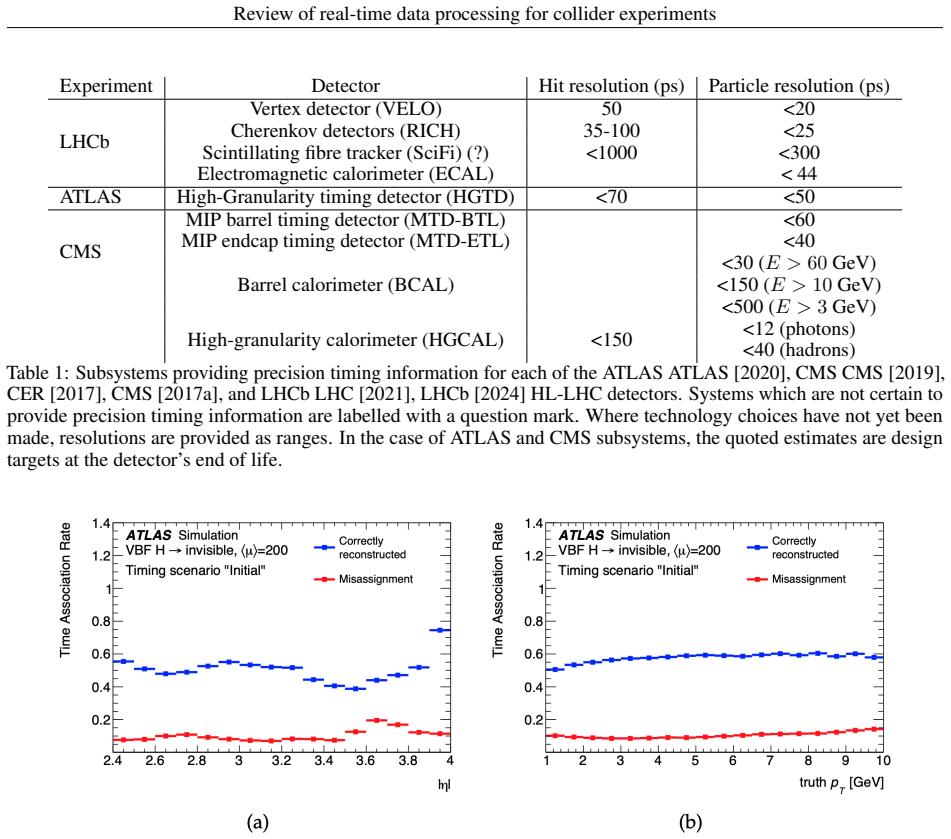
Whether the timing layers now planned for ATLAS and CMS can be integrated with data acquisition networks at full LHC collision rates without requiring a hardware trigger stage.
Figures
read the original abstract
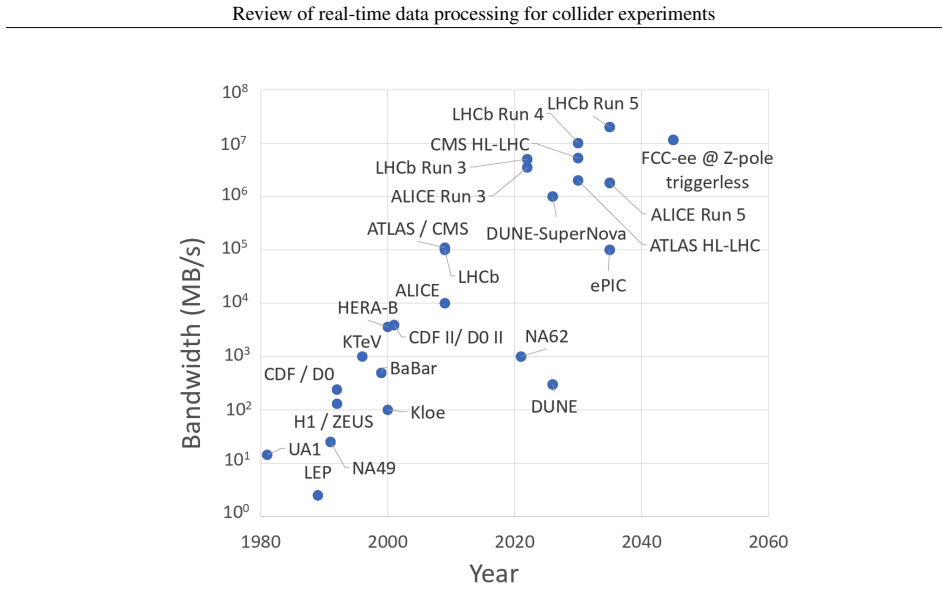
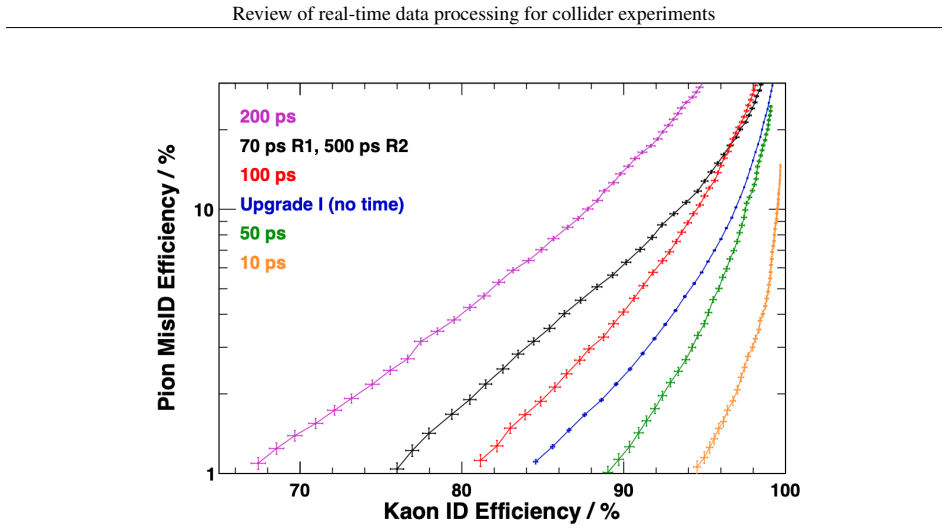
High Energy Physics experiments at flagship colliders produce and process some of the biggest datasets on Earth, with the current generation of flagship experiments at the Large Hadron Collider producing more than a tenth of the world's total internet traffic every second. Moreover the quantities of data produced have increased exponentially over the past decades and this trend shows no sign of slowing down. In parallel, the use of picosecond timing is becoming more common in HEP detectors, enabling qualitatively new approaches to real-time processing and selections. I review the planned introduction of precision timing information into the upcoming upgrades of the CMS, ATLAS, and LHCb experiments. I discuss the ways in which the combination of timing and networking technology may enable future detectors to be designed as triggereless from the ground up, and reflect on the physics benefits of such a paradigm shift for the field.
Editorial analysis
A structured set of objections, weighed in public.
Referee Report
Summary. The manuscript reviews the planned introduction of precision timing into the CMS, ATLAS, and LHCb upgrades at the LHC. It discusses how the combination of picosecond timing and high-bandwidth networking technologies may enable future collider detectors to be designed as triggerless from the ground up, and reflects on the potential physics benefits of this paradigm shift.
Significance. If the described trends in timing and networking hold, the paper could usefully frame community discussion on 4D detector architectures by synthesizing existing upgrade plans. It receives credit for explicitly hedging its central claim ('may enable', 'could bring') and for focusing on already-planned timing layers rather than claiming new quantitative demonstrations.
minor comments (3)
- [Abstract] The abstract states that current LHC experiments produce 'more than a tenth of the world's total internet traffic every second'; a specific citation or data source for this figure would improve verifiability.
- The discussion of 'physics benefits' of triggerless designs would benefit from at least one concrete example (e.g., improved acceptance for a specific rare process) even if kept qualitative.
- Consider adding a short table or bullet list summarizing the expected timing resolutions and channel counts for the three experiments' timing layers to aid comparison.
Simulated Author's Rebuttal
We thank the referee for the positive assessment of the manuscript, the recognition of its cautious phrasing, and the recommendation for minor revision. No specific major comments were raised in the report.
Circularity Check
No significant circularity
full rationale
This is a forward-looking review paper with no equations, derivations, fitted parameters, or mathematical claims. The text discusses existing planned detector upgrades at CMS, ATLAS, and LHCb and speculates on future triggerless designs using hedging language ('may enable', 'could bring'). No load-bearing step reduces to a self-definition, fitted input renamed as prediction, or self-citation chain. The paper is self-contained as a non-quantitative discussion of external technology trends.
Axiom & Free-Parameter Ledger
axioms (1)
- domain assumption Picosecond timing is becoming more common in HEP detectors
Reference graph
Works this paper leans on
-
[1]
Two FPGA Case Studies Comparing High Level Synthesis and Manual HDL for HEP applications
Marc-Andr\'e, T\'etrault. Two FPGA Case Studies Comparing High Level Synthesis and Manual HDL for HEP applications. 2018. arXiv:1806.10672
work page internal anchor Pith review Pith/arXiv arXiv 2018
-
[2]
The Phase-2 Upgrade of the CMS Level-1 Trigger
Zabi, Alexandre and Berryhill, Jeffrey Wayne and Perez, Emmanuelle and Tapper, Alexander D. The Phase-2 Upgrade of the CMS Level-1 Trigger. 2020
2020
-
[3]
Evolution of the energy efficiency of LHCb s real-time processing
Badaro, Gilbert and others. The Phase-2 Upgrade of the CMS Data Acquisition. EPJ Web Conf. 2021. doi:10.1051/epjconf/202125104023
-
[5]
Low vs High Level Programming for FPGA
Marjanovic, Jan. Low vs High Level Programming for FPGA. 7th International Beam Instrumentation Conference. 2019. doi:10.18429/JACoW-IBIC2018-THOA01
-
[6]
A Survey and Evaluation of FPGA High-Level Synthesis Tools , year=
Nane, Razvan and Sima, Vlad-Mihai and Pilato, Christian and Choi, Jongsok and Fort, Blair and Canis, Andrew and Chen, Yu Ting and Hsiao, Hsuan and Brown, Stephen and Ferrandi, Fabrizio and Anderson, Jason and Bertels, Koen , journal=. A Survey and Evaluation of FPGA High-Level Synthesis Tools , year=
-
[7]
, journal=
Lahti, Sakari and Sjövall, Panu and Vanne, Jarno and Hämäläinen, Timo D. , journal=. Are We There Yet? A Study on the State of High-Level Synthesis , year=
-
[8]
Fast inference of deep neural networks in FPGAs for particle physics
Duarte, Javier and others. Fast inference of deep neural networks in FPGAs for particle physics. JINST. 2018. doi:10.1088/1748-0221/13/07/P07027. arXiv:1804.06913
-
[9]
Computing for the Large Hadron Collider
Bird, Ian. Computing for the Large Hadron Collider. Ann. Rev. Nucl. Part. Sci. 2011. doi:10.1146/annurev-nucl-102010-130059
-
[10]
The data acquisition and reduction challenge at the Large Hadron Collider
Cittolin, Sergio. The data acquisition and reduction challenge at the Large Hadron Collider. Phil. Trans. Roy. Soc. Lond. A. 2012. doi:10.1098/rsta.2011.0464
-
[11]
Challenges for FCC-ee luminosity monitor design
Dam, Mogens. Challenges for FCC-ee luminosity monitor design. Eur. Phys. J. Plus. 2022. doi:10.1140/epjp/s13360-021-02265-3. arXiv:2107.12837
-
[12]
The Phase-2 Upgrade of the CMS Data Acquisition and High Level Trigger
CMS, Collaboration. The Phase-2 Upgrade of the CMS Data Acquisition and High Level Trigger. 2021
2021
-
[13]
The Phase-2 Upgrade of the CMS Level-1 Trigger
CMS. The Phase-2 Upgrade of the CMS Level-1 Trigger. 2020
2020
-
[14]
Technical Design Report for the Phase-II Upgrade of the ATLAS TDAQ System
ATLAS. Technical Design Report for the Phase-II Upgrade of the ATLAS TDAQ System. 2017. doi:10.17181/CERN.2LBB.4IAL
-
[15]
CMS TriDAS project: Technical Design Report, Volume 1: The Trigger Systems
Bayatyan, G L and others. CMS TriDAS project: Technical Design Report, Volume 1: The Trigger Systems
-
[16]
CMS The TriDAS Project: Technical Design Report, Volume 2: Data Acquisition and High-Level Trigger
Cittolin, Sergio and Rácz, Attila and Sphicas, Paris. CMS The TriDAS Project: Technical Design Report, Volume 2: Data Acquisition and High-Level Trigger. CMS trigger and data-acquisition project. 2002
2002
-
[17]
ATLAS high-level trigger, data-acquisition and controls: Technical Design Report
Jenni, Peter and Nessi, Marzio and Nordberg, Markus and Smith, Kenway. ATLAS high-level trigger, data-acquisition and controls: Technical Design Report. 2003
2003
-
[18]
ATLAS level-1 trigger: Technical Design Report. 1998
1998
-
[19]
LHCb trigger system: Technical Design Report
Antunes-Nobrega, R and others. LHCb trigger system: Technical Design Report. 2003
2003
-
[20]
Aaboud, M. and others. Search for low-mass dijet resonances using trigger-level jets with the ATLAS detector in pp collisions at s =13 TeV. Phys. Rev. Lett. 2018. doi:10.1103/PhysRevLett.121.081801. arXiv:1804.03496
-
[21]
Sirunyan, A. M. and others. Search for a Narrow Resonance Lighter than 200 GeV Decaying to a Pair of Muons in Proton-Proton Collisions at s =13 TeV. Phys. Rev. Lett. 2020. doi:10.1103/PhysRevLett.124.131802. arXiv:arXiv:1912.04776
-
[22]
LHC trigger & DAQ - An introductory overview , year=
Neufeld, Niko , booktitle=. LHC trigger & DAQ - An introductory overview , year=
-
[23]
Expression of Interest for an LHCb Upgrade
Nakada, Tatsuya and Ullaland, O and Witzelling, Werner. Expression of Interest for an LHCb Upgrade. 2008
2008
-
[24]
Aaij, R. and others. A Comparison of CPU and GPU Implementations for the LHCb Experiment Run 3 Trigger. Comput. Softw. Big Sci. 2022. doi:10.1007/s41781-021-00070-2. arXiv:2105.04031
-
[25]
Accettura, Carlotta and others. Towards a Muon Collider. 2023. arXiv:2303.08533
-
[26]
Gligorov, V. V. and Rekovi \'c , V. Review of real-time data processing for collider experiments. Eur. Phys. J. Plus. 2023. doi:10.1140/epjp/s13360-023-04599-6. arXiv:2310.04756
-
[27]
Abada, A. and others. FCC-hh: The Hadron Collider : Future Circular Collider Conceptual Design Report Volume 3. Eur. Phys. J. ST. 2019. doi:10.1140/epjst/e2019-900087-0
-
[28]
2020 Update of the European Strategy for Particle Physics. 2020. doi:10.17181/ESU2020
-
[29]
Evolution of the energy efficiency of LHCb s real-time processing
Aaij, Roel and C\'ampora P\'erez, Daniel Hugo and Colombo, Tommaso and Fitzpatrick, Conor and Gligorov, Vladimir Vava and Hennequin, Arthur and Neufeld, Niko and Nolte, Niklas and Schwemmer, Rainer and Vom Bruch, Dorothea. Evolution of the energy efficiency of LHCb s real-time processing. EPJ Web Conf. 2021. doi:10.1051/epjconf/202125104009. arXiv:2106.07701
-
[30]
Khachatryan, Vardan and others. Search for narrow resonances in dijet final states at (s)= 8 TeV with the novel CMS technique of data scouting. Phys. Rev. Lett. 2016. doi:10.1103/PhysRevLett.117.031802. arXiv:1604.08907
work page internal anchor Pith review Pith/arXiv arXiv doi:10.1103/physrevlett.117.031802 2016
-
[31]
Trigger-object Level Analysis with the ATLAS detector at the Large Hadron Collider: summary and perspectives. 2017
2017
-
[32]
Selected HLT2 reconstruction performance for the LHCb upgrade
LHCb. Selected HLT2 reconstruction performance for the LHCb upgrade. 2021
2021
-
[33]
McCallum
John C. McCallum. Historical prices of computing equipment. 2023
2023
-
[34]
The Beam and detector of the NA62 experiment at CERN
Cortina Gil, Eduardo and others. The Beam and detector of the NA62 experiment at CERN. JINST. 2017. doi:10.1088/1748-0221/12/05/P05025. arXiv:1703.08501
work page internal anchor Pith review Pith/arXiv arXiv doi:10.1088/1748-0221/12/05/p05025 2017
-
[35]
Aaij, Roel and others. The LHCb upgrade I. 2023. arXiv:2305.10515
-
[36]
Abi, Babak and others. Deep Underground Neutrino Experiment (DUNE), Far Detector Technical Design Report, Volume I Introduction to DUNE. JINST. 2020. doi:10.1088/1748-0221/15/08/T08008. arXiv:2002.02967
-
[37]
A comprehensive real-time analysis model at the LHCb experiment
Aaij, R. and others. A comprehensive real-time analysis model at the LHCb experiment. JINST. 2019. doi:10.1088/1748-0221/14/04/P04006. arXiv:1903.01360
work page internal anchor Pith review Pith/arXiv arXiv doi:10.1088/1748-0221/14/04/p04006 2019
-
[38]
Overview of trigger systems , journal =
Volker Lindenstruth and Ivan Kisel , keywords =. Overview of trigger systems , journal =. 2004 , note =. doi:10.1016/j.nima.2004.07.267 , url =
-
[39]
Trigger in UA2 and in UA1
Dorenbosch, Jheroen. Trigger in UA2 and in UA1. eConf. 1985
1985
-
[40]
and others , URL =
Decamp, D. and others , URL =. 1990 , HAL_ID =
1990
-
[41]
Basic concepts and architectural details of the DELPHI trigger system
Bocci, V and others. Basic concepts and architectural details of the DELPHI trigger system. 1994. doi:10.1109/23.467783
-
[42]
Abt, I. and others. The H1 detector at HERA. Nucl. Instrum. Meth. A. 1997. doi:10.1016/S0168-9002(96)00893-5
-
[43]
A Fast High Resolution Track Trigger for the H1 Experiment
Baird, A. and others. A Fast high resolution track trigger for the H1 experiment. IEEE Trans. Nucl. Sci. 2001. doi:10.1109/23.958765. arXiv:hep-ex/0104010
work page internal anchor Pith review Pith/arXiv arXiv doi:10.1109/23.958765 2001
-
[44]
The CDF Silicon Vertex Trigger
Ashmanskas, Bill and others. The CDF silicon vertex trigger. Nucl. Instrum. Meth. A. 2004. doi:10.1016/j.nima.2003.11.078. arXiv:physics/0306169
work page internal anchor Pith review Pith/arXiv arXiv doi:10.1016/j.nima.2003.11.078 2004
-
[45]
Amidei, D. and others. A Two Level Fastbus Based Trigger System for CDF. Nucl. Instrum. Meth. A. 1988. doi:10.1016/0168-9002(88)90861-3
-
[46]
Performance of the CMS Level-1 trigger in proton-proton collisions at √s=13 TeV
Sirunyan, Albert M and others. Performance of the CMS Level-1 trigger in proton-proton collisions at s = 13 TeV. JINST. 2020. doi:10.1088/1748-0221/15/10/P10017. arXiv:2006.10165
-
[47]
Amhis, Y. and others. Averages of b -hadron, c -hadron, and -lepton properties as of 2021. 2022. arXiv:2206.07501
-
[48]
New UTfit Analysis of the Unitarity Triangle in the Cabibbo-Kobayashi-Maskawa scheme
Bona, Marcella and others. New UTfit Analysis of the Unitarity Triangle in the Cabibbo-Kobayashi-Maskawa scheme. 2022. arXiv:2212.03894
-
[49]
CP Violation and the CKM Matrix: Assessing the Impact of the Asymmetric B Factories
Charles, J. and Hocker, Andreas and Lacker, H. and Laplace, S. and Le Diberder, F. R. and Malcles, J. and Ocariz, J. and Pivk, M. and Roos, L. CP violation and the CKM matrix: Assessing the impact of the asymmetric B factories, updated results and plots available at http://ckmfitter.in2p3.fr http://ckmfitter.in2p3.fr. Eur. Phys. J. C. 2005. doi:10.1140/ep...
work page internal anchor Pith review Pith/arXiv arXiv doi:10.1140/epjc/s2005-02169-1 2005
-
[50]
Model-independent bounds on new physics effects in non-leptonic tree-level decays of B-mesons
Lenz, Alexander and Tetlalmatzi-Xolocotzi, Gilberto. Model-independent bounds on new physics effects in non-leptonic tree-level decays of B-mesons. JHEP. 2020. doi:10.1007/JHEP07(2020)177. arXiv:1912.07621
-
[51]
New physics effects in tree-level decays
Brod, Joachim and Lenz, Alexander and Tetlalmatzi-Xolocotzi, Gilberto and Wiebusch, Martin. New physics effects in tree-level decays and the precision in the determination of the quark mixing angle. Phys. Rev. D. 2015. doi:10.1103/PhysRevD.92.033002. arXiv:1412.1446
work page internal anchor Pith review Pith/arXiv arXiv doi:10.1103/physrevd.92.033002 2015
-
[52]
Electroweak Baryogenesis and Standard Model CP Violation
Huet, Patrick and Sather, Eric. Electroweak baryogenesis and standard model CP violation. Phys. Rev. D. 1995. doi:10.1103/PhysRevD.51.379. arXiv:hep-ph/9404302
work page internal anchor Pith review Pith/arXiv arXiv doi:10.1103/physrevd.51.379 1995
-
[53]
Gavela, M. B. and Hernandez, P. and Orloff, J. and Pene, O. and Quimbay, C. Standard model CP violation and baryon asymmetry. Part 2: Finite temperature. Nucl. Phys. B. 1994. doi:10.1016/0550-3213(94)00410-2. arXiv:hep-ph/9406289
work page internal anchor Pith review Pith/arXiv arXiv doi:10.1016/0550-3213(94)00410-2 1994
-
[54]
Minimal Flavour Violation: an effective field theory approach
D'Ambrosio, G. and Giudice, G. F. and Isidori, G. and Strumia, A. Minimal flavor violation: An Effective field theory approach. Nucl. Phys. B. 2002. doi:10.1016/S0550-3213(02)00836-2. arXiv:hep-ph/0207036
work page internal anchor Pith review Pith/arXiv arXiv doi:10.1016/s0550-3213(02)00836-2 2002
-
[55]
Simultaneous determination of CKM angle and charm mixing parameters
Aaij, Roel and others. Simultaneous determination of CKM angle and charm mixing parameters. JHEP. 2021. doi:10.1007/JHEP12(2021)141. arXiv:2110.02350
-
[56]
Abudin\'en, F. and others. Combined analysis of Belle and Belle II data to determine the CKM angle _ 3 using B^+ D(K_ S ^0 h^- h^+) h^+ decays. JHEP. 2022. doi:10.1007/JHEP02(2022)063. arXiv:2110.12125
-
[57]
Abudin\'en, F. and others. Determination of |V_ cb | from B D decays using 2019-2021 Belle II data. 2022. arXiv:2210.13143
-
[58]
Abudin\'en, F. and others. Measurement of the B^ 0 D^ *- ^ + _ branching ratio and |V_ cb | with a fully reconstructed accompanying B meson in 2019-2021 Belle II data. 2023. arXiv:2301.04716
-
[59]
Adamczyk, K. and others. Determination of |V_ ub | from untagged B^0 ^- ^+ _ decays using 2019-2021 Belle II data. 2022. arXiv:2210.04224
-
[60]
Altmannshofer, W. and others. The Belle II Physics Book. PTEP. 2019. doi:10.1093/ptep/ptz106. arXiv:1808.10567
- [61]
-
[62]
Parametrization of the Kobayashi-Maskawa Matrix
Wolfenstein, Lincoln. Parametrization of the Kobayashi-Maskawa Matrix. Phys. Rev. Lett. 1983. doi:10.1103/PhysRevLett.51.1945
-
[63]
Mixing and CP Violation in the Charm System
Lenz, Alexander and Wilkinson, Guy. Mixing and CP Violation in the Charm System. Ann. Rev. Nucl. Part. Sci. 2021. doi:10.1146/annurev-nucl-102419-124613. arXiv:2011.04443
-
[65]
Design and performance of the LHCb trigger and full real-time reconstruction in Run 2 of the LHC
Aaij, Roel and others. Design and performance of the LHCb trigger and full real-time reconstruction in Run 2 of the LHC. JINST. 2019. doi:10.1088/1748-0221/14/04/P04013. arXiv:1812.10790
work page internal anchor Pith review Pith/arXiv arXiv doi:10.1088/1748-0221/14/04/p04013 2019
-
[66]
Observation of $C\!P$ violation in charm decays
Aaij, Roel and others. Observation of CP Violation in Charm Decays. Phys. Rev. Lett. 2019. doi:10.1103/PhysRevLett.122.211803. arXiv:1903.08726
work page internal anchor Pith review Pith/arXiv arXiv doi:10.1103/physrevlett.122.211803 2019
- [67]
-
[68]
Lees, J. P. and others. Evidence for an excess of B D^ (*) ^- _ decays. Phys. Rev. Lett. 2012. doi:10.1103/PhysRevLett.109.101802. arXiv:1205.5442
work page internal anchor Pith review Pith/arXiv arXiv doi:10.1103/physrevlett.109.101802 2012
-
[69]
Aggarwal, L. and others. A test of light-lepton universality in the rates of inclusive semileptonic B -meson decays at Belle II. 2023. arXiv:2301.08266
-
[70]
Aaij, R. and others. Measurement of the ratio of branching fractions B (B_c^+\, \,J/ ^+ _ ) / B (B_c^+\, \,J/ ^+ _ ). Phys. Rev. Lett. 2018. doi:10.1103/PhysRevLett.120.121801. arXiv:1711.05623
work page internal anchor Pith review Pith/arXiv arXiv doi:10.1103/physrevlett.120.121801 2018
-
[71]
Aaij, R. and others. Observation of the decay _b^0 _c^+ ^- _. Phys. Rev. Lett. 2022. doi:10.1103/PhysRevLett.128.191803. arXiv:2201.03497
-
[72]
and Duell, Stephan and Ligeti, Zoltan and Papucci, Michele and Robinson, Dean J
Bernlochner, Florian U. and Duell, Stephan and Ligeti, Zoltan and Papucci, Michele and Robinson, Dean J. Das ist der HAMMER: Consistent new physics interpretations of semileptonic decays. Eur. Phys. J. C. 2020. doi:10.1140/epjc/s10052-020-8304-0. arXiv:2002.00020
-
[73]
Abada, A. and others. FCC Physics Opportunities : Future Circular Collider Conceptual Design Report Volume 1. Eur. Phys. J. C. 2019. doi:10.1140/epjc/s10052-019-6904-3
-
[74]
On the Standard Model predictions for $R_K$ and $R_{K^*}$
Bordone, Marzia and Isidori, Gino and Pattori, Andrea. On the Standard Model predictions for R_K and R_ K^*. Eur. Phys. J. C. 2016. doi:10.1140/epjc/s10052-016-4274-7. arXiv:1605.07633
work page internal anchor Pith review Pith/arXiv arXiv doi:10.1140/epjc/s10052-016-4274-7 2016
-
[75]
Aaij, Roel and others. Physics case for an LHCb Upgrade II - Opportunities in flavour physics, and beyond, in the HL-LHC era. 2018. arXiv:1808.08865
work page internal anchor Pith review Pith/arXiv arXiv 2018
-
[76]
Ablikim, Medina and others. Measurement of the D K^- ^+ ^+ ^- and D K^- ^+ ^0 coherence factors and average strong-phase differences in quantum-correlated D D decays. JHEP. 2021. doi:10.1007/JHEP05(2021)164. arXiv:2103.05988
-
[77]
The hadron collider FCC-hh: Extended conceptual design report
Schulte, Daniel. The hadron collider FCC-hh: Extended conceptual design report. 2025. doi:10.23731/CYRM-2025-006
-
[78]
Holmes, Tova and Lee, Lawrence. Event Rates at a 10 TeV Muon Collider and Implications for Detector Design: Trigger, Data Acquisition, and Luminosity. 2025. arXiv:2508.06239
-
[79]
Ablikim, M. and others. Model-independent determination of the relative strong-phase difference between D^0 and D ^0 K^0_ S,L ^+ ^- and its impact on the measurement of the CKM angle / _3. Phys. Rev. D. 2020. doi:10.1103/PhysRevD.101.112002. arXiv:2003.00091
-
[80]
Wilkinson, Guy. Charming synergies: the role of charm-threshold studies in the search for physics beyond the Standard Model. Sci. Bull. 2021. doi:10.1016/j.scib.2021.07.032. arXiv:2107.08414
-
[81]
Abudin\'en, F. and others , collaboration =. Search for. Phys. Rev. Lett. , volume =. 2021 , month =. doi:10.1103/PhysRevLett.127.181802 , url =
-
[82]
Abudinén, F. and others , collaboration =. Measurement of the branching fraction for the decay B K^. doi:10.48550/ARXIV.2206.05946 , url =
discussion (0)
Sign in with ORCID, Apple, or X to comment. Anyone can read and Pith papers without signing in.