REVIEW 4 major objections 4 minor 53 references
Population rate coding in recurrent neuronal networks with undetermined-type neurons
T0 review · 4 major / 4 minor · reviewed 2026-08-14 · deepseek-v4-flash
Pith's one-line read A recurrent network whose neurons can send both excitatory and inhibitory synapses represents time-varying stimuli in population firing rate with peak correlation above 0.92 and outperforms a fixed-type E/I network.
desk verdict A competent but modest parameter study of a random E/I edge-coloring network, whose stated biological motivation (co-release) is not actually implemented; the encoding trends are plausible but the paper overclaims the model's relationship to co-release. read the letter →
The pith
A machine-rendered reading of the paper's core claim, the machinery that carries it, and where it could break.
The reading
What carries the argument
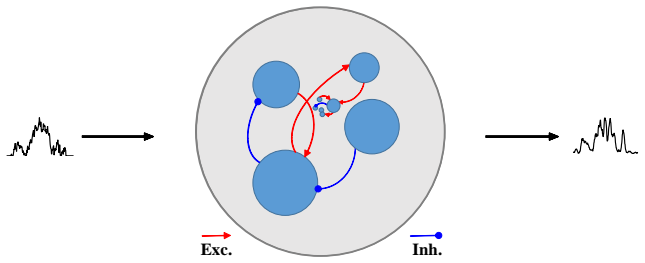
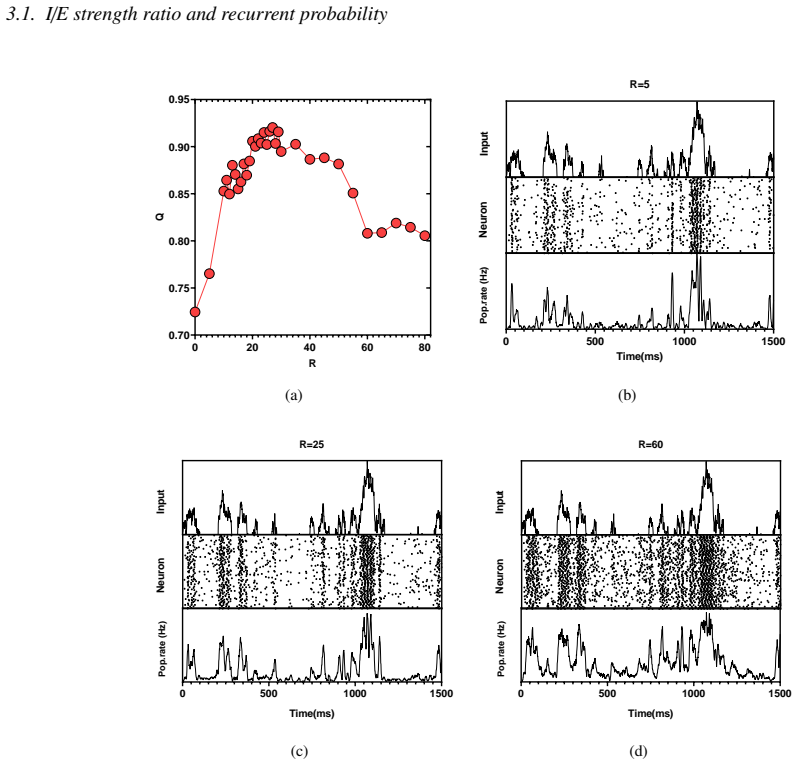
The key machinery is the undetermined-type assignment rule: each synapse is independently labelled excitatory with probability 0.8 or inhibitory with probability 0.2, so synaptic sign is treated as a property of the activated receptor rather than of the presynaptic neuron. The argument is carried by the ratio R = g_inh/g_exc, which controls whether the recurrent population is in an excitation-dominated or inhibition-dominated regime, together with the recurrent probability Prc, which fixes how many mixed-sign feedback paths exist. The encoding quality Q, defined as the maximum of the cross-correlation between the input signal and the population firing rate, is the measure that exposes the optimum: Q is high only when R, Prc, noise, and excitatory strength place the population in an intermediate dynamical state rather than at either extreme.
What would settle it
Run the identical encoding protocol on a matched network in which inhibitory postsynaptic effects are delivered only by a fixed set of 20 inhibitory neurons, keeping the same number of excitatory and inhibitory synapses, and compare Q; if the undetermined network no longer shows higher encoding fidelity, the paper's central comparison fails. Similarly, if allowing one presynaptic neuron to excite and inhibit the same postsynaptic cell causes Q to drop below the paper's exclusion rule, the biological motivation would be contradicted.
Extended reading notes
Core claim
The central discovery is that population rate coding survives and is sharpened by removing the assumption that each neuron has a fixed excitatory or inhibitory type. In the proposed undetermined-type network, each recurrent connection is independently assigned as excitatory with probability 0.8 or inhibitory with probability 0.2, so one presynaptic neuron may excite some postsynaptic targets and inhibit others. Using the maximum correlation Q between a half-wave-rectified Gaussian input and the population firing rate as the measure of encoding quality, the paper finds Q reaches values above 0.92 for intermediate inhibitory-to-excitatory strength ratios (about 15 < R < 40) and recurrent probability near 0.1. The optimal values of noise intensity, excitatory synaptic strength, and synaptic time constant are likewise intermediate, meaning the network encodes best in a state that is neither too excitable nor too suppressed. Under matched parameters, this undetermined network attains higher Q than a conventional network with 80 excitatory and 20 inhibitory neurons, which the paper takes as evidence that co-release of excitatory and inhibitory receptors is a plausible and beneficial coding mechanism.
Load-bearing premise
The load-bearing assumption is that randomly labelling each outgoing synapse as excitatory or inhibitory in a fixed 4:1 ratio, and never letting the same presynaptic neuron give both signs to the same postsynaptic cell, is a fair stand-in for receptor-determined co-release; if the real biological rule for synaptic sign differs, the reported encoding advantage belongs to the random-labelling rule rather than to the biology it is meant to capture.
Editorial extensions
If this is right
- Population firing rate can remain a high-fidelity code even when individual neurons have no fixed excitatory or inhibitory identity, as long as the collective mix of synapses is balanced.
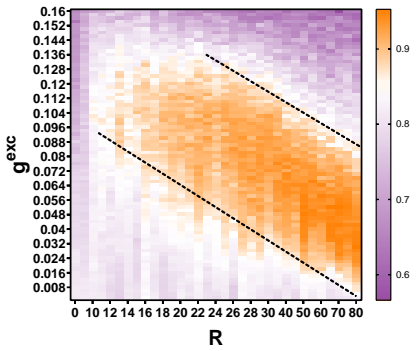
- Encoding quality is non-monotonic in inhibitory strength: both too-weak and too-strong inhibitory feedback degrade the population code, so an intermediate E/I balance is required for faithful encoding.
- Sparse recurrence around Prc = 0.1 is better than dense recurrence for this rate-coding task, suggesting that too many recurrent connections wash out the stimulus-related signal.
- Moderate background noise and fast synaptic kinetics improve fidelity, while strong noise and slow synapses degrade it.
- At identical parameters, the undetermined-type network outperforms the standard fixed 80/20 E/I network, implying that receptor-determined synaptic polarity is a rational modeling choice for population rate coding.
Reading between the lines
- If the random-sign assignment is interpreted as receptor-determined polarity, the model predicts that target-specific differences in receptor expression, rather than presynaptic cell type, determine whether a connection excites or inhibits; this could be tested by comparing networks with different correlations between target identity and synapse sign.
- The optimum near Prc = 0.1 may reflect a balance between averaging over many neurons and preserving stimulus transients: denser recurrence smooths away fast signal changes, while very sparse recurrence leaves too little shared activity to encode reliably.
- A natural extension the paper does not simulate is true co-release, where one presynaptic neuron simultaneously excites and inhibits the same postsynaptic cell; whether opposing conductances cancel or sharpen the code is an open question that could raise or lower the reported advantage.
- The 80/20 excitatory-to-inhibitory ratio is fixed throughout; testing sensitivity to other ratios, such as 70/30 or 90/10, would show whether the qualitative optimum is tied to the biological balance or is an artifact of the chosen 4:1 mix.
Signed reviews
Editorial analysis
A structured set of objections, weighed in public.
Referee Report
Summary. The manuscript studies population-rate coding in a recurrent Hodgkin-Huxley network in which each directed recurrent synapse is randomly assigned an excitatory (80%) or inhibitory (20%) sign independently of the presynaptic neuron's identity, which the authors call an 'undetermined-type' network. The stimulus is a half-wave-rectified Ornstein-Uhlenbeck process, and the encoding quality Q is the maximal correlation between the stimulus and the population firing rate at an optimal lag. Parameter scans over the I/E strength ratio R, recurrent probability Prc, noise intensity D, excitatory strength gexc, and synaptic time constant reveal an optimal regime around Prc ≈ 0.1 and 15 < R < 40 with Q above 0.9. The paper concludes that this undetermined network encodes better than a standard fixed-E/I network and interprets this as evidence that co-release of excitatory and inhibitory receptors should be considered.
Significance. If the computational results hold, the paper provides a systematic computational demonstration that edge-level random E/I sign assignment can be as good as or better than source-determined E/I assignment for population-rate encoding in recurrent Hodgkin-Huxley networks. The parameter sweeps are extensive and the qualitative inverted-U dependencies are coherent. The significance is, however, limited by the mismatch between the implemented model and the claimed biological motivation, and by the absence of quantitative uncertainty in the comparison to the determined network. The work would be a solid contribution if presented as a study of 'random-sign' or 'undetermined-type' connectivity rather than as evidence for co-release.
major comments (4)
- [Section 2.1 and Section 4] The implemented network assigns each recurrent connection an independent 80/20 E/I sign and explicitly states that one postsynaptic neuron never receives both E and I from the same presynaptic neuron; this is a per-synapse sign model, not a co-release model in which one terminal activates both receptor classes on the same target. Consequently, the abstract's and conclusion's claim that the results make it 'rational to consider the co-release of inhibitory and excitatory receptors' is not supported by the simulation. Please either simulate co-release explicitly or replace the co-release interpretation with the more modest claim about random, undetermined-type sign assignment, and add a sensitivity analysis for the 4:1 E/I ratio.
- [Section 3.3, Fig. 10] The central claim that the undetermined network outperforms the determined network is presented without error bars, trial counts, or statistical testing, and the figure legend in 10(b) is internally inconsistent ('gexc=0.08 gexc=0.1 gexc=0.08 gexc=1'). Given that the stated differences are small (roughly 0.85-0.9), the reader cannot assess whether the advantage is reliable. Please report mean ± SD over at least the 10 trials used elsewhere and state the exact parameters for both models.
- [Section 2.4, Eqs. (7)-(8)] There is an inconsistency in how the population firing rate is defined: Eq. (7) sets Δt=1 ms, while the correlation in Eq. (8) is computed with a 10 ms window sliding by 1 ms. Also, Eq. (7) as written gives spikes/ms, but Fig. 2 labels the ordinate in Hz. Since Q is a correlation coefficient it is invariant to this scale, but the manuscript should state the exact time bin used to generate the figures and provide the conversion factor; otherwise the simulations are not fully reproducible.
- [Section 3.2.2, Fig. 7] The text states that 'the product of R and gexc has a positive relationship with the encoding quality,' but the surrounding discussion and the figure indicate a non-monotonic (inverted-U) relationship, with both too-large and too-small inhibitory strength reducing Q. Please correct this statement to reflect the described optimum at intermediate values of R*gexc.
minor comments (4)
- [Throughout] There are numerous typos and cross-reference errors, including 'thses', 'hypthesis', 'In other word', and a reference to 'Fig. 5(b)' that should be 'Fig. 6(b)'.
- [Section 2.4.3, Eq. (10)] The synchronization measure k_{i,j} is not normalized by the number of time bins, and this quantity is never used in the Results; please either correct the formula or remove it to avoid confusing an undefined measure.
- [Section 3.1] The phrase 'the relationship of Q versus Prc around R≈0.1' appears to be a typo for 'Q versus R around Prc≈0.1,' since the curves shown in Fig. 4(c) are Q versus R for fixed values of Prc.
- [Section 3.3, Fig. 10(b)] The legend text 'gexc=1' is presumably a typo for 'gexc=0.1'; this should be corrected because the comparison of synaptic strength is a central element of the argument.
Circularity Check
No significant circularity: the encoding-quality results are direct simulation outputs, and the E/I-sign assignment and co-release motivation raise model-validity concerns, not circularity.
full rationale
The paper's central derivation is simulation-based: it constructs a Hodgkin-Huxley recurrent network, defines population firing rate and encoding fidelity Q as the maximum correlation between input and population rate, and then sweeps parameters R, Prc, D, gexc, and synaptic time constants, comparing against a fixed-E/I network. No parameter is fitted to an external target, and no 'prediction' is derived from fitted values; every Q value is a direct simulated output. The optimal ranges of R and Prc are read from the same parameter sweeps used to formulate the conclusions, but this is standard exploratory reporting of simulation surfaces rather than a reduction of a predicted quantity to an input by construction. The paper does state post hoc parameter choices such as 'we choose Prc = 0.12 cause that it is a compromise of the previous two cases' and 'proves the rationality of the parameter D = 1 that we selected before,' but these are selections reported after inspecting the sweeps, not fitted inputs disguised as predictions. The biological motivation regarding receptor-determined synaptic polarity and co-release is not actually implemented as co-release: Section 2.1 randomly assigns each connection as excitatory (80%) or inhibitory (20%) and explicitly avoids a postsynaptic neuron receiving both excitatory and inhibitory synapses from the same presynaptic neuron, and the Conclusion concedes the model is 'still not very biological enough.' This is a modeling-validity and interpretation limitation, not a circular derivation. There are no load-bearing self-citations, no imported uniqueness theorems, and no renaming of a known empirical result as a new organizational principle. The comparison with the determined E/I network is an independent baseline simulation. Therefore, under the stated rules requiring a specific reduction or fitted-parameter-as-prediction, no circularity is present; the appropriate score is 0.
Assumptions & free parameters
free parameters (8)
- E:I connection ratio =
4:1 (80% excitatory, 20% inhibitory)
- Excitatory synaptic strength gexc =
0.102 default; scanned 0.008 to 0.16
- I/E strength ratio R =
scanned 0-80; optimal around 15-40
- Recurrent probability Prc =
0.12 default; scanned 0.02-0.8
- Noise intensity D =
1 default; scanned 0.1-2
- Synaptic time constants tau_exc, tau_inh =
0.3 ms, 0.6 ms; ratio 2
- External stimulus parameters (K, A, tau_c) =
K=15, A=200, tau_c=80 ms
- Network size N =
100
assumptions (6)
- domain assumption Hodgkin-Huxley equations with specified conductances describe the neurons
- ad hoc to paper Random directed connectivity with independent E/I sign at each edge approximates receptor-determined synaptic function
- domain assumption Maximum input-population-rate correlation Q is an adequate measure of encoding quality
- domain assumption Half-wave rectified Ornstein-Uhlenbeck current represents the stimulus
- ad hoc to paper Avoiding E and I synapses from the same presynaptic neuron onto the same postsynaptic neuron does not alter the essential co-release phenomenon
- ad hoc to paper The 4:1 E/I connection ratio is physiologically appropriate
invented entities (1)
-
Undetermined-type neuron with randomly assigned outgoing synaptic signs
Cite this review
Pith. "Pith review of Population rate coding in recurrent neuronal networks with undetermined-type neurons." pith.science (2026). https://pith.science/paper/GRVQVPW4
@misc{pith2026190803886,
  author       = {Pith},
  title        = {Pith review of: Population rate coding in recurrent neuronal networks with undetermined-type neurons},
  year         = {2026},
  howpublished = {\url{https://pith.science/paper/GRVQVPW4}},
  note         = {Machine review of arXiv:1908.03886}
}
read the original abstract
Neural coding is a key problem in neuroscience, which can promote people's understanding of the mechanism that brain processes information. Among the classical theories of neural coding, the population rate coding has been studied widely in many works. Most computational studies considered the neurons and the corresponding presynaptic synapses as pre-determined excitatory or inhibitory types. According to physiological evidence, however, that the real effect of a synapse is inhibitory or excitatory is determined by the type of the activated receptors. The co-release of excitatory and inhibitory receptors in the same synapse exists widely in the brain. In this paper, we study the population rate coding in recurrent neuronal networks with undetermined neurons and synapses, different from the traditional works, in which one neuron can perform either excitatory or inhibitory effect to the corresponding postsynaptic neurons. We find such neuronal networks can encode the stimuli information in population firing rate well. We find that intermediate recurrent probability together with moderate Inhibitory-Excitatory strength ratio can enhance the encoding performance. Suitable combinations of the previous two parameters with the noise intensity, the excitatory synaptic strength and the synaptic time constant have promoting effects on the performance of population rate coding. Finally, we compare the performance of population rate coding between the traditional (determined) model and ours, and we find that it is rational to consider the co-release of inhibitory and excitatory receptors.
Figures

Figures from the paper (7 more)




Reference graph
Works this paper leans on
-
[1]
R. C. deCharms, A. Zador, Neural representation and the cortical code, Annual Review of Neuroscience 23 (1) (2000) 613–647, pMID: 10845077. doi:10.1146/annurev.neuro.23.1.613
-
[2]
W. T. Newsome, K. H. Britten, J. A. Movshon, Neuronal correlates of a perceptual decision, Nature 341 (1989) 52–54. doi:10.1038/ 341052a0
work page 1989
-
[3]
A. Georgopoulos, M. Taira, A. Lukashin, Cognitive neurophysiology of the motor cortex, Science 260 (5104) (1993) 47–52. doi:10.1126/ science.8465199
work page 1993
-
[4]
M. N. Shadlen, W. T. Newsome, Noise, neural codes and cortical organization, Current Opinion in Neurobiology 4 (4) (1994) 569 – 579. doi:https://doi.org/10.1016/0959-4388(94)90059-0
-
[5]
P. Marsalek, C. Koch, J. H. R. Maunsell, On the relationship between synaptic input and spike output jitter in individual neurons., Proceedings of the National Academy of Sciences of the United States of America 94 2 (1997) 735–40. doi:10.1073/pnas.94.2.735
- [6]
-
[7]
M. E. Mazurek, M. N. Shadlen, Limits to the temporal fidelity of cortical spike rate signals, Nature Neuroscience 5 (2002) 463–471. doi: 10.1038/nn836
-
[8]
A. Aertsen, M. Diesmann, M. Gewaltig, Propagation of synchronous spiking activity in feedforward neural networks, Journal of Physiology- Paris 90 (3) (1996) 243 – 247. doi:https://doi.org/10.1016/S0928-4257(97)81432-5
Show all 53 references
-
[9]
Riehle, S
A. Riehle, S. Gr ¨un, M. Diesmann, A. Aertsen, Spike synchronization and rate modulation di fferentially involved in motor cortical function, Science 278 (5345) (1997) 1950–1953. doi:10.1126/science.278.5345.1950
1997
-
[10]
Diesmann, M.-O
M. Diesmann, M.-O. Gewaltig, A. Aertsen, Stable propagation of synchronous spiking in cortical neural networks, Nature 402 (1999) 529–
1999
-
[11]
Litvak, H
V . Litvak, H. Sompolinsky, I. Segev, M. Abeles, On the transmission of rate code in long feedforward networks with excitatory–inhibitory balance, Journal of Neuroscience 23 (7) (2003) 3006–3015. doi:10.1523/JNEUROSCI.23-07-03006.2003
2003
-
[12]
T. P. V ogels, L. F. Abbott, Signal propagation and logic gating in networks of integrate-and-fire neurons, Journal of Neuroscience 25 (46) (2005) 10786–10795. doi:10.1523/JNEUROSCI.3508-05.2005
2005 doi
-
[13]
Masuda, K
N. Masuda, K. Aihar, Bridging rate coding and temporal spike coding by e ffect of noise, Phys. Rev. Lett. 88 (2002) 248101. doi:10.1103/ PhysRevLett.88.248101
2002
-
[14]
Masuda, K
N. Masuda, K. Aihara, Duality of rate coding and temporal coding in multilayered feedforward networks, Neural Computation 15 (2003) 103–125. doi:10.1162/089976603321043711
2003 doi
-
[15]
Masuda, K
N. Masuda, K. Aihara, Dual coding and e ffects of global feedback in multilayered neural networks, Neurocomputing 58-60 (2004) 33 – 39, computational Neuroscience: Trends in Research 2004. doi:https://doi.org/10.1016/j.neucom.2004.01.019
2004 doi
-
[16]
R. M. Bruno, B. Sakmann, Cortex is driven by weak but synchronously active thalamocortical synapses, Science 312 (5780) (2006) 1622–
2006
-
[17]
Kumar, S
A. Kumar, S. Rotter, A. Aertsen, Spiking activity propagation in neuronal networks: reconciling di fferent perspectives on neural coding, Nature Reviews Neuroscience 11 (2010) 615–627. doi:10.1038/nrn2886
2010 doi
-
[18]
E. D. Adrian, The basis of sensation, W W Norton and Co, 1928. doi:10.1016/0166-2236(92)90361-B . 12
1928 doi
-
[19]
Kostal, P
L. Kostal, P. Lansky, J.-P. Rospars, Review article: Neuronal coding and spiking randomness, European Journal of Neuroscience 26 (10) (2007) 2693–2701. doi:10.1111/j.1460-9568.2007.05880.x
2007
-
[20]
M. N. Shadlen, W. T. Newsome, The variable discharge of cortical neurons: Implications for connectivity, computation, and information coding, Journal of Neuroscience 18 (10) (1998) 3870–3896. doi:10.1523/JNEUROSCI.18-10-03870.1998
1998
-
[21]
Gerstner, Population dynamics of spiking neurons: Fast transients, asynchronous states, and locking, Neural Comput
W. Gerstner, Population dynamics of spiking neurons: Fast transients, asynchronous states, and locking, Neural Comput. 12 (1) (2000) 43–89. doi:10.1162/089976600300015899
2000 doi
-
[22]
Kandel, J
E. Kandel, J. Schwartz, T. Jessell, Principles of Neural Science, Prentice-Hall International edit, Elsevier, 1991
1991
-
[23]
Brunel, V
N. Brunel, V . Hakim, Fast global oscillations in networks of integrate-and-fire neurons with low firing rates, Neural Computation 11 (7) (1999) 1621–1671. doi:10.1162/089976699300016179
1999 doi
-
[24]
B. W. Knight, Dynamics of encoding in neuron populations: Some general mathematical features, Neural Computation 12 (3) (2000) 473–
2000
-
[25]
Dayan, L
P. Dayan, L. F. Abbott, Theoretical Neuroscience: Computational and Mathematical Modeling of Neural Systems, The MIT Press, 2005
2005
-
[26]
Masuda, B
N. Masuda, B. Doiron, A. Longtin, K. Aihara, Coding of temporally varying signals in networks of spiking neurons with global delayed feedback, Neural Computation 17 (2005) 2139–2175. doi:10.1162/0899766054615680
2005 doi
-
[27]
S. Wang, C. Zhou, Information encoding in an oscillatory network, Phys. Rev. E 79 (2009) 061910. doi:10.1103/PhysRevE.79.061910
2009 doi
-
[28]
D. Guo, C. Li, Population rate coding in recurrent neuronal networks with unreliable synapses, Cognitive Neurodynamics 6 (1) (2012) 75–87. doi:10.1007/s11571-011-9181-x
2012 doi
-
[29]
van Vreeswijk, H
C. van Vreeswijk, H. Sompolinsky, Chaos in neuronal networks with balanced excitatory and inhibitory activity, Science 274 (5293) (1996) 1724–1726. doi:10.1126/science.274.5293.1724
1996
-
[30]
Salinas, T
E. Salinas, T. J. Sejnowski, Correlated neuronal activity and the flow of neural information, Nature Reviews Neuroscience 2 (2001) 539–550. doi:10.1038/35086012
2001 doi
-
[31]
Brunel, Dynamics of sparsely connected networks of excitatory and inhibitory spiking neurons, Journal of Computational Neuroscience 8 (3) (2000) 183–208
N. Brunel, Dynamics of sparsely connected networks of excitatory and inhibitory spiking neurons, Journal of Computational Neuroscience 8 (3) (2000) 183–208. doi:10.1023/A:1008925309027
2000 doi
-
[32]
Mehring, U
C. Mehring, U. Hehl, M. Kubo, M. Diesmann, A. Aertsen, Activity dynamics and propagation of synchronous spiking in locally connected random networks, Biological Cybernetics 88 (2003) 395–408. doi:10.1007/s00422-002-0384-4
2003 doi
-
[33]
Teramae, T
J.-n. Teramae, T. Fukai, Local cortical circuit model inferred from power-law distributed neuronal avalanches, Journal of Computational Neuroscience 22 (3) (2007) 301–312. doi:10.1007/s10827-006-0014-6
2007 doi
-
[34]
Kremkow, A
J. Kremkow, A. Aertsen, A. Kumar, Gating of signal propagation in spiking neural networks by balanced and correlated excitation and inhibition, Journal of Neuroscience 30 (47) (2010) 15760–15768. doi:10.1523/JNEUROSCI.3874-10.2010
2010 doi
-
[35]
Kumar, S
A. Kumar, S. Rotter, A. Aertsen, Conditions for propagating synchronous spiking and asynchronous firing rates in a cortical network model, Journal of Neuroscience 28 (20) (2008) 5268–5280. doi:10.1523/JNEUROSCI.2542-07.2008
2008 doi
-
[36]
T. P. V ogels, L. F. Abbott, Gating multiple signals through detailed balance of excitation and inhibition in spiking networks, Nature Neuro- sciencedoi:10.1038/nn.2276
-
[37]
Mayor, W
J. Mayor, W. Gerstner, Transient information flow in a network of excitatory and inhibitory model neurons: Role of noise and signal autocor- relation, Journal of Physiology-Paris 98 (4) (2004) 417 – 428. doi:https://doi.org/10.1016/j.jphysparis.2005.09.009
2004 doi
-
[38]
R. Han, J. Wang, H. Yu, B. Deng, X. Wei, Y . Qin, H. Wang, Intrinsic excitability state of local neuronal population modulates signal propagation in feed-forward neural networks, Chaos: An Interdisciplinary Journal of Nonlinear Science 25 (4) (2015) 043108. doi:10. 1063/1.4917014
2015
-
[39]
Barral, X.-J
J. Barral, X.-J. Wang, A. Reyes, Propagation of spike timing and firing rate in feedforward networks reconstituted in vitro, bioRxiv doi: 10.1101/151134
-
[40]
URL https://en.wikipedia.org/wiki/Neuron
Wikipedia contributors, Neuron — Wikipedia, the free encyclopedia, [Online; accessed 26-August-2018] (2018). URL https://en.wikipedia.org/wiki/Neuron
2018
-
[41]
Shrivastava, A
A. Shrivastava, A. Triller, W. Sieghart, Gabaa receptors: Post-synaptic co-localization and cross-talk with other receptors, Frontiers in Cellular Neuroscience 5 (2011) 7. doi:10.3389/fncel.2011.00007
2011 arXiv
-
[42]
Kantamneni, Cross-talk and regulation between glutamate and gabab receptors, Frontiers in Cellular Neuroscience 9 (2015) 135
S. Kantamneni, Cross-talk and regulation between glutamate and gabab receptors, Frontiers in Cellular Neuroscience 9 (2015) 135. doi: 10.3389/fncel.2015.00135
2015
-
[43]
A. L. Hodgkin, A. F. Huxley, Currents carried by sodium and potassium ions through the membrane of the giant axon of loligo, The Journal of Physiology 116 (4) (1952) 449–472. doi:10.1113/jphysiol.1952.sp004717
1952 doi
-
[44]
Hansel, G
D. Hansel, G. Mato, C. Meunier, Phase dynamics for weakly coupled hodgkin-huxley neurons, EPL (Europhysics Letters) 23 (5) (1993) 367. doi:10.1209/0295-5075/23/5/011
1993 doi
-
[45]
X.-J. Wang, G. Buzs ´aki, Gamma oscillation by synaptic inhibition in a hippocampal interneuronal network model, Journal of Neuroscience 16 (20) (1996) 6402–6413. doi:10.1523/JNEUROSCI.16-20-06402.1996
1996
-
[46]
S. Wang, W. Wang, F. Liu, Propagation of firing rate in a feed-forward neuronal network, Phys. Rev. Lett. 96 (2006) 018103.doi:10.1103/ PhysRevLett.96.018103
2006
-
[47]
S. I. Thorpe, D. Fize, C. Marlot, Speed of processing in the human visual system, Nature 381 (1996) 520–522. doi:10.1038/381520a0
1996 doi
-
[48]
S. J. Thorpe, A. Delorme, R. van Rullen, Spike-based strategies for rapid processing, Neural networks : the official journal of the International Neural Network Society 14 6-7 (2001) 715–25. doi:10.1016/S0893-6080(01)00083-1
2001 doi
-
[49]
van Rullen, S
R. van Rullen, S. J. Thorpe, Rate coding versus temporal order coding: What the retinal ganglion cells tell the visual cortex, Neural Compu- tation 13 (2001) 1255–1283. doi:10.1162/08997660152002852
2001 doi
-
[50]
Gollisch, M
T. Gollisch, M. Meister, Rapid neural coding in the retina with relative spike latencies, Science 319 (5866) (2008) 1108–1111. doi: 10.1126/science.1149639
2008 doi
-
[51]
B. A. Olshausen, D. J. Field, Sparse coding of sensory inputs., Current opinion in neurobiology 14 4 (2004) 481–7. doi:10.1016/j.conb. 2004.07.007. 13
2004 doi
-
[518]
doi:10.1162/089976600300015673
-
[1627]
doi:10.1126/science.1124593
Reviewed August 14, 2026 · model on record in the stance chip above.
Discussion (0). Continue with ORCID to comment.