REVIEW 3 major objections 6 minor 62 references
Max Entropy Moment Kalman Filter for Polynomial Systems with Arbitrary Noise
T0 review · 3 major / 6 minor · reviewed 2026-08-07 · deepseek-v4-flash
Pith's one-line read MEM-KF represents beliefs as max-entropy distributions matched to higher-order moments, propagates those moments through polynomial dynamics, and solves every filter step, including point extraction, by convex optimization.
desk verdict A useful filter for affine-in-state measurements and polynomial dynamics, but the title overpromises: the update step is exact only when the observation model is affine in the state, and the recursive convergence claim is unsupported. read the letter →
The pith
A machine-rendered reading of the paper's core claim, the machinery that carries it, and where it could break.
The reading
What carries the argument
The load-bearing object is the Moment-Constrained Max-Entropy Distribution (MED), the unique density that maximizes entropy among all densities on $K$ matching prescribed moments up to order $r$. It has the explicit form $p(x)=\exp(-\sum_{\alpha\in\mathbb{N}^n_r}\lambda_\alpha x^\alpha)$, and its coefficients are recovered by minimizing the thermal-dynamics potential $\Delta(\lambda)=\int_K \exp(-\sum_\alpha\lambda_\alpha x^\alpha)\,dx+\sum_\alpha \lambda_\alpha \bar{x}^\alpha$, whose Hessian is the moment matrix and is therefore positive semidefinite. Two further mechanisms carry the recursion: the extended monomial system $\phi_r(x_{k+1})=A(w,u)\phi_s(x_k)$ turns polynomial dynamics into a linear map on moments, and the semidefinite moment relaxation of $\min_{x\in K} -\ln p(x|\lambda)$ turns point estimation into a convex program with a rank certificate.
What would settle it
Take a scalar polynomial measurement model $y=x^2+v$ with known Gaussian $v$ and a Gaussian prior. The exact likelihood is $\exp(-(y-x^2)^2/2)$, whose exponent has degree four, so the true posterior is not an MED of order two. Running MEM-KF with $r=2$ on this model and comparing its recovered posterior to the exact posterior computed by numerical quadrature should reveal a persistent mismatch that grows with the polynomial degree; if the filter instead matches the exact posterior, the claimed closure for general polynomial observations would need revision.
Extended reading notes
Core claim
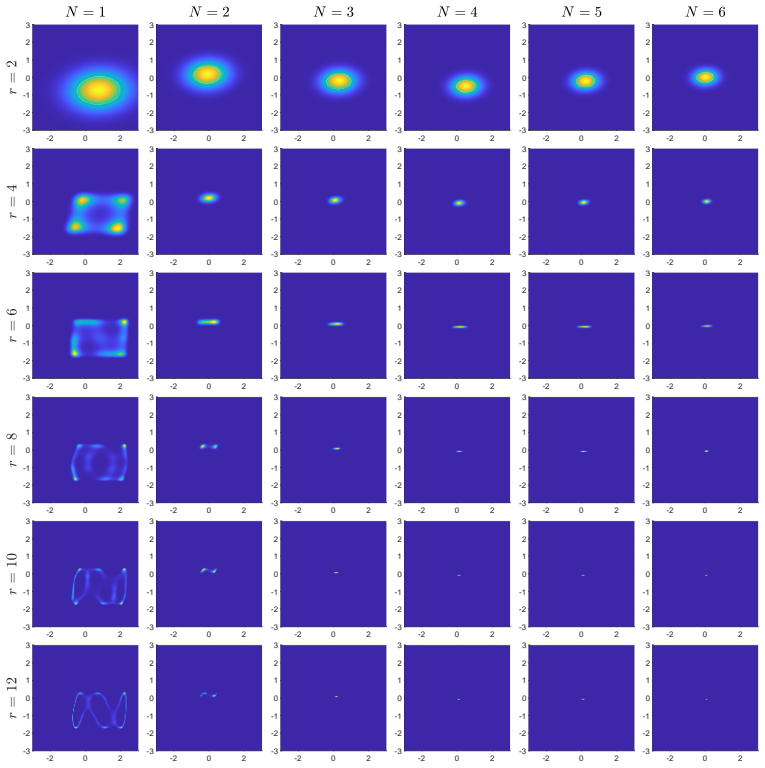
The central claim is that a Bayes filter on polynomial systems can be made closed by operating on moments rather than densities. Given the moments of the current belief, MEM-KF forms the maximum-entropy density consistent with them, $p(x)=\exp(-\sum_{\alpha\in\mathbb{N}^n_r}\lambda_\alpha x^\alpha)$, by minimizing a convex potential over the coefficients $\lambda$. It propagates the moment sequence through the extended dynamics $\phi_r(x_{k+1})=A(w_k,u_k)\phi_s(x_k)$, using independence of noise and state to write the next moments as $A(\bar{w},u_k)\bar{x}_\beta$. The update appends $m$ measurement likelihoods, each of the form $\exp(-\sum_\alpha \nu_{\alpha,i}x^\alpha)$, so the posterior stays an MED with $\lambda=\lambda^-+\sum_i\nu_i$. The authors then extract the maximum-density point estimate by solving the polynomial program $\min_{x\in K} -\ln p(x|\lambda)$ through a semidefinite moment relaxation, with a rank-one solution certifying global optimality; all of these steps are claimed to be convex.
Load-bearing premise
The filter's update step assumes the measurement model depends on the state through first powers only, so the likelihood stays an exponential polynomial; for curved measurement models the posterior leaves the assumed max-entropy family and the paper does not analyze that error.
Editorial extensions
If this is right
- The Kalman filter appears as the $r=2$ case of MEM-KF, so the new method contains classical linear-Gaussian filtering as a limit.
- When enough moments are matched, the recovered MED approximates the true posterior in $L^1$ for moment-determinate distributions, so reported uncertainty is not forced to be Gaussian.
- Multi-modal noise and beliefs, such as a measurement that could come from any of several landmarks, are represented by a single smooth density instead of a mixture or a particle set.
- The maximum-density point estimate comes with a certificate of global optimality when the SDP relaxation is rank-one, or with a relaxation-gap suboptimality bound otherwise.
- All filter operations, including normalization and point extraction, are convex, so the recursion avoids the usual nonlinear-filter custom linearizations and sampling heuristics.
Reading between the lines
- Beyond the stated claims, one could adapt the MED order to the degree of the measurement polynomial so that a nonlinear observation model still yields a closed posterior within the max-entropy family.
- Beyond the stated claims, the convergence guarantee presumes moment-determinate distributions; heavy-tailed noise would fall outside the asymptotic argument and would require a different representation or tail constraints.
- Beyond the stated claims, the quadrature cost scales with state dimension, so the practical test of the method is whether sparse or structured moment integration can lift it to higher-dimensional estimation problems.
- Beyond the stated claims, encoding ambiguous data association as moment constraints suggests the same mechanism could absorb other combinatorial uncertainties, such as ambiguous loop closures, without explicit hypothesis enumeration.
Editorial analysis
A structured set of objections, weighed in public.
Referee Report
Summary. The paper proposes the Max Entropy Moment Kalman Filter (MEM-KF), a recursive Bayes filter for polynomial systems with arbitrary noise. The belief is represented as a moment-constrained max-entropy distribution (MED), which is recovered from moment constraints by convex optimization. In the prediction step, moments are propagated through an extended polynomial dynamical system and the belief is re-fit as an MED; in the update step, the measurement noise is modeled as an MED and the posterior is obtained by adding log-likelihood coefficients. The point estimate is extracted by solving a semidefinite moment relaxation of the maximum a posteriori problem. Experiments on a synthetic linear measurement example and on SE(2) localization with unknown data association compare MEM-KF with BLUE, EKF, InEKF, UKF, UKF-M, and particle filters.
Significance. If the claims were fully supported, MEM-KF would be a valuable step toward principled nonlinear non-Gaussian filtering: it exploits polynomial structure to propagate moments exactly (under independence), uses a convex max-entropy recovery, and demonstrates that higher-order moment matching improves estimation over Gaussian approximations. The paper's numerical comparisons are substantive and include both unimodal and multimodal noise. However, the central update-step derivation is exact only for observation models that are affine in the state, while the paper claims general polynomial measurement models. As a result, the scope is overstated. In addition, the claim that all steps are exactly solvable by convex optimization is qualified only by a rank-1 condition in the point-estimation step. These issues are localizable and fixable by restricting the claims or extending the analysis, so the paper merits major revision rather than rejection.
major comments (3)
- [Section 6.4, Eqs. (11)-(12)] The update step assumes that the exponent of the likelihood, after substituting v=h(y,x), is a polynomial of degree at most r in x. For an observation model h of degree d>1 in the state, each term h(y,x)^alpha has degree d|alpha|, so the exponent lies in span(phi_{dr}(x)) rather than span(phi_r(x)); consequently, the equality in Eq. (11) and the coefficient addition lambda=lambda^- + sum_i nu_i in Eq. (12) do not hold within the degree-r MED family. The paper neither states this restriction nor analyzes the required truncation or degree raising. This is not a purely technical gap: all numerical experiments use observation models that are affine in the state (Eq. (15) in Section 7.2 and Eq. (18) in Section 7.3), so the experiments do not exercise the claimed polynomial measurement setting. The title, abstract, and Problem 1 should be revised to either restrict to affine-in-state observation models or extend the update analysis to polynomial h.
- [Abstract, Section 6.5, Conclusions] The statement that all steps in MEM-KF, including the extraction of the optimal point estimate, can be solved via convex optimization is stronger than what is established. The point-estimation step minimizes the polynomial -ln p(x|lambda) over K via the semidefinite moment relaxation (SDP) of Problem (13); the paper itself notes that a global optimum is certified only when the SDP returns a rank-1 solution (Section 6.5). Without rank-1, the SDP gives a lower bound, not necessarily the exact optimum. The claimed exactness should be qualified to hold only under the rank-1 condition, or the relaxation gap should be reported as a suboptimality bound.
- [Section 6.3, Eq. (9)] The notation A(\bar{w}_gamma,u) \bar{x}_{beta,k} is not defined and is misleading. Since A(w,u) in Eq. (6) is a matrix of polynomials in w, under independence E[A(w_k,u_k) phi_s(x_k)] = E[A(w_k,u_k)] E[phi_s(x_k)]; the expectation of A is obtained by replacing each monomial w^gamma with its moment \bar{w}_gamma, not by evaluating A at a vector of moments. If the intended meaning is the former, it should be stated explicitly; if it is the latter, Eq. (9) is wrong for nonlinear A (e.g., E[w^2] differs from (\bar{w})^2). The same notational issue appears in Algorithm 1.
minor comments (6)
- [Section 1] The phrase "multi-model distribution" should be "multimodal distribution".
- [Sections 5.2 and E] "Thermal dynamics potential" should be "thermodynamic potential".
- [Appendix E, Eq. (34)] The expression contains a stray "dx" inside the exponent and is garbled; please correct the displayed formula.
- [Section 6.4, final paragraph] "To predict the belief of the next step, we normalize the likelihood function via numerical integration to compute the moments" is confusing; this is part of the update step, so the wording should be adjusted.
- [Algorithm 1] The pseudocode uses nonstandard arrows such as "← −" in several lines; please use conventional assignment notation for clarity.
- [Appendix C, Eq. (24)] The normalization constant C_gamma is stated without derivation for the example; please clarify how the value 3 is obtained.
Circularity Check
No significant circularity: MEM-KF propagates exogenous moments and recovers MED by convex optimization; the update-step degree-closure gap is a correctness issue, not a circular derivation.
full rationale
The MEM-KF derivation chain is not circular by construction. The prediction step (eqs. (8)-(9)) computes E[phi_r(x_{k+1})] from the extended dynamics A(w,u) and the state/noise moments, which are inputs or previously propagated; the MED is subsequently recovered from those moments via the convex program in eq. (4). The update step (eqs. (11)-(12)) combines the prior MED parameters with likelihood coefficients, and the point estimate in eq. (13) is extracted from the fitted belief by an SDP relaxation. No parameter is fitted to a subset of data and then 'predicted' on the same subset, and no uniqueness theorem is imported from the authors' own prior work: the asymptotic guarantee (Theorem 1) cites the external result by Borwein and Lewis [53]. The paper's self-citations, e.g., [19], are contextual and not load-bearing. One correctness caveat, which is not a circularity, is that eq. (11) rewrites exp(-sum mu_alpha h(y,x)^alpha) as exp(-sum nu_alpha x^alpha) with nu in the degree-r canonical basis; for an observation model h that is polynomial of degree d>1 in x, h^alpha has degree up to dr, so the exponent lies in span(phi_{dr}(x)), not span(phi_r(x)), and the posterior is not a degree-r MED. The numerical experiments all use observation models that are affine in the state (y = x + v in Section 7.2 and R_k y_k + p_k = L_i + v in Section 7.3), so the experiments do not exercise this gap. That concern should be reported under correctness/scope, not circularity.
Assumptions & free parameters
free parameters (1)
- moment order r =
r=4 in SE(2) localization; r up to 12 in synthetic experiments
assumptions (5)
- domain assumption The state domain K is either R^n or a polynomial equality constrained set (Assumption 1).
- domain assumption Process and measurement noises are i.i.d. and independent of the state (Section 4).
- domain assumption The true belief and noise distributions are moment-determinate (Definition 1 and Theorem 1).
- ad hoc to paper The likelihood exponent sum_alpha mu_alpha h(y,x)^alpha has degree <= r in x so that the posterior is a degree-r MED (implicit in eqs. (11)-(12)).
- standard math Theorem 1 (Borwein and Lewis, 1991) on L1 convergence of max-entropy estimates is accepted.
Cite this review
Pith. "Pith review of Max Entropy Moment Kalman Filter for Polynomial Systems with Arbitrary Noise." pith.science (2026). https://pith.science/paper/GSAL6T2I
@misc{pith2026250600838,
  author       = {Pith},
  title        = {Pith review of: Max Entropy Moment Kalman Filter for Polynomial Systems with Arbitrary Noise},
  year         = {2026},
  howpublished = {\url{https://pith.science/paper/GSAL6T2I}},
  note         = {Machine review of arXiv:2506.00838}
}
read the original abstract
Designing optimal Bayes filters for nonlinear non-Gaussian systems is a challenging task. The main difficulties are: 1) representing complex beliefs, 2) handling non-Gaussian noise, and 3) marginalizing past states. To address these challenges, we focus on polynomial systems and propose the Max Entropy Moment Kalman Filter (MEM-KF). To address 1), we represent arbitrary beliefs by a Moment-Constrained Max-Entropy Distribution (MED). The MED can asymptotically approximate almost any distribution given an increasing number of moment constraints. To address 2), we model the noise in the process and observation model as MED. To address 3), we propagate the moments through the process model and recover the distribution as MED, thus avoiding symbolic integration, which is generally intractable. All the steps in MEM-KF, including the extraction of a point estimate, can be solved via convex optimization. We showcase the MEM-KF in challenging robotics tasks, such as localization with unknown data association.
Figures


Figures from the paper (5 more)



Reference graph
Works this paper leans on
-
[1]
The extended Kalman filter as a local asymptotic observer for nonlinear discrete-time systems
Yongkyu Song and Jessy W Grizzle. The extended Kalman filter as a local asymptotic observer for nonlinear discrete-time systems. InProceedings of the American Control Conference, pages 3365–3369. IEEE, 1992. 1, 3
work page 1992
-
[2]
The unscented Kalman filter for nonlinear estimation
Eric A Wan and Rudolph Van Der Merwe. The unscented Kalman filter for nonlinear estimation. InProceedings of the IEEE Adaptive Systems for Signal Processing, Communications, and Control Symposium, pages 153–158. Ieee, 2000. 1, 3
work page 2000
-
[3]
Sangli Teng.Optimization-based Robot Control and State Estimation on Matrix Lie Groups. PhD thesis, 2025. 2
work page 2025
-
[4]
Heng Yang and Luca Carlone. Certifiably optimal outlier-robust geometric perception: Semidef- inite relaxations and scalable global optimization.IEEE Transactions on Pattern Analysis and Machine Intelligence, 2022. 2
work page 2022
-
[5]
Input influence matrix design for mimo discrete-time ultra-local model
Sangli Teng, Amit K Sanyal, Ram Vasudevan, Anthony Bloch, and Maani Ghaffari. Input influence matrix design for mimo discrete-time ultra-local model. In2022 American Control Conference (ACC), pages 2730–2735. IEEE, 2022. 2
work page 2022
-
[6]
Sangli Teng, Ashkan Jasour, Ram Vasudevan, and Maani Ghaffari. Convex geometric motion planning of multi-body systems on Lie groups via variational integrators and sparse moment relaxation.International Journal of Robotics Research, page 02783649241296160, 2024
work page 2024
-
[7]
Junwoo Jang, Sangli Teng, and Maani Ghaffari. Convex geometric trajectory tracking using lie algebraic mpc for autonomous marine vehicles.IEEE Robotics and Automation Letters, 8(12): 8374–8381, 2023. doi: 10.1109/LRA.2023.3328450
arXiv 2023
-
[8]
Sangli Teng, Yukai Gong, Jessy W Grizzle, and Maani Ghaffari. Toward safety-aware informa- tive motion planning for legged robots.arXiv preprint arXiv:2103.14252, 2021
arXiv 2021
Show all 62 references
-
[9]
Discrete-time hybrid automata learning: Legged locomotion meets skateboarding.arXiv preprint arXiv:2503.01842, 2025
Hang Liu, Sangli Teng, Ben Liu, Wei Zhang, and Maani Ghaffari. Discrete-time hybrid automata learning: Legged locomotion meets skateboarding.arXiv preprint arXiv:2503.01842, 2025
2025 arXiv
-
[10]
A generalized metriplectic system via free energy and system˜ identification via bilevel convex optimization.arXiv preprint arXiv:2410.06233, 2024
Sangli Teng, Kaito Iwasaki, William Clark, Xihang Yu, Anthony Bloch, Ram Vasudevan, and Maani Ghaffari. A generalized metriplectic system via free energy and system˜ identification via bilevel convex optimization.arXiv preprint arXiv:2410.06233, 2024
-
[11]
Convex Geometric Motion Planning on Lie Groups via Moment Relaxation
Sangli Teng, Ashkan Jasour, Ram Vasudevan, and Maani Ghaffari Jadidi. Convex Geometric Motion Planning on Lie Groups via Moment Relaxation. InProceedings of the Robotics: Science and Systems Conference, Daegu, Republic of Korea, July 2023. doi: 10.15607/RSS. 2023.XIX.058. 4
2023 doi
-
[12]
Progress in symmetry preserving robot perception and control through geometry and learning.Frontiers in Robotics and AI, 9:232, 2022
Maani Ghaffari, Ray Zhang, Minghan Zhu, Chien Erh Lin, Tzu-Yuan Lin, Sangli Teng, Tingjun Li, Tianyi Liu, and Jingwei Song. Progress in symmetry preserving robot perception and control through geometry and learning.Frontiers in Robotics and AI, 9:232, 2022
2022
-
[13]
Lie algebraic cost function design for control on Lie groups
Sangli Teng, William Clark, Anthony Bloch, Ram Vasudevan, and Maani Ghaffari. Lie algebraic cost function design for control on Lie groups. InProceedings of the IEEE Conference on Decision and Control, pages 1867–1874. IEEE, 2022
2022
-
[14]
An error-state model predictive control on connected matrix Lie groups for legged robot control
Sangli Teng, Dianhao Chen, William Clark, and Maani Ghaffari. An error-state model predictive control on connected matrix Lie groups for legged robot control. InProceedings of the IEEE/RSJ International Conference on Intelligent Robots and Systems, pages 8850–8857. IEEE, 2022
2022
-
[15]
Rie- mannian direct trajectory optimization of rigid bodies on matrix lie groups.arXiv preprint arXiv:2505.02323, 2025
Sangli Teng, Tzu-Yuan Lin, William A Clark, Ram Vasudevan, and Maani Ghaffari. Rie- mannian direct trajectory optimization of rigid bodies on matrix lie groups.arXiv preprint arXiv:2505.02323, 2025. 2
2025 arXiv
-
[16]
Legged robot state estimation in slippery environments using invariant extended kalman filter with velocity update
Sangli Teng, Mark Wilfried Mueller, and Koushil Sreenath. Legged robot state estimation in slippery environments using invariant extended kalman filter with velocity update. In2021 IEEE International Conference on Robotics and Automation (ICRA), pages 3104–3110. IEEE,
-
[17]
Fully proprioceptive slip- velocity-aware state estimation for mobile robots via invariant kalman filtering and disturbance observer
Xihang Yu, Sangli Teng, Theodor Chakhachiro, Wenzhe Tong, Tingjun Li, Tzu-Yuan Lin, Sarah Koehler, Manuel Ahumada, Jeffrey M Walls, and Maani Ghaffari. Fully proprioceptive slip- velocity-aware state estimation for mobile robots via invariant kalman filtering and disturbance o...
2023
-
[18]
Legged robot state estimation within non-inertial environments.arXiv preprint arXiv:2403.16252, 2024
Zijian He, Sangli Teng, Tzu-Yuan Lin, Maani Ghaffari, and Yan Gu. Legged robot state estimation within non-inertial environments.arXiv preprint arXiv:2403.16252, 2024
2024 arXiv
-
[19]
Gmkf: Generalized moment kalman filter for polynomial systems with arbitrary noise.arXiv preprint arXiv:2403.04712, 2024
Sangli Teng, Harry Zhang, David Jin, Ashkan Jasour, Maani Ghaffari, and Luca Carlone. Gmkf: Generalized moment kalman filter for polynomial systems with arbitrary noise.arXiv preprint arXiv:2403.04712, 2024. 2, 3
2024 arXiv
-
[20]
Bayesian filtering: From kalman filters to particle filters, and beyond.Statistics, 182(1):1–69, 2003
Zhe Chen et al. Bayesian filtering: From kalman filters to particle filters, and beyond.Statistics, 182(1):1–69, 2003. 2, 3
2003
-
[21]
Recursive bayesian estimation using gaussian sums
Harold W Sorenson and Daniel L Alspach. Recursive bayesian estimation using gaussian sums. Automatica, 7(4):465–479, 1971. 2, 3
1971
-
[22]
Nonlinear bayesian estimation using gaussian sum approximations.IEEE transactions on automatic control, 17(4):439–448, 2003
Daniel Alspach and Harold Sorenson. Nonlinear bayesian estimation using gaussian sum approximations.IEEE transactions on automatic control, 17(4):439–448, 2003. 2
2003
-
[23]
Bayes theorem and digital realizations for non-linear filters.Journal of the Astronautical Sciences, 17:80, 1969
Richard S Bucy. Bayes theorem and digital realizations for non-linear filters.Journal of the Astronautical Sciences, 17:80, 1969. 2
1969
-
[24]
Digital synthesis of non-linear filters.Automatica, 7(3): 287–298, 1971
Richard S Bucy and Kenneth D Senne. Digital synthesis of non-linear filters.Automatica, 7(3): 287–298, 1971. 2
1971
-
[25]
Non-gaussian state—space modeling of nonstationary time series.Journal of the American statistical association, 82(400):1032–1041, 1987
Genshiro Kitagawa. Non-gaussian state—space modeling of nonstationary time series.Journal of the American statistical association, 82(400):1032–1041, 1987. 2
1987
-
[26]
Recursive bayesian estimation using piece-wise constant approximations.Automatica, 24(6):789–801, 1988
Stuart C Kramer and Harold W Sorenson. Recursive bayesian estimation using piece-wise constant approximations.Automatica, 24(6):789–801, 1988. 2, 3
1988
-
[27]
Particle filtering.IEEE signal processing magazine, 20(5):19–38,
Petar M Djuric, Jayesh H Kotecha, Jianqui Zhang, Yufei Huang, Tadesse Ghirmai, Mónica F Bugallo, and Joaquin Miguez. Particle filtering.IEEE signal processing magazine, 20(5):19–38,
-
[28]
Rudolph E. Kalman. A New Approach to Linear Filtering and Prediction Problems.Journal of Basic Engineering, 82(1):35–45, 03 1960. 3
1960
-
[29]
Probabilistic robotics.Communications of the ACM, 45(3):52–57, 2002
Sebastian Thrun. Probabilistic robotics.Communications of the ACM, 45(3):52–57, 2002. 3
2002
-
[30]
Observability-based rules for designing consistent EKF SLAM estimators.International Journal of Robotics Research, 29(5):502–528, 2010
Guoquan P Huang, Anastasios I Mourikis, and Stergios I Roumeliotis. Observability-based rules for designing consistent EKF SLAM estimators.International Journal of Robotics Research, 29(5):502–528, 2010. 3
2010
-
[31]
The invariant extended Kalman filter as a stable observer
Axel Barrau and Silvère Bonnabel. The invariant extended Kalman filter as a stable observer. IEEE Transactions on Automatic Control, 62(4):1797–1812, 2016. 3, 9
2016
-
[32]
Invariant Kalman filtering.Annual Review of Control, Robotics, and Autonomous Systems, 1:237–257, 2018
Axel Barrau and Silvere Bonnabel. Invariant Kalman filtering.Annual Review of Control, Robotics, and Autonomous Systems, 1:237–257, 2018
2018
-
[33]
Equivariant filter (eqf).IEEE Transactions on Automatic Control, 2022
Pieter van Goor, Tarek Hamel, and Robert Mahony. Equivariant filter (eqf).IEEE Transactions on Automatic Control, 2022. 3
2022
-
[34]
Moment-based Kalman filter: Nonlinear Kalman filtering with exact moment propagation.arXiv preprint arXiv:2301.09130, 2023
Yutaka Shimizu, Ashkan Jasour, Maani Ghaffari, and Shinpei Kato. Moment-based Kalman filter: Nonlinear Kalman filtering with exact moment propagation.arXiv preprint arXiv:2301.09130, 2023. 3
2023 arXiv
-
[35]
Moment-based exact uncertainty propaga- tion through nonlinear stochastic autonomous systems.arXiv preprint arXiv:2101.12490, 2021
Ashkan Jasour, Allen Wang, and Brian C Williams. Moment-based exact uncertainty propaga- tion through nonlinear stochastic autonomous systems.arXiv preprint arXiv:2101.12490, 2021. 3 20
2021 arXiv
-
[36]
Global optimization with polynomials and the problem of moments.SIAM Journal on optimization, 11(3):796–817, 2001
Jean B Lasserre. Global optimization with polynomials and the problem of moments.SIAM Journal on optimization, 11(3):796–817, 2001. 3, 11
2001
-
[37]
Planar pose graph optimization: Duality, optimal solutions, and verification.IEEE Transactions on Robotics, 32 (3):545–565, 2016
Luca Carlone, Giuseppe C Calafiore, Carlo Tommolillo, and Frank Dellaert. Planar pose graph optimization: Duality, optimal solutions, and verification.IEEE Transactions on Robotics, 32 (3):545–565, 2016. 3
2016
-
[38]
SE-Sync: A certifiably correct algorithm for synchronization over the special euclidean group.International Journal of Robotics Research, 38(2-3):95–125, 2019
David M Rosen, Luca Carlone, Afonso S Bandeira, and John J Leonard. SE-Sync: A certifiably correct algorithm for synchronization over the special euclidean group.International Journal of Robotics Research, 38(2-3):95–125, 2019. 3
2019
-
[39]
Simultaneous multiple rotation averaging using Lagrangian duality
Johan Fredriksson and Carl Olsson. Simultaneous multiple rotation averaging using Lagrangian duality. InAsian Conference on Computer Vision, pages 245–258. Springer, 2012. 3
2012
-
[40]
Rotation averaging with the chordal distance: Global minimizers and strong duality.IEEE Transactions on Pattern Analysis and Machine Intelligence, 43(1):256–268, 2019
Anders Eriksson, Carl Olsson, Fredrik Kahl, and Tat-Jun Chin. Rotation averaging with the chordal distance: Global minimizers and strong duality.IEEE Transactions on Pattern Analysis and Machine Intelligence, 43(1):256–268, 2019. 3
2019
-
[41]
A qcqp approach to triangulation
Chris Aholt, Sameer Agarwal, and Rekha Thomas. A qcqp approach to triangulation. In Proceedings of the European Conference on Computer Vision, pages 654–667. Springer, 2012. 3
2012
-
[42]
A convex relaxation to compute the nearest structured rank deficient matrix
Diego Cifuentes. A convex relaxation to compute the nearest structured rank deficient matrix. SIAM Journal on Matrix Analysis and Applications, 42(2):708–729, 2021. 3, 4
2021
-
[43]
Convex global 3D registration with Lagrangian duality
Jesus Briales and Javier Gonzalez-Jimenez. Convex global 3D registration with Lagrangian duality. InProceedings of the IEEE Conference on Computer Vision and Pattern Recognition, pages 4960–4969, 2017. 3
2017
-
[44]
Global registration of multiple point clouds using semidefinite programming.SIAM Journal on Optimization, 25(1):468–501, 2015
Kunal N Chaudhury, Yuehaw Khoo, and Amit Singer. Global registration of multiple point clouds using semidefinite programming.SIAM Journal on Optimization, 25(1):468–501, 2015
2015
-
[45]
Point reg- istration via efficient convex relaxation.ACM Transactions on Graphics (TOG), 35(4):1–12, 2016
Haggai Maron, Nadav Dym, Itay Kezurer, Shahar Kovalsky, and Yaron Lipman. Point reg- istration via efficient convex relaxation.ACM Transactions on Graphics (TOG), 35(4):1–12, 2016
2016
-
[46]
Global optimality for point set registration using semidefinite programming
José Pedro Iglesias, Carl Olsson, and Fredrik Kahl. Global optimality for point set registration using semidefinite programming. InProceedings of the IEEE Conference on Computer Vision and Pattern Recognition, pages 8287–8295, 2020. 3
2020
-
[47]
Cvxpnpl: A unified convex solution to the absolute pose estimation problem from point and line correspondences.Journal of Mathematical Imaging and Vision, 65(3):492–512, 2023
Sérgio Agostinho, João Gomes, and Alessio Del Bue. Cvxpnpl: A unified convex solution to the absolute pose estimation problem from point and line correspondences.Journal of Mathematical Imaging and Vision, 65(3):492–512, 2023. 3
2023
-
[48]
Optimal pose and shape estimation for category- level 3D object perception
Jingnan Shi, Heng Yang, and Luca Carlone. Optimal pose and shape estimation for category- level 3D object perception. InProceedings of the Robotics: Science and Systems Conference,
-
[49]
In perfect shape: Certifiably optimal 3D shape reconstruction from 2D landmarks
Heng Yang and Luca Carlone. In perfect shape: Certifiably optimal 3D shape reconstruction from 2D landmarks. InProceedings of the IEEE Conference on Computer Vision and Pattern Recognition, pages 621–630, 2020. 3
2020
-
[50]
On the local stability of semidefinite relaxations.Mathematical Programming, pages 1–35, 2020
Diego Cifuentes, Sameer Agarwal, Pablo A Parrilo, and Rekha R Thomas. On the local stability of semidefinite relaxations.Mathematical Programming, pages 1–35, 2020. 4
2020
-
[51]
The geometry of sdp-exactness in quadratic optimization.Mathematical programming, 182(1-2):399–428, 2020
Diego Cifuentes, Corey Harris, and Bernd Sturmfels. The geometry of sdp-exactness in quadratic optimization.Mathematical programming, 182(1-2):399–428, 2020. 4
2020
-
[52]
Estimation contracts for outlier-robust geometric perception.Foundations and Trends (FnT) in Robotics, 2023
Luca Carlone. Estimation contracts for outlier-robust geometric perception.Foundations and Trends (FnT) in Robotics, 2023. 4
2023
-
[53]
Convergence of best entropy estimates.SIAM Journal on Optimization, 1(2):191–205, 1991
Jonathan M Borwein and Adrian Stephen Lewis. Convergence of best entropy estimates.SIAM Journal on Optimization, 1(2):191–205, 1991. 5 21
1991
-
[54]
Maximum entropy in the problem of moments
Lawrence R Mead and Nikos Papanicolaou. Maximum entropy in the problem of moments. Journal of Mathematical Physics, 25(8):2404–2417, 1984. 5, 7, 13
1984
-
[55]
Tobenkin, Frank Permenter, and Alexandre Megretski.SPOTLESS: Conic and Polynomial Programming Toolbox
Mark M. Tobenkin, Frank Permenter, and Alexandre Megretski.SPOTLESS: Conic and Polynomial Programming Toolbox. Massachusetts Institute of Technology, 2013. https: //github.com/spot-toolbox/spotless. 7
2013
-
[56]
Robert W Johnson. Algorithm 988: Amgkq: an efficient implementation of adaptive multivariate gauss-kronrod quadrature for simultaneous integrands in octave/matlab.ACM Transactions on Mathematical Software (TOMS), 44(3):1–19, 2018. 7
2018
-
[57]
URL https://docs.mosek.com/ MOSEKModelingCookbook-letter.pdf
MOSEK ApS.MOSEK Modeling Cookbook., 2022. URL https://docs.mosek.com/ MOSEKModelingCookbook-letter.pdf. 7
2022
-
[58]
A fresh look at the Kalman filter.SIAM review, 54(4):801–823, 2012
Jeffrey Humpherys, Preston Redd, and Jeremy West. A fresh look at the Kalman filter.SIAM review, 54(4):801–823, 2012. 8
2012
-
[59]
The banana distribution is gaussian: A localization study with exponential coordinates.Robotics: Science and Systems VIII, 265:1, 2013
Andrew W Long, Kevin C Wolfe, Michael J Mashner, Gregory S Chirikjian, et al. The banana distribution is gaussian: A localization study with exponential coordinates.Robotics: Science and Systems VIII, 265:1, 2013. 9, 17
2013
-
[60]
Data- association-free landmark-based slam
Yihao Zhang, Odin A Severinsen, John J Leonard, Luca Carlone, and Kasra Khosoussi. Data- association-free landmark-based slam. In2023 IEEE International Conference on Robotics and Automation (ICRA), pages 8349–8355. IEEE, 2023. 9
2023
-
[61]
Unscented Kalman filtering on Lie groups
Martin Brossard, Silvere Bonnabel, and Jean-Philippe Condomines. Unscented Kalman filtering on Lie groups. InProceedings of the IEEE/RSJ International Conference on Intelligent Robots and Systems, pages 2485–2491. IEEE, 2017. 9
2017
-
[62]
Cambridge University Press, 2015
Jean Bernard Lasserre.An introduction to polynomial and semi-algebraic optimization, vol- ume 52. Cambridge University Press, 2015. 11 22
2015
Reviewed August 7, 2026 · model on record in the stance chip above.
Discussion (0). Sign in to comment.