REVIEW 2 major objections 5 minor 52 references
LRX-PINN: A Layer-Resolving XNet Physics-Informed Neural Network with Integrated Cauchy Activations for Convection-Dominated Problems
T0 review · 2 major / 5 minor · reviewed 2026-07-14 · grok-4.5
Pith's one-line read Integrated Cauchy ridge atoms match the value–gradient–curvature structure of thin convection layers, giving thickness-uniform exponential approximation and more accurate PINNs with far fewer parameters.
desk verdict Solid representation-theory paper: integrated Cauchy ridges give derivative-stable, thickness-uniform layer approximation, and the numerics back the story without overclaiming optimizer independence. read the letter →
The pith
A machine-rendered reading of the paper's core claim, the machinery that carries it, and where it could break.
The reading
What carries the argument
The geometric integrated Cauchy atom Ψ = A arctan((n·x−s)/ρ) + (B/2) log((n·x−s)²+ρ²), with physical width ρ=d/‖w‖. Its derivatives recover localized Cauchy kernels of amplitudes ρ⁻¹ and ρ⁻²; Theorem 1 shows one M-term sum approximates U, U′, U″ at rate σ⁻ᴹ, which Theorems 2–3 lift to thickness-uniform physical norms for both O(ε) and O(√ε) layers.
What would settle it
For a known analytic layer of thickness δ, compute best M-term integrated Cauchy error in the scaled X_δ norm; if that error grows as δ shrinks at fixed M, or fails to decay exponentially in M with δ-independent constants, the thickness-uniform claim is false.
Extended reading notes
Core claim
An integrated Cauchy ridge trial space matches the value–gradient–curvature hierarchy of convection–diffusion layers: one collection of atoms simultaneously approximates an analytic stretched profile and its first two derivatives at a common exponential rate, and after physical rescaling the approximation constants do not deteriorate as layer thickness tends to zero. This yields thickness-uniform best-approximation estimates for exponential and characteristic layers and a layer-scaled residual bound for the singularly perturbed operator, realized as LRX-PINN in strong form and as an embeddable trial space in stabilized variational PINNs.
Load-bearing premise
The exponential rates assume each stretched layer profile extends holomorphically into a fixed complex neighborhood whose size does not shrink with the physical layer thickness.
Editorial extensions
If this is right
- Best-approximation complexity for a fixed number of separated analytic layers grows only logarithmically with target accuracy and is independent of inverse minimum layer thickness.
- Strong-form PINNs and weak or hp-VPINN formulations can share the same layer-adapted trial space; the strong residual uses the full value–gradient–curvature hierarchy while the variational form needs only value and first derivative.
- Matching neuron physical width to O(ε) or O(√ε) by layer type removes the need to inflate network size solely because layers become thinner.
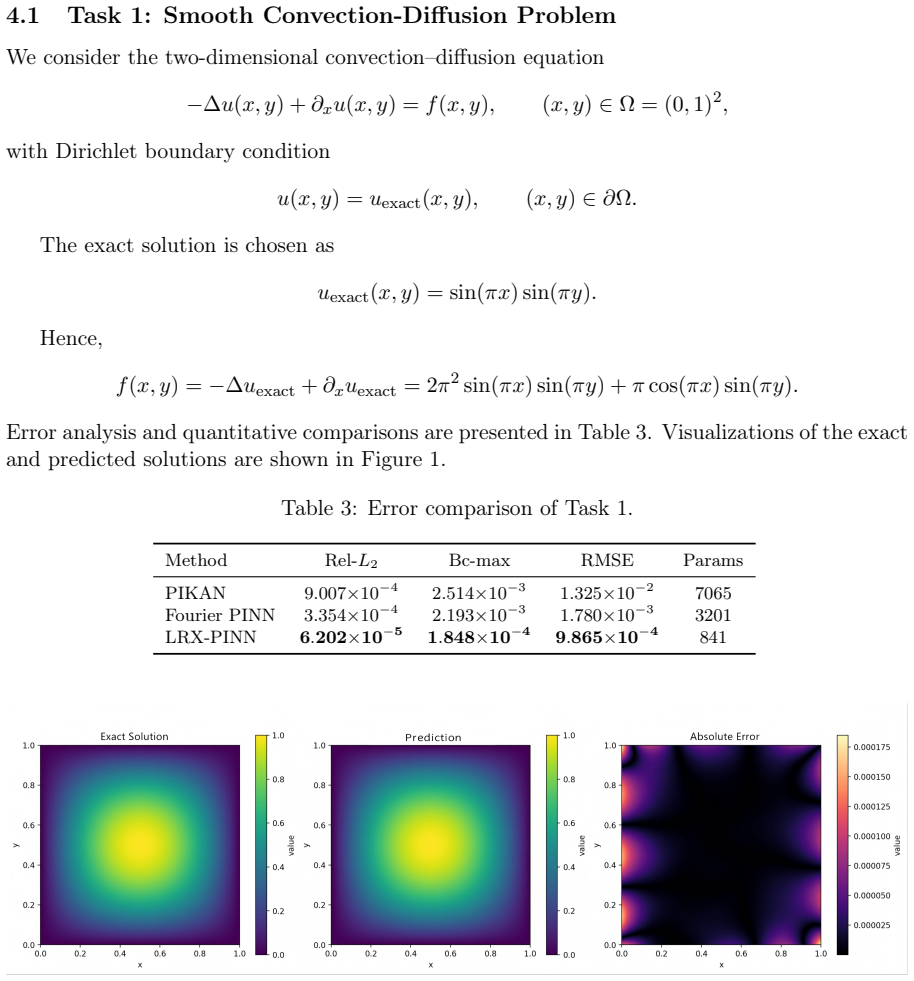
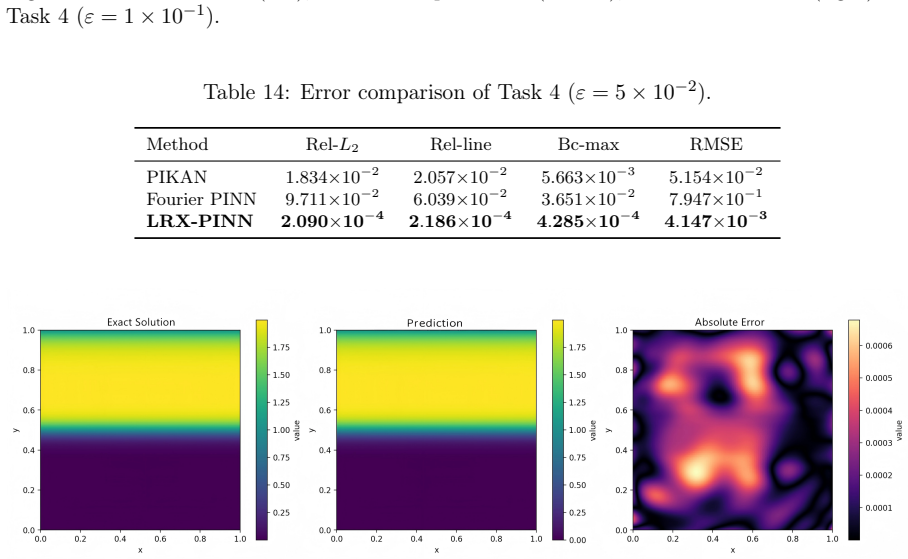
- On the reported benchmarks accuracy improves while trainable parameters drop below 30 percent of competing PINN architectures; embedding the basis into existing stabilized hp-VPINNs further lowers published error floors without retuning losses.
Reading between the lines
- The explicit physical width ρ could be monitored during training as an automatic layer detector, linking neural representation to classical layer-adapted mesh indicators.
- Closed-form residual expressions in the integrated Cauchy basis and its derivatives may reduce automatic-differentiation cost in higher dimensions relative to deep generic networks.
- Extending beyond linear steady problems first requires checking whether nonlinear layer profiles retain a sufficient complex neighborhood for the Cauchy-quadrature argument.
- Different ρ groups for coexisting exponential and characteristic layers suggest a multi-scale dictionary that could be sparsified by group selection rather than deeper stacking.
Editorial analysis
A structured set of objections, weighed in public.
Referee Report
Summary. The paper constructs an integrated Cauchy ridge trial space for convection-dominated convection–diffusion equations. Each atom is transition-type at the solution level, while its first and second derivatives recover localized Cauchy-type profiles; the parameters encode normal direction, location, and physical width ρ=d/∥w∥. For analytic stretched layer profiles, Theorem 1 proves that one M-term integrated Cauchy sum approximates U, U′, and U′′ at a common exponential rate via Cauchy-integral trapezoidal quadrature; Theorems 2–3 and Corollaries 1–2 then give thickness-uniform scaled L∞/H² estimates for both O(ε) exponential and O(√ε) characteristic layers, with residual consequences for strong and variational forms. The same basis is realized as LRX-PINN and embedded into existing hp-VPINN frameworks without changing their losses or stabilization. Numerics on interior, boundary, mixed, outflow, corner, and curved layers report higher accuracy than PIKAN and Fourier PINNs with far fewer parameters, and further gains over published hp-VPINN baselines.
Significance. If the claims hold, the work supplies a concrete, analyzable neural trial space matched to the value–gradient–curvature hierarchy of singularly perturbed layers, rather than only a new residual or training heuristic. The derivative-stable exponential approximation (Thm. 1) and thickness-uniform physical-space bounds (Thms. 2–3) are the main theoretical contribution; the numerical design (matched training, original vs integrated activation, embedding into unchanged hp-VPINN losses, seed robustness in Table 19, closed-form residual acceleration) is a genuine strength and separates representation effects from loss design. The paper is careful to separate best-approximation complexity from optimizer/conditioning costs (Remark 3, Thm. 4 discussion). This is a solid representation-oriented contribution for PINNs on convection-dominated problems.
major comments (2)
- The exponential rates in Lemma 1 / Theorem 1 rest on holomorphic extension of U (and of the contour parametrization) into a fixed complex neighborhood with constants independent of physical thickness δ. The manufactured benchmarks satisfy this; many practical layers (e.g., non-analytic or only C^k profiles, or layers with ε-dependent analyticity strips) may not. The paper already flags the representation–optimizer gap (Remark 3). A short discussion or one non-analytic / reduced-regularity numerical example would clarify the practical scope of the thickness-uniform residual claims without changing the theorems.
- Theorem 4 and Corollaries 1–2 cover coexisting O(ε) and O(√ε) layers via different atom widths, but the numerical suite does not include an explicit multi-scale manufactured solution with both exponential and characteristic layers simultaneously (Tasks 2–4 use a single scale; Tasks 5–6 are extreme but single-scale or curved). Adding one such experiment, or clearly stating that multi-scale coexistence is left to theory, would better support the multi-scale complexity claim.
minor comments (5)
- Section cross-references appear as Section?? in the introduction and organization paragraph; fix numbering.
- Abstract and title use LRX-PINN / XNet branding; the body title is “Layer-Resolving Rational Trial-Space Method…”. Align titles and keywords for consistency.
- Table 1 is a useful structural summary; a brief pointer from the theory section to the corresponding tasks would help readers map analysis to experiments.
- Initial scale d is task- and ε-dependent (Table 18, Fig. 16). State the selection protocol more explicitly in §3.3 so that the free-parameter list is transparent.
- Minor typesetting: missing spaces in compound words (e.g., “Physics-informedneuralnetworks”, “convection–diffusionproblems”) and occasional broken math spacing in the introduction.
Circularity Check
No significant circularity: approximation rates are classical complex-analysis best-approximation results; numerics compare against external baselines under fixed losses.
full rationale
The load-bearing theoretical chain is Lemma 1 (Cauchy-integral trapezoidal quadrature for holomorphic F) applied to U′, integration to obtain GM, and Cauchy estimates for U″ (Theorem 1), then rescaling to physical thickness δ (Theorems 2–3, Corollaries 1–2). These are standard complex-analysis arguments under stated holomorphic-extension hypotheses; they do not define the approximant from the residual they later bound, nor do they fit parameters to residual data and relabel the fit as a prediction. Self-citations to XNet/CompleX PINN ([28,29,41]) motivate the Cauchy family but are not used as uniqueness theorems that force the layer-scaled rates; the integrated-Cauchy analysis is re-derived in the paper. Numerical claims compare LRX-PINN to external PIKAN, Fourier-feature PINN, and published hp-VPINN numbers, and for Tasks 5–6 the original loss functionals and stabilization are held fixed so only the trial space changes. Empirical choice of initial d is ordinary hyperparameter selection, not a fitted-input-called-prediction. Remark 3 and the discussion of Theorem 4 explicitly separate best-approximation complexity from optimizer/conditioning costs. No step reduces a claimed prediction to its inputs by construction.
Assumptions & free parameters
free parameters (5)
- N_Cauchy (hidden neurons)
- initial activation scale d (per task/ε)
- loss weights λ_f, λ_b
- Adam/L-BFGS iteration budgets
- Fourier scale σ and KAN/Fourier widths
assumptions (4)
- domain assumption Stretched layer profiles U are holomorphic in a fixed complex neighborhood of a compact real interval with conjugate symmetry, enabling trapezoidal Cauchy quadrature exponential rates.
- domain assumption Local layer structure is essentially one-dimensional in a normal coordinate (planar patch or tubular neighborhood for curved layers).
- standard math Cauchy integral formula and trapezoidal-rule error bounds for 2π-periodic holomorphic functions on a strip.
- ad hoc to paper Best-approximation complexity is separate from nonconvex optimization, conditioning, and quadrature cost as ε→0.
invented entities (1)
-
Integrated Cauchy ridge atom / VIC_M trial space (LRX-PINN basis)
independent evidence
Cite this review
Pith. "Pith review of LRX-PINN: A Layer-Resolving XNet Physics-Informed Neural Network with Integrated Cauchy Activations for Convection-Dominated Problems." pith.science (2026). https://pith.science/paper/GSVADMLX
@misc{pith2026260703682,
  author       = {Pith},
  title        = {Pith review of: LRX-PINN: A Layer-Resolving XNet Physics-Informed Neural Network with Integrated Cauchy Activations for Convection-Dominated Problems},
  year         = {2026},
  howpublished = {\url{https://pith.science/paper/GSVADMLX}},
  note         = {Machine review of arXiv:2607.03682}
}
abstract
Convection-dominated convection-diffusion problems often develop thin layers, where the solution has sharp transition profiles and its derivatives are highly localized. This creates a structural mismatch for standard physics-informed neural networks (PINNs), whose trial spaces are not designed to match the value--derivative structure of such layers. We propose a Layer-Resolving XNet Physics-Informed Neural Network (LRX-PINN) based on integrated Cauchy activations. The proposed basis is transition-type at the solution level, while its derivative recovers a localized Cauchy kernel. We show that this structure matches the scaling of convection-dominated layers, inherits the Cauchy approximation mechanism at the derivative-profile level, and identifies \(d/\|w\|\) as the effective physical width of a ridge neuron. For analytic layer profiles, this yields derivative-stable exponential approximation in the stretched coordinate and a layer-scaled estimate for the strong residual of the singularly perturbed operator. Numerical experiments on several convection-dominated benchmarks show that LRX-PINN achieves higher accuracy than PIKAN and Fourier-feature PINNs while using less than \(30\%\) of their trainable parameters. On more challenging benchmarks, embedding the proposed representation into hp-VPINN-based frameworks further improves the best results obtained by existing hp-VPINN-based baselines without changing their original loss functionals or stabilization strategies. These results show that neural representations aligned with layer structure provide a compact and effective approach for convection-dominated problems.
Figures


Figures from the paper (29 more)




Reference graph
Works this paper leans on
-
[1]
Anandh, D
T. Anandh, D. Ghose, H. Jain, P. Sunkad, S. Ganesan, V. John, Improving hp-Variational Physics-Informed Neural Networks for Steady-State Convection-Dominated Problems, Computer Methods in Applied Mechanics and Engineering, 438 (2025), 117797
2025
-
[2]
Augustin, A
M. Augustin, A. Caiazzo, A. Fiebach, J. Fuhrmann, V. John, A. Linke, R. Umla, An assess- ment of discretizations for convection-dominated convection-diffusion equations,Computer Methods in Applied Mechanics and Engineering, 200 (47/48) (2011), 3395–3409
2011
-
[3]
G. R. Barrenechea, V. John, P. Knobloch, Finite element methods respecting the discrete maximum principle for convection–diffusion equations,SIAM Review, 66 (2024), 3–88
2024
-
[4]
Bear,Dynamics of Fluids in Porous Media, Elsevier, 1972
J. Bear,Dynamics of Fluids in Porous Media, Elsevier, 1972
1972
-
[5]
R. B. Bird, W. E. Stewart, E. N. Lightfoot,Transport Phenomena, John Wiley & Sons, 2002
2002
-
[6]
Bos and N
L. Bos and N. Levenberg, Bernstein–Walsh theory associated to convex bodies and applica- tions to multivariate approximation theory,Computational Methods and Function Theory, 18 (2018), 361–388
2018
-
[7]
A.N.Brooks, T.J.R.Hughes, Streamlineupwind/Petrov–Galerkinformulationsforconvec- tion dominated flows with particular emphasis on the incompressible Navier–Stokes equa- tions,Computer Methods in Applied Mechanics and Engineering, 32 (1982), 199–259
1982
-
[8]
S. Cai, Z. Wang, S. Wang, P. Perdikaris, G. E. Karniadakis, Physics-informed neural net- works for heat transfer problems,Journal of Heat Transfer, 143 (2021), 060801
2021
Show all 52 references
-
[9]
R. Codina, Stabilized finite element approximation of transient incompressible flows using orthogonalsubscales,Computer Methods in Applied Mechanics and Engineering, 191(39–40) (2002), 4295–4321
2002
-
[10]
De Paoli, Convective mixing in porous media: A review of Darcy, pore-scale and Hele- Shaw studies,European Physical Journal E, 46 (2023), 1–41
M. De Paoli, Convective mixing in porous media: A review of Darcy, pore-scale and Hele- Shaw studies,European Physical Journal E, 46 (2023), 1–41
2023
-
[11]
R. A. DeVore and G. G. Lorentz,Constructive Approximation, Springer, Berlin, 1993
1993
-
[12]
L. C. Evans,Partial Differential Equations, American Mathematical Society, 2010
2010
-
[13]
J. H. Ferziger, M. Perić,Computational Methods for Fluid Dynamics, Springer, 2002. 34
2002
-
[14]
Frerichs-Mihov, L
D. Frerichs-Mihov, L. Henning, V. John, On Loss Functionals for Physics-Informed Neural Networks for Steady-State Convection-Dominated Convection-Diffusion Problems,Commu- nications on Applied Mathematics and Computation, 8 (2026), 287–308
2026
-
[15]
Giera, T
S. Giera, T. Iliescu, V. John, D. Wells, SUPG reduced order models for convection- dominated convection–diffusion–reaction equations,Computer Methods in Applied Mechan- ics and Engineering, 289 (2015), 454–474
2015
-
[16]
Haghighat, R
E. Haghighat, R. Juanes, SciANN: A Keras wrapper for scientific computations and physics- informed deep learning using artificial neural networks,Computer Methods in Applied Me- chanics and Engineering, 373 (2021), 113552
2021
-
[17]
T. J. R. Hughes, L. P. Franca, and G. M. Hulbert, A new finite element formulation for computational fluid dynamics: VIII. The Galerkin/least-squares method for advective- diffusive equations,Computer Methods in Applied Mechanics and Engineering, 73(2) (1989), 173–189
1989
-
[18]
T. J. R. Hughes, Multiscale phenomena: Green’s functions, the Dirichlet-to-Neumann for- mulation, subgrid scale models, bubbles and the origins of stabilized methods,Computer Methods in Applied Mechanics and Engineering, 127(1–4) (1995), 387–401
1995
-
[19]
Jackson, On approximation by trigonometric sums and polynomials,Transactions of the American Mathematical Society, 13 (1912), 491–515
D. Jackson, On approximation by trigonometric sums and polynomials,Transactions of the American Mathematical Society, 13 (1912), 491–515
1912
-
[20]
A. D. Jagtap, G. E. Karniadakis, Extended physics-informed neural networks (XPINNs): A generalized space-time domain decomposition based deep learning framework for nonlinear partial differential equations,Communications in Computational Physics, 28 (2020), 2002– 2041
2020
-
[21]
X. Jin, S. Cai, H. Li, G. E. Karniadakis, NSFnets (Navier–Stokes flow nets): Physics- informed neural networks for the incompressible Navier–Stokes equations,Journal of Com- putational Physics, 426 (2021), 109951
2021
-
[22]
John, J.M
V. John, J.M. Maubach, L. Tobiska, Nonconforming streamline-diffusion-finite-element- methods for convection-diffusion problems,Numerische Mathematik, 78 (2) (1997), 165– 188
1997
-
[23]
G. E. Karniadakis, I. G. Kevrekidis, L. Lu, P. Perdikaris, S. Wang, L. Yang, Physics- informed machine learning,Nature Reviews Physics, 3 (2021), 422–440
2021
-
[24]
Kharazmi, Z
E. Kharazmi, Z. Zhang, G. E. Karniadakis, hp-VPINNs: Variational physics-informed neu- ral networks with domain decomposition, Computer Methods in Applied Mechanics and Engineering, 374 (2021), 113547
2021
-
[25]
Klimek,Pluripotential Theory, Oxford University Press, Oxford, 1991
M. Klimek,Pluripotential Theory, Oxford University Press, Oxford, 1991
1991
-
[26]
Kraus, Bernstein–Walsh type theorems for real analytic functions in several variables, Constructive Approximation, 33 (2011), 191–217
C. Kraus, Bernstein–Walsh type theorems for real analytic functions in several variables, Constructive Approximation, 33 (2011), 191–217
2011
-
[27]
A. S. Krishnapriyan, A. Gholami, S. Zhe, R. Kirby, M. Mahoney, Characterizing possible failure modes in physics-informed neural networks, Advances in Neural Information Pro- cessing Systems, 34 (2021), 26548–26560
2021
-
[28]
X. Li, Z. Xia, H. Zhang, Cauchy activation function and XNet,Neural Networks, 190 (2025), 107730. 35
2025
-
[29]
X. Li, X. Zheng, Z. Xia, From Kolmogorov to Cauchy: Shallow XNet Surpasses KANs, Advances in Neural Information Processing Systems, 38 (2025), 129075–129100
2025
-
[30]
Z. Li, D. Z. Huang, B. Liu, A. Anandkumar, Fourier neural operator with learned deforma- tions for PDEs on general geometries,Journal of Machine Learning Research, 24 (2023), 1–26
2023
-
[31]
Linß,Layer-Adapted Meshes for Reaction-Convection-Diffusion Problems, Springer, 2010
T. Linß,Layer-Adapted Meshes for Reaction-Convection-Diffusion Problems, Springer, 2010
2010
-
[32]
Z. Liu, Y. Wang, S. Vaidya, F. Ruehle, J. Halverson, M. Soljačić, T. Y. Hou, M. Tegmark, KAN: Kolmogorov–Arnold networks,International Conference on Learning Representa- tions, 2025
2025
-
[33]
Matthaiou, V
M. Matthaiou, V. John, M. Zainelabdeen, Bound-preserving physics-informed neural net- works for steady-state convection-diffusion-reaction problems,Computers & Mathematics with Applications, 199 (2025), 167–183
2025
-
[34]
K. W. Morton,Numerical Solution of Convection–Diffusion Problems, Chapman & Hall, 1996
1996
-
[35]
D. J. Newman, Rational approximation to|x|,Michigan Mathematical Journal, 11(1) (1964), 11–14
1964
-
[36]
Patra, S
S. Patra, S. Panda, B. K. Parida, M. Arya, K. Jacobs, D. I. Bondar, A. Sen, Physics- informed Kolmogorov–Arnold neural networks for dynamical analysis via Efficient-KAN and WAV-KAN,Journal of Machine Learning Research, 26 (2025), 1–39
2025
-
[37]
Raissi, P
M. Raissi, P. Perdikaris, G. E. Karniadakis, Physics-informed neural networks: A deep learning framework for solving forward and inverse problems involving nonlinear partial differential equations,Journal of Computational Physics, 378 (2019), 686–707
2019
-
[38]
H.-G. Roos, M. Stynes, L. Tobiska,Robust Numerical Methods for Singularly Perturbed Differential Equations, Springer, 2008
2008
-
[39]
Runje, S
D. Runje, S. M. Shankaranarayana, Constrained monotonic neural networks,Proceedings of the 40th International Conference on Machine Learning (ICML), 202 (2023), 29338–29353
2023
-
[40]
Sartor, A
D. Sartor, A. Sinigaglia, G. A. Susto, Advancing constrained monotonic neural networks: Achieving universal approximation beyond bounded activations,Proceedings of the 42nd International Conference on Machine Learning (ICML), 2025
2025
-
[41]
C. Si, M. Yan, X. Li, Z. Xia, CompleX physics-informed neural networks,Journal of Com- putational Physics, 2026, 114713
2026
-
[42]
J. Siciak, On some extremal functions and their applications in the theory of analytic functions of several complex variables,Transactions of the American Mathematical Society, 105 (1962), 322–357
1962
-
[43]
Sikora, P
M. Sikora, P. Krukowski, A. Paszynska, M. Paszynski, Physics informed neural networks with strong and weak residuals for advection-dominated diffusion problems,arXiv preprint arXiv:2307.07647, (2023)
2023 arXiv
-
[44]
J.Sirignano, K.Spiliopoulos, DGM:Adeeplearningalgorithmforsolvingpartialdifferential equations,Journal of Computational Physics, 375 (2018), 1339–1364
2018
-
[45]
C. Song, Y. Wang, Simulating seismic multifrequency wavefields with the Fourier feature physics-informed neural network,Geophysical Journal International, 232 (2023), 1503–1514. 36
2023
-
[46]
Tancik, P
M. Tancik, P. Srinivasan, B. Mildenhall, S. Fridovich-Keil, N. Raghavan, U. Singhal, R. Ramamoorthi, J. T. Barron, R. Ng, Fourier features let networks learn high frequency functions in low dimensional domains, Advances in Neural Information Processing Systems, 33 (2020), 7537–7547
2020
-
[47]
J. D. Toscano, V. Oommen, A. J. Varghese, Z. Zou, N. A. Daryakenari, C. Wu, G. E. Kar- niadakis, From PINNs to PIKANs: Recent advances in physics-informed machine learning, Machine Learning for Computational Science and Engineering, 1 (2025), 15
2025
-
[48]
J. L. Walsh,Interpolation and Approximation by Rational Functions in the Complex Do- main, 5th ed., American Mathematical Society, Providence, RI, 1969
1969
-
[49]
S. Wang, S. Sankaran, H. Wang, P. Perdikaris, Respecting causality for training physics- informed neural networks,Computer Methods in Applied Mechanics and Engineering, 421 (2024), 116813
2024
-
[50]
S. Wang, X. Yu, P. Perdikaris, When and why PINNs fail to train: A neural tangent kernel perspective,Journal of Computational Physics, 449 (2022), 110768
2022
-
[51]
Y. Wang, C. Xu, M. Yang, J. Zhang, Less emphasis on hard regions: Curriculum learning of PINNs for singularly perturbed convection–diffusion–reaction problems,East Asian Journal on Applied Mathematics, 14 (2024), 104–123
2024
-
[52]
Y. Wang, J. Sun, J. Bai, C. Anitescu, M. S. Eshaghi, X. Zhuang, T. Rabczuk, Y. Liu, Kolmogorov–Arnold-informed neural network: A physics-informed deep learning framework for solving forward and inverse problems,Computer Methods in Applied Mechanics and Engineering,423 (2025), ...
2025
Reviewed July 14, 2026 · model on record in the stance chip above.
Discussion (0). Continue with ORCID to comment.